
Superman is the most famous superhero of the modern world. IGN, an influential gaming and comic book website, recently ranked him number one on the list of top superheroes of all time. He first appeared in publication in 1938, quickly rising to fame via radio, national newspapers, and film. The vast number of storylines from Superman’s various comic book titles and other media tie-ins through all these years has further developed and enriched the character. Yet through all these changes, two things have always remained constant: he puts the needs of others ahead of himself and he never gives up. In this sense Superman offers a contemporary example of myth making and storytelling in the American folk tradition.
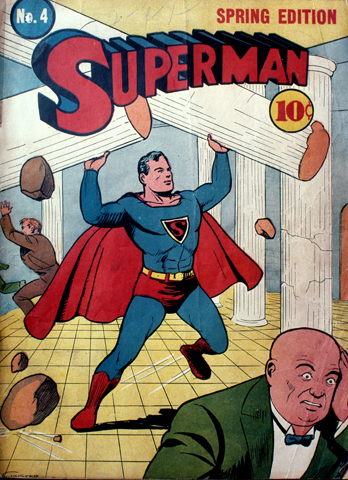
The cover of a Superman comic, from 1940. Superman emerged from the comic strips and pulp novels of the 1930s and gave young readers a legendary hero with god-like powers. Commercial success ensured Superman’s long tenure as the most-recognizable hero figure in the modern era. (Scott Mc Kiernan/ZUMA Press/Corbis)
Jerry Siegel and Joe Shuster created Superman in 1933. Their first conception portrayed him as a homeless vagrant who was injected with a potion from a mad scientist, giving him power over other people’s minds. The story, written for their small self-published magazine, received little attention. Some time later, Siegel envisioned Superman as a hero instead of a villain and over the next few years worked with Shuster on developing his personality, motivation, and costume. Superman’s personality came from several sources: the muscle-bound Doc Savage (called “superman” in advertisements), who appeared in pulp novels of the 1930s; John Carter of Mars, a normal human who became powerful on the Red Planet’s weaker gravity; and Popeye, who by eating spinach could transform himself from a weakling into a muscleman. Superman’s motivation was the ongoing quest for truth and justice seen in other popular vigilante heroes of the time: Zorro, Robin Hood, and the Lone Ranger. The unusual outfit—leotards covered by underwear, the big wide belt, and the distinctive boots—were associated with trapeze artists and circus strongmen, as well as the science fiction pulp and comic strip heroes Buck Rogers and Flash Gordon. In addition to these influences, Siegel and Shuster’s Jewish heritage infused Superman with allusions to the biblical Moses. Both, as infants, were jettisoned from their homes to escape death, and both exhibited great power in standing up for their people. It has been speculated that the murder of Siegel’s father, just weeks before Superman’s creation, must have played a part in creating a bulletproof hero who would protect the defenseless and bring justice to all.
Siegel and Shuster’s dream was to syndicate Superman in newspapers throughout the United States, the main outlet for comics during the 1930s, but they faced repeated rejection. Finally, in 1938 DC Comics (called National Comics and National Periodical Publications until 1977) purchased an abridged version of their Superman story for $130 for their first issue of Action Comics, in which Superman appeared on the cover. This first story had “mild mannered” news reporter Clark Kent working for the Daily Star (later becoming the Daily Planet). An innocent woman is on death row and Kent, changing identities, becomes Superman, finds the real criminal, and sets her free. A second episode has Superman stopping a husband from abusing his wife. Then Lois Lane, as Superman’s eventual long-standing love interest, is introduced. She despises the meek Kent, yet reluctantly goes out on a date with him only to be angered when he refuses to stand up to some thugs who begin bothering them. Lois, stomping off, is followed by the thugs whose ringleader forces her car off the road. As he pulls her into his car, Superman arrives, picks up the green car so prominently displayed on the cover of Action #1, and hangs the driver on a nearby telephone pole.
In these first appearances, Superman had much less strength, being able to leap just an eighth of a mile, hurtle only a twenty-floor building, and withstand anything just short of a bursting shell. In addition, he was impatient, easily angered, and could be violent in his quest for justice. As Action Comics initially included several other stories in each issue, it took several months before DC realized that people were buying the comic book because of Superman. By Action Comics #7, his growing popularity became incorporated into one of the stories when a con man, pretending to represent Superman, sells licensing rights to a radio show and an assortment of merchandise. It’s also in this issue that Superman’s “pal” Jimmy Olsen first appears. It is in these earliest episodes that many of the elements that make up the Superman story come together. For example, in Action #8, Superman’s super hearing is first mentioned, followed by his X-ray vision in #11.
Siegel and Shuster’s dream of newspaper syndication became a reality in January 1939, so that by the end of that year the Superman comic strip was running in more than sixty newspapers. In February 1940, the Superman radio show was first aired in which the well-known saying “up in the sky—look! It’s a giant bird! It’s an airplane! It’s Superman!” was first used. The radio show immediately became the top-rated kids’ program, and the two Superman comics—Superman and Action Comics—were together selling 2.5 million copies per month. So popular had he become that an eighty-foot-long Superman blimp joined the annual tradition of blimps flying overhead at that year’s Macy’s Thanksgiving Day parade.
Superman, along with the two other most famous DC characters, Batman and Wonder Woman, did extremely well during the war years. But after the war, sales involving superheroes dropped dramatically, with only these three surviving the postwar years without a break in publication. Superhero comics were replaced with funny comics, westerns, love stories, and adventure stories. Despite this drop in sales, the ongoing popularity of television and radio tie-ins would repeatedly resuscitate sales of Superman comic book titles. The most significant of these tie-ins were the long-running radio program Superman (renamed The Adventures of Superman in 1942); the 1953 George Reeves television series Adventures of Superman; the 1978 Christopher Reeve film version of Superman: The Movie, and its sequels; the 1993 television series Lois & Clark: The New Adventures of Superman; the 1996 Superman: The Animated Series; the 2001 Smallville; and finally the 2013 film Man of Steel.
Kryptonite
Derived from the lore of the superhero Superman, “Kryptonite” refers to material from Superman’s home planet of Krypton; this is the one substance that can render the Man of Steel weak and mortal. In common parlance, “Kryptonite” has come to refer to the Achilles heel, or single weakest point, of any given individual. The term is so pervasive and widespread that it has given its name to a popular brand of bicycle locks, as well as providing concepts key to any number of pop-culture references, including songs by the Spin Doctors and 3 Doors Down.
C. Fee
Since his first appearance, Superman has been featured in dozens of separate comic book titles, most notably Superman, World’s Finest Comics, Adventure Comics, Adventures of Superman, Superman: Man of Steel, and Superman: Man of Tomorrow. He has also played an important role in other spin-off comics, such as Superboy, Supergirl; Superman’s Family; Justice League of America; Superman’s Girlfriend, Lois Lane; DC Comics Presents; and Superman’s Pal, Jimmy Olsen. And beyond these, he has appeared in less traditional comics whose categories include miniseries, individual stories (called one-shots), crossovers (where DC characters interact with characters outside of the DC Universe), and elseworlds (where the stories are not part of the official recognized canon). Furthermore, additional storylines were created through his newspaper-syndicated comic strips, long-standing radio shows, various television series, and feature films.
With so many publications writing storylines independent of each other, fans of Superman looked to DC for narrative continuity. To meet this need, DC used the notion of parallel universes, called the DC Multiverse, in which characters and storylines from one time period, say the 1940s, could be separated from those of a later generation of writers and readers. DC also incorporated the concept of “crisis” where a part of the DC Universe is threatened with traumatic change or even elimination. The 1985 attempt to clean up the inconsistencies within the DC Universe was called Crisis on Infinite Earths. In this series, DC tried to satisfy its fandom by attempting to bring all these conflicting storylines into one grand narrative. For example, the story of Krypton included origin stories of Superman arriving here alone and another in which he arrived with others from Krypton. There was the long-standing narrative of Superboy replete with all his powers and wearing a small-sized version of his blue and red costume, while a second narrative, seen most prominently in the television series Smallville, involved him slowly learning of his powers. As each new generation of DC writers took Superman in new directions based on cultural trends and writers’ preferences, the grand narrative of Superman continued to expand.
Unlike Batman, who had villains almost as famous as himself (Joker, Two-Face, Penguin, Riddler), the only villain that could claim such a high status was Lex Luthor. Luthor made his first appearance in Action Comics #23 and Superman #4 as the mad scientist bent on world domination. Originally depicted as a middle-aged man with red hair, an artistic mistake in the newspaper strip made him older and bald. Twenty years would pass until the 1960 Adventure Comics #271 in which Siegel would write Luthor’s origin story and for the first time would give him a name. He ranks number four on IGN’s Top Comic Book Villains, behind Magneto, Joker, and Doctor Doom. Superman also had other enemies that, while not as recognizable in the wider popular culture, rank high within comic book fandom: Darkseid (sixth on the IGN list), Braniac (seventeenth), Bizzaro (twenty-fifth), and General Zod (thirtieth).
Among his closest friends and family are fellow news reporter and love interest Lois Lane; parents of Clark, Jonathan and Martha Kent; childhood friend Lana Lang; Daily Planet editor-in-Chief Perry White; gossip columnist Cat Grant; photographer Jimmy Olsen; and childhood best friend to Clark, Pete Ross. These characters, along with Superman, have undergone as many changes throughout all the years since being first brought to print.
Rick R. Lilla
See also Batman; DC Comics; Kirby, Jack; Lee, Stan; Marvel Comics
Further Reading
Ricca, Brad. 2013. Super Boys: The Amazing Adventures of Jerry Siegel and Joe Shuster—the Creators of Superman. New York: St. Martin’s Press.
Tye, Larry. 2012. Superman: The High-Flying History of America’s Most Enduring Hero. New York: Random House.
Weldon, Glen. 2013. Superman: The Unauthorized Biography. Hoboken, NJ: Wiley.
Younis, Steve. 2014. Superman homepage. http://www.supermanhomepage.com/news.php. Accessed July 18, 2014.