
Americans remember Harriet Ross Tubman for her courageous leadership, aiding the escape of countless slaves in the 1850s and 1860s. She was instrumental in advancing the Underground Railroad, a clandestine pathway by which slaves in the southern United States sought escape from their bondage. On the basis of these acts of valor and dissent, Tubman has emerged as a folk hero of the era of slavery in the United States.
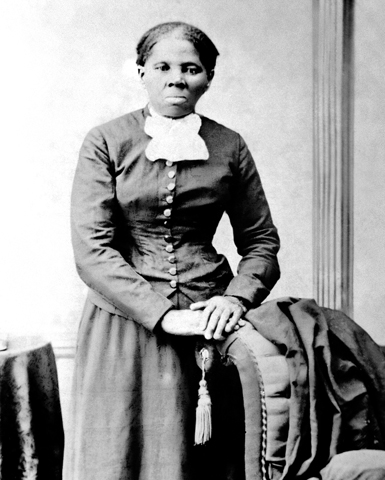
Harriet Tubman escaped slavery in 1849 and joined other abolitionists to create the Underground Railroad. This network of anti-slavery activists and safe houses helped to liberate many slaves prior to emancipation. In her later years she advocated women’s rights and justice for ex-slaves. (Library of Congress)
Born Araminta “Minty” Ross in Bucktown, Maryland, Tubman was enslaved on a plantation on the state’s eastern shore. She was one of nine children born to Harriet Green, a cook, and Ben Ross, a woodsman. Her siblings included Linah (b. 1808), Mariah Ritty (b. 1811), Soph (b. 1813), Robert (b. 1816), Ben (b. 1823), Henry (b. 1830), and Moses (b. 1832). As was the case with many slaves of this era, the exact date of Tubman’s birth is unknown. Scholars estimate that she was born in approximately 1825, although even her own claims in this regard varied.
While just a girl, Tubman watched her mother struggle to keep the family intact. The three oldest children were sold and relocated, and never reunited with the rest of the family. Tubman witnessed her mother fend off an attempt to remove another child for sale. In such moments, Tubman learned that resistance to slavery, while dangerous, remained possible.
Tubman’s early life was arduous, as she was pressed into domestic service while a young child. Subsequently, she was compelled to physical labor in the fields. Throughout, Tubman was subject to the lash when her work or her manner did not satisfy her master. On at least one occasion, she suffered a head injury at the hands of an overseer. As a result, she experienced lifelong after-effects, including headaches and seizures.
In 1844, she married a free black man by the name of John Tubman. Sometime after their union, she changed her first name to Harriet. Thereafter, she was known as Harriet Tubman. It was about this time that Tubman discovered a sad irony of her condition: unbeknownst to her family, their mother was to be granted manumission by a previous master. If known, this bequest would have rendered both Harriet Ross and her children free. Because slaves did not have legal standing in the court system, however, there was no prospect of remedying this injustice.
In 1849, Tubman managed to flee to Philadelphia, a city where slavery was illegal. This escape was dangerous by any standard, but she was not content to remove only herself from the horrors of slavery. Rather, she made repeated trips back into the slaveholding South to assist others to freedom. At first, she led her own family out of slavery. Later, she facilitated the exodus of a number of other slaves. Each time, Tubman risked her own safety to guide the way for others. At this point in U.S. history, federal laws compelled the return of fugitive slaves to their masters. In particular, the Fugitive Slave Act of 1850 made it illegal even for those in regions where slavery was no longer permitted to assist runaway slaves. If recaptured, slaves were subject to punishment and retribution by slaveholders. In addition, as her role in the Underground Railroad became known, specific rewards were offered for Tubman’s arrest or capture.
Harriet Tubman was integral to the formation of the Underground Railroad. This term refers to a clandestine network of people willing to facilitate slaves’ escape from captivity by providing safe houses along the route through the upper South. Every northbound journey she took represented a hazard both for Tubman, as conductor, and for her passengers. Most slaves who traveled the Underground Railroad hoped to make their way to either the northern United States or Canada.
Tubman later played a part in the Civil War, serving first as a cook and a nurse. Later, her experience with clandestine operations proved useful as she worked as a spy for the Union army. During the war, her efforts contributed to the liberation of hundreds of slaves.
Tubman eventually made her home in upstate New York, where she emerged as a benefactor, renowned for her acts of philanthropy. After the conclusion of the Civil War, she helped establish educational institutions for emancipated slaves. Later, she made a gift of land so that a home for disadvantaged African Americans might be established.
Tubman’s many experiences with abolition and women’s rights made her a sought-after speaker on reform topics. She addressed audiences about the dignity of her people and about the importance of women’s suffrage.
Tubman died on March 10, 1913, and was laid to rest in Auburn, New York’s Fort Hill Cemetery. Publications from the era ran tributes to her many contributions to social justice. Today, her heroic deeds are recognized at such sites as the National Underground Railroad Freedom Center in Cincinnati, Ohio, and the National Park Service’s Harriet Tubman Underground Railroad National Monument in Cambridge, Maryland.
Tubman was commonly described as “the Black Moses” or “the Moses of her people,” leading them out of bondage. She continues to be widely recognized for her steadfast advocacy on behalf of fellow slaves. Tubman’s role with the Underground Railroad made her an iconic figure. As is the case with many folk heroes, Tubman has been the subject of countless stories, songs, and other tributes, so much so that it is difficult to distinguish which accounts are accurate and which are hyperbole. That is, Tubman is such a beloved figure that she has been both revered and idealized by those she has inspired with her deeds.
In addition to the oral and written lore surrounding Tubman’s acts of leadership and courage, there were several reputed folkways that assisted travelers on the Underground Railroad in navigating their journeys. One such claim is that the display of particular patterned quilts outside residences helped signal where fugitive slaves might safely lodge. Another claim regarding “riders” of the Underground Railroad is that they used songs, particularly spirituals, to communicate messages related to their travel northward. Whether or not these claims are historically accurate, they represent the way folk memory both recalls and recasts the past.
Underground Railroad
Perhaps no myth recounting the trials and tribulations of slaves in the antebellum South captures the American imagination as vividly as the notion of the Underground Railroad. Unfortunately, its name suggests an organization and structure far beyond the reality facing brave fugitive slaves. While abolitionists, Quakers, and many free blacks certainly did attempt to help these hardy souls on the run, especially in the North after the Fugitive Slave Act of 1850, out of a total slave population in the millions, perhaps several tens of thousands escaped to Canada with the aid of a loose conglomeration of sympathizers and safe houses, dubbed the “conductors” and “stations” of the Underground Railroad.
C. Fee
Harriet Tubman’s best-known accomplishment was her fearless service as a freedom fighter, working on behalf of those who would otherwise spend the rest of their lives as slaves. In addition, she distinguished herself as a civil rights activist, speaker, and reformer.
Tubman’s passion for justice and her resolve in its pursuit have been invoked as a symbol during subsequent struggles for equality, such as the civil rights movement of the twentieth century. In this regard, some observers compare Harriet Tubman’s role to that of Rosa Parks during the Montgomery bus boycott. In both folklore and the popular imagination, Tubman embodies the notion that regular people make history, and that individual acts can initiate meaningful social change.
Linda S. Watts
See also Truth, Sojourner
Further Reading
Bentley, Judith. 1990. Harriet Tubman. New York: F. Watts.
Clinton, Catherine. 2004. Harriet Tubman: The Road to Freedom. Boston: Little, Brown.
Humez, Jean McMahon. 2004. Harriet Tubman: The Life and the Life Stories. Madison: University of Wisconsin Press.
Lowry, Beverly. 2007. Harriet Tubman: Imagining a Life. New York: Doubleday.
Sernett, Milton C. 2007. Harriet Tubman: Myth, Memory, and History. Durham, NC: Duke University Press.