
In the latter half of the twentieth century a complex folklore of alien (or extraterrestrial) abduction stories developed in American popular culture. These elaborate tales of abduction, medical experimentation, spiritual transformation, and government conspiracy grew from post–World War II accounts of contact with UFOs (unidentified flying objects). Alien abduction stories share many themes with traditional legends of fantastic journeys to other worlds and mythic tales of encounters with supernatural beings. However, in most alien abduction scenarios, the more fantastic elements of these encounters and the journeys associated with them are reinterpreted through modern cultural and technological themes, such as interplanetary space travel, advanced technology, and medical research.
Since the earliest days of widespread UFO sightings in the 1940s, speculation centered on their extraterrestrial origin and on the U.S. government’s supposed effort to suppress knowledge of these phenomena. In the early 1970s, widespread media coverage of alien abductions helped shape the common visual and narrative structure shared by most abduction accounts. By the 1980s and 1990s, abduction and UFO stories had developed into a genre of popular entertainment represented in numerous best-selling books, blockbuster films, and highly rated television programs. Simultaneously, a rich body of conspiracy theories circulated in alternative press outlets, through the Internet, and via a loose network of “ufologists.” The theories purported to explain the origin of UFOs, the significance of abductions, and the failure of cultural and governmental elites to officially acknowledge the UFO and abduction phenomenon.
Before Abduction: UFOs in a Cold War Context
Alien abduction stories have their roots in the epidemic of UFO sightings that became a media sensation in post–World War II American culture. Stories of unidentified lights and aerial phenomena long predate the twentieth century and are a significant part of many folk traditions and sacred literary corpora. Tales of unexplained ghostly, angelic, demonic, and otherwise extraterrestrial aerial sightings have been common in many religious, historical, and scientific discourses for millennia. With the invention of manned buoyant flight in the eighteenth century and of airships in the nineteenth century, reports of unidentified aerial phenomena became more commonly attributed to human or human-like agencies. Speculation on the origins of these aerial phenomena variously drew on religious, occult, or scientific theories in an effort to explain their significance.
With the invention of aerodynamic flight in the twentieth century, reports of unidentified aerial phenomena increased dramatically. Notably, pilots of airplanes often reported encountering unidentified crafts, with some of the most famous cases involving Allied military pilots seeing mysterious aerial phenomena (dubbed “foo fighters”) during World War II. Widespread reports, however, did not begin until after the war.
On June 24, 1947, while flying near Mt. Rainier in Washington State, pilot Kenneth Arnold reported seeing nine shiny objects flying erratically at supersonic speeds. When Arnold recounted his sighting to the press, he described the objects as being “saucer-like” and “flat like a pie pan.” Arnold’s description of the objects attracted national media coverage and the term “flying saucer” became a common descriptor for similar aerial phenomena.
Following Arnold’s sighting, reports of flying saucers proliferated in the United States, prompting the U.S. Air Force to investigate. In 1951, Edward J. Ruppelt took over the Air Force’s investigations of various sightings and officially adopted the phrase “unidentified flying object,” abbreviated first as UFOB and later simplified to UFO, to replace phrases like “flying saucer,” which he regarded as misleading. The program, eventually known as Project Blue Book, investigated more than 12,000 UFO sightings before closing in 1970. Many of the sightings could be accounted for naturally—clouds, the planet Venus, meteors, ball lightning—while others were attributable to the increase of commercial aircraft and the militarization of U.S. airspace during the Cold War. Although Air Force investigators explained most sightings as natural phenomena or misidentified private or military aircraft, about 700 sightings remained unexplained and classified.
Following close on the heels of Arnold’s account, a July 8, 1947, press release reported that the U.S. Army had recovered the wreckage of a flying saucer after it crashed on a ranch near Roswell Army Air Field in Roswell, New Mexico. Early conflicting reports of the “Roswell Incident” noted that the crashed vessel was made of unusual material with incredible, unearthly properties, while other accounts described the object as a mere weather balloon. In the years following the 1947 press release, new interpretations of the incident popularized the idea that the unidentified craft was piloted by living beings, most likely of an extraterrestrial origin.
The contradictory messages from military sources prompted speculation about what really happened at Roswell and increased skepticism about other official attempts to scientifically explain UFO sightings. A series of popular books, such as Frank Scully’s Behind the Flying Saucers (1950) and Donald Keyhoe’s The Flying Saucer Conspiracy (1955), alleged that the U.S. government was covering up the truth about UFOs for nefarious national security reasons. As conspiracy theories proliferated, wild speculation in this book and similar works focused on everything from the foreign (i.e., Soviet) origin of UFOs to claims that UFOs were top-secret military weapons.
As reports of flying saucers spread in the popular press and conspiracy theories abounded, accounts of contact between humans and the pilots of these crafts emerged. Such tales of contact became commonplace in the early 1950s after Arnold and other UFO enthusiasts hypothesized that UFOs—because of their seemingly advanced technological properties—might be the product of intelligent extraterrestrial life forms. George Adamski, for example, reported finding a flying saucer and its pilot in the California desert. On November 20, 1952, Adamski claimed, he and some friends conversed with a human-like alien being who lectured them on the dangers of nuclear weapons and atomic radiation. Religion scholar J. Gordon Melton has identified Adamski as a paradigmatic figure in UFO lore who fused the “fantastic voyage” literary tradition of the eighteenth and nineteenth centuries—most clearly represented in the spiritual cosmological wanderings of Emanuel Swedenborg and the astral travels to Mars of Helene Smith—with the technological anxieties of the post–World War II nuclear age. Adamski and other contactees (as messengers who shared wisdom gleaned from UFO contact came to be known) started many new religious movements—derisively dubbed “UFO cults”—during the latter half of the twentieth century, including groups such as George King’s Aetherius Society and Claude Vorilhon’s Raëlian movement.
Alongside both military and popular interest in UFOs, a loose network of academics, scientists, and the generally curious pioneered the field of “ufology,” often derided as pseudoscience by critics, to investigate sightings and contact with UFOs. Ufologists insisted on using popular folk conceptions of scientific methodology to classify and investigate UFO sightings. Prominent ufologists included J. Allen Hynek, a Northwestern University astronomer who worked with the Air Force’s Project Blue Book. Hynek developed the “close encounters” classification of UFO contact. Although initially skeptical of UFO sightings, Hynek eventually argued that such events might be explained as being extraterrestrial or extradimensional in origin. In his book The UFO Experience: A Scientific Inquiry (1972), Hynek described close encounters of the first to the third kinds: encounters of the first kind include visual sightings; those of the second kind leave traces of physical evidence of UFO descent; and the third kind involve the presence of animated creatures in or near the UFOs. Hynek founded the Center for UFO Studies (CUFOS) in 1973 to work with other groups, such as the Mutual UFO Network (MUFON), to investigate UFO sightings. MUFON volunteers use the classification systems developed by Hynek and refined by others to investigate sightings and abduction claims and distribute their findings through alternative scientific journals and conferences.
When taken together, these factors—Cold War–era militarization of airspace, widespread interest in contact with otherworldly beings, and the democratization of scientific investigative techniques—form the cultural milieu behind the explosion of alien abduction reports in the 1960s and 1970s. During the 1960s, popular interest in UFOs shifted away from interpretations that viewed these crafts and their inhabitants as benevolent human-like purveyors of antinuclear New Age wisdom to stories that emphasized their monstrous, alien otherness. Simultaneously, many ufologists began to outline conspiracy theories to explain the U.S. government’s failure to acknowledge the truth of these visits. These conspiracy theories became more and more complex in the wake of the assassination of President John F. Kennedy in 1963. As popular concerns shifted away from the threat of foreign communism to domestic issues associated with civil rights, the anti–Vietnam War protest movement, and government corruption in the wake of the Nixon presidency, conspiracy theories generally, and those associated with UFOs specifically, grew to focus more and more on the manipulation of human agency and mutilation of the human body.
From Contact to Abduction
Scholars generally trace the origin of contemporary alien abduction stories to the experiences of Betty and Barney Hill. On September 19, 1961, while driving through the White Mountains in New Hampshire, the couple saw a light flying in the sky. The disc-like craft followed them, shone a light on them, and then disappeared. When the Hills arrived home, they realized the trip had taken two hours longer than they had thought. In the days that followed, the Hills experienced extreme anxiety and nightmares. In 1964, Barney Hill underwent hypnotic therapy with his psychiatrist and recovered repressed memories of alien beings taking him and Betty aboard the UFO and experimenting on them. Under hypnosis, Betty recalled similar traumatic procedures. When asked to describe the beings who kidnapped them, Barney said the beings had “rather odd-shaped heads, with a large cranium. … And the eyes continued around to the sides of their heads. … [T]he mouth itself … was much like when you draw one horizontal line with a short perpendicular line on each end. … The texture of the skin … was grayish, almost metallic looking” (Fuller 1966, 260).
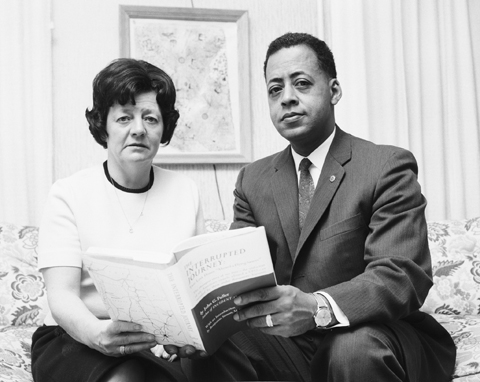
In the twentieth century, Americans cast their gaze into space and developed a tradition of UFO and alien-themed story-telling, including accounts of abduction and captivity. Betty and Barney Hill are pictured here with a book about their alleged alien abduction in 1961, which was written by John G. Fuller and titled The Interrupted Journey. (Bettmann/Corbis)
The Hills’ account, retrieved in part through hypnosis and the recovery of repressed memories, coincided with a number of controversies in the American psychiatry medical establishment. Concerns over the malleability of the human brain peaked with the “brainwashing” scares of the Cold War while public interest in repressed memories contributed to a number of controversies, including the so-called “Satanic Panic” of the 1980s. Memories of sexual abuse, especially impregnation, abortion, and DNA experimentation in the form of hybrid alien-human children became increasingly popular components of abduction accounts in the wake of the Hills’ revelations.
The Hills’ experience and their description of their abductors were recounted in the best-selling 1966 paperback, The Interrupted Journey, and later in NBC’s 1975 made-for-TV movie The UFO Incident. The film helped establish the Hills’ account as the prototypical alien abduction experience. Following the broadcast of the film, reports of contact with UFOs dramatically increased from approximately two a year (from 1947 to 1975) to more than fifty per year by 1976. Hynek’s close encounters classification system relied on the Hills’ abduction incident and became increasingly popular and well known, eventually inspiring Steven Spielberg’s iconic blockbuster film Close Encounters of the Third Kind (1977). By the 1990s, the relationship among UFOs, alien abduction, and government conspiracies developed into a cottage industry on many Internet websites and message boards, while popular television programs such as The X-Files reinforced the linkages among the three phenomena.
With the spread of abduction stories through multiple media, the popular folklore surrounding UFOs and abductions expanded to include a host of other phenomena including animal mutilations, accounts of contact with “men in black” trickster figures, crop circles, and ever more elaborate conspiracy theories implicating governments both earthly and alien. UFO and abduction accounts often promiscuously commingle with other forms of alternative knowledge related to ESP, racial conspiracy theories, the existence of Bigfoot, and any number of other paranormal themes. Such elaborate tales have been grist for numerous Hollywood movies, network television programs, a vast bibliography of fictional and (purportedly) nonfictional accounts of contact with UFOs, and a similar-sized market of skeptical literature designed to debunk UFO stories.
Michael J. McVicar
See also Area 51; Conspiracy Theories; Crop Circles; Montauk Project; Roswell (New Mexico) UFO Landings; X-Files
Further Reading
Barkun, Michael. 2013. A Culture of Conspiracy: Apocalyptic Visions in Contemporary America. 2nd ed. Berkeley: University of California Press.
Birchall, Clare. 2006. Knowledge Goes Pop: From Conspiracy Theory to Gossip. Oxford: Berg.
Bullard, Thomas E. 1989. “UFO Abduction Reports: The Supernatural Kidnap Narrative Returns in Technological Guise.” Journal of American Folklore 102 (404): 147–170.
Clancy, Susan A. 2007. Abducted: How People Come to Believe They Were Kidnapped by Aliens. Cambridge, MA: Harvard University Press.
Dean, Jodi. 1998. Aliens in America: Conspiracy Cultures from Outerspace to Cyberspace. Ithaca, NY: Cornell University Press.
Fuller, John G. 1966. The Interrupted Journey: Two Lost Hours “Aboard a Flying Saucer.” New York: Dial Press.
Hynek, J. Allen. 1972. The UFO Experience: A Scientific Inquiry. London: Corgi Books.
Keyhoe, Donald E. 1955. The Flying Saucer Conspiracy. New York: Holt.
Matheson, Terry. 1998. Alien Abductions: Creating a Modern Phenomenon. Amherst, NY: Prometheus Books.
Moffitt, John Francis. 2003. Picturing Extraterrestrials: Alien Images in Modern Culture. Amherst, NY: Prometheus Books.
Rojcewicz, Peter M. 1987. “The ‘Men in Black’ Experience and Tradition: Analogues with the Traditional Devil Hypothesis.” Journal of American Folklore 100 (396): 148–160.
Scully, Frank. 1950. Behind the Flying Saucers. New York: Holt.
Alien Abduction Stories and UFOs—Primary Document
Charles Hoy Fort, New Lands (1923)
During the lifetime of Charles Hoy Fort (1874–1932), the United States was transformed by the appearance of telephones, electric lighting, airplanes, and other technological marvels, while scientists like Albert Einstein revolutionized our understanding of space. Reports of these advances created a frenzy in the era’s newspapers and magazines, and reporters occasionally engaged in crazed speculation about strange atmospheric occurrences. In this selection from Fort’s New Lands, published in 1923, the author suggests that “extra-mundane vessels” from space may have abducted “terrestrial aeronauts,” a very early example of speculation about UFOs and close encounters with aliens.
It is said, in the Scientific American, that, according to the Warrentown (Va.) Solid South, a number of persons had seen white-robed figures in the sky, at night. The story in the Richmond Dispatch is that many persons had seen, or had thought they had seen, an alarming sight in the sky, at night: a vast number of armed, uniformed soldiers drilling. Then a dispatch from Wilmington, Delaware—platoons of angels marching and countermarching in the sky, their white robes and helmets gleaming. Similar accounts came from Laurel and Talbot. Several persons said that they had seen, in the sky, the figure of President Garfield, who had died not long before. Our general acceptance is that all reports upon such phenomena are colored in terms of appearances and subjects uppermost in minds.
L’Astronomie, 1888–392:
That, about the first of August, 1888, near Warasdin, Hungary, several divisions of infantry, led by a chief, who waved a flaming sword, had been seen in the sky, three consecutive days, marching several hours a day. The writer in L’Astronomie says that in vain does one try to explain that this appearance was a mirage of terrestrial soldiers marching at a distance from Warasdin, because widespread publicity and investigation had disclosed no such soldiers. Even if there had been terrestrial soldiers near Warasdin repeating mirages localized would call for explanation.
But that there may be space-armies, from which reflections or shadows or Brocken specters are sometimes cast—a procession that crossed the sun: forms that moved, or that marched, sometimes four abreast; observation by M. Bruguiere, at Marseilles, April 15 and 16, 1883 (L’Astro., 5–70). An army that was watched, forty minutes, by M. Jacquot, Aug. 30, 1886 (L’Astro., 1886–71)—things or beings that seemed to march and to counter-march: all that moved in the same direction, moved in parallel lines. In L’Annee Scientifique, 29–8, there is an account of observations by M. Trouvelot, Aug. 29, 1871. He saw objects, some round, some triangular, and some of complex forms. Then occurred something that at least suggests that these things were not moving in the wind, nor sustained in space by the orbital forces of meteors; that each was depending upon its own powers of flight, and that an accident occurred to one of them. All of them, though most of the time moving with great rapidity, occasionally stopped, but then one of them fell toward the earth, and the indications are that it was a heavy body, and had not been sustained by the wind, which would scarcely suddenly desert one of its flotsam and continue to sustain all the others. The thing fell, oscillating from side to side like a disc falling through water.
…
In October, 1913, occurred something that may not be so very mysterious because of nearness to the sea. One supposes that if extra-mundane vessels have sometimes come close to this earth, then sailing away, terrestrial aeronauts may have occasionally left this earth, or may have been seized and carried away from this earth. Upon the morning of Oct. 13, 1913, Albert Jewel started to fly in his aeroplane from Hempstead Plains, Long Island, to Staten Island. The route that he expected to take was over Jamaica Bay, Brooklyn, Coney Island, and the Narrows. New York Times, Oct. 14, 1913—”That was the last seen or heard of him … he has been as completely lost as if he had evaporated into air.” But as to the disappearance of Capt. James there are circumstances that do call for especial attention. New York Times, June 2, 1919—that Capt. Mansell R. James was lost somewhere in the Berkshire Hills, upon his flight from Boston to Atlantic City, or, rather, upon the part of his route between Lee, Mass., and Mitchel Field, Long Island. He had left Lee upon May 29th. Over the Berkshires, or in the Berkshires, he had disappeared. According to later dispatches, searching parties had “scoured” the Berkshires, without finding a trace of him. Upon June 4th, army planes arrived and searched systematically. There was general excitement, in this mystery of Capt. James. Rewards were offered; all subscribers of the Southern New England Telephone Company were enlisted in a quest for news of any kind; boy scouts turned out. Up to this date of writing there has been nothing but a confusion of newspaper dispatches: that two children had seen a plane, about thirteen miles north of Long Island Sound; that two men had seen a plane fall into the Hudson River, near Poughkeepsie; that, in a gully of Mount Riga, near Millerton, N. Y., had been found the remains of a plane; that part of a plane had been washed ashore from Long Island Sound, near Branford. The latest interest in the subject that I know of was in the summer of 1921. A heavy object was known to be at the bottom of the Hudson River, near Poughkeepsie, and was thought to be Capt. James’ plane. It was dredged up and found to be a log.
Source: Fort, Charles Hoy. New Lands. New York: Boni and Liverwright, 1923, pp. 459–460, 522–523. Available online at Internet Sacred Text Archive. http://sacred-texts.com/fort/land/index.htm.