
EARLY IN THE MORNING OF JUNE 4, 1941, JUST OVER A YEAR after the invasion and occupation of France, four men entered a car in Berlin and were driven west. They were followed by a truck bearing not the matériel of war, but seven cases, almost a ton, of photographic and artistic equipment and supplies. Though none was by training a member of the SS, each bore a title and wore the gray uniform of Hitler’s elite troops in order that they might cross the border more easily—SS Sturmbannführer Herbert Jankuhn, professor of history and curator of prehistoric antiquities at the museum of Kiel; SS Unterscharführer Schlabow, director of the museum of the history of traditional Germanic costume at Neumünster; and SS Sturmbannführer Alber and SS Mann Herbert Jeschke, a photographer and a painter, both from Berlin. They reached Paris in a little over twenty-four hours. There they conferred with military authorities for almost two days before leaving for Normandy, where they were expected at Bayeux’s Hotel Lion d’Or.
The next morning there were negotiations, first with Maître Dodeman. The mayor had not been informed of the plan to move the little group’s activities from Bayeux to the château of Monceaux. He mumbled something about a “fire hazard” and insisted on consulting the ministère des beaux-arts. M. Le Prunier, a local professional photographer, was called to provide supplementary photographic material. But Professor Jankuhn, head of the mission, was disappointed with what he saw in M. Le Prunier and exasperated that the Agfa plates they had brought with them did not seem to fit the camera at hand. He made a quick trip to Paris to ask for the services of a specialist in color photography and a close-up lens.
On June 13, Jankuhn could wait no longer. He ordered the heavy sealed canister to be brought from its concrete bunker in the cellar of the Bishop’s Palace. The canister was opened, and a long piece of cloth, smelling noticeably of insecticide, was removed and rolled between two wooden bobbins. This was the procedure that M. Falue, steward of the Bishop’s Palace, used whenever German officers (and there had been many lately) pulled up to Bayeux’s Town Hall in a black Mercedes or Citroën or even on motorcycle and demanded to see der Teppich.

Vault in which the Bayeux Tapestry was stored during World War II
PHOTO COURTESY OF EMMANUEL BRÉARD, CAMARA BAYEUX
Jankuhn’s visit was different from those of the others. He came with orders directly from Germany’s minister of the interior, Heinrich Himmler, and perhaps even from Reichsführer Hitler himself. Himmler established a research group, Das Ahnenerbe, for the purpose of preserving useful cultural heritage, and he was directly responsible for the Jankuhn mission, which was to photograph it, paint it, and study its meaning for the Third Reich. As an account of a great battle won by a great Scandinavian, William the Conqueror, whose ancestors were relatively recent settlers from the North, the Tapestry was an example of original Germanic art, not the “degenerate art” that Hitler had assembled, exposed, and sold off in Switzerland several years earlier. And like his plans for the new Teutonic empire, it had endured for almost a thousand years.
Jankuhn, a specialist in Viking culture, must have shivered at that first glimpse. It was like a photograph from the eleventh century, of the horses and men, the costumes and arms, the ships and buildings, of the Viking world. How could he have failed to imagine the Führer as the last in the line of conquerors whose legacy was still alive in that very room? From all that he had read to prepare for this day, Jankuhn knew that the bishop of Bayeux at the time of the Conquest, William’s half-brother Odo, was most likely the one who had ordered the Tapestry in the first place. That was before Odo’s ambition got him into trouble and William had him imprisoned, some say, because Odo wanted to be pope.
On June 17, Jankuhn, Dr. Hörmann, a representative of the Kunstschutz beim OKM, the military service charged with the mission of protecting works of art, M. Dupont, a French government inspector of historical monuments, M. Falue, and an interpreter drove to the château of Monceaux. They concluded it was, just as the mayor had said, “not immune from the threat of fire.” Monceaux was not a suitable place for serious study. The group set out for the monastery at Juaye-Mondaye, ten kilometers from Bayeux, where it was agreed they would work—every day from 9:00 A.M. until 9:00 P.M.—beginning on June 23 until August 1. Three customs agents would be lodged in the monastery under the supervision of M. Falue to guard the Tapestry day and night. On the night of June 19, Professor Jankuhn, unable to wait, ordered a few pictures to be taken in the bishop’s palace under a photographic lamp that had also traveled all the way from Berlin. The Tapestry accompanied by a German motorcycle guard “armed from head to foot,” was transported from Bayeux to Mondaye on the morning of June 22. On June 26, two military policemen posted signs on the monastery door prohibiting entrance by occupation troops.
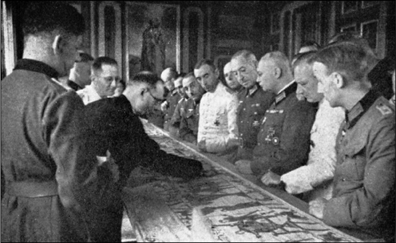
German art historians examining the Bayeux Tapestry
PHOTO COURTESY OF EMMANUEL BRÉARD, CAMARA BAYEUX
For some time before the Jankuhn mission to Bayeux, the leaders of the Third Reich had been interested in original artifacts to substantiate claims to racial purity As early as 1936, Hitler and Himmler tried to bring back to Berlin a fifteenth-century manuscript of Tacitus’s Germania. Written in the first century, Tacitus’s account of the meeting of Roman and northern civilizations was considered “the birth certificate of the German race.” At first, the Reich’s efforts to remove the Germania from its home in the Balleani family library in Fontedamo, Italy to its “natural homeland” in Berlin were thwarted by Mussolini, who sought to keep it as a monument to Roman imperial claims. But after the downfall of Mussolini, and as late as the fall of 1943, Hitler sent a convoy of SS officers to search for Tacitus’s text, which they failed to discover in its hiding place in the kitchen cellar of the nearby Balleani castle of Iesi.1
In the spirit of Tacitus’s Gemianía, the leaders of the Reich saw the Bayeux Tapestry as a visual record of Teutonic ingenuity and daring. And so, standing before the unfurled embroidery, the professor and the artist focused their attention upon the most dramatic scenes, such as the launching of a fleet of ships to conquer England from a spot on the Norman coast not too far from where they presently stood. That was just two weeks before the Battle of Hastings, which changed the history of England and brought a new order to Europe—and could not have failed to resonate with the new order so much on the minds of everyone in the room.
Himmler’s goal was twofold. He was responding to complaints from both the French and Germans that so many officers of the occupation force had demanded to see the Tapestry that the object itself was being harmed by all the unrolling and rerolling. The authorities decided that it would be studied for some reasonable amount of time, photographed, and described, then removed to one of the safe depositories for national artworks, the château of Sourches, in the department of Sarthe in the Loire Valley near Le Mans. Himmler was interested in finding in the Tapestry the origins of the German state in the Norman state of Sicily and in Normandy itself Reich leaders had read the biography of Kaiser Frederick II (1194–1250) published in 1931 by a young historian, Ernst Kantorowicz. They admired in the medieval German king and Roman emperor, whose mother, Constance of Sicily, was a Norman, the dream of uniting Germany with the South. A document entitled “The Dossier on Research of the Society of Das Ahnenerbe Concerning the Bayeux Tapestry” makes the claim as early as July 8, 1939, that “this masterpiece has especially for us considerable value. The Tapestry shows that the heritage and the customs of Vikings from Scandinavian countries continued to live in Normandy in a relatively pure form. We must study in depth certain details, particularly the arms, the equipment, and the costumes, in order to date and to prove its Norman origin.” Further, “Scientific study and interpretation of events will,” it was hoped in the early days of the occupation, when Hitler was thinking of crossing the English Channel, “give supplementary information about the invasion of England by the Normans.”2
Jankuhn, who had worked previously on the Celtic dig at Haithabu, Schleswig, had been selected as the man most qualified to lead the team that would study the Tapestry And study they did. Alber, the photographer, made three trips to Paris to develop his color negatives and to buy more plates. When he left Mondaye on June 30, 1941, he had photographed the Tapestry in its entirety. Nonetheless, Jankuhn engaged another photographer, Frau Uhland of the Kunstwissenschaftlichen Institut (Art Institute) of Marburg, to replace Alber. The arrival of a woman in the monastery so shocked the monks of Mondaye that they insisted the table, specially constructed for the little group’s work, be moved along with all the photographic and artistic equipment and the Tapestry itself from the upper floors to the ground floor, which was more suitable for guests.
In her pains to be thorough, Frau Uhland carefully removed the thread basting that attached the original Tapestry to its backing, which had been placed there sometime between the sixteenth and the eighteenth centuries, and photographed portions of the embroidered stitching from the rear. Meanwhile, SS Loeb, a military reporter, made two documentary films to be shown as newsreels, and Jeschke, the painter, produced watercolor drawings of many of the details and the scenes of the Tapestry—the figureheads of the boats, dress, shields, dragons in the margins, the so-called portal of Ælfgyva, banners, and helmets—which, as we shall see, are most illustrative of the Viking world. On July 15, 1941, Count Metternich, German officer, curator of historic monuments in the Rhenish region, and chief of the Scientific Mission for the Preservation of Historic Monuments of France, arrived on a tour of inspection. Professor Jankuhn assured him that the study team would wrap up its work by the end of the month.
When Jankuhn left Bayeux on August 5, 1941, he took with him some twelve cases of research material, 426 black-and-white and color photographs (plus 351 doubles), precise measurements and a description of the Tapestry in its most minute detail, enough samples of the thread to conduct “controlled experiments,” and a journal filled with the pleasures and frustrations of everyday life in occupied Bayeux—the difficulty of finding a car to take him to Mondaye, the goodwill of the monks, electricity outages that hindered the photographic work, and the excellent dinners prepared by the owner of the Lion d’Or, after which he listened to the news reports broadcast from the general headquarters of the Führer.3 Jankuhn was surprised to learn on June 22, 1941, that Hitler had invaded Russia, for he must have realized that the opening of an eastern front would defer, if not cancel, any thought of invading Great Britain.
By August 8, Jankuhn was back in Kiel making arrangements for Loeb’s documentary film to be the centerpiece of an arts festival inaugurated by the Reichsführer and for the edition of a four-volume collective work by historians, ethnologists, literary specialists, and architects on all aspects of the Tapestry to be published in a series entitled the History of Art in Western Europe. Though the book never appeared, the members of Jankuhn’s scholarly team conducted extensive discussions about the political versus the religious nature of the Tapestry in an orchestrated attempt to establish its Germanic origins. Professor Jankuhn read a paper entitled “The Conquest of England by the Normans, According to the Bayeux Tapestry” to Himmler’s circle of friends in Berlin in April 1943 and another at the academy in Stettin in August of that same year.4
The Bayeux Tapestry was again sprayed with naphthalene to prevent damage by moths, replaced in its waterproof lead cylinder, and transported on August 19 from Bayeux to the château of Sourches. There had been negotiations about where to find the twenty-five gallons of gas necessary for the 350-kilometer round trip, and Maître Dodeman’s appeal directly to Count Metternich had met with a negative response. A local merchant volunteered his ancient gas-generator delivery truck, which, early in the morning of August 18, 1941, was loaded with a dozen sacks of coal to be converted to combustible fuel. The three men who accompanied the Tapestry had to get out and push their valuable load up steep hills, the truck would not restart after lunch, and it broke down several times en route. The drivers, with permission from the authorities for only a one-day trip, would not make it back that night. They found lodging thanks to the caretaker of the City Hall of Alençon, where all the hotels were full with refugees evacuated by the Germans for “mysterious reasons” from the Norman coast. When the drivers returned to Bayeux at 11:30 the next morning, they were, according to one eyewitness, “fatigued and all covered with soot.” Mayor Dodeman of Bayeux wrote a letter of gratitude to the mayor of Alençon.5
The Tapestry did not remain undisturbed for very long. At the end of 1943, Jeschke, the painter, was granted permission to visit Sourches for the purpose of making more drawings. And as late as July 6, 1944, fully a month after Allied troops had landed on the beaches of Normandy, SS Sievers of Himmler’s Ahnenerbe Heritage Bureau ordered in the name of the Reichsführer that “this important Germanic monument” be moved from France to an SS bunker in Berlin.
Why didn’t Hitler simply seize the Bayeux Tapestry in 1941 when he had the chance? Perhaps he didn’t because he wished to leave this early artifact of Nordic culture upon French soil as a marker, a claim of the Teutonic presence dating back to a time even before the creation of nation-states. In any event, by the time he got around to it, it was too late. As Allied troops pressed toward Paris in August 1944, German press and radio reported the false news that the Bayeux Tapestry had fallen into the hands of an American antiques dealer. And only in February 1945 did German authorities discover that on June 27, just after the Allied landing in Normandy, the Tapestry was transferred under the auspices of the German Commission for the Protection of French Artworks to the basement of the Louvre.
On August 21, 1944, in the middle of the street fighting between French partisans and the German occupiers of Paris, two men in SS uniforms and a truck “stuffed with containers of gas when fuel was in short supply everywhere” presented themselves to General Von Choltitz, commander in chief of the German army of the capital, who in a later account reports that they delivered a command:6
—Orders from the Reíchsführer SS, Herr General, we have come to remove the Bayeux Tapestry to Berlin.
—What good luck, replied Von Choltitz, you want to place it out of harm’s way?
—Ja, Herr General.
—I’m very glad. Would you please follow me out on the balcony.
The three of us looked at the Louvre directly across the way. Projectiles were falling thick and fast. From the rooftop an enemy machine gun began to fire in the direction of the Seine.
—You see, I said, the tapestry is there, in the basement of the Louvre.
—But, Herr General, the Louvre is occupied by the enemy! replied one of the SS.
—Of course it is occupied, and heavily too….
—But, under these conditions, Herr General, how can we take possession of the tapestry?
—Messieurs, I said, you are the leaders of the best soldiers in the world. I will put five or six of my best men at your disposal and will cover you as you cross the rue de Rivoli. You need only capture one door and, fighting your way in, carry it off.
The two SS hesitated, then one found a way out.
—Herr General, the French government has no doubt already removed the tapestry?
—Not at all, the tapestry is there, but you will have to seize it by force….
“I had evaluated the two men correctly,” Von Choltitz notes. “When one has served long in the army one learns to distinguish a soldier from a mere wearer of a uniform. I got rid of the two messengers of the Reichsführer and never saw them again.”
The Tapestry was exhibited in Paris in the fall of 1944 before returning to the Bishop’s Palace of Bayeux. From there it was transferred to the former Grand Seminary, remodeled to house the Municipal Library and Centre Guillaume le Conquérant after a cleaning and restoration in 1982–1983. One observer of this final reinstallation claimed in an article entitled “The Bayeux Tapestry Still Smells” that the Tapestry retained the odor of insecticide, the last vestige of its time in hiding during World War II.7
Part of the aura surrounding the Tapestry has to do with its longevity. In the middle of the nineteenth century, the French poet Théophile Gautier exclaimed: “How remarkable that this fragile strip of linen should have come down to us undamaged through the centuries when so many strong buildings have fallen into ruins!”
The Tapestry is a survivor.
Hitler was not the first to be fascinated by the Bayeux Tapestry and to want to use the images of war to make war. The Tapestry was born in armed conflict, and it has elicited strong militaristic and patriotic feelings in times of great national and international upheaval. Like any major work of art from the ancient or medieval world, it has a tale to tell.
The Tapestry has known periods of shining in the spotlight and of obscurity. From the time of its creation in the years following the Conquest of 1066, it left no trace whatsoever until an inventory of goods of the Bayeux Cathedral compiled in 1476 mentions “a very long and narrow curtain embroidered with images and writing which show the Norman conquest of England.” This is all there is before the Tapestry emerged from the mists of time and entered the historical record with the publication in 1729 of a presentation that the French historian Antoine Lancelot made to the Académie Royale des Inscriptions et Belles-Lettres in 1724 in which he spoke of a drawing made by a friend of a “monument of William the Conqueror.” The drawing had left him baffled: “In spite of all my endeavors, I have, up to the present, been unable to discover whether this sketch represents a bas-relief or a sculpture round the choir of a church or a tomb; whether it is a fresco, a painting on the glass of several windows, or, possibly, a tapestry.”8
Lancelot’s article provoked the interest of a monk of the Congregation of Saint-Maur, Paris, the classical scholar Dom Bernard de Montfaucon, who wrote to a fellow Benedictine, Dom Romain de La Londe, prior of Saint Stephen’s in Caen, Normandy. From de La Londe, Montfaucon learned that the sketch was indeed the first part of a tapestry. The drawing was made by Anne Foucault, daughter of Nicolas-Joseph Foucault, governor of Normandy from 1689 to 1704 and a collector of antiquities. It was found among his papers after his death in 1721. Thus, when the first volume of an inventory of royal monuments appeared in 1729, plates XXXV XLIX contained images engraved from Anne Foucault’s original drawings.9 Montfaucon, meanwhile, dispatched a draftsman to copy the rest, which appeared in volume II of the Monumens de la Monarchie Française along with what may be considered the first essay on the Tapestry, attributing it to William’s wife, Mathilda, who, Lancelot maintained, commissioned it shortly after 1066.10
For most of its existence, the Tapestry lay quietly rolled upon the winchlike device on which it was apparently stored from time beyond memory until the middle of the nineteenth century, either in Notre-Dame of Bayeux, the bishop’s palace, or the Municipal Library. It was visited at first by what were known before the birth of the discipline of archaeology as “antiquarians,” amateurs, connoisseurs, and collectors interested for the most part in local history or in family genealogies. Antiquarian curiosity led, in fact, to discovery of many of the manuscripts of the Middle Ages, neglected by the Renaissance and by the neoclassicism of the seventeenth century, which turned to ancient Greece and Rome and averted its eyes from the medieval past, from “the time of the Goths,” in the phrase of Renaissance writer François Rabelais. In prerevolutionary France, as in England to this day, medieval manuscripts were often still housed in the castles of their ancestral owners.
Once a year, during the Feast of Relics and the Octave of Saint John, a liturgical period of eight days in July, the Tapestry was unrolled and hung around the nave of the cathedral, as we know from a series of letters published between 1730 and 1732 by the antiquarian Jean de la Roque, who visited Bayeux some fifteen years earlier. So, too, we know that the Tapestry was seen in 1746 by an English antiquarian, William Stukeley, and in 1752 by Andrew Ducarel, who confirms the report of an annual exhibition in July. But for the most part, the Tapestry lay dormant upon its roller until it was put on permanent display and began to attract the tourists who in the middle of the nineteenth century replaced the antiquarians and connoisseurs of an earlier era.
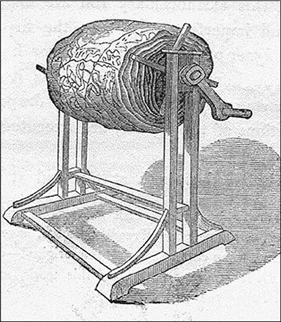
Engraving from 1824 of the winch on which the Bayeux Tapestry was wound
FROM THOMAS FROGNALL DIBDIN, A BIBLIOGRAPHICAL ANTIQUARIAN AND PICTURESQUE TOUR IN
FRANCE AND GERMANY (LONDON: ROBERT JENNINGS AND JOHN MAJOR, 1829)
On several occasions before Hitler’s attempt to seize it, the Tapestry was the focal point of national and international drama and fell into considerable risk. In the aftermath of the French Revolution, which relegated the possessions in libraries and cathedrals to “communal destruction,” it narrowly escaped catastrophe when a local military contingent from Bayeux wrapped one of its equipment wagons in an “old piece of cloth resting in the Cathedral.” Only at the last minute did a lawyer by the name of Lambert Léonard Leforestier obtain a legal injunction that he waved before the unruly crowd, which backed off Léonard Leforestier removed the Tapestry to his own office in the Commissary of Police in return for his promise to furnish a canvas substitute. In 1794, under a movement to preserve national treasures menaced by the Terror of 1793, the Tapestry was “nationalized” and became public property as an antiquity in the care of the National Commission for the Arts. On 10 Ventôse, year II, (February 23, 1794), the local commissioners saved it once again from being cut into pieces to decorate a revolutionary float. This time, however, they tried to make its protection permanent with a letter to the mayor:
Our task, Citizen, embracing, as it does, the investigation of everything of interest to Public Education, we cannot neglect an object, the possession of which was considered an honor for our community under the Ancien Régime. The conquest of England by the Normans has long been a matter of personal pride to us. Today, when all parts of the Republic are united where national wealth and glory are concerned, the record of the Conquest has become public property… we must therefore request you to inform us of the place at which the Tapestry is stored so that we may effect its removal to one of the depots in this district.11
In August of that year, the Tapestry was removed from the sacristy of the cathedral and unrolled in the “Temple of the Supreme Being,” a government depot. At that time, too, its condition was assessed by a comparison with the original drawings published by Montfaucon.
Napoleon, contemplating an invasion of England, had the Tapestry put on display in the Musée Napoléon in Paris between November 1803 and February 1804. It is from this exhibition that the Bayeux Tapestry known until then as the Tapestry of Duke William, received its second name, imposed by the director-general of French museums: la tapisserie brodée de la reine Mathilde— Queen Mathilda’s Tapestry. The emperor, then only first consul, was reported to have studied it and been so impressed by the parallel between a comet observed in France and southern England shortly after the installation and the “hairy star” depicted in the Tapestry to signal the relation between Harold’s coronation and William’s crossing of the Channel that a description was printed in the guide to the exhibition: “Dover, December 6, 1803. Last night about five o’clock we observed a superb comet which rose in the south-west and moved towards the north: it had a tail about thirty yards long. The whole countryside was lighted for many miles around, and after it disappeared, one smelled a strong odour of sulphur.”12
The Tapestry, for the first time a national rather than a local object, captured the imagination of the French public. The exhibition in the capital inspired a play at the Théâtre du Vaudeville, La Tapisserie de la Reine Mathilde, which, in contrast with the drama of invasion, featured women alternately embroidering and praying onstage for the success of their warrior husbands.13
Upon its return from Paris to Bayeux, the Tapestry, still preserved on an enormous pulleylike roller from which it was unwound and rewound for viewing, received a number of visitors. The most diligent was Charles Stothard, a British artist dispatched in 1818 by the Society of Antiquaries of London for the purpose of making a detailed full-size color reproduction. Stothard spent two years sketching the Tapestry, at the end of which, comparing his drawing with that of Montfaucon, he concluded that the crude method of storing it would mean that “in the course of a few years, the means of accomplishing” what he had done “would no longer exist.”14 Stothard apparently knew of what he spoke, since during the period he was sketching, a piece of the Tapestry was removed, later turning up in the Victoria and Albert Museum, London, where it was exhibited until its return in 1871. Mrs. Stothard had been suspected of the theft, a suspicion countered by one of Mrs. Stothard’s nephews, who claimed that Mr. Stothard already possessed two pieces of the Tapestry at the time of their marriage.15 Stothard’s and others’ warnings about deterioration were taken seriously, however, and the Tapestry was removed in 1842 to a room in the Bibliothèque Publique, where it was unwound and exhibited behind glass. Since that time, the Tapestry has been absent only three times from public view: once during the Franco-Prussian War of 1870 under fear of a German invasion of Normandy; again at the outbreak of World War II; and, finally, for the examination and restoration of 1982–1983.
Was the Bayeux Tapestry intended originally for a religious or a secular purpose? Was it meant to hang in a great cathedral or a princely hall?
The case for the Tapestry as a religious work destined for a cathedral is based largely upon external evidence—that is, on comparison with surviving textiles or descriptions of church hangings on both sides of the English Channel. Records show that around 840, Saint Agelme, bishop of Auxerre, France, ordered for his church a “large number of hangings.” Around 985, Abbot Robert commissioned for the Abbey of Saint-Florent of Saumur “dosserets, curtains, and hangings in wool.” At the end of the ninth century, Adelaide of Poitou, wife of King Hugh Capet, donated a hanging depicting the terrestrial sphere to the Abbey of Saint-Denis. An Anglo-Saxon woman by the name of Ælfflæd offered a woven hanging (cortinam) to the Church of Ely after the death of her husband, Ealdorman Byrhtnoth, at the Battle of Maldon in 991.16 The abbot of Saint-Riquier, who died in 1075, took great care to decorate the monastery both “by acquiring cloths and in having hangings made.”17
That the Bayeux Tapestry was in its earliest mention found among the goods of the Cathedral of Bayeux supports the claim that it was originally intended for a church, as does the unconfirmed observation by the Tapestry’s German examiners during World War II that marks could be found on its canvas backing at regular intervals corresponding to the spacing of the cathedral’s piers. “No place lends itself better to the lengthy unfurling of this embroidered fabric than the nave of a church, or, better yet, the nave of a cathedral,” writes a former curator of the Centre Guillaume le Conquérant in Bayeux.18 If the Tapestry was made for a cathedral, none would be more likely than that of Bayeux, which was reconsecrated in 1077 by William’s brother Odo, who may also have been at the origin of such a large embroidery project.
Though the Tapestry is a great secular public work of art, religious images and acts are spread throughout the story of the difficult succession after the death of Edward the Confessor, the king who would be saint. Harold visits the church at Bosham before departing for the Continent, the hand of God appears over Westminster Abbey as King Edward is buried, Harold’s oath is sworn on religious relics, he holds an orb topped by a cross in the scene of coronation next to Archbishop Stigand in the “orans” pose of prayer. The insignia the Normans carried into battle may be the papal banner conferred upon William by Pope Alexander II. Alongside religious images and acts, we see the outer trappings of religion, not only the church at Bosham and Westminster Abbey, but the monastery at Mont-Saint-Michel.
For a work of art created in an intensely religious age, however, the Tapestry, unlike written chronicles, which pay attention to the will of God in human affairs, or The Song of Roland, with its repeated “Christians are right, and Pagans are wrong,” shows surprisingly little religious reference to 1066. Bishop Odo, the singular religious figure of the Tapestry, may bless the feast before the Battle of Hastings, but he is not a great spiritual figure. A feudal baron with benefit of clergy, he is a “muscular” Christian whoparticipates in the councils of war and leads with William the charge at Hastings. The Tapestry hints at belief not in Christian providence, but in the supernatural, as, for example, in the appearance of Halley’s comet and the so-called ghost ships in the margins above and below the spreading of the news of Harold’s betrayal. And it contains obscenities that make it more appropriate for hanging in the great hall of a feudal castle than in the Cathedral of Bayeux. Horses sport epic erections as they prepare for battle, a monk touches the head of the mysterious woman Ælfgyva between the scenes of Harold’s capture and transfer to William’s court, nude women and men cavort with clear erotic intent. All show a concern with the body condemned by the medieval church.
The Tapestry’s borders are filled with images of hunting and bear baiting; with real animals, snails, peacocks, camels, lions, birds, and fish; with fantastical animals, griffins, centaurs, and winged beasts; and with animal fables in the tradition of Aesop. This is the very kind of decoration—the drolleries, grotesques, babouíneríes, and bas-de-page—found in the margins of many medieval manuscripts. In the twelfth century, the Cistercian Saint Bernard, reacting against what he saw as the laxity of the Cluniac rule, condemned such doodlings as inappropriate to display in a church. “What can justify that array of grotesques in the cloister where the brothers do their reading, a fantastic conglomeration of beauty misbegotten and ugliness transmogrified?” Bernard asks. “What place have obscene monkeys, savage lions, unnatural centaurs, manticores, striped tigers, battling knights, or hunters sounding their horns? … One would sooner read the sculptures than the books, and spend the whole day gawking at this wonderland rather than meditating on the law of God.”19
The Tapestry is a mixed genre. Alongside the high style of defining glorious epic events are the lower-styled animal fables and bawdy tales of the type known to have been recited in the marketplace, at fairs, and after dinner in the great hall of a princely palace. The Tapestry might just as well have hung in such a secular space as in a church.
Gold thread shone
in the wall-hangings, woven scenes
that attracted and held the eye’s attention.20
Thus the Beowulf poet describes the wall decorations of the Scandinavian mead hall, where men from the North drink, carouse, and listen to tales of heroic warriors like Beowulf himself
Beowulf may belong to the seventh century, but the tradition lasts much longer. In the thirteenth-century Old French heroic poem Girard de Roussillon, the guest chamber of one count’s palace is “everywhere spread with tapestries and hangings,” and other rooms are “so covered around with hangings that you could not see the stone and wood of the walls behind.” Both the early-twelfth-century chronicler Orderic Vitalis and the poet Robert Wace claim that “after the death of William the Conqueror, several dishonest servants carried off hangings from his palace at Rouen.” Evidence for hangings that not only cover the wall but tell a story is found in a Latin poem from the end of the eleventh or beginning of the twelfth century. Baudri de Bourgueil describes a fabric in the bedroom of William’s daughter Adela depicting with inscriptions the events leading up to the Conquest. Certain of the details of Baudri’s description—the appearance of a comet, William’s council of war, the cutting of forests and building of ships, Harold’s manner of death—indicate he has actually seen the Bayeux Tapestry But details such as the claim that Adela’s hanging is made of precious gold, silver, and silk, studded with gems and pearls, make Baudri’s sighting of the Tapestry less likely
Using a one-seventh-scale model, the art historian Richard Brilliant has attempted to arrange the Bayeux Tapestry along the walls of an oblong hall. Placing scene 1 at one corner and important thematic transitions in the corners of the room, Brilliant speculates that the unfinished Tapestry might have ended where it begins, in Westminster Abbey with the coronation of William and a conjectural restoration of some six and a half feet. The Tapestry hung below the high windows designed to preserve warmth and provide maximum light, would have required a hall 93 feet long and slightly less than 26 feet wide.21 This is a large room, to be sure, but such dimensions are not incommensurate with the Hall of the Exchequer, the royal castle at Caen, approximately 37 by 100 feet, or the royal hall in Westminster erected before 1100, 67 by 240 feet. The original placement of the Tapestry in a great castle hall would not have eliminated Odo as its patron, for Odo, as the Earl of Kent and the greatest landholder in England after the king, had a predilection for ostentatious goods. He kept palaces on both sides of the Channel and even one in Rome.
It is possible, of course, that the Bayeux Tapestry was intended for what today would be termed “multiuse,” that it was transported from castle to cathedral and back and might even have been exhibited out of doors. Despite Saint Bernard’s objections, the obscenities in the margins and elsewhere were less of an impediment to hanging in a great medieval church than they would have been after the Reformation and Puritan revolution. Though the events the Tapestry depicts and the cast it gives them may be spectacularly feudal and secular, it is likely that even viewers in a great castle hall would have seen the will of God made manifest in the affairs of men.
Truth to tell, we will never know whether the Bayeux Tapestry was made for cathedral or castle or both. The very need to make it a religious or a secular work is another way of asking whether the Tapestry is an Anglo-Saxon or Norman work of art and is more wrapped up in the nationalistic rivalries of the nineteenth and twentieth centuries than in the original intent and meaning of the object itself To the extent that the Tapestry is seen as a religious object, originally intended to be hung in a cathedral, it is Norman and French (though Normandy was not reannexed to France until 1203–1204). And to the extent that it is thought to be a secular hanging meant for a palace, it is Anglo-Saxon and English.
On the side of the French, the Conquest was a first crusade, allying as it did the Normans with the pope. One of the justifications of war in Norman eyes was the elimination of Harold’s archbishop of Canterbury, Stigand, who had received neither papal blessing nor the pallium in Rome. Though marriage was not yet a sacrament, Harold had married by cohabitation, outside of ecclesiastical purview. His treachery, moreover, consisted in the breaking of an oath, a “sacramentum,” which was a sin and fell under church jurisdiction in sacred matters. The proper place to display divine vengeance for Harold’s sin was in the house of the Lord.
On the side of the English, the idea of the Conquest as a crusade meant the imposition of Norman popery upon an Anglo-Saxon church uncorrupted by the degeneracy and deceitfulness of Rome. Such an argument became especially acute after 1530 and Henry VIII’s break with the Roman church, and it filtered through to the nineteenth century when many English saw the possibility of a return to purer ideals and practices in place in England before the arrival of the Normans and “worldly religion which came in with the Conqueror” (Thomas Arnold, 1846). In such an account, Harold’s treachery is no treachery, his sin no sin at all. Rather, he was tricked by William, who held him captive, and any oath he might have sworn was sworn under duress. The Bayeux Tapestry contains the story of a great injustice, but it does not make manifest the divine will in human events. It has, therefore, no place in a church.
• • •
Who commissioned the Tapestry? Who actually made it?
Dom Bernard de Montfaucon, the Tapestry’s “discoverer,” claimed William’s wife, Mathilda, to be at the origin of a work commemorating her husband’s victory at Hastings. This view, based on local legend rather than hard evidence, was no doubt at the root of the Tapestry’s change of name in the early nineteenth century from King William’s Cloth to the Tapestry of Queen Mathilda. Montfaucon went unchallenged for almost a century. In 1814, Abbé Gervais de La Rue, a cleric in Caen and a gentleman scholar who had spent the decades after the French Revolution in exile in England, maintained that the Tapestry had been commissioned not by Queen Mathilda, William’s wife, but by Empress Mathilda, the Conqueror’s granddaughter, sometime after 1106, that it had actually been stitched after 1162, and that it remained unfinished at her death in 1167. De La Rue reasoned that the Tapestry could not have survived the fire that destroyed the Bayeux Cathedral in 1106 and that many of the particulars of the story it depicts could have come only from Wace’s history of the Dukes of Normandy, the Roman de Rou, composed in the 1160s or 1170s.
That Queen Mathilda should be the patron of the Bayeux Tapestry makes it English, stemming as it does from the reputation of Anglo-Saxon women for sophisticated textile work, the so-called opus anglicanum, or English work, and from the belief that only women could actually have embroidered it, reflected in the Anglo-Saxon proverb “A woman’s place is at her embroidery” (“fæmne æt hyre bordan geríseth”) 22 And because of records that have survived of wives embroidering hangings to commemorate the heroic deeds of their husbands. In addition to the woven hanging that Ælfflæd offered to the Church of Ely after the death of her husband, Byrhtnoth, we find that in the reign of Cnut, a granddaughter of Byrhtnoth, Ealdswith, received the parish of Coveney in Cambridgeshire from the Abbey of Ely to work on embroidery. King Cnut’s second wife, Emma/Ælfgyfu (see p. 120), William the Conqueror’s great-aunt, gave to the same Church of Ely “a remarkable ‘purpura [textile] adorned with gold and precious gems” along with coverings for the altar. Edward the Confessor’s wife, Edith, was known for her needlework. William the Conqueror’s wife, Mathilda, left a chasuble made by an embroideress called “Alderet’s wife” to Winchester Abbey when she died in 1083.23William the Conqueror’s chaplain and biographer, William of Poitiers, remarks upon the skill of English embroideresses. It is easy to imagine the scene, depicted by the Victorian painter George Elgar Hicks, of Queen Mathilda and her Anglo-Saxon or English ladies embroidering together in one of the numerous workrooms or “ladies’ chambers” depicted in Old French literature. Indeed, one of the earliest forms of the lyric is the woman’s work song, or the chanson de toile, weaving songs whose subject is often a lover or husband absent in the wars.
A little more than a decade after Gervais de La Rue published his implausible ideas about the Tapestry’s patron, Frédéric Pluquet, a pharmacist from Bayeux, filled the prescription of his life with the suggestion that the obscenities in the borders eliminated the possibility of women either as patrons or as creators. And in an unpublished lecture delivered to the Mechanics Institute of Lews in 1860, Mark Anthony Lower claimed that “the Tapestry contains some indelicacies deemed incompatible with the idea that a virtuous and dignified lady like Queen Matilda was the originator of the work.”24 Thus began the reign of Odo the patron.
After William, Odo figures more prominently in the Tapestry’s version of the Conquest story than anyone else. “I believe that the Tapestry was made for Bishop Odo, and that it was most likely designed by him as an ornament for his newly rebuilt cathedral church of Bayeux,” wrote E. A. Freeman, who in 1869 was the foremost authority on the Norman Conquest. Some accept the patronage of Odo but believe he intended it for a palace rather than a church. Others argue in favor of some form of collaboration: Mathilda for presentation to Odo, Odo under Mathilda’s direction, Odo for production in Normandy with the financial backing of Mathilda, Odo in Normandy for execution in England by Anglo-Saxon hands, jointly by Mathilda and Odo with the design of a Saxon-Norman artist for embroidery in Normandy by Normans, jointly by Mathilda and Odo with the collaboration of William’s other half-brother, Robert of Mortain. Others still maintain that neither Odo nor Mathilda was at the Tapestry’s origin, that it was created for the monks of Waltham Abbey, founded by Harold and his burial place. Or that Odo’s English vassals Vital, Wadard, and Turold, all of whom are pictured and mentioned by name in the Tapestry, guided its manufacture. The Tapestry is seen alternately as a gift to Odo in return for large landholdings, a defense of Odo after his imprisonment by William in 1082, and a “plea-gift” to William in order to remind him of his brother’s crucial role in the expedition and Conquest of 1066.
Where and when was the Tapestry embroidered?
The search for a precise location and date is no less fraught than the quest for a patron. Some scholars maintain with fervor that the Tapestry originated in a French or Continental school, that it was made at the Monastery of Saint-Bertin at Saint-Omer, at Mont-Saint-Michel, or in the Samur region of the Loire Valley.25 Other scholars claim with equal fervor that the Tapestry was embroidered in England and locate its origins among Anglo-Saxons at Worcester, at Barking Abbey under Abbess Ælfgyva, at Nunnaminster (St. Mary’s) in Winchester, or within Odo’s orbit in Kent. If in Kent, then Canterbury, England’s greatest cultural and religious center, is a likely place for stitching. The Tapestry has been ascribed separately both to Canterbury’s cathedral Monastery of Christ Church and to the Abbey of Saint Augustine. Since Odo, Earl of Kent, was never archbishop of Canterbury the Tapestry might have been made not there, but at one of his estates or one of the Kentish nunneries under his patronage, like Minster-in-Sheppey. Odo would presumably have transported the Tapestry back to Normandy either shortly after it was made or at the time of his release from prison and exile from England by William the Conqueror’s son William Rufus.
In almost all understandings of the Tapestry, the question of timing is crucial, and plausible dates for its manufacture vary wildly between the decade immediately following the Conquest, to Gervais de La Rue’s suggestion that it was embroidered a century later, to Bolton Corney’s claim in 1839 that it was made after 1203–1204 to commemorate the French king’s recapture of Normandy, or even after that in order to honor the Bayeux episcopacy of Robert des Ableges (1206–1231), a favorite of the French king Philippe-Auguste. If commissioned by Mathilda, the Tapestry had to have been made before her death in 1083. If commissioned by Odo for Bayeux Cathedral, it would have to be before the re-consecration of 1077. If by Odo for a palace, it could have been made either before his imprisonment in 1082 or between William’s deathbed pardon of Odo in 1087 and Odo’s death ten years later. If commissioned by Odo’s vassals Vital, Wadard, and Turold for the purpose of his defense, the Tapestry was stitched during the period of his imprisonment.
If the Tapestry was sewn in England, it could not have been later than the time of Odo’s disgrace; and if in Normandy, it could have been almost anytime after 1066. Speculation about the date of the Tapestry is fed by internal evidence bearing upon the accuracy of its depiction of costumes, hairstyle and beard, arms and armor, heraldic insignias, horses and ships, architecture and decoration, trees, inscriptions, hunting technique, and military strategy as chronological keys to the time it was made. They are the source of much scholarly debate and, in the place of certainty have brought only further doubt.
In the complete absence of contemporary documentation, we will never know who commissioned the Bayeux Tapestry, Mathilda, Odo, or another. We will never know who actually sewed it, Norman or Anglo-Saxon laywomen or nuns or even monks. We will never know exactly where it was made or when. From our lack of information and uncertainty emerge the most contradictory suppositions rooted in the attempt beginning in the nineteenth century to make it either Anglo-Saxon or Norman— which is to say, either English or French. The Tapestry is, of course, perfect for such speculation. The Battle of Hastings was, in the phrase of a modern critic, “a damn close-run thing.” The causes and the outcome of the Conquest are not clear, and either side can read itself into the Tapestry’s ambiguities: its mixture of styles, high and low; its showing of King Harold as both untrustworthy and strong, his death the result of a lucky arrow shot and not the wrath of God; its refusal to clarify the nature of Harold’s oath or to specify what King Edward said on his deathbed; its ragged right edge, which leaves unresolved the final act of the Tapestry’s visual drama.
In the decades following the Napoleonic Wars, heroic poetry and monumental visual works were pressed into the service of expanding nation-states in search of a glorious past by which to build an even more glorious future. And in the long quarrel between England and France, no event was more crucial than the Battle of Hastings, no cultural objects more contested than The Song of Roland, sung in the minutes before the fight, and the Tapestry itself.