
IN EARLY JUNE 1833, A TWENTY-FOUR-YEAR-OLD STUDENT and bohemian, Francisque Michel, wrote a letter to France’s minister of public instruction, François Guizot. The move was audacious. Though he still attended lectures occasionally at the Sorbonne, Michel, the poor son of a lycée teacher from Lyon, had failed the entrance exam to the school created in 1821 to prepare students in the science of reading and assessing manuscripts, the École des Chartes. He earned a meager living copying manuscripts at the Royal Library And now he wrote to request that the government send him to England for the purpose of transcribing unpublished Old French manuscripts in British libraries and museums.
In the three years he had been in Paris, Michel acquired a reputation as an oddball, frequenting the Romantic literary circle of the poet Charles Nodier. There he was spotted by Alexandre Dumas, author of The Three Musketeers, who described him as “a digger of old charters, sometimes so preoccupied with his research during the day that he forgets where he is and shows up wearing a Louis XIII style hat and yellow shoes.”1 Dumas’s description is telling. In it we catch a glimpse of Michel’s nighttime, romantic, heedless, “yellow-shoed” side, which came out in a series of Gothic tales that he composed in the mode of Sir Walter Scott. Yet Dumas also gives a hint of Michel’s daytime occupation as a tracker and transcriber of manuscripts. By the time he wrote to Guizot, he had already edited and published six volumes. Michel was what today would be considered an “independent scholar,” paid for duplicating documents in the tradition of the Benedictine monks of Saint-Maur under the Old Regime and continued by the civil authorities after the Revolution of 1789.
Michel was ambitious, tenacious, and bold, part of a new breed of men who, with the arrival of France’s bourgeois king Louis-Philippe after the revolution of 1830, sought to free France from the tutelage of the church under the Restoration (1815–1830). The government of Louis-Philippe’s July Monarchy rewarded initiative in what was to be a great era of economic and cultural renewal, the beginnings of the Industrial Revolution in a France that had just begun to recover from the upheavals of revolution and the Napoleonic Wars. Michel must have sensed a change afoot, and he was also calculating. He attended Guizot’s courses at the Sorbonne before the professor of medieval history was appointed by Louis-Philippe to carry out widespread educational reform. He no doubt met Guizot’s chief adviser, Charles Fauriel, either at the Sorbonne or at the Royal Library
In his daring letter, Michel played on all the themes he knew would fall on receptive ears. He offered to continue in England work already begun in France, to “locate charters and titles, both published and unpublished, for the volume that the Académie des Inscriptions et Belles-Lettres has requested I continue, along with three students of the Royal École des Chartes.” Michel emphasized the patriotic value of such a trip. He would bring back from England to France copies of documents that, despite their current location, were part of a French national legacy because they were written in Old French. And he rooted their usefulness in what was seen to be the origin of Anglo-French relations—that is, the Norman Conquest of England. Scholars “cannot study in all its detail the history of the Anglo-Saxon kings and of the Dukes of Normandy,” Michel reminded Guizot, without the sources his mission would provide.
Michel’s reference to the Conquest reveals a deeper motive. In the proposal that the government send him to England, the wily student set his sights on recovering the original version of a poem sung by a jongleur named Taillefer to the troops of William the Conqueror’s army on the morning of October 14, 1066, just before the Battle of Hastings. Others had been on the track of it, but Michel was convinced they were wrong to think that the lost manuscript of the “Romance of Roncevaux” was one of the two recently published poems about Charlemagne from libraries in the Paris region. “Likewise, Sir,” he addressed Guizot enticingly, “the mythical history of Charlemagne,… the Anglo-Norman poem composed around the middle of the eleventh century on the travels of Charlemagne to Constantinople and the Romance of Roncevaux written in the early years of the first half of the twelfth century, are also to be found only in England.”
Francisque Michel could not help thinking of that other letter, the one written in 1828 by Jean-François Champollion, who died only the year before, requesting that he be sent by the government of Charles X to make drawings of Egyptian antiquities. Like Michel, Champollion came from the provinces to Paris before he was twenty He was precocious and largely self-educated, taught himself ancient languages, and read a paper on the Coptic language to the Academy of Grenoble at the age of sixteen. Most of all, Champollion deciphered the language of the Rosetta Stone, which led not only to a position at the Louvre, but to a chair in Egyptology created for him at the Collège de France. Michel must have calculated that if he could only find the “Romance of Roncevaux,” he might dispense with all the exams, the dull courses, and days of copying in the Royal Library The government might even create for him a position in medieval French literature at the Collège de France. The “Romance of Roncevaux” would be a new Rosetta Stone.
How did Michel know about Taillefer and the “Romance of Roncevaux,” or what would come to be called The Song of Roland, without the very sources he proposed to bring back to France?
Roland, Charlemagne’s nephew and the hero who died fighting the Saracens in the eighth century, was known as a legend, and a legend bound to national honor. The composer Claude Joseph Rouget de Lisle wrote a poem entitled “Roland at Roncevaux” just two weeks after composing the French national anthem “La Marseillaise” in 1792. Alongside the patriotic “Allons, enfants de la Patrie” (“Come, children of the Fatherland”), we find the Roland refrain “Mourons pour la Patrie” (“Let us die for the Fatherland”). In 1806, with Napoleon at the height of his power after the Battles of Ulm and Austerlitz (1805), the monarchist Claude Auguste Nicolas Dorion published a heroic poem entitled The Battle of Hastings, or England Conquered, which features not Anglo-Saxons against Normans, but Englishmen against French. Dorion reminds his readers of the fact, contained in medieval chronicles, that some version of a song about Roland was sung by William’s warriors before the Battle of Hastings and that even before that Roland had dipped his sword in English blood. When France invaded Spain in 1823, Victor Hugo, only twenty at the time, assured French soldiers that Roland, the hero who had died in the Pyrenees near the Franco-Spanish border, “looked down approvingly from heaven.”2
As early as 1814, Charles Nodier, to whose salon Michel would come some fifteen years later, speculated about the survival of an epic connected to Hastings, as did the poet Chateaubriand, who had spent time in England after the Revolution.3 We know from a review that Michel published in 1832 of a thesis on the “Romance of Roncevaux” that he had read English scholar Thomas Tyrwhitt’s 1798 edition of Chaucer’s Canterbury Tales, in which Tyrwhitt mentions a manuscript without title in Oxford’s Bodleian Library, but “which could be an older copy of that which Du Cange cites frequently under the title of the Roman de Roncevaux.”4
Michel knew about Taillefer because of one of the first publications of a work in Old French. In 1827, Frédéric Pluquet, a pharmacist from Bayeux interested in the medieval history of Normandy published the twelfth-century Robert Wace’s Roman de Rou, the story of the conquest and settlement of Normandy and England by William’s ancestor Rollo up to Wace’s own day—that is to say the reign of William the Conqueror’s grandson Henry II (ruled 1154–1189). “Taillefer, who sang very well, was mounted on a horse that raced along, and he went in front of the duke singing of Charlemagne, Roland, and Oliver and the knights who died at Roncevaux” (Wace, v. 8013)—this is a passage that surely must have tantalized Michel. But none of these would have been of much use if Michel had not been alerted to the possibility that the “Romance of Roncevaux” might be in England by a scholarly old priest who worked at the same table as Michel at the Royal Library.
Abbé Gervais de La Rue, born in Caen, Normandy, in 1751, was close to eighty years old by the time he met Michel and the other young transcribers of manuscripts whom he loved to hush when they spoke too loudly or seemed to be stealing a moment of fun from the serious task of transcription. He would tell them of the mythic quality of British museums, claiming to have worked for years at the Tower of London “without ever hearing a peep” from the British scholars working there.
De La Rue had spent a number of years, possibly several decades, in what was the equivalent of forced exile after the Revolution. He had not wasted his time, but used it wisely, reading Old French manuscripts in British libraries as well as presenting a number of papers to the learned societies of England. On February 4, 1796, he read a paper on the poet Wace to the London Society of Antiquaries in which he linked poetry to victory on the field at Hastings: “The minstrel Taillefer, at the head of the Norman army, announced the moment of the celebrated battle of Hastings, by chanting the song of Charlemagne and Roland; and, repeating this composition, the troops marched on to victory.” De La Rue suggested a connection between Roland and the Bayeux Tapestry when, in an earlier presentation, a “Letter to the Earl of Leicester, President of the Society of Antiquaries” read on December 4, 1794, he wondered whether or not Wace, as “Monsieur Lancelot in his explanation of the tapestry of Queen Mathilda… has contended,” knew the embroidered account of the Norman Conquest.5 So, too, de La Rue knew that one of the lines of the Oxford manuscript quoted by Thomas Tyrwhitt mentions the name “Turold” as the one who either composed or recited the “Romance of Roncevaux”—“Here ends the tale that Turold declines”—and that the Tapestry shows a mysterious dwarfed figure by the name of Turold among the messengers of William the Conqueror to Guy of Ponthieu at the time of Harold’s capture. It is more than likely given the collaboration of the old abbé and the young student in the transcription room of the Royal Library that it was there Michel learned of an Oxford manuscript connected to Roland.
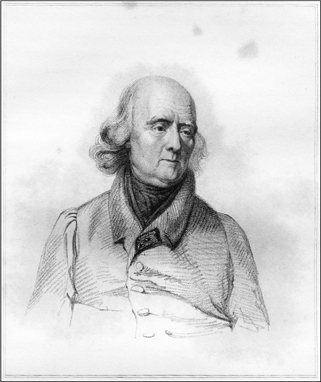
The Abbé Gervais de La Rue, who tipped off Francisque Michel about The Song of Roland
FROM THOMAS FROGNALL DIBDIN, A BIBLIOGRAPHICAL ANTIQUARIAN AND PICTURESQUE TOUR IN FRANCE AND GERMANY (LONDON: ROBERT JENNINGS AND JOHN MAJOR, 1829)
Upon receipt of Francisque Michel’s letter, Minister Guizot consulted his old friend and colleague from the Sorbonne Charles Fauriel, the “father of the renewal of historical studies in nineteenth-century France,” whose assessment was favorable but who reminded the minister in a letter written on June 19, 1833, that M. Michel was not one of the independently wealthy scholars of an earlier age: “Not being able to undertake such a trip with his own resources, he needs to be encouraged by the government.”6Guizot then sent the proposal, mentioning specifically the possibility of learning about the Battle of Hastings and William the Conqueror, to a committee of the Académie des Inscriptions et Belles-Lettres, specialists in Greek, Sanskrit, Arabic, and Chinese, who also approved. Meanwhile, Guizot asked his undersecretary Pierre-Paul Royer- Collard to bring him examples of Michel’s published work, not the manuscript editions but anything that might give some indication of the young man’s character and political beliefs. Royer-Collard fell upon Michel’s review in the Cabinet de Lecture of August 14, 1832, of a PhD thesis, Dissertation sur le Roman de Roncevaux, that had been defended at the Sorbonne only three weeks earlier. Here, Francisque Michel congratulated “the old University for having, for the first time, given up its Greek and Roman banalities.”
Guizot must have thought the young man impertinent, but he must also have recognized that Michel’s attack upon the Sorbonne was just the kind of daring that was needed to build a France equal to the great nations of the past. Nor would it have been easy to resist feeling just a tinge of gleeful satisfaction at the barb aimed at the old “Sorbonnards” who had made his life so difficult during the Restoration.
After a personal interview conducted in the early days of July only a month after receiving the young man’s original letter, on July 24, 1833, François Guizot in the name of the July Monarchy granted the modest sum of 1,000 francs to Francisque Michel for the purpose of “a literary voyage to England.” Guizot dispatched a letter to Charles Maurice de Talleyrand, the French ambassador to London, recommending M. Francisque Michel, “an educated and energetic young man.” Because he was something of a daring freebooter, the minister would keep the scholar on a short leash. He was not at the outset interested in the “Romance of Roncevaux” but ordered, upon Fauriel’s recommendation, that Michel be allowed to copy two historical works, the first being Geoffrey Gaimar’sHistory of the Anglo-Saxon Kings of Great Britain and of the Conquest by William the Conqueror and the second, Benoît de Saint-Maure’s Chronicle of the Dukes of Normandy. In addition, regular reports would be required in order to ensure that the transcription of medieval manuscripts justified the expenditure.
As a young Romantic in a Romantic age, Michel must have realized that times were changing, but he could not have known to what extent the arrival of his letter in the Ministry of Public Instruction was a piece of exquisite timing, how well it coincided with Guizot’s own ideas concerning the study of national, and particularly secular, history. Guizot was aware that the Ministry of Public Instruction had just recently, in 1828, been separated from the Office of Ecclesiastical Affairs. Indeed, he was one of the professors relieved of their teaching duties in the wake of the religious fervor of the Restoration.
Guizot was aware, too, that the rivalry among France, Germany, and England would be played out in part upon the field of historical and literary studies. The Germans found their national epic The Nibelungenlied in the last century, and though Emperor Frederick had scoffed at it at first, hadn’t they used this story of the defeat of the Burgundians by the Huns as a rallying cry after Napoleon defeated them in 1806? Guizot knew that in 1819 the Germans had founded a “Society for research and publication of documents related to ancient Germanic history” and had launched a huge publishing venture, the Monumenta Historiae Germanica, aimed at editing sources, especially medieval texts.
An appeal to the medieval past began very early in Germany, with Friedrich von Schlegel, the Brothers Grimm, and the discovery of the folkloric roots of the free tribes of the ancient German forests. And it continued very late, as seen in Himmler’s attempt to find in the Bayeux Tapestry evidence of the unity of modern Germans, Anglo-Saxons, and Scandinavians in an original Teutonic race.
In the decades following the Napoleonic Wars, the study of philology, which involved the dating, location, and classification of primary medieval texts, was part and parcel of the construction of empire and of German national identity, aided by the resources of the state and uniting the Academies of Berlin, Munich, and Vienna. The establishment of a chair of Romance philology at the newly captured city of Strasbourg in 1872 was a symptom of the proliferation after 1860 of such posts in a country where study of the Middle Ages represented a catalyst to nationalism and a cultural arm in the wars against England and France.
Guizot knew that the Germans were out to use the Middle Ages to show that Germany had existed for longer than its current political disunity would indicate. He realized that any claim to longevity of this type would end in claims of territorial legitimacy. This is why, on June 27, 1833—that is, between the time of Michel’s original request and the government’s positive response—Guizot created the Society for the History of France, a private publishing venture by subscription, for the purpose of encouraging “the study and the appreciation of our national history in the context of healthy criticism, and especially through the search for and the use of original documents.”7 At the end of ten years, the Society for the History of France had four hundred members, and at the end of twenty-five years, it had published seventy tomes, many devoted to the Middle Ages. In 1841, the society brought out five volumes of documents relating to the trials—condemnation and rehabilitation—of Joan of Arc, the heroine of another battle in the centuries-old war with the English.
Guizot sensed that the English were not far behind the Germans. The Society of Antiquaries of London had sent the young Charles Stothard to make drawings of the Bayeux Tapestry, which he carried back with him to Britain. With all their antiquarian societies and clubs, the English had begun to publish Anglo-Saxon historical and literary works. The French might have thought the English naïve for having believed initially that their national epic Beowulf was written in Danish and not the language of England before the Conquest, Anglo-Saxon, but they published it nonetheless in 1815. That was the same year the English and the Prussians defeated the French at Waterloo. In 1833, Beowulf appeared in modern English translation.
Guizot’s project of finding and publishing original source texts continued to fulfill the need felt after the Revolution to examine old documents in order to determine ownership, revenues due, and laws. History as a source of law was a venerated feudal principle of the Old Regime in a world in which family memory served as a source of legitimacy and the exercise of rights. But the question now facing the government was how to transform local, seigneurial, and family archives into a national one. The Institute of France had exercised control over archives under the First Empire and the Restoration. But the old specialists in family history were dying out, and February 22, 1821, saw the royal creation of the École des Chartes, a school for the examination of documents, in order to “revive a type of study indispensable to the glory of France.”
Just as the kings of the Old Regime had found their history in Greece and Rome, and just as Emperor Napoleon had continued the dream of empire, Guizot and Fauriel together felt the need for a national narrative and for a present in which France might hold its own against Germany and Great Britain. In this, the Middle Ages, as the cradle of French civilization, represented a privileged terrain. However, one would have to find there works dealing not with Greek and Roman heroes, but with French aristocratic ladies and knights and with ordinary citizens, the ancestors of the enterprising merchants, lawyers, and bureaucrats who made up France’s “third estate.”
Guizot sought to find in the Middle Ages the origins of the French bourgeoisie, “that is to say,” he wrote in a letter to King Louis-Philippe on November 27, 1834, “the first institutions which worked to free and to raise the nation.”8 Guizot imagined the rapid construction of a tradition that would embody the new France. In November 1833, the order went out to prefects to seek “documents having to do with our national history” in public libraries and departmental archives. A month later, Guizot submitted an increased budget request of 120,000 francs for fiscal 1835 in order to “accomplish the great task of a general publication of all the important and unedited materials having to do with the history of our country” He had proposed editing himself a thirty-volumeCollection of Documents Relative to the History of France from the Foundation of the French Monarchy up to the Thirteenth Century. It was Guizot who transformed Versailles into a national museum.
• • •
Francisque Michel arrived in London at the beginning of September 1833 and immediately fell ill. On September 10, he wrote to Guizot complaining of the cost of living in Great Britain. Guizot, as we know from notes written to his undersecretary Royer-Collard, did not want to send more money until he “had seen work already done.” The suspicious minister demanded, in addition, a letter from an English physician attesting to Michel’s medical condition. But by October 8, Michel had already sent three notebooks of transcriptions and promised ten more each month. On November 8, he wrote to Guizot again protesting a lack of money. He wondered if he might retain the salary earned in France for copying work at the Royal Library in addition to the stipend for copying in British museums, a request Guizot refused. He closed with a reminder that the postage paid by the French government on letters sent to him covered only the route from Paris to Calais and that he had to pay a postage due of 28 francs.
Francisque Michel traveled to England with letters of introduction from Abbé Gervais de La Rue to British scholars, including Francis Douce, keeper of records at the Tower of London. And the English took note even before his arrival. The Gentleman’s Magazine of August 1833 carried an announcement under the column “Foreign Literary Intelligence” that “M. Francisque Michel has been appointed by the Minister of Public Instruction to go to England, for the purpose of inspecting the public libraries and archives and of making notes or copies of everything he may find elucidating the ancient history and literature of France.”
Michel worked assiduously at the British Library, completing the two editions mentioned specifically in the government commission. Guizot’s hesitancy subsided, and his enterprising man in London was put on a regular stipend of 500 francs per month. Meanwhile, Michel made trips to libraries in Cambridge, where he met John Mitchell Kemble, who had translated Beowulf in 1833, and the acclaimed editor, then still a student, Thomas Wright. There is some evidence that Michel might also have met Alfred, Lord Tennyson, and later he published the first French translation of Tennyson’s medieval-inspired Idylls of the King.
The event that was to change the face of French letters and even of the nation took place in Oxford’s Bodleian Library almost two years after the student’s daring letter to the visionary minister. On July 13, 1835, Francisque Michel discovered what he believed to be the poem sung by Taillefer at the Battle of Hastings. “I write to you from the town of Alfred, right near the Bodleian, where I just found… Guess what?” Michel wrote to his former teacher and patron, Louis-Jean-Nicolas Monmerqué. “The Song of Roland!! It’s almost the squaring of the circle” (see insert, figure 2). Monmerqué shared Michel’s letter with Guizot. It was from that moment that France knew for the first time the literary version of Charlemagne’s expedition to Spain in 778, the attack upon his rear guard by pagans, the death of his beloved nephew Roland, and the emperor’s revenge—all of this written in the Old French language at a time when Europe was arguably French.
Michel’s enthusiasm stemmed from the knowledge that France had at last found a national epic to rival the English Beowulf and the German Nibelungenlied. The Song of Roland might serve to direct attention away from ancient and distant civilizations, on the one hand, and away from local provincial histories on the other. The old antiquarians like Pluquet and de La Rue had been interested for the most part in the history of Normandy and of Norman families. Pluquet had emphasized in his edition of Wace’s Roman de Rou its importance for “our Norman history” De La Rue, who had throughout his life lived at the expense of the wealthiest family in Caen, the Mathans, in their Château de Cambes, had promised in his article on Wace that “the genealogist will find many curious and interesting facts relating to ancient families.” Reading the medieval work will, moreover, “furnish any one who may think it worth while to peruse them, with new light upon the history, the government, and the manners and customs of the Normans.”
Michel had little use for the Normans, toward whom he at times showed downright antipathy. In his introduction to Benoît de Saint-Maure’s Chronicle of the Dukes of Normandy, one of the works Guizot had paid for, he describes the bloodthirsty men from the North: “Drawn by the hope of carnage and booty, the Normans, like the bears of their country, swept down from the pole and wanted to take part in the kill; they threw themselves upon the dying, ripped them apart, became intoxicated with their blood; then, satiated, they fell asleep on the breast they had torn apart.”9
For the French, The Song of Roland was a living lesson in patriotism throughout the course of a patriotic century. And if Guizot had been skeptical at first, he was convinced in the end. “The trip of M. Francisque Michel to England,” he wrote in his report to the king in December 1835, “has produced significant results,” and he mentioned specifically not only the Norman chronicles, but The Song of Roland.
Michel was the first to link Roland to the Battle of Hastings, and Roland became France’s Iliad; Roland became France. “The essential character of the epic,” wrote François Génin on the first page of his 1850 edition of Roland, “is greatness joined to naïveté; the virility, the energy of man joined to simplicity, to the innocent grace of a child: it is Homer.” Gaston Paris, the son of the man for whom the chair in medieval studies of which Michel dreamed was created in 1853 and who did more for medieval studies in the second half of the nineteenth century than anyone else, urged on the eve of the Franco-Prussian War that the French should “recognize ourselves as the sons of those who died at Roncevaux and of those who avenged them.”10 Around the same time, his colleague at the Sorbonne Léon Gautier claimed in his 1872 edition of the poem and in clear resonance with the language of the New Testament that Roland is “France made flesh” (“La France faite homme”). “What we should seek,” Gautier prescribed in an 1892 instruction to schoolteachers, “is to read with a vibrating voice and a heart filled with emotion, a translation of our old poem so as to make children admire its simple and profound beauty. We should seize the opportunity of this reading to say to these young Frenchmen: ‘Look, my children, how great France already was and how she was loved more than eight centuries ago.’”11 Paul Lehugeur, lecturing officers at the French military academy in Saint-Cyr, showed how alive the Homeric Roland still was in 1900: “The Song of Roland,” he reminded the general army staff, “is our Iliad.”12
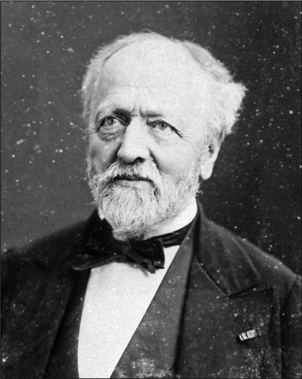
Francisque Michel
PHOTO BY NADAR; © BIBLIOTHÈQUE NATIONAL DE FRANCE
Francisque Michel made many trips to England and Scotland after his discovery of The Song of Roland in 1833. Only one, however, was an official government mission. Prosper Mérimée, the author of Carmen who was also interested in the archaeology of public monuments and served as senator for life and an adviser to Emperor Napoleon III after 1853, dropped a hint. “You could do a good deed,” he goaded Michel, “by publishing something on military equipment. That’s a subject that interests the Emperor and with which he is familiar. I advise you to read his book on artillery, which is excellent…. Believe me, if you have something new to say, you will attract his attention, but keep in mind, he is not interested in erudition. What he wants is to learn something that he doesn’t already know.” In 1863, Michel was sent by the French government to England and Scotland for the purpose of retrieving documents connected to the early history of artillery, recently discovered by him “in the archives of Great Britain.”13
Reacting to the German model of philology, which used the Middle Ages to establish the Germanic roots of France in the Frankish invasions of Gaul and the Germanic roots of England in the Saxon invasions of Britain, both the French and the English pressed the study of medieval documents into national and even military service. Throughout the nineteenth century, the French felt attacked not only by the weapons of war, but by erudition. “With numbers and discipline on their side,” wrote the French historian Fustel de Coulanges in 1872, “the German people show in their scholarship the same qualities as in war. … German historians form an organized army…. One can distinguish the leaders from the soldiers. … Each new recruit enlists in the unit of a master, works with him, remains anonymous for a long time like a private, then becames a captain, and twenty new recruits will work for him…. They march in rank, in regiments, in companies.”14 Léon Gautier blamed the French defeat of 1870 upon their scholarly defects and the German victory upon their “scientific method”: “We face a nation that makes war scientifically, geographically, physically, chemically For the Prussian fights in the same manner as he criticizes a text, with the same precision and the same method.”15 The historian Gabriel Monod, who served in the ambulance corps in the Ardennes in 1870, sensed that the scholarly gap between Germans and French was due to a “lightness” of national character that rendered French soldiers willfully blind and prevented them from fighting effectively.16 In a report on the current state of philological studies presented to the Philological Society of London in 1873, the philologist and editor of texts Paul Meyer complained about the disciplined German scholars who invaded French libraries each spring during school vacations “in the hope of finding a topic for a doctoral dissertation.”17
By the middle of the century, Hippolyte Fourtoul, Louis Napoleon’s first minister of education and a specialist in medieval art, issued a decree “encouraging research which, by drawing the attention of experts towards the ancient and glorious traditions of our country, will raise the spirit of national feeling.”18 Fourtoul established a chair in medieval French language at the Collège de France for Paulin Paris, curator of manuscripts of the Royal Library. Paulin Paris concluded his inaugural lesson with the words “Greetings, then, Messieurs, to our Middle Ages … greetings to the old national muse.” Fourtoul had issued an order in 1856 for the publication of all medieval French literature written before 1328 in sixty volumes of sixty thousand lines each and sent a letter to the scholar in charge of the project, François Guessard, with the exclamation “Publish all, all, ALL” handwritten in the margin.19
Medieval studies flourished in France after the defeat of the Franco-Prussian War of 1870–1871. In the four years between 1876 and 1879, the French government endowed 250 new chairs of literature and history, supported by university libraries.20 Scholars founded journals dedicated to medieval culture: Revue des Langues Romanes (1870), Romania (1872), Revue de Philologie Française et Provençale (1887), Le Moyen Age (1888), and Annales du Midi (1889). The monuments of Old French literature, many found in English libraries, were edited. With the help of the Rothschild family, the greatest medievalist specialists of their time, Gaston Paris and Paul Meyer, founded the Société des Anciens Textes Français. In the decade after the Franco-Prussian War, there occurred another war alongside the territorial dispute over Alsace and Lorraine: the rush to claim—to locate, copy, and publish—medieval works in Old Provençal, the language of the South, and in Old French.
French national interest in the Middle Ages was matched by a revival of medievalism in England. If the French had their Roland, Charlemagne, and Joan of Arc, the English had their legends of Arthur, Robin Hood, and King Alfred. The English and French fought each other intermittently between the middle of the eighteenth and the first decades of the nineteenth centuries, and genuine military encounters were often continued in the form of cultural warfare. After the English, led by Admiral Edward Hawke, destroyed the French fleet in November 1759, Horace Walpole wrote a poem entitled “On the Destruction of the French Navy,” recalling the days of King Arthur. Joseph Wharton’s 1761 poem “To His Royal Highness the Duke of York” features Arthur’s ghost, which praises those willing to fight the French. At the time of the American Revolution, the poet Edward Thomas invoked Arthurian legend to celebrate Admiral George Rodney’s defeat of the French fleet in the Caribbean.21 In the midst of the Napoleonic Wars, Felicia Dorothea Browne denounced the “iron sceptre” of Napoleonic tyranny with an appeal to “Britannia’s heroes,” who “live from age to age! … From doubtful Arthur, hero of romance, / King of the circled board, the spear, the lance.”22 The Napoleonic Wars culminated in the Battle of Waterloo, where the French were defeated by a combined force of Prussians and English, led by the Duke of Wellington, who was in the aftermath adored as “the new Arthur.”
The myth of King Arthur is especially apt, since Arthurian legend was first created in the century after the Norman Conquest. Arthur represented a hero of resistance against the invasion of Britain by the Saxons and a lightning rod of hope that a “once and future king” might return as a liberator from the new oppressors who had come from Norman France. Indeed, for the English the nineteenth century was imagined as a time when England might finally shed “the Norman yoke.”
The Scottish novelist Sir Walter Scott may not have invented the idea of Saxon enslavement, but he did much to popularize it in the historical novel Ivanhoe (1819).
Norman saw on English oak.
On English neck a Norman yoke;
Norman spoon in English dish,
and England ruled as Normans wish;
Blythe world to England never will be more,
Till England’s rid of all the four.
Thus Scott’s serf Wamba reminds his Norman oppressors Front-de-Boeuf and De Bracy of an Anglo-Saxon proverb—Wamba, whose neck is literally ringed by a collar showing his servile status: “Wamba, the son of Witless, is the thrall of Cedric of Rother-wood.”Ivanhoe is set at the end of the twelfth century, yet no one could mistake Sir Walter Scott’s reference, in a novel begun just two years after Waterloo, to contemporaneous struggles going all the way back to 1066:
A circumstance which greatly tended to enhance the tyranny of the nobility and the sufferings of the inferior classes arose from the consequences of the Conquest by Duke William of Normandy. Four generations had not sufficed to blend the hostile blood of the Normans and Anglo-Saxons, or to unite, by common language and mutual interests, two hostile races, one of which still felt the elation of triumph, while the other groaned under all the consequences of defeat. The power had been completely placed in the hands of the Norman nobility by the event of the battle of Hastings, and it had been used, as our histories assure us, with no moderate hand.23
Scott expresses what was already a current idea in seventeenth-and eighteenth-century political debates—the belief in a golden age when the British “lived as free and equal citizens under representative institutions” before the arrival of a foreign king, his oppressive nobles, and religious policies beholden to the pope.24 This “Whig” view of history explains, of course, the appeal of King Arthur, the liberator who actually fought the Saxons. It accounts for the British fascination with the legend of Robin Hood, the Saxon hero, as J. Frederick Hodgetts describes him in the children’s story Edwin, the Boy Outlaw (1887), with “no taint of Norman blood.” Early references to Robin Hood date from the second half of the eighteenth century, and the figure of the rebel against harsh Norman forest laws runs throughout the 1900s.
The free, good Anglo-Saxon and the enslaving Norman oppressor is a literary and historical theme sometimes put to surprising use on both sides of the English Channel. The French historian Augustin Thierry, under the influence of Ivanhoe and under the received notion that Norman-Saxon relations after the Conquest were the source of contemporary social differences, sided with the freedom-loving Saxons against the “Norman usurpers and imposers of feudalism” in what was a liberal and Republican attack upon the British ruling class. Thomas Carlyle used the Saxon-against-Norman motif as a means of raising the “Condition-of-England Question” and of equating the Saxons with ordinary Englishmen as against the upper classes, though his thinking is perhaps more complicated than that of Scott or Thierry For Carlyle, both Saxons and Normans are part of the Teutonic race, Normans being Saxons “who had learned to speak French.”25
In the first volume of his History of England, focused upon the period subsequent to the reign of James II, Thomas Macaulay laments that the Conquest “gave up the whole population to the tyranny of the Norman race.” Macaulay considers English history, dominated until the end of the twelfth century by kings born in France, to have begun in earnest only with the rebellion against King John and the signing of the Magna Carta of 1215, guaranteeing inalienable rights to the barons of England. In the second half of the nineteenth century, E. A. Freeman made the claim, which historians have echoed ever since, that Edward the Confessor, who had spent eighteen years in exile in France, brought back with him a preference for all things Norman and thus contaminated the “free Teutonic spirit” with “Norman vice.” The Normans or the French, Freeman believed, were Catholic, dishonest, and decadent and had disturbed the peace of Europe ever since. Curiously, this is exactly what French historian Jules Michelet thought of the English, which was not without its benefits. It was by hating England, Michelet believed, that France became France.26
Though England and France were allies in the Crimean War (1854–1856), that enterprise ended finally in discord between the two. And when it came to the Franco-Prussian War of 1870–1871, many English liberals rejoiced at Prussia’s victory over Napoleon Bonaparte’s nephew Louis Napoleon, who had fled to London in 1840 after trying to topple the Orleanist monarchy and had returned as emperor in 1848. They saw in Prussia a fellow Germanic people with an enemy in common in the French. “The war on the part of Germany is, in truth, a vigorous setting forth of the historical truth that the Rhine is, and always has been, a German river,” E. A. Freeman wrote.
As a Hanoverian, Queen Victoria shared in the Germanic tradition inimical to France. Victoria’s mother was the sister of Leopold, Duke of Saxony, and her husband, Albert, was the son of the Duke of Saxe-Coburg-Gotha. All of their children married either Germans or Scandinavians. Victoria and Albert named their second son Alfred, and no monarch before or after Victoria participated more fully in the tradition of the most celebrated and steadfast Saxon king—Alfred.
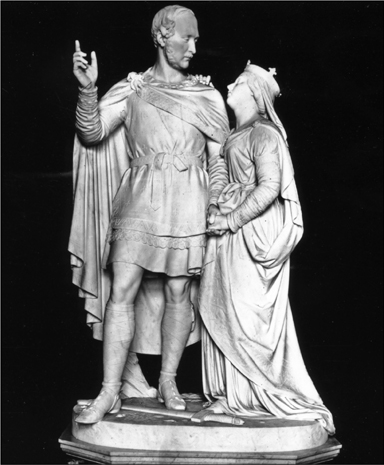
Statue of Queen Victoria and Prince Albert in Saxon garb
THE ROYAL COLLECTION © 2006 HER MAJESTY QUEEN ELIZABETH II
With grave utterance and majestic mien
She with her eighteen summers filled the Throne
Where Alfred sate: a girl, withal a Queen,
Aloft, alone!
Thus the poet laureate Alfred Austin, in “England’s Darling,” read at the diamond jubilee celebration in 1897, commemorated Victoria’s coronation. Though she died on January 22, 1901, Victoria’s reign was to have culminated in millenary celebrations of Alfred’s death in 901. Bishop Creighton of London in The King Alfred Millenary claims that the English “might surely feel proud to consider it an absolute fact that our history had gone on since the days of Alfred till now, and that the sign and token of it was that the blood of Alfred still ran in the veins of her most Gracious Majesty Queen Victoria.”
The return to Saxon roots was nowhere more evident than in the growth of Anglo-Saxon studies, which worked to establish a connection between the inhabitants of Britain before the Norman Conquest and the British Empire on which the sun never sets. Thomas Arnold, who became Regius Professor of Modern History at Oxford in 1841, just four years after Victoria’s coronation, insisted that “we, this great English nation, whose race and language are now overruning the earth from one end of it to the other,—we were born when the white horse of the Saxons had established his dominion from the Tweed to the Tamar…. So far our national identity extends, so far history is modern, for it treats of a life which was then, and is not yet extinguished.”27
Just as the French encouraged the publication of original source texts in Old French, the English sought to make the historical and literary monuments of the Anglo-Saxon world available to a wider public. The antiquarian movement in England spread its interest in old ballads to other works, beginning with the Roxburghe Club, founded in 1812, its members responsible for furnishing reprints of “some rare old tract or composition.” The Camden Society was founded in 1838, the Early English Text Society in 1864, with the goal, according to its spearhead, Frederick Furnivall, of a printing “in accessible form of all the English Romances relating to Arthur and his Knights.” Furnivall’s effort was the culmination of the impetus, begun in the previous century, to claim Arthurian literature as an indigenous British phenomenon rather than simply a translation from the French. In all, some twenty-nine historical societies were founded between 1834 and 1849.28 Unlike the governments of Germany and France, however, it was not until 1858 that the British leadership became directly involved in publishing works found in state collections, beginning with the Rolls Series.
The publication of Anglo-Saxon works had begun before the arrival of Francisque Michel in London in 1833, yet his hand is to be seen even there. In the report delivered to the minister of public instruction upon his return to France in 1835, Michel mentions that he has compiled along with John Mitchell Kemble “a catalogue of all the works in Anglo-Saxon and in Gothic that I have found in the course of my research.” And in the introduction to that catalog, Kemble calls for the English to catch up with the Germans in the science of the study of manuscripts.
The publication of original works was synonymous with an inventory stock of Anglo-Saxon and English as a national tongue. The Reverend Thomas Dale became Britain’s first professor of the English language and literature when he was appointed in 1828 to a chair at University College, London. Other universities followed suit. The Oxford English Dictionary project, begun in 1842 and not completed until 1920, was more than just a dictionary. It was a virtual inventory—a census—of all the uses of all the words in English from their beginnings to the present. Around the middle of the nineteenth century the British took stock of their language as a form of cultural property indistinguishable from patriotic sentiment. “The love of our own language, what is it in fact but the love of our country expressing itself in one particular direction?” asked the Victorian philologist Robert Chevenix Trench in 1855.
At its outer limit, the question of linguistic origins became wrapped in race. “The grammar, the blood and soul of the language,” claimed Max Müller in a series of lectures delivered at the Royal Institution of London in 1861, “is as pure and unmixed in English as spoken in the British Isles as it was when spoken on the shores of the German ocean by the Angles, Saxons, and Jutes of the continent.”
The great conduit of language and literature from the Anglo-Saxons to the English race was Thomas Malory, who was the first, as S. Humphreys Gurteen asserts late in the century, to revive “the good old Saxon” tongue and thus to cast off the Norman linguistic yoke. In Malory, the English found their own. Le Morte d’Arthur was the beginning of a process of “reversing the Conquest,” in the phrase of Claire Simmons. As the first author of an Arthurian masterpiece, a “master in the telling use of Saxon speech,” Malory “took the volumes in existence… as a weaver takes his skeins, and, using his pen as his shuttle, wove out of them a history of his ‘Round Table,’ as Matilda and her maidens pictured the story of the Conquest in the tapestry of Bayeux.”29 Thus, Frederick Dixon uses the metaphor of weaving to express the essential link between the free Anglo-Saxons before the Conquest and Malory, a link completed among the Victorians in what came to be known as the opus anglicanum, needlework reviving a much older medieval tradition. “The woman who sews now, sews more beautifully, turning out work more equal to that of her ancestress, the Anglo-Saxon lady,” Sir Walter Besant reminds us at the time of Victoria’s jubilee in what became a commonplace of the age.30
Given the patriotic purpose to which medieval documents and monuments were put, it is no surprise that interest in the Bayeux Tapestry coincided with the growth of rivalry among European states. Almost as soon as the Enlightenment ideals of universal man and common humanity came into being, they were countered by a turning toward medieval history as opposed to the universalizing Greco-Roman past. The Middle Ages were still visible in the French and English countryside in the form of buildings and monuments, whatever their state of ruin. Beginning with the Romantics, the “cult of ruins,” and especially old churches, provided what the French poet Chateaubriand termed the “moralization of landscape” in the “midst of scenes of nature,” and Victor Hugo, the “vestiges of races past and the sacred bed of a dried river.”31 Alongside the architectural presence of the medieval past, manuscripts were still to be found in church libraries and in castles. As the patriotic study of the Middle Ages grew after 1789, it came to constitute an important element of what made England England and what made France France.
The rivalry between England and France that motivated Francisque Michel to find and publish the actual poem sung on the morning of the Norman Conquest is written into almost all understandings of the Bayeux Tapestry from the time of its discovery until the present—that is, the attempt to determine when, where, by whom, for whom, and for what purpose it was made as a way of determining whether the first Anglo-Norman work of art is English or French. The two most significant scholarly contributions of the end of the last century, which subsume all the rest, participate no less in the will to ascribe the Tapestry to a nation-state. “There is general agreement that it was made in England within a generation of 1066,” writes David Bernstein in his extraordinary Mystery of the Bayeux Tapestry (1986). Wolfgang Grape refutes Bernstein’s conclusions in his equally extraordinary The Bayeux Tapestry: Monument to a Norman Triumph (1994): “If we review all the analogies suggested to date, assess the historical evidence and weigh the balance of probability throughout, only one conclusion is possible. The Bayeux Tapestry is a Norman work, probably worked in the 1070s and made in Bayeux.”
Whether the Bayeux Tapestry is English or French is much more deeply rooted in the national rivalries of the nineteenth century, setting Germany and England against France, than in the reality of medieval perceptions and events. Extending the famous dictum of Carl von Clausewitz (1780–1831), according to which “war is a continuation of political relations by other means,” to read “scholarship is a continuation of war by other means,” we understand the attempt to locate the Tapestry’s manufacture on one side of the English Channel or the other alongside the publication of founding epic works like The Song of Roland, the Nibelungenlied, and Beowulf the rise of academic medieval studies, and the uses and abuses of popular literature connected to medieval legends in the complex building of nation-states. In the nationalistic rivalry between Great Britain and France, the Tapestry occupies pride of place.
The Bayeux Tapestry is special, first and foremost, because it is the only one of its kind. There are more than a hundred epic songs extolling the courage in the Crusades and in local skirmishes of the medieval warriors of England and France, but only one pictorial narrative of the great Norman Conquest. Images resembling those of the Tapestry are to be found in other artistic media, sculpture, murals, and manuscripts, but not in large hangings or weavings. The textiles that can be compared to the Tapestry are of a later date.
The Tapestry is also special because, unlike massive archaeological or architectural monuments, it is both prodigious and portable. William may have brought the stones for many of the building projects undertaken in England after the Conquest from the other side of the Channel, but once built, they remained in place. Though one may wonder how the monoliths of Stonehenge might have been hoisted so high, no one argues that they were brought to their present location from somewhere else. Manuscripts, coins, ornamental objects, furniture, textiles, and the Tapestry, of course, are different. They circulated—in trade, in war, in diplomatic and domestic exchange. When Europe woke to the Middle Ages, many were discovered in spots distant from the place of their making.
The movement of cultural objects between the British Isles and France is particularly fluid. Between the Conquest of 1066 and the French recapture of Normandy in 1203–1204, they were one country, and the traffic in goods and artifacts never ceased. Many of the literary and historical documents in Old French are, like Roland, still found in British libraries and museums. If the Tapestry was made in England, as many believe, how did it end up in France? How did what began as the unquestionably English King William’s Cloth or Queen Mathilda’s Tapestry become the French Tapisserie de Bayeux? Was its ultimate destination, as has been suggested, Bishop Odo’s palace in Rome, where it would take its place among the great Roman triumphal columns and friezes? The debate over provenance, the Tapestry’s status as a religious or a secular object, the question of who commissioned it, and where and when it was actually made are wrapped in national claims, in what was at the time of the Tapestry’s discovery a true territorial dispute.