
SECTION I: Multiple-Choice Questions
DO NOT OPEN THIS BOOKLET UNTIL YOU ARE TOLD TO DO SO.
At a Glance
Total Time
55 minutes
Number of Questions 70
Percent of Total Grade 50%
Writing Instrument
Pencil required
Instructions
Section I of this examination contains 70 multiple-choice questions. Fill in only the ovals for numbers 1 through 70 on your answer sheet.
Indicate all of your answers to the multiple-choice questions on the answer sheet. No credit will be given for anything written in this exam booklet, but you may use the booklet for notes or scratch work. After you have decided which of the suggested answers is best, completely fill in the corresponding oval on the answer sheet. Give only one answer to each question. If you change an answer, be sure that the previous mark is erased completely. Here is a sample question and answer.
Sample Question
Chicago is a
(A) state
(B) city
(C) country
(D) continent
Sample Answer

Use your time effectively, working as quickly as you can without losing accuracy. Do not spend too much time on any one question. Go on to other questions and come back to the ones you have not answered if you have time. It is not expected that everyone will know the answers to all the multiple-choice questions.
About Guessing
Many candidates wonder whether or not to guess the answers to questions about which they are not certain. Multiple choice scores are based on the number of questions answered correctly. Points are not deducted for incorrect answers, and no points are awarded for unanswered questions. Because points are not deducted for incorrect answers, you are encouraged to answer all multiple-choice questions. On any questions you do not know the answer to, you should eliminate as many choices as you can, and then select the best answer among the remaining choices.
WORLD HISTORY
SECTION I Time—55 minutes 70 Questions
Directions: Each of the questions or incomplete statements below is followed by four suggested answers or completions. Select the one that is best in each case and then fill in the corresponding oval on the answer sheet.
Note: This examination uses the chronological designations B.C.E. (before the common era) and C.E. (common era). These labels correspond to b.c. (before Christ) and a.d. (anno Domini), which are used in some world history textbooks.
1. Before 800 B.C.E. Indo-European steppe tribes were different from Chinese, Indian, and Middle Eastern societies in which of these ways?
(A) Steppe societies were more likely to have built architectural monuments with religious symbolism.
(B) Indo-European societies were ruled by oligarchies, while the other societies were governed by monarchies.
(C) Indo-European tribes did not develop a common religion on which to base social bonds.
(D) Chinese, Indian, and Middle Eastern societies formed permanent settlements with wealth based on land.
2. A major factor in the spread of Eastern Orthodoxy was
(A) the Mongol invasions of the Balkans and Kiev Russia
(B) the development of the Cyrillic alphabet
(C) the use of icons and symbols in religious ceremonies
(D) integration of folk customs and practices into religious doctrine
3. During the Medieval period, the dominant ethnic group in Eastern Europe was the
(A) Vikings
(B) Slavs
(C) Normans
(D) Russians
4. A cultural civil war in Rwanda in 1994 led to the genocide of millions of people from which of the following ethnic groups?
(A) |
Hutus |
(B) |
Zulus |
(C) |
Tutsis |
(D) |
Pashtuns |
5. Feudal states arose in both Europe and China directly as a result of
(A) the decline of the Roman and Byzantine Empires
(B) the fragmentation of central government units
(C) poor living and unsanitary conditions in larger towns and cities
(D) economic changes brought about by new technologies
6. Which of the following was NOT a result of the Opium Wars?
(A) Chinese port cities were open to foreign trade and Britain took possession of Hong Kong.
(B) Lower tariffs were set on goods manufactured in Western nations.
(C) Churches were permitted in port cities and Christian missionaries could travel freely within China.
(D) China was able to successfully end the importation and sale of opium.
7. Feudalism and manorialism were different in which of the following ways?
(A) Trade and commerce were more important in the feudal system.
(B) Feudalism was a political system while manorialism was an economic system.
(C) Advances in agricultural technology had a more positive impact on feudalism than on manorialism.
(D) While feudalism involved the exchange of military services, only manorialism involved a social hierarchy.
8. “People send to one another to know if any of their family has a mind to have the small-pox; they make parties for this purpose, and ... the old woman comes with a nut-shell full of the matter of the best sort of smallpox, and asks what vein you please to have opened.”
Source: Lady Mary Wortley Montagu, Smallpox Vaccine in Turkey, written while on a trip with her husband, the British Ambassador to the Ottoman Empire, 1717.
The medical procedure Lady Montagu witnessed in the Ottoman Empire led to which of the following medical advances?
(A) The use of leeches to remove toxins from patients’ bloodstreams
(B) The use of live viruses in preventing contagious diseases
(C) The advent of the Hippocratic Oath
(D) The ability of nurses, not just doctors, to administer vaccines and injections
9. The split between Sunni and Shi’a Muslims occurred as a result of
(A) divergent interpretations of religious texts
(B) conflict over the translation of liturgy into native languages
(C) disagreement over leadership succession issues
(D) a rift between more fundamentalist and more liberal branches of Islam
10. Which of the following nations is NOT a declared nuclear state?
(A) People’s Republic of China
(B) Great Britain
(C) France
(D) Argentina
11. The Eastern Question concerned
(A) how European nations would fairly partition the continent of Africa
(B) the manner in which Prussia, Austria, and the Ottoman Empire would maintain the balance of power in Europe
(C) the opening of port cities in China, Japan, and Korea to foreign trade
(D) how to fill the void left by the decline of the Ottoman Empire
12. The reasons for intense imperialism among European nations included all of the following EXCEPT
(A) industrialization generated the demand for new sources of raw materials
(B) the military need to establish strategic bases around the world
(C) there was a belief in the racial superiority of Europeans
(D) population decline in European nations required new sources of labor
13. Which of the following statements about slavery in the pre-modern world is NOT accurate?
(A) In Greece, slaves were most often foreigners or prisoners of war.
(B) In the Islamic world, slaves of kings could rise to high-level positions.
(C) All pre-modern societies except those in India and China traded slave labor.
(D) Slavery was not always a lifetime commitment, and many slaves were taken as prisoners of war.
14. One major difference between the Inca and the Aztec civilizations was
(A) while the Inca were agrarian, the Aztecs were nomadic
(B) the Aztecs built religious monuments while the Inca did not
(C) Incans were monotheistic while the Aztecs worshipped many gods
(D) the Aztec developed a system of writing while the Inca did not
15. Which of the following resulted from to revolutionary movements in Latin American colonies?
(A) Social inequality continued to exist.
(B) Key industries were nationalized.
(C) Widespread economic reforms were instituted.
(D) Representative democracies were formed.
16. The changes that took place in Russia in the 1990s demonstrated
(A) that modernization is a requirement for long-term social and political stability
(B) that cultural and ethnic differences between segments of the population will undermine attempts at nationalism
(C) that there are inherent problems in an economy governed through central planning
(D) that the development of a substantial middle class can bring about political change
17. The Columbian Exchange involved which of the following?
(A) Sugarcane from Europe; olive trees from the Caribbean
(B) Peanuts from South America; rice from Africa
(C) Pigs from South America; coffee from Europe
(D) Sheep from Europe; slaves from North America
18. One key difference between the Ottoman Empire and the Tokugawa Shogunate was that
(A) while the Ottoman Empire established Christianity as its state religion, the Tokugawa banned Catholicism
(B) the Tokugawa Shogunate governed over a decentralized, feudalistic system while the Ottomans were able to centralize and govern using a neo-Confucianism model
(C) the Ottoman Empire was less interested in expansionism than the Tokugawa Shogunate
(D) the Tokugawa Shogunate was less influenced by other cultures than the Ottoman Empire was
19. The three major mercantile city-states in medieval Italy were
(A) Genoa, Sicily, Rome
(B) Rome, Sicily, Pisa
(C) Genoa, Pisa, Venice
(D) Vienna, Genoa, Rome
20. Why was the League of Nations a failure?
(A) Nations were reluctant to join and support the league.
(B) The United States was given too much power in the decision-making of the organization.
(C) It lacked the monetary means to effect real change in the world.
(D) It established biased and unacceptable standards of fairness and international conduct.
21. Which of the following is NOT an accurate statement about Confucianism?
(A) The ethical system is primarily concerned with relationships.
(B) Specific duties are tied to one’s status in society.
(C) It prescribes the correct organization of the state to achieve the maximum benefits for the most members of society.
(D) Only those who are devout and lead moral lives will be saved.
The Cold War 1960-1991
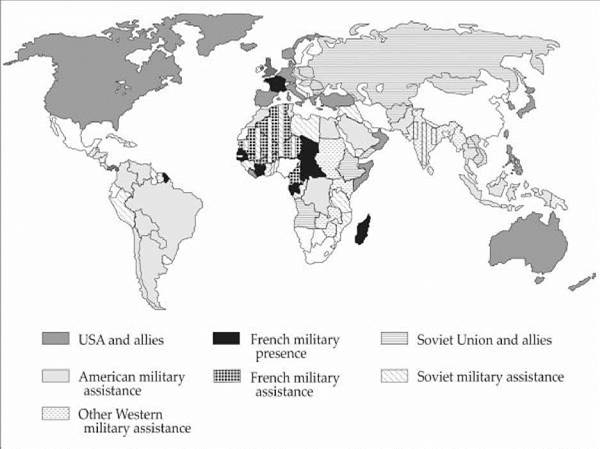
22. Which of the following statements about the information in the above map is accurate?
(A) The Soviet Union was the primary source of military aid throughout South and Central America.
(B) During the Cold War, England played a greater role in African politics than the United States or the Soviet Union.
(C) United States military aid had little impact on Western European political structure.
(D) China maintained a military presence in southern African nations during the Cold War.
23. Which of these was NOT an outcome of the Bronze Age?
(A) The rise of an aristocratic military class
(B) The fall of centralized governments
(C) Additional outlets for artistic expression
(D) Advances in seafaring technology
24. Which of these is a true statement about Mongol invasions between 1100 and 1500 C.E. ?
(A) While Mongols were able to convert Russia to Islam, they failed to spread Muslim beliefs throughout India.
(B) Mongols adopted elements of Chinese culture, which were then spread to other parts of Asia.
(C) Mongol invasions were successful in China and Japan, but unsuccessful in Korea.
(D) Mongol rule in Russia helped build a peaceful society based on Russian traditions.
25. In the 1100s, manorialism began to end in European nations for all of the following reasons EXCEPT
(A) the development of a money-based economy
(B) the formation of towns and cities
(C) peasant rebellions against nobles
(D) severe floods that destroyed fields and crops
26. Which of the following is an example of cultural synthesis?
(A) Translation of the Bible into French
(B) The tea ceremony in Japan
(C) Construction of galleons by the Spaniards
(D) Papermaking in China
27. Which of the following is NOT an accurate statement about British rule in India?
(A) British rule led to the modernization of India’s infrastructure.
(B) India’s cotton market declined due to the mercantilist practices of the British East India Company.
(C) The caste system was not eliminated with the introduction of Western culture.
(D) The Sepoy Rebellion of 1857 was successful in ousting the British from India.
28. Which advancement from the Scientific Revolution is matched correctly with its inventor?
(A) Morgagni: philosophy
(B) Copernicus: chemistry
(C) Newton: physics
(D) Kepler: botany
29. In the mid-1300s, Mansa Musa created a strong centralized Islamic government in
(A) Kush
(B) Ethiopia
(C) Axum
(D) Mali
30. The Hague was originally created to
(A) administer Scandinavian bureaucracy
(B) resolve regional differences among Austria, Prussia, and Russia
(C) regulate the trade activities of Dutch merchant and craft guilds
(D) handle the foreign affairs of the Netherlands’ provinces
31. Which of the following statements illustrates the difference between English and Portuguese colonization efforts?
(A) England generally governed its territories in a less invasive fashion than Portugal did.
(B) While Portugal introduced the concept of monoculture in its African colonies, England was less concerned with exploiting natural resources.
(C) Portuguese territories were limited to Africa and Asia, while England held more colonies around the world.
(D) While English colonies depended on slaves for agricultural labor, Portugal relied on native populations to work on plantations.
32. Which of the following is NOT a true statement about the Holy Roman Empire?
(A) The empire did not have one common language or nationality.
(B) The empire granted citizenship to men in some conquered territories.
(C) The empire had a decentralized government with strong local autonomy.
(D) The empire split into Germany, Austria, and Italy in the late 1300s.
33. A slave insurrection in 1791 and inspiration from the French Revolution ultimately led to the independence of which of the following in 1804?
(A) Mexico
(B) Haiti
(C) Brazil
(D) Chile
Japan in Corea
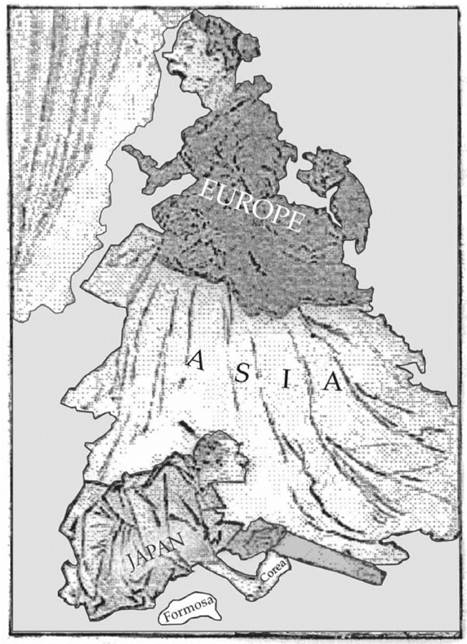
Japan—“Does It Hurt Up There?”
34. The main idea of this cartoon is that
(A) Japan was becoming a stronger player in expansionism and imperialism in Asia
(B) European colonialism was destroying Asian nations and cultures one piece at a time
(C) Japan was content to accept smaller nations like Formosa, leaving the larger Asian nations for European colonialism
(D) Japanese colonialism was aimed primarily at southern Asia, while European nations focused on central and northern Asia
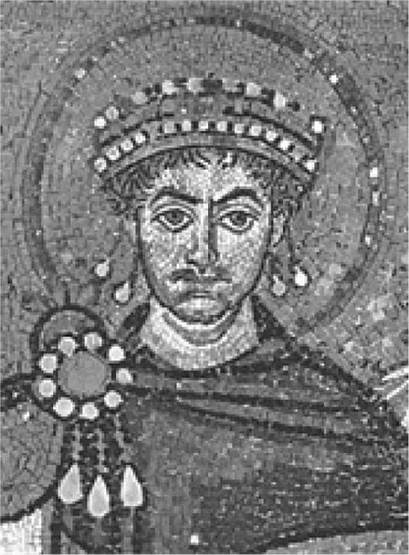
35. The above image exhibits Justinian during his reign. Which of the following was a key contribution from Justinian’s reign?
(A) Codification of Roman law after the fall of the Roman Empire
(B) Resurgence of the Roman Empire in the 6th century C.E.
(C) Religious tolerance of the Muslim faith
(D) Reconciliation of Eastern Orthodox and Roman Catholic faiths
36. It is thought that early Bantu migrations circa 1000 B.C.E. through Africa were caused by
(A) growth in the African slave trade, which caused people to migrate farther inland and south
(B) establishment of trade routes along coastal west Africa, which created more routes by which to migrate
(C) environmental changes, which disturbed the ecosystem people relied on for hunting, gathering, and farming
(D) advances in gold and salt mining technologies and improved transportation routes to Mali and Ghana
37. After the fall of the Han Dynasty in China, religion in China was influenced by a large number of religious sects. Which of the following had the greatest impact on religion in China?
(A) Islam
(B) Zoroastrianism
(C) Hinduism
(D) Buddhism
38. Prior to the fall of the Berlin Wall and the reunification of Germany, West Germany and East Germany were
(A) democratic and communist, respectively.
(B) both communist.
(C) communist and democratic, respectively.
(D) both democratic.
39. A major difference between industrialization in England and Japan was that
(A) while England had a well-developed rail system, Japan depended on water transportation
(B) Japan was more dependent than England on foreign imports to establish and operate industrial facilities
(C) working conditions were better in Japan than in England
(D) class tensions between workers and owners were an issue in England but not in Japan
40. Which of the following is the correct chronological order of events from earliest to most recent during the French Revolution?
(A) Formation of the National Assembly, Storming of the Bastille, Execution of Louis XVI, Adoption of the Declaration of the Rights of Man
(B) Formation of the National Assembly, Storming of the Bastille, Adoption of the Declaration of the Rights of Man, Execution of Louis XVI
(C) Storming of the Bastille, Formation of the National Assembly, Execution of Louis XVI, Adoption of the Declaration of the Rights of Man
(D) Execution of Louis XVI, Adoption of the Declaration of the Rights of Man, Formation of the National Assembly, Storming of the Bastille
41. Japanese feudal society comprised all of the following positions EXCEPT
(A) shinto
(B) shogun
(C) samurai
(D) taikun
42. Overt syncretism is an essential feature of which of these religions?
(A) Legalism
(B) Greek paganism
(C) Christianity
(D) Judaism
Jewish Immigration to Poland-Lithuania until 1600
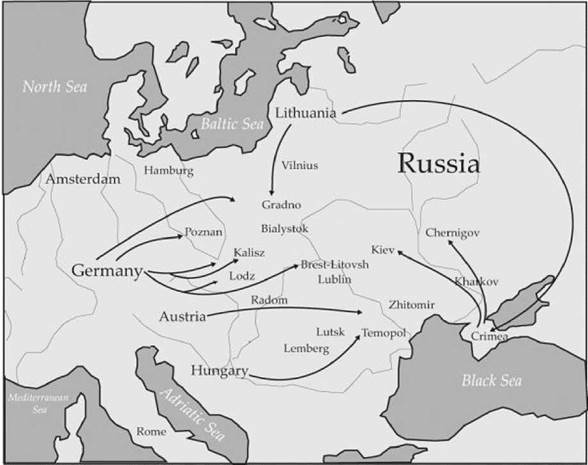
43. The primary catalyst for the Jewish migrations from Germany, Hungary, and Crimea was probably
(A) the impact of the Crusades on Jewish settlements in eastern Europe
(B) more tolerant policies towards immigrants and minorities in Poland and Russia
(C) the Ottoman Empire’s expansionist policies in western European and Mediterranean lands
(D) the development of pogroms and the establishment of ghettos where Jewish people were forcibly sent to live
44. Which of these scientific and cultural achievements are INCORRECTLY matched with the civilization in which they developed?
(A) Cyrillic alphabet and engineering: Rome
(B) Poetry and algebra: Islam
(C) Astronomy and the idea of zero: Maya
(D) Geometry and drama: Greece
45. Which of the following did NOT play a role in the Crusades?
(A) Militaristic and expansionistic European monarchies
(B) The promise of salvation to Christian crusaders
(C) The desire of nobility to become more involved in trade
(D) The establishment of a Jewish state in Palestine
46. The Renaissance did not have a great impact on Spain because
(A) language differences prevented the spread of Renaissance thinking
(B) Spain was geographically isolated from other parts of Europe
(C) the Spanish government strictly censored humanistic ideas and writers
(D) Islamic influence in Spain prevented the adoption of many of the art forms of the Renaissance
47. Which of the following accurately describes what Churchill called the Iron Curtain?
(A) The boundary between the Eastern and Western bloc nations during the cold war.
(B) The wave of military conquest of Nazi Germany prior to British involvement in the conflict.
(C) The spread of industrialization into Eastern Europe following World War II.
(D) The coalition of communist states following World War II.
48. The ability of developing nations to establish stable economies is compromised by all of the following EXCEPT
(A) problems attracting foreign investment and multinational corporations
(B) cultural, tribal, and ethnic differences that threaten political stability
(C) the inability to attract a sufficient workforce to urban areas
(D) unstable currency and unmitigated inflation
49. By 1914, which of the following remained an independent nation in subSaharan Africa?
(A) Egypt
(B) South Africa
(C) Ethiopia
(D) Congo
50. The Monroe Doctrine was significant because
(A) it declared the Americas off limits to European imperialist powers.
(B) it provided financial support to re-establish Europe following the defeat of Napoleon in 1815.
(C) it provided the United States with the French Louisiana territory greatly expanding its territorial possessions.
(D) it stated that the United States would intervene in disputes between Europe and nations of the Americas in order to maintain peace.
51. Which of the following statements about the slave trade between 1450 and 1750 is NOT true?
(A) New ethnic and racial categories grew as a result of contact among Europeans, Africans, and Native Americans.
(B) In some African nations, slavery strengthened existing monarchies.
(C) New crops and agricultural technology improved the diet and health of Africans.
(D) By the late 1700s, the slave trade had been abolished in Asian and Islamic nations.
52. African goods traded on the Trans-Saharan Route included
(A) tea and cloth
(B) tea and gold
(C) salt and gold
(D) rice and sugarcane
53. All of the following were features common to the success of early nationstates in Europe EXCEPT
(A) a common language
(B) geographically distinct territory
(C) a set of common laws
(D) a feudal system
54. Roman law was most significant for which of the following reasons?
(A) It was the first set of laws written down for easy transmission.
(B) It was arranged systematically for easy reference.
(C) It was a combination of Roman law and foreign law.
(D) It served as the basis for laws in Western Europe after the Roman Empire vanished.
55. “The ordinary means therefore to increase our wealth and treasure is by Foreign Trade, wherein wee must ever observe this rule; to sell more to strangers yearly than wee consume of theirs in value.”
Source: Thomas Mun, England’s Treasures by Foreign Trade, c. 1630.
Thomas Mun’s observations are consistent with
(A) laissez-faire economics
(B) colonialism policies
(C) mercantilism policies
(D) manorialism economics
56. The most important impact of the demilitarization of Japan after World War II was the
(A) restoration of the Meiji Empire and a return to a more traditional society
(B) reassignment of Japan’s colonies to the United States
(C) ability to devote a significant share of Japan’s budget to industrialization
(D) sudden lack of resources to deal with nuclear fallout
57. The only nation that did NOT engage in mercantilism during the 1600s and 1700s was
(A) Portugal
(B) Italy
(C) Spain
(D) England
58. Which of these statements about women’s rights before 800 C.E. is accurate?
(A) Hindu law and custom extended property rights to women in the upper castes only.
(B) Confucianism gave women a limited role; however, they could become members of the meritocracy.
(C) Women in the Jewish faith were allowed to hold positions in the religious hierarchy, but they could not own land or divorce.
(D) According to Islamic law, women could own property, inherit belongings, and have dowries.
59. During the Middle Ages, in which of these societies did invasion and migration NOT play a significant role in social, cultural, and economic change?
(A) Great Zimbabwe
(B) Byzantium
(C) Kievan Russia
(D) Song China
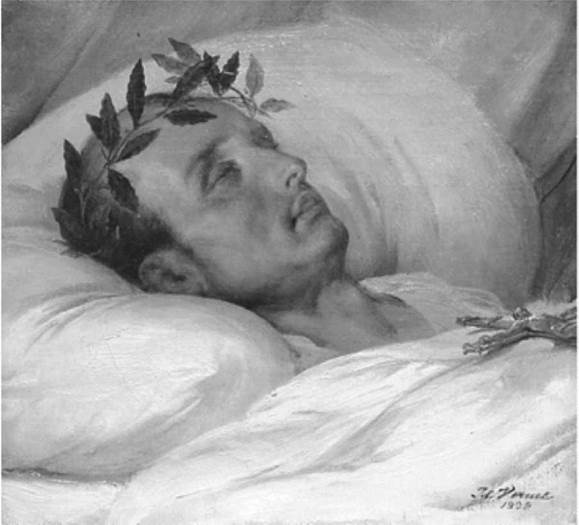
Napoleon su son lit de mort by Horace Vernet (1826)
60. The image above depicts an artist’s rendition of Napoleon on his deathbed wearing a crown reminiscent of the leaders of Roman Empire. All of the following represent similarities between Napoleon’s French Empire and the Roman Empire EXCEPT
(A) Both were ruled by emperors
(B) Both ultimately fell due to inability to control their vast territories
(C) Both relied on the power of a strong military
(D) Both were ultimately absorbed by conquering peoples
61. The Neolithic Revolution was characterized by the
(A) change from nomadic herding to settled farming
(B) growth of iron toolmaking technology
(C) migration of early peoples to the Americas
(D) decline of the Roman Empire
62. In which of these nations was the Truman Doctrine first put to use?
(A) Turkey and Czechoslovakia
(B) Poland and West Germany
(C) Yugoslavia and Turkey
(D) Greece and Turkey
63. The Franco-Prussian war (1870) was significant for all of the following reasons EXCEPT
(A) it established France as the leading power in Central Europe
(B) it established Prussia as the leading power in Central Europe
(C) it helped consolidate and unify the Germanic states into a single empire
(D) it demonstrated the superiority of Prussian training and leadership
64. The English Bill of Rights of 1689 contained all of the following provisions EXCEPT
(A) the king could not maintain an army without Parliamentary approval
(B) only members of the Protestant church could rule England
(C) people had the right to petition the king to redress grievances
(D) jury trials were guaranteed to accused criminals
65. In The Communist Manifesto, Karl Marx outlined how he believed a communist revolution should proceed and what results would be produced. In which of the following ways did the Russian Revolution NOT fit Marx’s model?
(A) The Russian Revolution involved less violence and took far less time than Marx had envisioned.
(B) Russia was less industrialized than Marx believed was necessary for revolution to occur.
(C) The Russian Revolution involved far more bourgeoisie and elite citizens than Marx had predicted.
(D) Marx thought that women had little to contribute to the success of communism, but they were more involved in the revolution and received more benefit from it than Marx had predicted.
66. The primary goal of the Meiji Restoration was to
(A) diminish the power of the shogun and the samurai
(B) isolate itself from foreign influences
(C) liberalize civil and criminal legal codes
(D) increase agricultural and industrial productivity
67. Which of the following statements about Europe during the period 1450 to 1750 is the LEAST accurate?
(A) Political stability brought economic growth that fueled advances in the arts and sciences.
(B) While European nations were successful at exploration and exploitation in the western hemisphere, little colonization occurred elsewhere.
(C) Europeans benefited from contact and exchange with other civilizations more than other civilizations benefited from contact with Europeans.
(D) While more women had the opportunity to be educated, most Enlightenment ideas about freedom and equality were not applied to women.
68. The foundation of ancient Indian civilization is best described by all of the following EXCEPT
(A) reincarnation
(B) the Dao
(C) caste
(D) karma
69. “I content that we are the first race in the world and that the more of the world we inhabit the better it is for the human race ... I content that every acre added to our territory provides for the birth of more of the English race, who otherwise would not be brought into existence.”
Source: Cecil Rhodes, A Plague of Europeans: Westerners in Africa Since the Fifteenth Century.
Cecil Rhodes’s statement is consistent with which of the following?
(A) Laissez-faire economics
(B) Manifest destiny
(C) Liberalism
(D) Social Darwinism
70. The civilizations of the Sumerians, the Phoenicians, and the Maya were similar in that each
(A) developed extensive writing systems
(B) emphasized equality in education
(C) established monotheistic religions
(D) encouraged democratic governments
WORLD HISTORY
SECTION II
You will have 10 minutes to read the contents of this green insert. You are advised to spend most of the 10 minutes analyzing the documents and planning your answer for the document-based question essay in Part A. You may make notes in this green insert. At the end of the 10-minute period, you will be told to break the seal on the pink free- response booklet and to begin writing your answers on the lined pages of the booklet. Do not break the seal on the pink booklet until you are told to do so. Suggested writing time is 40 minutes for the document-based essay question in Part A and 40 minutes for each of the essay questions in Part B and Part C.
BE SURE TO MANAGE YOUR TIME CAREFULLY.
Write your answers in the pink booklet with a pen. The green insert may be used for reference and/or scratchwork as you answer the free-response questions, but no credit will be given for the work shown in the green insert.
DO NOT OPEN THIS BOOKLET UNTIL YOU ARE TOLD TO DO SO.
WORLD HISTORY
SECTION II
Part A
(Suggested writing time—40 minutes)
Percent of Section II score—33 1/3
Directions: The following question is based on the accompanying Documents 1-8. (The documents have been edited for the purpose of this exercise.) Write your answer on the lined pages of the Section II free-response booklet.
This question is designed to test your ability to work with and understand historical documents. Write an essay that:
• Has a relevant thesis and supports that thesis with evidence from the documents.
• Uses all of the documents.
• Analyzes the documents by grouping them in as many appropriate ways as possible. Does not simply summarize the documents individually.
• Takes into account both the sources of the documents and the authors’ points of view.
• Explains the need for one type of additional document.
You may refer to relevant historical information not mentioned in the documents.
1. The Chinese have a saying, “You can win a kingdom from horseback, but you cannot rule from there.” Throughout history, the world’s leaders have had to persuade everyone else that they deserve the authority they hold.
Using the following documents, evaluate the different rationales for the legitimacy of power. Is there one “best” way to govern? What additional documents would be useful in attempting to answer this question?
Document 1
Source: Procopius, author of official histories of Emperor Justinian’s reign such as On the Wars, excerpt from Chapter VII, Secret History, c. 550 C.E.
As soon as Justinian came into power he turned everything upside down. Whatever had before been forbidden by law he now introduced into the government, while he revoked all established customs: as if he had been given the robes of an Emperor on the condition he would turn everything topsy-turvy. Existing offices he abolished, and invented new ones for the management of public affairs. He did the same thing to the laws and to the regulations of the army; and his reason was not any improvement of justice or any advantage, but simply that everything might be new and named after himself. And whatever was beyond his power to abolish, he renamed after himself anyway.
Of the plundering of property or the murder of men, no weariness ever overtook him. As soon as he had looted all the houses of the wealthy, he looked around for others; meanwhile throwing away the spoils of his previous robberies in subsidies to barbarians or senseless building extravagancies. And when he had ruined perhaps myriads in this mad looting, he immediately sat down to plan how he could do likewise to others in even greater numbers.
Document 2
Source: Mao Zedong, concluding remarks at the Sixth Plenum of the Central Committee, 1938.
Every community must understand this truth: Political power grows out of the barrel of a gun. Our principle is that the Party commands the gun; the gun shall never be allowed to command the Party. But it is also true that with the gun at our disposal we can really build up the party organizations; the Eighth Route Army has built up the Party organization in North China. We can also rear cadres and create schools, culture, and mass movements. Anything can grow out of the barrel of a gun. Viewed from the Marxist theory of the state, the army is the chief component of the political power of the state. Whoever wants to seize and hold on to political power must have a strong army. Experience in the class struggle of the era of imperialism teaches us that the working class and the toiling masses cannot defeat the armed bourgeois and landlord except by the power of the gun: In this sense we can even say that the whole world can be remolded only with the gun. As advocates of the abolition of war, we do not desire war; but we can only be abolished through war—in order to get rid of the gun, we must first grasp it in the hand.
Document 3
Source: Nicolo Machiavelli, excerpt from Chapter VIII, The Prince, (1513).
Hence it is to be remarked that, in seizing a state, the usurper ought to examine closely into all those injuries which it is necessary for him to inflict, and to do them all at one stroke so as not to have to repeat them daily; and thus by not unsettling men he will be able to reassure them, and win them to himself by benefits. He who does otherwise, either from timidity or evil advice, is always compelled to keep the knife in his hand; neither can he rely on his subjects, nor can they attach themselves to him, owing to their continued and repeated wrongs. For injuries ought to be done all at one time, so that, being tasted less, they offend less; benefits ought to be given little by little, so that the flavour of them may last longer.
Document 4
Source: A sourcebook in Chinese Philosophy.
What is meant by saying that peace of the world depends on the order of the state is this: When the ruler treats the elders with respect, then the people will be aroused toward filial piety. When the ruler treats the aged with respect, then the people will be aroused toward brotherly respect. When the ruler treats compassionately the young and the helpless, then the common people will not follow the opposite course. Therefore, the ruler has a principle with which, as with a measuring square, he may regulate his conduct ...
Therefore the ruler will first be watchful over his own virtue. If he has virtue, he will have the people with him. If he has the people with him, he will have the territory. If he has the territory, he will have wealth. And if he has wealth, he will have its use. Virtue is the root, while wealth is the branch ...
Document 5
Source: John Locke, Two Treatises on Government, Section 95, 1690.
Men being, as has been said, by nature, all free, equal, and independent, no one can be put out of this estate, and subjected to the political power of another, without his own consent. The only way whereby any one divests himself of his natural liberty, and puts off the bonds of civil society, is by agreeing with other men to join and unite into a community for their comfortable, safe, and peaceable living one amongst another, in a secure enjoyment of their properties, and a greater security against any, that are not of it. This any number of men may do, because it injures not the freedom of the rest; they are left as they were in the liberty of the state of nature. When any number of men have so consented to make one community or government, they are thereby presently incorporated, and make one body politic, wherein the majority have a right to act and conclude the rest.
Document 6
Source: Ashoka Maurya, the third emperor of the Maurya Dynasty, converted to Buddhism and applied Buddhist philosophy to ruling a pluralistic society, excerpt from The Rock and Pillar Edicts of Ashoka, 304-232 B.C.E.
Beloved-of-the-Gods speaks thus: This royal order is to be addressed to the Mahamatras at Samapa. I wish to see that everything I consider to be proper is carried out in the right way. And I consider instructing you to be the best way of accomplishing this. All men are my children. What I desire for my own children, and I desire their welfare and happiness both in this world and in the next, that I desire for all men.
The people of the unconquered territories beyond the borders might think: “What is the king’s intention towards us?” My only intention is that they live without fear of me, that they may trust me and that I may give them happiness, not sorrow. Furthermore, they should understand that the king will forgive those who can be forgiven, and that he wishes to encourage them to practice Dhamma so that they may attain happiness in this world and the next. I am telling you this so that I may discharge the debts I owe, and that in instructing you, that you may know that my vow and my promise will not be broken. Therefore acting in this way, you should perform your duties and assure the people that, “The king is like a father. He feels towards us as he feels towards himself. We are to him like his own children.”
Document 7
Source: The Imperial Catechism, 1806.
Question: What are the duties of Christians toward those who govern them, and what in particular are our duties toward Napoleon I, our emperor?
Answer: Christians owe to the princes who govern them, and we in particular owe to Napoleon I, our emperor, love, respect, obedience, fidelity, military service, and the taxes levied for the preservation and defense of the empire and of his throne. We also owe him fervent prayers for his safety and for the spiritual and temporal prosperity of the state.
Question: Why are we subject to all these duties toward our emperor?
Answer: First, because God, who has created empires and distributes them according to his will, has, by loading our emperor with gifts both in peace and in war, establishing him as our sovereign and made him the agent of his power and his image upon earth. To honor and serve our emperor is therefore to honor and serve God himself.
Document 8
Source: Soviet political cartoon, c. 1920.
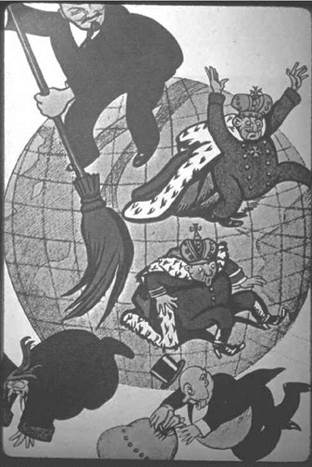
Lenin, The New Brush that sweeps up.
END OF PART A
WORLD HISTORY
SECTION II
Part B
(Suggested planning and writing time—40 minutes)
Percent of Section II score—33 1/3
Directions: You are to answer the following question. You should spend 5 minutes organizing or outlining your essay. Write an essay that:
• Has a relevant thesis and supports that thesis with appropriate historical evidence.
• Addresses all parts of the question.
• Uses historical context to show change over time and/or continuities.
• Analyzes the process of change and/or continuity over time.
2. Evaluate the evolution of nationalism since 1750 in ONE of the regions listed below. Include a discussion of the relationship between nationalism, racism, isolationism, and imperialism. Describe the status of the region around 1750 as your starting point.
The Middle East Eastern Europe South America The Far East
END OF PART B
Part C
(Suggested planning and writing time—40 minutes)
Percent of Section II score—33 1/3
Directions: You are to answer the following question. You should spend 5 minutes organizing or outlining your essay. Write an essay that:
• Has a relevant thesis and supports that thesis with appropriate historical evidence.
• Addresses all parts of the question.
• Makes direct, relevant comparisons.
• Analyzes relevant reasons for similarities and/or differences.
3. During the twentieth century, considerable effort was expended by Western nations to support democratic and western-friendly governments in developing nations. Select TWO of the nations below and evaluate the success of such efforts.
For each nation, consider the reasons behind the interventionist policy, key national and world leaders involved, and whether the democratization programs have resulted in long-term political, social, and economic stability.
Iran
Vietnam
Nicaragua
Chile
STOP
END OF EXAM