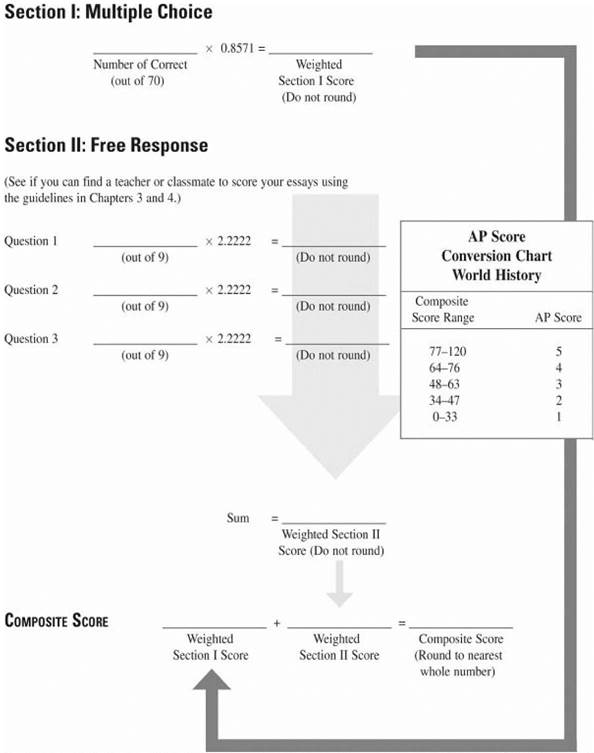
ANSWER KEY TEST 2
1. D
2. B
3. B
4. C
5. B
6. D
7. B
8. B
9. C
10. D
11. D
12. D
13. C
14. D
15. A
16. C
17. B
18. D
19. C
20. A
21. D
22. C
23. B
24. B
25. D
26. C
27. D
28. C
29. D
30. D
31. A
32. D
33. B
34. A
35. A
36. C
37. D
38. A
39. B
40. B
41. A
42. B
43. B
44. A
45. D
46. C
47. A
48. C
49. C
50. A
51. D
52. C
53. D
54. D
55. C
56. C
57. B
58. D
59. D
60. D
61. A
62. D
63. A
64. B
65. B
66. D
67. B
68. B
69. D
70. A
1. D The primary difference between steppe tribes and other ancient civilizations was their settlement patterns. While civilizations in China, India, and the Middle East developed as sedentary societies, the steppe tribes remained nomadic well past 800 B.C.E.
Using POE, you can eliminate (A) if you remember that the steppe tribes were nomadic, and thus unlikely to build monuments. (B) is not the correct answer because it is an untrue statement about all of the societies in question. While there were some monarchies in ancient China, India, and the Middle East, there were also times when these civilizations were under the control of military dictatorships, feudalistic systems, and even rudimentary democracies. Steppe tribes were governed by a tribal leader who came to power as a result of the respect of other tribal members. Indo-Europeans did develop social bonds, and their religion was based on polytheism, so (C) is not the correct answer.
2. B In the late 800s, Byzantine missionaries spread into the Slavic regions in eastern Europe. One way to gain more converts was to present the Bible and other liturgy in native languages. St. Cyril, a missionary, developed the Cyrillic alphabet from Greek.
To use POE, remember that, while Mongol invasion was an important path of cultural diffusion, the Mongols adopted and spread Islam, not Eastern Orthodoxy, so (A) is not the correct answer. And, while you might remember that the iconoclast controversy was resolved with the decision to allow icons and symbols to be used in the church, (C), this was not a major factor in the spread of Eastern Orthodoxy to distant lands. Moreover, Eastern Orthodoxy was not very flexible in its acceptance of other forms of observance, especially considering that many of the Slavic people engaged in polytheistic worship, so (D) is also incorrect.
3. B Use POE to eliminate the Normans (C) because they were western European.
While the main area of Viking raids was western Europe, they also moved into eastern Europe, but not in a sufficient enough number to be considered dominant, so (A) is out. Both the Slavs, (B), and the Russians, (D), were eastern European; however, the Slavs were the dominant ethnic group in eastern Europe. (B) is the correct answer.
4. C Over a million of ethnic Tutsis were killed by the Hutus during the unrest in Rwanda in 1994. The two groups had been in conflict due to ethnic divides established during colonial rule by Germans and Belgians.
5. B As central governments weakened, the need for cooperation and protection provided the impetus for the formation of the feudal system. You can use POE on (C) and (D), feudalism had nothing to do with the conditions in cities, but the economic changes that did occur with feudalism were based more on political disunity than on new technology. Although (A) is a smart guess, it is incorrect because it only applies to European feudalism. The decline of these two empires had little impact on the political and economic organization of China.
6. D In the late 1700s and early 1800s, European nations were interested in establishing more trade with China. While China had many goods that the West wanted, China was not that interested in western goods. There was a trade imbalance and this was unacceptable (especially to England). To address this, Britain took opium grown in India and shipped it to China.
Before long, the balance of trade had been reversed under an Open Door (permissive trade) agreement, and silver and tea were flowing freely out of China. The Opium Wars were attempts by the Chinese government to stop the opium trade and expel foreign influence from its shores. Answer choice (D) was the goal of China during the Opium Wars, but unfortunately, it was not the result.
The other choices are true and therefore not the answer. The British won the first Opium War (1842), which required China to open up more port cities to foreign trade. This policy would soon be extended to other western European nations and eventually to the United States. England also took possession of Hong Kong, (A). (B) and (C) were also all impacts of the conflicts. China was forced to sign treaties that allowed more Western goods into the country. And, while China had kicked missionaries out of the country in the 1600s and 1700s, now organized religion was free to enter China. Furthermore, treaties signed in the mid-1800s actually legalized the opium trade in China.
7. B Feudalism was a political system characterized by a series of interlocking obligations between a monarch and nobles of different levels. The system was based on giving land in exchange for loyalty and military aid and resulted in a decentralized form of government. Manorialism was an economic system in which wealth was based on land. Peasants worked nobles’ farms in exchange for food, shelter, and protection.
Use POE and common sense to get rid of (A) and (C). During the medieval period, there was simply not a great deal of trade and commerce occurring. Plus, advancements in agricultural technology that increased yields or efficiencies would certainly have had a positive impact on manorialism. (D) is also incorrect because there certainly was a hierarchy within the feudal system. In both Europe and Japan, the class structure looked like a pyramid: the monarch at the top, followed by different levels of lords in the middle, and then the knights at the bottom.
8. B The clue here is small-pox. Using POE, you can get rid of (A) because the implication is that something was being put in, not taken out, and there is no mention of leeches. (C) and (D) are out because neither is a procedure. While Lady Montagu does write about “what vein you please to have opened,” the important procedure that she witnessed—and that was later adopted by western nations—was (B), the use of live vaccines to prevent illness.
9. C In the late tenth century, the Shi’a movement developed to challenge Sunni dominance of Islam. The Sunni believed that while the caliphs were leaders, they were not religious authorities. On the other hand, the Shi’a thought that the caliphate was both a spiritual and political leader and that the position should only be held by a descendant of Mohammad.
Using POE, you can get rid of (B) because this simply did not happen. And while there were philosophical differences between the two groups, the catalyst for the split between Shi’a and Sunni Muslims was not (A) or (D).
10. D Who has nuclear weapons? Countries that have detonated nuclear bombs (either for testing or for real) include Russia, the United States, France, North Korea, India, Pakistan, China, and Great Britain. Not Argentina, (D).
11. D By the early 1900s, the Ottoman Empire was referred to as the “Sick Man of Europe.” Beginning in the 1700s, internal and external pressures eroded the power of the empire. European encroachment into northern Africa, nationalist rebellions in the Balkans, and the rise of the Young Turks contributed to political instability in the region.
Use POE on (A) and (C) because Africa is not “Eastern,” and neither are the majority of Europe’s less than entirely compliant colonies, and because while China, Japan, and Korea are eastern, it should strike you that what this answer choice is more nearly describing is the Open Door policy, by which western nations exploited China. (B) is a smart guess because the Eastern Question did involve power plays between European nations, but the nations involved were England, France, Russia, and Italy. The issue questioned what would be done with the Ottoman Empire’s land, so the presumption was that they would no longer be a power in world politics.
12. D Remember to read the question carefully and eliminate answer choices that you know are true reasons for imperialism. Immigration into western European nations (especially into urban areas) provided sufficient labor resources to fuel industrial expansion. Imperialism was closely tied to industrialization, and as European nations began to dominate the world economy they searched for new sources of raw materials and new markets for manufactured goods. (A) is an accurate statement, and thus is not the answer.
(B) is also true and therefore not the answer. Industrialization also involved the need to move goods quickly and safely, so European nations used their colonies as military bases as well. The Panama Canal and the Suez Canal are examples of protectorates, which served both economic and military purposes.
(C) is true (and therefore not the answer)—English philosopher Herbert Spencer applied the biological evolution described by Charles Darwin to social interactions. Social Darwinism justified imperialism because the supposed superiority of the Anglo-Saxon race gave them a moral imperative to “civilize” the rest of the world.
13. C Prior to 1000 C.E., nearly all pre-modern civilizations, including China and India, traded slave labor. Indo-Aryans added a new caste, the sundras, to accommodate slaves and servants at the bottom of the caste system.
All the other answer choices are true and therefore not the answer. Slaves in Greece were most often prisoners of war or foreigners either living in Greek lands or brought back from Greek military and trade expeditions, (A). The Islamic Empire had a hierarchy of slaves that allowed those who served at the highest levels to attain high social status, and some even rose to high governmental positions, (B). (D) is particularly true of African societies, though the loss of honor is a common theme in slavery both worldwide and throughout history.
14. D While the Aztec did have a formal system of writing, the Inca did not have a similar system and instead relied on quipu, a rope with different color and size knots, for record keeping.
Savvy POE will get rid of (A), (B), and (C). Both the Inca and Aztec were sedentary civilizations with a hierarchical social structure—both of which are characteristics of agrarian, not nomadic, societies. Likewise, you know that religion played a dominant role in all Mesoamerican civilizations and that architectural monument building was a feature of both the Aztec and the Inca. Finally, general knowledge about Mesoamerica includes polytheism and the supremacy of the sun god. Both the Aztecs and the Inca expanded their empires to control large territories at the height of their respective reigns. At one point, the Aztec Empire stretched from northern Mexico to Guatemala.
15. A This question asks you to draw a broad generalization about the various revolutions in Latin American nations. What you need to do is find an equally broad answer that fits a diverse range of independence movements. In the late 1800s, independence movements occurred in Peru, Chile, Argentina, Brazil, Bolivia, Mexico, Venezuela, Columbia, and Ecuador (among other nations).
The only answer that applies to the nations of Latin America is (A). The revolutions in many nations were led by the upper and middle classes who were frustrated at the lack of mobility. In other lands, lower-class workers led independence movements. Simon Bolivar, himself a member of Venezuela’s upper class, proclaimed that successful revolutions depended on the participation of all groups. The results of revolution, however, were similar in this one regard: Social stratification continued to exist, clashes among different classes and races persisted, and the economic gap among groups of people grew.
Using POE, remember that there were few key industries emerging in Latin American nations, and these countries relied on significant foreign investment to build their economies. Foreign concerns ran most of the rubber, coffee, rail, and sugar industries in Latin America. These nations did not nationalize their key industries, (B). Few economic reforms were instituted because, in some nations, elites led the revolution and were opposed to long-lasting change. In other lands, reforms might have been desired, but political and social instability prevented them from occurring. (C) is incorrect as well. While some Central American countries were originally part of New Spain (Mexico), they gained their independence by the end of the nineteenth century as well. By and large, constitutional democracies failed in Latin American nations. Military dictators ruled in some nations (Mexico, Brazil) and civil wars broke out in others. (D) is not the correct choice.
16. C The downfall of communism in the old Soviet Union occurred in large part because of economic problems associated with a huge bureaucracy that wasn’t flexible enough to respond to changing global economic conditions. Communism was abandoned throughout Eastern Europe and most of the rest of the world. Even China, the largest remaining communist country, made massive economic adjustments by adopting many elements of capitalism, a change which further supports the idea that, during the 1990s, most people concluded that there are some inherent problems with too much central economic planning.
Using POE, you can get rid of any answer choice that either doesn’t describe Russia or that isn’t a result of changes in Russia. (B) and (D) don’t describe Russia during the 1990s. Cultural and ethnic differences fueled nationalism (which, after the downfall of communism, led to independence movements and the subsequent breaking up of the Soviet Union into different republics, including Russia, the Ukraine, Latvia, and Uzbekistan). Plus, a substantial middle class didn’t develop under communism, so it couldn’t have brought about the political changes in the early 1990s. Modernization also lagged behind the west during the communist years; so, even though efforts to modernize increased throughout the 1990s, you can get rid of (A) because it’s too early to tell whether that will lead to long-term social and political stability.
17. B To use POE, find one product in the choice that is not correctly matched to its geographic location. (A) and (D) are the most obvious wrong choices, but (C) is also no good. (A) is incorrect because sugarcane came first from Africa to the Caribbean—where, incidentally, it was often turned into rum—and (D) is out because slaves did not come from North America but rather were sent there. Coffee came from South America, so (C) is incorrect.
18. D Remember that the correct answer must contain statements that are true about both of these civilizations. The Tokugawa Shogunate worried about the influence Christian missionaries and foreign traders might have on Japan, so it created a closed society. On the other hand, the Ottomans were influenced by many of the cultures with which they had contact. The Ottomans converted to Islam, blended Byzantine and Persian art, and learned about gunpowder and Confucianism from China.
Use POE to get rid of answers you know are untrue about either the Ottoman Empire or the Tokugawa Shogunate. Although it is correct to state that the Tokugawa did ban Christianity to prevent Spanish and Portuguese colonization attempts, the Ottomans embraced Islam, not Christianity, so (A) is incorrect. One defining feature of the Tokugawa Shogunate was its success in removing power from the daimyo and establishing a strong, central government, making (B) the wrong answer. (C) is also incorrect because it misrepresents both the Ottomans and the Tokugawa. The Ottoman Empire was built and sustained on expansionism; the Tokugawa brought peace and prosperity to Japan through isolationist policies.
19. C One way to tackle this question is to eliminate answer choices that contain cities that are not in Italy. If you read the answers quickly, (D), the word Vienna looks a lot like Venice. But, Vienna is in Austria, so (D) isn’t the right answer. That leaves you with (A), (B), and (C). Remember the important role played by Venice, not only in the formation of strong maritime city-states, but also in the Renaissance. Even if you are unsure about the other cities, you know that Venice needs to be part of the answer, so pick (C).
20. A The League of Nations was meant to bring all nations together to deal with the world’s problems. However, many nations were reluctant to join including the United States (whom never joined the organization despite having suggested it). Since the United States never participated it did not have any decision-making capacity, eliminating (B). It did have monetary support from member nations (C) and did attempt to establish acceptable standards of fairness and conduct (D).
21. D Remember that Confucianism is a philosophy and not a religion. The notion of salvation and how to attain it are features of many religions, but not hallmarks of philosophical systems.
Use POE to eliminate the answer choices that are characteristics of Confucianism. One of the principles of Confucian thought is that a harmonious society is built on five important interpersonal relationships, each of which springs from filial piety, or respect for parents and elders. (A) is a valid statement and, therefore, an incorrect answer choice. So is (B) because the philosophy is based on the proper conduct for each role in society. Confucianism also served as the basis for the meritocracy system and civil service examinations, which were embraced by Chinese dynasties. Benevolent rulers surrounded by well-educated scholars acted to promote the common good. Thus, Confucianism does address government organization, and (C) is not the answer.
22. C Western Europe was already noncommunist. Using the map, you can eliminate (D) because China did not have any holdings in Africa during this period, (B) because you cannot tell this information from the map, and (A) because the map contradicts this information. While France, Russia, and the United States are represented in the graphic, England is not. And, while most of the fighting took place in Southeast Asia (Korea, Vietnam, Cambodia), there were wars of independence in Pakistan (Bangladesh), civil wars throughout sub-Saharan Africa (Uganda, Zaire) and Latin America (Nicaragua, Chile) where military aid from both sides was used to try to influence political outcomes.
23. B The ability to produce a surplus of food due to better farming technology led to more permanent settlements, which grew into cities. This gave rise to more formal social systems, including the need to govern groups of people. Remember you are looking for the answer that is not true.
Use POE and your knowledge of the Bronze Age to get rid of answers that are true. You know that the Bronze Age had a significant impact on the movement of people and the interaction of cultures. Don’t forget to read the question carefully, and then use POE to select the answer that is not an accurate statement. (A) is true, and therefore not the answer, because weapons made out of bronze were expensive and were reserved only for the higher classes.
(C) is also not the answer for two reasons. First, with an agricultural surplus, more people were free to pursue life as artisans and craftspeople. Second, new materials were available for different types of art such as jewelry making. If you weren’t sure what to do with (D), you should take your best guess between (D) and (B), but historians and archaeologists believe the Bronze Age saw the development of the first plank-built boats.
24. B The impact of Mongol invasions on European, Asian, and north African countries is uneven. While Mongols brought peace and prosperity to China (under Yuan rule) and India (under the Sultanate of Delhi and the Mughal Dynasty), their conquest of Russia resulted in the destruction and emigration of native Russians. (This is why (D) is an incorrect answer choice!) While ruling China, Mongols integrated elements of Chinese culture and society (most notably the formation of a strong, central bureaucracy to help run government). Through subsequent invasions of other lands, cultural diffusion occurred.
Using POE, remember that the Mongols were unsuccessful in spreading Islam to China and Russia; however, many Indians converted to Islam during Mongol reign as a way to break free of the social constraints of the caste system. (A) is not the correct answer. Make sure you read all the answers carefully! Yes, the Mongol invasion was successful (for a time) in China, but the Mongols never successfully occupied Japan—though they tried numerous times during the Yuan dynasty. Korea did fall to the Mongols under Kublai Khan’s reign. (C) is not the right answer. Akbar was a Mughal leader who modernized the military and instituted land reform programs. He is best known for his interest in other religions and building a society based on tolerance.
25. D Manorialism was the dominant medieval European economic system and was characterized by a focus on agricultural production. While there were certainly bad seasons of drought and flood, this was not really an important reason for the end of manorialism. Remember, you are looking for the answer that is not true.
Use POE to get rid of choices that are true. You should eliminate (B) and (C) because anything that competed with farms and farming or undermined the labor force was bad for manorialism. (A) is also out because the manorial system equated land with wealth; the development of a money economy based on the production and sale of goods was one feature that led to its downfall.
26. C Cultural synthesis means that something created in one civilization was blended with something from another civilization. The galleon was based on a Chinese design that was then modified by the Spanish to increase its utility for cross-Atlantic travel. The galleon became the dominant ship used in exploration and supply missions to the Americas (numerous galleons are sunk off the coast of Florida). Independent development or adoption of an element from another society is not synthesis, nor is a society inventing something on its own, so (B) and (D) are incorrect—cross them off. Similarly, translation of the Bible into French did not change the text, so (A) is out.
27. D While you might not remember the exact year, it should have occurred to you that India did not gain its freedom in the nineteenth century. Independence was won in 1947. The Sepoy Rebellion resulted in the removal of the British East India Company as the governing body in India, but did not free India from foreign rule.
Use POE to eliminate answer choices that are accurate statements about British rule in India. Compared with France and Spain, England was not the worst colonizer, and certain segments of Indian civilization did benefit from British rule. (A) is a true statement because the British did develop extensive rail lines and road systems in order to facilitate the movement of goods. The British imported various forms of Western civilization into India: for instance, education, culture, and 4:00 afternoon tea. However, the caste system persisted. In a way, a new, higher caste was added that contained the English who moved to India. (C) is accurate and therefore not the answer. So, too, is (D): cotton was grown in what is now India (and Pakistan) as early as the fifth century B.C.E., but the Indian cotton market did suffer due to the policies and practices of the British East India Company.
28. C Even if you have no idea who Morgagni and Kepler are, you can answer this question! Use POE to eliminate those pairs you know are incorrectly matched. Copernicus studied astronomy, not chemistry, so (B) is out. Now you might be stuck. However, looking at the two remaining choices, you know that the little experiment with the apple and gravity means that Newton’s field of study was physics, so (C) is the correct answer. You don’t even need to know that Kepler also studied astronomy and physics or that Morgagni was somewhat famous for his work in medicine, especially anatomy!
29. D It is rumored that the wealth displayed by Mansa Musa on a pilgrimage to Mecca persuaded Ibn Battuta to journey to Mali. Mansa Musa opened trade routes and brought Islam to Mali. Even if you aren’t sure who Mansa Musa was, the word Islamic will help you eliminate some of the answer choices and take a smart guess. Ethiopia, (B), was one of the few east African nations to remain Christian. Axum, (C), was also converted to Christianity. (More importantly, note that Axum reached its height of power in the mid-500s).
Speaking of the Axum, it was the successor civilization to the Kush in northeast Africa. Another interesting point is that the Kush could not have been Muslim because their rule ended before 570 C.E. (Muhammad’s date of birth). So, for a variety of reasons, (A) is an incorrect answer.
30. D While other European nations were adopting absolutism in the fifteenth and sixteenth centuries, the Netherlands retained a localized governance structure with power held by provincial legislatures. Naturally, disagreements arose over various policies and actions, mostly those having to do with foreign affairs, so there was a federal assembly (the States General) who met in The Hague.
Use POE and common sense to eliminate answer choices you know are wrong. The Hague is in the Netherlands, so it would probably have little involvement in the activities of central European nations, such as those listed in (B), and little interest in running Scandinavian government, (A). (C) is not a bad answer choice, but it is not correct.
31. A Think in relative terms. The British were relatively better imperialists than the Portuguese (and the Spanish and Belgians, for that matter). In India and Hong Kong, the English cultivated a class of native citizens to help run the government and who could rise to relatively high positions of power.
You can use POE to eliminate (C) and (D). The fact that Brazil is in South America makes (C) the wrong answer choice, and you are well aware of the use of slaves on sugarcane plantations throughout Latin America, so (D) cannot be the right answer either. (B) is an incorrect choice because all colonizers built their economic relationships with their colonies on mercantilism and monoculture. European nations had little concern with the long-term economic survival of their protectorates; the need for agricultural products and natural resources was more important. In Brazil, those resources were coffee and sugar.
32. D You might associate the Holy Roman Empire with Italy because that’s where Rome is located. However, the empire encompassed the parts of central Europe that eventually became Germany, Austria, and some of the Slavic nations. Remember you are looking for the choice that is not true.
During the Age of Absolutism, the Holy Roman Empire stood as an example of how not to form a nation-state. The empire was a loose confederation of Germans, Italians, French, Hungarians, and Slavs that was held together by religion and little else. (A) is accurate, so it’s not the answer. The ruler of this large territory, for part of its history, was elected by a council (Diet) of nobles who were autonomous, regional rulers, so (C) is not the answer. The Roman Empire granted full citizenship to men in Rome automatically, but the same was not true of men in conquered territories. The empire offered citizenship to men in conquered areas to minimize resistance to its rule, but also to encourage men to enlist in the Roman armies, which needed a constant source of new recruits to maintain and expand the empire. So (B) is not the answer.
33. B Haiti gained its independence from France in 1804 following a slave uprising and inspiration of the rising up of the people during the French Revolution. Mexico (B), Brazil (C), and Chile (D) would not gain independence for another approximately twenty years.
34. A By the beginning of the twentieth century, Japan was an industrial power and competed with Western nations for colonies and influence. That is not to say that Europe was any less interested in gaining land in Asia. Looking at the cartoon carefully, you will see Japan “cutting off” Korea from the rest of Asia. The cartoon does not focus attention on European colonization efforts, so (B), (C), and (D) are all out.
35. A Justinian Code was critical for maintain Roman law present in the Byzantine Empire beyond the collapse of the Roman Empire. The Roman Empire collapsed in the 5th century would not see a resurgence (B). At the time of Justinian, Islam had yet to develop (C). Justinian was not associated with reconciliation between the two churches which grew more apart during the rise of the Byzantine Empire.
36. C The fragile ecosystem of sub-Saharan Africa could not support the population growth that came with new farming technologies developed by the Bantu. In addition, desiccation turned much of the available agricultural and grazing lands to desert.
It is theorized that the biggest Bantu migrations, from about 400 B.C.E. to 500 C.E., began in eastern Nigeria and moved south and east along the path of the Congo River. (A) and (B) are out because, while trade and religion did open up significant parts of Africa to exploration and settlement, they were not primary causes of the Bantu migration. (D) is also incorrect because, while new technologies certainly did open up more areas of Africa to development, this was not a reason for Bantu migrations.
37. D Mahayana and Chen (Zen) Buddhism were largely incorporated into Confucian and Daoist philosophy and had the greatest impact on religion and society in post-Han China.
38. A West Germany backed by Western powers was a democratic state. East Germany, however, was controlled by the Soviet Union and was communist. During the decline of the Soviet Union during the 1980s, East Germany began negotiating with West Germany to reunify.
39. B The primary difference between industrialization in Japan and England was that Japan lacked natural resources. England had ample supplies of coal and had huge amounts of resources in its colonies. Japan had comparatively fewer natural resources and colonies, and therefore had to import most of the energy sources and raw materials for its factories.
Using POE, you can get rid of anything that doesn’t accurately describe Japan or England. Both countries are island nations that built rail lines between their major cities (although England had more rail lines) and were entirely dependent on water transportation for contact with the outside world, so eliminate (A). Additionally, class tensions existed in both Japan and England, but working conditions improved in England as progressive policies were enacted by Parliament and as unions formed, so (C) and (D) have to be eliminated.
40. B The National Assembly was formed to establish a united body of power among the Third Estate. Soon after, the Bastille was stormed and then the Declaration of the Rights of Man was written. Louis XVI was executed four years after the start of the Revolution.
41. A Japanese feudal society was organized in a hierarchy similar to that in feudal Europe. Use POE to cross off the positions you know were part of the system: samurai and shogun. If you weren’t sure about (D), taikun, take the 50-50 shot between (A) and (D) and move on to something you know more about. But if you remembered that Shinto is a religion, not a social position, you should have been able to eliminate (D) and pick (A).
42. B First use POE to eliminate (A) because it is not a religion. Syncretism means, “the integration of different religious beliefs and practices.” Akbar the Great’s attempt to synthesize Hinduism, Zoroastrianism, Jainism, and Christianity is one example. Christianity, Judaism, and Islam are monotheistic religions with relatively strict doctrines, none of which encourage integration of competing religious thoughts into its belief systems, so cross off (C) and (D). The right answer is (B). Greek paganism combined different ideologies and rituals as it expanded its territory and absorbed other cultures.
43. B Russia and Poland opened up their borders in order to bring in more settlers.
Religious intolerance in western Europe certainly played a role in the Jews’ willingness to migrate. If you look at the map, you’ll see that Jews migrated into eastern Europe, Russia, and Lithuania. Get rid of (C) because this might have accounted for some movement from Crimea, but not from Germany and Hungary. (A) is not the correct answer either. The Crusades (and the Reconquista in Spain and Portugal) had more of an impact on religious tolerance in western Europe, the Mediterranean, and the Middle East. It was not a major factor in the movement of Jews. However, the impact of the Crusades on the Jewish population in western Europe is a clue to the correct answer. (D), then, makes for a decent guess, but (B) will be the answer.
44. A While Roman civilization made significant contributions in the field of engineering, the Cyrillic alphabet was invented in the Byzantine Empire. Tricky!
Make sure you read the question carefully to ensure that you select the answer that is not true. Use POE to eliminate the choices that you know are true. In the Islamic civilization, literature consisted of complex poetry forms and mathematical advances included the creation of algebra, so (B) is not the answer. You should remember that drama, especially tragedies, were invented by the Greeks and that the work of mathematicians such as Pythagoras and Euclid led to the field of geometry. (D) is out. And (C) is correct—and therefore not the answer, so cross it out—because the Mayans did indeed develop the concept of zero (they weren’t the only ones) and a complex understanding of astronomy.
45. D Don’t forget to read the question carefully—you need to find the answer choice that is not accurate. While the Crusades did involve converting the Holy Land back to Catholicism, a Jewish state was not established in the Middle East until 1947. The Crusades were a series of military campaigns with a strong religious overtone that occurred from the late eleventh century through the thirteenth century. While the primary purpose of the Crusades was to take Jerusalem back from the Muslims, it turned into a quest to prevent the spread of Islam and to acquire more wealth and power for European leaders. As a consequence of the Crusades, feudal power diminished and commerce and cultural diffusion increased. However, they also resulted in widespread religious intolerance.
Use POE to eliminate answers that are true. During the Crusades, kings became more powerful because they were the only ones who could put together the substantial resources to mount such extensive campaigns. There was also competition among the various monarchs for the wealth and power associated with the Crusades to the Holy Land. (A) is true and therefore not the answer. Because you know that the Crusades were religious in nature, you can eliminate (B). There were many risks and few rewards facing the average Crusader, and the promise of salvation was an incentive offered by the Church to recruit soldiers. While the original idea for the Crusades was religious, returning crusaders brought back goods and tales of the thriving commercial trade network they saw in the Middle East. With the decline of feudalism, European aristocrats (and royalty) saw the Crusades as a way to expand economic power and influence, so (C) was a reason behind the Crusades (and therefore not the answer).
46. C Before we consider what made Spain different from other European nations, use POE to eliminate answer choices you know are wrong. For instance, (A) makes no sense. Somehow, the Renaissance spread to England and France, and neither of those nations was Italian-speaking. You also know that (B) is wrong. Spain is not isolated. It borders France to the north, and England is geographically farther from Italy than Spain.
Knowing that (D) is the incorrect answer is the key to understanding why (C) is the correct answer. During the 700s, Spain and Portugal came under Muslim rule with the invasion of the Moors. For hundreds of decades, Spain fought to free itself of Islamic influence, and what resulted was a strong nation-state with extremely little tolerance for religious dissent. So the Catholic rulers of Spain did not warmly embrace the ideas of the Renaissance.
47. A The Iron Curtain is the line between Eastern and Western bloc nations.
Churchill called it so because Easterners were not allowed to cross it and Westerners could influence it.
48. C Remember that you are looking for the answer that is not true. Urban populations swell as people migrate from rural areas hoping to build better lives.
Cross off the answers that are true. Developing nations have a difficult time becoming self- sufficient for political, social, cultural, and economic reasons. Political instability prevents foreign firms from investing in some of these nations. The inability to ensure profitable operation plus employee safety has prevented companies from investing in many countries in Africa, Southeast Asia, and Latin America. (A), (B), and (D) are not the answer. In some countries, the colonial power built infrastructure to serve its own imperialist purposes.
49. C By 1914, only Liberia and Ethiopia remained independent nations. All of the rest of sub- Saharan Africa were under European control.
50. A The Monroe Doctrine was significant because it declared the Americas as an imperialism-free zone. Although the United States would not likely be able to enforce this policy, it was largely accepted by Europe which had turned its attention to Africa and Asia.
51. D While the focus of much of the literature is on the transatlantic, European-dominated slave trade, Islamic and Asian nations also engaged in slavery. Remember to read the question carefully—the correct answer is the one that is not true. Use POE and eliminate the choices that you know are true about the slave trade. (A) is true. In the New World, intermarriage led to the creation of the mestizo, mulatto, and zambo classes. While the slave trade decimated Africa’s population, its impact on African rulers was not always negative. Numerous kings, such as those in Ashanti and Benin, saw cooperating with the Europeans as a path to riches. Trading slaves for guns, these rulers were able to maintain strong control over their empires; therefore, (B) is not the answer. As a result of triangular trade, crops such as corn were introduced to Africa. Some of these were more tolerant to drought and some produced higher yields than native plants, so diet and health were improved. (C) is not the answer.
52. C The trans-Saharan trade route ran from west Africa to north Africa to Europe.
East and central Africa became more prosperous with the success of this route, which was also responsible for increased European and Muslim missionary efforts in the region. While cloth, silk, and spices from Europe and Asia did comprise some of the goods transported on the Trans-Saharan Route, the question asks what African goods were involved. Use POE to eliminate answer choices containing Asian goods (tea, silk, and spices). But in doing so, be very careful—both rice and sugarcane were African products, even though you may associate rice with Asia and sugarcane with the Caribbean. Sugarcane came to the Caribbean as a result of the Columbian Exchange, but rice cultivation developed separately in both Africa and Asia, with each continent using different strains of rice. Africans, however, generally grew only enough rice for themselves and their families without a tradable surplus, so it would not have been part of the trans-Saharan movement of goods, products, and people.
53. D The term nation implies certain bonds among people. Early nation-states in Europe (England, France, Germany, Italy) met with varying levels of success, depending on how strong those bonds were. Don’t forget that you are looking for the answer choice that is not true. Think about the successful nation-states (England, France) and use POE to eliminate the features you know were present in these two lands. In both England and France there existed a common language, (A), a distinct territory, (B), and common laws (no matter how unevenly applied), (C). Not only was feudalism, (D), not a necessary feature of nationalism, but such fragmentation actually had to be eliminated for strong nation-states to arise. One of the problems in Italy and Germany (in addition to cultural and language barriers) was the persistent power of regional nobility.
54. D Read the question carefully— you need to select the reason the College Board would think the Roman law code is most important in terms of World History. That happens to be because it serves as the basis of the modern codes of law in Western Europe, so (D) is the correct answer. Use POE to eliminate answer choices that aren’t so significant or unique to Roman Law, such as (A) and (B). While (C) is true, it isn’t necessarily the most important ramifications of the Roman law code for World History as a whole and therefore the answer must be (D).
55. C (A) is not correct because traditional laissez-faire economics state that economies function best with the least governmental interferences, and Mun’s quote clearly calls for some policies that would interfere with the workings of laissez-faire, so (D) is out. While Mun’s quote fits into the reasons for imperialism, (B) is not the correct answer. Colonialism alone did not create the economic conditions favorable to the mother country. Instead, it was the imposition of mercantilism on colonies that allowed for this favorable balance of trade to occur.
56. C One reason for Japan’s rapid industrialization and growth as a global power was because the nation could devote all of its resources to rebuilding its economy. While the United States (and its allies) and the Soviet Union spent billions of dollars on the Cold War, Japan was free to focus on internal growth—meaning (D) can’t be the answer. Use what you know about postWorld War II Japan to eliminate (A) and (B).
57. B Simply put, every colonizing nation engaged in mercantilism with its colonies.
Under mercantilism, the economic relationship between colonies and European nations was developed to create a favorable balance of trade for the mother nations. Colonies were restricted in what they could trade and with whom, and they were prevented from developing self-sufficient economies.
For example, the British colonies in America were required to buy certain goods (tea) from England and were not allowed to trade certain items with France and Italy. Colonies became not only sources of raw materials, but also captive markets for goods manufactured in Europe. The correct answer to this question is the one nation who was not involved in colonization: Italy, (B).
58. D If you remember that Islamic society was pretty egalitarian in terms of social hierarchy, you can apply this to the rights of Muslim women. Also keep in mind that most civilizations granted few women any substantial rights in premodern times. Using POE and common sense, eliminate (A) because the Hindu caste system did not only discriminate against those in lower castes, but against women as well. (B) is out because only men could sit for the civil service exam and serve as mandarins. As in other faiths, Jewish women were not allowed to hold positions in the religious hierarchy, so (C) is also incorrect.
59. D A major theme on the AP exam is change and continuity in societies over time.
Change can occur through different methods: invasion, migration, independent population growth, innovation and invention, and so on. The Song Dynasty went through a period of tremendous social, economic, and cultural growth beginning in the late 900s. Innovations in agriculture led to the growth of huge commercial cities and increased prosperity. To use POE, remember that during the period from 600 to 1450 C.E. there was a tremendous increase in the contacts among different people. Many of these exchanges occurred as a result of migration, trade, and war. The correct answer to this question will be the society that experienced tremendous change yet not as the result of outside influence.
In Africa, the Great Zimbabwe changed as a result of the discovery of new trade routes and valuable natural resources. (A) is not the right answer. As you (hopefully) remember, Mongol invasions of Russia had a long-lasting (and not very positive) impact. The Tartars destroyed the Kievan city-state system and isolated Russia from European civilization. Kiev was changed through invasion, so (C) is out. Byzantium society was changed greatly as a result of invasion; not only because of Arab, Slav, and Bulgur invasions into the empire but also as a result of Byzantium expansionism. Moreover, western Catholics led an attack on Constantinople as part of the Fourth Crusade, which further weakened the empire and left it open to later Arab attack. (B) is not the correct answer.
60. D Following the defeat of Napoleon, the European powers decided to mostly restore Europe to its pre-Napoleonic state including France whereas the Roman Empire was absorbed by conquering tribes following its fall in the 5th century. Both the French Empire and Roman Empire were ruled by emperors (A), fell due to inability to control their vast territories (B), and relied on military strength (C).
61. A The Neolithic Revolution (about 8000-3000 B.C.E.) was characterized by people moving from nomadic lifestyles to agricultural lifestyles. Even if all you remember is that the Neolithic Revolution happened way in the past, near the beginning of the history covered in your AP World History class, you should be able to eliminate some answers. People began to use bronze near the end of the Neolithic Revolution, and iron didn’t come until way after that, so (B) has to go. “Revolutions” usually describe a totally new way of doing things or an overthrow of leadership or government, so (C) and (D) don’t make much sense.
62. D The purpose of the Truman Doctrine was to contain the spread of communism.
The United States perceived a communist threat to Greece and Turkey and approved a $400 million aid package for these two nations. If you remember that the Truman Doctrine was not applied in communist nations, then you can use POE to eliminate answer choices with Czechoslovakia, (A), Poland, (B), and Yugoslavia, (C).
63. A France was quickly defeated by Prussia during the Franco-Prussian War. The war established Prussia as a power in Central Europe (B) and consolidated Germany into a large unified state (C) with a superior military strength (D).
64. B Because you know that the American Bill of Rights was based on key provisions of the English Bill of Rights, you can guess that religious restrictions were not included. The correct answer is the provision that was not part of the Bill of Rights. The Test and Corporation Acts of the late seventeenth century ensured that British office-holders were Anglican.
The Bill of Rights placed numerous limitations on the power of the English monarch. Among those restrictions was one that stated the king could not raise taxes or establish an army without Parliamentary approval. It also gave jury trials to those accused of crimes and allowed British citizens the right to appeal decisions made by the king. Furthermore, it allowed those in Parliament to speak freely and even to criticize the monarch. Finally, it prohibited excessive bail and cruel and unusual punishment. So (A), (C), and (D) were all parts of the Bill of Rights. Use POE to get rid of these choices.
65. B Marx built his argument on the need for the proletariat to rise up against the capitalist- industrialist regime. In 1917, Russia did not have a large industrial worker base, so Lenin and Trotsky adapted Marxism to include all oppressed people, including peasants. The great irony of communism is that it has been most successful in less-industrialized nations.
Use POE and eliminate answers you know are wrong or don’t make sense, like (A). Marx probably did not envision how long a revolution would take or how bloody it would be. (C) is also not an accurate statement. The 1905 (non-communist) Revolution was run by the bourgeois, and the 1917 Revolution was more radical and proletariat in nature. (D), too, is out, because Marxism appealed to women because it promised equal treatment of all people under communism, and Marx wrote extensively about the unequal burden assumed by women in industrial societies.
66. D The key thing to remember about the Meiji Restoration is that it was a time of great modernization and westernization in Japan. All class distinctions were eliminated, the emperor was reinstalled as the leader of Japan, laws were modernized, and the nation rapidly industrialized. A two-house legislature (Diet) was established. Japan also set out to become an imperial power in the world. Choices (A) and (C) were outcomes of the Meiji Restoration, but not goals so you can eliminate those two choices. Japan believed the only way it could avoid entering into unequal treaties and be subjected to foreign influences (like what happened in China) was to build its own industrial and military bases. (B) is not an accurate statement about the Meiji Restoration.
67. B Exploration took Europeans to Africa, India, and the Far East in addition to the western hemisphere. Remember to read the question carefully and choose the answer that is the least accurate statement about Europe during this time period. Use POE to eliminate answers that are true. (A) is true. A direct result of the establishment of stable, centralized political units in France, England, and Spain was the ability to spend resources on art, literature, education, and exploration, so (A) is not the answer. Eliminate (C) because you know that the benefits of exploration and colonization rarely, if ever, accrued to the native populations of North and South America, Africa, and India. (D) is true and cannot be the answer, because while there were some European women who played important roles as nuns, writers, painters, and salon hosts, the rights and roles of women were not greatly expanded during the Enlightenment, even though more women had access to education. There simply were no opportunities to become equal members in society.
68. B If you know that Hinduism is an ancient religion that developed in India and if you understand its general components, this question is easy. That’s because all of the wrong answer choices have to do with Hinduism. The correct answer choice has nothing to do with Hinduism. The Dao is defined as the “way of nature” and it is the central component of Daoism, an ancient Chinese belief system.
Reincarnation, (A), the caste system, (C), and karma, (D), are all associated with Hinduism. Karma goes hand-in-hand with another important term you should know called dharma. Dharma refers to the behaviors necessary to maintain natural order, and karma refers to the law of moral consequences (of violating those behaviors), which holds that one’s status in the present life has been determined by the deeds in previous lives (reincarnation). That status is known as one’s caste, and it can change as one’s karma changes.
After reincarnation, a higher or lower caste awaits a person whose karma improved or declined in the previous life.
69. D Cecil Rhodes, a British adventurer who became the prime minister of the Cape Colony, was a firm believer in English imperial power. While his reasons for capturing more land for Mother England did involve power and advantage, they also centered on the idea of European supremacy and a moral imperative to convert “savages.” These sentiments are most consistent with (D), Social Darwinism.
70. A The Sumerians, Phoenicians, and the Maya all developed extensive writing systems. The Phoenicians laid the groundwork for the alphabet later used by the Greeks, the Sumerians used cuneiform, and the Maya used hieroglyphs.
Even if all that you remember is that these were ancient civilizations, you can eliminate a couple of answer choices. None of these civilizations emphasized equality in education because none of them emphasized equality at all. Equality is a fairly modern concept, so get rid of (B). The same goes for democracy. It was attempted for a while in ancient Greece and Rome, but it didn’t re-emerge until the Age of Enlightenment, so get rid of (D). All of the societies were polytheistic, so even if you just remember one of them, you have to get rid of (C).
HOW TO SCORE PRACTICE TEST 2