
3
SOCIALLY, I HAVE never been a daredevil, but academically, I probably qualify as one. And I am fortunate that, long before I arrived in America, my professors—in their own way—encouraged this quality in me.
One of the best and most feared math professors at the University of Tirana was Professor Bardulla. His family, we heard, had been killed by the Communist regime. He was harsh and short-tempered, and he never smiled; he wore an old suit covered in cigarette burns, and he was almost always drunk, even during lectures. He often brought a bottle with him to class. But even drunk, he was still sharper and more quick-witted than many of his colleagues. It has been quite a long time, but I still remember his permanently red eyes sparkling with a mix of powerful intellect and bottled-up pain.
I took Professor Bardulla’s final exam and finished it earlier than the other students. When I stood up to leave, he looked at me, furrowed his eyebrows in disgust, and quietly asked, “What do you think you are doing?” I told him I had tried a different solution than the one he had taught, and with this shortcut, I needed less time. He took my papers and read them line by line.
My heart pounded as I watched him turn the pages and wince. He reached the end, put the exam away, and said nothing. He just stared at the floor while I waited to be scolded. Then he looked at me sternly and said, “I need to give you a piece of advice that you must remember for the rest of your life. Never, ever do this again. Never try a new method or a new solution in an exam. It is too risky. If you get it wrong, you fail. Do you understand? At least with the known solutions, you can get partial credit.”
In a weak voice, I asked, “Was my solution wrong?”
“No,” he said. “It is correct, and I like it.”
I like it. Those three words encouraged me to set off on the path of intellectual risk-taking. (And although I couldn’t have anticipated my future, I’m very glad I succumbed to my attraction to math. It gave me the confidence not to shy away from a physics problem when the math appeared too complicated.) It helped, too, that the physics and math professors in Tirana took pride in their students and fed our curiosity in any manner that they could. This attitude was not unusual—in Communist Albania, knowledge was a way of protesting and rising above the suffocating regime. Albanian intellectual society both deeply respected knowledge and was thirsty for it, especially since there were no other distractions or entertainment available.
In many ways, the regime’s iron fist made intellectual ideas more alluring, not less. For example, forbidding Western literature didn’t make us less interested in it; it had the opposite effect—it increased our curiosity and desire to read and learn. Highly skilled people in different professions found underground ways to escape boredom and censorship; groups of them regularly met for coffee to share advances and discoveries in their different fields. My parents’ circle of friends ranged from medical doctors to scientists, writers, composers, and artists. I loved listening to their conversations; they broadened my horizons and encouraged me to respect and nurture interests in other areas.
Perhaps the combination of my upbringing and the deprivations of the regime sparked my habit of drilling down on questions that intrigued me to the exclusion of almost everything else. But whatever its origins, this quality came to define my graduate studies—and sent my research in a different direction, away from what some of the leading minds in my chosen field considered mainstream.
Scientists study physics to understand how things work and establish the principles and laws of nature that describe the operation of our world. Indeed, classical physics, which explains the visible, macroscopic world, predicts outcomes with 100 percent certainty. In the parlance of physics, it describes a deterministic world.
But gradually, as the twentieth century unfolded, it became clear that certain phenomena in the microscopic realm could not be explained by the laws of classical physics. Another set of principles operated in that domain, the chief characteristic of which was not determinism but almost maddening uncertainty. Over several decades, an entire branch of physics arose to deal with this uncertainty: quantum theory, whose mathematical laws and operations are described by quantum mechanics. And as I delved deeper into my PhD studies in Milwaukee, I began to suspect that the answer to the universe’s origin might be hiding somewhere in the realm of quantum mechanics.
As I’ve written, the trajectory of my life had been changed by events beyond my control. Had any of the events that brought me to the present been different, my life would have taken a different path.
Today, whenever I am teaching quantum theory to my students, I cannot help but think that my own life bears some resemblance to a quantum reality, a collection of chances and events, each of which, had they turned out differently, would have taken me down a very different path. Had the Berlin Wall not fallen, I would probably be living in a dictatorship, probably forced into internal exile like my father. Had I submitted to the peer pressure of jumping the embassy walls with my friends, I would not now be researching the universe; I would probably be living somewhere in Europe, perhaps not even having finished college. Had I not submitted a Fulbright application, I might never have left Albania. Had I not accepted an assistant professorship at the University of North Carolina at Chapel Hill just over a decade after I arrived in the United States and four years after I completed my doctoral dissertation, I would most likely be living in some other state or some other country. And had I been more “practical” in my choice of research problems and not given in to my curiosity about the creation of the universe, the only theorizing I would be doing about early cosmology would be over coffee or cocktails. Had any of these events been different, my life would have been different. And that is the essence of the quantum world, the world from which our universe was born.
As if the options and uncertainties at the level of one individual like me were not confusing enough, the discoveries that became quantum theory—arguably the most profound theory in the history of science—combine to describe the whole world in terms of a staggering, multilevel, almost incalculable number of uncertainties, a mind-boggling concept that has driven our greatest scientists to the edge of reason. Consider this one example: In the quantum world, it is possible for a single object to exist in two different states—to be both a particle and a wave and perpetually fluctuate between the two. Furthermore, the entire quantum world is based on probabilities—the chances of having different outcomes to the same questions. These qualities of the quantum world defy reason, yet as far as physicists are concerned, they are a fact of life, the same as gravity or the changing of the seasons.
Most of the discoveries of quantum theory emerged in the twentieth century. In the twenty-first century, quantum principles underlie every aspect of the groundbreaking discussion of the first and last moments in the life of the universe. This revolution in thought is all the more remarkable when you recall that at the end of the nineteenth century, many physicists did not even believe in the existence of the atom.
Most important for our purposes, the breathtaking rise of quantum theory laid the groundwork for subsequent research into the tiniest scales in the universe, including the microscopic origin story of the universe itself. Understanding how this field of physics originated and what implications it holds is key to comprehending why the mystery of the universe’s origins unraveled as it did.
Much of the credit for the origins of quantum mechanics goes to the German scientist Max Planck. My dad and I derived great pleasure from listening to radio broadcasts of Bach in the dark of night, and like us, Planck was a lover of music. But ultimately he pursued physics, despite being told that there was almost nothing new to be discovered. In the late nineteenth century, no one would have suspected, not even Planck himself, that he would become a disrupter who threatened centuries of classical physics and a revolutionary who rang in the new century, the belle époque in physics, with a new theory of nature called quantum mechanics.
Classical physics describes a deterministic world. But during Planck’s time, it became clear that certain phenomena in the microscopic realm could not be explained by the laws of classical physics. Another set of principles, those of quantum theory, operated in that domain.
Conservative in his thinking and renowned for his scientific integrity, Planck started off as a strong proponent of classical physics. Like his protégé Einstein, he admired James Clerk Maxwell’s classical theory of electromagnetism, which unified electricity and magnetism and is considered one of the great breakthroughs of the nineteenth century. Maxwell’s theory describes a continuous stream (spectrum) of energies from both undulating electric and magnetic fields. These radiation energies are often referred to interchangeably as “light waves.” Light waves would prove to be at the center of Planck’s conversion story—and of Einstein’s.
Light waves share a series of common properties with all the other types of waves (shown in figure 2). Whether they are made of light, sound, or seawater, waves have three common features: wavelength, which is the distance from one crest of a wave to the next; frequency, which measures how many wavelengths (or crests) pass through a fixed point each second; and amplitude, the strength of the wave, which is measured by the height of the wave’s crest. But unlike waves that require a medium—a material in which the wave can travel and be sustained—Maxwell’s electromagnetic waves can propagate in empty space-time, in a vacuum. They can sustain themselves by transforming from one form to another as they travel, an electric field becoming a magnetic field and vice versa, in cycles. (The only other waves known in nature that can spread through a vacuum are gravitational waves—a type of wave that, in Planck’s day, had not yet been discovered.)
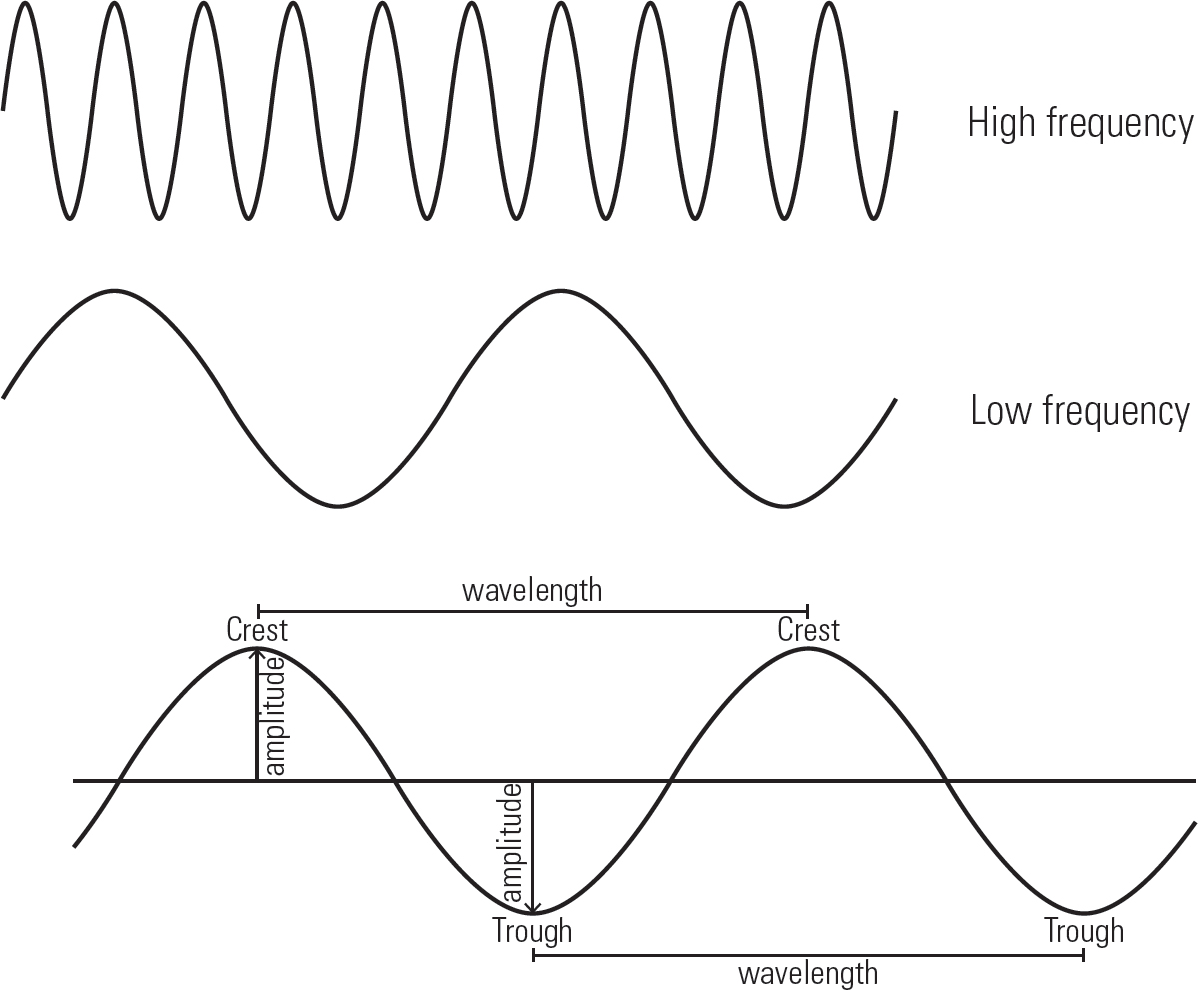
Figure 2. Characteristics of a wave defined by their amplitude, frequency, and wavelength, as shown.
At first, their admiration of Maxwell’s work prompted both Planck and Einstein to resist the very theory they were helping to establish. At the same time, they shared a combination of traits exhibited by all great scientists, then and now: the courage to advance radical, groundbreaking ideas by deploying rigorous skepticism, a skepticism that requires the merciless and arduous scrutiny of every detail of their ideas. A good scientist is both a rebel and a conservative, a creator and an auditor, all in one.
Planck ultimately broke with classical physics due to the influence of Boltzmann’s atomic theory and Boltzmann’s probability relation to entropy, a theory that he had opposed and resisted for a decade. Planck was forty-two years old when he declared, in October 1900, that light had a “double personality.” It was not only a radiation wave, as Maxwell envisioned it, but also a collection of photon particles (so named by Einstein, from the Greek word for “light”). This insight would turn physics on its head and pave the way for some of the most revolutionary research about the cosmos.
Planck published the hypothesis that light was a collection of discrete quanta (in layman’s terms, bundles of radiation waves) that resemble particles.*
Planck’s collection of energy quanta was the first-ever description of a quantum particle. His insight revealed a new component in the DNA of nature: the wave-particle duality of quantum mechanics. In time, Planck’s quanta would form the basis for a new field of physics—and a host of new theories and discoveries about the origins of the universe.
Planck also replaced Maxwell’s continuous spectrum of waves with a collection of steplike (quantized) levels of energy. According to him, energies of light waves do not roll continuously into one another but instead jump from one level to the next in discrete steps, each step being one finite quanta at a time.
To picture Planck’s quantized spectrum, suppose you are that light wave and the energy levels are the floors in a building. Imagine you are going from the second floor (high energy) to the first floor (lower energy). You can do this by taking the elevator, which will continuously lose height in smooth incremental bits, or by taking the stairs, in which case you are going down in discrete finite steps, one step at a time. You cannot take half a step or a quarter of a step. If you don’t want to fall, you have to take exactly one step—one quanta. In our analogy, a building designed by Maxwell would not have a staircase; a building designed by Planck would not have an elevator.
Planck’s contribution was brave and significant. It laid the first block in the foundations of quantum theory out of which a new theory of nature would emerge. It also proved crucial to my investigation in decoding the origin of the universe. Because Planck’s work revealed that at its earliest moments, our universe was not just an object—it was also a wave.
The next step in the development of quantum mechanics was to prove that wave-particle duality existed beyond light. Here, two seminal contributions stand out. The Danish physicist Niels Bohr pioneered an atomic model in which electron particles circled the nucleus of the atom in well-defined orbits. Meanwhile, the French physicist Louis de Broglie hypothesized that electrons could behave like waves as well as particles.
De Broglie’s conceptual leap led us to view all the particles and light in the universe as, intrinsically and simultaneously, both waves and particles. All particles, including you and me. Including the whole universe! We are simultaneously stardust and starlight. We are all waves!
I’m making light (so to speak) of a profound statement about the implications of the wave-particle duality of matter and light, a universal property of the universe that immediately begs some simple questions: If you and I are waves, how come we don’t see a wave trailing us as we walk down the street? Why can’t we glow like the stars do? If one’s dual self, the quantum shadow, can be a wave, why can’t a person travel through glass and walls like light and sound waves do?
If you are entertaining the idea of testing this last question at home (as I have inadvertently done myself in my more absentminded moments), I can offer a scientific reason why you shouldn’t: your wavelength is way too small to pass through the glass or the wall. A human of average weight walking at normal human speed would have a wavelength of about 10^(-36) meters (this is 1 divided by 10 followed by 36 zeros), sufficiently minuscule to be beyond observation, much smaller than the thickness of any wall you wish to penetrate, and thus irrelevant to your own experience. Any object bigger than a human, such as a planet, a star, or a galaxy, would have an even smaller associated wavelength, so we can safely ignore their wavy nature. Big, heavy objects have very short wavelengths. Light, tiny objects have long wavelengths. Consequently, in classical physics, which governs the realm of macroscopic objects, objects are just objects and waves are just waves, and neither can be simultaneously both a wave and an object.
I learned the lesson that we humans cannot easily switch into waveforms on the night before the defense of my doctoral dissertation in Milwaukee. Physicists are often lost inside their own heads, and certainly I was on this particular evening. I had gone to my neighborhood bookstore, which had a coffee shop, and sat there for hours rechecking my formulas and explanations. I finally left, exhausted, but I was still lost in thought, turning pages of equations in my head for a final check as I walked. So, in a manner of speaking, I existed in my head as only a waveform but neglected to take into account the fact that I was also a physical object. I reached the main street that led to my building and began to cross, but, as was my habit, I never looked up to see if the pedestrian light was red. (It was.) Worse, but typical of me, as I stepped onto the sidewalk, I bumped into someone. I apologized to him without looking up, not noticing that he was a policeman. He called after me and gave me a jaywalking ticket for one hundred dollars. I apologized some more and tried to appeal to him by explaining that I had my PhD defense the next morning and was so focused on it that I hadn’t noticed the crossing light. “Exactly,” he said. “This will save your life. Next time you are so focused inside your head, you will remember that you are the only person in Milwaukee who ever got a hundred-dollar jaywalking ticket. Next time, you will pay attention to the traffic lights.”
Things might have been different if I existed in a quantum world! In contrast to a classical object, which has a specific location at some point in space—for example, by the traffic light on one side of the road—a wave is an extended object that spreads throughout space. In this example, if I could have switched into a waveform, I could have existed on both sides of the road simultaneously—without breaking any traffic rules.
Subatomic particles are, to put it mildly, very different from large heavy objects (like humans), and they operate very differently; they are light, and they are tiny. It is in this domain that quantum theory rules and where all matter displays its dual wave-and-particle nature simultaneously. An electron, a proton, a neutron, a quark, an atom, a photon, and indeed the whole universe in its tiny infancy—all are waves and particles at the same time!
Ironically, we know this wave-particle duality is true from a nineteenth-century classical physics experiment first conducted in 1801 by Thomas Young. Called the double-slit experiment, it explains, very simply, a key property of waves known as superposition. When we have a bunch of waves in one place, they add up, literally, point by point; this addition is known as superposition of waves, and their pattern is called an interference pattern.
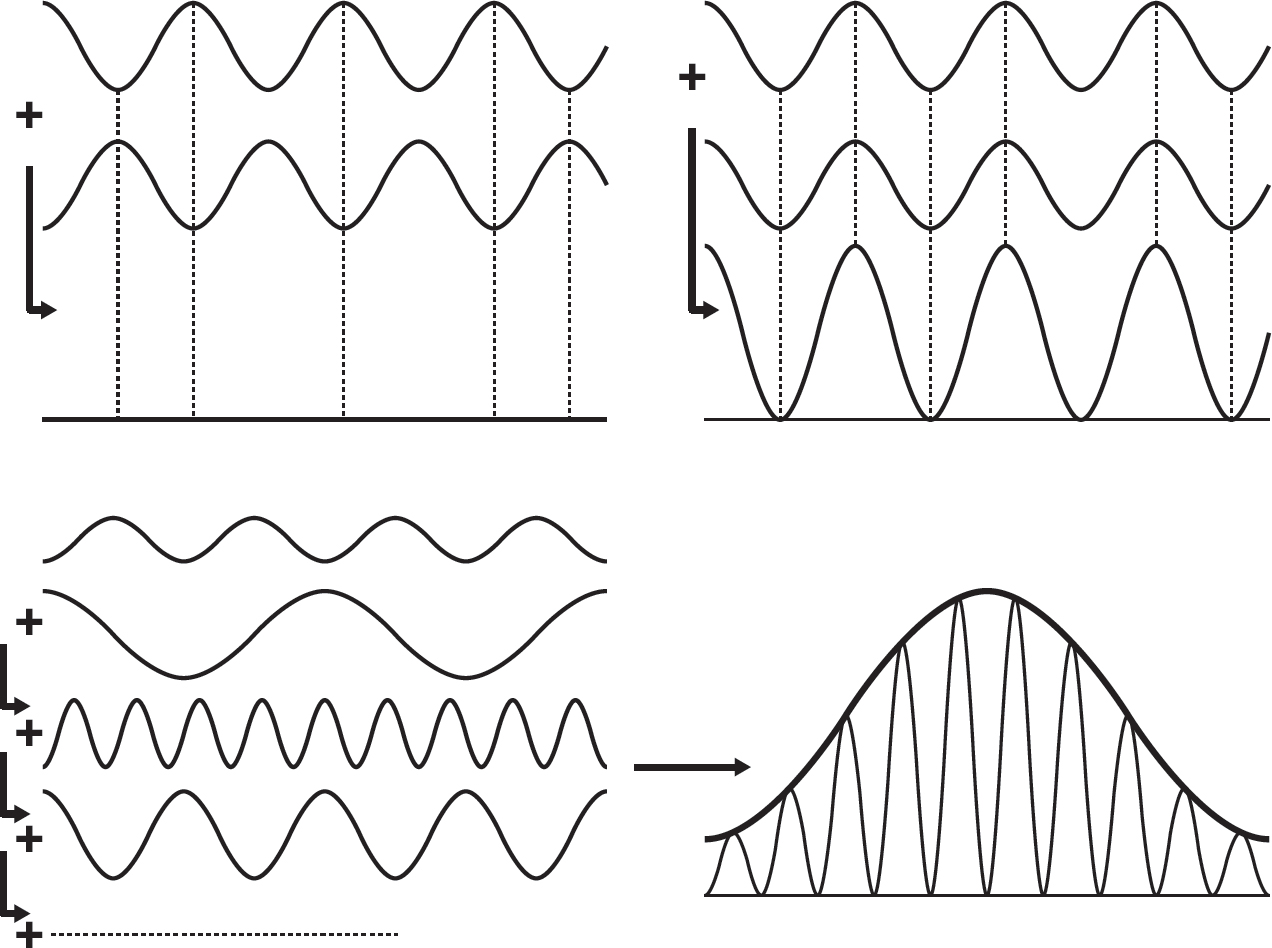
Figure 3. Waves’ superposition when they are out of phase (top left) and in phase (top right). Many of them with different phases, frequencies, and amplitudes add up to a wave packet (bottom).
From daily experience, we know superposition to be true. When you attend a concert, you do not hear the sound wave produced by each individual instrument in the orchestra; rather, the music you hear is the packet of all the instruments’ sound waves added together. Similarly, when you switch on the recessed lights in your hallway, you do not distinguish each unique light wave from each individual bulb; rather, you see the packet of light waves from all the bulbs blended together as one. The enveloping shape of all these superposed waves that move together as one unit is called a wave packet. (As we will see later, our universe at the earliest moments of its existence was a wave packet.)
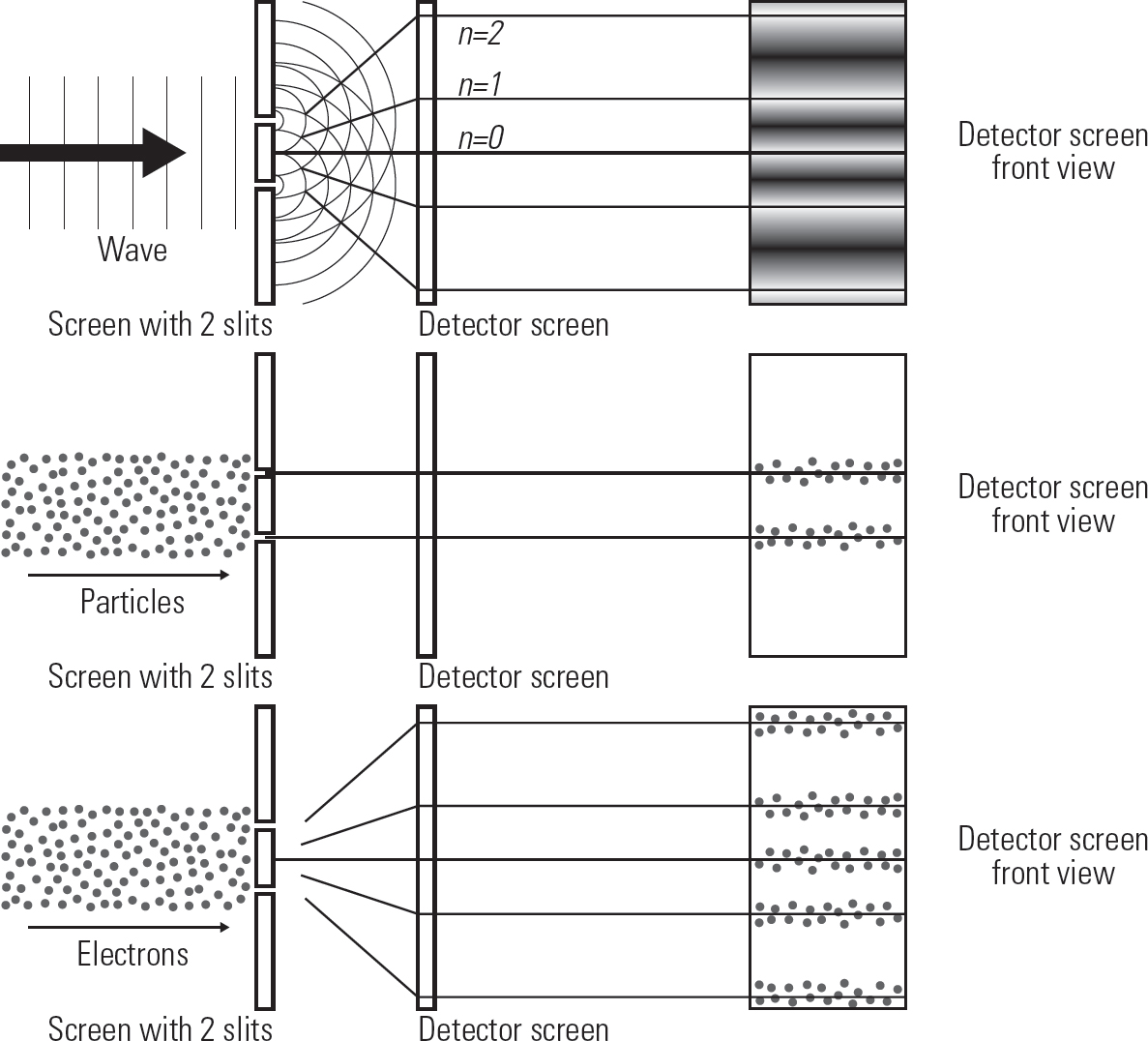
Figure 4. The double-slit experiment. Top panel: Light goes through two slits and creates an interference pattern on the screen behind. Middle panel: If electrons were particles, then we would see only two bright spots on the screen behind. Bottom panel: Electrons must also be waves because they add up and interfere, just like the light waves do in the top panel; therefore we see many bright and dark spots on the projection screen—the interference pattern of electron waves (“n” simply refers to bands).
In the double-slit experiment, the experimenter simply shines a light onto a board with two slits and then observes the pattern projected onto a screen behind. You can try this yourself if you are so inclined. The pattern that you will see on the screen is a series of alternating bright and dark spots, because in some places, the waves amplify each other, and in other places, they cancel each other out. If the light wave traveling through the first slit was at a peak while the light wave traveling through the second slit was at a valley, then the peak cancels out the valley; the two waves add up to zero and produce a dark spot on the screen, as in figure 4. (We call this “destructive interference.”) But if the two different light waves passing through the two different slits were both at a crest, then the crests amplify each other—they are added together to produce an even higher peak—and appear as a bright spot on the screen (“constructive interference”).
Generally, the bundle of sound waves at most locations in a concert hall or the bundle of light waves in your home is not completely in phase or completely out of phase but somewhere in between. Often the phases are randomly distributed; therefore, the addition of waves, rather than amplification of a flat line, leads to a wave packet with an enveloping shape, as in figure 3.
Moreover, it doesn’t matter what kind of waves we use. Sound waves produce the same interference pattern as light waves. Sound engineers know that, due to destructive interference, there are areas of “cheap seats,” where the music can barely be heard because when the sound waves reach that location, they are out of phase and cancel each other out. (These areas of the concert hall are, in effect, the dark spots from the double-slit experiment.) In the same hall, there are other areas of “expensive seats,” places that benefit from constructive interference; here, the sound waves are in phase and the music is amplified. (These are the bright spots from the double-slit experiment.) Water waves produce the same interference pattern. If I were to throw two stones into a pool, I would see the resulting liquid waves meet and either amplify or cancel each other in modulations of troughs and crests, which form an interference pattern.
The same phenomenon happens in the quantum world, but with subatomic particles. When you shine a beam of electrons (or any other quantum particle) through the double slit, it gives the same interference pattern of dark and bright spots on the screen as the light waves. Indeed, the double-slit experiment offered a rare, early opportunity to test quantum mechanics. If quantum mechanics were nonsense, if there were no such thing as wave-particle duality, if particles were just particles, then sending a beam of electrons through a pair of slits would be akin to throwing marbles through open windows. The clunky marbles would leave random scratches on the wall where they hit. But the electron double-slit experiment reveals a complete interference pattern (the bottom panel of figure 4), confirming the wave properties of electrons. As we will see later in the book, when the waves are infant universes, the interference pattern of waves becomes pivotal in testing the origin of our universe.
Thanks to the work of Planck and de Broglie and the other giants of twentieth-century physics who followed in their footsteps, wave-particle duality is a fundamental concept in physics today—and it is also continuing to revolutionize our understanding of the cosmos. Perhaps nowhere is this revolution more profound than in the study of the universe’s origins. We know that the infant universe—itself a quantum object—was a lot smaller than an electron or a quark. And as we will see shortly, quantum interference in the infant universe is a crucial key to unlocking the mystery of the universe’s creation.
To the end of his days, Planck remained reluctant to take credit for the scientific revolution initiated by his own work. For more than two decades, Planck wished for his ideas to be considered purely mathematical rather than meaningful physical reality. His unease with quantum theory is best captured in his own words, engraved on the wall of the lobby in the Nobel Prize Museum in Gamla Stan, Stockholm. These words still ring true today: “A new scientific truth does not triumph by convincing its opponents and making them see the light, but rather because its opponents eventually die, and a new generation grows up that is familiar with it.” (This saying has since been shortened to the pithier phrase “Science advances one funeral at a time.”)
Nevertheless, Planck and other pioneering scientists had developed a new and lasting theory of nature. By the mid-1920s, the revolution started by Planck had become unstoppable. Previous phenomena that appeared mysterious in classical physics found simple explanations in the new theory. Bohr’s atomic model and de Broglie’s electron-as-a-wave model had pushed the boundaries further by showing that not only light but also matter is simultaneously waves and particles. Once convinced that they had the correct answer, quantum theory’s founding fathers did the unthinkable: they remained steadfast against the might of classical physics and crossed over to the quantum realm, forever changing the way humans think. I would get a taste of what that kind of resistance felt like when going public with my own theory about the universe’s origins—but I am getting ahead of myself.
Physicists, in my experience, have dual lives of their own. They can be regular people, relaxed, happy, goofy even, but they suddenly become the complete opposite when they are immersed in work or debating or scrutinizing each other’s ideas. Time stops; life stops; there is no room for emotions. All that matters is mathematical rigor and razor-sharp logic, both of which require intense concentration. Solving the problem is the only thing that matters, because when you finally get the answer, it is magic.
My husband, Jeff Houghton, is not a physicist. I met him in Albania in 1992 when he arrived from Great Britain to work as an economic adviser in a European Union economic-development project, and we became friends. His project in Albania ended in December 1993, a month before I left the country to fly to the United States. Since we were going to be based on two different continents, I was convinced we would not see each other again. So he was the last person I expected to see on that January day a month later when I heard my name called on the loudspeaker in the Zurich airport and was instructed to approach the Swissair desk.
He was standing there in a casual manner as if meeting me by chance in the Zurich airport was a perfectly normal thing. He gave me a hug and asked if I would like a coffee, adding that he would like one because he had caught an early flight from London to Zurich in order to arrive before me. Then he asked if I’d like him to fly with me on the next leg of my trip to the United States.
I was confused, but to be polite I said, “Yes, please,” which drew a round of applause from the people behind the Swissair desk. I asked him if we should get a plane ticket for him before we had coffee. The Swissair attendant smiled and said he had already bought a ticket for that flight, the seat next to mine, before my plane had landed.
For a while, before we married and had our daughter, he worked in Europe and I lived in the United States, but we spoke on the phone daily, thus managing to do what subatomic particles cannot: know with certainty both our speed and our location at the same time.
How scientists came to know about and describe the lack of certainty in the properties of the subatomic world—the next great “quantum” leap in our intellectual journey—is among my favorite stories in modern physics. It begins, appropriately enough, with someone who was essentially a graduate student.
In Copenhagen in the 1920s, a twenty-one-year-old highly gifted German student, Werner Heisenberg, attended one of Bohr’s lectures on the atomic model and was so impressed that he asked to become Bohr’s assistant. A few years later, in 1927, Heisenberg debuted the uncertainty principle, the central building block in the foundation of quantum mechanics—the theory on which I would rely in gaining a new understanding of the moment of creation.
Heisenberg’s uncertainty principle declares that at the subatomic level, nature forbids us from knowing both the location and speed of a particle simultaneously with precision. It is central to explaining why the quantum world is filled with such constant uncertainty and why every outcome is based on probabilities. The principle is built on the dual nature of quantum particles as being both particles and waves. When we attempt to measure the speed at which the quantum particle moves, the particle switches to its dual twin, a wave. Instead of a point-like particle that inhabits a single zip code and address, the wave spreads throughout the universe, as illustrated in figure 5. Therefore, when the speed of the particle is known, its location is hard to pinpoint. And vice versa—when the location of the particle is measured exactly, then the range of possible values for its speed grows.
Thus, the speed and location of a particle are forever interlocked in a contradictory relationship. If you measure the speed of the particle with such accuracy that your margin of error is nearly zero, then nature forbids you from knowing precisely where the particle is located, no matter how clever you are and how sophisticated your measuring devices. The quantum particle (that is, the wave) may be found anywhere in the universe and you will never know for certain where. The reason behind this is explained by arithmetic: One divided by zero is infinity. If the error in measuring the particle’s speed is nearly zero, then the error you will make in measuring its location is correspondingly very large—nearly infinite, in fact.
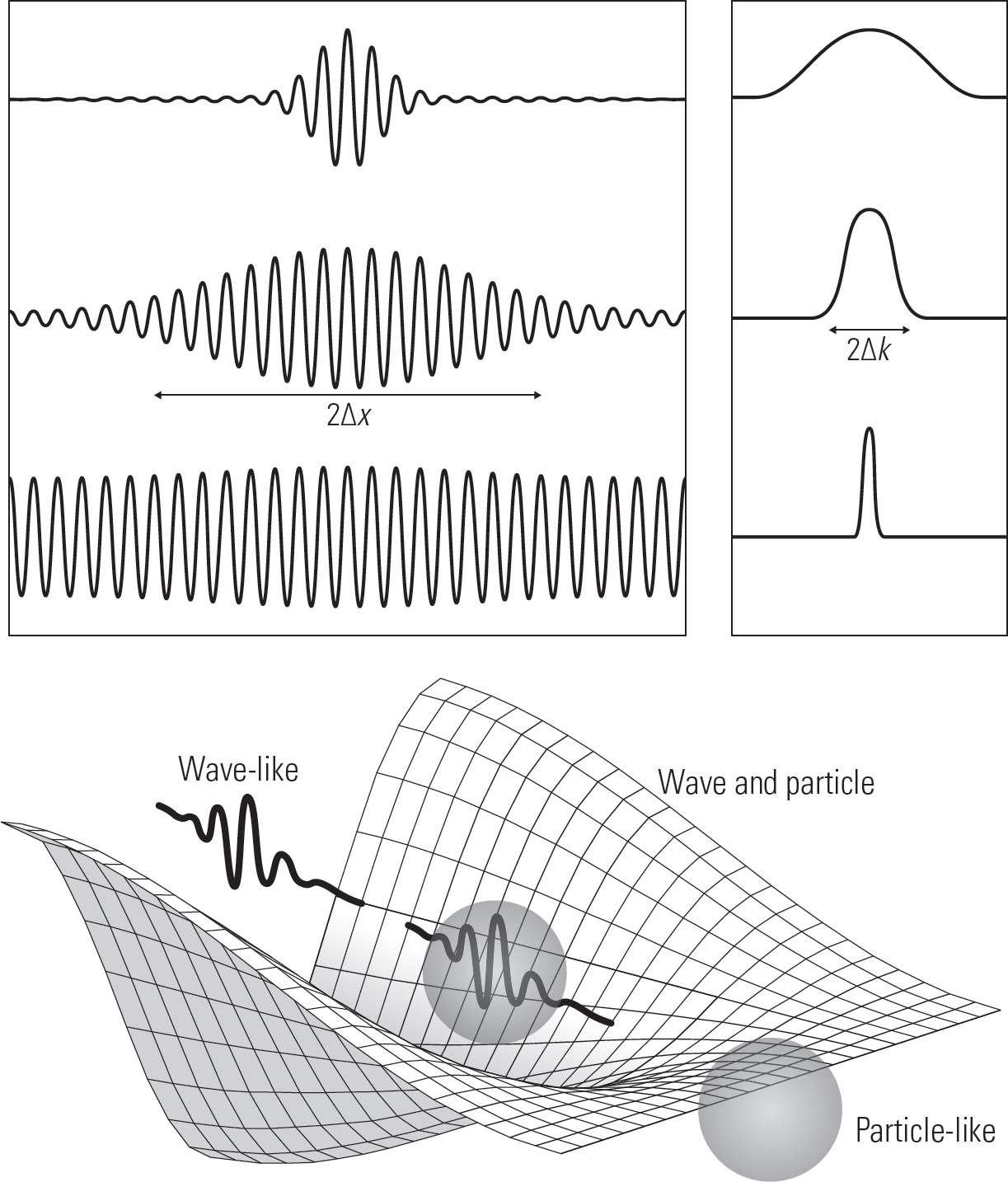
Figure 5. Top: Spreading of the wave and particle when the speed is known to great precision. A narrow wave packet (small Δx) corresponds to a large spread of wavelengths (large Δk); a wide wave packet (large Δx) corresponds to a small spread of wavelengths (small Δk). Bottom: An illustration of wave-particle duality set against an imagined space-time background. A particle is equivalent to the wave packet; most of it is “gathered” around the particle’s location, but parts of the wave still stretch out to infinity.
Heisenberg’s uncertainty principle mathematically captures the uncertainty of the quantum universe, where information, be it energy or momenta, is spread over a range of possibilities instead of holding a single value. These possibilities do not exist in classical physics—in the visible world. But a quantum world is built from wave packets that wiggle around and spread out. The best we can do to describe a quantum world is estimate the chances (in science jargon, the probability) of each possible course that a quantum particle might take. And because our universe began as a quantum object, Heisenberg’s uncertainty relations were intrinsically woven into its fabric from infancy and remain even in our big, visible, classical universe of today.
For cosmologists, the implications of Heisenberg’s principle are simple: We cannot predict what will happen to the universe. The best we can do is calculate and speak of the probabilities that these events may come into existence.
Of course, Heisenberg was well aware of how weird his kind of universe sounded. As the British biologist J. B. S. Haldane put it: “The universe is not only queerer than we suppose but queerer than we can suppose.”
Einstein himself could not digest the ludicrous implications of Heisenberg’s principle. A quantum universe may sound weird even to seasoned physicists—but that is irrelevant. Whether or not we accept it, nature has chosen it for us; numerous experiments have confirmed the validity of quantum theory to a very high degree of precision. The universe has sided with Heisenberg.
But the consequences of an uncertainty principle when applied to the whole universe are alarming. They imply that nothing in a quantum universe can be determined with certainty. Ever! Instead, they suggest that nature operates a lottery on a universal scale. If every possible universe in nature corresponds to an individual lottery ticket, each of them has nonzero odds of being the winning ticket, but none of them has a 100 percent certainty. Anything goes!
Imagine a universe that contains a planet Earth on which there is a little country called Albania. Let’s say that 13.8 billion years after the Big Bang, there is a 30 percent chance that Albania will become a dictatorship, a 40 percent chance that it won’t, and a 30 percent chance that this country may not exist in the universe at all. There is no way of knowing, at the moment our universe bangs into existence, which one of those events will be realized 13.8 billion years later. Instead, we have a pool of chances of various possibilities that an event may happen. Rather than operating in a deterministic way, every event in the universe, including the state of the primordial universe itself, is indeterministic. The universe is fundamentally uncertain.
Until the end of his days, Einstein was convinced that some profound insight was missing from quantum mechanics. He and other founding fathers of quantum mechanics could not accept the indeterminism introduced in nature by the uncertainty principle, so they tried to force their new theory into a construct that could support a single, deterministic universe. This is how the saga of a single universe continued throughout the twentieth century. But they failed. That failure eventually led to building the intellectual foundations on which the search for a testable theory of the multiverse began in the twenty-first century.
As if Heisenberg’s uncertainty principle were not unsettling enough, a new development soon took the field of quantum physics in an even more uncertain direction.
Working independently of Bohr and Heisenberg in the early 1920s, the Austrian physicist Erwin Schrödinger, intrigued by de Broglie’s findings that electrons were both waves and particles, focused on the wave-particle duality of quantum mechanics. Along with Planck, Einstein, Bohr, and Heisenberg, Schrödinger labored until the end of his life to disprove the implications of quantum theory.
Yet in 1926, Schrödinger made the most important discovery of his life and, unknown to him then, of the lives of generations of physicists. This discovery was the Schrödinger equation. It allows scientists to calculate what happens over time to a quantum particle as it is pulled or pushed by external forces. The Schrödinger equation also is the last pillar to complete our understanding of quantum physics.
Schrödinger’s equation is not as impossible as it sounds. To make sense of it, imagine a group of physicists taking a walk on a mountain range—for example, the Rockies in the United States or the mountains of the Lake District in England. Suppose that the physicists are all carrying handfuls of marbles (the physicist’s favorite toy!). At the top of a mountain, our physicists accidentally drop their marbles. In dismay, they watch their marbles roll down the mountain in all directions and settle into nearby valleys and lakes.
The marbles in this scenario won’t stop rolling until they reach the bottom of each valley because the Earth’s gravity pulls them down. In fact, they gain speed as they roll because their total energy (which is made up of their kinetic energy and gravitational potential energy) must be conserved. As the marbles get closer to the bottom, their interaction energy with Earth’s gravitational field, known as potential energy, is converted to energy of motion, or kinetic energy, to compensate for the decrease in the gravitational potential energy, in order to keep the sum of the two unchanged. The mathematical expression for conserving the total energy is an equation that describes the classical motion of each marble as it rolls downhill.
Putting the difference between a classical and a quantum particle aside for the moment, Schrödinger’s equation serves the same role as the above classical equation of motion for the marbles: Given the information on the mass of the particle and the external forces acting on it, this equation describes how a quantum particle evolves in time. It is the quantum version of the classical equation of motion. Both sets of equations are guided by the same principle: they constrain the total energy of the particle—the sum of its kinetic and potential energies must be conserved. Energy cannot be created out of nothing; thus, it must be conserved.
To see how this works, imagine now that Earth’s gravitational potential energy represented by mountain ranges and the marbles have been rescaled to be subatomic size—say, the size of electrons. These electrons are in the presence of some external field similar to the gravitational field on the marbles in a mountain range. The type of the external field to which these electrons are subjected does not matter for our purposes; this external force could itself be gravitational, nuclear, electromagnetic, or something else. All that matters is that there is an external force exerted on the electrons, just like the gravitational pull of the Earth is exerted on the marbles. The motion of these electrons is given by solutions of the Schrödinger’s equation.
Despite their similarity, the classical and Schrödinger equations of motions are conceptually very different on some key points. Schrödinger’s equation operates in a quantum world, and it treats particles as if they were waves. To complicate matters, it doesn’t produce a single answer for how a “quantum marble” will move. Instead, it offers a family of waves with each of the waves moving on a different path.
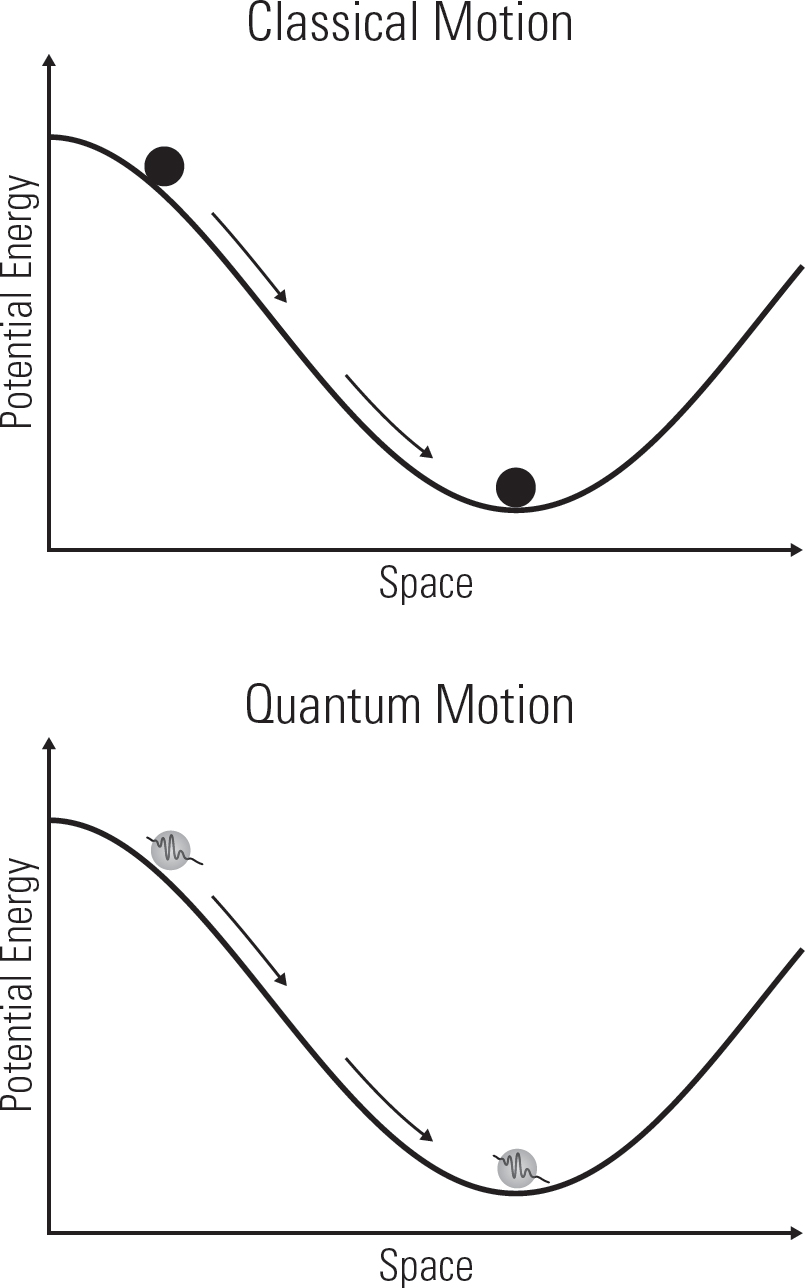
Figure 6. The top graph shows a marble rolling down a mountain under the influence of the Earth’s gravitational potential energy. The bottom shows a quantum particle, such as the inflaton, rolling down a potential energy field. Thanks to Schrödinger, we know that this quantum particle is also a probability wave.
Crucially, each wave solution coming out of Schrödinger’s equation is interpreted as a probability wave, meaning a quantum particle has a nonzero probability of following any of these wave paths—and we won’t know beforehand which one the particle will choose.
Furthermore, unlike visible, classical particles, which follow determined trajectories in real space-time, quantum particles evolve in a space of possible paths, each with its probability of happening.* That multitude of possible paths captures the full uncertainty of the quantum world.
Heisenberg, the originator of the uncertainty principle, approved of Schrödinger’s wave solutions being conceived of as probability waves.*
With Schrödinger’s equation, the complete quantum “machine”—the mathematical device—that nature uses to run its probability game was finally revealed. Into one side of the equation, we feed the mass of the quantum particle and the external forces acting on it; on the other side, the machine spits out the answer, the probabilities for what may happen to the paths that particle will follow over time.
So what happens if we turn this quantum machine to the seemingly intractable problem of the explosion of the early universe? What happens if the particle that we feed into the machine is the inflaton, the cosmic particle that drove the inflation of the universe at its infancy? What insights can quantum physics provide about this mysterious moment? How can it help us understand the elegant but incomplete theory of cosmic inflation?
When Guth and Linde’s inflaton particle and its hypothetical potential energy are fed into the machine of the Schrödinger equation, it spits out the answer of an inflationary universe. Much like the marbles rolling down Earth’s gravitational potential energy on the mountain, Guth and Linde’s inflaton rolled down a potential energy well that was so shallow, the inflaton rolled extremely slowly—so slowly that its energy didn’t appear to change over time.
Cosmic inflation is a paradigm rather than a theory because there are many models, postulated by many scientists, for what the hypothetical primordial potential energy of the inflaton could be. Despite the variety in their postulated inflation energies, all of the models of the cosmic-inflation paradigm achieve the same result: the inflaton breathes its fire into the Big Bang, “blowing up” the infant universe and accelerating the universe’s growth uniformly in all directions. A little later, this same quantum particle fills the universe with all matter and light and energy to make it into the beautiful place we call our universe today.
But how do we go from the origin of a quantum particle to a vast collection of matter, stars, galaxies, and planets—a universe so expansive that we could not journey across it even if we were given many lifetimes? Here, the theory of cosmic inflation seemed to come up short—which intrigued me and made me wonder what path Boltzmann, Planck, and Penrose would have chosen.