
4
PHYSICISTS ARE HAPPIEST when they identify new problems rather than new solutions. (Sometimes also when they are told that they are smarter than their colleagues.) New problems mean the potential for new discoveries and a subsequent lack of boredom. And such is the beauty of the quantum world that it never ceases to offer new insights into old problems, including the rich story of cosmic inflation.
After receiving my doctorate from the University of Wisconsin–Milwaukee in 2000, I decided to devote most of my time to cosmology. Instinctively, I knew this field was about to enter a golden era. Technology was allowing us to explore farther and deeper into outer space and microscopic space alike, and the standard model of cosmology—the dominant theoretical model that describes the evolution of the universe—contained more mysteries than ever, mysteries that a new generation of scientists would have an opportunity to solve.
And as I embarked upon my newly chosen scientific career, one mystery in particular captured my interest.
In the standard model of cosmology, a minuscule fraction of a second after the Big Bang ends, the universe is roughly the size of a blueberry; it has exited the initial inflationary stage. It is a classical object (although the stuff inside it is still quantum), and while its growth is no longer accelerating, it continues to expand. But if nothing can exceed the speed of light, how do the wavelengths of these particles catch up and communicate with each other over the growing distances across the expanding universe?
Here, the wave-particle duality of quantum mechanics might provide the explanation. As the primordial patch of space is blown up like a balloon in the same manner in all directions to cover the whole infant universe, everything inside is being stretched along with it.
To be clear, while particles are assumed to be stretching at the same scale as the universe, this does not mean that an electron suddenly becomes as big as the whole universe. Rather, what changes is the particles’ wavelengths. These particles are still subatomic, governed by quantum theory, and thus retain their wave-particle duality. So, as the universe inflates, these photons’ and particles’ wavelengths get stretched, not the particles themselves.
This phenomenon accounts for something else: the cooling of the infant universe. As the wavelengths of these wave-particles expand, their energies decrease in an identical relationship, which causes the whole universe to cool down uniformly as it expands.
The temperature of the universe continues to drop after inflation ends, since the universe continues to expand. But when inflation ends, the energy of the inflaton has to go somewhere—and it does. The inflaton particle decays into other particles of matter and light and transfers all of its energy to them, a process known as reheating. (In truth, the universe does not actually reheat; rather, it is filled with radiation, just like George Gamow predicted in his Hot Big Bang model. The word reheat is a misnomer derived from the explanation for the similar properties of our universe after inflation and Gamow’s Hot Big Bang.)
This continuous cooling as the universe expands creates the conditions for elementary particles—protons, neutrons, and electrons—to become stable. They first appear at about a ten-millionth of a second after the Big Bang. A bit later, these particles combine into the first atoms of hydrogen (see figure 7), and the universe is covered by a cloud of hydrogen.
Three minutes into the life of the universe, a phenomenon known as Big Bang nucleosynthesis (BBN) takes place. BBN produces helium and other elements heavier than hydrogen that populate the universe, and it lasts for about four minutes. At this stage, although the universe has begun to cool (it technically started cooling almost as soon as it began to inflate), it still remains so hot that photons—that is, light—and matter particles like protons, neutrons, and electrons are boiled and mashed together into a plasma state, making the universe opaque.
Not until some 380,000 years later does the universe’s temperature fall sufficiently for photons to completely free themselves from other particles in the plasma; they thereafter remain visible to observation as a bath of radiation in the background sky. As these light particles separate from matter, the universe becomes transparent. This background bath of radiation, which continues to permeate the outer reaches of the universe to this day, is called the cosmic microwave background radiation, or CMB. (I will return to CMB later on, because it is going to matter a lot as my own quest progresses.)
A few billion years or so after cosmic inflation ends, structures (stars, galaxies, and clusters of galaxies) start to form, the result of the gravitational condensation of the remnants of the hydrogen cloud. All the regions in the sky that have high concentrations of matter collapse gravitationally under their own weight and start making the first stars. The next stage is the production of heavier elements. Metals are produced by fusion—the smashing together of lighter elements at extreme pressure to make a heavier one—inside the cores of stars.
Once stars form, the universe goes through a long and perhaps less interesting period where nothing major happens; the universe continues to expand and its temperature continues to cool. (The reconstructed history of our inflating universe in space and in time from the first moment to the present is shown in figure 7.)
But if our universe started purely from the energy of cosmic inflation, how did everything within it, from photons to matter particles that make stars and galaxies, come to be here?
Cosmic inflation has an answer to this question, too, and a very good one. While Einstein’s equations convincingly demonstrate that the overall growth of the universe comes from the matter and energy inside it, quantum theory reveals what seeded this matter and energy in the universe when cosmic inflation ended. The origin of these structures arises from Heisenberg’s uncertainty principle. In quantum mechanics, fluctuations of energy, including the energy of cosmic inflation, are always present. We can think of quantum fluctuations as unpredictable small deviations that flicker on the paths of quantum particles and as variations that glint their energies. They are mathematically captured by the Heisenberg uncertainty principle, therefore, since quantum fluctuations in the initial energy of inflation are unavoidable, then when the universe stops inflating, it suddenly finds itself filled with waves of quantum fluctuations of the inflaton energy. The whole spectrum of the primordial fluctuations in the inflaton energy, some with mass and others without, are known as density perturbations. The shorter waves in this spectrum, those that fit inside the universe, become photons or particles depending on their mass as the universe cools down.*
After inflation ends, the primordial soup of photons and particles is scattered uniformly through the universe as a distribution of blobs (lots of mass) and voids (little mass). The over-dense regions with blobs of mass collapse under their own weight and create stars and galaxies. The sky tonight is the result of these primordial fluctuations; they show up as light and stars. The origin of matter and light inside the universe is, therefore, purely quantum in nature.
Furthermore, Einstein’s equations connect the energy of these fluctuations to the space-time on which they exist (remember, energy tells space how to curve). Specifically, the energy contained in the inflaton fluctuations triggers tiny tremors in the very fabric of space-time. And the tiny tremors in the fabric of the universe in turn induce weak ripples or vibrations in the gravitational field inside the universe. These ripples are known as primordial gravitational waves.
We can make models of failed universes. Different inflationary models produce different amounts of matter and light, resulting in different density perturbations. These density perturbations, which establish the matter-energy content of the universe, determine what happens to its growth. If a lot of matter is produced, the universe will not hang around long enough for humans to arrive; it will quickly cave in on itself and collapse like a black hole when it is still young. If there are too few of these fluctuations, the universe won’t have enough matter to clump. The over-dense regions will be too few and too far apart—with the result that the universe will be barren of life and structure. It will continue expanding but will be comparatively empty.
In my mind, the answer to this riddle—the extremely small chances that our universe has to start with the right type of inflaton potential energy and a smooth patch of space—lay in decoding where the inflationary energy originated and what was there before.
The strength of the inflaton fluctuations that create the desired amount of density perturbations and, ultimately, all the matter and radiation we observe in the universe are directly determined by the details of the energy of the inflationary model. The trouble is that there is a large family of models under the umbrella of the cosmic inflation paradigm. Choosing the right potential energy, the one that contains the desired features that reproduce the structures we observe in the universe, is a theoretical construction done by hand, a model selected from a myriad of potential inflaton energies. Physicists hoped that one day, instead of an ad hoc design, they could motivate and derive this unique model of cosmic inflation based on fundamental physics laws. This challenge intrigued me.
As I went through a group of popular models of cosmic inflation, I could appreciate what made the opponents of the theory most unhappy: If the inflationary model had to be meticulously constructed to give the right answer—that is, the right amount of perturbations to explain how our universe came to exist in the exquisitely balanced form that it did—then isn’t cosmic inflation an unnatural way of starting a universe? Observationally, our universe does turn out to have the perfect amount of density perturbations (about one part in a hundred thousand) to stay flat and hang around long enough for stars to form and make heavier elements and—eventually—human life. The opponents of cosmic inflation were rightly concerned that the hypothetical potential energy and the initial tiny patch from which our universe inflated appeared carefully designed, or fine-tuned, to produce precisely this amount of perturbations.
This special arrangement seemed to be the crux of the origin problem. If the inflationary universe is in a specially ordered state at its initial moment of existence, then its entropy must be nearly zero, which means it has an infinitesimally small chance of happening. In other words, for cosmic inflation to switch on and kick-start the universe into being requires very special initial conditions indeed. To have all of these—a flat universe with the right amount of structure scattered uniformly and homogeneously through our skies—for the price of one inflaton particle, the infant universe must have been in a remarkably unusual state of exceptional order.
Here is the dilemma physicists face: Cosmic inflation offers the whole cosmic origin story in one irresistible package. But it does so at the cost of one assumption: a finely tuned start of the universe at high energies on an exquisitely smooth tiny patch of space. And this is a huge assumption, because everything else we know about the workings of the universe tells us that the odds of our universe starting the way it did, in a tailor-made initial state of exceptional order with an entropy state of nearly zero, are ominously small!
Penrose had made a splash in the 1970s by pointing out this embarrassing fact, and it led to some even more embarrassing implications. Since starting a universe with this state is more improbable than any other possibility, then even what might be conceived of as outrageously impossible will have a higher chance of existing than our universe does.
Consider this spooky example as a dramatic statement of the unlikeliness of our existence: The spontaneous formation of a brain in empty space stands a much greater chance (statistically) of occurring than the creation of our universe through cosmic inflation! I kid you not. This compelling description of improbability has become known as the Boltzmann brain paradox in celebration of the legacy of the man whose own mind produced the entropy equation and its relation to probability. The standard model of cosmology does indeed seem to lead to the conclusion that floating brains and all other sorts of science-fiction events you never thought possible should not only exist but outnumber and overwhelm us. As absurd as this floating brains idea sounds, you won’t be able to get a straight answer from any physicist as to why these brains are not there. Granted, it is an outlandish and ludicrous example, but it provides a dramatic indicator of the extreme unlikelihood of cosmic inflation.
For some scientists, these were good enough reasons to discard cosmic inflation and replace it with a new model of cosmology. While open to persuasion, however, I still believed that cosmic inflation was correct but incomplete.
Moreover, as I spent years going through every page of our cosmic evolution, I became convinced that discarding cosmic inflation was not a wise solution to its origin problem. Cosmic inflation has performed spectacularly well against all observations that have been made of the universe to date.
Meanwhile, the pressure from freshly discovered cracks and paradoxes in our understanding of the universe was growing. In addition to the mystery of its origins, the universe was about to throw another curveball at us. In 1998, while I was still a graduate student at UWM, the distinguished astrophysicists Saul Perlmutter, Adam Riess, and Brian Schmidt had made a surprise announcement: The universe was inflating—again!
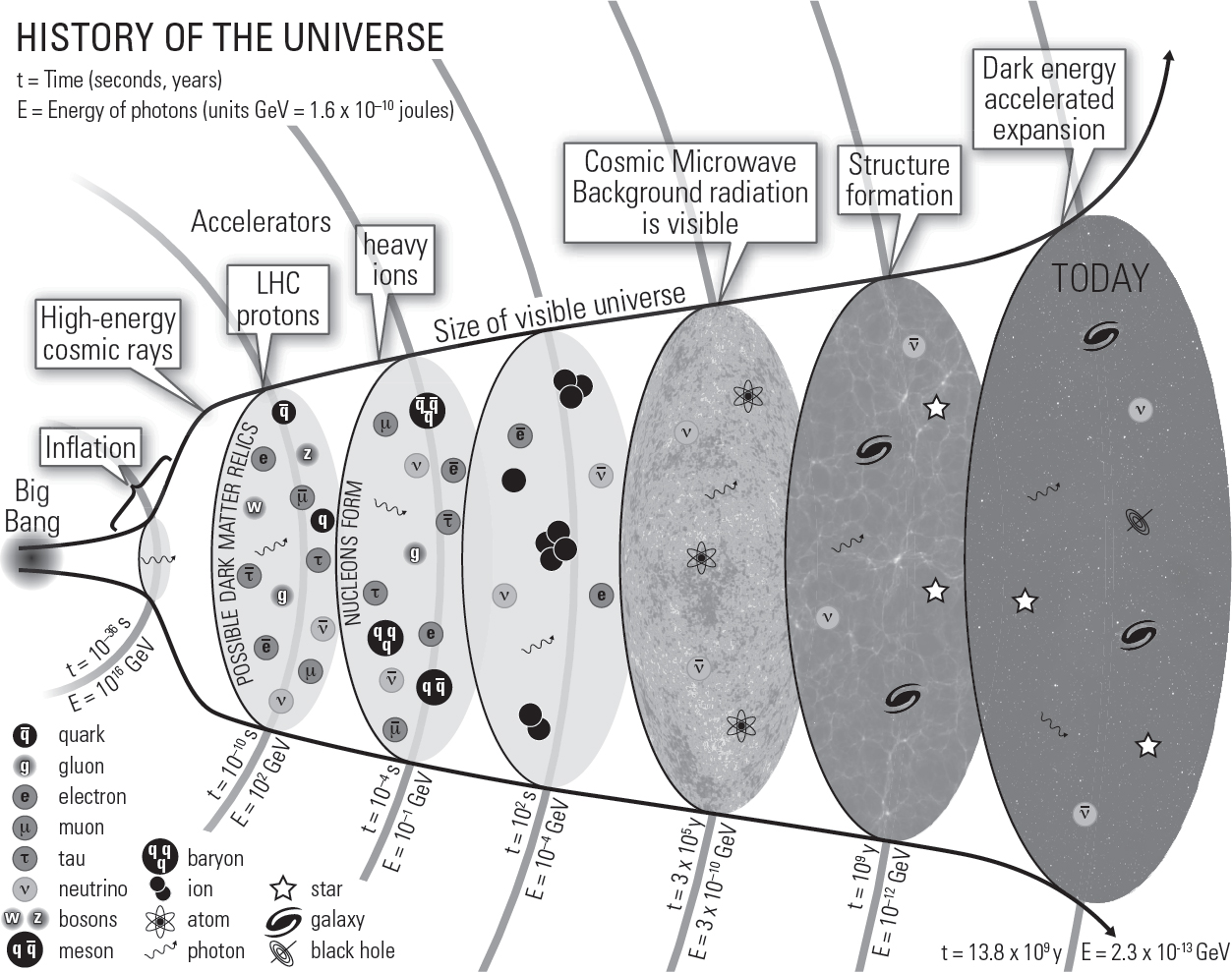
Figure 7. The whole standard model of cosmology is contained in this diagram. Time runs on the horizontal axis from the first moment of Big Bang inflation to present. Space runs on the vertical axis. Note that the universe is growing in time and it is flat in space, as can be seen by taking slices of the universe at each moment in time.
Particle Data Group at Lawrence Berkeley National Lab
The name for the energy that is making the universe inflate again is mysterious and foreboding: dark energy. Dark energy is a true enigma even to the best scientific minds. It became my particular fascination by the end of my graduate work; indeed, you could say that my deep interest in the universe’s beginnings was cemented by contemplating how it will end. During my two-year postdoctoral fellowship in Pisa, Italy, at the Scuola Normale Superiore di Pisa, that was my sole concentration. Scuola Normale Superiore is one of the most inspiring institutions I have ever worked at. Its rich history provided the perfect setting for contemplating the destiny of the universe. Galileo and, more recently, the great nuclear physicist Enrico Fermi had trod the hallowed halls of the university. Fermi’s former office was only two doors from mine; I could see the Leaning Tower of Pisa from my window.
Dark energy behaves like an ether; its energy mysteriously diffuses out of a vacuum and yet it permeates every speck of the universe and pervades the very fabric of space-time. Similar to the energy that jump-started cosmic inflation, dark energy has two unusual properties: the amount of it per unit volume, its energy density, is (almost) a constant, and its pressure is negative. Both of its components, energy density and pressure, will determine what happens to our universe in the future. While the total amount of dark energy contained in the universe controls the speed of expansion of the universe, its pressure controls the acceleration of its expansion—that is, the rate at which the expansion of the universe increases or decreases.
The total amount of dark energy grows in direct relation to the expansion of the universe, so as the universe expands and every other energy source dilutes and ultimately empties out, dark energy will be the only energy left. Thus, dark energy becomes the ultimate arbiter of the universe’s destiny. The density of dark energy is tiny—approximately one one-thousandth of an electron volt. But while this number may sound small, don’t be fooled: dark energy dominates the energy of our present universe.
Visible matter, or what physicists call baryonic matter or baryons, is the stuff we are made of; it includes every proton and neutron, all the atoms in our bodies and in every living thing, the stars and planets, the galaxies and clusters of galaxies, and the cosmic dust. In sum, it is all the material that we see in the world around us—and it accounts for less than 5 percent of the total energy density in the universe. Dark matter—a type of matter that is nonluminous and therefore invisible to the eye—makes up about 20 percent of the universe’s energy. The remainder, dark energy, makes up a staggering 75 percent.
Oddly, our universe had the perfect amount of dark energy at the beginning—only a tiny bit—which allowed the cosmos to hang around long enough for all the structure and life to occur. The baffling question, one for which no one has an answer, is: Why isn’t this number zero or, alternatively, the same as the Big Bang energy?
The discovery of dark energy presented two other daunting mysteries. First, if our universe had contained even a little bit more of this unfathomable energy, it would have grown too quickly and too early, before matter clumped together and formed stars. The universe would have been ripped apart and would have remained featureless from the accelerated expansion billions of years ago. How did we get so lucky?
Second, just like the mysterious source of the energy that unleashed cosmic inflation at the beginning of time, the origin of dark energy is unknown. While I was in Pisa, my Spanish-born colleague and friend Mar Bastero-Gil and I proposed a likely source for dark energy, arguing that it was stored in a particular way in the quantum fluctuations of what might be empty space-time or, perhaps, a vacuum. But as of this writing, this second mystery endures too.
Without the answers to these questions about dark energy, we cannot definitively settle the larger question of how the universe will behave in the future. It is littered with Heisenberg uncertainties—which might be just as well, because the options are not encouraging.
What might a dark-energy future hold? According to what we do know about it, dark energy promises multiple cataclysmic endings for the universe, more shocking than even the most inventive science-fiction writers could imagine. Soon (and don’t worry—by soon, physicists mean cosmological timescales measured in billions of years), when dark energy is virtually the only energy left in the universe, galaxies might break apart so quickly that they will lose contact with one another. Each local galaxy, including our own Milky Way, would become its own universe, disconnected from the other regions and separated by distances that can be reached only at superluminal speeds.
The universe’s ultimate death could, cosmologists hypothesize, come in one of at least three ways. If our universe remains in an accelerated expansion forever, the distance between stars and galaxies will be so big that our sky will appear empty, and the universe’s temperature will fall to nearly absolute zero. Life will not be able to arise or be sustained; starlight will not reach us; the sky will be frigid, empty, and dark. All species would suffocate; all clocks would freeze. The last tick of our cosmic clock, just before the end of time, would become the universe’s last heartbeat.
A second possibility is that dark energy is not actually vacuum energy but an inflaton-type particle that temporarily moves so slowly that it mimics pure vacuum energy. But in the future, this particle may decide to alter its speed and energy. If it speeds up, it could ultimately reverse the universe’s expansion and cause it to contract and get hotter and then collapse in a blaze of fire.
Finally, dark energy could become what has been described as phantom energy, energy that becomes wild and uncontrollable. In this scenario, galaxies and stars and atoms and, ultimately, the very fabric of the universe are ripped apart. Worse still, the process is accelerated, and the universe will be shredded in a relatively short time, perhaps only ten to the power of thirty billion years.
Of course, the fate of the universe remains to be written. But what we do know is that our ending is inseparably intertwined with our beginnings, because it was inflation energies and dark energies together that drove our universe into its accelerated expansion. Both have and will control the growth of the universe from its first moment to its last. And from the start, both had to be calibrated just right to ensure that our universe survived. Otherwise, matter could not have clumped, stars would not have formed, we wouldn’t be here, and the universe’s very fabric would have already ripped apart billions of years ago.
The revelation that both the origin and the destiny of the universe rely on the same underlying enigma, that the same type of energy that sparked the first episode of inflation and created the universe will also produce the final episode of inflation when the universe ends, led to scientists’ renewed interest in our origins. Adding dark energy to the mix of problems associated with cosmic inflation also raised a challenge to the universe’s origin story that was too important for physicists to ignore.
In the early 2000s, as scientists were faced with these two fundamental mysteries—the creation and the final destiny of the universe—cosmology entered a golden era: an age of big problems in need of solutions. And as luck would have it, it was also when I began my career as a full-fledged working scientist. Like my colleagues, I couldn’t wait to get busy.
Physicists are very good at playing God using so-called thought experiments. We cannot reproduce the Big Bang inflationary explosion to create universes in a lab, nor can we travel back in time to explore what was there before the Big Bang. However, our minds are our cosmic labs; we can use the tight constraints of math, the laws of nature, and our astrophysical observations to imagine, scrutinize, and sift through all the possible scenarios in the form of thought experiments. So, as is customary for a “pen-and-paper” theoretical physicist, I started by coming up with a variety of new thought experiments and analyzing existing ones.
In my first thought experiment regarding the universe’s creation, I relied on the Penrose theorem that the entropy of the universe is quite large at present but was nearly zero at its first moment. I envisioned starting with a big universe full of entropy and with all the structures already in it, like our present universe. Wouldn’t that be far more likely to happen than starting with a tiny universe that banged into an explosion and went through all the trouble of actually making the structure of stars and galaxies (and us)?
I tweaked this example further. What if I were to conjure up another non-special universe, one that started big but, instead of expanding, kept shrinking until it crunched to a point? In this new universe, I would have naively reversed the direction of time (our second law of thermodynamics), exchanged the future with the past, and swapped the present high-entropy state of the universe with its past low-entropy state 13.8 billion years ago.
Could these tricks solve the origin problem? Is a universe starting in a state of high entropy more likely to occur than the real universe we inhabit? Unfortunately, no—it is not that easy! This new universe that started big and full of entropy turned out to be just as unlikely to occur as our universe, which started small and devoid of entropy. For one simple reason: according to the second law of thermodynamics, the entropy of a universe keeps increasing relative to where it began. As we discussed in chapter 1, Boltzmann taught us that the entropy of the universe is a measure of its probability to spontaneously come into existence; therefore, if the universe had a low entropy at its creation relative to the present, then, correspondingly, it would have a low chance to exist.
Fine, I thought, the new universe model doesn’t solve the problem of the unlikeliness of our origin. But how about another possibility: A universe that bounces back and forth, from big to small and from small to big again, in eternal cycles? That should evade the second law of thermodynamics, since we have completely lost track of what to call the beginning of the universe and what to call the end. When the universe bounces and repeats its bouncing, all the cycles are the same. Such a universe should give us the freedom to choose an initial state of high entropy and a final state of low entropy. We can choose the beginning of the universe to be the moment when it has just crunched at the end of one cycle, the moment when it has just bounced back and reappeared small and growing in the next cycle, or the moment when it is halfway through the cycle.
Such models do exist. But like the previous one, they collapse in humiliation thanks to the second law of thermodynamics. The entropy of any universe we model cannot decrease with time, ever. That is, a universe simply cannot reorganize itself to go spontaneously from a disordered state to an ordered state. What I learned from playing out such thought experiments in my head was that it didn’t matter how we started or what kind of a universe we have; we will still conclude the origin of that universe is special. Our universe was not unique in starting with a low-entropy state and therefore a low probability of existence. The second law of thermodynamics made any universe appear special.
Although this way of thinking took me further away from a solution, I realized that existing models built on such reasoning were too naive. There is no such thing as an absolute measure of entropy in the universe; an entropy state is high or low only relative to some other entropy state. All these models failed because I applied the second law of thermodynamics to a single universe. Whichever new universe I started with, its entropy would increase in the future relative to its own entropy at the beginning.
No matter what we call the first moment in the life of the universe, the universe will increase its entropy the instant after it begins and will continue to do so in the future. As entropy increases, disorder and the amount of “missing” information increases over time (recall that, according to Boltzmann, entropy is simply the missing information about a microstate of the system contained in any given collection of microstates). That means that no two cycles in the bouncing universe can be identical; each cycle will have its own individuality. Building a universe that goes through identical cycles is impossible, since it keeps increasing its entropy over each cycle. The universe cannot recover in one cycle all the information it lost in the previous cycle; the lost information, in the form of entropy increase, is lost for good. Entropy increases irreversibly from past to future. Thus, the cycles of this universe cannot be identical or reversible; they cannot evade the second law of thermodynamics or the irreversible arrow of time (the direction of time from past to future).
With the help of these thought experiments, I had reached a turning point in my investigation.
I concluded that, quite generally, the origin of any single universe is unlikely, no matter what people conjured up in thought experiments. Independently of how the universe starts and how it evolves, whether it grows, shrinks, bounces, or gets ripped apart in its final state, it will always evolve toward disorder; its future will always be more disordered than its past, because its entropy must increase. Which is why the second law of thermodynamics that states “entropy always increases” holds a supreme position among all the laws of nature. These thought experiments helped me realize that the mystery of our unlikely existence is a generic problem for starting any universe in any manner. Which didn’t make sense.
This reasoning convinced me that deconstructing and reconstructing the universe would not help shed light on its origin. No matter what kinds of universes I made up in my mind, they would all suffer from an unlikely origin. The constructs were doomed. But at least they helped me narrow down the possibilities and figure out what didn’t work.
The common thread in these thought experiments was that they were based on comparing entropies within a single universe. This made me think that the hypothesis of having only one universe was why these thought experiments ran into trouble with the second law of thermodynamics and therefore always failed to explain the origin of the universe. The single-universe assumption was to blame. Why were physicists still clinging to it, I wondered—and what would happen if we discarded it?
It is difficult to overestimate the appeal of a singular universe to most twentieth-century physicists. The beauty of science lies in its simplicity, a simplicity encoded in the logical structure of its equations. At the same time, the value of science lies in its predictive powers, in its ability to state with certainty what will happen to an object—in this case, the whole universe. The idea of a single universe described by a single unified theory provided both simplicity and predictability. It satisfied both of these basic scientific cravings.
The bias toward a singular universe with a single set of laws ruling it is an ancient idea dating back to Plato. Much more recently, Einstein spent the later years of his life in search of a single theory of everything that would reveal the one manual of laws covering our whole universe, from its origin to its ultimate destiny.
As I slowly chipped away at the problem of the universe’s origins, I came to see that most of the prominent ideas circulating in the physics community were not fundamentally different from earlier ideas going all the way back to antiquity. And previous attempts had failed to solve the problem. Before digging too deep, I thought it was important that I understood other researchers’ points of view. Specifically, what made these scientists keep returning to the same framework of a single universe wrapped up in a theory of everything or, alternatively, steering away from this problem altogether? I suspected one of the reasons was the long history of what I call the single-universe school of thought.
Although I still had no clear idea of what might work, I realized that this mystery required a different approach. If the small probability of existence was generic to all universes, then something very basic must be missing from our understanding of the issue. What could that be?