
The so-called endogenous psychoses, particularly schizophrenia, represent one of the greatest enigmas of modern psychiatry and medicine. In spite of extreme investment of time, energy, and money, the problems related to nature and etiology of the psychotic process have successfully resisted efforts of generations of scientists. The theories of psychosis cover an extremely wide range from strictly organic to purely psychological and even philosophical interpretations. All these extreme positions have as their representatives brilliant, sophisticated, and respectable scientists with impressive credentials.
According to those researchers who adhere to the medical model, psychoses represent such a drastic distortion of the correct perception of reality that one must postulate a serious pathology of the organs that mediate the perception of the world and the interpretation of the sensory data, particularly of the central nervous system. Partisans of this view insist that the cause of psychoses must lie in some acquired or inherited biochemical, physiological, or even anatomical anomalies of the brain. An acceptable alternative suggests that a pathology in other organs or systems of the body may be involved that changes the biochemistry of the body and influences the brain indirectly. Although search for such organic causes has so far been largely unsuccessful, all conditions involving unusual states of consciousness continue to be treated as “diseases” with an etiology that has yet to be discovered. Since psychiatric research has so far failed to detect the actual causes of psychoses, the definition of “disease” is characteristically equated with the manifestation of symptoms, and symptomatic relief is seen as an indicator of improvement.
The psychological theories of psychosis fall into three distinct categories. The most extreme formulations on the opposite end of the spectrum from the medical model see psychoses as basically problems of living or different ways of being in the world. Phenomenology, existential analysis, and Daseinsanalysis could be mentioned here as important examples of approaches that emphasize philosophical understanding rather than interpretation in terms of medical pathology. Most psychological theories see psychoses as pathological states that have psychological rather than organic roots. With a few exceptions, the orientation of these theories is biographical; this narrow focus prevents them from seeing significant psychological factors beyond the range of childhood traumas. Some of these approaches complement intrapsychic dynamics by factors of a sociological nature. The third category of psychological theories of psychosis is most interesting and promising. It involves approaches that emphasize the positive value in the psychotic process. In this view, many unusual states of consciousness traditionally considered psychotic, and thus indicative of serious mental disease, are seen as radical attempts at problem-solving. If properly understood and supported, they can result in psychosomatic healing, personality transformation, and consciousness evolution.
Clearly, then, there is no general agreement in psychiatry and psychology about the nature and etiology of the psychotic process. Most serious researchers tend to emphasize the enormous complexity of the problem and to think in terms of “multiple etiology.” This term suggests that the problem of psychosis cannot be reduced to any simple chain of biological, psychological, or social causes. There is not even unanimity on the clinical diagnostic labels. For example, American psychiatrists tend to use the label of schizophrenia rather generously, whereas their European colleagues tend to reserve this diagnosis for special cases with deep “core problems” (Kernschizophrenie).
The situation in the therapy of psychoses is equally confusing. With the possible exception of manic-depressive disorders, where there seems to be greater unanimity, the diversity of therapeutic measures directly reflects the differences in theoretical understanding of the process. The approaches that have been used with varying degrees of success and failure range from drastic convulsive methods and psychosurgery through psychopharmacological therapy to purely psychological procedures. Some recent therapeutic methods directly contradict the medical strategy in the treatment of psychoses. Instead of aiming at reducing symptoms and inhibiting the psychotic process, they attempt to create a supportive framework and encourage the client to experience the symptoms as fully as possible. From this viewpoint, it even seems appropriate to use techniques that intensify and accelerate the process and bring it to a positive resolution, namely, psychedelics or deep experiential therapy.
It is this last approach that I would like to explore and support, since according to my experience, it is an extremely vital and promising alternative to the traditional treatment of psychosis. Strong evidence from several different fields of research shows that, among persons experiencing unusual states of consciousness and routinely labeled as psychotic, there is a substantial subgroup of individuals who are involved in an extraordinary and potentially healing process of self-discovery and consciousness evolution. If the conditions are less than optimal—which is currently the norm in this culture at its present level of psychiatric understanding—this process is frequently arrested at one of its dramatic and difficult stages.
A psychiatrist or psychologist who knows the territory both theoretically and experientially will be able to support and guide this process, instead of using an indiscriminately suppressive approach, which for these cases is inappropriate, harmful, and counterproductive. An insensitive routine administration of tranquilizers and the use of other repressive measures can freeze this potentially beneficial process and interfere with its successful resolution. Such a therapeutic strategy can lead to chronicity and the necessity of long-term maintenance medication with ensuing irreversible side effects. It remains to be seen what proportion of all psychotic states belongs to this category and how many individuals in the general population are involved in such a process. Psychiatry, with its socially stigmatizing labels and terrifying hospital milieus and therapeutic procedures, has created an atmosphere inconducive to honest feedback. Under these circumstances, it is unlikely that we will obtain reliable statistics correctly reflecting what is happening in the population until we create an atmosphere of understanding and support.
The results of anonymous polls (McCready and Greeley, 1976) indicating that 35 percent of Americans at some point in their lives have had mystical experiences show what more honest and realistic statistics about the incidence of unusual states of consciousness might look like. Until the general atmosphere changes, many individuals involved in such a process will hesitate to share their experiences, even with their closest relatives, for fear of being considered insane and subjected to the insensitive routines of psychiatric treatment.
I now turn to the question of psychosis from the viewpoint presented in this book. The first issue to consider is the problem of the current scientific paradigm. The understanding of psychosis and the approach to it are critically determined by the philosophy of Western science and by the fact that psychiatry is established as a medical discipline. All definitions of psychosis emphasize the individual’s inability to discriminate between subjective experience and an objective perception of the world; the key phrase in the definition of psychosis is thus “accurate reality testing.” It is therefore obvious that the concept of psychosis is critically dependent on the current scientific image of reality. As a result of its commitment to the Newtonian-Cartesian paradigm and the confusion of this model with an accurate, objective, and exhaustive description of reality, traditional psychiatry has defined sanity as perceptual and cognitive congruence with the mechanistic world view. If an individual’s experience of the universe seriously deviates from this model, this will be seen as an indication of a pathological process involving the brain, or a “disease.” Since the diagnosis of psychosis cannot be separated from the definition of reality, it will have to be drastically influenced when a major shift in scientific paradigms changes the image of the nature of reality.
The medical model of mental illness has been considerably weakened by overwhelming evidence from history and anthropology, indicating the relativity and culture-bound nature of the criteria for mental health and normalcy. The human behaviors that have been considered acceptable, normal, or desirable in different cultures and during various historical periods cover a very wide spectrum. They show a considerable overlap with what modern psychiatry defines as pathological and indicative of mental disease. Medical science is thus trying to establish a specific etiology for many phenomena that, in a broader cross-cultural context, appear as variations of the human condition or the collective unconscious.
Incest, which has been abhorred by most ethnic groups, was deified by such high civilizations as those of the ancient Egyptians and the Peruvian Incas. Homosexuality, exhibitionism, group sex, and prostitution have been perfectly acceptable in certain cultures and ritualized or consecrated in others. While certain ethnic groups, such as the Eskimo, have practiced the sharing of spouses and others have encouraged general promiscuity, in some cultures adultery has been punished by death. The strict endorsement of monogamy in some societies can be similarly contrasted with the social sanctioning of polygamy or polyandry in others.
Whereas some groups find nudity natural and have a casual approach to sex and/or excretory activities, others show an abhorrence of basic physiological functions and odors, or cover the entire body, including the face. Even infanticide, murder, suicide, human sacrifice and self-sacrifice, mutilation and self-mutilation, or cannibalism have been perfectly acceptable in certain cultures and glorified and ritualized by others. Many of the so-called culture-bound psychiatric syndromes--quite unusual and exotic forms of experience and behavior that occur selectively in certain ethnic groups—can hardly be interpreted as diseases in the medical sense.
Since all these extreme psychological phenomena seem to represent norms in certain cultures or at certain points of history, the determined quest for their medical causes reflects a cultural bias rather than a well-founded scientific opinion. The Jungian concept of the collective unconscious with its countless variations, offers a powerful and more promising alternative to the medical model. It is interesting to realize that even changes in the spirit of the time (Zeitgeist) and vogue can occasionally bring deviations from previous norms which, occurring in isolated individuals within the old context, would have been sufficient for a diagnosis of mental illness.
What should be seen as sane, normal, or rationally justified depends critically on circumstances and on the cultural or historical context. The experiences or behavior of shamans, Indian yogis and sadhus, or spiritual seekers in other cultures would be more than sufficient for a diagnosis of psychosis by Western psychiatric standards. Conversely, the insatiable ambitions, irrational compensatory drives, obsession with technology, the modern arms race, internecine wars, or revolutions and riots that pass for normal in the West would be seen as symptoms of utter insanity by an East Indian sage. Similarly, our mania for linear progress and “unlimited growth,” our disregard for cosmic cycles, our pollution of such vital resources as water, soil, and air, and our conversion of thousands of square miles of land into the concrete and asphalt one sees in places like Los Angeles, Tokyo, or Saõ Paulo would be considered by a Native American or a Mexican Indian shaman as absolutely incomprehensible and dangerous mass madness.
But the lessons from history and anthropology go beyond the relativity of experience, appearance, and behavior. Some phenomena, seen by Western psychiatrists as symptomatic of mental disease, have been considered by ancient and non-Western cultures as healing and transformative when they occurred spontaneously. The deep appreciation of these cultures for such forms of experience and behavior is clearly reflected in the fact that they spent much time and effort in developing ingenious techniques for inducing them. The mind-altering procedures used for this purpose range from such simple techniques as fasting, sleep deprivation, social and sensory isolation (staying in high mountains, caves, or deserts), and forced restriction of oxygen supply or other respiratory maneuvers to psychedelic substances. Certain spiritual traditions have developed elaborate methods for this purpose, using visual input, sound technology, kinesthetic stimulation, or mental exercises.
Those individuals who successfully integrate their inner journeys become intimately familiar with the territories of the psyche. Such individuals are also capable of transmitting this knowledge to others and of guiding them along their path. In many cultures of Asia, Australia, Polynesia, Europe, and South and North America, this has been the traditional function of the shamans (Eliade 1964). The dramatic initiation experiences of shamans that involve powerful death-rebirth sequences are interpreted by Western psychiatrists and anthropologists as indicative of mental disease. Usually referred to as “shamanic disease,” they are ‘discussed in relation to schizophrenia, hysteria, or epilepsy.
This reflects the typical bias of Western mechanistic science and is clearly a culture-bound value judgment, rather than an objective scientific opinion. Cultures that acknowledge and venerate shamans do not apply the title of shaman to just any individual with bizarre and incomprehensible behavior, as Western scholars would like to believe. They distinguish very clearly between shamans and individuals who are sick or insane. Genuine shamans have had powerful, unusual experiences and have managed to integrate them in a creative and productive way. They have to be able to handle everyday reality as well as or even better than their fellow tribesmen. In addition, they have experiential access to other levels and realms of reality and can facilitate nonordinary states of consciousness in others for healing and transformative purposes. They thus show superior functioning and “higher sanity,” rather than maladjustment and insanity. It is simply not true that every bizarre and incomprehensible behavior would pass for sacred among uneducated aboriginal people.13
Many ancient and aboriginal traditions have developed elaborate cartographies of unusual states of consciousness that are of inestimable value for those who are facing difficult stages of their own inner journeys. The ancient books of the dead, the traditional Hindu, Buddhist, Taoist and Sufi scriptures, the writings of Christian mystics, or Kabbalistic and alchemical texts are just a few examples of this kind. In these writings, experiences that might appear incomprehensible and bizarre to the ignorant and uninitiated are seen as predictable and lawful stages of a transformative process by the masters of the art.
Open-minded researchers willing to study the healing potential of these states will discover to their great surprise that it far exceeds any therapeutic means available to traditional psychiatry. Many cultures of the world have altogether independently developed techniques for supporting or inducing such experiences. These techniques have been used systematically in a variety of rites of passage, healing rituals, ceremonies of ecstatic sects, and mysteries of death and rebirth.
Since the ritual practices of non-Western cultures might seem too exotic to be applicable to our Western conditions, we can point to important examples from ancient Greece, which is traditionally considered the cradle of Western civilization. The sacred mysteries of death and rebirth flourished in Greece and in neighboring countries in many different forms. Among the best known were the Eleusinian and the Orphic mysteries, the Bacchanalia or Dionysian rites, the ceremonies of Attis and Adonis, and the Samothracian rituals of the Corybantes.
As a matter of fact, two giants of Greek philosophy whom Western civilization holds in great esteem have both left testimony about the healing power of the mysteries. Plato, who was himself allegedly an initiate of the Eleusinian version, gave a detailed description of the ritual experience in his dialogue, Phaedrus (1961), while discussing different forms of madness. He used as an example of telestic or ritual madness the Corybantic rites (1961b), in which wild orgiastic dancing to flutes and drums culminated in an explosive paroxysm. Plato considered sequence of intense activity and extreme emotions with subsequent relaxation as a powerful cathartic experience that had remarkable therapeutic potential.14
Another great Greek philosopher, Plato’s disciple Aristotle (Croissant 1932), also saw the mysteries as powerful ritual events capable of healing emotional disorders. He believed that, through the use of wine, aphrodisiacs, and music, the initiates experienced an extraordinary arousal of passions with a subsequent catharsis. This was the first explicit statement that a full experience and release of repressed emotions is an effective mechanism in the treatment of mental illness. In agreement with the basic thesis of the Orphics, Aristotle postulated that the chaos and frenzy of the mysteries were eventually conducive to order.
The concept of psychosis presented here is also supported by important observations from traditional psychiatry. It has been known for decades that psychiatric patients can occasionally emerge from acute episodes with a level of integration and functioning higher than that before the onset of the disease. (Dabrowski 1964). It has been noted that such a positive outcome is especially likely when the content of the psychotic experience involves elements of death and rebirth or destruction and recreation of the world.
The currently routine practice of indiscriminate pharmacological suppression of psychotic symptoms is in strange conflict with the old clinical observation that dramatic psychotic states have a much better prognosis than those that develop slowly. Several controlled psychopharmacological studies have shown that certain subgroups of psychotic patients have better recovery rates when they are treated by inactive substances (placebos) than when they receive tranquilizers (Carpenter et al. 1977; Young and Meltzer 1980). This was confirmed in a controlled experiment at Agnew State Hospital in San Jose, California, conducted by Maurice Rappaport, Julian Silverman, and John Perry (1974; 1978). In some other studies, no substantial difference was found between psychotic patients treated by tranquilizers and those receiving placebos (Mosher and Menn 1078). In general, patients with paranoid symptoms exhibiting primarily the mechanism of projection seem to do better when they receive psychopharmacological treatment, whereas those who experience the process internally have a better chance without medication.
There have been other therapeutic experiments in which patients received no tranquilizers and were encouraged to experience the psychotic process. R. D. Laing’s project in Great Britain (1972a; 1972b) and John Perry’s Diabasis in San Francisco (1966; 1974; 1976) are examples. An even more unusual and radical approach to the psychotic process is to provide new understanding, support, and encouragement for the client and use psychedelic sessions or nondrug experiential techniques to expedite the process and facilitate good resolution. In an extensive therapeutic study of LSD psychotherapy conducted at the Psychiatric Research Institute, in Prague, I observed a dramatic improvement in several manifestly psychotic patients that transcended by far anything that can be achieved by the traditional suppressive psychopharmacological treatment. The changes in these patients involved not only the disappearance of symptoms but also a deep and significant restructuring of personality. Condensed biographies of these patients and the history of their treatment have been published elsewhere (Grof 1980). Similar results were reported by Kenneth Godfrey and Harold Voth (1971), who used LSD psychotherapy in the treatment of psychotic patients at the Veteran’s Administration Hospital, in Topeka, Kansas.
Use of therapeutic strategies of this kind requires an entirely new understanding of psychosis, since it makes no sense in the context of existing theories, whether they are organically or psychologically oriented, with the exception of Jungian analytical psychology. Traditional psychiatry offers two basic options in the approach to psychoses, neither of which is particularly convincing or satisfactory. Those professionals who are organically oriented relegate all the experiences and behaviors that the mechanistic paradigm cannot explain to the realm of the bizarre and morbid. They attribute them to some pathological processes in the organism yet to be discovered and attempt to suppress them by all available means. Psychiatrists and psychologists who subscribe to psychogenic theories of psychosis are generally restricted by the conceptual straitjacket of mechanistic science and have a narrow biographical emphasis. They offer theoretical explanations that reduce the problem of psychosis to infantile regression and practice psychotherapeutic approaches that use exclusively interpretations and maneuvers related to the biographical domain.
According to the new model presented here, functional matrices that are instrumental in psychotic episodes are intrinsic and integral parts of human personality. The same perinatal and transpersonal matrices that are involved in psychotic breakdowns can, under certain circumstances, mediate the process of spiritual transformation and consciousness evolution. The critical problem in understanding psychosis is, then, to identify the factors that distinguish the psychotic process from the mystical one.
Research following the model described in this book should focus on two important issues that seem to have great theoretical and practical relevance for the understanding of psychoses. The first is the question of the triggering mechanisms that make it possible for various unconscious contents to emerge into conscious awareness. It seems important to explain why some people confront the perinatal and transpersonal elements of their psyches only when they take a psychedelic drug or use some powerful nondrug technique while others are literally bombarded by these deep unconscious contents under the circumstances of everyday life.15
However, this is only one part of the problem. The other issue, which is probably even more important, is the question of the individual’s attitude toward the content of these experiences, his or her personal style in dealing with them, and the ability to integrate them. This can be clearly demonstrated in LSD sessions where the trigger of the experience is standard and well known, yet the style can be mystical or psychotic. Here, as in spontaneously occurring episodes of unusual experiences, the individual’s capacity to keep the process internalized, “own” it as an intrapsychic happening, and complete it internally without acting on it prematurely is clearly associated with the mystical attitude and indicates basic sanity. Exteriorization of the process, excessive use of the mechanism of projection, and indiscriminate acting out are characteristic of the psychotic style in confronting one’s psyche. Psychotic states thus represent an interface confusion between the inner world and consensus reality. This distinguishes them sharply from both mystical and shamanic states of consciousness where this discrimination is maintained. Obviously the choice of either the mystical or the psychotic mode not only reflects intrinsic personality factors, but can also be critically dependent on the external circumstances under which the individual experiences a dramatic confrontation with his or her unconscious.
Psychiatric research suggests that the psychotic process is a phenomenon of extreme complexity and the end result of a variety of factors operating on different levels. Careful studies have revealed significant variables related to constitutional and genetic elements, the developmental history of the individual, hormonal and biochemical changes, situational precipitating factors, environmental and social influences, and even cosmobiological determinants. However, the concept of perinatal and transpersonal matrices is still critical for the understanding of psychosis, since none of the above factors can explain the nature, content, and dynamics of psychotic phenomena. At best these factors can be seen as conditions that activate the perinatal and transpersonal matrices or weaken the defense mechanisms that prevent them from appearing under normal circumstances.
Many otherwise strange and incomprehensible aspects of psychotic states suddenly show deep experiential logic when we see them in terms of the dynamics of perinatal or transpersonal matrices. I have already discussed the specific connection between perinatal matrices and the phenomena related to depressions, manic depressive disorders, and suicide: inhibited depressions are psycho-genetically related to BPM II, agitated depressions to BPM III, and manic episodes to an incomplete transition from BPM III to BPM IV. Similarly, the two categories of suicidal fantasies, or impulses and specific individual choice of suicide, show deep logic if approached in the context of perinatal dynamics. Any of these phenomena can reach such intensity and relevance that they will qualify for being considered psychotic. There is a smooth transition between deep depression and depressive psychosis. The latter can manifest the content of BPM II in a pure form, including hallucinations of hell, devils, and diabolic tortures. Similarly, mania frequently reaches psychotic proportions.
However, the real crux for the theory and practice of psychiatry is the multifarious and picturesque group of psychotic conditions referred to as schizophrenias. This is a rather heterogeneous group with a common denominator that seems to be our basic ignorance about the nature and etiology of the psychological states involved. It is conceivable that for some forms of this disorder we may some day be able to establish clear organic etiology and pathology. This has happened in the past, when some patients considered schizophrenic were transferred into the new diagnostic categories of general paralysis or temporal epilepsy, and successfully treated. Consequently, the following statements should not be seen as sweeping generalizations about schizophrenia, but as an interpretive framework for many conditions currently included in this category.
Since psychological traumas in the life of the individual facilitate experiential access to perinatal and transpersonal matrices, one can find distinct biographical emphasis in the symptomatology of schizophrenia. However, the presence of elements suggestive of earlier stages of psychological development does not mean that all schizophrenia can be interpreted as regression into childhood. Many aspects of schizophrenic symptomatology can be meaningfully and logically related to the dynamics of various perinatal matrices and, thus, to individual stages of the biological birth process. While in neurosis the elements of perinatal matrices appear in a mitigated form and are colored by postnatal traumatic events, in psychosis they are experienced in an unmitigated and pure form. The following discussion is based on clinical observations from LSD psychotherapy in which schizophrenialike states of various kinds not only can occur in the context of the death-rebirth process in psychedelic sessions, but also occasionally persist in postsession intervals after poorly resolved and integrated sessions that have involved perinatal elements.
The early stages of BPM II appear to be the deep basis for the undifferentiated anxiety and generalized threat characterizing paranoia. The corresponding biological situation is the very beginning of delivery mediated at first by chemical signals and changes in the organisms of the mother and child and later by the mechanical contractions of the uterus. The intrauterine cosmos of the fetus that has been its abode for the nine months of pregnancy suddenly ceases to be a safe place and becomes hostile. The nature of this assault is initially only chemical; because of the diffuse and insidious nature of the noxious influences and because of its own cognitive limitations, the fetus is unable to identify what is happening.
Reexperienced by an adult without psychological insight into its real nature, this state tends to be projected and interpreted in terms of the subject’s current life situation. The most important element of this experience is a state of intense anxiety with a sense of an insidious but elemental threat and undifferentiated universal danger. The subjects involved tend to interpret these alarming feelings as the result of noxious radiation, toxic gasses, chemical poisons, evil influences from members of secret organizations, assaults of malevolent black magicians, intrigues of political adversaries, or an invasion of alien energies from extraterrestrial beings. Other experiences observed in this situation involve being drawn into a gigantic whirlpool, swallowed by a mythological monster, or descending into the underworld, where one is attacked by chthonic creatures and exposed to diabolic ordeals and trials by demonic entities.
BPM II in its fully developed form contributes to schizophrenic symptomatology the themes of inhuman torture by ingenious contraptions, an atmosphere of eternal damnation, a never-ending suffering in hell, and other types of no-exit situations. Detailed studies in early psychoanalytic literature showed that the influencing machine of the schizophrenic represents the body of the mother. Victor Tausk’s paper (1933) is of particular interest in this connection, although he fails to recognize that the endangering maternal organism is the delivering mother, rather than the mother of early infancy. Here belong also the meaningless and bizarre world of cardboard figures and lifeless robots, and the grotesque atmosphere of strange and fantastic circus sideshows.
The phenomenology of BPM III adds to the clinical picture of schizophrenia a rich spectrum of experiences that characterize the various facets of this functional matrix. The titanic aspect is represented by sensations of extreme tension, powerful energy flows and discharges, and images of battles and wars. The element of warfare can be related to events in the phenomenal world or involve archetypal themes of enormous scope—angels battling devils, heros and demigods challenging gods, or fights of mythological monsters. Aggression and sadomasochistic elements of BPM III explain the occasional violence of schizophrenic patients, automutilations, murders and bloody suicides, as well as visions and experiences involving cruelties of all kinds. Strange distortions of sexuality and perverted interests seen in psychotic patients are characteristically related to the sexual aspect of the third perinatal matrix, as has been detailed earlier. And finally, interest in feces and other biological material, coprophilia and coprophagia, magical power attributed to excreta, ritual manipulation of organic substances of the body, retention of urine and feces, or refusal to control the sphincters clearly betray the involvement of the scatological facet of BPM III.
The transition between BPM III and BPM IV, then, contributes to the rich spectrum of schizophrenic phenomenology the apocalyptic images of the destruction of the world and one’s own annihilation, scenes of the judgment of the dead or the Last Judgment, experiences of rebirth and recreation of the world, identification with Christ or other divine personages symbolizing death and resurrection, grandiose and messianic feelings, elements of divine epiphany, angelic and celestial visions, and a sense of redemption and salvation. The involvement of this aspect of perinatal dynamics can also contribute a manic element to schizophrenic symptomatology and create clinical pictures that represent a mixture of schizophrenic psychosis and manic-depressive disorders.
However, the entire range of schizophrenic symptomatology cannot be adequately understood without including the elements of BPM I and the wealth of transpersonal experiences. The elements of the first perinatal matrix are represented in both their positive and negative aspects. Many psychotic patients experience episodes of ecstatic union with the universe and God, sometimes in intimate connection with the feelings of symbiotic union with the maternal organism on the level of the good womb or good breast. Similar experiences have been reported by mystics, saints, and religious teachers of all ages. This naturally raises the question about the relation between psychosis and mysticism, their similarities and differences.
An experience of unity with the divine that is well completed and integrated involves a sense of deep peace, tranquility, and serenity. The individual realizes that his or her divine origin is not exclusive and personal, but applies to everyone. It seems obvious that countless people in the past and even in the present have already discovered this truth about themselves, others have that potential and will reach the insight in the future. This combination of grandiosity and utmost humility, together with a lack of ostentatiousness or demonstrativeness, seems to characterize the mystical way of dealing with experiences of this kind.
Schizophrenic patients, on the other hand, tend to interpret their experiential connection with the divine in terms of their uniqueness and their special role in the universal scheme of things. They evaluate the relevance of their new insights in terms of their identification with their everyday personalities or body-egos, which they have not surrendered. As a result, they write letters to presidents ond other government officials, trying to convince the world at large of their divine origin, they demand to be acknowledged as prophets, and they use various means to fight their real or imagined enemies and opponents.
It would be an obviously absurd oversimplification and reductionistic error to see states of mystical union and spiritual liberation as being identical with undifferentiated states of consciousness experienced by the child during its embryonic existence and in the postnatal symbiotic interaction with the maternal organism. The regression involved is experienced by an individual who has undergone a complex development through many stages of consciousness evolution and matured physically, emotionally, and intellectually during the years of life following the early events in infancy. In addition, a mystic in an ecstatic rapture is clearly tapping genuine transcendental and archetypal dimensions that by far transcend biology. However, the mystical and psychotic states are not always as clearly distinguishable from each other and as far apart on a linear scale as Ken Wilber (1980) suggests in his discussion of the pre-egoic versus trans-egoic states.
Clinical observations suggest strongly that states of mystical union of a certain kind are deeply connected with positive aspects of BPM I. An individual who connects experientially with an episode of undisturbed intrauterine existence seems to have easy access to an experience of cosmic unity, although this in no way means an identity of the two states. Similarly, there seems to be a definite liaison between disturbances of embryonic life—resulting from maternal diseases during pregnancy, anxiety states and chronic emotional stress, toxic or mechanical influences, and attempted or impending abortions—and schizophrenic distortions of spirituality and perception of the world.
A critical and fundamental threat to embryonic existence bears deep similarity to the onset of delivery, which represents the final and irreversible destruction of the intrauterine state. Fetal crises are thus experienced in a way that resembles the early stages of BPM II; this involves a sense of universal danger, generalized paranoid feelings, bizarre physical sensations, and perceptions of insidious toxic influences. The archetypal images accompanying these states take the form of demons or other metaphysical evil forces from different cultures.
The early symbiotic union with the mother also seems to be the source of psychotic experiences in which the individual cannot distinguish between himself and other people or their various aspects, and even the elements of the nonhuman world. This can result in feelings of being influenced by telepathy or by various science fiction gadgets of thought transfer. Individuals can also believe that they are reading other people’s thoughts and feelings and be convinced that their thoughts cannot be concealed and are accessible to other people or even broadcast to the entire world. The wishful delusions and elements of uncontrolled daydreaming and autistic thinking can be understood as attempts to reinstitute the original and undisturbed intrauterine condition. The same is true for certain forms of the catatonic stupor of patients who remain for hours or days in fetal positions and manifest a total disregard for the intake of food and their incontinence of bladder and bowels.
Subjects who experience in their psychedelic sessions episodes of intrauterine distress often describe or manifest perceptual and conceptual distortions that bear a close resemblance to those found in schizophrenic patients. LSD subjects who have relatives or friends suffering from schizophrenia or paranoid conditions can experience at this point a full identification with these persons and develop a deep intuitive understanding of their problems. Numerous psychiatrists and psychologists who participated in the LSD training program of professionals have reported that during such perinatal sessions they kept remembering or actually visualizing their psychotic patients and were able to gain valuable insights into their world.
Observations of this kind suggest that the reliving of undisturbed intrauterine experiences is closely related to certain types of mystical and religious states, whereas episodes of embryonic crises show association with schizophrenic experiences and paranoid conditions. This finding is obviously related to the apparent existence of a rather precarious boundary between psychosis and the process of spiritual transformation. In psychedelic sessions, a clearly psychotic state can evolve into an experience of mystical revelation. Individuals involved in spiritual search and practices occasionally confront psychotic territories within themselves, while schizophrenic patients often visit the mystical experiential realms.
A problem of great relevance for both mystical states and psychosis is the incidence of ecstatic experiences and their relation to psychopathology and to the dynamics of unconscious matrices. Observations from psychedelic therapy suggest that there is an entire spectrum of ecstatic states that differ from each other considerably, not only in the intensity of the affective component, but by their nature and the level of the psyche in which they originate. The ecstatic states associated with the biographical level are usually considerably less powerful and significant than those that originate in the perinatal or transpersonal realms. They are typically associated with positive COEX systems and reflect the individual’s history of biological and psychological satisfaction. The deepest biographical sources of such ecstatic feelings are expeiences of early symbiotic union with the maternal orgnism during the period of nursing. They involve a sense of total organismic fulfillment and emotional nourishment; although they have a very strong biological emphasis, they are also characteristically accompanied by a strong feeling of the numinous.
A far more important source of ecstatic experiences is the perinatal level of the unconscious. The observations of the phenomenology of the death-rebirth process during deep experiential work offer unique insights into the psychology and psychopathology of ecstasy. Earlier in this chapter, two different types of suicide and their dynamic connections with perinatal dynamics were described. In a very similar way, it is possible to distinguish three categories of ecstasy originating on the perinatal level and to demonstrate their specific relation to basic perinatal matrices.
The first type of ecstasy can be called oceanic or Apollonian ecstasy. It is characterized by extreme peace, tranquility, serenity, and radiant joy. The individual involved is usually motionless or shows slow and flowing movements. He or she experiences a blissful, tension-free state, a loss of ego boundaries and an absolute sense of oneness with nature, with the cosmic order, and with God. A deep intuitive understanding of existence and a flood of various specific insights of cosmic relevance are characteristic for this condition. A total absence of anxiety, aggression, guilt, or any other negative emotions, and profound feelings of satisfaction, security, and transcendental love complete the picture of this type of ecstasy.
This condition is clearly related to BPM I and, thus, to the experience of symbiotic union with the mother during intrauterine existence and nursing. The associated later memories involve nourishing emotional relationships, relaxing situations with total satisfaction, and beautiful experiences with art and nature. The corresponding imagery involves beautiful natural scenery, showing nature at its best—creative, abundant, nourishing, and safe: the associated archetypal images reflecting this state are those of the great mother goddesses or Mother Nature, heaven or paradise.
Predictably, there is a very strong emphasis in this oceanic ecstasy on the element of water as the cradle of all life and on milk and circulating blood as two nourishing liquids of cosmic significance. Experiences of fetal existence, identification with various aquatic forms of life, or a consciousness of the ocean, as well as visions of the star-filled sky and a sense of cosmic consciousness are all very common in this context. The art forms related to this experience are architectural works of transcendental beauty, paintings and sculptures radiating purity and serenity, flowing, peaceful, and timeless music, and classical ballet. Monumental Hindu or Greek temples, the Taj Mahal, the paintings of Fra Angelico, Michelangelo’s masterpieces, or the marble sculptures of the ancient Greeks, and Bach’s music are important examples.
The second type of ecstasy is in all its aspects diametrically opposed to the first; it can best be described as volcanic or Dionysian ecstasy. It is characterized by extreme physical and emotional tension, a strong element of aggression and destructiveness oriented both inward and outward, powerful driving energies of a sexual nature, and erratic hyperactivity or rhythmic orgastic movements. From the experiential point of view, volcanic ecstasy is characterized by a unique mixture of extreme physical and/or emotional pain with wild sensual rapture. As the intensity of this peculiar amalgam of agony and ecstasy increases in intensity, various experiential polarities fuse and cannot be differentiated from each other. The experience of freezing cold appears to be indistinguishable from caustic heat, murderous hatred from passionate love, perverted sexuality from craving for trascendence, the agony of dying from the ecstasy of new birth, the apocalyptic horrors of destruction from the excitement of creation, and vital anxiety from mystical rapture.
The subject has a sense of approaching an event of world-shattering significance—spiritual liberation, revelation of the ultimate truth, or oneness with all of existence. However, no matter how convincing the promise of physical, emotional, and metaphysical freedom may be, and no matter how close one feels to the celestial realms, the experiences connected with BPM III, to which this type of ecstasy belongs, are always just an asymptotic approach to the final goal, and they never actually reach it. To have a sense of arriving or completing the spiritual journey, one must connect with the elements of BPM IV and BPM I, and thus with the oceanic ecstasy.
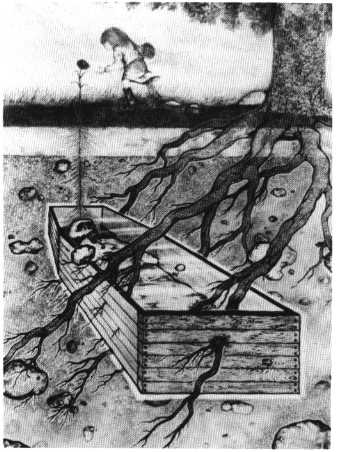
Fig. 42. A painting illustrating the cycle of death and rebirth that was inspired by a psychedelic session. The fact that the little flower feeding on the remnants of the past is a carnation reflects a play on words and is an allusion to reincarnation.
The characteristic memories or visions accompanying volcanic ecstasy are related to the atmosphere of unbridled Bacchanalia and carnivals, amusement parks, red light districts and nightclubs, and fireworks, and to the excitement associated with such dangerous activities as car racing or parachuting. The religious imagery associated with this type of ecstatic rapture involves sacrificial rituals, martyr death, the Sabbath of the Witches and satanic rituals, Dionysian orgies and temple prostitution, flagellantism, and aboriginal ceremonies combining sexuality and religion, such as fertility rites and phallic worship. In everyday life, powerful elements of volcanic ecstasy can be associated with the final stages of childbirth. More mitigated forms can be encountered in various intense sport activities, rock and disco dancing, rides in amusement parks, and wild sexual parties. Related art forms involve visual arts depicting the grotesque, sensual, and instinctual aspects of life, wild rhythmic trance-inducing music, and dynamic orgiastic dance.
The third category of ecstatic rapture associated with the perinatal process is dynamically related to BPM IV. and can best be described as illuminative or Promethean ecstasy. It is typically preceded by a period of determined emotional and intellectual struggle, agonizing longing and yearning, and desperate search for answers that seem to be hopelessly out of reach. Promethean ecstasy strikes like a divine lightning that destroys all the limitations and obstructions and provides entirely unexpected solutions. The individual is flooded by light of supernatural beauty and experiences a state of devine epiphany. He or she has a deep sense of emotional, intellectual, and spiritual liberation and gains access to breathtaking realms of cosmic inspiration and insight. This type of experience is clearly responsible for great achievements in the history of humanity in the areas of science, art, religion, and philosophy.
Another interesting problem related to the dynamics of schizophrenia that should be briefly discussed in the context of perinatal matrices is the relation beween psychosis and the female reproductive functions. It is well known that various psychopathological disorders are closely connected with the menstrual cycle and particularly with pregnancy, delivery, and the postpartum period. In the past this has been interpreted almost exclusively in terms of hormonal imbalance and its effects on the psyche.
The material discussed here throws an entirely new light on this problem. Observations from deep experiential work show an important dynamic connection between the experience of being born, of giving birth, and of sexual orgasm. Women reliving their birth in psychedelic sessions frequently have a simultaneous strong feeling of delivering a child. They can actually have great difficulties distinguishing whether they are being born or giving birth, while they are at the same time experiencing orgiastic sexual feelings. This might be expressed behaviorally by switching from a fetal position to a characteristic gynecological posture with the use of abdominal press. This dilemma of giving birth versus being born is then resolved in an experience that synthetizes the two modes— that of giving birth to a new self.
These observations clearly indicate that, in addition to the hormonal imbalance emphasized by traditional psychiatry, the post partum psychopathology reflects important psychological dynamics related to perinatal matrices. The process of delivering a child seems to bring the mother close to reliving her own trauma of birth. It tends to activate not only her basic perinatal matrices, but also all the later secondary elaborations of the birth trauma involving conflicts about sex, death, biological material, pregnancy, childbirth, and pain. Under proper circumstances, with the right understanding and a sensitive approach, this period can be a great opportunity for deep psychological work. Conversely, if the dynamics involved is misunderstood and the mother is forced to repress the emerging material, it can result in the development of serious emotional and psychosomatic problems. In extreme cases, disturbances of this kind can reach psychotic proportions.
To a lesser degree, emotional problems can also be accentuated during the premenstrual period; an increased tendency to anxiety, irritability, depressions, and suicidal ideation occuring at this time has been known as the premenstrual syndrome. There are deep anatomical, physiological, and biochemical similarities between menstruation and delivery; it can be said that each menstruation is a microdelivery. It is therefore quite plausible that during each menstruation the perinatal material is experientially particularly available. This similarity between menstruation and delivery seems to suggest that the menstrual period represents a similar mixture of opportunity and problem that was discussed earlier in regard to delivery.
In the preceding discussion, considerable emphasis has been placed on the perinatal roots of various schizophrenic symptoms. However, many aspects of the phenomenology of psychosis seem to have their origins in the transpersonal realms of the human psyche. These domains contribute to schizophrenic symptomatology the interest in ontological and cosmological problems; an abundance of archetypal themes and mythological sequences; encounters with deities and demons of different cultures; ancestral, phylogenetic, and past incarnation memories; elements of the racial and the collective unconscious; the experiential world of extrasensory perception and other paranormal phenomena; and a significant participation of the principle of synchronicity in the individual’s life. Also, unifying experiences of a higher order than those related to perinatal dynamics should be mentioned—identification with the Universal Mind, with the Absolute, and with the Supracosmic and Metacosmic Void.
In spite of the revolutionary developments in modern psychology represented by the contributions of Jung, Assagioli, and Maslow, all these experiences are still automatically considered symptomatic of psychosis by traditional psychiatry. In the light of LSD psychotherapy and other powerful experiential approaches, the concept of psychosis will have to be dramatically revised and reevaluated. The matrices for perinatal and transpersonal experiences seem to be normal and natural components of the human psyche, and the experiences themselves have a distinct healing potential if approached with understanding. It is therefore absurd to diagnose psychosis on the basis of the content of the individual’s experience. In the future, the definition of what is pathological and what is healing or evolutionary may have to emphasize the attitude toward the experience, the style of dealing with it, and the ability to integrate it into everyday life. In this framework, it will also be necessary to distinguish clearly between a therapeutic strategy that is conducive to healing and one that is noxious and counterproductive, and ultimately causes iatrogenic damage.