
XI
RICARDO’S ARGUMENT applied in the first instance to foreign trade and to the relationship between rich countries and poor countries. The same type of argument, however, was also used to explain how capital could be made to neutralise, but not replace, the market in a domestic context and, by so doing, to address the divisions between the rich and the poor at home rather than abroad. This was the argument underlying the distinction between the constitution and the administration of a state that supplied much of the conceptual architecture of the History of the Social Movement in France, 1789–1850, published in 1850 by the Danish-German-Austrian legal theorist Lorenz von Stein.1 As Stein presented it, the distinction added a further dualism to those that could already be found in the commercial-noncommercial, sovereignty-government, and public-private distinctions. It did so, he argued, because modern constitutional principles applied essentially to individuals, while modern administrative principles applied essentially to groups.
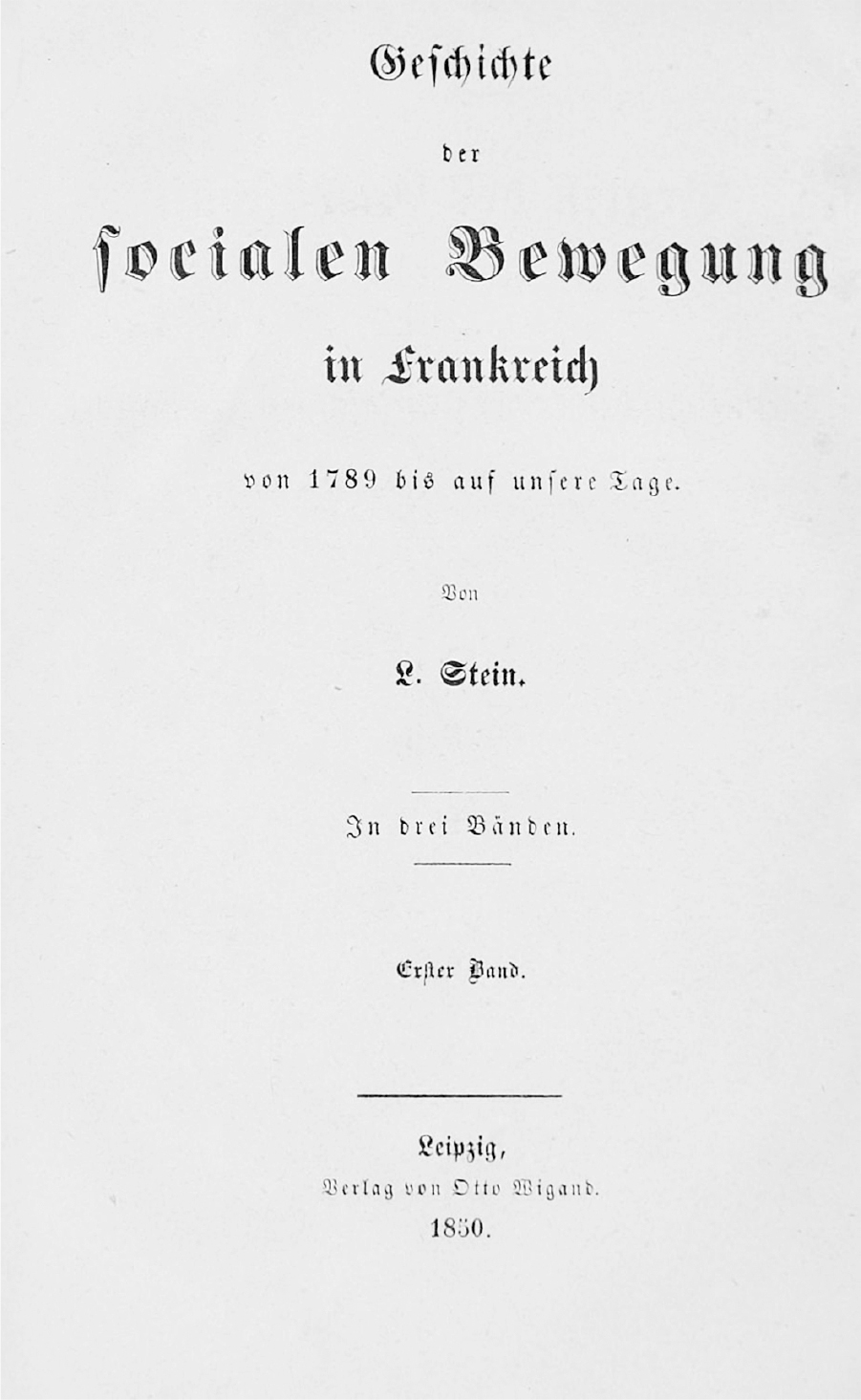
FIGURE 8. Lorenz von Stein, Geschichte der socialen Bewegung in Frankreich von 1789 bis auf unsere Tag (1850)
As with the other distinctions, the problem was to find a way to ensure that both sets of principles could be accommodated within a single state. Constitutional principles applied to individuals, regardless of their various circumstances, endowments, and life chances. Administrative principles applied to groups, precisely because of their various circumstances, endowments, and life chances. The first existed to secure formal equality, while the second existed to establish real social cohesion. As Stein recognised, combining the two sets of principles amounted to an embryonic theory of social democracy. “The transition from democracy towards this new configuration,” he wrote, “is already apparent in the idea of social democracy. At present, the content of that idea is still obscure and if it does not emerge from that obscurity, it will disappear. But if it does emerge, it will have to become a theory of society, and then the future will belong to it.”2
The argument was made at the end of the great cycle of revolutions that swept across Europe in 1848 and relied very heavily on Hegel’s state–civil society distinction. Stein’s version of the nexus formed by the state, civil society, and the administration centred on money, credit, and public debt. He explained why it did most fully in the long introduction that he wrote to his History of the Social Movement in France. The title of that introduction—“The Concept of Society and Its Laws of Motion”—was, as Stein went on to argue, designed to indicate that the concept of the state had to be matched by a concept of society.3 Putting the two together, Stein claimed, would become the basis of a theory of state action that would be both compatible with, but also distinct from, society.
The starting point of Stein’s theory of state action was the problematic relationship between individual autonomy and social interdependence. As was the case with many earlier theorists of the division of labour from Rousseau to Hegel, the problem was generated by the initial tension between individual needs and desires, on the one hand, and the limited amount of time and ability that any individual had available to meet them. The obvious solution to this tension, Stein wrote, was the division of labour. But the development of the division of labour gave rise to a further array of problems about information, coordination, and rules. Something more than interpersonal reciprocity was needed to provide a common will to meet these common needs. This, Stein argued, was what a state could do. It was also why it made sense to define the state as simply “a community manifesting its actions and will through its personality.”4 Personality, according to Stein, was, therefore, the principle of the state. It was the name that could be given to the state’s ability to unite and coordinate individual wills in ways that enabled them to realise everything that was best in each and every individual personality. The claim was redolent of the long-drawn-out German-language discussions of the reasons for the Creation and the purpose of human existence—discussions that, in the early nineteenth century, had given rise to the theological and anthropological speculations of Friedrich Schleiermacher, Ludwig Feuerbach, and August Cieszkowski that played readily into Marx’s philosophy of history. As in those earlier discussions, Stein’s version of the answer had a clear moral and historical goal. Given, he wrote, that the state was made up of individuals, it followed that “the measure of development of every individual is the measure of development of the state itself.”5
Stein’s argument appeared, however, to lead towards two apparently incompatible conclusions. If, on the one hand, the state’s development was predicated on every aspect of individual material, cultural, and spiritual development, it seemed to follow that its constitution had to make as much provision as possible for all of its members to be as fully involved as possible in the life of both the state and its government. From another point of view, however, the same emphasis on the symbiotic relationship between individual personality and the personality of the state seemed to mean that the state itself would be radically dependent on its members’ resources and capacities. If the state was supposed to enable its members to become as fully themselves as possible, it seemed to be bereft of the means to do so. Although, because it was simply the locus of the division of labour, civil society was subordinate to the state, the reality, in fact, was entirely the opposite. “The state,” as Stein put it, “has no real existence outside of society.”6 But society was, by definition, an acquisitive society (a phrase that Stein was one of the first to use) because, in an important sense, it was predicated on the aspirations and ambitions of a multitude of increasingly differentiated individual personalities, while the identity of the state was predicated on the other hand on a single common personality. In a state, individual personality was combined with the unitary personality of the state, but in civil society individual personality was differentiated from every other individual personality. The combination of the drive for unity and the drive for individuality and individual acquisition meant that the state-society relationship was based on a radical contradiction. As Stein went on to show, this meant that while personality, or a single will made up of an integrated combination of unity and multiplicity, was the underlying principle of the state, the underlying principle of society was actually interest, or a centrifugal combination of diversity and difference generated by the division of labour.7 The two principles were not only radically at odds with one another, but were also locked into a power relationship in which the state would, in effect, be little more than a target waiting to be captured by one or another of its predatory components.
The contradiction not only supplied a framework for explaining why, as Stein went on to describe it, the history of the social movement in France was a history of class struggle, but it also seemed to show, more generally, why any claim about the compatibility between individual personality and the personality of the state was condemned to end in a double bind.8 If the personality of the state supplied the means to manage the division of labour, the division of labour was, inversely, the source of the individual drives and inequalities of property, capital, time, and money that ruled out the idea of a state personality. The dilemma soon gave rise to a number of putative solutions. One solution, usually associated with Marx and his followers, was to try to eliminate the state, while another, sometimes associated with Proudhon, was to try to dissolve the state into as many self-governing institutions as possible. Stein’s solution was to remain closer to Hegel’s concept of the state, but to combine it with a radically different theory of state power and state action.
Stein’s theory of state power and state action was fiscal and financial in character. It was fiscal because a functioning fiscal system called for a comprehensive administrative system, made up not only of a body of tax officials, but also of further clusters of legal, financial, and property-related offices to supply the information and procedures required by the functional ramifications of the fiscal system itself. This meant that a bureaucratically organised administrative system, comparable to Hegel’s own idea of a universal estate, would have to be the other side of what, as Stein also emphasised, would be a highly inclusive political constitution. While a constitution was the means by which individuals, with their individual personalities, could have a real relationship to the state, and to the personality of the state, an administrative system was the means to ensure that the two types of personality would be kept distinct.
As with Hegel, an administrative system was the keystone of a commercial society because it was the one institution that actually existed on both sides of the state–civil society divide. Without a constitution and with no proper administration, Stein argued, individuals would simply turn towards monarchy as the most obvious embodiment of the idea of the state.9 Trying to maintain a viable distinction between individuals and the state under the aegis of a genuinely democratic regime would be even more difficult because the separation of the public from the private built into a bureaucracy would dissolve into a reiterated and more morally demanding game of role switching. The concept of a democratic bureaucracy was a concept too far. On Stein’s terms, representative government, from this point of view, required a bureaucratic state.
Importantly, however, the core of Stein’s theory of state power and state action was more financial than fiscal and relied as much on monetary as on administrative or bureaucratic means. This, Stein claimed, was because the one self-evident sign of a sovereign state was its ability to create money and, by extension, to manage and preserve a stable currency. This claim meant that public debt was the real mechanism with the power to reconcile the state and civil society because the financial resources that the state could generate had the potential to overcome the contradiction between multiple individual personalities and its own single personality. The financial resources in question could do so, Stein argued, because the funds borrowed by the state could be added to the pool of private capital both by means of a decentralised system of interest-free loans and, more generally, because borrowing funds would remove smaller amounts of capital from society than taxation would, while payments of interest on debt would ensure that some of the borrowed funds would go back into circulation. The state-backed flows of income and expenditure generated by public debt would be managed by the bureaucracy, but the resources themselves would be allocated by means of decisions within a constitutionally specified institutional network. Monetary and financial policy could be used, therefore, to offset the divisions generated by private property to enable the propertyless to acquire the education, skills, and capital required for economic survival in an acquisitive society.
“A state without a debt,” Stein observed famously, “either cares too little for its future or demands too much from its present.”10 Trade without credit, he wrote elsewhere, was “like a bird without wings,” while credit itself was rather like the clothes that parents would buy for their children: the right measure had to be several sizes too large.11 Seen this way, Stein claimed, public debt went together with “social democracy.” In his usage, there was a real significance to both parts of the phrase. The democratic side applied to the constitution and its arrangements, while the social side applied to the bureaucracy and its provisions. “The principle of social democracy,” Stein concluded, “is therefore universal suffrage inasmuch as it has to do with the constitution and the abolition of social dependence in the working class and inasmuch as it has to do with the administration. In social democracy, the constitution is the democratic element, while the administration is the social element.” The combination, he added, was the “natural and unavoidable outcome of the liberal movement.”12
Capital, on Stein’s terms, was the means to neutralise capitalism or, alternatively, to make capitalism safe for social democracy. In one sense, the idea was similar to Louis Blanc’s because its starting point was an analogous distinction between capital and capitalism. But Stein’s idea was also radically different from Louis Blanc’s idea because it relied on money and markets rather than associations and cooperation as solutions to the related problems of inequality, injustice, and exploitation. Louis Blanc’s solution was predicated on replacing private property by public property, including the public ownership of capital. Stein’s solution was predicated on the recognition of monetary sovereignty as one of the main attributes of a state, and on the further recognition of financial and fiscal policy as two of the cornerstones of democratic politics. This is what they still seem to be.