
PART II
VII
ONCE, THE BEST-KNOWN ALTERNATIVE to capitalism was communism. It is less clear, however, that communism was an equivalent alternative to a commercial society. This is why it is worth beginning with communism before describing the earlier discussions of the problematic quality of a commercial society. Starting with communism makes it easier to see what, in relation to capitalism, communism was designed to solve and what, by contrast, the various participants in the earlier discussions of commercial society took to be the problems that they had to solve. For Marx, in contradistinction to these earlier writers, the fundamental problem was the problem of property and, more specifically, the peculiar type of property that Marx called labour-power. On this basis, the ultimate solution to the problem of property and, particularly, property in labour-power was to be supplied by the division of labour. For almost everyone else, however, the relationship between the problem and the solution was the other way round. Here, the fundamental problem was the division of labour, while the solutions to the problem were expected, instead, to come from different types of property.
It was once usual to say that communism was a kind of synthesis of British political economy, German philosophy, and French socialism. The claim was made initially by Marx and Engels themselves and has continued to echo down the ages. It would be more accurate, however, to say that communism was a kind of synthesis of French legal thought and German theology as these developed between 1830 and 1848, partly in opposition to British political economy and its French followers including, most famously, Jean-Baptiste Say. This was because French legal thought and German theology contained two concepts that were central to Marx’s concept of communism. The first was the idea of a negative community of goods, while the second was the idea of individual autonomy. Together, as Marx used them, they appeared to offer the prospect of a solution to the combined problems of property and the division of labour.
The concept of a negative community of goods is now known only to specialists in legal history and among some students of Marxism.1 It was, however, still alive in the United States at the very end of the nineteenth century where it was used in the context of a Supreme Court ruling on whether the state of Connecticut was entitled to prohibit the export of game birds beyond its borders even though the killing of game birds was authorised and allowed within its borders. It also had a prominent presence in eighteenth-century English jurisprudence, this time in the context of the English Game Laws and, more specifically, the treatment of the right to hunt by the English jurist William Blackstone in his famous Commentaries on the Laws of England. The subject of property was central to the arguments laid out in both these settings because both sets of arguments turned on the related questions of whether wild animals could be legitimately owned and, by extension, of how it was possible to distinguish legal ownership from legitimate use.
The concept of a negative community of goods was designed, in the first place, to provide a way to distinguish ownership from use. It was originally a Roman law concept that, like much other Roman law, was incorporated into the great treatises of natural jurisprudence published in the seventeenth century by Hugo Grotius and Samuel Pufendorf. From Pufendorf, the concept was transmitted to a widely used eighteenth-century French treatise on property law written by a jurist named Robert Joseph Pothier, and from there it passed into the arguments addressed by the United States Supreme Court in 1895. “The first of mankind,” Pothier wrote in his treatise on property in 1762,
had in common all those things which God had given to the human race. This community was not a positive community of interest, like that which exists between several persons who have the ownership of a thing in which each has his particular portion. It was a community which those who have written on the subject have called a negative community, which resulted from the fact that those things which were common to all belonged no more to one than to the others, and hence no one could prevent another from taking of these common things that portion which he judged necessary in order to subserve his wants. Whilst he was using them others could not disturb him, but when he had ceased to use them, if they were not things which were consumed by the fact of use, the things immediately re-entered into the negative community and another could use them. The human race having multiplied, men partitioned among themselves the earth and the greater part of those things which were on its surface. That which fell to each one among them commenced to belong to him in private ownership and this process is the origin of the right of property. Some things, however, did not enter into this division and remain therefore to this day in the condition of the ancient and negative community.2
The concept could still be found in the political philosopher Karl Salomon Zacharia’s Vierzig Bücher vom Staat (Forty books on the state) of 1843 and in the German political economist Wilhelm Roscher’s Principles of Political Economy of 1854, but it was given far more prominence by its appearance in Pierre Joseph Proudhon’s explosive Qu’est-ce qu’est la propriété? (What is property?) of 1840. Property, Proudhon famously announced, was theft, and it was the concept of negative community that enabled him to say so.
The assertion was a straightforward reply to Pothier’s assertion that God, having sovereign dominion over the universe and all the things within it, had created the earth and all its creatures for the benefit of humanity and had given humanity a dominion subordinate to his own.3 This, Pothier had explained, was why the original community of goods given by God was a negative, not a positive, community. In it, nothing belonged to anyone because everything was available to everyone. It followed entirely logically, Proudhon pointed out, that property was theft, because property that was positively owned, even by the whole human race at any particular moment of time, must have been appropriated from the original negative community. Individual ownership was, therefore, appropriation on a compound scale. It had happened, he argued, because the abstract concept of property had supplanted the real use of particular things. For Proudhon, however, individual ownership also carried the seeds of its own solution. It meant, on the one hand, emancipation from the community, but, on the other hand, it also meant insecurity, isolation, and a struggle for survival that property alone could not solve. There had, therefore, to be something that was neither society without property, or the negative community that was communism, nor property without society, or egoism. Proudhon called it anarchy. It meant establishing social arrangements in terms of internal moral qualities, like honesty, courage, or compassion, rather than external material qualities, like wealth, ostentation, or display. “To express this idea by a Hegelian formula,” he wrote, “I would say”:
communism, first mode, first cause of sociability, is the first term of social development, the thesis; property, the reverse of communism, is the second term, the antithesis. When we have discovered the third term, the synthesis, we shall have the required solution. Now this synthesis necessarily results from the correction of the thesis by the antithesis; and so it is necessary, by a final examination of their characteristics, to eliminate those features which are hostile to sociability. The union of the two remainders will give us the true mode of humanitarian association.”4
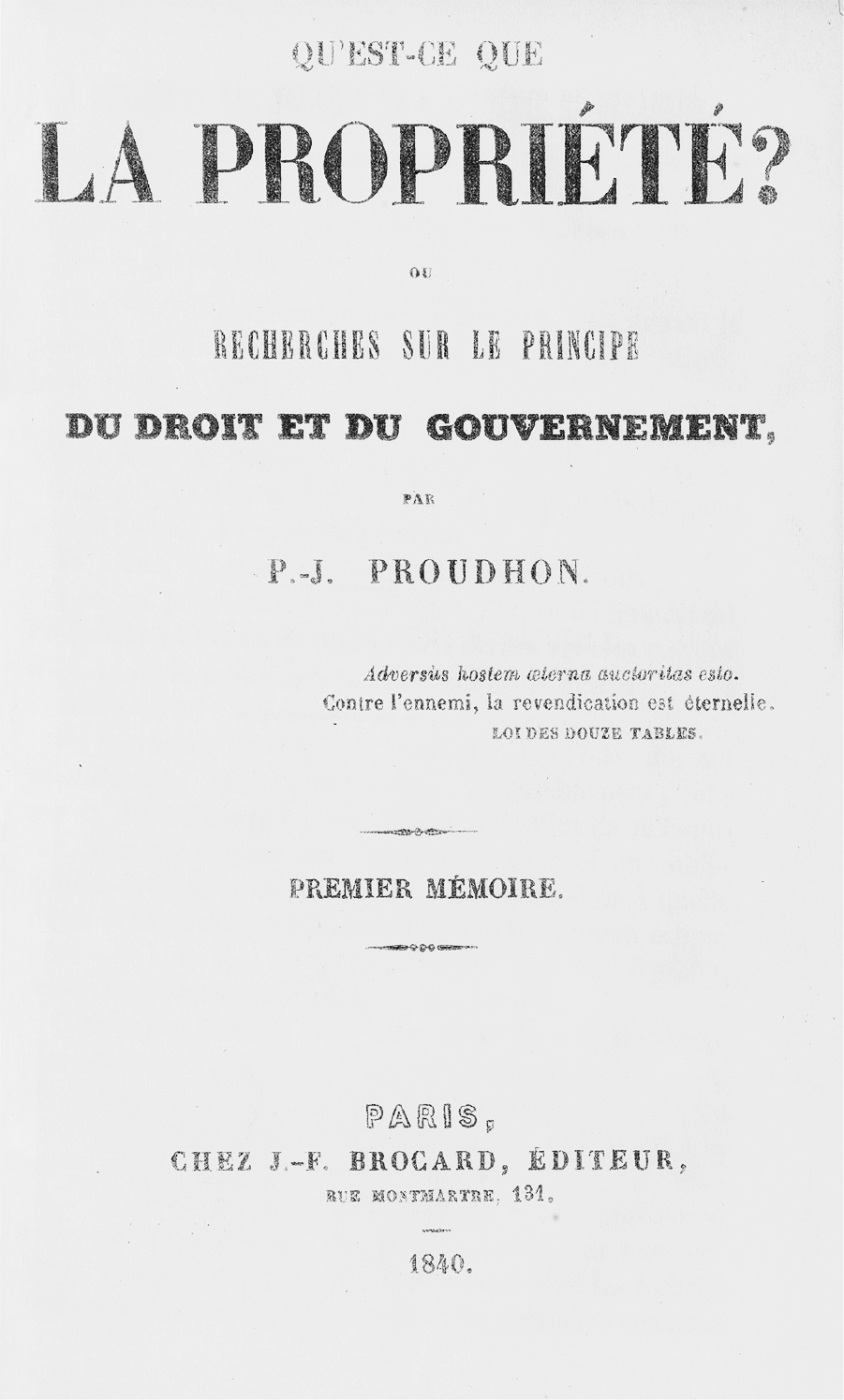
FIGURE 5. Pierre Joseph Proudhon, Qu’est ce que la propriété? (1840)
Communism, Proudhon continued, “rejects independence and proportionality,” but property “satisfies neither equality nor law.”5 Building these four elements into social arrangements would make it possible to go beyond either the absence of property that came with the negative community or the absence of community that came with the presence of property. With equality and law based on possession and use, individual abilities in all their richness and diversity would, finally, have a home in human affairs.
With Proudhon, the concept of a negative community belonged to the past. With Marx, however, it belonged to the future. This, in part, was because his concept of the proletariat relied on a more positive evaluation of the division of labour than Proudhon was either willing or able to make. In this concept of the proletariat, the proletariat was the class responsible both for producing the wealth of the world and, ultimately, for emancipating the world by making its own collective labour-power the source of a new, postcapitalist version of a negative community.6 In part, however, it was also because Marx’s concept of the proletariat as the source of a new version of a negative community relied on two features of early nineteenth-century German philosophy that Proudhon himself did not know. The first was a concept of the division of labour as a humanly created analogue of the Creation itself. The second was a concept of collective action as praxis or something more like the reflection, deliberation, and choice usually associated with individual action because, unlike a collectivity, individuals are usually taken to be persons, equipped with something called personality, or the ability to do things voluntarily rather than involuntarily. Class consciousness, as Marx conceived it, was a product of the proletariat’s capacity to acquire or inject the attributes of personality into the otherwise alienated properties of labour-power.
This capacity was partly a product of the interdependence involved in the division of labour. Since the proletariat had no property of its own, it had to rely on work and wages in order to survive, or, without work or wages on a general scale, it would be forced to seize control of the means of production to provide itself with the means to live. Revolution, in this rendition, would preserve life, not property, and, since this was its goal, the real content of a modern revolution would be the creation of the conditions that were required to establish a genuinely negative community of goods. This time, however, it would be a community that owed more to culture than to nature and was grounded upon civilisation and science rather than kinship and custom. Communism, like the original negative community, would be based on the absence of ownership rather than on common ownership. It would bring back use instead of property and, in doing so, would break the chain binding individual needs to government, laws, and the state. Marx, it should be emphasised, was consistently hostile to the idea of equality. This was not because of any initial assumptions about superiority or inferiority, but instead because equality presupposed comparisons, relationships, and rules, while human needs, in the most literal of senses, were purely individual in character.
The source of this insistence on individuality was a Protestant theological tradition that had been picked up and used as the basis of a more secular philosophy of history by one of Marx’s contemporaries, Ludwig Feuerbach. Its starting point was the question of why the Creation was required, or could have been necessary at all. God, after all, was perfect in every way, and it was not easy to explain why something equipped with every possible power should have wished to add to perfection itself. One answer was that the one thing that it was not possible for God to do was to create another divinity, because it would, self-evidently, be indistinguishable from the existing God. The point of creating was, after all, something created. In keeping with the logic of this argument, this was why the point of the Creation was humanity. Although God could not create another God, God could, nonetheless, create humanity, and if every human could develop and express his and her individual abilities and qualities as comprehensively as they could, then God would have created something like another divinity without actually having created another God.
The idea circulated initially in the late eighteenth- and early nineteenth-century romantic, but also theological, circles associated with the young Hegel and Friedrich Schelling. Over the course of the nineteenth century, it turned into one of the key components of the sociology of Georg Simmel and, later, into one of the foundational concepts of the differentiation theory of the twentieth-century German sociologist Niklas Luhmann.7 One of its main targets was the philosopher Immanuel Kant, while one of its most eloquent exponents was the Protestant theologian Friedrich Schleiermacher. The insight into the real significance of human diversity that accompanied this version of the idea of the Creation, Schleiermacher wrote in his Monologen of 1800, had become his “highest intuition.” Before he had come to know it, he explained, he had subscribed simply to the conventional view that “humanity revealed itself as varied only in the manifold diversity of outward acts,” and that individuals were not, as he put it, “uniquely fashioned” but were, instead, fundamentally “one substance and everywhere the same.” The new insight entailed a radical change of perspective. Instead of each individual coming to represent the generic attributes of humanity, each individual would come, uniquely, to represent him- or herself. “I saw clearly,” Schleiermacher wrote, “that each man is meant to represent humanity in his own way, combining its elements uniquely, so that it may reveal itself in every mode and that all that can issue from its womb can be made actual in the fullness of unending space and time.”8 From this perspective, the division of labour could be redescribed as something that was considerably more than it seemed. Humanity, taken as a whole and if it was equipped with all the capabilities of its individual members, would have the potential to rise to the omnicompetence of the divinity. Appearances notwithstanding, there was a point to the division of labour that transcended work and wages or any type or form of property. Human society could display all the attributes of the divinity if it could reach the right level of diversity coupled with the right level of integration. As Ludwig Feuerbach wrote in his Essence of Christianity, “the true sense of theology is anthropology and there is no distinction between the predicates of the divine and human nature, and, consequently, no distinction between the divine and human subject.”9
On this basis, the division of labour could be seen as a bridge between causality and creativity, or as the link that connected the phenomenal world of natural causation to the noumenal world of divine creation. As another of Marx’s contemporaries, an unusual Polish philosopher and theologian named August Cieszkowski, began to show, the division of labour could now be understood as the key to the realisation of what Feuerbach described as an identity of predicates.10 Here, the idea of humanity as something capable of matching the omnicompetence of the divinity was reinforced by the further thought that, in one crucial respect, humanity was equipped with a resource that God did not actually need. This was a knowledge of space and time. God, being eternal, transcended space and time. Humans, being finite, inhabited space and time. If humanity could find a way to use space and time to combine diversity with integration, then these two measures of human finitude could become the medium that enabled humanity to acquire the attributes of personality and, in a real sense, become like a God. To do so, humanity would have to find a way to build something like the reflexive capability used by individuals in making their choices and decisions into its own much more comprehensive culture and consciousness. Cieszkowski gave the name of praxis to this capacity for collective consciousness and collective action. Like many other people of his generation, he went on to show how it was history, meaning both people and events in the past and the subsequent understanding of people and events in the past, that had the power to turn individual consciousness into collective consciousness and individual choice into social praxis.
There were several other conceptual contributions to the philosophy of history that formed the basis of The Communist Manifesto and its terse initial announcement that the history of “all hitherto existing society” was the history of class struggles.11 But the philosophy of history that gave The Communist Manifesto its content and direction was a philosophy of history that had property at its centre and its core. It began with the appropriation of goods from nature. It continued with the expropriation of goods that were originally possessed and then went on to follow the forcible transformation of possession into property, of users into owners, and of the dispossessed into sellers of labour-power as, slowly and violently, the social and economic arrangements of a world made up of the two great classes of bourgeois and proletarians came comprehensively into view. Increasingly, the contradictions between the freedom of the market and the despotism of the factory, and between the circulation of commodities and the consumption of labour-power would, the Communist Manifesto predicted, give rise cumulatively to an insuperable tension between the ownership of capital and the needs of the proletariat. Conflict would be followed by conflict, and the history of that conflict would be registered as class consciousness. This was why, in the final analysis, the expropriators would be expropriated, and the class that owned no property would turn a world that belonged to the bourgeoisie into a world that had really been made by the proletariat and which was now available for its use. In keeping with the argument of Marx’s theses on Feuerbach, The Communist Manifesto turned the story of the Creation into a story about how the division of labour would turn, by way of collective praxis, into a negative community based on need and use.
But if need and use were the hallmarks of the new version of communism, where did this leave the division of labour? Capitalism would have gone because there would be no more property. But without the division of labour, what would remain? The government of men might well, as the phrase went, have been replaced by the administration of things, but the second part of the phrase could still raise as many questions as the first. Capitalism, in short, could well give rise to a world beyond property, but it is less easy to imagine a world beyond a commercial society. In this respect, the name itself is a clue to the thing. The main attribute of the thing, at least on Adam Smith’s assessment, was that it was a society and not simply property. This is why the distinction between capitalism and a commercial society is still historically and analytically significant. To begin with Marx and the concept of capitalism is, therefore, to begin in midstream. Before Marx and before capitalism, the concepts and the reality of commercial society and the division of labour both existed, together with a large and partly forgotten body of discussion of how they had come to work and, from time to time, how they could be made to work differently.
Although the starting point of these discussions was supplied by Adam Smith and the concept of commercial society, there were also a number of other and further versions of what was involved in thinking about markets, politics, and the division of labour that were published before the concept of a commercial society was swallowed up by the concept of capitalism. Some, echoing Smith, involved examining the division of labour in terms of the relationship between justice and expediency, with the aim here of explaining how both could be accommodated by a single political system. Some authors, like Georg Wilhelm Friedrich Hegel, approached the subject of the division of labour from the vantage point of the relationship between civil society and the state, with the aim in this case of showing how an administrative system could straddle them both. Others, like David Ricardo, approached the subject of the division of labour from the perspective of international trade and comparative advantage, with the aim in this further case of explaining why a paper currency favoured commercial reciprocity. Yet others, like Lorenz von Stein after the revolutions of 1848, approached the subjects of civil society and the division of labour in terms of public debt and public administration, and began to call the outcome social democracy. The aim of what follows is to begin to piece these discussions together quickly and somewhat schematically because they help, cumulatively, to throw more light on capitalism than seems to have been possible by relying on the concept of capitalism itself.