
CHAPTER TWO
THE CITY OF Rochester lies on the north coast of Kent, at the mouth of the river Medway. Like most modern cities, it has its fair share of tall buildings, from elegant Victorian mansion blocks to ugly sixties high-rises. The building that dominates this city’s skyline, however, was built not in the modern age, but almost nine centuries ago. The great tower of Rochester Castle still dwarfs everything for miles around, including the Norman cathedral that stands in its shadow. Even a modern visitor who is used to tall buildings, and familiar with stone castles, cannot help but be impressed; in terms of sheer size alone, Rochester bowls you over.
It becomes almost impossible, therefore, to imagine the impact this building must have had on people when it first appeared. Back in the early twelfth century, when construction work began, what emerged was not just a brand new castle, but a brand new type of building. By this time, the citizens of Rochester must have thought they knew all about castles. An earth-and-timber affair had been foisted upon them shortly after the Conquest, and a few years later some of its wooden walls had been replaced with stone ones. But these earlier structures, whether wood or stone, paled into insignificance in comparison with the monster that now began to rise against the city’s skyline. No one in Rochester, or anywhere else for that matter, had ever seen anything like it.
To begin with, Rochester’s size is truly superlative. Measuring 125 feet from its base to the top of its turrets, it takes the prize for being the tallest great tower in the country. Built from 1127, it is also one of the earliest examples of its type, and was the property of the Archbishop of Canterbury – then one of the most powerful lords in the kingdom.
The castle’s greatest claim to fame, however, is not its early origins or its distinguished ownership, but the sequence of events that later engulfed it. In 1215, Rochester had the misfortune to be visited by one of England’s worst kings, and subjected to the biggest and most spectacular siege that the country had ever seen. For two months in the autumn of that year, the struggle for Rochester Castle decided the fate of King John – and whether his kingdom would stand or fall.
This chapter focuses on great towers like Rochester, and attempts to ask all kinds of questions about them; how they were built, what they were for, how they were attacked, and how they were defended. But it is important to remember that such towers, or ‘keeps’ as they are often called, were not intended to stand alone. Like the wooden tower on a motte, a great tower needed to be supported by a whole range of other buildings, grouped together in a bailey. Even though many keeps seem isolated today, we should not forget that they were once surrounded by (and to some extent dependent on) a host of smaller buildings that were huddled around their feet.
It is also important to stress that there is no sense in which the great tower ‘evolved’ from the wooden tower on top of a motte. Stone castles were, of course, bigger, stronger and taller, nicer to live in and much more expensive to build. But, as we saw in the previous chapter, they originated in France at exactly the same time as wooden ones. Likewise, timber castles continued to be built in England and France well into the thirteenth century. It is not a case of a ‘Wood Age’ being followed by a ‘Stone Age’. The switch to the building of keeps cannot be represented as a technological advance; one type of castle did not ‘develop’ out of the other. Nevertheless, stone castles themselves did develop, and by the time Rochester was constructed, building a keep was the norm – for the tiny minority of castle-owners rich enough to afford one. The twelfth century was the golden age of the great tower.
Although Rochester is an early example of this type of building, it is by no means the earliest. In England, the tradition of building towers began with the most famous of them all – the Tower of London. Today, when people talk of ‘the Tower’, they mean the entire complex of royal buildings that occupies the south-eastern corner of the City. They also tend to think of it in terms of its later history as a Tudor prison – a place of ravens, Beefeaters and beheadings. Yet all the important buildings on the site were erected long before Henry VIII, Mary and Elizabeth I gave them their bloody reputation. The Tower was built not as a prison, but as a castle – arguably the most important castle in England. Most of the outer walls, towers and chambers are the work of England’s thirteenth-century kings. The building at the heart of the complex, however, which has given its name to the whole, was constructed earlier still. The White Tower was the work of William the Conqueror, and it was the first keep in England.
If motte-and-bailey castles came as a shock to the Anglo-Saxons, then the new castle that William started to build beside the Thames in the 1070s must have knocked them for six. The Anglo-Saxons had seen stone buildings before (many churches were built in stone), but they were not internationally renowned for their masonry skills. Before the Norman Conquest, the kings of England were accustomed to living in wooden halls, much as their distant Germanic ancestors had done. In fact, when the Anglo-Saxons talked about ‘building’, they used the word timbrian; if an Englishman told you he was going to build something, you took it for granted he was talking about woodwork.
In France, of course, building a stone residence would not have raised nearly as many eyebrows. But even the most sophisticated French mason would have been surprised and impressed by the scale of the building project that William had embarked upon in London. Nothing on the Continent could compare in size and grandeur with the Tower. It has recently been suggested that the smaller tower of Ivry-la-Bataille in Normandy, now in ruins, might have provided the inspiration for the basic shape, but the scale of William’s new building was entirely novel.
So what prompted William the Conqueror and his engineers to build on such a scale, and to build in stone? Even today, the Tower is a hugely impressive building, and impressing people was without doubt one of William’s intentions: this was a building project which said that the Normans were here to stay.
Monumental pride, however, might be only half the story. The other way of understanding the Tower is to imagine how nervous and edgy the Normans were in the 1070s – it was, after all, still only a few years after the Conquest, and the English continued to be obstinate and rebellious. In more peaceful circumstances, if a king wanted a palace complex, he might have preferred to distribute the buildings – the hall, the chapel, the bedrooms – over a wider area. Instead, what William and his architect decided to do was to stack all these rooms one on top of the other, and encase the whole structure in immensely thick stone walls. A great tower like this might be first and foremost a monument to vanity, but it also betrays a crucial element of fear.
Whatever the actual inspiration, the final result was an astounding building. Measuring 107 by 118 feet at its base, and standing 90 feet high, William and his sons created a giant among castles. Construction on this scale had not been witnessed in Britain since the time of the Romans. The Normans were well aware of this, and seem to have been deliberately styling themselves as new Romans, come a-conquering in imperial style. William of Poitiers, the Conqueror’s sycophantic biographer, regularly compares his royal master to Julius Caesar (William was better, naturally), and suggests that the king’s leading men were equivalent in wisdom and power to the Roman senate. It is possible to see this attitude reflected wherever William built in stone. At the Tower of London, parts of the old Roman city wall were incorporated into the wall of the castle’s bailey. At Colchester, the former Roman capital, William built another great tower, very similar in design to the Tower of London and probably created by the same architect. Although it now stands only two storeys high (and, thanks to misguided restoration in the eighteenth century, looks faintly ridiculous), it was once even bigger than its London counterpart. The new building was constructed on the ruins of the old Roman Temple of Claudius. This, of course, gave the Normans a convenient head-start, but importantly it also emphasized their authority as rulers. Finally, at Chepstow in Wales, the castle’s original two-storey stone hall still stands on the cliff-top high above the River Wye. Once thought to be a creation of William’s close friend, William Fitz Osbern, it has recently been reinterpreted as an audience chamber built for the king himself, perhaps in order to receive tribute from his Welsh subjects. Again, it is a building with Roman resonances. It was built with materials taken from the nearby Roman town of Caerwent, and decorated throughout in an imperial style.
So William the Conqueror’s great towers in London and Colchester, and the hall-keep at Chepstow, are our prototype English keeps. Few other stone towers can be dated with certainty to the period before 1100. Taken together, these buildings provided inspiration for the next generation of castle-builders, and supplied them with a model for the next hundred years. By the time building work began at Rochester Castle, some fifty years later, the prototype had settled down into something approaching an archetype.
Despite its monumental size, Rochester is in many ways a ‘typical’ building of its time. On the one hand, it shares many features with the stone castles that William constructed. Like the Tower of London, Rochester was built to be strong and defensible. At its base, its walls are twelve feet thick, and only slightly thinner at the top, where they narrow to ten and a half feet. The windows on the lower floors are small, only becoming larger towards the top of the building.
But while there are superficial similarities between William’s buildings and castles of later decades, there are also important differences. Whereas both the Tower of London and Colchester Castle are quite squat in appearance (Colchester, even at its full height, was broader than it was tall), Rochester is a slender, soaring building, four storeys in height compared to the Tower’s three. While William’s architect was apparently inspired by a Continental original at Ivry in Normandy, the mason who built Rochester seems to have based his design on the giant castle at Loches in France.
However, the biggest difference between Rochester and earlier towers in England is in the nature of its entrance. William’s towers were entered via a first-floor doorway, reached by means of an external wooden stair. At Rochester, the entrance was much more elaborate: the front of the building was covered by an additional wing, known as the forebuilding. This became a fairly typical feature of towers in the twelfth century: an entrance block contrived to frustrate attackers and impress visitors. To get into Rochester Castle, friend or foe had to mount a stone staircase that snaked around the base of the tower, creating a passageway that could be blocked with portcullises and barred with a drawbridge. Clearly, this was a building whose owner, if he wanted to, could keep you out. At the same time, however, it was equally important for a castle-owner to impress his guests. At Rochester, once visitors had negotiated the grand sweep of the outer stairway, they were admitted to the entrance level of the forebuilding. This room, of course, would shield the castle’s main doorway from a direct assault. But it is also a very large and impressive chamber, with high ceilings and beautiful rounded archways, decorated with the chevron or zigzag pattern that the Normans liked so much. As at other castles, it was probably intended as a waiting room, where visitors would be deliberately delayed, giving them time to admire the building, and putting them in a mood of suitable reverence prior to meeting the owner.
The slender stone tower, with a forebuilding over its entrance, was the commonest design for keeps in the twelfth century. But while these buildings share certain basic characteristics, it is important to stress the enormous overall variety in their design. In one way or another, each one is different from its peers, and there are many examples that are far removed from the simple stone box. In Suffolk, for example, the little stone keep at Orford is a particularly ingenious and intentionally whimsical creation, with circular rooms and three large buttressing towers. More imposing and hardly less original, the tall, almost windowless keep at Conisbrough is a similarly rounded and buttressed affair. At Norwich, the great keep, much-restored in the nineteenth century, is thought to belong to the early decades of the twelfth century and has no close parallels in England, except nearby Castle Rising, which was clearly inspired by its bigger neighbour. But whatever shape he settled on, the twelfth-century lord who wanted to dazzle his neighbours was going to be building a great tower. From the start of the century, new keeps were constructed up and down the country, from Newcastle in the north to Porchester in the south; altogether, more than fifty had been erected by the century’s end. Dover in Kent, one of the last to be built, was also one of the greatest – a final hurrah for the keep, and a worthy descendant of the Tower of London.
To build on this scale, of course, took enormous resources, and for this reason many of the more important keeps were built by kings. In twelfth-century England, there were four of them: Henry I (1100–35), Stephen (1135–54), Henry II (1154–89) and Richard I (1189–99). From the point of view of castle building, Stephen and Richard were not very important. Stephen was too busy fighting his cousin Matilda for control of the country throughout his troubled reign, and had neither the time nor the money to invest in large-scale building projects. Richard I does enjoy a reputation as a castle-builder, but it derives from his magnificent new fortress (Château Gaillard) at Les Andelys in Normandy, rather than the improvements that he carried out to his English castles. Our great castle-building kings in the twelfth century are the two Henrys. Henry I, youngest son of William the Conqueror, was a famously unpleasant individual, but nevertheless a noted builder of stone castles. Usually credited with the huge keep at Norwich, he is also thought to have built new towers at Canterbury, Gloucester and Corfe. He ruled England successfully, through a combination of administrative genius and calculated brutality (unlike Edward I, who only does it in a Hollywood film, Henry really did throw one of his enemies out of a castle window). As Duke of Normandy, however, Henry had a much harder time, and therefore invested most of his castle-building budget in his troubled dukedom. The king was responsible for the keeps at Caen, Domfront and Arques, as well and repairs and rebuildings at other Norman castles.
The prize for building keeps in England, however, must go to Henry II. Always remembered for his ill-timed rhetorical question, ‘Who will rid me of this turbulent priest?’, Henry II also deserves lasting fame as England’s pre-eminent builder of great towers. At the start of his reign, young Henry’s position was the opposite to that of his namesake and grandfather, Henry I. With strong support from his Norman barons, the new king’s grip on his Continental inheritance had long been secure. In England, however, he was a newcomer, and found at his accession that the power of the Crown had been much diminished during the war-torn reign of his predecessor, King Stephen. Henry therefore set about re-establishing the Crown’s authority, and he did this in the most visible way possible – by building castles. The king was responsible for brand new keeps at Scarborough, Newcastle, Orford and Dover, as well as the small keep at the Peak in Derbyshire, and perhaps a now-vanished tower at Nottingham.
But, as with motte and baileys, the building of stone towers was not exclusively a royal affair. Great barons of the twelfth century also adopted the stone tower design, and built some of the most distinguished and important examples. Rochester, of course, was built by the Archbishop of Canterbury, while Conisbrough was built by Henry II’s half-brother Hamelin. The giant square keep at Kenilworth was built by the Sheriff of Warwick, and the vanished keep at Bungay was erected by the Earl of Norfolk. Several of these baronial towers were constructed during the reign of King Stephen, who, along with his rival Matilda, embarked on a policy of creating new earls in order to win support. Building a keep was an excellent way of proclaiming one’s own new-found importance, and there is good reason to think that it was recent ennoblement that inspired the building of towers at Hedingham and Castle Rising.
When it comes to working out how much these castles cost, however, we have to rely on royal examples, because Crown records always survive much better than their aristocratic equivalents. For our detailed knowledge of costs in the twelfth century, we have to thank Henry I. Henry, when he wasn’t indulging his enormous sexual appetite (he had a string of mistresses before and after his marriage, and fathered at least twenty bastard children) was busy inventing new ways to govern the country. He is credited not only with the introduction of a new breed of administrative sheriff to manage his affairs in the English counties, but also with the creation of a new financial court to check on their activities. Twice a year, his sheriffs were obliged to come before the officers of this court and account for all the money they had received from rents, fines and taxes. The process was made easier with the help of a large visual and mathematical aid – a kind of abacus, with counters placed on a chequered cloth. Almost at once, people began to refer to the court as the Exchequer. When a sheriff was summoned before it, he either had to produce the money he owed, or give a good reason for its absence. One such good reason might be the building of a royal castle in the county at the king’s orders. Provided the sheriff could account for the money he had spent on building (produce receipts, if you like), the corresponding amount would be deducted from what he owed.
Amazingly, the records of the Exchequer have survived. The clerks wrote up their accounts on huge parchment rolls, known as ‘pipe rolls’ (for the simple reason that, when rolled up, they looked like pipes). Using these ancient documents, we can find out rough costs for royal castles, and also gauge the length of time it took to build them.
The sad thing is that although Henry I invented the whole accounting system, only one roll survives from his reign. As a result, we are not very well informed about the king’s castle-building activities. In fact, early twelfth-century towers – whether royal ones like Norwich, or baronial ones like Rochester – belong to a mysterious Dark Age, almost entirely unilluminated by written records. Fortunately, in Rochester’s case, we know from a copy of a royal charter that building began in 1127; and a Kentish chronicler noted in passing that the Archbishop of Canterbury began to construct ‘a noble tower’ at this time. But as to how long it took to build the mighty keep, and how much it cost, we can only make intelligent guesses by comparing it with examples from later in the century.
From the start of Henry II’s reign, the pipe rolls survive in an almost unbroken series, and we can calculate the cost of some of the king’s keeps. The great tower at Dover, for example, which is shorter than Rochester but bigger at the base, cost around £4,000 and took ten years to build (1180–90). The much smaller keep that Henry built at Orford cost about £1,500 and took just six years to build (1166–72). With these figures in mind, and allowing for a small amount of inflation, the keep at Rochester must have cost at least £3,000, and taken between eight and ten years to construct.
To the modern reader, of course, these sound like castles at knock-down prices. When you look at the contemporary pay packets, however, you begin to realize that would-be castle-owners had to start saving early. In the twelfth century, an unskilled labourer earned a penny a day, while a skilled labourer might take home tuppence. A fully armed knight, risking life and limb and providing his own kit, would expect to receive a shilling (twelve pence) in return for a day’s military service. Only at the top of the scale did things start to improve. The king’s annual income – which was also the government’s annual budget – was somewhere between £10,000 and £20,000 a year. Even for the king, therefore, building a tower like Dover or Rochester would absorb between a quarter and a third of his money for a year, or 3 to 4 per cent of his annual budget spread over a decade. In the twelfth century, then, there were only a handful of people who could afford to build a great tower.
What our records cannot tell us is how these towers were actually built. We have to wait until the thirteenth century before we get really detailed building accounts for castles (see Chapter Three). Occasionally, the pipe rolls will record the name of the architect or mason working on a particular building. Henry II’s favourite builder, responsible for the keeps at Dover and Newcastle, was one Maurice the Engineer. In almost every other case, however, the names of the geniuses who designed and erected these wonderful buildings are lost to us.
The towers themselves, however, provide us with some clues as to how they were built. Rochester, for example, was constructed with two types of stone. Most of it is Kentish ragstone, very probably quarried near Maidstone, and shipped from there up the River Medway to Rochester. The fine details, however – the fireplaces, the window arches, and the cornerstones – are fashioned from a softer stone, more suitable for carving. This is Caen stone, which (as the name suggests) had to be transported from Caen in Normandy, a journey of over a hundred miles. Tons and tons of stone, quarried in northern France, ferried hundreds of miles by scores of ships over dozens of voyages – this is the scale of the enterprise we have to imagine to explain how Rochester Castle came to be built.
From the enormous cost of their construction and the many years they took to build, it is evident that keeps like Rochester were not simply thrown up without design or purpose. They are complex structures, built to serve the needs of a great lord and his household. Each room in a tower was built with a specific purpose in mind.
For this reason, there’s a certain sense of disappointment when you step inside the main part of the keep at Rochester, because the interior is open to the sky. At some point after the Middle Ages (it is not known exactly when), a ferocious fire ripped through the tower, destroying the wooden floors and melting the lead roof. If you look closely, you can see the scars left by this inferno on the interior walls. The keep’s present condition, however, does offer certain compensations. In the first place, it allows you once again to appreciate the building’s huge size. The first reaction is to gaze upwards to the roof, but it soon strikes you that you are only observing half the interior space – the tower is divided in two by a cross-wall, which gives the whole structure greater solidity.
The other advantage of this perspective is that it enables you to see all four floors at once, and appreciate their common architectural features. Each principal chamber has a large ornately decorated fireplace, with a chimney flue that curves into the thickness of the wall. Similarly, there are garderobes (toilets) on every floor, and the well that runs up through the centre of the cross-wall is also accessible at every level. In other words, we have a building with mod cons and creature comforts throughout – central heating, lavatories, and water ‘on tap’. As in the forebuilding, the quality of the stonework is an indication that the living here was luxurious. The beautiful rounded Norman arches, with their zigzagged chevrons, tell us that this was once a residence of the first rank.
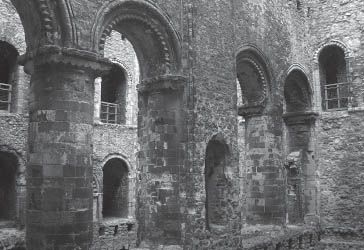
The great cross-wall that divides Rochester’s keep. At the level of the hall, the wall breaks into columns, allowing passage between the two halves of the tower.
It does, however, take a considerable feat of imagination to picture the castle in its heyday. In spite of the evidence of quality, the interior of Rochester today has a grim, dark and industrial feel, like an abandoned Victorian factory. What must it have been like to wander around these rooms, to walk between the giant pillars, and to stand beside a roaring fireplace? We can get some idea by comparing Rochester to other, better-preserved twelfth-century keeps. Take Hedingham Castle, for example, which stands near the banks of the river Colne in Essex, where the great tower was built at almost exactly the same time as Rochester. Hedingham was begun by Aubrey de Vere, probably after he was promoted to the rank of Earl of Oxford in 1141, and shares many architectural features with its Kentish cousin. From the outside it is slightly less imposing, as it is somewhat smaller and has lost its forebuilding; but it is quite a lot smarter, being finished with expensive blocks of cut stone. The arrangement of the interior is also slightly different, but it nevertheless gives us a very strong sense of what life was like in a twelfth-century tower.
Stepping inside Hedingham’s keep is like stepping back eight hundred and fifty years in time. As at Rochester, the key word is luxury, which is evident everywhere. The difference at Hedingham is that the masonry is in almost perfect condition. Although the castle has lost its roof and floors on several occasions over the centuries (most recently at the start of the previous century, when soldiers stationed on the roof started a fire to keep warm – and got more than they bargained for), the castle’s owners have always replaced them. Consequently, the interior is almost perfectly preserved. At Rochester, all the soft stone used to make windows, archways and fireplaces has been worn away by the wind and the rain, or stolen for use in other buildings. At Hedingham, however, these details look as though they were carved yesterday. Despite the fire, original medieval plaster still clings to the walls, and if we peer closer we can still see traces of paint. What’s more, by looking closely at the whole building, we can begin to understand the actualpurpose of twelfth-century keeps.
* * *
Curiously, one of the most important things to understand about castles like Rochester and Hedingham is how little time their owners actually spent in them. The kings and nobles of the twelfth century were constantly on the move. One of Henry II’s courtiers, Peter of Blois, described how the king’s movements were a constant burden to his household:
If the king has said he will remain in a place for a day – and particularly if he has announced his intention publicly by the mouth of a herald – he is sure to upset all the arrangements by departing early in the morning. And you then see men dashing around as if they were mad, beating packhorses, running carts into one another – in short, giving a lively imitation of Hell. If, on the other hand, the king orders an early start, he is sure to change his mind, and you can take it for granted that he will sleep until midday. Then you will see packhorses loaded and waiting, the carts prepared, the courtiers dozing, traders fretting, and everyone grumbling.
Henry’s constant travelling, however, was not exceptional – it’s just that it would have been nice if he’d made his mind up. (‘I hardly dare say it,’ said Peter, ‘but I believe that in truth he took delight in seeing what a fix he put us in.’) Every medieval king travelled around the country from place to place. So too did their great nobles: earls, bishops and barons. Like the king, these men owned estates that were widely scattered across the country and, like the king, they wanted to visit all of them on a regular basis.
They did this for two reasons. In the first place, as landlords, they wanted to see that their officials were managing their estates properly, and also to remind their tenants who was in charge. Secondly, the economic needs of their households compelled the aristocracy to keep moving around. The household of a medieval magnate was large – it included not just the lord and his immediate family, nor just their domestic servants, but a whole host of others. A handful of knights, usually quite young and boisterous, would have been part of the household, and would have accompanied their lord when he was out riding and hunting. A number of clerks were also in constant attendance, in order to perform divine services, and also to write letters and keep records (most aristocrats could read, but they didn’t dirty their hands with quill and ink). In addition, there were cooks and carters, huntsmen and falconers, stable-lads and skivvies. All told, a lord in the twelfth or thirteenth centuries might move around the country with up to fifty people in tow. All these people required food and drink, and also ran up other expenses for things such as fuel, candle wax, and clothing. In a medieval economy, without many big market towns, it was impossible to feed this many people (and, of course, their horses) if they stayed in one place for very long: they would quickly consume all the available food. The simplest solution was to keep the household moving around, gobbling up reserves of food as it went, then moving on to the next place when the cupboard was bare. So twelfth-century lords rarely stayed in one place for more than a few weeks, and would sometimes move on after just a few nights.
Of course, they would not have had a castle at each of their manors. The greatest lord – the king – had many castles dotted around the country, as well as palaces and hunting lodges. Great earls and the greatest barons may have had two or three castles among their many properties. But most noblemen only had the resources to invest in one major castle, and would have contented themselves with timbered lodgings – still luxurious, naturally – on their other manors. So for most of the time, a castle such as Hedingham or Rochester remained almost empty while its owner and his household were away touring the other parts of his estate. In their absence, a skeleton staff would remain attached to the castle, in order to supervise the lands around it, and to guard it in the unlikely event of an attack.
The most important member of this permanent staff was the constable, who was responsible for the building itself. Also important was the lord’s estate steward, who would reside in the castle and use it as an administrative centre. His job was to manage his master’s lands, and this meant holding courts to discipline tenants, as well as collecting monies and rents from them. The first floor of a keep may have been used for such purposes, and may also have been used as accommodation for the steward and the constable. At Hedingham and Rochester the first-floor chambers are comfortable and well appointed, with en suite toilets and large fireplaces. At the same time, they are grand enough for an official like the steward to hold court there when occasion demanded.
All such humdrum business was forgotten when news reached the castle that the lord was on his way. If the constable was lucky, and his master didn’t behave like Henry II, this wouldn’t take him completely by surprise. Either the visit was prearranged, or outriders from the lord’s household arrived a few days in advance to warn the constable to put the castle in a state of readiness. First things first – was there enough food? The cellars had to be checked. Certain types of food and drink could be stockpiled; salted meat, cheeses and barrels of wine would keep for weeks or months. But they had to be quickly supplemented with plenty of fresh food. Fresh meat, especially deer, was either hunted in the parks, or walked into the kitchens in the bailey. Perishables like fish and eggs had to be sourced rapidly, and ale – which also went bad quickly – had to be brewed. Typically, the lord would send his baker in advance of his arrival to ensure that the household had plenty of bread for the duration of its stay.
It wasn’t just food the constable had to worry about. Fresh reeds had to be cut as bedding for those sleeping in the castle, and fresh oats and hay were gathered for the many horses that would need stabling. All these preparations, as well as any repairs to the castle, had to be carried out quickly, and the whole place had to be cleaned from top to bottom before the lord arrived.

An eighteenth-century cross-section of Hedingham.
On arrival, the focus of the lord and his household would have been the castle’s great hall. The hall was celebrated in medieval literature as the place of light, warmth and good cheer. The household would have dined here with the lord, his lady and their noble guests seated at one end at the high table, and the remainder of the household at tables to either side. During dinner they might have been entertained by musicians or storytellers. The twelfth century was a golden age for troubadour poets, and they often wrote for aristocratic patrons, especially rich women. Like a hall in a school or college, the hall could be used for solemn ceremonies as well as elaborate feasts. Then, when the feasting was over, the hall served as a bedchamber for all but the most important members of the household. The hall, in short, was all-important.
But where was it? In old guidebooks to castles, it is often assumed that the hall was part of the keep. In many ways, this is a natural assumption, given the grandeur of certain chambers in towers like Dover and Orford. The chambers on the second floor of the keeps at Rochester and Hedingham are in each case the grandest rooms of all, stretching to twice the height of the other rooms, and both surrounded by a gallery built into the thickness of the outer wall. Without question, these rooms are ‘halls’ of some kind. But is either of them the main hall, where the household dined and slept? A close study of both buildings suggests perhaps not. For one thing, most great towers don’t have integral kitchens (though there are exceptions – Castle Rising in Norfolk, for example, has one). Any food cooked at Rochester or Hedingham must have been prepared in a separate kitchen, which stood in the bailey. If, therefore, a feast was held at either castle, the kitchen staff would have had a long walk across the open courtyard of the bailey and up two different sets of stairs before they even reached the entrance to the second floor. It seems far more likely that the feasting took place in a separate hall in the bailey, positioned next to the kitchen so that the food could be brought in with ease. Few such bailey halls survive today, but we have already seen that Roger of Montgomery had a great hall in the bailey of Hen Domen. Rare examples of stone halls in the bailey survive at Richmond Castle in Yorkshire, and also at Great Oakham in Rutland.
So if they were not for dining, what was the purpose of the halls in the towers at Rochester and Hedingham? Clearly they were not private chambers, because in both cases they are overlooked by galleries. They were, it has been suggested, purely ceremonial spaces. We might call them presence chambers: grand rooms where their owners could sit in state, receive important guests, and hold court. This, of course, did not necessarily prevent them from being used for dining if the owner thought it appropriate – feasting was also a matter of ceremony. Of course, it would have meant that the kitchen staff had to work much harder; but then there is no evidence to suggest that medieval magnates ever worried unduly about making life hard for other people.

The countersunk roof of the keep at Richmond Castle.
Most great towers, like their wooden counterparts, provided additional accommodation for their owners. At Rochester, the top floor of the castle is thought to have contained private sleeping chambers for the Archbishop of Canterbury, as well as a very large and ornate private chapel for his personal use. Similar sleeping quarters existed at Dover and the Tower of London. At Hedingham, however, there was originally no such private space for the lord to rest his head. Although from outside, the keep appeared to have four floors (like Rochester), the top floor was in fact a ‘dummy’ – the walls, despite their windows, merely concealed a countersunk roof. The present third floor is actually a late medieval addition – a very early example of loft conversion. Such ‘dummy’ floors were not, in fact, uncommon – the keeps at both Richmond and Scarborough were similarly constructed. The point in each case was that the tower should look big and impressive, so that everyone could see it for miles around; a useful reminder that keeps were constructed for their ceremonial and symbolic value as much as their residential and defensive potential.
The interior of castles like Rochester and Hedingham, therefore, can tell us a great deal about the needs and pretensions of their owners, and the kinds of activities that they considered important. It is appropriate to dwell on these peacetime functions, because castles are too often regarded in exclusively military terms. One of the great myths about the nobility of the Middle Ages is that they loved nothing better than to wage war against the king or, failing that, each other. Nothing could be further from the truth. Of course, medieval aristocrats relished the practice of arms, and used their prowess to justify their high position in society: it would be disingenuous to call them peace-loving, or even peaceable individuals. But they were not marauding idiots (in most cases, at least), and were well aware that peace brought material advantages. In order to build castles, stuff them with nice things, and put enough venison and pheasant on the table, kings and barons alike depended on a steady flow of cash. They needed their tenants to pay rent and their bailiffs to sell off agriculture surpluses. Put crudely, great magnates were landlords and farmers, and as such they sought to safeguard their income by protecting their tenants rather than terrorizing them. Nothing is more damaging to the economy than war, and for that reason most right-thinking individuals did their best to avoid it.
However, then, as now, politics and principles could on rare occasions force men – even men who were normally peaceable – to take up arms. When they did so, castles became all-important, and warfare was all about the struggle to control them.
On 11 October 1215, a crack troop of a hundred knights arrived at the gates of Rochester Castle and demanded to be admitted. The constable of the castle, Sir Reginald de Cornhill, did not hesitate, for he had been expecting them. The drawbridge was lowered, the doors swung open, and the horsemen swept inside.
These men were rebels, come into Kent on a highly dangerous mission. Earlier in the year, along with scores of other noblemen, they had seized control of London in defiance of their king. In recent days, however, they had started to sense that the tide was turning against them, and had therefore decided to take action. Selected by their fellows as the bravest and most skilled in arms, they had ridden south-east to open up a second front. If London was to hold out, they knew they had to distract the king, and draw his fire away from the capital.
Their plan, in this respect, was brilliantly successful. Two days later, a royal army drew up outside the walls of Rochester. King John had arrived.
John was the youngest son of Henry II, and the runt of his father’s litter. He is familiar to all of us as the bad guy from the Robin Hood stories – the snivelling villain who betrayed his elder brother, ‘Good’ King Richard the Lionheart, and made a grab for the English throne. It will hardly surprise most people to learn that this picture of John is a caricature – the Robin Hood legends originated long after the king was dead. Nevertheless, even if we scrape off all the mud that has been flung at John over the centuries, he still emerges as a highly unpleasant individual, and a man unsuited to the business of ruling. Contemporaries might not have recognized the hideous, depraved monster of legend, but they would have acknowledged the basic truth of the matter – John was a Bad King.
To find out what people really thought about King John, we have to leave the stories of Robin Hood, and turn instead to another piece of writing, very different but no less famous. In 1215, shortly before they set off to seize Rochester Castle, John’s enemies compiled a list of complaints about him, and presented it to the king in the hope of persuading him to behave better in the future. The list was drawn up in the form of a charter and, because it was so long, the charter itself was very big. People soon started referring to it simply as the Big Charter; or, in Latin, Magna Carta.
So, by looking at Magna Carta, we can work out why people were annoyed with King John. What aggravated them most, it seems, was the way in which he constantly helped himself to their cash; the first clauses of the Charter are all concerned with limiting the king’s ability to extort money. In 1204, five years into his reign, John had suffered a major military and political disaster when he lost Normandy, Anjou and Poitou to the king of France. These provinces had formed the heart of John’s empire, and trying to get them back had kept him busy for the past ten years. Ultimately, however, by plotting his recovery, John was paving the way to his own downfall. The cost of building an alliance to strike back against the French king was enormous, especially because it was John’s misfortune to rule at a time when inflation was causing prices (of mercenaries, for example) to soar. With increasing frequency, John passed the costs on to his English subjects, imposing ever greater and more frequent taxes, fining them large sums of money for trivial offences, and demanding huge amounts of cash in return for nothing more than his grace and favour. Very quickly, John managed to create a situation where the people who didn’t want him in charge outnumbered those who did – a dangerous scenario for any political leader.
In some respects, however, the rebellion that the king faced in 1215 was not entirely his own fault. Both his father and his brother had governed England in much the same fashion, expanding their power at the expense of the power of their barons. One very visible way of measuring their success is by looking at their castles. At the start of Henry II’s reign in 1154, only around 20 per cent of all castles in the country were royal. The two decades before Henry’s accession had seen a proliferation of private castles (mostly motte and baileys) built without the king’s consent. One of Henry’s first actions as king was to order (and, where necessary, to compel) the destruction of such fortifications. Moreover, Henry and his sons, as we have seen, built new castles – big, impressive stone towers like Newcastle, Scarborough, Orford, and Odiham. By the time of John’s death, the ratio of royal castles to baronial ones had altered drastically; almost half the castles in England were in royal hands. Castles, therefore, provide a good index of the king’s power against the power of his barons.
It is evident that the rebels brought long-term grievances such as this to the negotiating table in 1215, because John tried to address them in Magna Carta.
‘If anyone has been dispossessed without legal judgement from his lands or his castles by us,’ the king said, ‘we will immediately restore them to him.’
But John went on to add that his subjects should make allowances for anyone who had been similarly dispossessed ‘by King Henry our father, or King Richard our brother’. Such hair-splitting, however, ignored the basic truth of the matter, which was that Henry and Richard were simply better kings than John. They were skilled warriors, while he was condemned for his cowardice. Although he proved a capable administrator (John could be dynamic and efficient when it came to collecting taxes), he was a bad manager, unfit to command the loyalties of his leading subjects, unable to check or channel their ambitions, and uneven in his distribution of rewards. Most of all, John was just an unpleasant guy. He sniggered when people talked to him. He didn’t keep his word. He was tight-fisted and untrusting. He even seduced the wives and daughters of some of his barons. Henry and Richard might have acted unfairly from time to time, but overall people liked them; almost nobody liked John.
It was John’s personality, in the end, that doomed Magna Carta to failure. There was little point in persuading John to make such an elaborate promise, because he was bound to try and wriggle out of it. Sure enough, no sooner had negotiations ended than the king was writing to the Pope, explaining how the Charter had been forced out of him, and asking for it to be condemned. By the time the Pope wrote back, however, John’s opponents had already worked out for themselves that Magna Carta was not worth the parchment it was written on. The king would never keep his promises, and they had no way of compelling him to do so. They too abandoned the Charter as a solution, in favour of the much simpler plan of offering John’s crown to someone else. By the autumn of that year, both the king and the rebels were openly preparing for war.
This war was eventually fought right across the country. The South-East of England, however, and especially Kent, was the most important arena of conflict, because both parties were seeking assistance from the Continent. The rebels, for their part, had decided to offer the crown of England to Prince Louis, eldest son of the king of France. They had already made overtures to him in the course of the summer, and were hoping he would soon arrive and stake his claim in person, bringing with him much-needed reinforcements. John, meanwhile, was also looking across the Channel for help, but in his case from Flemish mercenaries. The king had recently despatched his recruiting agents overseas, and was hovering anxiously on the south coast, trying to secure the loyalty of the Channel ports, and waiting for his soldiers of fortune to arrive.
In such circumstances, control of Rochester Castle, which stood at the point where the main road to London crossed the River Medway, became all-important. John understood this as well as anyone, and for this reason had been trying to get his hands on the castle since the start of May, when the rebellion against him had first raised its head. The king had already written to the Archbishop of Cantebury twice, asking, in the nicest possible way, if he would mind instructing his constable to surrender the great tower into the hands of royal representatives. Both times, however, the request fell on deaf ears. The archbishop was one of John’s leading critics and, realizing only too well what the king’s intentions were, had promptly done nothing. Likewise, there was no love lost between the king and Rochester’s constable, Sir Reginald de Cornhill. He was one of the hundreds who were heavily in debt to the Crown, and John had recently deprived him of his job as Sheriff of Kent. Cornhill’s response was probably more decisive; the likelihood is that he got a message through to the rebels in London, pledging his support, and expressing his willingness to help them.
When they realized that Rochester was theirs for the taking, the rebels in London formulated their plan. A detachment of knights would be sent to occupy the castle and hold it against John, and the man to lead it would be Sir William de Albini. Sir William is quite a dark horse: we don’t have a great deal of information about him. Of course, the fact that he was chosen (or volunteered) to lead the mission indicates that he must have been a skilled and respected warrior. One contemporary writer calls him ‘a man with strong spirit, and an expert in matters of war’. More puzzling is the fact that he does not seem to have had any of the personal grudges harboured by John’s other opponents. On the one hand, he was clearly one of the leaders of the rebellion: back in the summer he had been named as one of the twenty-five men who were to enforce Magna Carta. On the other hand, Albini only joined the other rebels a week before the Charter was drafted. Whatever his own motivation for taking up arms against his king, in the weeks that followed there was no doubt about the strength of his commitment to the rebel cause.
Albini and his companions arrived at Rochester on a Sunday. On entering the castle, they found to their alarm that the storerooms were badly provisioned. Not only were they short on weapons and ammunition; there was, more worryingly, an almost total lack of food. They quickly set about remedying the situation, plundering the city of Rochester for supplies. In the event, however, their foraging operation only lasted forty-eight hours. By Tuesday, John and his army were outside the castle gates.
In such circumstances, we might not necessarily expect there to have been much of a fight. Just because one side in a dispute occupies a castle, and the other side turns up outside with an army, it does not automatically follow that a siege must take place. The defenders inside a castle might peer over their battlements at a colossal army, rapidly calculate the odds, and conclude that surrender is in their own best interests. Likewise, in many cases the prospective besieger will roll up with his army, assess the defences to be far too strong to break, and move on to take easier, softer targets. In this dispute, however, with each side playing for the highest stakes, and Rochester being so crucial to their respective plans, the king and his enemies exhibited an uncommon degree of determination. The rebels in the castle, in spite of their poor provisions, decided they were going to tighten their belts and stick it out. King John, pitching his camp outside the castle, looked up at the mighty walls of Rochester, and vowed he was going to break them. The scene was set for a monumental siege.
* * *
It is a wonderful siege to investigate, not only because it turned out to be one the biggest sieges of the Middle Ages, but also because the evidence we have for it is so good. For English history up until the end of the twelfth century, we are for the most part at the mercy of monastic chroniclers for our knowledge of what went on. These men were the journalists of their age and, like modern journalists, their quality is remarkably varied; some are highly accurate, but others are partisan, ill informed, and over-imaginative. Fortunately, we have several good, sober and reliable chroniclers to guide us through the siege of Rochester, who supply us with all kinds of accurate information about the way the struggle progressed. For example, one of our informants, Ralph of Coggeshall, provides us with an account of the preliminary encounter between John and the rebels. The king’s aim on arriving in Rochester was to destroy the bridge over the Medway, in order to cut off his enemies from their confederates in London. On the first attempt he failed; his men moved up the river in boats, setting fire to the bridge from underneath, but a force of sixty rebels beat them back and extinguished the flames. On their second attempt, however, the king’s men had the best of the struggle. The bridge was destroyed, and the rebels fell back to the castle.
This kind of reporting is invaluable, and some of the additional details that Ralph provides are no less compelling (he tells us, for instance, in the shocked tones that only an outraged monk can muster, how John’s men stabled their horses in Rochester Cathedral).
For the first time in English history, however, we do not have to rely entirely on writers like Ralph. From the start of John’s reign, we have another (and in some respects even better) source of information. When John came to the throne in 1199, the kings of England had long been in the habit of sending out dozens of written orders to their deputies on a daily basis. But John made an important innovation: he instructed his clerks to keep copies. Every letter the king composed was dutifully transcribed by his chancery staff on to large parchment rolls, and these rolls are still with us today, preserved in the National Archives. The beauty of this is that every letter is dated and located. Even if John’s orders were humdrum, we can still use them to track the king wherever and whenever he travelled. We know, for example, that on 11 October the king was at Ospringe, and that by 12 October he had reached Gillingham. His first order at Rochester was given on 13 October, and on the following day, he wrote to the men of Canterbury.
‘We order you,’ he said, ‘just as you love us, and as soon as you see this letter, to make by day and night all the pickaxes that you can. Every blacksmith in your city should stop all other work in order to make [them]… and you should send them to us at Rochester with all speed.’
From the outset, it seems, John was planning on breaking into Rochester Castle by force.
In the early thirteenth century, siege warfare was a fine art with a long history, and a wide range of options were available to an attacker. Certain avenues, however, were closed to John, because the tower at Rochester had been deliberately designed to foil them. The fact that the entrance was situated on the first floor, and protected by its forebuilding, ruled out the possibility of using a battering ram. Equally, the tower’s enormous height precluded any thoughts of scaling the walls with ladders, or the wheeled wooden towers known as belfries. Built of stone and roofed in lead, the building was going to be all but impervious to fire. Faced with such an obstacle, many commanders would have settled down and waited for the defenders to run out of food. John, however, had neither the time nor the temperament for such a leisurely approach, and embarked on the more dangerous option of trying to smash his way in. But simply getting close enough to land a blow on the castle was going to be enormously risky. We know for a fact that the men inside had crossbows.
Crossbows had been around since at least the middle of the eleventh century, and were probably introduced to England (along with cavalry and castles) at the time of the Norman Conquest. In some respects, they were less efficient killing machines than conventional longbows, in that their rate of ‘fire’ was considerably slower. To use a longbow (the simplest kind of bow imaginable), an archer had only to draw back the bowstring to his ear with one hand before releasing it; with a crossbow, the same procedure was more complicated. The weapon was primed by pointing it nose to the ground, placing a foot in the stirrup and drawing back the bow with both hands – a practice known as ‘spanning’. When the bowstring was fully drawn, it engaged with a nut which held it in position. The weapon was then loaded by dropping a bolt or ‘quarrel’ into the groove on top, and perhaps securing it in place with a dab of beeswax.

A diabolical weapon. This twelth-century carved capital shows devils using crossbows.
Such an involved readying routine meant that crossbows were not suited to every type of warfare – in the thick of battle, for example, they were of limited use. For men under siege, however, with ample time to span, load, aim and release, the crossbow was the weapon of choice. What the crossbow lost in speed, it more than made up for in range and penetrative power. Spanning created far greater tension in the bar across the top of the bow (the prod) than the equivalent action with a longbow. By John’s day, moreover, the crossbow had become even more deadly, because prods were being constructed using a new technique. Earlier versions were made from a simple strip of wood – typically yew or ash. From the end of the twelfth century, however, crossbow-makers were producing laminated or ‘composite’ prods, made not only from wood but also from strips of whalebone and animal sinew, glued together and wrapped in parchment (dried sheepskin). These new composite prods created a weapon with an enormous range – anything up to 900 feet was attainable. In terms of penetrative power, they were lethal. A knight dressed in a mail shirt and carrying a wooden shield might have stood some chance against conventional archery (unless, like poor old King Harold, he got hit in the eye). Against a well-aimed crossbow bolt, however, he had no hope: the bolt would shatter his shield and pierce right through his mail. All of a sudden, survival in warfare was much more of a lottery, even for those rich enough to afford the most expensive armour. Small wonder that the Pope condemned crossbows, and that people claimed they were invented by the Devil.
According to Matthew Paris (a monk of St Albans, and one of the more tabloid chroniclers of the thirteenth century), King John came closer than he knew to being killed by a crossbow during the siege of Rochester. From inside the tower, the king was spotted by a rebel crossbowman, who promptly drew a bead on his royal target, and made ready to shoot. Before he pulled the trigger, however, he asked William de Albini for permission, and the rebel leader refused. As mere men, said Albini, it was not for them to end the life of kings – only God could decide how to deal with John. The story shows every sign of being made up; the monk wrote it down almost twenty years after the siege, and immediately followed it up by pointing out a biblical parallel. But even if we can’t take the tale at face value, it shows at least that contemporaries were aware of the huge potential of the crossbow – even a lowly foot soldier, armed with such a weapon, could contemplate killing a king. John of all people would have been well aware of this. In 1199, the seemingly invincible Richard the Lionheart had been felled by a single crossbow bolt to the shoulder, and the festering wound had later ended his life. As well as his own legendary cowardice, the memory of his big brother’s untimely death probably persuaded John to stay well out of crossbow range in 1215.
But if John was kept on his guard by his opponents, he was not content merely to cower behind his own defences. On the contrary, the king had also come equipped with the latest in siege technology, and his new toys were far bigger. Another very reliable and well-informed chronicler, the anonymous Barnwell Annalist, tells us that the king came to Rochester with ‘five throwing machines’. Without doubt, these machines were the heaviest artillery of the age: trebuchets.
Trebuchets were giant slingshots or catapults, deliberately designed and built to smash down castle walls. The idea of creating such a weapon was not new; machines that hurled missiles at masonry had been around for hundreds of years. Trebuchets, however, were a new twist on this old idea, a product of a revolutionary piece of thinking in the late twelfth century.

A man readies a mangonel.
Throwing machines worked on one of two basic principles. Either they were powered by torsion, or they worked like a see-saw. Torsion machines had been in use since Roman times; the mangonel, for example, was a simple sprung throwing arm attached to a heavy wooden base, winched back, loaded and released. Similarly, the ballista or springald, a kind of giant crossbow, was another weapon used by the Romans that was still being deployed by both defenders and attackers in the Middle Ages. By contrast, machines which used the see-saw principle were a more recent development, but nevertheless were still well established by King John’s day. In the tenth century, the Chinese invented a simple device that became known in the West as a perrier. A triangular frame supported a long throwing arm, rather like a see-saw, but with the pivot very close to one end of the beam. To operate it, men would heave on a set of ropes that hung from the short end of the arm, sending the long end up into the air, hurling its missile skywards.
The trebuchet was a more sophisticated version of the perrier, devised by the Arabs in the course of the twelfth century. Rather than having its throwing arm flipped by men pulling on ropes, it relied on a large counterweight to perform the same function.
There are no surviving originals from the Middle Ages, but we do have pictures and diagrams of trebuchets in medieval manuscripts. Using this information, a team of historians end engineers has built a replica at Caerphilly Castle in Wales. Like a crossbow, the trebuchet is a machine which works on the principle of stored energy. The first part of the process involves heaving the counterweight – a wooden box filled with around two tons of earth and rocks – up and into place. A team of four or five men pulling on ropes can do this in about five minutes. Once the weight is raised and secured in place, the machine can be loaded. The missile – here a ball of cast concrete, but originally made of stone or lead – is then placed in the end of a sling attached to the long end of the throwing arm. When all is ready, a sharp pull on the trigger causes the counterweight to drop, pulling the short end of the arm downwards with tremendous force, hurling the long end upwards, and pulling the rope-sling after it.
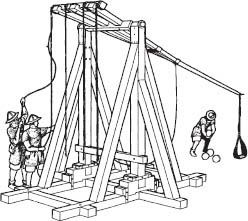
A perrier.
The whole motion, difficult to describe, is extremely elegant to watch; it looks like a cricket ball being bowled overarm. The surprising thing is the noise – or rather, the lack of it. Instead of the explosive charge of a cannon, and the whistling of the missile, there is just a scrape as the ball moves from under the frame, a shudder as the arm is stopped in its spin, and then – nothing. The ball moves through the air in total silence. It’s like watching a film with the sound turned off. The effect is utterly captivating: the motion of the machine and the arc that the missile describes are both exceedingly graceful.

The replica trebuchet at Caerphilly. The counterweight (within the frame) is raised by pulling the arm at one end and winching at the other.
The Caerphilly trebuchet, it must be said, is an impressive beast. With a twenty foot-long throwing arm, it is a ‘full-sized’ replica, and its twenty-five-pound missiles would cause serious damage if directed against buildings (at Caerphilly, they splash down into the moat). It would have been quite possible, however, for medieval engineers to build much larger trebuchets – monster machines more than twice the size, with throwing arms up to fifty feet long. Very little could stand in the way of such huge weapons. Wooden buildings in a castle’s bailey would be smashed to smithereens. Lead roofs would offer no resistance. The only thing that might withstand a direct hit was masonry. Whether or not it did so would depend on a number of factors – how close the attacker dared to bring his engines, how large the machines were, and how heavy the missiles. It would also depend on the skill of the engineer and the precision of his catapult, since to bring down solid stonework would in most cases require several hits in the same place. Above all, it would depend on one question: how thick and well built were the walls?
The men inside Rochester Castle were now asking themselves much the same thing: would the walls of the tower, twelve feet thick, hold out against King John’s trebuchets? The Barnwell Annalist says that the bombardment of the keep did not cease by day or night. There is no suggestion, either from Barnwell or from any of the chroniclers, that the defenders were subjected to the kind of psychological and biological horrors we often hear about in other sieges. Sometimes rotting animal carcasses or the heads of fallen comrades were hurled over the walls of a besieged city or castle, in an attempt to spread plague and terror. John may not have resorted to such tactics (though one would hardly put it past him), but he knew, in any case, that the relentless barrage was piling psychological pressure on his enemies. As the stones rained down on them, as their food ran short, and as the winter cold began to set in, surely they could not hold out much longer?
And yet they did. Part of the reason for the rebels’ dogged determination was an earnest belief that the cavalry would arrive – either in the shape of Prince Louis, or in the more likely form of their London associates. According to one chronicler, the knights who remained in the capital had sworn to Albini and his colleagues that, should Rochester be besieged, they would ride to their aid. Up to a point, they kept their promise. Two weeks into the siege, a force of seven hundred horsemen left London and headed towards Rochester. Halfway there, however, their nerve failed; at Dartford, they turned and headed back. Why they did this is unclear, but it is possible that their scouts had returned with news of the size of the John’s army. We don’t know how large the king’s force was, but we can get some idea from the fact that seven hundred fully armed knights turned in fear and fled.
John would have learned soon enough that his other enemies had retreated back into their hole, and the news must have gladdened him somewhat. It was only a small consolation, however, because the fact remained that Rochester Castle and its defenders were still holding out, despite everything his expensive siege engines could throw at them. With every day that passed, it was becoming increasingly, maddeningly clear that the trebuchets were not going to work. The king, therefore, placed all his faith in his last remaining option: to drive a mine under the great tower, in the hope of bringing it crashing to the ground.
The technique of undermining was not a new one; the Romans and the Vikings are known to have used mines when laying siege to cities. The aim was to drive one or more tunnels under the foundations of the walls, supporting the ground above with timber props, which were then burnt away to create a collapse. But this wasn’t always possible. If the defences were built on solid rock, tunnelling underneath them was virtually impossible. Water defences, or even just soft or waterlogged ground, also meant that mining was out of the question. And even if the conditions for mining were ideal, conditions for miners themselves were anything but. The environment in which such men worked was dark, damp and dangerous: the process could easily end in disaster if the soil above them suddenly subsided.
Digging a mine in peaceful circumstances was difficult enough, but doing so during a siege was doubly dangerous, since the besieged would do everything in their power to frustrate the miners’ progress. Just getting close enough to begin digging would involve dodging a shower of arrows and crossbow bolts, so miners took care to approach under the cover of a ‘tortoise’ or ‘cat’ – a wooden canopy, moved on wheels, and covered in damp animal hides to prevent it being set on fire. Even once they were underground, the miners were still in danger of attack. Roman writers speak of defenders flooding enemy mines and drowning their assailants. A more common approach was for the defenders to dig a counter-mine, either in the hope of causing a collapse, or simply with the intention of meeting their opponents head on, and engaging them in subterranean hand-to-hand combat.
Luckily for John, his engineers reported that the ground around Rochester was suitable for mining. Even so, it was far from being an easy task. Despite having at their disposal all the picks that the men of Canterbury could manufacture, the operation was set to take weeks. At one point, progress ground to a halt when the miners came up against solid stone foundations – not those of the keep or the bailey walls, but the old Roman walls of Rochester. Only by making a detour could they continue with their tunnelling.
For the defenders trapped inside the keep, it was an agonizing waiting game. There is no indication that they tried any of the advanced techniques of counter-attack above, beyond of course trying to pick off miners with crossbows when they emerged from tunnelling. As with the trebuchets, they could only pin their hopes on the solidity of the tower and its foundations. These, we know, were profound; excavations in the late nineteenth century failed to find the bottom of the walls. Getting right underneath the keep must have been a hellish task.
Finally, however, John’s miners managed it. By 25 November, the mine was ready. Hundreds of tons of masonry were now supported only by wooden pit props. On the same day, John sent a letter to his trusted servant, Sir Hubert de Burgh. ‘We order you,’ he said, ‘to send us forty bacon pigs.’ This was not, however, the makings of a thank-you dinner for the hardworking miners – even a glutton like John would have struggled to finish that many ham sandwiches. The kind of pigs the king wanted, he went on to specify, were ‘the fattest and least good for eating’. It was not food that John was after, but fuel. The unfortunate animals were needed ‘to set fire to the stuff which we have put under the tower at Rochester’.
Once the mine was finished, it would have been stuffed with brushwood, straw and kindling to feed a great fire. How the pig fat was introduced is a matter of debate. An older generation of more imaginative historians envisaged the forty-strong herd being driven into the tunnels while still alive, burning torches tied to their tails. Sadly, modern military experts now think this unlikely; the idea of live pigs running around with firebrands attached is just too farcical, even for King John. It is now believed that the pigs were slaughtered and rendered down for their fat, which was subsequently poured into barrels and rolled into the mine.
With or without an accompaniment of squealing pigs, the scene that followed must have been both horrifying and spectacular. Torches were introduced to the tunnels. Deep underground, the kindling caught and the pig fat crackled. Flames started to lick the fatty wooden props and, as the fire grew to a roar, the props started to snap. Suddenly, the ground above the mine fell away. The great keep shuddered and split. With a final deafening roar, a quarter of the building came crashing to the ground.
The dust had hardly settled before John’s men were pouring into the keep through the gaping hole. Amazingly, in spite of the terror and confusion that the collapse must have caused, the men inside fought on. The south-east corner of the keep had been reduced to rubble, but its great cross-wall remained standing; using this, the rebels mounted a last, desperate line of defence. It was successful: try as they might, the king’s men were still unable to force their way in.
At the start of the siege, John had openly derided his opponents’ stamina.
‘I know them too well,’ he allegedly spat. ‘They are nothing to be accounted of, or feared.’
Having now spent seven weeks besieging them, the king must have felt like eating his words.
In the end, despite all John’s military ingenuity, it was starvation that finally forced the rebels to surrender. By this stage the men in the keep were totally out of supplies, and had been reduced to living on the flesh of their own expensive war-horses. This, says the Barnwell Annalist, ‘was a hard diet for those who were normally used to fine food’. At first the defenders tried to cut their losses by sending out ‘those who seemed the least warlike’: perhaps those too exhausted to fight, or possibly non-military personnel, such as clerics or blacksmiths. John, however, was in no mood for such half-measures. When these men emerged he had them mutilated, lobbing off their hands and feet in an effort to persuade those still inside to surrender. Eventually, lacking the strength to fight on any longer, the remaining rebels gave themselves up. By curious coincidence, it was 30 November – the feast of St Andrew, Rochester’s patron saint. The struggle for the city’s castle had lasted for the best part of two months.
‘Living memory does not recall,’ concluded the Barnwell Annalist, ‘a siege so fiercely pressed, and so staunchly resisted.’
After such a long, costly and bitter struggle, John was apparently in no mind to be merciful. According to one of the chroniclers, the king intended to celebrate his victory by having every member of the rebel garrison hanged. This would not have been entirely out of character – the king was famous for gloating when he had the upper hand. However, according to the same writer, one of John’s foreign captains persuaded him to show clemency in the name of self-interest. The war, he argued, was not yet over. What if John or his allies were themselves captured at some later stage? Better the king should imprison his enemies, rather than start a round of tit-for-tat killing that might end up with his own neck in a noose.
It is doubtful that John really needed to have the logic of this argument explained to him by one of his own men. Showing mercy towards a defeated opponent was perfectly normal behaviour in the early thirteenth century. Ever since 1066, warfare in England had been regulated by the code of chivalry. In John’s day, this had nothing to do with later perversions like laying your cloak over a puddle, or letting your enemy strike the first blow. It meant, in essence, that political killing was taboo. Naturally, this did not apply to the non-noble members of society. John had already demonstrated as much when he ordered the mutilation of the ‘less-than-warlike’ members of Rochester’s garrison during the final stages of the siege. After the surrender, he proved the point a second time by hanging one of the rebel crossbowmen (apparently punished for his treachery – the lowborn bowman had been raised in John’s household). Chivalry was not about a high regard for human life in general; it was a code that condemned killing among the upper classes, based on exactly the kind of enlightened self-interest advocated by John’s foreign captain.
Chivalric self-interest, moreover, extended beyond insuring against future reprisals. The man who spared his noble opponents stood to make a significant profit in the form of ransoms. Prisoners were valuable assets, as John fully appreciated. When the rebels were being clapped into chains, the king personally confiscated the most important ones for himself. For example, William de Albini was despatched to the king’s castle at Corfe, and ended up with a price on his head of £4,000. Having appropriated the choicest prisoners in this manner, John generously distributed the less important individuals among his cronies as gifts.
For the rebels themselves, the defeat at Rochester was a massive blow to their cause, and it left the remaining barons in London feeling totally discouraged. The Barnwell Annalist, concluding his section on the siege of Rochester, commented that ‘there were fewwho would put their trust in castles’, and he was absolutely right. When John moved into East Anglia at the start of 1216, the castles of Colchester, Framlingham and Hedingham fell in quick succession. All three were mighty stone castles, and before Rochester, men might have hoped to defend them. After the great siege of that autumn, there was no longer the will to do so.
John, however, despite scoring these new successes, never managed to pluck up the courage to risk a decisive assault on London. His delay cost him dearly. In May 1216, a full year after the rebellion had flared up, Prince Louis landed in Kent and quickly gained control of south-eastern England. All the castles that had fallen to John were suddenly back in the hands of his enemies. Only those fortresses which the king had placed in the hands of his closest servants held out for him. Hubert de Burgh – the man who came through with the pigs – successfully defended the great castle at Dover against the French assault.
By the autumn of 1216, the war was deadlocked. John held sway in the Midlands, but the south and east remained in the hands of his opponents. Ultimately, the situation was resolved by the king’s over-exertion and overindulgence. In early October, after a really good dinner with the burgesses of King’s Lynn, John fell sick with dysentery. He struggled on for a few days, time enough to reach the castle at Newark. By the time he got there, however, it was plain to everyone that he was dying. In the small hours of the morning on 18 October, as a gale howled around the castle walls, the king finally gave up the ghost.

The rebuilt corner of Rochester’s keep.
Since the cause of the war had been John himself – his bad governance, his untrusting personality, and his broken promises – the king’s death removed most of the reasons for fighting. It was much more difficult for the die-hard rebels to justify their opposition to John’s blameless nine-year old son, now crowned as King Henry III. Moreover, the new king’s governors encouraged a cease-fire by recognizing the legitimacy of many of the rebels’ grievances. They issued a new version of Magna Carta, and indicated that in future the king would respect its terms. The only person who stood to lose out now was Prince Louis; it took a decisive battle at Lincoln and a large payment of cash to persuade him to go home.
By 1217, the war was over; John was dead and peace had been restored. Rochester Castle, however, remained shattered and broken – a pale reflection of its former glorious self. It was not until ten years later that builders arrived to make good the damage. The work they carried out was not a reconstruction, but a repair job. Inside the castle, the new archways look shabby in comparison with the elegant originals. Outside, the contrast is even more striking. The collapsed corner of the keep was rebuilt, not with a square tower as before, but with a round one. This had nothing to do with aesthetics; the repairs make a real mess of what was previously a very handsome building. But the king’s masons weren’t interested in making the castle look pretty, or putting it back together piece by piece. The recent siege had demonstrated, in the most dramatic way imaginable, that great towers – even the greatest towers – were vulnerable. Masons, however, had already thought of ways to make castles stronger.