
CHAPTER THREE
CAERNARFON IS ONE of my favourite castles in the UK. It sits right beside the sea on the coast of north Wales, opposite the island of Anglesey, surrounded by swans and besieged by seagulls. Despite its remote location, the castle is familiar to millions of people because of the spectacular ceremony that took place there in 1969 – the investiture of Prince Charles as Prince of Wales.
It was, for many reasons, the perfect place for such an occasion, not least because of its stadium-like proportions. For centuries, poets and painters had come to Caernarfon and gazed in wonder at this giant among castles. In his diary of 1774, Dr Samuel Johnson described it as ‘an edifice of stupendous majesty and strength’.
For me, part of Caernarfon’s appeal is its difference from the castles I grew up with in Kent, like Rochester and Dover. To begin with, there is no single great tower or keep. Instead, the castle derives its military strength from a huge circuit of walls. This was the big departure in castle design in the thirteenth century and, in this respect, Caernarfon is a ‘typical’ castle of its time. In every other way, however, this mighty fortress-palace, with its polygonal towers, masonry of different colours, and the carved stone figures on top of its battlements, is a truly exceptional building.
As we shall see, Caernarfon is the work of many thousands of anonymous individuals. Ultimately, however, the castle is the accomplishment of one man – the English king, Edward I. It was built to mark, in the grandest way possible, his conquest of Wales in 1283. Edward wanted a castle that was a royal palace and an impregnable fortress, an administrative centre for his new dominions, and a grand statement that Wales had become part of a new ‘British’ empire. In Caernarfon, all his wishes were fulfilled.
Perhaps the most remarkable thing about Caernarfon, however, is that it does not stand alone. The castle is ‘only’ the greatest of a whole string of new fortresses, all built by Edward I with astonishing speed at the end of the thirteenth century. The famous castles at Harlech and Conway, Rhuddlan and Flint, as well as the great unfinished castle of Beaumaris, were all built at the king’s command in the wake of his victory. Together they form a group of buildings that still rank among the most impressive engineering achievements the world has ever seen. Not only are they mighty fortresses – a perfect realization of the new ideas of the thirteenth century – they are also works of art, intended to spell out in the most dramatic fashion the achievement of a conquering king.
So what drove Edward I to this excessive display of power? What kind of man was he? As a king, Edward had many great qualities. Physically very big and very strong, he was an expert warrior and a skilled general. He lived up to the image of an ideal Christian ruler by going on crusade. He was also a great legislator, and a faithful husband. But Edward also possessed several less endearing character traits – a dark side, if you like – which earlier historians tended to overlook. Contemporary chroniclers noted that he could be sly and duplicitous. He lacked the ability to see any issue except from a point of view other than his own. Most importantly, he was a king who would not tolerate any attacks on the dignity of the Crown.
It is always dangerous to imagine we can read peoples’ thoughts and intentions, especially if they have been dead for seven hundred years. But if we were forced to psychoanalyse Edward, and to explain why he was so prickly about his royal dignity, we would probably point to the hard lessons he learnt in his father’s reign. Edward’s father was Henry III, whom we recently left as a little boy of nine, being crowned after the death of his own father, King John. From the time of his accession in 1216 until his death in 1272, Henry had a long but troubled reign. Although not actively unpleasant, like John (Henry actually comes across as quite an amiable chap) he lacked good judgement and made bad, even inept policy decisions. By 1258, the great men of the realm had had enough of his mistakes, and forcibly deprived the king of power.
By this time, Edward was around. He was, however, still only a teenager, and powerless to assist his father. All he could do was stand in the wings and watch as the king was humiliated. One can easily imagine how angry he felt, and how frustrated he was at his inability to intervene. Just a few years later, Edward did lead the fight-back that restored Henry to power, but by then he had already learnt his hard lessons about rulership. The young Lord Edward was determined never to let such a shameful thing happen again. When he was king, he would defend his royal rights tooth and nail, and accept no challenges to his authority. By God, he was going to be absolute master in his own kingdom, and woe betide anybody who dared to suggest otherwise.
Henry died in 1272, and in due course Edward succeeded him. Of course, once he was crowned, the new king faced political opposition just like any other ruler – occasional conflict between the monarch and his magnates was an accepted part of medieval government. Some English lords did stand up to Edward from time to time, and several of them lived to regret it. The greatest challenge to the king, however, came not from the political heartlands of England, but from the distant hills and valleys of Wales.
At the start of Edward’s reign, Wales was a completely separate country from England. Of course, the kings of England had always huffed and puffed about their superiority, and expected Welsh rulers to acknowledge their subservient status. To all intents and purposes, however, these rulers were independent. English kings were able to cope with the reality of the situation because Wales was not a united country. The mountainous landscape made it difficult for any one Welsh ruler or dynasty to establish overall control, and as a result the land was divided into petty kingdoms.
In the thirteenth century, however, things started to change. The rulers of Gwynedd, the tiny kingdom in the North-West of Wales, became steadily more powerful in their own region, and eventually began to establish control over their southern neighbours. From the middle of the century, the Welsh united under the leadership of one man. His name was Llywelyn ap Gruffudd.
Llywelyn saw it as his destiny to lead a united Wales. When he was a young man, however, the prospects of doing so looked very bleak. His grandfather had started to build up a federation of Welsh rulers at the beginning of the century, but it had collapsed during the disastrous rule of his uncle Dafydd; all his grandfather’s achievements were undone, and the English invaded large parts of north Wales. As a result, when Llywelyn himself came to power in 1246, he succeeded only to his ancestral lands in Gwynedd and, because of Welsh laws of inheritance, even this meagre prize had to be shared with his brothers.
From this unpromising start, Llywelyn rebuilt his family’s fortunes. Having defeated his brothers in battle in 1255, he went from strength to strength, driving the English out of north Wales, and establishing ever-stronger links with his southern neighbours. In time, he matched and then surpassed the successes of his grandfather. According to contemporaries, he was not only a skilled warrior, but also a charismatic leader. In the words of one English chronicler, the Welsh followed Llywelyn ‘as if they were glued to him’.
Llywelyn’s rapid rise to greatness was helped enormously by the incompetence of Henry III. The events of 1258, as well as moulding the character of the young Edward I, had led to a civil war in England that left the country paralysed in the face of Llywelyn’s advances. When the war finally came to an end in 1267, the power of the English Crown was badly shaken. Henry III was forced to seek peace with the Welsh, and had no option but to recognize Llywelyn’s recent territorial gains. He also went one stage further, and bestowed a new title upon the Welsh leader. When the peace treaty was drawn up at the ford of Montgomery, Llywelyn was named ‘Prince of Wales’. He was the first native ruler of Wales to be accorded this title by an English king.
He was also to be the last. The treaty of Montgomery, while it magnified Llywelyn personally and recognized his conquests, also carried the seeds of his destruction. For all the fine words it lavished on Llywelyn, it was, like Magna Carta, an ambiguous document, more likely to provoke further conflict than bring about lasting peace. Although Henry had acknowledged Llywelyn’s territorial gains, the English lords who had actually lost lands along the Welsh border were determined to claw them back. At the very end of Henry’s reign, a struggle for power began that eventually led England and Wales to all-out war.
The scale and nature of the struggle is best illustrated by mighty Caerphilly Castle. Built by the Earl of Gloucester in an effort to assert his right to a disputed part of the border, and completed just as Edward I came to the throne, the new castle was one of thefundamental causes of the conflict that followed. It is, moreover, an ideal castle for illustrating the huge advances that had taken place in castle-building since the twelfth century.
The biggest difference between Caerphilly and castles of the previous generation is that there is no sign of a keep. In the course of the twelfth century, the technology of attack had caught up with great towers, as the rebels at Rochester had learned to their cost. From the end of the century, therefore, castle designers began to experiment with a new idea. Rather than building a keep, they trusted instead to a large circuit of high walls, punctuated by even taller towers. The towers broke the walls at regular intervals, and were thrust forwards, enabling defenders to shoot arrows or crossbow bolts right down at the base of the wall. An early example of this new arrangement can be seen at Framlingham Castle in Suffolk, which was built in the 1190s; a similar set of walls was built around the keep at Dover shortly before. In both cases, however, the towers set into the walls are square. In the thirteenth century, the preference was almost always for round ones, as seen at Caerphilly. Without a doubt, this was because round towers were perceived to be stronger.
The weakest point in a castle’s walls had always been the entrance, or gatehouse. In the twelfth century, this was typically a single tower, such as the one at Framlingham. In the early thirteenth century, however, a new, far more elaborate design was devised. Castle-builders realized that by building two round towers either side of the entrance, they could produce a much stronger type of gatehouse. Anyone approaching such a building had to pass between the towers, under the watchful gaze of the guards, and flanked on either side by menacing arrow-loops. This new design also created extra space over the gate which could be used for accommodation, usually for the castle’s constable. As time wore on, twin-towered gatehouses grew ever larger and more elaborate: so much so that, by the time we reach Caerphilly, the gatehouse is the same size as a twelfth-century keep.
Finally, in the thirteenth century castle-builders developed the idea of ‘concentricity’, or having multiple lines of defence. If you look at Caerphilly, you can see that as well as the main inner walls which form the castle courtyard, there is another set of walls running all the way around the outside. Like the inner defences, this second line of walls is provided with crenellations (battlements), arrow-loops and gatehouses. Moving out even further from the centre, there is a third line of defence in the form of the enormous artificial lake which surrounds the castle. Water defences like this gave all kinds of protective benefits. As well as making it very difficult to storm the castle directly, they also prevented attackers from bringing their siege engines too close, and they made digging a mine under the walls completely out of the question.

Caerphilly.
At the time it was built, Caerphilly was an absolutely state-of-the-art castle, and one of the largest in Britain. The arrival of such a monster in what he considered to be his own backyard clearly left Llywelyn fuming. On two separate occasions during the building programme, the prince overran the area and brought construction to a halt, at the same time complaining to the English king. Henry III, however, was too feeble to stop Gloucester, and the regency government appointed after his death only made matters worse. By 1274, much to Llywelyn’s chagrin, Caerphilly was nearly completed. Bitter and resentful, the prince pinned all his hopes on the new English king – Edward. He had just returned from a crusade.
Edward, to his credit, did not immediately take sides with his English barons: there was little love lost between the king and the Earl of Gloucester. There were also good reasons, from Edward’s personal point of view, for keeping Llywelyn happy. The king had returned from his crusade with large debts, and the Welsh prince owed him money. In return for the recognition of his title and conquests in 1267, Llywelyn had been charged 25,000 marks (£16,666), and was paying it off in instalments. Edward could ill afford to lose such a sum. Indeed, so great were the financial benefits of restoring Anglo-Welsh relations that Edward chose to ignore a calculated diplomatic snub from Llywelyn, when the prince failed to attend his coronation.
So Edward did not take sides; but nor did he solve the prince’s problems, and the Welshman remained angry. If we look at the situation from Llywelyn’s point of view, 25,000 marks was a lot of money to pay for a treaty that wasn’t working. He was supposed to be Prince of Wales, for Heaven’s sake! If men like Gloucester could build castles like Caerphilly and get away with it, his new title was surely a joke, and everything he had struggled so hard to achieve seemed under threat. Llywelyn grew more and more frustrated, and in his frustration, he made a terrible, fatal error: he tried to coerce Edward I into action. Not only did he withhold money that he owed to the king; he also withheld his homage.
Homage was a symbolic act. To pay homage to someone involved kneeling before them and placing your hands together as if in prayer. You then put your hands between the hands of the other person, and swore to serve them faithfully. It was a public ceremony, intended to advertise that a dependent relationship was being established. When he was invested as Prince of Wales at Caernarfon in 1969, Prince Charles carried out exactly the same procedure before Queen Elizabeth II, watched by a TV audience of over five hundred million people.
In 1275, Edward I decided it was time to perform this elaborate ceremony with Llywelyn. The prince had been offered several previous opportunities to pay homage to the king, but on each occasion had found an excuse to be elsewhere. So at Easter that year, the king thought he would make things easier for Llywelyn by doing most of the travelling. The English court came to Chester, and members of the political communities of England and Wales convened there in order to watch. In an age before TV and newspapers, Edward’s only option for publicity was to pack the place with spectators. We must imagine a day of grand ceremony, just as in 1969; similarly stage-managed, with great solemnity and pageantry. Everyone was going to watch as Llywelyn kneeled before Edward and acknowledged him as his lord and master.
Or at least they would have done, had the prince showed up. Instead, his non-appearance left them confused, disappointed and bored. Far worse, it left Edward looking foolish, with large amounts of egg on his face, and the blow to his dignity was fatal. In a furious rage, the king returned to Westminster. He was still cross two years later when he wrote to the Pope.
‘In order to receive [Llywelyn’s] homage,’ he fumed, ‘we so demeaned our royal dignity as to go to the confines of his land.’
From Edward’s point of view, it didn’t matter what problems the prince had: his homage was absolutely non-negotiable. There were, therefore, to be no more concessions on Edward’s part. Llywelyn could come to Westminster, perform his homage and apologize, or he could face the consequences.
The prince, however, was not for turning either. He refused to budge an inch, and the slide towards confrontation became irreversible. Matters were not helped when, later in the same year, Llywelyn uncovered a plot on his life by some of his own men. When their treachery was discovered, they fled to England, and Edward refused to hand them over. The king, meanwhile, discovered that Llywelyn was planning a marriage alliance with his enemies, and retaliated by seizing the prince’s bride-to-be as she was en route to Wales. Eventually, by the autumn of 1276, Edward decided he had had enough. On 12 November that year, in the presence of a full council of magnates at Westminster, he declared that Llywelyn was a rebel. Their personal quarrel was going to be settled by war.
It was not, however, going to be a war of equally matched combatants. In the thirteenth century, the economic and the military power of England vastly outstripped that of its western neighbour. England had major cities, prosperous market towns and a booming economy. Edward could tap this wealth with taxes and customs, and supplement it with loans from Italian bankers. Wales, with a pastoral economy, few towns and little coinage in circulation, was going to be no competition.
But at the same time, Llywelyn had one great advantage: geography. His ancestral lands were protected by the impenetrable mountains of Snowdonia. Many times in the past, English kings had attempted to lead armies into north Wales, only to be defeated by the harsh terrain and beaten back by the unforgiving weather. Just twenty years beforehand, Henry III, with young Edward in tow, had tried to advance into Wales, and failed miserably. So the prince remained defiant, confident he could weather any storm that Edward might unleash.
The king launched a three-pronged attack, with one army moving up from the south, and a second driving into mid Wales. Edward himself took command of the third and largest contingent, which headed directly into north Wales. The strategy was an old one: he marched a route that had been trodden by Roman legions as well as his own Norman forebears. The king’s intention was to move slowly but surely along the north coast, establishing permanent bases as he went.
The scale of the English war effort, however, was new. By the height of the campaign, the king’s force alone numbered fifteen thousand men. As they went, a separate army of eighteen hundred diggers cut a wide new road through the dense forest. The king sent his lieutenants to occupy the island of Anglesey, which supplied the heartlands of Gwynedd with much of its grain. The whole operation, as contemporaries observed, was like the undertaking of some massive siege, the object being to isolate Llywelyn in his stronghold of Snowdonia and starve him into submission.
In the end, there was not very much in the way of actual fighting – by this stage, Llywelyn had lost much of his earlier adhesive appeal. In order to defend his new principality, and pay the annual render to the English king, the prince had been forced to extort large sums of money from all classes of society – churchmen, burgesses, nobles and peasants. Understandably, his popularity had started to suffer. During the summer, even while the English army was still mustering, many Welshmen had surrendered, and transferred their allegiance to Edward: more than half the king’s northern army was made up of men from south Wales. In such circumstances, Llywelyn had little option but to seek terms. On 2 November he met with members of Edward’s council at his palace at Conway. One week later, peace was proclaimed.
The peace that Edward imposed on Llywelyn was humiliating. He did not remove his opponent, or even take away his title ‘Prince of Wales’. But by the time the king had finished restructuring the realities of power in the province, it hardly mattered what Llywelyn called himself. All the other Welsh chiefs now had to swear allegiance directly to the king. The prince was left with little more than his ancestral lands in Gwynedd. The united Wales he had been building for twenty years had been broken into pieces.
Edward set about enforcing this settlement by building a string of new castles to hem the prince in. Two were built in the south at Builth and Aberystwyth, but little remains of either castle today. More substantial ruins survive at the two larger and more expensive castles that the king built in the north, at Rhuddlan and Flint. Rhuddlan was most expensive of all, a reflection of Edward’s intention that it should be the seat of royal government in north Wales.
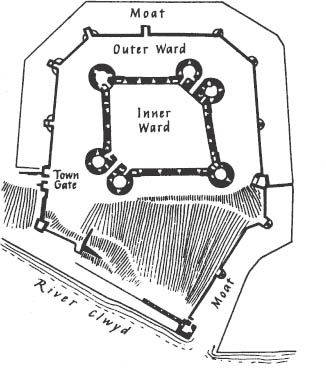
Rhuddlan.
The castle was built to a typical thirteenth-century design. As at Caerphilly, there are high walls around a central courtyard, round towers and gatehouses. It is also, like Caerphilly, a concentric castle, but in this instance the moat is dry. In fact, the only major difference between the two castles is one of scale: Edward would not have thanked you for saying it, but Rhuddlan is a lot less impressive than the Earl of Gloucester’s giant castle in the south. From our point of view, however, it does have one great advantage. Because it was built by a king rather than an earl, Rhuddlan shows up in Crown records. Using these documents, we can look in detail at the processes involved in building a thirteenth-century castle.
In comparison with the meagre amounts of information from earlier centuries, there is a huge amount of written evidence about castle-building under Edward I. Using original government rolls from the Exchequer, we can find out the names of the builders, the exact costs, the precise dates and more besides. In the case of Rhuddlan, these rolls reveal one especially amazing fact: as well as building the castle, Edward also straightened the River Clwyd.
The location that the king chose for Rhuddlan was in many ways ideal – indeed, the remains of a Norman motte and bailey, which can still be seen to the south-east of the new castle, show that Edward was not the first to identify its strategic advantages. The king did, however, foresee problems in keeping the site supplied. The River Clwyd was far too winding to allow his large cargo ships to reach it. Edward’s typically audacious solution was a huge feat of medieval civil engineering. From the fens of Lincolnshire and East Anglia, the king recruited hundreds of diggers, ditchers and delvers. By September 1277 there was an army of 968 men working on what the records call ‘the great ditch’. Using only picks and shovels, their job was to make perfect what nature had left unfinished: to straighten the three-mile stretch of river that wound its way from the castle to the coast.

Using satellite photography, it is still possible to make out the original loops and bends that Edward I’s engineers straightened seven centuries ago.
Today, using mechanical digging equipment, the canalisation of the Clwyd might be achieved in five to six months, and would cost somewhere in the region of £5 million. Even by modern standards, therefore, what Edward had embarked upon was an enormous construction project. And by such feats of engineering, the king left the Welsh in no doubt – he was a man who would go to extraordinary lengths to get his own way.
The new castles of Rhuddlan, Flint, Aberystwyth and Builth were permanent reminders of the humiliating defeat inflicted on Llywelyn in 1277. But the English victory did not end with the planting of fortresses. Edward was also determined to introduce English governmental practices and English law to Wales, and this, more than anything, provoked a widespread backlash. In letters to the Archbishop of Canterbury, Llywelyn and his courtiers complained about the unfair ways in which they were treated by English officials and, most of all, the way in which their national identity was being denied.
‘All Christians have laws and customs in their own lands – even the Jews in England have laws among the English,’ they reasoned. ‘We had our immutable laws and customs in our lands, until the English took them away after the last war.’
In addition to these general grievances, there were certain Welshmen who, having supported Edward in the war, came to feel that their service had gone unrewarded. Although they had quickly flocked to the king’s banner, they had received only meagre handouts, while the richest pickings went to Edward’s English commanders. One man in particular who felt hard done by was Llywelyn’s younger brother, Dafydd ap Gruffudd. He and others like him, having helped bring down the prince’s oppressive regime, now found it replaced by the even more onerous and unsympathetic rule of foreigners.
In 1282, these accumulated tensions finally spilled over into concerted action. Late on the eve of Palm Sunday, the English lord Roger Clifford, one of Edward’s old friends and a major beneficiary of the 1277 settlement, was sleeping soundly in his bed in his new castle at Hawarden. Suddenly and without warning, the castle was stormed by a band of Welshmen, led by Dafydd. Clifford was dragged from his bed and carted off into captivity, while many of his household were killed. The same night, other English castles were attacked. It was clearly a well-conceived and well-executed uprising. Llywelyn, although he claimed not to have authorized the attacks, nevertheless soon assumed the leadership of what quickly became a national rebellion, and joined in the assault on Edward’s castles at Flint and Rhuddlan.
When news of the uprising reached Edward, his response was swift. He immediately appointed commanders to three different armies, and ordered a general muster of troops for May. In military terms, it was the same strategy he had used five years before. The king personally led a large army along the north Welsh coast, while the two other armies, led by trusted lieutenants, pressed into mid and south Wales. Politically, however, the ante had been upped massively. Edward was now embarking not merely on an expedition to punish Llywelyn, but on a mission to destroy him. In a letter to his commanders, the king resolved chillingly ‘to put an end finally to the matter… of putting down the malice of the Welsh’.
No one, however, was pretending it was going to be an easy operation. To begin with, delays in mustering his armies had left Edward contemplating something that no English king had ever dared to attempt before – a winter campaign in Wales. At first, the king’s bold move seemed like a bad decision. The southern army ran into trouble when the Earl of Gloucester was defeated, and another commander, William de Valence the younger, was killed in action. In early November, a group of English knights was sent to take Anglesey and create a bridge across the Menai Straits, but they met with disaster when they were ambushed by the Welsh and driven into the sea. Nevertheless, these remained setbacks rather than reverses. The armies on this occasion were twice the size they had been before, and total expenditure on the campaign dwarfed the cost of Edward’s earlier Welsh adventure. One modern estimate puts the 1282 figure at £150,000 – about seven times that of 1277. Everything indicates that this time, the king was bringing the full power of the English state to bear on his Welsh adversary.
With such enormous resources ranged against him, Llywelyn’s future looked exceedingly bleak. In Snowdonia, the Welsh prince watched the relentless build-up of well-provisioned troops with dismay. He began to realize that his only hope of survival was to break free from the snare that Edward was drawing around him. The easiest escape route appeared to be to the south-east, towards an area of the border where English control seemed to be weak.
His break for the border was Llywelyn’s last move. On 11 December 1282, within a few miles of the new castle at Builth, the prince and his companions were ambushed by a group of English knights. The Welshmen fought bravely but were ultimately bested,and Llywelyn, who remained unrecognized throughout, fell in the course of the fighting. Later, when his killers realized the significance of their deed, they hacked off the prince’s head and in jubilation sent it north to Edward. It was at Rhuddlan, where the northern army had paused in its march, that the two old adversaries came face to face for a final time. Having seen it for himself, the king sent Llywelyn’s head to London, for all his subjects to admire. From the start of 1283, and for many years later, it adorned a spike outside the Tower.
As the news spread through Wales, the country despaired. ‘Is it the end of the world?’ asked one Welsh poet. What little resistance still remained now quickly crumbled, and the last native stronghold at Castel-y-Bere fell at the end of April 1283. Two months later, the fugitive Dafydd ap Gruffudd was captured, and treated to a far more elaborate and grisly death than his brother. After the pretence of a carefully staged show trial at Shrewsbury, Dafydd was dragged, hanged, disembowelled and quartered.
With the native dynasty vanquished, Edward parcelled out some of the conquered lands to his followers, and confiscated all the remaining land in north-west Wales for himself. He set about securing his hold on his new territories by building three new castles: Harlech, Conway, and Caernarfon.
Just by looking at these locations on a map, you can appreciate that the king was choosing the sites for his new castles with care. They are separated by more or less equal distances, each castle being sited no more than a day’s march from its nearest neighbour. There was, however, a great deal more to the positioning of Edward’s new fortresses than this simple observation implies. For example, in choosing to build at Conway, Edward deliberately ignored the more obvious site of an earlier English castle just a few miles away at Deganwy. A comparison of the two sites is therefore very revealing, since it shows the way in which thinking about castles had changed, even in the space of Edward’s own lifetime.
Today, very little remains of Deganwy castle. It once sat on the top of a twin-peaked hill on the eastern side of the Conway estuary. The highest point for miles around, with commanding views over the surrounding landscape, the site is an absolutely stunning defensive location. The site actually has natural crenellations – a series of smaller hills ringing the summit. From the point of view of protecting an army, this would seem to be the perfect spot. The Romans, who built a camp here in the first century AD, clearly thought as much. The princes of Gywnedd thought so, too: Llywelyn’s grandfather built a castle here at the beginning of the thirteenth century. And Henry III, Edward’s father, also thought Deganwy was by far his best bet. When he seized control of the area in 1245, he built an entirely new castle on the ruins of the old one.
Edward I, however, thought otherwise. Fantastic defensive location it might be, but Deganwy has one very major drawback. Like Rhuddlan, it stands a long way from the sea. There was, however, no question of improving water-borne access on this occasion. The River Conway lies at the bottom of the hill, hundreds of fact below the castle site. Even as the crow flies, the river and the sea are half a mile away, and the path that winds its way from the shoreline to the castle is considerably longer – almost two miles. The result (as at least one TV film crew can testify) is that Deganwy is very difficult to supply. Being on top of a hill might make it easy to defend, but it also makes it very easy to surround. Once cut off from the sea and the river, it didn’t matter how strong the hill-top castle was; a besieging army would only have to wait for the defenders’ food to run out, then watch them starve.
Such drawbacks were not acknowledged by Henry III when he began to rebuild the castle in the mid 1240s. They soon became apparent, however, to the soldiers who were stationed there during the initial stages of construction. Writing home, one soldier in the king’s army described the terrible conditions that existed in the English camp.
‘We dwell here,’ he said, ‘in watchings and fastings, in prayer, in cold and nakedness. In watchings, for fear of the Welsh, with their sudden raids upon us by night. In fastings for lack of victuals, since the halfpenny loaf cannot be got for less than fivepence. In prayer, that we may quickly return safe and sound to our homes. In cold and nakedness, for we live in houses of linen and have no winter clothes.’
When supplies finally arrived, Deganwy’s disadvantages were all too apparent, for the English could not reach their own ships. A boat coming from Ireland was inexpertly steered into the Conway estuary, and became grounded on a sandbank. The English and the Welsh fought over the beached vessel for twenty-four hours, but eventually it was the Welsh who gained the upper hand and made off with its precious cargo. Such handicaps ultimately led to Deganwy’s destruction. In the autumn of 1263, the castle’s inadequacy was underlined for a final time when Llywelyn (then enjoying his glory days) captured the castle and razed it to the ground. The castle lies in ruins today largely because of the prince’s comprehensive demolition.
So, when Edward I marched into the area in 1283, he decided that there was absolutely no point in following the ancient tradition of fortifying Deganwy by rebuilding his father’s castle. Like Napoleon, Edward understood that his soldiers marched on their stomachs. As the letter written in 1245 testifies, they also needed warm clothes, strong tents, and plenty of ammunition. The English king had conducted a successful winter campaign in 1282 and 1283 precisely because he had managed to keep his armies supplied with such basic necessities. If he was going to hold on to his conquests, he knew he had to keep his supply lines open. Deganwy was therefore left to decay, and a new site was selected. Forgoing the superb defensive position on top of the hill, Edward opted for a location on the opposite bank of the river, right on the shoreline. The result was Conway – a castle whose walls are lapped by the sea, enabling Edward to bring his cargo ships right up to the gate.

Harlech.
Edward sited all his castles in this manner so that they could be kept supplied at all times. Conway, Caernarfon and Flint all stand by the sea today. Harlech, although it now appears landlocked, was not always so isolated. The land below the castle has been reclaimed – the sea once ran right up to the base of the cliff. At Rhuddlan, we have already seen how the king canalized the river for exactly the same logistical reasons. By building castles where the water could lap at their walls, Edward made it impossible for the Welsh to deploy their traditional tactics. No longer could the king’s fortresses be blockaded and destroyed. From now on, the English would have a permanent foothold in Wales.
In certain cases, choosing the optimum strategic position for a castle also enabled Edward to make a political point. When it came to grandstanding, the king was a master showman, with a ruthless eye for detail. As is well known, when he later invaded Scotland, Edward seized all the symbols of native power, including, most famously, the Stone of Destiny. It is less widely appreciated, however (precisely because, in this instance, the king was more successful), that he did exactly the same thing a generation before in Wales. After the conquest of 1283, Edward seized all of Llywelyn’s regalia – his crown, orb and sceptre – and had them sent back to Westminster. Similarly, he confiscated the prince’s seal-matrices and had them melted down to make a silver chalice.

Conway.

Caernarfon.
But it is Edward’s castles that provide the most outstanding testimony to his determination to impose a new identity on Wales. Neither Caernarfon nor Conway were built on virgin sites; both, towns had been popular destinations for Llywelyn’s court. Edward flattened these settlements, removing or destroying the great halls of the Welsh princes, and building his new castles in their place. The old days of independence, the Welsh were to understand, were now over; a new and more powerful authority was rising in its place. At Conway, there had once stood a great Cistercian abbey, founded by Llywelyn’s grandfather and the last resting place of the prince’s ancestors. Edward levelled the building, and built Conway castle directly over their bones. With calculated callousness, the king literally erased the memory of Llywelyn’s family from the face of the earth.
Construction at Harlech, Conway and Caernarfon started in the summer of 1283, in each case within days of the arrival of Edward’s army. The first task at all three locations was establishing the castle site and making it secure. At Harlech and Caernarfon, this meant cutting ditches around the perimeter; no mean feat at Harlech, since this involved hacking through solid rock. Such work, like the ‘sea-ditch’ at Rhuddlan, required armies of labourers, and they were drawn from all over the country. Like those who built castles in the twelfth century, these men were paid a daily wage, mostly at the rate of one or two pence a day. The work, however, was backbreaking and dangerous, and for this reason many men had to be forcibly persuaded to accept the king’s offer of a job. The belief that large numbers were pressed into service is borne out by an entry on one of the building accounts, which records three mounted sergeants who were paid to escort three hundred diggers from Yorkshire, ‘in case they should flee while on the road’.
With the ditches underway, a wooden palisade was put up around the castle site, and temporary wooden buildings were erected. These buildings were not just the medieval equivalent of Portakabins; they included suites of rooms for Edward and his household, evidently built to some standard of luxury. At both Conway and Caernarfon, separate chambers were built for Edward’s queen, Eleanor, and gardens were laid out for her enjoyment, the turf being shipped in specially. Although all the timber buildings would eventually be replaced by stone, the investment in wooden walls was nevertheless enormous – twenty shiploads of timber were sent from Liverpool to Caernarfon in the first few weeks of building.
But the essential commodity, of course, was not timber, but stone. As we saw in Chapter Two, it made good sense to source the bulk of the material as locally as possible, but the expensive stone needed for window frames and fireplaces had to come from further afield. In the case of Edward’s castle at Aberystwyth, built after the first Welsh war, high-quality stone was shipped all the way round the Pembrokeshire coast from Bristol. Other commodities had similarly long journeys. Lead for roofing and plumbing the castles was mined in the mountains of Snowdonia and brought overland to the construction sites. Iron and steel were ordered from Staffordshire, and ropes were sent from Lincolnshire.
Again, we know these kinds of details because the processes of construction are detailed clearly in surviving records. The same records also give us the precise number and kind of workmen on each site. Most of the labour force were of the unskilled variety, press-ganged in the counties. There were, however, scores of skilled artisans on every site, including carpenters and plumbers, and in the later stages, glaziers. When work at Harlech was at its height in the summer of 1286, in addition to the 546 general labourers, there were 115 quarriers, 30 blacksmiths, 22 carpenters and 227 stonemasons.
Stonemasons were the key to the whole operation. They were skilled workers, and paid at the accordingly high rate of three to four pence a day. They were sometimes known as freemasons, not because they dressed up in aprons and indulged in arcane ceremonies, but because they had the ability to carve the more expensive ‘freestone’, which could be chiselled in any direction without splitting. Working any kind of stone was a slow process, especially if the patron demanded that every inch of a building was finished to the same high standard. Typically working in teams, masons travelled the country from one project to the next, and worked mostly in the warmer months of the year.
The written records, for all their exhaustive detail, are rather inexpressive when it comes to the actual processes involved in the construction of a castle. To understand these, we have to turn to the illustrations in contemporary manuscripts. These provide a wealth of additional information: how scaffolding was erected, how stone was carved, and how blocks of stone were moved around the site. Heavy blocks were either dragged on sleds, or wheeled from place to place in carts. The method of lifting them off the ground and up to the level of the builders was particularly ingenious – at each site, carpenters constructed several windlass cranes, powered by men in a treadmill. One such crane survives at the top of the spire in Salisbury Cathedral.

The treadmill crane at Salisbury cathedral.
Because the castles had to fulfil a vital military role, Edward drove construction on at lightning speed. Astounding as it seems, the records show that Conway Castle was substantially completed in just four years. Harlech scarcely took longer, and was finished by 1289. Only at Caernarfon did work drag on into the 1290s and beyond. The speed and scale of construction meant that these castles were not cheap. Harlech, with a price tag of £10,000, was the least expensive of the three. Conway, being larger and more sophisticated, cost something in the order of £15,000. When the builders finally put down their tools at Caernarfon, the project had absorbed at least £27,000.
So, from the summer of 1283, we have to imagine thousands of men being conscripted from all over England, marched to north-west Wales, and beginning to build Conway, Harlech and Caernarfon. The big question that remains is, who was in charge? Edward was of course the prime mover behind the project, but who masterminded the layout and design of the new castles, supervised the workforce, and ordered the materials? Today we would expect these jobs to be shared by a number of individuals – an architect would come up with the initial design, a surveyor would inspect and assess the site, a foreman would take charge of the labour force and so on. In the Middle Ages, however, all these tasks fell to one man. He was the master mason, a uniquely skilled and talented individual.
All kinds of jobs might fall to the master mason. He was responsible for sourcing the stone and devising the machines for lifting the blocks. He carried with him the ‘moulds’ or templates that were used to mark the uncut pieces of stone. Unlike a modern architect, he had no formal professional training; his skill with stone and his knowledge of geometry and mechanics were all acquired on the job. Master masons worked their way up from the ranks of the ordinary masons, and started their careers cutting blocks just like the rest. Moreover, although his skills might elevate him above his peers, a master mason was never entirely removed from the workplace. Even though he might conceive of the design for a whole building, and have hundreds of men working under him, he was not confined to an office; he might still be found, chisel in hand, working alongside his fellows.
Who was Edward I’s master mason? Until recently, all that historians had to conjure with was a name: Master James of St Georges. He first occurs in the records in the spring of 1278, when he appears at Flint and Rhuddlan ‘to ordain the works of the castles there’. After the second Welsh war, he is styled ‘Master of the King’s Works in Wales’, and receives the very high salary of three shillings a day for his efforts. Clearly this is our master mason. But who was he? He appears in 1278 out of nowhere. Where had he come from? Nobody could say until, just sixty years ago, a historian called Arnold Taylor became Chief Inspector of Welsh Monuments (1946–55), and set out to solve the mystery.
In the course of his work, Taylor came to know Edward’s Welsh castles inside out. He soon became puzzled by some unusual and apparently unique features. In the first place, he noticed that there were small square holes in the sides of the towers. This in itself was perfectly normal; you find such holes in the sides of castles everywhere. They were for the wooden scaffolding supports or joists to fit into while the castle was being built, and are known as ‘putlog holes’ because (wait for it) they are the holes where they put the logs.
Something, however, was not quite right about the ones at Conway and Harlech. Normally they wrapped around the walls or towers of a castle at the same horizontal level. At Edward’s Welsh castles, however, the holes spiralled around the towers, suggesting that the original scaffolding had been sloped, rather like the slide on a helter-skelter.
There were other oddities. Conway and Harlech had several archways that were perfectly semicircular. This might not sound especially strange, but Taylor knew from his experience of other castles in England and Wales that such archways were not to be found elsewhere in the UK on buildings of this date. Similarly, Taylor realized that the windows in the great gatehouse at Harlech, as well as being exceedingly large and handsome, were apparently unique. Despite his extensive knowledge of castles, he had never seen anything like them. And then there were the toilets. Nothing unusual there, you might think. Taylor, however, was intrigued by the peculiar projecting funnel-shaped design he saw at Harlech. Again, he’d never seen anything else quite like it.
Could these clues – putlog holes, archways, windows and toilets – help reveal the identity of Master James of St Georges? Taylor decided to find out. The evidence in the architecture seemed to suggest that, whatever else he might be, Master James was certainly not British. And so, in the autumn of 1950, Taylor left Britain on a quest to find him. Following what was no more than a strong hunch, he headed for Switzerland, and the tiny alpine province of Savoy.
Today, Savoy is a region shared between Switzerland, Italy and France. In the thirteenth century, however, it was an independent state, ruled by a dynasty of counts. Although small in size, its position made it powerful. The counts of Savoy controlled the Alpine passes between France and Italy, and therefore controlled traffic and communication between the kings of England and France to the west, and the Emperor and the Pope to the east.
Even so, it might seem an odd place to go looking for clues about Welsh architecture. Taylor, however, had done his homework. He knew, for example, that since the middle of the thirteenth century, there had been strong ties between the counts of Savoy and the English royal family. Precisely because of their powerful role as brokers of international relations, Henry III had married into the Savoyard family and, for a time, his court was dominated by his relatives from Savoy. Edward grew up in the company of Savoyard uncles and cousins and, when he was king, continued to cultivate the connection between the two dynasties. Many of his best friends were from Savoy, including the great Otto de Grandson, whom Edward put in charge of north Wales after the conquest.
Having reached Savoy, Taylor headed for the eastern edge of Lake Geneva, and the castle of Chillon. As Taylor says in his writings, ‘It is easier to remember than to communicate one’s impressions on visiting this marvellous building for the first time.’ The castle stands on a small island right by the edge of the lake, and seems to rise directly out of the water, like a ship in harbour. Unlike Edward’s castles, it has been much restored and rebuilt since the thirteenth century, but what it occasionally lacks in medieval authenticity it more than compensates for in overall ambience. Seen from the west, framed by the snowy peaks of the Swiss Alps, the castle and its setting are nothing less than breathtaking.
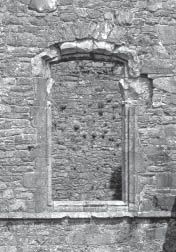
Windows at Harlech

Chillon.
The castle at Chillon was originally established in the first half of the twelfth century, but most of the existing walls and towers were built in the middle of the thirteenth century, at the command of the then count, Peter of Savoy. It was here that Arnold Taylor made his first major discovery. Several of the windows, although much restored in the late nineteenth century, were identical in design to those in the gatehouse at Harlech. Not only were they a similar shape; they were exactly the same size. When Taylor measured them from top to bottom, he found that they differed in height from their Welsh equivalents by just a quarter of an inch. Two sets of windows, a thousand miles apart, but with less than half an inch between them – a big clue, surely, that Taylor was on to something.
Other discoveries soon followed. Heading further into the Alps, Taylor came to two smaller castles at La Batiaz and Saillon. Both were built in the thirteenth century by Peter of Savoy as part of his struggle with the bishops of Sion to control the Rhône valley. As castles, neither is as striking as Chillon, but their locations are similarly stunning. La Batiaz is perched dangerously on top of a spur of rock, many hundreds of feet above the small town of Martigny. It was here that Taylor found his second major clue. On the side of the castle walls is a pair of projecting garderobes, built to exactly the same funnel-shaped design as the solitary example at Harlech. Subsequent investigations have uncovered no similar examples. In other words, Taylor had stumbled across another rock-solid, utterly distinctive architectural parallel between the castles of Wales and Savoy.

Garderobes at Harlech

La Batiaz
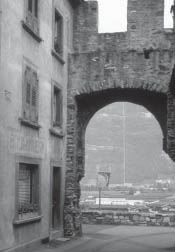
Archways at Saillon

Harlech.
The final pieces of architectural evidence were located a few miles up the valley in Saillon. A marvellous little place, the town still has an authentic medieval feel, and is built at a ridiculously steep angle on a small foothill of the Alps. Little remains of Peter of Savoy’s castle today – just a single round tower. The town walls, however, were also built at that time, and contained all the clues Taylor needed. The towers along the walls had the same spiralling putlog holes as those at Conway and Harlech, and the arches of the town gates were of the same semicircular design as the Welsh ones. Furthermore, beyond the clinching evidence of these identical features, the appearance of the walls as a whole gave Taylor an unmistakable feeling of déjà vu: seen from a distance, they are entirely reminiscent of the town walls at Conway.
All the unusual features of Edward I’s Welsh castles, therefore, had identical counterparts in medieval Savoy. What was the connection? The counts of Savoy, like the kings of England, kept detailed financial records of their building projects, and luckily these records still survive in the archives at Turin. It was there that Taylor found the answer. When he unrolled the fragile accounts for the 1260s, he found that Peter of Savoy’s castles had been built by two men, a father and son team, called Master John and Master James. The later accounts showed Master James working alone and, in particular, working on a brand new castle site, owned by the counts of Savoy but located over a hundred miles away near the French city of Lyon. The name of this castle was St Georges-d’Esperanche. This, Taylor recalled with delight, was the very place that, in 1273, Edward I had stopped on his way back from crusade to visit his Savoyard cousin. It seems very likely, since work on the castle was still underway at the time, that the king may have been introduced to a skilled master mason and castle-builder par excellence, who went by the name of Master James of St Georges.
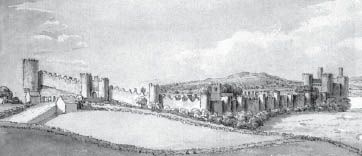
The town walls at Conway
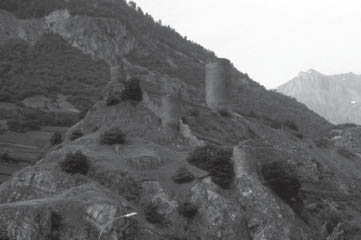
Saillon.
Arnold Taylor’s hunch had paid off – he had discovered the true identity and origins of Master James, and proved beyond question that he was one of the world’s greatest architects. Not only was he responsible for the great royal castles in Wales; he was also the designer of a string of castles in Savoy. When you look at his early handiwork, you can see how Edward I, travelling through the Alps in 1273, must have been impressed, not to say envious. It is always slightly galling when you drop in on relatives and discover that their new house is quite a lot nicer than yours. Sitting in the magnificent chambers of Chillon Castle, gazing at Lake Geneva through the ‘Harlech’ windows, one is tempted to think the unthinkable. Was Edward really driven by necessity and outraged honour, as he would always claim? Or did he just want a lovely new set of fabulous castles in the mountains, like his cousins?
We will never know. What we do know is that when Edward formulated his castle-building plan in 1278, there was only one man for the job. The king summoned Master James and put him in charge of the entire operation. Since the results were Conway, Harlech and Caernarfon, we can say with some certainty that his faith was not misplaced. Edward was clearly delighted with the castles because, as well as paying his architect a handsome salary, he also gave him a wonderful gift. In 1290, he appointed Master James as constable of Harlech castle. What better reward for the architect than to live in the magnificent gatehouse that he himself had created?
Harlech is in some respects Master James’s most striking castle, owing largely to its situation on a great outcrop of rock, with views out to sea to the west and vistas of Mount Snowdon to the east. Impressive as it is, however, the castle was intended to house only a garrison and a resident constable – it would have been a little pressed to accommodate the king and his court. At Conway and Caernarfon, though, the story was different. These were castles built as palaces, where Master James designed and built spectacular suites of rooms for the king, his family and the royal household.
The best place to appreciate the luxury of Master James’s designs is at Conway, since its royal apartments still survive. Domestic comfort has taken several steps forward since the twelfth century and its great towers. Not only do we find plenty of grand fireplaces, but also many more toilets – even the tiny watching-chamber for the king’s chapel is thoughtfully provided with en suite facilities. The biggest advance, however, is in terms of windows. Although the windows on the outside of the castle are few and tiny, the windows on the inner courtyards are large and stately, and would have been fitted throughout with stained glass of many colours.
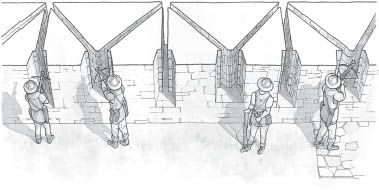
Soldiers using the crossbow-loops at Caernarfon.
At Caernarfon, meanwhile, you can appreciate the military sophistication of Master James of St Georges’ design. On the exposed southern side of the castle, two passageways run through the curtain wall for its entire length, one above the other, punctuated at regular intervals with crossbow-loops. The garrison, therefore, with archers and crossbowmen shooting from within the walls as well as behind the battlements on top, had treble the defensive force. On the north side of the castle, the arrangement of the defences is even more ingenious. What from the outside seems to be a bank of five conventional crossbow-loops is revealed on the inside to be a cunning arrangement of interlocking slots, with each loop capable of being shared by up to three archers. The result, combined again with the potential number of men shooting from the battlements and the towers, has been justly called ‘one of the most formidable concentrations of “fire-power” to be found in the Middle Ages’.
The best place, however, to stand and admire the military might of Caernarfon Castle is at the main entrance, the so-called King’s Gate. Any would-be attacker trying to get in this way was faced with a daunting set of obstacles. In the first place, there was the great ditch in front of the gate, which could only be crossed by means of the drawbridge. If, by some miracle, the attacker managed to get past that, he was confronted by five sets of sturdy oak doors, alternated with no less than six portcullises. Above his head were holes in the ceiling, called meutrières or murder-holes, conventionally believed to have been for boiling oil or rocks, but now generally (and rather boringly) considered to have been water chutes, for use if a fire was started in front of the gates. Even if we grudgingly accept this new hypothesis, we can still draw comfort from the fact that the gatehouse is liberally provided with crossbow loops and flanked by the other mural towers and wall-walks on this side of the castle. Boiling oil or no boiling oil, our would-be assailant was going to have a hard time getting in this way.
The King’s Gate is unquestionably a mighty piece of military thinking, but its functions are not purely practical. Above the doors is a carved statue of a king, which makes Caernarfon the earliest example of a castle with an ornamented gatehouse. As with the forebuildings on our twelfth-century castles, this is an entrance designed to impress the friendly visitor as well as deter the attacker. Some of the military paraphernalia can also be read in this way. One portcullis, for example, is a jolly good idea, and two portcullises might likewise be interpreted as very prudent. But does anyone really need six portcullises or, for that matter, five sets of oak doors? Another way of looking at these barriers is to see them as part of a ceremonial procession route. We have to imagine a distinguished visitor entering the castle, and being treated to the spectacle of doors swinging open and portcullises being raised in an intentionally elaborate ballet. It seems clear that a deliberate degree of theatricality has been incorporated into the architect’s design.
The sense of drama at Caernarfon’s King’s Gate in fact extends to the whole castle. The fashion for towers in the thirteenth century, you will recall, was for round rather than square, and indeed we have seen round towers at Caerphilly, Flint, Rhuddlan, Harlech and Conway, as well as at Chillon, La Batiaz and Saillon. Caernarfon’s towers, however, are neither round nor square, but polygonal. Some of them have eight sides, and one has a total of ten. Moreover, in the Middle Ages it was typical to finish the walls of a castle with whitewash. At Conway and Harlech you can still see traces of this original finish (and imagine how different and glorious they would have looked in their heyday). Once again, however, Caernarfon was unusual. Instead of being covered over, the castle’s walls were left bare, in order to expose to the outside world the different coloured bands of stone in the masonry.
Why was Caernarfon Castle so different to all the others? The answer, it seems, lies in Edward’s love of chivalric literature. The king was a big fan of the legendary King Arthur, and on several occasions we can catch him indulging his passion for all things Arthurian. In 1278, despite having plenty of other pressing business, he personally attended the disinterment of two bodies at Glastonbury Abbey, which the monks swore blind were those of Arthur and his queen, Guinevere. After the conquest of Wales in 1283, Edward was ceremonially appeased with a bauble known as ‘Arthur’s Crown’, which he subsequently presented at the high altar of Westminster Abbey. The following year, Edward organized a ‘round-table’ tournament in Wales; and the great round table on display in Winchester Castle has recently been scientifically dated to Edward’s reign. King Arthur, we should note, was according to legend not simply a king of England, but the king of a united island of Britain, and this alone would have made him an attractive role model for a conquering king like Edward. When he later wrote to the Pope to justify his right to rule Scotland, it was the historic precedent of Arthur that Edward cited in his defence.
Edward’s enthusiasm for the mythical British past was evidently keenly felt, and without a doubt he had heard an ancient Welsh tale called The Dream of Macsen Wledig. It was first written down in the fourteenth century, but had already been current for several hundred years. The story recounts how Macsen (or Maximus), a Roman Emperor, dreamed of travelling from Rome to Wales, until he came to a point where the river met the sea, and saw a great castle, ‘the fairest castle that mortal had ever seen’. The location of this castle, the poet later reveals, was Caernarfon. Edward, therefore, by choosing to build his new castle there, was not only building on top of yet another hall of the Welsh princes; he was making this ancient legend come true by building his own fairy-tale castle, like the one in Macsen’s dream. Macsen’s status as a Roman emperor is reflected in the decoration of Caernarfon’s largest tower, which is topped with stone carvings of imperial eagles, and appropriately called the Eagle Tower.
The cleverest part, however, is the message hidden in the banded masonry and the polygonal towers. According to the same Welsh legends, the Emperor Macsen was the son of the Emperor Constantine, celebrated not only as the first Christian emperor, but also as the founder of the new imperial capital of Constantinople (modern Istanbul). There is no indication that Edward ever visited this city, but someone in his entourage clearly knew what the walls there looked like. They have banded masonry, and polygonal towers. Caernarfon, even though it stands at the opposite end of Europe, is an unmistakable echo of Constantine’s imperial city.
The big question is, of course, who came up with these ideas? It is totally unanswerable and therefore all the more intriguing. We might be tempted to ascribe all the invention to Master James, but it was clearly Edward himself and not his master mason who was inspired by King Arthur. We might imagine Master James coming over from Savoy with a set of sketches tucked under his arm, but again this is highly unlikely. At Harlech, Conway and Caernarfon, each castle is built to fit the platform of rock on which it stands, and therefore much of the design had to be worked out on the spot. Moreover, there is no indication from his work in Savoy that Master James had ever designed or built a twin-towered gatehouse before he came to England. The fact that he constructed such gatehouses at Harlech and Rhuddlan suggests he was open to new ideas, or tried hard to incorporate his patron’s wishes. Later, when Edward was at war with the Scots and needed a castle at Linlithgow, he wrote a letter to Master James telling him precisely what kind of design he wanted, specifying (among other things) the depth of the ditch and the number of towers. There is no doubt that Edward had similarly strong views about what he wanted in Wales, and gave equally detailed orders to his master mason.

Polygonal towers and banded masonary: Caernarfon

Constantinople.
At Conway and Caernarfon, Edward ordered Master James not only to build new castles, but also to lay out whole new towns. In each case, large new settlements were created, surrounded by handsome sets of town walls. These walls, which still stand today to a remarkable degree of completeness, were built in the earliest stages of the construction process, in order to protect the workers from attack while the rest of the work was carried out. Their impressive scale is reflected not only in their present appearance, but also in their original cost. The Caernarfon walls alone cost £2,100.
Edward wanted new towns in Wales for several reasons. On the one hand, building new boroughs was an attempt to make his castles self-sufficient. With a prosperous town on the doorstep importing goods from all over Europe, a garrison could be kept supplied with food, wine and other essentials throughout the year. Most of the things that English soldiers wanted or needed could not be bought locally, and this itself was a symptom of the larger problem that the new towns were intended to remedy: the Welsh. Seen through the eyes of thirteenth-century Englishmen, the Welsh were an utterly barbarous bunch. For example, rather than getting down to the serious business of cultivating fields and growing crops, they preferred to stand around all day tending sheep. Consequently, rather than enjoying a civilized English diet (which included, among other things, wine and bread), the Welsh had only meat and milk. Likewise, when it came to religion, they had Christianity so back to front that they could hardly be considered Christians at all. From an English point of view, the conquest was just about the best thing that could have happened to Wales. It was, admittedly, a strong medicine for the Welsh, but one that would eventually make them better people.
Towns, it was felt, were the best way to begin improving the moral fibre of the natives – even the Archbishop of Canterbury heartily endorsed the idea. Once exposed to civic life, the Welsh would come to experience English standards of decency, understand the way normal people behaved and, in time, it was hoped, start to act like upright Englishmen. This did not mean, however, that the Welsh were expected to actually live in the towns – good heavens, no! Edward’s new boroughs were inhabited exclusively by English colonists, who were given generous tax breaks to induce them to come and set up shop in Wales. The Welsh, it was intended, would come into the towns only to buy or sell goods, encouraged by laws that made it illegal to trade anywhere else. To any right-thinking person, this seemed to be a win-win situation. The English burgesses had a monopoly that would guarantee their prosperity, and the Welsh had no excuse not to come into town and be dazzled by the bright lights of civilization.
What it meant in practice, of course, was that the Welsh came to hate the towns. Obliged to trade within their walls, yet at the same time denied any of the privileges of the English mercantile elite, the Welsh quickly singled out the towns as the source of their oppression. If the subtler symbolism of polygonal towers, banded masonry and imperial eagles was lost on them, the overall message sent out by the castles and their attendant towns was abundantly clear: Wales was now a conquered nation, ruled by an arrogant alien power. Inevitably, it was a message they chose to resist. In 1294, the Welsh rose again as a nation, venting their fury on both the towns and the castles. In the winter of that year, Edward’s iron ring of fortresses was put to the ultimate test.
This revolt had a leader of sorts – a distant cousin of Llywelyn ap Gruffudd called Madog ap Llywelyn, who began styling himself as Prince of Wales. Madog, however, was only small fry; the rebellion he claimed to lead was actually much bigger than he was. It was a true national rising, a series of carefully co-ordinated attacks on the new English settlements. Harlech, Conway and Caernarfon were all targeted. The Welsh scored a major victory when the walls of Caernarfon, still not finished, were breached and thrown down. Both town and castle were overrun, the burgesses and royal officials massacred, and the fabric of the castle despoiled.
Edward, as you can well imagine, was livid when he heard the news. Apart from the fact that Caernarfon was his pride and joy, he was busy getting ready for a fight with the king of France; the Welsh uprising meant that this new war would now have to wait. However, with large numbers of men and equipment already mustered, the English king was well equipped to deal with the Welsh revolt. His response was, in fact, the largest deployment of troops in Wales so far, with numbers even exceeding those of the conquest campaign of 1282. A total of thirty-five thousand men were re-routed and sent west. From Chester, the king set out at the head of a northern army of sixteen thousand, determined to retake his castles.
Everything went smoothly until the king reached Conway, at which point disaster struck. The English supply lines, which stretched all the way back to Chester, were cut by an attack from the Welsh, trapping Edward and his large army in the town and in the castle. For the first time in decades, the Welsh had the upper hand, and it looked like the unthinkable might happen: the English king who never backed down might be forced into a humiliating surrender.
Edward tried to improve his chances of survival by dismissing half his army, but this purge still left him with eight thousand hungry mouths to feed. With the majority of men living in tents, in close quarters with animals and without proper sanitation, there was also the risk of losing hundreds, even thousands, to disease. To make matters worse, it was starting to turn bitterly cold. According to contemporary chroniclers, the winter of 1294 was particularly appalling.
One chronicler, Walter of Guisborough, describes how, as the dead of winter approached, supplies of wine had almost run out. When only one barrel remained in the castle, the soldiers set it aside for the king. Edward, however (great guy that he was) would have none of it, and ordered instead that it be shared out among his men. The story is typically heroic stuff and probably a fabrication (Walter is a great storyteller, but his tales are notoriously tall). It does, however, serve to underline the increasing desperateness of the king’s situation. The days and weeks that Edward spent at Conway must have been dark ones. As he sat in his new great hall, trying to jolly his knights along, he must surely have remembered his father’s failures in Wales. Castles like Deganwy, then only recently constructed, had been besieged and destroyed. English troops, ill equipped and ill supplied, had frozen and starved to death. Royal armies, surrounded on all sides by hostile forces, were forced into ignominious retreat. Was history about to repeat itself? Were he and his army about to suffer the same fate?
The answer, in the end, was no – though in the early days it was a close-run thing. The king and his army ultimately survived for two reasons. In the first place, Edward could command enormous resources from the rest of his empire. It was a huge logistical exercise for his government ministers, but ships eventually sailed into Conway harbour carrying grain and vegetables, wine, chicken and fish. They came not just from English ports like Bristol and Chester, but from the king’s colonies further afield in Ireland and Gascony. Secondly, the ships on this occasion could actually get to the troops, because both the town and castle of Conway were located right on the sea-shore. Edward’s choice of site, when put to the test, proved to be a very good one. After three months cooped up in a city of tents, rather than suffering, the king’s troops actually ended up with more than they could eat. By the start of the spring, the town’s quayside was awash with unwanted food. Huge piles of grain had been dumped there and, having become wet in the April rains, had sprouted shoots; they now resembled little hills. The harbour stank of rotting fish that nobody wanted to buy, even at knock-down prices. Logistically, this is still extremely impressive stuff. Edward had fielded a total of thirty-five thousand men, and no one had gone hungry.
In the spring, the king’s army rode out to find the revolt practically over. Most of the fighting had been done by the other commanders while Edward was holed up in Conway. The king ordered the execution of the ringleaders – though not, surprisingly, Madog ap Llywelyn: he was carted off to London, destined for imprisonment in the Tower. Harsh penalties were inflicted on local communities, with hundreds of hostages being taken, and heavy fines imposed.
The community that suffered most from these repercussions was the town of Llanfaes. Situated on the eastern tip of the island of Anglesey, it had been the most prosperous native settlement in Wales. It had also been one of the centres of the rebellion, a fact that the townspeople had highlighted when they lynched their English sheriff at the start of the revolt. Anglesey had exposed itself as the weak link in Edward’s chain of defences, and the king responded accordingly. He decided to build one last great fortress, and made a deliberate point of destroying Llanfaes in the process. The result was Beaumaris – Master James of St Georges’ most perfectly conceived castle.
* * *
The name Beaumaris, which literally means ‘pretty marsh’, is an indication of the principal problem that the new site presented to the master mason. Unlike Caernarfon, Conway and Harlech, which all offered rocky platforms on which to build, the flat and marshy land around Llanfaes offered few natural advantages. It did, however, mean that there were no restrictions when it came to shape, and so Master James was able to create a perfectly symmetrical building. In the eyes of many, Beaumaris is the ultimate concentric castle, with two great gatehouses, drum towers on each corner, and an outer wall that runs for a quarter of a mile. The architect compensated for the absence of rock-solid foundations by surrounding the whole structure with a moat. He also provided the castle with its own deep-water harbour, so that ships of up to forty tons in weight could get supplies right up to the watergate.

Beaumaris.
In terms of construction, Beaumaris was the biggest challenge to date. Not only did Edward demand that building was carried out at relentless speed; the castle’s island location meant that most of the stone had to be delivered by water, which caused costs to soar. In the first six months of building, the works absorbed £7,800, and over a quarter of this sum was spent on transportation of materials. At one point there were almost three thousand men working at Beaumaris, the biggest workforce yet deployed by a king who had already smashed all previous records.
By the late 1290s, Edward’s massive resources were stretched to breaking point. As well as pouring more men and money into Wales, the king was also engaged in wars against the Scots and the French. Fighting on so many fronts at once brought opposition from his subjects in England, who had become tired of footing the bill for such costly campaigns. Although Edward weathered the political storm, it left Master James trying to cope with an ever-worsening cash crisis. In February 1296, the architect wrote to the officials of the Exchequer in Westminster with a desperate plea for more money.
‘If our lord the king,’ he began, ‘wants the work to be finished as quickly as it should be, and on the scale which it has been commenced, we could not make do with less than £250 a week.’
Anticipating the objections of the money-men, he reminded them that he had to pay four hundred masons, two hundred quarrymen, thirty smiths, and three thousand others, including carpenters, plasterers, and general labourers. Moreover, fear was starting to get to these men. With Wales only recently pacified, they were surrounded by a deeply hostile population. Despite the presence of ten mounted sergeants, twenty crossbowmen and one hundred footsoldiers, Master James still had doubts about their safety.
‘As to how things are in the land of Wales, we still cannot be sure,’ he said. ‘As you know, Welshmen are Welshmen.’ Having put down his pen, the mason picked it up once more to add a heartfelt postscript. ‘My lords, for God’s sake be quick with the money,’ he scribbled. ‘Otherwise everything done up to now will have been to no avail!’
The letter obviously did the trick. Edward made sure that Master James got the money he needed, and building work at Beaumaris went on. At the same time, repairs were under way at Caernarfon – over £1,000 was spent rebuilding the town’s damaged walls, and the building of the castle continued apace. Notwithstanding the distractions in Scotland and France, and despite cutbacks in all other areas, the king continued to pour men and materials into Wales. Year by year, his two greatest castles grew steadily more grand.
By 1305, Edward’s imperial vision had almost been realized. He had conquered Wales, eliminated its rulers, and crushed all trace of rebellion. Six great stone castles stood finished, and two more were nearing completion. By this date, Edward had also added Scotland to his dominions. The northern kingdom, after nine years of spirited resistance, had finally been bludgeoned into submission. Londoners who had grown bored gawping at Llywelyn ap Gruffudd’s skeletal features could now venture down to London Bridge, where William Wallace’s freshly severed head was the latest grisly attraction. To us, his actions may make Edward seem like a bloody tyrant, a Caligula or a Stalin. But many contemporaries saw it differently. For patriotic Englishmen, Edward had become what he had always aspired to be – a new Arthur, ruling over a united kingdom of Britain.
It was, however, a fleeting vision. Even as the king clutched at his dream, it slipped through his fingers. In 1306, the Scots rose in rebellion. Edward moved north to crush it, but he grew ill in the course of the summer and, although his armies had some notable successes, the revolt was not extinguished. Christmas was spent at Lanercost, and the following spring Edward crossed to Carlisle, planning to lead a fresh expedition into Galloway. At that point, however, time caught up with the sixty-eight-year-old king. On 7 July, at Burgh by Sands on the Cumbrian coast, Edward himself was conquered.
Just eighteen months later, Master James of St Georges, the genius behind the king’s Welsh castles and one of the greatest architects of the European Middle Ages, followed his employer to the grave. Neither Caernarfon nor Beaumaris was ever finished. Work at both castles ground on for another two decades, but the vast river of money no longer flowed as freely. By the 1320s, it had slowed to a tiny trickle, and ten years later it stopped completely: building on both sites was abandoned forever. Today the castles still stand incomplete, their appearance much as it was seven centuries ago. At Caernarfon, the majestic outer walls conceal an interior only half-realized. The royal apartments intended for the upper ward were never built, and the gatehouses, so imposing from the outside, have the feel of a movie set when viewed from behind. At Beaumaris, the inner walls, which had grown to about half their intended height, simply stop at the same horizontal level. You can almost picture the workmen packing up their tools and going home.
In one sense, Edward’s great chain of castles did their job. As tools of conquest, they were supremely successful. The Welsh never drove the English out, and their country continued to be ruled by foreigners. As royal palaces, however, Edward’s castles can only be viewed as failures. Their great halls, intended for feasting and revelry, stood empty. Their suites of chambers, designed for luxurious living, were never finished. The king had imagined royal visits on a grand scale; Beaumaris was to have accommodation enough for five separate royal households. But future kings and queens of England stayed away, preferring their comfortable homes in southern England to Edward’s windswept white elephants in north-west Wales. Within a few generations, the castles were falling into ruin, reduced to the role of administrative outposts in a failing English empire. Ultimately, despite spending enormous sums of money on huge armies and spectacular castles, Edward’s dreams died with him.
Never again would a king of England attempt to build a castle on the scale of Caernarfon. In the fourteenth century, Edward’s successors learnt to accept that, in reality, their power in Britain stopped at England’s borders. Instead of expanding northwards and westwards, they turned their attentions south and east, and began once again to exercise their ambitions on the Continent. The result was endless war in France, unbroken peace at home – and a brand new breed of castle.