
Chapter 8
Who is a saint? The Catholic Church says that a saint is someone who has demonstrated heroic virtue, someone who is a friend of God, someone who is in heaven—and these all finally amount to the same thing. Saints are those who have allowed Jesus thoroughly to transfigure them from within. Paul caught this when he observed, “yet I live, no longer I, but Christ lives in me” (Gal 2:20). In chapter 5 of Luke’s Gospel we find an odd story about Jesus and Peter. As the eager crowd presses in on him, Jesus spies two boats moored by the shore of the lake. Without asking permission, he gets into the boat belonging to Peter and says, “Put out into deep water and lower your nets for a catch” (Lk 5:4). What followed, as we have seen earlier when analyzing Mark’s version of this scene, is the miraculous catch of fishes. Read with spiritual eyes, this story reveals the essential feature of sainthood. For a Galilean fisherman his boat was everything; it was his livelihood, his work, the means by which he supported his family. Peter’s fishing vessel represents, therefore, his professional creativity, his link to the wider world, the key to his survival. Jesus simply gets into the boat and commences to give orders—and the result is the greatest catch Peter the fisherman had ever made. Jesus’s uninvited boarding of the vessel represents the invasion of grace, the incoming of the divine love into someone’s life. Precisely because God is noncompetitive with creation, precisely because he wants human beings to come fully to life, this inrushing of grace does not destroy or interrupt what it invades; it enhances it and raises it to a new pitch. Peter, one presumes, had been successful enough as a fisherman, but now, under Jesus’s direction, he goes out into the deep and brings in more than he could ever have imagined possible. This is what happens when we cooperate with grace, when we allow Christ to live his life in us.
The saints are those who have allowed Jesus to get into their boats and who have thereby become not superhuman or angelic but fully human, as alive as God intended them to be. The entire purpose of the church, as we have seen, is to produce saints. Scripture, tradition, Liturgy, official teaching, moral instruction, and the sacraments are all means to the end of fostering friendship with God. And that is why knowing and loving the saints is so essential to the life of the church. We need the saints in order to come to a richer understanding of God, for each saint in his or her particular manner reflects something of God’s perfection. We might think of God as an absolutely intense white light that, when refracted in creation, expresses itself in an infinite variety of colors. The saints reflect particular colors, and that is precisely why their variety is so important in the life of the church. Saint Francis of Assisi speaks a very definite truth about God, but he barely begins to represent the fullness of the divine reality. And that’s why we require lots of other saints.

The Duomo, interior, Florence. WORD ON FIRE
What I would like to do in this chapter is to explore briefly the lives of four relatively contemporary friends of God: Katharine Drexel, Thérèse of Lisieux, Edith Stein, and Mother Teresa of Calcutta.1 I want to place special emphasis on the manner in which Jesus, uninvited, graciously invaded their lives and with their cooperation transfigured them from the inside out. I will tell the stories of these women, for it is crucially important that we see them in action so that we can apprentice to them, learn from them, and finally fall in love with them. My hope is that these four stories will give at least some indication of the splendid variety on display in the lives of the saints so that you might more readily discover the form of holiness that is specially suited to you. I chose these four women because each represents an elevated or transfigured form of one of the virtues. Katharine Drexel shows us what justice looks like when it is invaded by love; Thérèse of Lisieux demonstrates what ordinary prudence—knowing the right thing to do—looks like when radicalized by Christ; Edith Stein is an icon of evangelical courage; and Mother Teresa of Calcutta embodies the power of poverty and asceticism when placed in the service of Jesus. I could describe these virtues abstractly, but you will better learn about them if you have the opportunity to watch them. I want you to apprentice to these women, and that requires some patience and time.
Katharine Drexel
Katharine Drexel was born in Philadelphia on November 26, 1858, the same year as the apparitions at Lourdes. Her father was Francis Anthony Drexel, an internationally known banker and one of the richest men in the United States. Katharine’s childhood was, by her own admission, idyllic. Along with her siblings she was given a first-class education in languages, literature, philosophy, music, and painting. She lived in a sumptuous mansion in Philadelphia and summered with her family at a lovely country estate outside the city. On several occasions during her youth she made the grand tour of Europe, staying in the finest hotels and taking in the sights, especially those dear to Catholic pilgrims. Katharine’s father and stepmother (her natural mother had died just after giving birth to Katharine) were both devout Catholics, and they maintained a chapel in their home. Most nights, after returning from work and before sitting down to dinner, Mr. Drexel would repair to the chapel for a half hour of intense prayer. Also three afternoons a week the Drexels would open up their home to the poor and needy of Philadelphia. They drilled into their children the conviction, deeply rooted in the Catholic sensibility, that their wealth had been entrusted to them and was destined, therefore, to be used for the common good.

St. Katharine Drexel as a young woman, 1879. ARCHIVES OF THE SISTERS OF THE BLESSED SACRAMENT
When she was fourteen, Katharine met a man who would exert a decisive influence on her life, Father James O’Connor, the parish priest of the region where the Drexels’ summer home was located. Katharine was already exhibiting signs of spiritual seriousness, and under Father O’Connor’s direction she laid out a careful program for growth in holiness—a fairly unusual resolve for a teenaged girl. In 1878, when she was twenty, Katharine’s formal education ended, and in January of 1879 she was officially presented to Philadelphia high society. One would think that for a young woman of her social class this event would have been of utmost importance, but Katharine was, frankly, rather bored and nonplussed by it all. Soon afterward, and within a few months of each other, Katharine’s beloved father and stepmother died, and Katharine found herself the heiress to a very large fortune. She and her sisters each received approximately four million dollars from their father’s estate, closer to four hundred million in our terms. But Katharine was deeply unsettled, not knowing quite what to do with the money—or, for that matter, what to do with her life, for her religious longings were at odds with her growing sense of worldly responsibility. At this difficult moment two men came to see her: Bishop Martin Marty and Father Joseph Stephan. Both were working for the Catholic Indian Mission, the church’s institutional outreach to Native Americans on the Great Plains. The two churchmen described their work so eloquently that Katharine was inspired to give a large portion of her inheritance to support their mission.
These first connections with the work of missioners to the Native Americans did little to settle the turmoil that Katharine was feeling in regard to the direction of her life. Her inner strife was accompanied by (and perhaps was the cause of) a good deal of physical suffering as well. During this time she commented to Father O’Connor that she felt like a little girl who had ripped the face of a beautiful porcelain doll only to discover that it was stuffed with straw: a wonderful image for this daughter of privilege. In order to alleviate her physical and psychological suffering, she did what any number of wealthy Americans of the time did in such circumstances: she went to Europe in order to “take the baths,” to go to a series of spas and soak in waters that were thought to have restorative powers. On this trip Katharine’s life would indeed change, but the transformation would have nothing to do with the baths. At the end of her sojourn, still anxious and unsettled, still distraught over the death of her parents, still unsure of her vocation, she had an audience with Pope Leo XIII. Kneeling before the pope, she spoke of her great passion for the Indian mission and then she said, “Holy Father, what you must do is find an order of priests or an order of sisters who will catechize, teach, and care for these people.” The pope fixed her with his gaze and said, simply, “You should be that missionary.” Leo XIII’s words cut her to the soul. Suddenly feeling sick, she couldn’t get out of the Vatican fast enough, and when she had left the building, she sobbed and sobbed. The pope had obviously struck a nerve—and through Leo’s words, Jesus had begun, rather decisively, to get into Katharine’s boat.
Prior to the meeting with Pope Leo, Katharine had been considering the possibility of a religious vocation, but her spiritual director had consistently warned her away from the idea, convinced that someone of Katharine’s privileged background would not be able to adjust to the austerities of religious life. But the pope’s words had focused her desire and emboldened her spirit. In 1888 she wrote to Father O’Connor: “Are you afraid to give me to Jesus Christ? God knows how unworthy I am, and yet can he not supply my unworthiness if only he give me a vocation to the religious life? Then joyfully I shall run to him.” This was perhaps just the sign of Katharine’s independence that her spiritual mentor was waiting for, because his capitulation to the young woman’s demand was swift and complete: “This letter of yours … makes me withdraw all opposition to your entering religion.” What soon became clear to Katharine was that she was to become not only a nun but, as the pope had suggested, also the founder of an order dedicated to some of the poorest and most forgotten Americans. In a letter to her spiritual director she said bluntly, “I want a missionary order for Indians and Colored people,” and she concluded that since such a society didn’t exist she’d have to found it. Once this resolution was clear in her mind and heart, all of her anxiety and inner turmoil melted away. She knew what she wanted, and, like Mary, she proceeded in haste to get it.
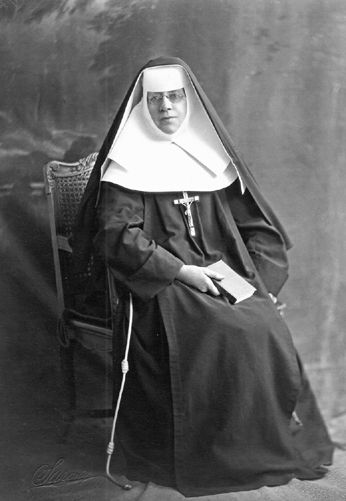
St. Katharine Drexel after final profession (vows for life), 1895. ARCHIVES OF THE SISTERS OF THE BLESSED SACRAMENT
She entered the novitiate of the Sisters of Mercy of Pittsburgh in May of 1889. Her purpose was to learn the ways of the religious life in preparation for the establishment of her own community. Two years later she made her profession as the first member of the Sisters of the Blessed Sacrament for Indians and Colored People. From the beginning she wanted to associate her missionary work closely with the Liturgy and the Eucharist. Like so many of the saints, Katharine quickly managed to attract a large number of people to her mission. The many young women who eagerly joined her were given three years of training in a motherhouse outside Philadelphia and then sent out to do missionary work. One of the first outposts of the sisters was among the Pueblo Indians of New Mexico; next they set up a school for African-American children along the James River in Virginia. What followed was perhaps Mother Drexel’s most important foundation, Xavier University in New Orleans. This center of learning, dedicated to advanced Catholic education for young blacks, was the first of its kind in the United States. In time Mother Drexel founded schools, hospitals, and institutes all across the country.
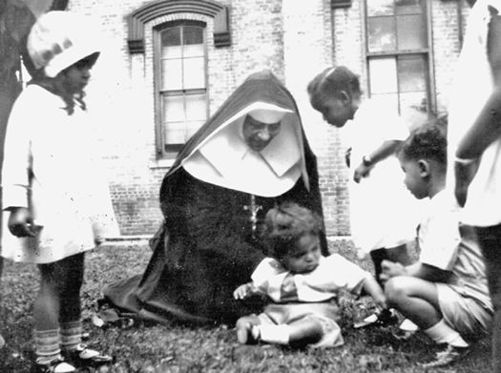
St. Katharine Drexel with children at Xavier University of Louisiana, early 1930s. ARCHIVES OF THE SISTERS OF THE BLESSED SACRAMENT
Where did the money come from for all of these works and undertakings? It came almost exclusively from Katharine Drexel’s trust fund, the four million dollars bequeathed to her by her father. She gave and gave, until there was, literally, nothing left to give; she completely spent her considerable fortune in service of her mission. The ancient moral philosophers spoke of justice, the act of rendering to each his due. Inspired by this ethical ideal, many wealthy people across the ages have given of their surplus to help those who did not have enough and who were because of their innate dignity as human beings owed a better life. Was Mother Drexel’s dedication born of justice? Yes, indeed—but it was so much more than mere justice. It was, if you will, elevated and transfigured justice, justice under the influence of grace, not simply a calculation of what was owed but a superabundant and excessive gift on behalf of the other. It was a going out into the deep—and a taking in of a miraculous catch of fish.
For many years Mother Drexel directed the work of her community from her headquarters near Philadelphia, but she was by no means a prisoner of the place. She traveled widely, all across the country, visiting her sisters at a time when travel, especially in the untamed West, was quite difficult. A trip that she undertook in 1935, when she was seventy-seven years old, is typical. After visiting her sisters in New Orleans, she journeyed to Port Arthur, Texas, and then by night train to Gallup, New Mexico. From there she went to San Francisco; Portland, Oregon; and Seattle, before making her way to the tiny outpost of Wenatchee, from which she set out on a four-hour trip to her sisters’ mission. While on still another trip that same year, Mother Drexel suffered a heart attack, and her doctors told her that unless she curtailed her schedule, she wouldn’t survive. Thus Katharine Drexel entered into what she came to consider the most spiritually productive period of her life. For the next twenty years, while sequestered in the motherhouse, she spent hours every day and night before the Blessed Sacrament, praying for the success of her order. Mother Drexel died on March 3, 1955, at the age of ninety-seven, but her work, born of transfigured justice, endures to this day.
THÉRÈSE OF LISIEUX
Outside the little French town of Lisieux there stands an enormous and elaborately decorated basilica dedicated to a very simple woman who is also one of the most extraordinary saints of the church. Thérèse was a cloistered Carmelite nun who died at the age of twenty-four and who at her death was known only to her family and her fellow sisters in the convent. One of her sisters, in fact, wondered what they could possibly write about her in the obituary that would circulate among the other French Carmelites. Yet within a few years of her death Thérèse had a worldwide reputation, and within a couple decades of her passing she was declared a saint and eventually a doctor of the church. When a reliquary carrying her bones was brought to the United States in the 1990s, millions of people responded, and when it was brought to Ireland, practically the entire country gathered to see it. How do we begin to explain this? We have to start with the spiritual autobiography, called The Story of a Soul, which Thérèse wrote at the prompting of her superior in the last years of her life.
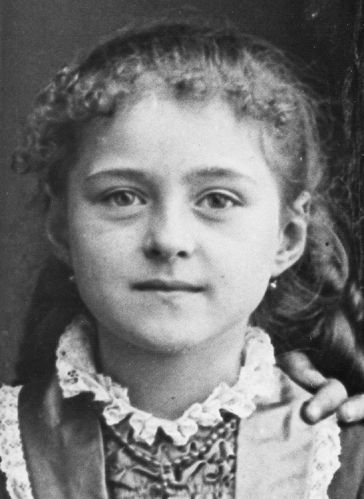
St. Thérèse of Lisieux, 1881.
I will confess that when I first read The Story of a Soul I was not particularly impressed. Like many others, I found it overly sentimental, and as a post-Freudian I was only too willing to see in its girlish spiritual enthusiasms evidence of neuroses and repressions. But then I noticed that a number of great intellectuals loved Thérèse. Among her cultivated admirers were Dorothy Day, Edith Stein, Thomas Merton, John Paul II, and Hans Urs von Balthasar. When I was a doctoral student in Paris, I attended a seminar conducted by my thesis director, Father Michel Corbin, a brilliant Jesuit specialist in medieval thought. Corbin commented that the French do not refer to Thérèse of Lisieux as “the little flower,” as Anglophones do, but rather as la petite Thérèse (the little Thérèse), in order to distinguish her from la grande Therese (Teresa of Avila). But then he added, “After many years of reading both saints, I realize that Thérèse of Lisieux est vraiement la grande Therese” (she is really the great Thérèse). I knew then that I had to take a second look.
Thérèse was born on January 2, 1873, the youngest child of Louis and Zelie Martin, two extremely devout members of the French middle class. By her own admission, Thérèse’s early childhood was arcadian. A beautiful girl, she was doted on by everyone, especially her father. He was her petit roi (little king) and she was his petite reine (little queen). She entered happily into the intensely religious rhythms and practices of the Martin household, and from a very early age she had the intuition that she would enter the Carmelite convent and become a nun. The idyll of her childhood came to an abrupt end with the death of her mother in 1877, when Thérèse was only four. In the wake of this trauma the little Thérèse became moody and withdrawn, “sensitive to an excessive degree.” Her time at public school in Lisieux was unpleasant, for her sheltered and pampered background had not prepared her for the relative rough-and-tumble of the playground. Picked on mercilessly by her classmates, she felt for the first time in her life “weighed and found wanting.”
The full effect of her mother’s death on Thérèse would become clear when Pauline, her older sister and substitute mother, decided to enter religious life. After Pauline disappeared behind the walls of the convent, Thérèse experienced a strange malady, with both physical and psychological symptoms, some of them frightening. She would cry violently, suffer from severe headaches, and fall into fits of uncontrollable shivering. When Pauline “took the veil,” Thérèse suffered a particularly violent episode: “she screamed and shrieked in extreme fear, contorted her face, rolled her eyes, saw monsters and nightmarish figures, was shaken by convulsions and had to be forcibly restrained.” Here is Thérèse’s own simple description of this awful period: “I was terrified of everything.” It is easy enough to see this as a psychotic episode, but what matters is not so much the etiology of her malady as the way Thérèse assessed and handled it. She came in time to see this period of her life as a testing and a purging. What was being purged, she concluded, were precisely her narcissism and her fussy self-absorption.
What finally saved her from this suffering was a manifestation of grace. On May 13, 1883, Thérèse was bedridden, utterly debilitated physically and psychologically. She noticed a statue of the Blessed Mother, which had recently been placed in her room. She was struck by the ravishing beauty of Mary, especially by the Virgin’s smile. Somehow, as she registered that smile and allowed it to permeate her being, all of her physical and psychological symptoms left her, and she was healed. How does one explain this extraordinary incident? I suppose it could be examined under any number of rubrics, but what matters is that Thérèse appreciated it as a manifestation of God’s grace, which is to say, God’s unmerited love. Without any prompting from us, not as a reward for our efforts, even while we are helpless, God breaks into our hearts and changes us. After she had come of age, Thérèse emerged as one of the great “doctors of grace” in the Catholic tradition, once comparing herself to a little child who, knowing her deep incapacity to please the Lord by her own exertions, stands before him and simply lifts up her arms, hoping to be raised up.
The next major step in Thérèse’s spiritual journey was, again, a small, private affair, nothing to which a conventional biographer would think of drawing attention. It took place on Christmas Day 1886. There was a custom in the Martin household that just after Midnight Mass, on Christmas morning, the children would draw from their shoes little gifts that their father had placed in them. Thérèse loved this ritual and was especially delighted by her father’s active participation in it. But on this particular Christmas morning, just before the commencement of the ritual, Thérèse went upstairs to fetch something, and when she was presumably thought to be out of earshot, her father said, “Well, fortunately, this is the last year.” Normally, such a comment coming from her father would have broken Thérèse’s heart, but something quietly miraculous happened: Thérèse calmly decided not to take offense and to respond in love. Suppressing her feelings of disappointment, she calmly descended the stairs and with unfeigned sincerity and enthusiasm entered into the family ritual. Certainly a simple scene, but when read through spiritual eyes, it was momentous precisely because it represented the breakthrough of God’s love into Thérèse’s heart. To love, as we have seen, is to will the good of the other as other, to break free of the preoccupations and needs of the ego. Deciding not to weep and not to indulge her hurt feelings and instead to bring joy to her father and sisters was an act of pure love, and this is why Thérèse felt it was so important that this birth of Christ in her heart took place on the feast day that celebrates Jesus’s birth into the world. And it came suddenly, unbidden, changing her in an instant—the graceful entry of Jesus into her boat.
In the wake of this Christmas conversion, Thérèse resolved with renewed intensity to enter Carmel. Her desire to be a religious, which, as we have seen, she had held on to since she was a very small child, now became a burning conviction, in her own words, “a divine call so strong that had I been forced to pass through flames, I would have done it out of love for Jesus.” After some reluctance her father acquiesced to his daughter’s desire, though she was only fifteen, under the canonical age for entry into the cloister. He agreed to be her advocate, and he accompanied her on visits to a variety of ecclesiastics and bishops, all of whom initially told her that she was too young and would be obliged to wait before entering the convent. Through a combination of intelligence, charm, and sheer moxie, Thérèse managed to wear all of them down. She came finally to the bishop of Bayeux, and he adamantly refused to give the girl permission, at which point her father told her to give up. Undaunted, Thérèse resolved to bring the case to the highest court. In the hopes of securing an audience with the pope, she joined a group of French pilgrims who were making their way to Rome. On November 20, 1887, Thérèse had her opportunity to speak to Leo XIII. Though she and the other pilgrims had been instructed not to say anything to the pope, Thérèse blurted out, “Holy Father, in honor of your jubilee, permit me to enter Carmel at the age of fifteen.” The pope smiled and told her to do what her superiors ordered. But the girl persisted: “O Holy Father, if you say yes, everyone will agree.” The pope responded, “Go … go … you will enter Carmel if God wills it.” At that point, still begging and weeping, she was carried off bodily by two papal guards. How fascinating that both Thérèse of Lisieux and Katharine Drexel would, within a few years of each other, leave an audience with Leo XIII in tears. One month later the bishop of Bayeux relented and Thérèse was granted permission to enter the Carmel at Lisieux. For the next nine years, until her death at twenty-four, she never left the confines of that simple place and lived the austere life of a Carmelite religious.
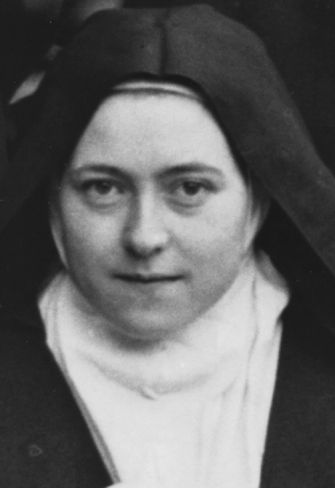
St. Thérèse of Lisieux, 1895.
In the course of those years she cultivated a spiritual path that she came to call “the little way.” It was not the path of her great Carmelite forebears Teresa of Avila and John of the Cross, not the method suited for spiritual athletes, but a way that any simple believer could follow. It had a good deal to do with spiritual childhood, becoming little in the presence of God the Father: dependent, hopeful, waiting to receive gifts. Here is one of her own descriptions: “Jesus deigned to show me the road that leads to this Divine Furnace and this road is the surrender of the little child who sleeps without fear in its Father’s arms.” One cannot help but appreciate how Thérèse extrapolated from her own experience of tender intimacy with a father who offered unconditional love. Her approach also involved a willingness to do simple and ordinary things out of great love: little acts of kindness, small sacrifices graciously accepted, putting up with annoying people. One of the most entertaining and spiritually illuminating sections of The Story of a Soul is Thérèse’s account of her infinitely patient dealings with a cranky old nun to whom she had been assigned as a helper. Every kindness of Thérèse was met with correction and signs of displeasure on the part of the old lady, but still the younger nun persisted in love.
I spoke of Katharine Drexel’s sanctity as a sort of elevated justice. We might characterize Thérèse’s holiness as a transfigured prudence, for at the heart of the little way is the capacity to know in any given situation the precise demand of love, how best in the here and now of the present moment to will the good of the other. Toward the end of her life Thérèse experienced the intense desire to do all the things that the great figures of church history had done. She wrote, “I wanted to be priest, martyr, missionary, evangelist, and doctor,” but she wondered how she could possibly accomplish any of this tucked away in her little monastery in Lisieux. Then she read Paul’s first letter to the Corinthians, and she was struck by the magnificent passage where Paul speaks of the more excellent way, the way of love. In a flash Thérèse grasped that love is the form of all the virtues, love is what makes the lives of the saints possible, love is what undergirds the efforts of priests, missionaries, evangelists, and doctors. She concluded, “Jesus, my love, I found my vocation. I will be love in the heart of the Church.” That is the little way, which continues to beguile millions around the world.
I mentioned that I, like many others, first reacted negatively to the overly emotional, sentimental style of Thérèse of Lisieux, but even the most skeptical readers are usually won over by the account of her terrible struggle with unbelief at the very end of her life. This intense spiritual suffering coincided almost exactly with the onset of the tuberculosis that would eventually take her life. What began to plague Thérèse were terrible doubts concerning the existence of heaven. Like Hamlet she began to wonder whether anything followed “the sleep of death.” And this was no passing bout of intellectual scrupulosity; it lasted up until the moment of her death: “The trial,” she wrote just before she died, “was to last, not a few days or a few weeks, it was not to be extinguished until the hour set by God himself and that hour has not yet come.” What is especially interesting is that Thérèse interpreted this struggle not as dumb suffering but as a participation in the pain experienced by many of her contemporaries who did not believe in God: “During those joyful days of the Easter season, Jesus made me feel that there were really souls who have no faith … he permitted my soul to be invaded by the thickest darkness.” We will see how remarkably similar this language is to that of Mother Teresa of Calcutta. Thérèse of Lisieux died at age twenty-four on September 30, 1897.
EDITH STEIN
Edith Stein was born on October 12, 1891, the Jewish Day of Atonement, in Breslau, a town situated today within the borders of Poland but at that time part of the Prussian empire. She was the seventh and youngest child of pious Jewish parents, and like Thérèse she was doted on by her parents like, in her own words, “a cross between a fairy princess and a porcelain doll.” One of Edith’s earliest recollections is of herself standing in front of a “big white door, drumming on it with clenched fists because she wanted to get to the other side.” That sort of fierce, even grim, determination would mark her all her life. Her father died suddenly when Edith was still quite young, and she bonded strongly with her mother. Frau Stein introduced her daughter to the disciplines and feasts of the Jewish religion, as well as the world of the Bible, and her elder brother Paul began to read to her regularly from the great works of German literature. During her teenage years Edith’s passion for literature grew, even as her faith faded, and by the time she was ready for university study she considered herself an atheist.
As a university student she became fascinated by the work of Edmund Husserl, considered the founder of the famously complex system of philosophy called phenomenology. She longed to study with the master personally and so went in 1913 to Göttingen, where Husserl taught. Immediately she fell in love with the natural beauty and the deep intellectual culture of the place, and in short order she was introduced to Husserl and to the circle of brilliant students that had formed around him, including Dietrich von Hildebrand and Max Scheler, two thinkers who would deeply influence the development of Catholic thought in the twentieth century. She labored away at her doctoral studies, pursuing the typically phenomenological theme of empathy or fellow feeling, how one can enter into another’s appropriation of experience. Like many doctoral students before and since, Edith felt tremendous strain while undertaking the project. She later wrote: “This excruciating struggle to attain clarity was waged unceasingly inside me, depriving me of rest day and night … Little by little, I worked myself into a state of veritable despair.” Edith survived this period of struggle, finished her thesis, and earned her doctorate in 1915, barely two years after arriving in Göttingen. Upon reading her dissertation, the master himself commented approvingly if a tad condescendingly, “You are a very gifted little girl!” Soon after she finished her work, Husserl received an appointment to the University of Freiburg in Breisgau, and the master asked Edith to accompany him as an assistant. She went with him to Freiburg but found her work less than satisfying, because Husserl treated her, despite her enormous intellectual gifts, as a glorified secretary. In fact, many of Edith’s friends were scandalized that someone with her great mind was being forced to perform such menial tasks.
In 1917, during the fiercest fighting of the First World War, Edith paid a courtesy call to the widow of Adolf Reinach, an old acquaintance from her Göttingen days who had been killed in battle. She expected to find the young woman devastated, but instead she found her sad but fundamentally at peace. Her serenity, Edith learned, was the product of the woman’s Christian faith. Edith commented later, “It was my first encounter with the Cross and the divine power that it bestows on those who carry it.” This insight was an extraordinary breakthrough for the intense, rational woman who long ago had given up on religious faith. What began to strike her, in the wake of this encounter, was that many of her colleagues in the Husserl circle—as well as the master himself—were devout Christians. This caused her to question her doctrinaire rejection of faith. Also phenomenology itself—which urged an openness to any and all phenomena—encouraged her to investigate religion more sympathetically and objectively. Jesus was preparing to enter the boat.
Another turning point occurred while Edith was strolling with a friend through the old section of Frankfurt. They chanced upon the cathedral, and the two women entered the building as tourists, intent on admiring the architecture. Edith spied a woman, fresh from her rounds of shopping, kneeling in the empty church, obviously lost in prayer. She had certainly seen people at prayer in the synagogue during services, but she had never seen anything like this communion with a presence personal and yet unseen. “I could never forget that,” she wrote. Edith Stein’s conversion was not like Paul’s, sudden and dramatic. It was more like Augustine’s or John Henry Newman’s: gradual, interior, accompanied by a good deal of intellectual wrestling. One night, while staying with friends outside Freiburg, Edith searched through their library looking for something to divert her for the evening. She came upon Saint Teresa of Avila’s autobiography. She took the book off the shelf and stayed up all night reading it. The next morning she put down the text and declared simply, “That is the truth.” What precisely impressed her about the book is impossible to say. When pressed on the matter later, Edith replied, “secretum meum mihi” (that is my secret). It seems fair to conclude that the reading of Teresa’s Life was the galvanizing moment, the occasion for all of the strands to come together.
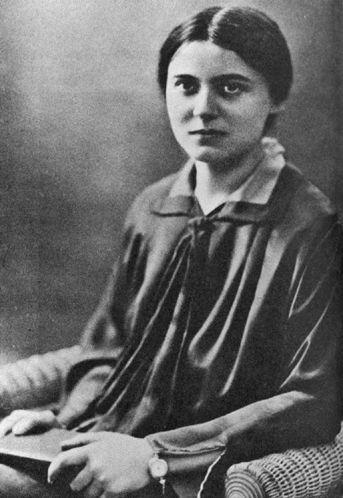
St. Edith Stein, c. 1916. PERMISSION OF JOSEPHINE KOEPPEL, OCD
After a few weeks of reading and praying, Edith approached the local priest and asked to be received into the church. When he balked, due to her recent conversion, she said, “Prufen-sie mich!” (Test me!). She was baptized on January 1, 1922, in those days, the Feast of the Circumcision, the first shedding of Jesus’s blood. Though she wanted, almost immediately after baptism, to join the order of Teresa, her spiritual director advised her to wait. Edith became an instructor in a teachers training academy run by a community of Dominican sisters. Among these daughters of Saint Dominic, Edith began to live what was essentially a religious life. She fell in love with the Eucharist, spending hours a day in silent adoration. So impressed were the Dominican sisters that they set up a special chair for her near the Blessed Sacrament. Edith was finding a new and vibrant center; Jesus was in the boat. During those years Edith deepened and broadened her scholarship, becoming a well-known lecturer throughout Germany. She made the reconciliation of the classical Catholic philosophy of Aquinas and the contemporary phenomenology of Husserl central to her intellectual work.
Her desire for Carmel continued to burn, and in June of 1933 Edith was accepted into the Carmelite convent in Cologne. Though she was far older than the other postulants and novices, she took readily to the discipline of Carmelite life, as though she was born for it. On April 15, 1934, she was formally received into the community and took the name Sister Teresa Benedicta a Cruce, literally, Teresa, blessed by the cross. She moved into the rhythm of prayer and work, but also at the prompting of her superiors she resumed her intellectual research, producing eventually the lengthy philosophical treatise Eternal and Finite Being as well as a thorough study of the thought of John of the Cross entitled The Science of the Cross. In 1938 Sister Teresa took her final vows as a Carmelite and was thus privileged to wear the black veil, evocative of her total consecration to Christ.
In November of that same year Kristallnacht (the Night of Broken Glass) took place, and suddenly Jews all over Germany were in acute danger. Concerned for her safety, Edith’s superiors transferred her from the Carmel in Cologne to the Carmel of Echt in Holland. But just two years later the Nazis overran Holland, and Edith was once again threatened. Bravely the Dutch Catholic bishops raised their voices in protest over the ill treatment of Jews in their country. The archbishop of Utrecht went so far as to order that a condemnation of the Nazi policy be read publicly from every pulpit in the country. The Germans retaliated brutally, ordering a roundup of all Jews in Holland who had converted to Catholicism. On Sunday August 2, 1942, the Gestapo came for Edith and her sister, who had joined Edith in the convent. Amid the confusion, anxiety, and raised voices, Edith calmly said, “Come, Rosa, we’re going for our people.” The sisters were held briefly in a camp in Holland and then were packed onto what amounted to a cattle car for the trip to Auschwitz. A former student of Edith’s reported an encounter with the nun when the train stopped briefly at a platform in Germany. After greeting her, Edith asked her to convey a message to the mother superior in Echt: “We are going to the East,” a sentence with both a literal and a spiritual meaning. She was undoubtedly trying to communicate information about their geographical destination, but “the East” is also mystical language for heaven and eternal life. There is still another report from a German soldier who was making his way to the Russian front. On August 7 he was standing on the train platform in Breslau, Edith’s hometown, when a train pulled up, filled with people packed together like animals. When the door slid open, the young man was practically overcome by the unbearable stench. Then a woman appeared in the characteristic habit of the Carmelites. She commented to the soldier on the terrible conditions on the train and then, looking about wistfully, said, “This is my beloved hometown. I will never see it again.” Many years later this former soldier saw a photograph of Edith Stein and identified her as the nun he had met that day.
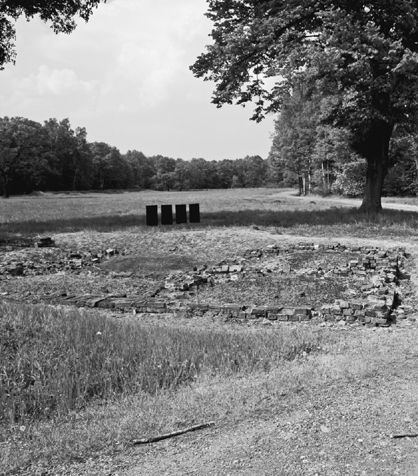
Site of St. Edith Stein’s death, Auschwitz. WORD ON FIRE
On August 9, 1942, Edith arrived at the death camp of Auschwitz-Birkenau. She was selected for immediate execution. The guards brought her to a crude barracks where she was forced to remove her clothes, and then to a small execution chamber where she was murdered by poison gas. Subsequently, her body was placed in a pit and burned—and the ashes strewn to the wind. The classical moral philosophers spoke of courage as the virtue that enables one to do the good despite external threats. What we see in a martyr such as Edith Stein is not ordinary courage but courage elevated and transfigured through love. We see a willingness to give away even one’s life out of love for Christ and his people.
MOTHER TERESA OF CALCUTTA
Mother Teresa was born Agnes Gonxha Bojaxhiu on August 26, 1910, in Skopje, Serbia. When she was a girl of twelve Agnes felt called to the religious life, though she had up to that point never as much as laid eyes on a nun. A key player in the shaping of her vocation was a young Croatian Jesuit priest who introduced her to the spiritual exercises of Saint Ignatius and who shared with her inspiring stories of the missionary activity of Jesuits around the world, especially in India and Bengal. Moved by these accounts, Agnes applied at the age of eighteen to the Loreto Sisters, the Irish branch of the Institute of the Blessed Virgin Mary, which had a strong missionary presence in India. During her postulancy she took the name Sister Mary Teresa of the Child Jesus, after the recently canonized Little Flower. After spending a brief training period in Ireland (where she learned the English language, which she would use for the rest of her life), Sister Teresa set sail for India.
When she arrived in India she was dazzled by its luxuriant natural beauty and shocked beyond words by its grinding poverty. Though she had known poverty in Serbia, nothing had prepared her for what she saw in India. The conviction grew in her that service to such poor would involve a radical simplifying of her own life. After completing her novitiate Teresa began teaching at the convent school in Darjeeling, a tranquil city near the Himalayas, and working part-time as a nurse in the order’s hospital. Then she was sent to Calcutta to teach in a school run by the Loreto Sisters. This city, marked by crushing poverty, would be her home for the rest of her life. At first Sister Teresa was relatively isolated from the worst of Calcutta’s misery, teaching courses in geography and English behind the high walls of a boarding school. But in time she made her way to a primary school some distance away where she once again came face-to-face with dreadful destitution. For the next several years Teresa (called “Mother” after she had taken final vows) worked at a furious pace, teaching, administering a variety of institutions, and caring for the sick. So arduous was her work that she experienced a breakdown and was sent to recuperate at Darjeeling, the restful place where she had been a novice.
On the train to Darjeeling she had the experience that would change her life. On that dusty ride she heard the voice of Jesus calling her “to be a Missionary of Charity” and to serve “the poorest of the poor,” to follow him with reckless abandon and utter trust. She called this vocation within her vocation “the hidden treasure for me,” and it was the moment when Jesus most decisively got into her boat. When she returned to Calcutta she submitted herself to the spiritual direction of Father Celeste Van Exem, a Belgian Jesuit who would prove an extremely helpful and important figure in her life. After a year of prayer and discernment, Mother Teresa and Father Van Exem went to Ferdinand Périer, the archbishop of Calcutta, to present the idea of founding an order to serve the poorest of the poor. A wise character, Périer tested the vocation of the little nun, throwing up all sorts of objections and roadblocks. Despite his opposition, she persisted, and the archbishop’s admiration for her grew. Périer eventually consulted experts in canon law and devised a way to release Mother Teresa from her formal ties to the Loreto Sisters so she could found her own community. In April of 1948, after several years of testing and waiting, canonical approval came from Rome, and Mother Teresa said to the archbishop simply, “Can I go to the slums now?”
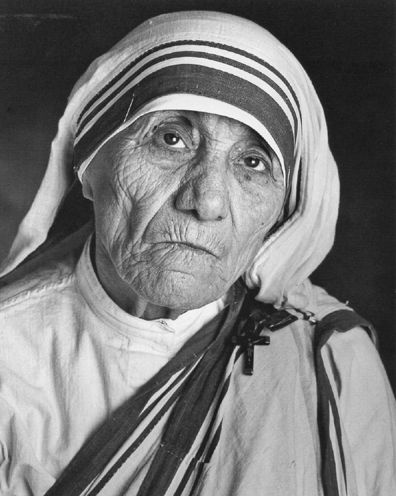
Blessed Teresa of Calcutta, 1987. MICHAEL COLLOPY
In the first weeks and months of her new life, Mother experienced terrible bouts of loneliness, depression, and discouragement—and an accompanying desire to return to the relative comfort and stability of the Loreto Sisters. But she persevered, for she knew that she had to become like the poor in every way—both physically and psychologically—in order to serve them effectively.
As we have come to expect from stories of the saints, people soon came to join Mother Teresa’s mission, some of them her former students. These became the first Missionaries of Charity. Mother quickly formed them into a religious community, fashioning a rule that combined elements of the Jesuit and Franciscan spiritual traditions. Throughout she put special emphasis on the sisters’ identification with the poorest of the poor. The first Missionaries of Charity were allowed to possess only a cotton sari, some coarse underwear, a pair of sandals, a crucifix, a rosary, a metal bucket for washing, and a very thin mattress that served as a bed. Also, like the early Franciscans and Dominicans, they were compelled to beg for their food. There was a kind of poverty built into the very rhythm of their day. During the week the sisters rose at 4:40 AM, brushed their teeth with ash from the kitchen stove, and scrubbed their bodies with a small bar of soap that had been divided into six pieces. Between 5:15 and 6:45 they meditated, prayed, and attended Mass. They then ate a small breakfast and were on the streets doing their work by 7:45. They returned at noon for prayers and a frugal midday meal and then rested and did spiritual reading before returning to their pastoral work in the slums.
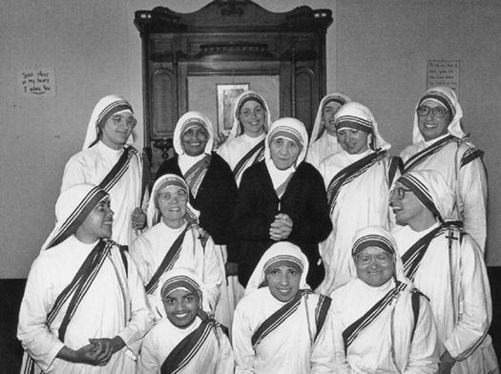
Missionaries of Charity Final Professions, Washington, D.C., 1995. MICHAEL COLLOPY
Mother called for a poverty that went beyond mere physical hardship. One newcomer to the order, a woman from a rather aristocratic background, found the toilet in the convent dirty one day and turned away in disgust. Mother Teresa passed by without seeing the sister and immediately rolled up her sleeves, took out a broom, and cleaned the toilet herself. Another time a young member of the order won a gold medal for her medical studies; Mother instructed the sister to give it to the student who had come in second, for she intuited that for that particular sister the hoarding of honors would be as detrimental to her work as the hoarding of wealth. Essential to the lives of the Missionaries of Charity was a complete and simple trust in God’s providence. Once when the sisters were utterly without food they resolved to pray. Suddenly a knock came on the door and there stood a woman carrying some bags of rice, just enough, it turned out, to feed the community that night. The philosophers speak of temperance, the virtue by which we control our desires for food, drink, and sex so that we might achieve the demands of justice. What we see in Mother Teresa is elevated or transfigured temperance, a disciplining of the desires that goes far beyond the requirements of justice so as to serve the infinite demand of love.
At first the work of Mother’s order was restricted to Calcutta, but beginning in the 1950s and 1960s the Missionaries of Charity spread throughout India and then around the world: Venezuela, Tanzania, Australia, the United States, England. By the end of the 1990s there were five hundred communities on six continents. Mother Teresa said, “If there are poor people on the moon, we shall go there too!” In time Mother became an internationally renowned figure, winning the Nobel Peace Prize in 1979. To the surprise of many outside the church, she used her Nobel speech as an occasion to decry abortion as the greatest enemy of peace in contemporary society. Mother never had any ambiguity in her mind about the different kinds of poverty and suffering that bedevil the human race.
No account of Mother Teresa’s life would be complete without a reference to her terrible interior struggle, her unique participation in the anguish of Christ. Though she experienced extraordinary closeness to Jesus in her early religious life, including, as we have seen, a vivid encounter with him during the time of her call, once the order got under way she experienced just the opposite: an aching sense of the Lord’s absence. And this darkness lasted, with one brief respite, for the rest of her life. Here is one particularly devastating account of what it felt like to endure this darkness: “In my soul, I feel just that terrible pain of loss—of God not wanting me—of God not being God—of God not really existing … my work holds no joy, no attraction, no zeal.” It is important to note that this is not depression in the ordinary psychological meaning of the term. During the many years of abandonment, Mother functioned at a very high level, directing her community and traveling the world as a teacher and evangelist. She came to understand her suffering, as did Saint Thérèse, as a sharing in the passion of Jesus, his own feelings of abandonment by the Father. Feeling the absence of God, Mother Teresa entered even more fully into the suffering of those she longed to serve, the poorest of the poor.
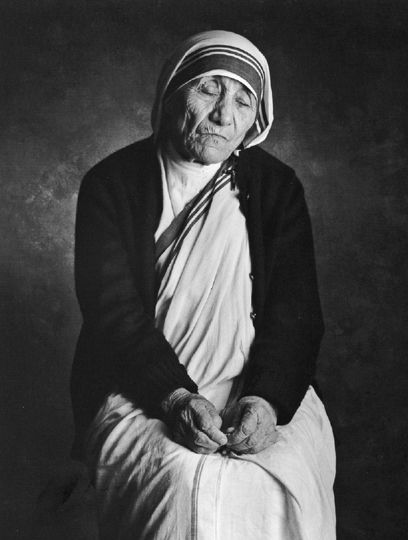
Blessed Teresa of Calcutta, 1987. MICHAEL COLLOPY
Mother Teresa died in Calcutta on September 5, 1997, at the age of eighty-seven. When her body was displayed for public viewing, it was, of course, clothed in the habit of the Missionaries of Charity, but it was left shoeless, revealing her remarkably misshapen feet. For many people, those gnarled feet bore the most eloquent witness to the hard years she had spent on behalf of the least of Jesus’s brothers and sisters.
CONCLUSION
The holiness of God is like a white light: pure, simple, complete. But when that light shines, as it were, through the prisms of individual human lives, it breaks into an infinite variety of colors. The four women we’ve considered in this chapter couldn’t be more different from one another—and that is why each one reveals a unique dimension of the divine holiness. God’s grace shone through Edith Stein and gave us the clarity of her intellectual work and the beauty of her martyrdom; it shone through Thérèse of Lisieux and gave us the little way; it shone through Katharine Drexel, producing a miracle of transfigured justice; it shone through the unrepeatable identity of Mother Teresa and brought forth the Missionaries of Charity. The church revels in the variety of its saints because it needs such diversity in order to represent, with even relative adequacy, the infinite intensity of God’s goodness.
1. For a more detailed analysis of the lives and witnesses of these saints, see Father Barron’s book The Priority of Christ (Grand Rapids, Mich.: Brazos Press, 2007).