
Chapter 9
People pray all the time. Studies show that even those who describe themselves as nonbelievers pray. What precisely is this activity in which so many of us willingly engage? Prayer has taken on myriad forms over the centuries. Speaking, processing, singing, remaining silent, emptying the mind of all imagery and conceptuality, reading sacred texts, dancing, and petitioning from the bottom of one’s heart have all been construed as modalities of prayer. But is there a common denominator, some fundamental characteristic? Saint John of Damascus, a monk and theologian from the eighth century, said, “Prayer is the raising of one’s mind and heart to God,” and Saint Thérèse of Lisieux said that prayer is “a surge of the heart, it is a simple look towards Heaven, it is a cry of recognition and of love, embracing both trial and joy.” Prayer is born of that awareness, felt more than thought, that the transcendent realm impinges on our lowly world and hence can be contacted. A basic Christian conviction is that this reaching for God meets an even more passionate divine reaching for us. Perhaps we would put it best by saying that the mystical coming together of these two longings—our longing for God and God’s longing for us—is prayer.
I don’t know any other place on earth that evokes the power of prayer more than the magnificent Sainte-Chapelle in Paris. Built by King Louis IX (Saint Louis) in the thirteenth century as a grand repository for the relic of Jesus’s crown of thorns, the Sainte-Chapelle is a jewel box of stained glass and gothic tracery. When you enter the building you have the distinct impression of having stepped across a threshold into another, higher world. Lord Kenneth Clark, the great twentieth-century art historian, said that when the light pours through the colored glass of the Sainte-Chapelle, it sets up a kind of vibration in the air, an electrical charge. It is, if you will, the artistic representation of the electric meeting of two spirits, human and divine. It is what a human heart, elevated to and by God, looks like: transfigured, luminous, radiantly beautiful.
In the Catholic tradition, prayer is learned through apprenticing to masters who are experienced in the way of prayer. Prayer seems to be one of those practices that, as the cliché has it, is caught rather than taught. In the course of this chapter we will sit at the feet of a series of masters and try to catch some of their wisdom in regard to this mysterious and alluring act of raising the mind and the heart to God. As we will see, one form of prayer is asking God for things; but in its more fundamental forms, prayer is being with God, becoming attuned to God, thinking his thoughts and feeling his feelings. We will understand this kind of communion only through careful attention to the lives of some of the people who have practiced it.
BEGINNING WITH THOMAS MERTON
I realize that speaking of prayer usually puts us in mind of rather alien figures: medieval monks in their choir stalls or perhaps hermits squirreled away in their desert huts. I believe that hermits and monks have a great deal to teach us, but I would like to begin with someone much closer to our own time and temperament, someone who tramped through Times Square and frequented the jazz clubs of Manhattan in the first half of the twentieth century, a spiritual teacher who emerged from the maelstrom of contemporary doubt and secularism. When Thomas Merton’s autobiography, The Seven Storey Mountain, which chronicles his conversion, was published in 1948, it caused a sensation and contributed mightily to a spiritual revival across the United States and to an awakening of interest in the ancient traditions of mysticism of which most Americans were simply unaware. This very contemporary figure remains, therefore, a privileged portal through which twenty-first-century seekers can explore the meaning of prayer. I will provide a fairly detailed portrait of Merton, for I want to invite you to feel his need for God from the inside. I want you to know what motivated someone who experienced so many of the anxieties and opportunities of our time finally to dedicate his life to raising his mind and heart to God.
Thomas Merton was born in the south of France in 1915, the son of a New Zealander father and an American mother, his parents having met at art school in Paris just before the outbreak of the First World War. Merton’s mother died when he was only a boy of six, and he subsequently lived a sort of vagabond life, wandering the world with his painter father, spending short periods in New York, Bermuda, France, and England. When Merton was sixteen and a boarding school student at Oakham in England, his father died, and the young man found himself more or less alone in the world. After a brief tour of the continent, he enrolled at Cambridge University in the fall of 1933 and commenced to conduct himself in a deeply irresponsible way: too much drinking, too much carousing, too much sex. Though this was kept secret for many decades, it has now been determined that Merton fathered a child during that chaotic year and that both mother and child were later killed in the London blitz of 1940. Merton’s guardian, an old friend of his father’s, was shocked by his young charge’s reckless behavior, and after making certain legal and financial arrangements he sent Merton out of the country. Merton landed in New York and resumed his academic career at Columbia University.
Merton fell in love with Columbia, a place he referred to affectionately as “a great sooty factory.” He became, in short order, something of a big man on campus, joining a variety of student organizations and delighting his contemporaries with accounts of his vivid experiences in a variety of countries. Merton was throughout his life and by all accounts great company: funny, musical, quick witted, and a gifted mimic. He was for a time the arts and humor editor of The Jester, the student literary publication at Columbia, and in connection with that magazine he met some of the intellectually liveliest and most creative students on the scene. Among his friends were Robert Lax, who would become a well-regarded avant-garde poet, and Robert Giroux, later a prominent publisher. Among his professors were the novelist Lionel Trilling and the great Shakespeare scholar Mark Van Doren. Van Doren especially would have a profound influence on Merton, eventually helping the young man with his writing and even planting some of the seeds of his vocation to the priesthood. Merton certainly flourished at the sooty academic factory of Columbia, but it was the flourishing of a secular modern man seeking experience and, above all, pleasure.

St. Patrick’s Cathedral, New York. WORD ON FIRE
In the spring of 1938 Thomas Merton was walking down Fifth Avenue in the vicinity of St. Patrick’s Cathedral, and he paused at the display window of Scribner’s Bookstore. He noticed a text called The Spirit of Medieval Philosophy by the French writer Etienne Gilson. Since he was taking a course at Columbia on medieval French poetry, Merton thought it might be helpful to know more about the intellectual assumptions of the time, so he bought the book. On the subway, making his way home, he eagerly opened the package and examined his purchase. Much to his surprise and chagrin, he noticed on the frontispiece of Gilson’s text the Latin words Imprimatur (let it be printed) and Imprimi potest (it can be printed), signs that the book was officially approved by the Catholic Church. He said he was seriously tempted to throw the book out the window of the train. However, “by a special grace,” he kept the book and actually read it.1 It revolutionized his life. What he found in the pages of Gilson’s study was a clear presentation of the subtle and sophisticated understanding of God that is characteristic of Catholic thought. Thoroughly modern Merton had assumed, like most of his peers, that God was a “noisy mythological figure,” and religion the stuff of “neuroses and projections.” He had never imagined that there was a disciplined academic tradition that spoke of God in such a compelling and intellectually satisfying manner. What he discovered, most specifically, was the idea of God’s “aseity,” that is, God’s capacity to exist through the power of his own essence.2 He found that God is not one being, however supreme, among many, but ipsum esse subsistens, the sheer act of being itself. It is not unimportant that around the time he was discovering Gilson’s meditations on God as the ground of contingency both of Merton’s grandparents, to whom he had been deeply devoted, passed away. More than any other experience, the death of loved ones typically convinces one that the world of ordinary experience is fleeting, evanescent, not self-sufficient and hence opens one to the properly transcendent. This visceral perception was for Merton at a propitious moment given substantive intellectual expression in the technical vocabulary of The Spirit of Medieval Philosophy.
In the wake of the encounter with Gilson’s book, Merton’s life began to change. The God described so persuasively by the Catholic tradition began to tug at him with great insistence, and Merton felt the desire to commune personally with the God he had discovered intellectually. His first move was to attend some Protestant services (his mother had been a Quaker, and some of his only childhood experiences of going to church involved the silent worship so characteristic of the Quakers), but he found himself unmoved. Then one Sunday morning Merton woke up with an intense desire to go to Mass, so he went to the Catholic parish associated with Columbia, the Church of Corpus Christi on 121st Street on the Upper West Side. He entered the place nervously, for he knew very little about the Mass or proper liturgical etiquette, and he slipped (unnoticed, he hoped) into a back pew. He made it through the ceremony, and though he understood very little of it, he was thrilled by the experience. Walking out of the church that morning, he said, was like entering a new world where “even the ugly buildings of Columbia were transfigured.”3 Then he sat down for breakfast at a dilapidated little diner on 111th Street and even in that simple place he felt as though he was “sitting in the Elysian Fields.”4 Having broken into Merton’s life through the ministration of Gilson’s book, God was now working his way deeper and deeper into the young man’s heart.
Not long after this overwhelming Sunday morning experience, Merton presented himself to one of the priests at Corpus Christi for formal instruction in the Catholic faith. He drank in the catechetical lessons and was soon ready for baptism. The ceremony took place at Corpus Christi, and Merton’s godfather was Edward Rice, the only Catholic in his largely Jewish circle of Columbia friends. Throughout his life Merton would commemorate the anniversary of his baptismal day with great solemnity and gratitude. Not long after he became a Catholic, Merton was strolling down Sixth Avenue in midtown Manhattan with his best friend, Robert Lax, who was himself a deeply spiritual man. In the midst of their lively exchange, Lax suddenly asked, “Tom, what do you want out of life?” Merton replied, “Well, I suppose I want to be a good Catholic,” and Lax countered, “No, no, that’s not enough. You should want to be a saint.”5 Lax was, consciously or not, echoing a famous remark of Leon Bloy, the French spiritual master. Bloy commented that there is only one real sadness in life: not to be a saint. Whatever other sadnesses we might encounter—failure, poverty, dishonor, and so forth—are finally phantoms. Lax’s observation unnerved Merton and convinced him that he had to think in a much more serious way about his spiritual life. He began to permit to resurface an intuition he had actually had for many years, and he began to explore the possibility of becoming a priest. He looked into a number of different religious orders, and after some deliberation he applied to the Franciscan order and was initially accepted. So confident was he in this choice that he fantasized about the kind of work he would do as a Franciscan and even about the religious name he would take: Frater John. He was devastated when upon learning more of the details of his past life the Franciscans subsequently rejected him. The account of his tearful breakdown in the presence of a rather cruel confessor, to whom he had poured out his frustration, is one of the most heartbreaking scenes in The Seven Storey Mountain.6
In time Merton got over the worst of his disappointment and took a job teaching English at the Franciscan college of St. Bonaventure in upstate New York. He resolved that there, as far as possible, he would live a quasi-religious life, praying the office of a priest and living under the same roof as the Blessed Sacrament. While he was in New York City on an academic break, he sat down with Daniel Walsh, an adjunct professor of medieval philosophy at Columbia with whom Merton had become friends. They spoke together of many different religious orders, and Walsh said that the one that impressed him the most was the Trappist order, the Cistercians of the Strict Observance, to give them their proper name, a community of men living the classic Benedictine rule in austerity and silence. Walsh urged Merton to make a Holy Week retreat at the Trappist Abbey of Our Lady of Gethsemani in Kentucky. What Merton found at Gethsemani took his breath away, for he later wrote that he discovered there “the still point around which the whole country revolves without knowing it.”7 Immersing himself for that week in a community radically dedicated to the praise of God, he encountered the power of adoratio, the right praise that rightly orders the soul and, ultimately, the entire society. He knew in his bones that he had to become part of Gethsemani.
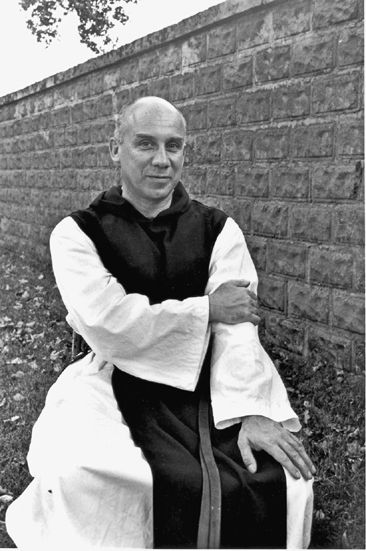
Photograph of Thomas Merton by Akers, 1959. USED WITH PERMISSION OF THE MERTON LEGACY TRUST AND THE THOMAS MERTON CENTER, BELLARMINE UNIVERSITY
Perhaps precisely because they saw themselves as a penitential order, the Trappists did not balk at Merton’s checkered past. Several months after his retreat, on December 10, 1941, Merton entered the abbey as a postulant. He would stay there, almost continuously, for the remaining twenty-seven years of his life, confounding the predictions of some of his Columbia friends who had known him in his raucous days. There he gave himself entirely to prayer and matured as a monk, a writer, a poet, and a spiritual teacher. And through his writings—The Seven Storey Mountain, The Sign of Jonas, Conjectures of a Guilty Bystander, The New Man, and New Seeds of Contemplation, to name just a few—Merton conveyed the Christian spiritual tradition with special credibility to a contemporary age marked by the nihilism and superficiality from which he himself had managed, by God’s grace, to escape. But what precisely did Merton teach? His writings are complex and multivalent and they are shaped by the thought of a bevy of philosophers, mystics, and poets. But Merton’s greatest master, the figure who breathes through practically all of his writings, is a sixteenth-century Spaniard named Juan de Ypes Alvarez, better known by his Carmelite religious name, John of the Cross. Having walked through the Merton gate, I would like now to move, with you, into the spiritual world of John of the Cross.
JOHN OF THE CROSS AND
CONTEMPLATIVE PRAYER
John of the Cross was born in 1542 and became a Carmelite friar in 1563. He was thoroughly trained in the high theology of his time, especially the thought of Saint Thomas Aquinas. Under the influence of Teresa of Avila—about whom we will speak in detail later—John dedicated himself to the reform of his order, attempting to restore it to its Gospel simplicity and zeal. Like most reformers, John was unpopular among those he wished to reform. In December of 1577 a group of his Carmelite brothers arrested him and brought him to Toledo and effectively imprisoned him in a house of the order. They placed John in a stifling room, six feet by ten feet, letting him out only to make him kneel in the refectory, where he was subjected to beatings by his brothers. While holed up in what amounted to a tiny prison cell, John began to compose verses in his mind (he had neither pen nor paper), and these poems constitute not only some of the gems of Spanish literature but also some of the most eloquent articulations of the Catholic spiritual tradition. After nine months of imprisonment, John managed to escape, climbing through a tiny window and clambering down the wall of the Carmelite house and eventually over the wall of the city to safety. He then resumed his work of preaching, writing, and reforming.

The Tomb of Saint John of the Cross, Segovia, Spain. WORD ON FIRE
What stands at the heart of John’s teaching? In his poem “The Living Flame of Love,” John offers a powerful image of the human soul. We human beings, he says, have within us “great caverns,” which are infinitely deep, unfathomable. These are intellect, will, and feeling—and they are infinite, precisely because they are ordered to God. The mind eagerly comes to know particular things, individual truths, but none of these achievements finally settles the mind, just the contrary. The more the mind knows, the more it wants to know, each answer engendering a new question. The twentieth-century philosopher Bernard Lonergan said that the mind by an inner dynamism “wants to know everything about everything.”8 Thomas Aquinas spoke of the intellectus agens (the agent intellect), which restlessly asks the question quid sit? (what is that?) about whatever comes under its consideration. Both Lonergan and Aquinas knew that the mind won’t rest until it comes to the fullness of truth, to what the theological tradition calls the “beatific vision,” seeing God face-to-face.
The will reaches out to particular goods, but no limited good ever fully satisfies it. For example, you are reading these words because, presumably, you are seeking the particular good of learning more about Catholic thought and history. But that particular act of your will finds itself necessarily situated within the context of some higher or further desire. No matter how much satisfaction you might gain from reading and understanding my modest reflections, you will want something better, higher, more illuminating. A parent desires that her child successfully complete elementary school so that the child, in turn, might make it to high school and then university and then, perhaps, graduate school so that she might launch a successful and gratifying career, that she might make a contribution to society, and so forth. There is always a nesting of one desire in another, or, to shift the metaphor, always an opening toward newer horizons for the will.
Finally, our souls order us to beauty and justice. But no matter how much beauty we take in we always want more; in fact, the greater the beauty, the greater our appetite for beauty is whetted. We long for justice, and sometimes we achieve it to a degree, but no justice here below ever fulfills our desire for final, perfect justice. Martin Luther King Jr., who was personally responsible for some of the most remarkable social achievements in American history, could nevertheless speak of a “Promised Land” for which he still longed and which he knew would always elude him in this world.
This spiritual anthropology helps to explain why most of us are so unhappy most of the time. I don’t mean that most of us are psychologically depressed; I mean that our infinite desire never meets in the world an object commensurate with it. And thus even as we experience great joy we still twist and reach with a restless dissatisfaction, like the figures on Michelangelo’s Sistine Chapel ceiling. John of the Cross uses his image of the infinitely deep caverns to diagnose the fundamental spiritual disorder that we all share, namely, trying to fill those caverns with the petty goods of the finite world: pleasure, sex, power, and prestige. As we have seen in chapter two, this drive leads, inexorably, to addiction and hence to deeper dissatisfaction. Or maybe we cover the caverns over, pretending that they don’t exist. This is the characteristic pathology of contemporary materialism and secularism: convincing ourselves, even as we are starving spiritually, that we’re perfectly full. The good news, as far as John of the Cross is concerned, is that this subterfuge, this illusion created by the ego, cannot possibly endure, and the person must finally awaken to the insufficiency of the world. That is when he turns, perhaps in desperation, to the infinite. That is when he seeks, almost despite himself, to raise his mind and heart to God.
John of the Cross’s dark night is often used as a metaphor for depression or loss of direction, but that is not at all how John meant it. If the soul is to order itself to God, it must rid itself of attachments to anything creaturely. That is, it must overcome its tendency to turn something less than God into God, and it must accordingly purge and let go of idols. It is most important to note that this purging hasn’t a thing to do with a puritanical disdain for the body, or the cultivation of a fuga mundi (flight from the world) spirituality. John of the Cross fully shares the biblical and Catholic sense of the goodness of creation. The process of the dark night has to do with the proper ordering of desire: God first, everything else second and for the sake of God.
The purgative process unfolds in two steps, what John calls “the dark night of the senses” and “the dark night of the soul.” During the first phase a person detaches himself from every sensual good or pleasure that has taken central position in his life. He lets go of food, drink, sex, and sensible delight in the measure that these have become soul-ordering values. In terms of the life of Jesus, the dark night of the senses would correspond to the Lord’s long fast in the desert and his resistance to the tempter’s suggestion that he turn stones into bread. Once the dark night of the senses is complete, one is ready to enter into the purgative discipline of the dark night of the soul. During this process the seeker learns to detach himself from those more rarified substitutes for God, which are the concepts, ideas, and images of the mind. There are spiritually alert people who have managed to free themselves from the more ordinary distractions but who are nevertheless beguiled by the products of their own religious consciousness, which are every bit as creaturely as food and drink and fame. These too have to be set aside, let go of. At this point, we can see why the image of the dark night has come to be associated with depression, for this purgative path is indeed painful, sometimes wrenchingly so. If one’s life has been ordered around the love of some creaturely value, then the reordering process will cost dearly. There is, accordingly, indeed something austere about John’s spiritual style. A story has been told about a younger Carmelite colleague of his who was a deeply spiritual man. One day he told John how much he loved a particular crucifix that had been given to him and that had proven a wonderful aid to prayer. John bluntly told him to surrender it, for it had become an object of attachment. Once again this is neither cruelty nor fussy puritanism; it is honesty and clarity in regard to the demands of the dark night.
I confess that I hesitated to share that anecdote, because I am loath to leave the impression that John of the Cross was nothing but a dyspeptic ascetic. He saw the dark night in both of its stages as merely preparatory, a conduit to a blissful experience of God. When the purgations are complete, the soul is ready for the journey into God, or, better, it is ready to receive the gift that God wants to give. Consider these gorgeous lines from John’s poem on the dark night, composed during that awful sojourn in the prison cell in Toledo:
One dark night,
fired with love’s urgent longings
—ah, the sheer grace!—
I went out unseen,
my house being now all stilled.9
The stilled house symbolizes the soul that has passed through the dark night and has found rest from its addictive patterns of desire. But notice that the stillness is not an end in itself. Once the errant desires have been quieted, that deep, abiding, infinite desire can surface; “love’s urgent longings” can at last be felt. And then the soul is ready for its journey toward God:
On that glad night,
in secret, for no one saw me,
nor did I look at anything,
with no other light or guide
than the one that burned in my heart.10
Since it represents liberation, the night is “glad,” and since the soul has rid itself of any need for approval or fame, it exults in the fact that no one sees it, and since it no longer relies on worldly goods, it doesn’t “look at anything,” and, finally, since the deepest desire of the heart has surfaced, the soul knows precisely where to go, needing “no other guide” than that very longing. This last idea finds an echo in “The Living Flame of Love,” where John speaks of those infinite caverns being illumined by the light and heat of God.
Then come these lines, evocative of the high point of mystical union with God:
Upon my flowering breast
which I kept wholly for him alone,
there he lay sleeping,
and I caressing him …
I abandoned and forgot myself,
laying my face on my Beloved;
all things ceased; I went out from myself,
leaving my cares
forgotten among the lilies.11
Is there anywhere in the literature of the world a more compelling and beautiful description of union with God? In order to indicate what it is like to be, at last, in possession of the God who alone can satisfy the deepest aching of the heart, John reaches, naturally enough, for erotic language, the imagery of sexual intimacy. His heart (the “breast” in the imagery of the poem) has all along been ordered to God, though through much of his life he had allowed this truth to become obscured. Now, having gone through the dark night, he is ready to receive the one he was always destined to receive: “there he lay sleeping,/and I caressing him.” Finally, he imagines himself face-to-face with God, literally in the attitude of adoratio. At the climax of the spiritual journey is the recovery of Eden, the restoration of the easy friendship that Adam enjoyed with God, the realization of the worship foreshadowed in the Temple.
TERESA OF AVILA AND THE
PRAYER OF THE CENTER
Perhaps the most important figure in the life of John of the Cross was Teresa of Avila, the Carmelite nun who inaugurated the reform movement in which John participated. A few decades older than John, Teresa was the daughter of nobility and enjoyed a fairly pampered childhood. When she was still a very young woman she entered the Carmelite monastery at Avila and lived a decent but unheroic spiritual life for many years. As Teresa entered her forties her spirituality became more intense and serious, and she began to receive a series of mystical visitations. She would see Christ, the Blessed Mother, and the saints, not so much with her bodily eyes as with the eyes of her mind and imagination. It would be wrong to dismiss these experiences as mere subjective fantasies, for they came to her unannounced and struck her with overwhelming and often disconcerting power. During these intense encounters she would typically pass into an ecstatic trance, sometimes lying motionless for up to half an hour. Other times she was known to levitate. There are even stories told of some of the stronger nuns being called upon to pull her back to the ground when she would take off! The most famous of these mystical encounters was what came to be called the “transverberation,” which Teresa vividly describes in her autobiography. She relates that an angel repeatedly pierced her heart with a fire-tipped spear and that the experience was simultaneously painful and so pleasurable “that she wished it would never end.” It was this scene that Gian Lorenzo Bernini so unforgettably immortalized in marble. In the writhing body, panting mouth, and contorted face of the saint, Bernini makes explicit the sexual overtone that is clearly implicit in Teresa’s description, but which also vividly calls to mind John of the Cross’s erotic analogies. I can only smile when post-Freudians announce that they have “discovered” the unconscious sexuality lurking behind Teresa’s mystical experience. There was, I dare say, precious little unconscious about it, for the association of the intense union with God and sexuality is as old as the biblical Song of Songs.

The Ecstasy of Saint Teresa by Gian Lorenzo Bernini, the Carnaro Chapel of Santa Maria della Vittoria, Rome. WORD ON FIRE
What can we moderns, we inheritors of the skeptical scientific turn, make of all this? To be sure, such experiences are, even within the religious tradition, rare, and Teresa would be the first to insist that they don’t constitute the heart of the matter, spiritually speaking. Her disciple John of the Cross, in fact, said that extraordinary visions should be taken in and then promptly let go of. Nevertheless, they do seem to play a role—from biblical times to the present day—in the divine economy. Might God not deign, occasionally, to signal his presence in a remarkable and vivid way? Might he not, at privileged times, allow the supernatural world to manifest itself in this ordinary world? Might he not, as Flannery O’Connor put it, “shout in the realm of the deaf,” in order to remind us of his existence? In a word, we can make too much of Teresa’s encounters, but at the same time, we can make too little of them.
At the prompting of her spiritual directors, Teresa began to write down her experiences in prayer for the benefit of her Carmelite sisters, and the books she composed—The Interior Castle, The Book of Her Life, The Way of Perfection among others—constitute some of the gems of the Catholic spiritual tradition. What stands at the heart of her teaching? To understand what she was trying essentially to communicate, it is best to look at the title of her most famous work. Teresa of Avila discovered, at the very depth of her soul, Christ dwelling in her, and this divine presence, she said, was like an interior castle. Consider what this image would have conveyed to a sixteenth-century Spaniard. A castle was a keep, a place of safety and power, shelter from the storm. To be grounded in Christ, Teresa realized, was to be rooted in the very power that is here and now creating the cosmos, in the God who is beyond the vagaries of space and time. As we have seen at different points in this book, most of us sinners seek to anchor our lives in some worldly good, but these earthly attachments are necessarily evanescent and therefore unsatisfying. They are vulnerable to corruption, criticism, wear and tear, the shifting moods of the crowd, and final dissolution. None of them—pleasure, money, power, honor—is, in a word, a castle. But Christ is—and that is why the wise person reorients his life toward him, seeks refuge in him, leans on him. Teresa essentially echoes Paul’s “it is no longer I who live, but Christ who lives in me.” The ego, with all of its preoccupations and false moves, all of its contradictory desires and flimsy defenses, is unreliable; but the inner Christ—eternal, omnipotent, commanding, clear—is like a rock, a redoubt, a castle.

Avila Cathedral, Spain. WORD ON FIRE
In so many of the spiritual masters we find the theme of the center, which is to say, the divine still point around which the entirety of the self properly revolves. We have already analyzed the gothic rose windows along these lines and we have suggested that worship involves turning the entire self toward God. Meister Eckhart, a fourteenth-century Dominican spiritual writer, speaks of the Seelengrund (the ground of the soul) as the point where God and the creature meet in friendship, and John of the Cross described the “inner wine cellar,” the place where, at the depth of the soul, the “spirits” are kept, a place of intoxication and elevation. Ignatius of Loyola, the founder of the Jesuit order and a contemporary of both Teresa and John, made detachment, or what he called “indifference,” the organizing principle of his spirituality. He famously prayed, “Lord whether I have a long life or a short life, whether I am healthy or sick, whether I am rich or poor, is a matter of indifference to me, as long as I am following your will.” That kind of insouciance can come only from having made contact with the center. Teresa’s interior castle is still another evocation of this “place” where the soul rests confidently in Christ and where a mystical marriage unfolds.
In light of these considerations, we recall Teresa’s most famous prayer, one that can only be uttered from the center:
Let nothing disturb you;
Let nothing frighten you.
All things are passing.
God never changes.
Patience obtains all things.
Nothing is wanting to him who possesses God.
God alone suffices.
All of this takes on a new resonance when one visits Teresa’s hometown and sees the miles of castellated walls that surround and protect it. Teresa came of age as a nun and mystic within the confines of a great castle, and she came to realize that those exterior walls were but a fleeting and creaturely sign of the ramparts and castle within.
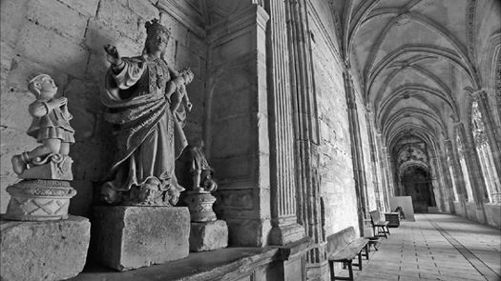
Segovia Cathedral, cloisters, Spain. WORD ON FIRE
PRAYER OF PETITION
We commenced with Thomas Merton, and Merton led us to John of the Cross, who brought us in turn to Teresa, and through these figures we’ve been exploring the meaning of John of Damascus’s lyrical phrase “raising the mind and the heart to God.” In Merton’s ecstatic retreat at Gethsemani, in John’s celebration of the mystical marriage, in Teresa’s resting in the interior castle, we have caught a glimpse of what the church calls contemplative prayer, that rare and rarefied encounter with God beyond speech and words and concepts. But I imagine that when most people hear the word “prayer” they don’t think immediately of such a thing; they probably think of asking God for something. And, indeed, petitionary prayer is one of the most fundamental ways that we raise our minds and hearts to God. It is also the commonest form of prayer in the Bible. Every major scriptural character—Abraham, Isaac, Jacob, Joseph, Moses, Joshua, Samuel, David, Solomon, Ezra, Nehemiah, Peter, James, Paul, and John—all pray in this way; they all ask God for things. There is something, of course, primal and elemental about this kind of prayer: “O God, please help me! O Lord, save my child!” If we could place a net capable of catching prayers as they waft their way to heaven from hospitals and churches, we would corral millions upon millions of them. Finally, the paradigmatic prayer that Jesus taught us—the Our Father—is nothing but a series of petitions, and Jesus urged his followers, again and again, to persevere in prayer: “Ask and it will be given to you; seek and you will find; knock and the door will be opened to you” (Mt 7:7).
Even though this form of prayer seems simpler and more basic than contemplation, in fact petitionary prayer is more difficult to make sense of theologically than contemplative prayer. When we speak of petitionary prayer, dilemmas and anomalies emerge that have puzzled religious thinkers for centuries. If God cannot change, what is the point of asking him for anything? And if God is omniscient, what is the point of telling him what you need? Keep in mind that the same Jesus who told us to ask and ask again also informed us that God “knows what we need before we ask.” One way to shed light on this problem is to refer to the biblical master metaphor for God, namely, the parent. Throughout the Bible, God is referred to as a father and even in some texts as a mother: “could a mother forget her baby?” and “let us nurse with delight at her abundant breasts.” Parents hear petitions from their children constantly, persistent requests for things, some good and some quite bad—and decent parents know what their child needs long before she asks for it. But none of this conduces a parent toward stifling those requests or pronouncing them useless—even if he is obliged frequently to respond negatively. God indeed knows everything about everything, so he is aware of what we need before we ask; yet still like a good parent he delights in hearing our requests—and like a good parent, he does not always respond the way we would like him to.

Woman at prayer. WORD ON FIRE
Saint Augustine offers another perspective on our dilemma. God wants us to ask, seek, and petition persistently not in order that he might be changed but that we might be changed. Through the initial refusal to give us what we want, God compels our hearts to expand in order to receive adequately what he wants to give us. In the very process of hungering and thirsting for certain goods, we make ourselves worthy vessels. It is not as though in petitioning God we are approaching a stubborn pasha or big city boss whom we hope might be persuaded by our persistence. Rather it is God who works a sort of spiritual alchemy in us by forcing us to wait. In his treatment of the Lord’s Prayer Thomas Aquinas tells us, very much in the spirit of Augustine, that the initial petition of the Our Father, “hallowed be thy name,” is not asking for something to change in God, for God’s name is always holy; it is asking that God might work a change in us so that we hallow God above all things.
Aquinas provides what I take to be the richest theological framework for petitionary prayer when he speaks of God praying through us. Aquinas is convinced that God, as the unmoved mover, can never be changed by our prayer; nevertheless, God can arrange his providential governance of the universe in such a way that what he wants to give will be coordinated with our asking for it. On this reading, whatever is good and right and true in our prayer is God already praying in us, adjusting our desire to his desire. Do not forget the attribute of God that I have been insisting upon throughout this book, namely, God’s noncompetitiveness. Since he is not the supreme being but the very ground of being, God’s “invasion” enhances us, makes us more authentically free. A very good example of this dynamic is the prayer for the liturgy of Augustine’s mother, Saint Monica. The text begins as follows: “Lord, you graciously received the tears of Monica for the conversion of her son Augustine.” Mind you, it does not say that the tears of Monica moved God to act or compelled him somehow to change the structure of his providence; it says that God accepted those tears in coordination with granting the grace of conversion to her son, implying that God himself was effectively crying through the tears of Monica.
BACK TO MERTON
During his years at Gethsemani Abbey, Thomas Merton was remarkably productive. Besides the dozens of books he authored, he wrote hundreds of poems and articles as well as private journals that have been published in eight volumes. He also maintained an impressive correspondence with writers, cultural figures, and religious leaders all over the world, including, among many others, the poet Czeslaw Milosz, the theologians Hans Urs von Balthasar and Jean Leclerq, the singer Joan Baez, and Pope John XXIII. He also almost single-handedly caused a revival of monastic life in America. Inspired by The Seven Storey Mountain, hundreds of candidates applied to Trappist and Benedictine houses all over the country. Gethsemani itself became filled beyond capacity. During the 1950s, as he emerged into national prominence, Merton wanted more and more to withdraw into solitude and contemplation. His abbot gave him permission to spend time alone in an old toolshed near the edge of the monastery property and, at Merton’s prompting, came close to allowing his most famous monk to live atop a fire observatory post overlooking the forest. Eventually he gave Merton leave to live alone in a hermitage on the monastery grounds but off the beaten path. In that simple, humble, and isolated place, Merton lived and worked the last years of his life.
The pivotal theme of his writings, throughout the 1940s, ’50s, and ’60s was contemplation, the form of prayer that he learned from John of the Cross. Merton insisted, over and over again, that contemplation ought not to be seen as an arcane practice of certain spiritual athletes, but as something that stands at the heart of the Christian thing, since it is nothing other than the organization of a person’s life around the divine center. In language redolent of Teresa, John of the Cross, and Meister Eckhart, Merton spoke of le point vierge (the virginal point), which is the place of contact between the soul and Christ. He characterized contemplative prayer as “finding that place in you where you are here and now being created by God.” That magnificent description was born of Merton’s discovery, many years before, of Gilson’s notion of the divine aseity. If God is that which exists through the power of his own essence, then, as we have seen in chapter three, whatever else exists must come forth in its totality from the creative power of God. Creation, then, is not only an event “at the beginning of time”; it is something happening right now. To pray contemplatively is to find the place at the very bottom of one’s being—the point vierge, the interior castle, the inner wine cellar—where God’s life and love are sustaining you in existence. Once that center is found, everything else changes. When we find that place, we necessarily find that which connects us to everyone else and everything else in the cosmos.
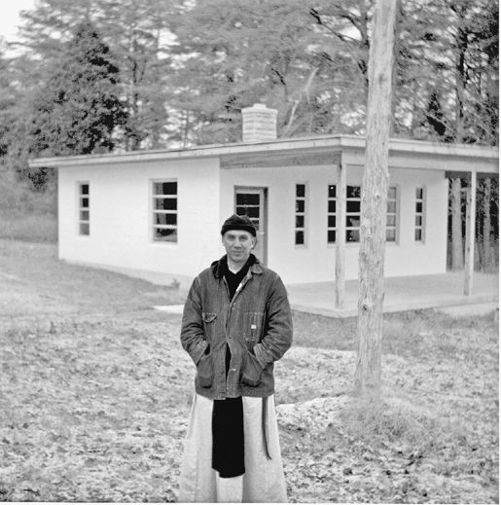
Photograph of Merton at Hermitage. USED WITH PERMISSION OF THE MERTON LEGACY TRUST AND THE THOMAS MERTON CENTER, BELLARMINE UNIVERSITY
This helps to explain why Merton wrote so energetically about nonviolence in the 1960s. Some see this as a surrender to trendiness on Merton’s part and an abandonment of the more classically Catholic spirituality he espoused earlier in his life, but I believe that this is a superficial reading. In speaking incisively against atomic weapons and against the war in Vietnam, Merton was drawing practical moral conclusions from creation metaphysics and from the contemplative prayer that gave him access to the divine center. Merton consistently denied that he was a strict pacifist in the manner of Francis of Assisi or Dorothy Day; he insisted that practitioners of the Catholic spiritual tradition, adepts of contemplation, should always exercise a fundamental option for nonviolence, for their prayer must teach them that all people, despite whatever political or cultural conflicts might divide them, always remain, at the deepest level, siblings.
On March 18, 1958, Merton was in Louisville for some practical business and found himself at the corner of Fourth and Walnut Streets in the heart of the shopping district. In that ordinary place he had an experience in some ways as extraordinary as Teresa of Avila’s encounter with the angel: “I was suddenly overwhelmed with the realization that I loved all those people, that they were mine and I theirs, that we could not be alien to one another even though we were total strangers. It was like waking from a dream of separateness.”12 Merton had come to Gethsemani to escape the world, in the negative sense of that term, and to do penance for his sins. In the course of his long retreat (at the time of the Louisville experience, he had been seventeen years in the monastery), he had moved, through contemplative prayer, deep into the center. And it was from that place that this mystical perception of union was born. “This sense of liberation from an illusory difference was such a relief and such a joy to me that I almost laughed out loud. And I suppose my happiness could have taken form in the words, ‘Thank God, thank God that I am like other men.’ ”13 Merton clearly sees the paradox that it was precisely his contemplative isolation that made this experience possible: “This changes nothing in the sense and value of my solitude, for it is in fact the function of solitude to make one realize such things.”14 He also sees the Christological dimension of this moment: “I have the immense joy of being man, a member of a race in which God himself became incarnate.”15We are linked to one another not only through our common creation but also by the universality of the mystical body of Jesus. Here is how Merton summed up this ecstatic experience: “And if only everybody could realize this! But it cannot be explained. There is no way of telling people that they are all walking around shining like the sun.”16
Somehow in that humdrum place in downtown Louisville it all came together for Merton: metaphysics, creation, incarnation, contemplation, nonviolence, and universal love. And this grandeur of vision, this unification of thought and action, this sense of getting what it is all about is the effect of real prayer, of raising the mind and heart to God.
1. Thomas Merton, The Seven Storey Mountain (Orlando, Fla.: Harcourt Brace Jovanovich, 1948), 191.
2. Ibid.
3. Ibid., 234.
4. Ibid.
5. Ibid., 264.
6. Ibid., 330–32.
7. Ibid., 363.
8. Bernard Lonergan, The Collected Works of Bernard Lonergan, vol. 5, Understanding and Being (Toronto: University of Toronto Press, 1990), esp. 146–55.
9. John of the Cross, “The Dark Night,” in The Collected Works of St. John of the Cross, trans. Kieran Kavanaugh and Otilio Rodriguez (Washington, DC: ICS Publications, 1991), 358.
10. Ibid., 359.
11. Ibid.
12. Thomas Merton, Conjectures of a Guilty Bystander (New York: Doubleday, 1989), 156-57.
13. Ibid., 157.
14. Ibid., 158
15. Ibid., 157.
16. Ibid.