
Chapter 10
I would submit that the doctrines concerning the so-called Last Things—hell, purgatory, and heaven—are simultaneously the most fascinating and most objectionable of all of the beliefs of the Catholic Church. When people want to critique or dismiss Catholic doctrine they will often point to the supposed incompatibility of affirming the existence of an all-good God and the existence of an eternal hell, a place of unending torture. And at least from the time of Marx and Freud, many would point to the doctrine concerning heaven as an indication of, at best, the church’s naïveté and, at worst, its duplicity. Is the belief in a place of perfect happiness after we die not a classic case of wishful thinking, childish fantasizing? And hasn’t it been used as “opium for the masses,” simply a way to mollify people while they endure the agonies of this life? John Lennon sang,
Imagine there’s no heaven
It’s easy if you try
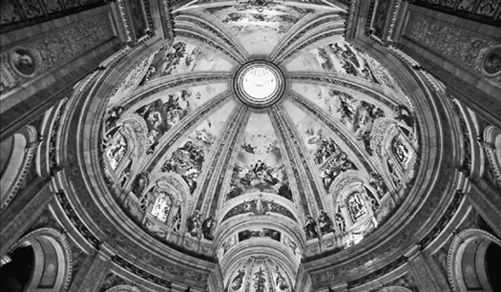
Basílica de San Francisco el Grande, detail, Madrid. WORD ON FIRE
He was speaking for anyone with a fundamentally Marxist or Freudian orientation. And even many Christians who gladly accept the doctrines of heaven and hell find the Catholic teaching on purgatory bizarre and arbitrary, lacking in any biblical foundation.
At the same time, even nonbelievers often find themselves compelled by these teachings. Everyone—believer and nonbeliever alike—wonders and worries at some point about what will happen after we die. Hamlet spoke of death as “the undiscovered country, from whose bourn no traveller returns” (3.1. 78–79), and the entire “To be or not to be” speech reflects an uneasy, bewildered fascination with what awaits us once we’ve “shuffled off this mortal coil.” Everyone loves a ghost story—in part because of its cathartic quality—but also because it seems to provide some hint of another world. More to it, the doctrines of heaven, hell, and purgatory beguile us precisely because of our sense of justice. Far too many good people die without receiving in this life a sufficient reward for their goodness, and many wicked people die without being compelled in this life to pay for their wickedness. If God is just, it seems there has to be some state of being, some place in which these injustices are set right. Here Marx seems wide of the mark indeed. For the vast majority of suffering people who believe in heaven and hell, these doctrines don’t quiet their indignation at injustice in this world; rather they arouse it.

The Duomo, detail, Florence. WORD ON FIRE
In this final chapter we turn to the Last Things. What does the Catholic Church teach in regard to heaven, hell, and purgatory? What does it hold concerning a dimension that we cannot directly see but that nevertheless intrigues all of us who live on the near side of the sleep of death?

Notre Dame, detail, Paris. WORD ON FIRE
BEGINNING WITH DANTE AND HELL
T. S. Eliot said that Western literature is essentially divided between two great figures, Shakespeare and Dante, all the rest qualifying as secondary. If Eliot is right, how fascinating that the principal work of one of the two greatest poets in the Western literary tradition is about our topic—about heaven, hell, and purgatory. Dante wrote his masterpiece, The Divine Comedy, while he was wandering in exile from his hometown of Florence, to which he would never return. Due to the machinations of his political enemies he had been condemned to permanent exile while he was on a trip to Rome. During those lonely and painful years, when he had lost his way both personally and politically, Dante composed his meditation on the next world. The Divine Comedy is a work of creative imagination, and therefore we shouldn’t take it altogether literally; nevertheless it is filled with sound theology (we know that Dante studied theology for a time in Paris, not long after the death of Thomas Aquinas) and informed by the perceptiveness of a transcendently great poet who was also a believer. Therefore as we attempt to gaze through the veil into the world that lies beyond we can take Dante as a helpful guide.
The Divine Comedy commences with Dante’s midlife crisis: “Midway on the journey of our life, I found myself alone and lost in a dark wood, having wandered from the straight path.” He identifies the year as 1300, when he was thirty-five, precisely midlife for those who took the psalmist’s statement seriously that the life span is “seventy years, or eighty for those who are strong.” Having lost his direction (as many do at midlife), Dante cries out in despair, and his prayer is heard by Mary, the Mother of God, who sends for Lucy, the patroness of light, who in turn sends for Beatrice, whom Dante loved while she lived in this world. Finally, Beatrice sends for the Roman poet Virgil, who conducts Dante on a journey through hell. This opening shows us something of great importance, namely, that what we know about the next world affects profoundly our experience of this one, that, in a real way, heaven, hell, and purgatory affect the manner in which our present lives unfold. Sometimes, Dante is telling us, crises here below can be solved only by situating our suffering within the wider context of the transcendent order.
Virgil arrives on the scene and informs Dante that his suffering will end, but only after he has seen the dimensions of the next world, beginning with hell. Chilled by the famous sign ABANDON HOPE ALL YE WHO ENTER HERE, Dante nevertheless follows his guide into the underworld, where he is compelled to see a variety of sinners as they undergo punishment. Dante does not construe what he sees as arbitrary divine cruelty, but rather as an expression of justice, each sinner being allowed to experience the negativity that flows logically and naturally from his dysfunctional behavior. Hell, we learn, is a place created not by God but by errant human freedom. Down and down they go into an increasingly narrow space (hell, in Dante’s imagination, is shaped something like an inverted cone). In his presentation of the topography of hell, the poet has intuited the narrowing of the soul that follows from sin, the turning inward characteristic of self-preoccupation.
At the very bottom of the pit Virgil and Dante confront Satan, the prince of darkness. There is certainly a tendency within the literature of the West to romanticize Satan as a powerful and clever figure: think, for example, of Milton’s devil in Paradise Lost. But there is nothing of that in Dante. The medieval poet imagines the devil not as a hero but as a sad, even pathetic, figure. He is enormous—Virgil and Dante think they are seeing a giant windmill as they approach him—but he is powerless, stuck in ice that rises to his waist. He flaps his enormous wings, but they take him nowhere and only succeed in making the world around him colder. Ice, by the way, is a much better symbol of hell than the traditional fire, for it signals the stuck, immobile quality of sin, which effectively freezes one within the confines of the ego. Saint Augustine famously defined sin as the state of being “incurvatus in se” (caved in on oneself), and Dante’s Satan, the sovereign of a kingdom precisely the size of his own self, splendidly exemplifies the Augustinian definition. The spirit is meant to fly out beyond itself—hence angels have wings—but sin traps us and weighs us down. Chesterton commented that the angels can fly, because they take themselves so lightly! Dante’s Satan takes himself with utter seriousness.
As they get closer, Virgil and Dante notice that the devil has three faces on his one head, a sort of gross mockery of the three persons of the Trinity. The image subtly suggests a spiritual point of some moment, namely, that each sinner, to the degree that he considers himself the center of the universe, makes himself divine. Part of the intense joy of heaven, as we shall see, is to know that one is not God and hence to stand ready for an infinitely fascinating journey into God. Thinking that he is God, Satan has precisely nowhere to go. Next Dante specifies that Satan weeps from all six of his eyes. Again, there is nothing glamorous about evil: sin is just a sad, depressing, soul-shrinking business. God has made his creatures for joy, and this is why turning away from God invariably results in sadness. As Virgil and Dante approach the great beast we expect some sort of confrontation: surely the devil will stop them or attack them. But he doesn’t even notice them. Virgil tells Dante to hop onto the shaggy sides of Satan (he has haunches like a goat’s) and to make his way down to the center of the earth. Though I suppose this scene is a tad anticlimactic, it speaks the spiritual truth that sin produces something like the fog of depression, which renders someone unresponsive, turgid, and dull-witted. The faculties of mind and will and sensuality and imagination light up precisely when they are directed to goods outside the self and finally toward the One who is supremely interesting. Dante’s journey through hell gives us a vivid picture of what the rejection of God looks like, even a visceral sense of what it feels like.

The Last Judgment, detail, by Michelangelo, Sistine Chapel, Vatican City. WORD ON FIRE
Within the thematic context of The Divine Comedy, Dante is learning, by his exploration of hell, how he has managed to find himself, at midlife, in a hellish place. By examining the suffering of the damned and the deep sadness of Satan, he has come to appreciate how his own violence, self-absorption, indifference, pride, and cruelty have compromised his happiness. Hell—like heaven—can be anticipated even now. And this can help us to make sense not only of the existence of hell but also of the compatibility of hell with the infinity of the divine love. The existence of hell—at least as a possibility—is a corollary of two more fundamental convictions: that we are free and that God is love. As we have seen in chapter three, love is not one of God’s attributes or an emotional state that God falls into from time to time; love is the very nature and essence of God. Love is what God is. Therefore God is like the sun that shines on the good and bad alike and the rain that falls on the just and unjust alike. God doesn’t love in response to our goodness; instead, whatever goodness we have is a consequence of God’s love.
Therefore the interesting question is this: how is that never-changing divine love experienced by human beings? And the answer is: it depends on the freedom of the one who does the experiencing. God surely delights in the simplicity and beauty of his nonrational creatures, but he especially delights in those who are capable of serving him “wittily in the tangle of the mind” and freely in the dramatic choice of the will. Endowed with mind and will, we human beings can respond to the divine love or we can reject it. We can bask in its light or we can turn from it. The choice is ours. God wants all people to be saved, which is just another way of saying that he wants them all to share in his life. But his life is love freely given, and therefore it can be had only in the measure that it is freely returned. “Hell” is a spatial metaphor for the state of having freely refused this love, having chosen to live outside of its ambit. Perhaps here we can see the applicability of the traditional symbol of fire. C. S. Lewis said that it is none other than the love of God that lights up the fires of hell. He means that when we resist the divine love it burns us in the same way that the bright light of day would torture the eyes of someone who had been trapped underground for an extended period, or in the way that a cheerful person would exquisitely annoy someone who is sunk in sadness. The sun is just being the sun, and the joyful person is just being joyful, but both can be received in a sharply negative way by someone who is ill disposed to take them in. It has even been proposed that heaven and hell are the same “place,” but inhabited by people of entirely opposite dispositions. Picture a table piled high with food and surrounded by hungry diners, each of whom has a long fork attached to his or her wrist. Those who insist on feeding themselves will go hungry, while those who are willing to feed one another will be perfectly satisfied. What God holds out to everyone all the time is the banquet of his love, but some know how to eat at that table and others don’t.
Many object that an infinitely good God could never send anyone to hell. What I’ve tried to show, with the help of Dante and Lewis, is that this manner of thinking is misleading. God “sends” no one to hell; rather people freely choose to go there. As Lewis pointed out, the door to hell is always locked from the inside. If there are any human beings in hell, they are there because they absolutely insist on it. The conditional clause with which the last sentence began honors the church’s conviction that, though we must accept the possibility of hell (due to the play between divine love and human freedom), we are not committed doctrinally to saying that anyone is actually “in” such a place. We can’t see fully to the depths of anyone’s heart; only God can. Accordingly, we can’tdeclare with utter certitude that anyone—even Judas, even Hitler—has chosen definitively to lock the door against the divine love. Indeed, since the liturgy compels us to pray for all of the dead, and since the law of prayer is the law of belief, we must hold out at least the hope that all people will be saved. Furthermore, since Christ went to the very limits of godforsakenness in order to establish solidarity even with those who are furthest from grace, we may, as Hans Urs von Balthasar insisted, reasonably hope that all will find salvation. Again, this has nothing to do with our perfectibility; it has to do with God’s amazing grace.
PURGATORY
If the doctrine of hell is the most objectionable article of faith in the Catholic system, then the doctrine of purgatory is probably a close second. For many Christians—even for many Catholics—purgatory seems a holdover from the Middle Ages, a superstitious and unnecessary teaching with no clear biblical support. Especially in light of the way in which the doctrine was being used practically as a means of fund-raising (the buying and selling of indulgences), Martin Luther and the other Protestant reformers became sharp critics of the doctrine of purgatory. What precisely is the Catholic teaching in this regard? Here is the formulation found in the Catechism of the Catholic Church: “All who die in God’s grace and friendship, but still imperfectly purified, are indeed assured of their eternal salvation; but after death they undergo purification, so as to achieve the holiness necessary to enter the joy of heaven. The church gives the name Purgatory to this final purification of the elect” (CCC 1030–1031). Traditional theology has distinguished between “mortal” and “venial” sins, that is, between those sins that involve a definitive rupture in one’s relation to God and those that negatively affect but do not break one’s friendship with God. As the name suggests, the first type of sin “kills” the divine life in the one who commits it. To get some sense of what this destruction of the relation to God means, imagine the effect that adultery has on a marriage. Venial sins, on the other hand, do not kill the divine life in a person; nevertheless they still compromise one’s friendship with God and still affect the soul in a negative way, scarring it or warping it. Consider how a bad action, performed repeatedly, twists the will, predisposing it to choose along the same negative line in the future: cruelty begets more cruelty, and small acts of injustice usually conduce to greater injustice. This sort of sin, therefore, needs correction, the wounds that it leaves need healing, and the negative tendency it inculcates needs redirecting. We can see this happening in acts of penance, self-denial, fasting, and prayer that effectively bend the will back in the right direction.
Lough Derg is a rocky, uninviting island located in the middle of a forgotten lake in northwest Ireland. To this place, strangely, thousands of people come every year to make a penitential spiritual retreat. They are ferried to the island and then told to take off their shoes. They are to remain unshod for the duration of their spiritual exercise. They spend the first day praying the Rosary, walking on their knees over punishing beds of stone, and attending services. For that day and night they are not permitted to sleep. If they doze off at church, attendants rudely awaken them. A friend of mine who attends this retreat regularly said that the forced sleeplessness is by far the most trying feature of the retreat. After two and a half days of practically constant prayer and spiritual exertion, the retreatants are ferried back to the mainland. In the Middle Ages this island was known as St. Patrick’s Purgatory, and popular legend said that the entrance to purgatory was nearby. We can dispense, of course, with the crude literalism, but we should still pay attention to the association of what took (and takes) place on Lough Derg and what the church means by purgatory in the supernatural sense. Those who come to the island love God. They wouldn’t go through such punishment unless they did. But they recognize imperfections in themselves that need to be corrected so that their relationship to God can be set fully right, and therefore they willingly go through a crucible. Just as denizens of hell (if there are any) are there freely, so those who pass through purgatory do so because they want to. Once more, this has nothing to do with a supposed cruelty or capriciousness on God’s part; it has to do with the sinner’s perceived need to deal with the effects of his sin.
Imagine a worldly person—self-absorbed, superficial, spiritually undeveloped—who suddenly experiences a conversion to God. He perceives the inadequacy of his life and he wants to change. And so, impulsively, he resolves to leave his job, travel to Calcutta, and help in the work of the Missionaries of Charity. As he shares the lives of the sisters and joins in their daily task of caring for the most wretched, he is, objectively speaking, in heaven, for he is fully surrendered to a life of love and self-denial. But his years of hedonism, materialism, and self-absorption have so poorly disposed him to such a life that he experiences his new situation as hellish suffering, and it awakens in him the deepest anxiety and resentment. If he remains open to the new life, if he continues, despite his resistance, to give himself to it, he will find in time that his resistance weakens and his faults are purged away. He will discover, at last, that it is possible to walk the path of love effortlessly and freely. And at that moment the place of suffering will become a place of springs. This, I think, is an apt analogy for what the church means by purgatory. There are many people who leave this life as friends of God, but who are far from able to live the life of heaven effortlessly. They require, accordingly, a Lough Derg, a Calcutta, a necessarily painful training in the way of love—a purgatory.

Lough Derg, Ireland. WORD ON FIRE
In order to get an even fuller illustration of the meaning of this doctrine, it might be helpful to turn once again to The Divine Comedy. After Virgil and Dante finish their journey through hell, they pass through the middle of the earth and climb out the other side. There they spy the great mountain of purgatory, divided into seven levels or “stories.” On each of the levels those who are saved but still imperfect are cleansed of the effects of one of the seven deadly sins: pride, envy, anger, sloth, avarice, gluttony, and lust. On the first story, the prideful are made to carry massive boulders, which weigh them down, pressing them to the earth. Pride is self-elevation, and therefore the effects of pride are purged away through a humbling of the ego, a reorientation to the earth (humus in Latin), to the simple truth of things. The envious spend their lives looking resentfully at the achievements of others and delightedly at the failures of others. Therefore on the second level they are punished by having their eyelids sewn shut. They are also compelled to hear the Gospel story of Mary, who at the wedding feast of Cana did not rejoice in the misfortune of the young couple but pressed Jesus to help them. On the third story the angry are inundated with smoke in order to make them feel how anger has blinded them and distorted their speech. The slothful, literally in the dead center of purgatory, are made to run, and they hear, over and again, the Gospel reminder that Mary “went in haste” to the hill country of Judea after the Annunciation. The avaricious, who in life were preoccupied with the goods that money can buy, are nailed to the ground, their faces quite literally rubbed in matter. On the sixth level, the gluttonous are, as we’d expect, starved; and on the seventh story the lustful are forced to pass through fire in order to feel the burning effect of their sexual dysfunction.
What I hope is clear is that none of this has a thing to do with divine cruelty. It is a function of what the church father Origen of Alexandria called the schola animarum, the school of souls. In his Spiritual Exercises Saint Ignatius of Loyola often recommended theagere contra (act against) principle: when a spiritual seeker discovers within herself a distortion, she ought to act, even in an exaggerated way, against it. If too much sensual pleasure is her problem, she ought to fast; if ambition is her difficulty, she ought purposely to take the lowest place; if envy bedevils her, she ought to praise those who awaken the feeling of resentment in her. Purgatory is a school of souls, where the agere contra principle is followed. And one is freed from this state precisely when one is ready.
Twice already I’ve referenced the classical Protestant objection that purgatory is an unbiblical doctrine, a medieval innovation. Is this true? To be sure, the word “purgatory” is nowhere to be found in Scripture, but, to be fair, “incarnation” and “Trinity” are equally absent. Yet one could argue that the seeds of the idea of purgatory are indeed in the Scriptures. One classic reference is in 2 Maccabees. After a battle the Israelite general Judas Maccabeus examines the corpses of fallen Jews and discovers idolatrous amulets on the persons of some of the dead, and he surmises that their apostasy was the reason for their demise. But then he urges that prayers and sacrifices be offered on their behalf. The author of 2 Maccabees comments: “[F]or if he were not expecting the fallen to rise again, it would have been useless and foolish to pray for them in death. But if he did this with a view to the splendid reward that awaits those who had gone to rest in godliness, it was a holy and pious thought. Thus he made atonement for the dead that they might be freed from this sin” (2 Mac 12:44–46). The assumption is that at least some of the dead are friends of God (asleep in godliness) but who can nevertheless benefit from prayer and who stand in need of deliverance from sin. They are, in short, in the condition of what Catholic theology calls purgatory.

Glendalough, Ireland. WORD ON FIRE
EXCURSUS ON ANGELS AND DEVILS
We have been talking about hell and purgatory, states of being that transcend the world of ordinary experience. But is this kind of speech even coherent? Why should we imagine that there is anything beyond what we can see, touch, and measure? It might strike many today as surprising that in Europe prior to the scientific revolutions of the seventeenth and eighteenth centuries and in many cultures today where the scientific model isn’t predominant a belief in a transcendent dimension inhabited by spiritual realities was and is taken utterly for granted. And I do not mean this as a critique of those cultures, but rather as a dig at a certain “scientism” that sharply reduces reality to the empirically verifiable. The Bible, for instance, is intensely interested in the full panoply of visible things: human beings, plants, animals, trees, the earth itself, even those insects that crawl on the ground. But it is equally interested in the whole realm of God’s invisible creation, the denizens of heaven. The Nicene Creed, which is conditioned by a deeply biblical consciousness, speaks of God who has created “the heavens and the earth … all that is seen and unseen.” Can we inhabitants of the “disenchanted” post-Enlightenment universe make sense of this?
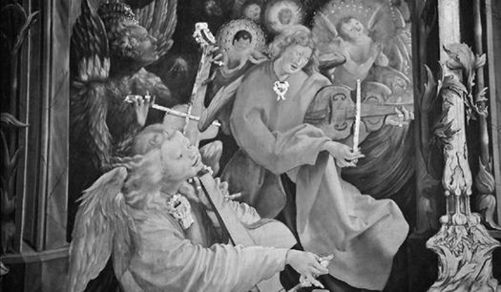
Isenheim Altarpiece by Matthias Günewald, detail (Unterlinden Museum, Colmar, France). WORD ON FIRE
Thomas Aquinas in the thirteenth century and Teilhard de Chardin in the twentieth century mounted similar arguments for the existence of a transcendent spiritual order. Both drew attention to the explosive fecundity of God’s creativity evident in our ordinary experience: the numberless insects, plants, cells, molecules, planets, and galaxies. And then both Aquinas and Teilhard wonder whether it is reasonable to suppose that between the stunning variety evident in the physical universe and God there yawns simply a great abyss. Wouldn’t it be more rational, they conclude, to assume that mediating between the Creator and his material creation is an equally variegated and complex spiritual realm, an order of creatures who exist at a higher pitch of perfection and intensity than embodied things? And might this dimension be invisible to us not because it is merely fantastical but because we are not equipped to sense it? When considering Mary’s Assumption in an earlier chapter, I spoke of the translation of her body into a higher level of existence, one that is not less real but more real, more complete, than ours. I meant that she entered the “space” of the angels and spirits. Again, when we picture these creatures we tend to see them in our mind’s eye as diminished, wispy versions of ourselves, but this is to get it precisely backward. It would be much more correct to see ourselves as wispy versions of them. They exist more fully, more intensely, and more completely than we do.
Aquinas described an angel as a “separated intelligence,” meaning a creature endowed with intelligence and will but independent of matter. This means that the angel can know in an immediate, intuitive way, not needing, like us, to go through the relatively messy process of sensing, imagining, and abstracting. It means that the angel transcends space and time, able to move effortlessly through both. Each angel, precisely as immaterial, Aquinas said, is its own species, for what accounts for individuation within a species is embodiedness. I am one instance of the species Homo sapiens, and you are another, because you and I are instantiated in different bodies, which give us unique features and enable us to occupy different spaces, and so forth. But angels, who have no bodies, cannot be differentiated that way. To make all of this abstract language a bit more accessible, picture, as far as you can, every human being who has ever lived, every human being currently alive, and every human being who will ever live up to the end of time. And now imagine all of them—with all of their powers and perfections—gathered into a single great entity. That might give you some idea of what one angel is like—and also why the typical reaction to an angel is fear.

The Last Judgment, detail, by Michelangelo, Sistine Chapel, Vatican City. WORD ON FIRE
In our tradition the angels are associated with the praise of God. In fact, the highest angels, the seraphim, derive their name from a Hebrew word that means “the burnt ones.” They are on fire because their praise has brought them so close to the pure heat and light of God. We also speak in this context of the singing of the angels. Though we shouldn’t literalize this language (spiritual realities don’t exactly have voices), we shouldn’t dismiss it as mere pious poetry. The harmonizing of the angels is meant to indicate the symphony of mind and will among these spiritual creatures as they praise God. In our exploration of the Liturgy we explained how the great Gloria (“Glory to God in the highest and peace to his people on earth”) expresses the hope that when we together make God our highest concern that act will conduce to peace among us. We are praying for what the angels already have: a concord that comes from orthodoxy.
The word “angel” is derived from the Greek angelos, which means “messenger.” As Saint Augustine indicated, angels are named based on their function, not their nature, for we come to know these pure spirits in the measure that they are sent by God on mission into our dimensional system. Thus the Bible speaks, for example, of Raphael’s involvement with Tobit, the three angels who visit Abraham, and Gabriel’s commission to announce the Incarnation to the Virgin Mary. Though they are at a higher pitch of existence, angels can, it seems, mix and mingle with us. How can we explain this? We shouldn’t think of “spirit” and “matter” as mutually exclusive. Indeed, it would be very hard to account for God’s creation of the material universe if spirit and matter were incompatible. I would suggest that we consider matter as a less intense expression of being than spirit. This means that the spiritual order can stoop to the material, even if the reverse direction is not possible. An adult can condescend to enter into the thought world of a three-year-old, but the child could never, even in principle, rise up to understand the complexity of adult consciousness. In a similar way, angels can interface with our system—even to the point of assuming material form—though we cannot, on our own power, accommodate ourselves to their system.

Isenheim Altarpiece by Matthias Grünewald, detail (Unterlinden Museum, Colmar, France). WORD ON FIRE
I can easily enough imagine someone who has followed the argument to this point and has managed, perhaps with some reservation, to accept the existence of angels but who balks at affirming the existence of devils. Surely that conviction is a holdover from a superstitious and prescientific age. According to the mind of the church, a devil is a fallen or morally compromised angel. If we admit that human beings are capable of moral corruption (and it would be extremely difficult not to), I don’t see why it would necessarily be difficult to grant that certain angels might have turned in on themselves and away from God and thereby fallen into corruption, and that they with malicious intent could involve themselves in the world of our ordinary experience. Saint Paul said that we do battle not with flesh and blood but with angels and principalities, that is to say, with unseen powers that exert a malign influence on the affairs of human beings. Once again, we shouldn’t think of the spiritual realm as “far away” in the ordinary sense, as though it were a distant corner of the cosmos. It is other indeed, but qualitatively, not quantitatively so, and this means that the spiritual realm can interact, both positively and negatively, with our realm. Before turning from this topic of the devil, I feel obliged to insist that all Gnostic and Manichaean fantasies concerning the devil as God’s opposite or opponent have to be set aside. Satan is not the “dark side” that faces the light of God in a terrible cosmic struggle. He is a fallen creature whom God allows, for God’s own inscrutable purposes, to work woe in the world. We should take the devil with requisite seriousness, but we shouldn’t give this finally uninteresting and pathetic creature too much attention.

Angel. WORD ON FIRE
HEAVEN
In coming to the topic of heaven, we come to the end of these reflections and to the goal of the Catholic faith. Everything else that we have talked about—God, Jesus, the church, the sacraments, Mary, the Liturgy, the saints—is meant to conduce to heaven. What God finally desires for us human beings is participation in his own Trinitarian life, which is to say, the life of love. Heaven is love in the fullest sense, love completed. Paul said that there are three things that last—faith, hope, and love—and that the greatest of these is love. Love is the greatest because in heaven, faith and hope will fade away, but love will endure. Heaven is the “place” where everything that is not love has been burned away and hence heaven is the fulfillment of the deepest longing of the human heart.
There are many different images for heaven in the Bible and the great tradition: the banquet, the wedding feast, the wine of the Kingdom, life, light, peace, the Father’s house, paradise, the heavenly Jerusalem, eternal rest, and refreshment, to name just a few (CCC 1027). Though each of these images speaks some truth concerning heaven, the reality itself lies beyond all our imagining, since it is equivalent to the very life of God, that which “no eye has seen, nor ear heard, nor the heart of man conceived.” With this caution ever in mind, I should like to focus on three metaphors for heaven that have always struck me as particularly illuminating: the beatific vision, the city, and the new heavens and the new earth.

The Duomo, detail, Florence. WORD ON FIRE
Thomas Aquinas said that the human mind is marked by a dynamism that propels it outward. The mind comes to know a particular thing by relentlessly asking the question “what is that?” This question leads to ever deeper insight into the object or event, opening up ever wider horizons of meaning. Thus I might say in regard to the machine on which I’m currently tapping, “That’s a computer.” But my mind is unsatisfied with that statement and asks, “What is a computer?” Through a series of perceptions, comparisons, insights, and judgments, my mind concludes that a computer is a type of machine. But what is a machine? It is an artificial contraption. But what is that? It is a cleverly designed coming together of physical objects. But what are those? Those are worldly things. What are worldly things? They are beings, existing things. But what is existence? At this point the mind has reached a sort of horizon or limit, for it is asking about the very nature of to be, the Truth Itself, if you will. It is looking, however inchoately, into the face of God. This is precisely why Aquinas says that in every particular act of knowledge, God is implicitly co-known; for God is the intended goal of the mind, whether the intellectual seeker explicitly knows it or not. Aquinas’s analysis here is not far from John of the Cross’s description of the inner caverns that can be filled only by God.
For Aquinas the will can be viewed in a similar way. Even in its simplest moves the will necessarily seeks the good, and it finds it, to a degree, in this world. But no matter how much good the will achieves, it is always unsatisfied, yearning for more. Even the greatest goods the world can offer—beauty, pleasure, power, esteem, adventure, success—leave the will restless, desiring a still greater good. Jean-Paul Sartre and his existentialist colleagues drew from this fact the conclusion that life is simply absurd. But Thomas Aquinas and the other masters of the Christian tradition have drawn a very different conclusion, arguing that the dissatisfaction of the will, even when it is in possession of the highest worldly goods, is a clear indication that the will is ordered to a transcendent value, one that is vaguely sensed but never attained in this life. This is why, as C. S. Lewis realized, the most exquisite experiences in life—aesthetic pleasure, sexual intimacy, deep friendship—are always accompanied by a certain aching sadness, a sense that there must still be something more. “Heaven” is what corresponds to that desire beyond desire and to that searching beyond searching. The mind and the will—despite (or because of) all of their achievements here below—still want definitively to see.
In his autobiographical novel A Portrait of the Artist as a Young Man, James Joyce told of the encounter between Stephen Daedalus (his literary alter ego) and a beautiful woman standing knee-deep in the water off the Dublin strand. Stephen sees the woman and is immediately entranced by her. He describes the harmonious balance of the various elements that constitute her figure and form. As he is completing the ecstatic appreciation of her beauty, she turns and for a moment looks at Stephen, “suffering” his gaze before turning back to contemplate the open sea. At this the young man exclaims, “Oh heavenly God!” Joyce, who was thoroughly trained in scholastic philosophy and who maintained a lifelong appreciation for Aquinas, has deftly caught the dynamic we’ve been describing. Precisely at the moment when Stephen possesses something radiantly true and beautiful he comes to an awareness of his longing for the heavenly God. The woman’s glance out to the open sea is evocative of the transcendent ordering of the mind and will beyond what they can possibly attain here below. In his first letter to the Corinthians, at the end of the hymn to love in chapter 13, Saint Paul expresses in simple and poetic language that toward which I’ve been gesturing: “At present we see indistinctly, as in a mirror, but then face to face. At present I know partially; then I shall know fully, as I am fully known” (1 Cor 13:12). Seeing God in the face has accordingly become one of the principal metaphors for this heavenly fulfillment of the heart.
I first laid eyes on the north rose window at Notre Dame Cathedral in Paris on June 12, 1989, the day I arrived in Paris to commence my doctoral studies. Though I was jet-lagged, anxious, and confused, though I barely knew where I was going, I made my way that day through the Latin Quarter to the Ile de la Cité so that I could see the building that I had for so many years loved and savored through photographs. I entered the cathedral, walked up the central aisle, turned left at the transept, and then stood fixed and mesmerized for twenty minutes by the sheer beauty of that window. Every single day that I was in Paris until I returned home for Christmas, I went to that spot and stared. What drew me there so compulsively? The north rose window is strikingly beautiful. Aquinas, who was working in Paris in the thirteenth century and would have known that window when it was brand-new, said that beauty occurs at the intersection of three elements: wholeness, harmony, and radiance. We say something is beautiful—a face, a painting, a golf swing—when it hangs together as one (it has wholeness), when all of its parts work together in consonance (it has harmony), and when it shines forth as an archetype of what such a thing should be (it has radiance).

Rose window, Notre Dame, Paris. WORD ON FIRE
The great wheel of the north rose window, with its myriad parts in harmonious interconnection and with the sunlight shining through it, certainly qualifies as a beautiful thing. But its beauty is in service of a higher good, for it is meant to be a foretaste of the beauty of the beatific vision. One is supposed, even while looking at it, to look beyond it and say, “Oh heavenly God.” One of the clues of this transcendent purpose is in the window’s numeric symbolism. Around the central figures of Christ and his mother are eight small circles. Then on the next major row we find sixteen circular images (medaillons in French), and on the next twice sixteen, or thirty-two, images, and then finally another row of thirty-two. If we add thirty-two, thirty-two, sixteen, and eight, we arrive at eighty-eight. In a word, the entire window is an artistic meditation on the number eight. Then we recall that eight is a symbol of eternity, since it stands immediately outside of seven, which evokes the seven days of the week, or the completed cycle of time.
Another clue is found in the very complexity and inexhaustibility of the window’s composition. Why was I drawn for so many days to look at the rose window? Partly because there was just so much to take in. The vision of God is like that. Saint Bernard said that heaven will slake our thirst, but the very slaking will, paradoxically, make us thirsty for more. We will know all that we want to know, but that very satisfaction will convince us how much we don’t know. Thomas Aquinas said that what the saints in heaven grasp for the first time is just how incomprehensible God is and therefore just what an adventure the life of heaven will be.
I realize that all of this talk about knowing and seeing can give the impression that the life of heaven is a rather lonely and passive business, like a solitary stroll through an art gallery. Wouldn’t even the most fascinating and beautiful vision, we wonder, eventually become tiresome? This is why it is most important to supplement the image of beatific vision with that of the city, the new Jerusalem. There is nothing passive or individualistic about a city—say, Paris, New York, Rome, San Francisco, or Rio de Janeiro—bustling with energy, life, and creativity. These are places where communal activities and entertainments of all varieties are on offer: business, sports, art, transportation, education, fine dining, and politics. Life in the heavenly Jerusalem is something like that. In union with the angels and saints, our minds, wills, and energies fully alive and properly focused, we will live in thrilling interdependent communion with one another. Because of our sins and the natural conflicts of finite existence, here on earthcommunio is so rare, so hard to achieve; but in the city on high, when we have been raised to a new pitch of perfection and when the self-absorption of sin has been burned away, we will rejoice in one another’s accomplishments and delight in the harmony that we can achieve together.
Under this latter rubric, think of heaven as a kind of game, involving many participants gathered together around a common purpose, their powers and energies fully engaged. If you’re a fan of football, imagine a beautifully executed touchdown pass; if you prefer basketball, think of a crisply turned fast break; if you like classical music, think of an orchestra working its way through an intricate section of Beethoven’s “Emperor” Concerto with verve and panache. And now imagine those types of play being performed in front of a deeply appreciative audience who exult in the sheer beauty of what they are witnessing. And finally picture a city that is filled, night and day, with activities of such rare perfection. That might give you some idea of the heavenly Jerusalem, the house of Jesus’s Father in which there are many mansions indeed.
A final image that I would like to consider is that of the new heavens and the new earth. The mere mention of “heaven” awakens, I’m afraid, the incipient Platonism that lies dormant in so many religious people. By Platonism I mean the conviction that there is, metaphysically speaking, a two-tiered universe, with the spiritual realm on top and the material realm very much on the bottom, and the accompanying conviction that the whole point is to escape from the lower into the higher as expeditiously as possible. Many Christians are more Platonist than biblical in that they see the goal of the spiritual life as getting out of this world and “going to heaven,” or to put it more precisely, facilitating the soul’s departure from the body and its subsequent journey to a purely immaterial realm. But this is not what Christian hope is really about.
The Apostles’ Creed concludes with “I believe in … the resurrection of the body and life everlasting”; and the Nicene Creed closes with “We look for the resurrection of the dead, and the life of the world to come. Amen.” Neither declaration of Christian faith speaks of the conviction that the soul will escape from the body and live forever in a disincarnate state; both speak of resurrection, which involves not the leaving behind of the body but the transfiguration of the body. The risen Jesus appeared very much in an embodied state to his disciples: “touch me and see that I have flesh and bones.” The God revealed in the Bible made the physical universe and took infinite delight in it: “he found it all very good.” At what a remove this stands from all forms of Gnosticism and Manichaeanism, which hold that the material world is something of a mistake, an offscouring of spirit. Presumably the biblical God who made the good earth has no intention of giving up on it, but rather wants to save it and redeem it. And this is precisely what the language of the resurrection of the body is all about: not an escape from matter but a renewal of it.
What will the resurrected body be like? Drawing inspiration from the Gospel descriptions of the risen Christ, Thomas Aquinas speaks of its subtilitas (subtlety), by which he means its capacity to transcend time and space; and of its claritas (radiance), by which he means its luminous brilliance; and of its agilitas (agility), by which he means its suppleness and athleticism. He imagines the glorified body as a body fully itself but exercising its power at a qualitatively higher degree of perfection. The contemporary theologian John Polkinghorne, who is also a particle physicist, has offered some fascinating speculations in regard to the resurrected body. Relying upon Aquinas’s view that the soul is the “form” or patterning energy of the body, he speculates that at death that form is “remembered” by God, preserved in the divine mind, and then reconstituted with a new and immortalized materiality. We might imagine the way in which the “form” of a picture could be preserved in a computer and then downloaded in any number of new instantiations, bigger and more impressive than the original. Because it would be informed by the same pattern, this new body would be continuous with the old one yet be something altogether new, something more splendid and complete. And could this same manner of thinking help us to conceive what a “new heaven and a new earth” might be?
It has been said that the best way to prepare ourselves for life in the world to come is to cultivate our capacity for surprise.