
Chapter 2
I was at great pains in the first chapter to emphasize the centrality of Jesus’s person. Christian faith centers on who Jesus is and not what he said. The great creeds, for example, never mention the words of Jesus, but they are desperately interested in articulating his identity with exactness. Having said this, I would be loath to give the impression that the teachings of Jesus are a matter of indifference to Christians, for nothing could be further from the truth. Once they clearly understood that Jesus was Yahweh moving among his people, that he was, in the language of Saint John, the very Word of God made flesh, the first Christians were keenly interested in remembering, understanding, and propagating Jesus’s teaching. And, in fact, wherever they’ve been heard, the words of Jesus have proved fascinating, disorienting, sometimes confounding, deeply transformative, and always unforgettable. Would the end of slavery have happened without Jesus’s command to love one’s neighbor as oneself? Would the civil rights movement in the United States have gotten under way without Jesus’s teaching about loving one’s enemy? Would Gandhi’s liberation of India or the collapse of Communism have been possible without Jesus’s summons to nonviolence? How many prospective persecutors have been brought up short by Jesus’s word: “Let the one among you who is without sin be the first to throw a stone at her” (Jn 8:7)? How many, locked in a stance of resentment and wounded pride, have been changed by Jesus’s story of the prodigal son? How many social reforms have been prompted by Jesus’s devastating line, “whatever you did for one of these least brothers of mine, you did for me” (Mt 25:40)? How many anxious hearts have been calmed by the reminder to “Learn from the way the wild flowers grow. They do not work or spin” (Mt 6:28)?
Jesus himself, though he was consistently reluctant to claim the title of Messiah, readily enough assumed the mantle of prophet, a teacher of the divine truth. The throngs followed him because of his miracles, to be sure; but they also were captivated by the sweet discourse that came from his mouth. That preaching was a paramount aspect of his work is disclosed in one of the commonest refrains in the Gospels: “and Jesus taught the crowds.” Scholars speculate today that even during Jesus’s lifetime his disciples were memorizing and passing on his sayings. At a particularly difficult point in his ministry, most of Jesus’s disciples left him. He turned to his inner circle and plaintively asked, “Do you also want to leave?” (Jn 6:67). Peter, speaking for the whole apostolic company replied, “Master, to whom shall we go? You have the words of eternal life” (Jn 6:68). I cannot imagine a clearer witness to the power of Jesus’s speech.
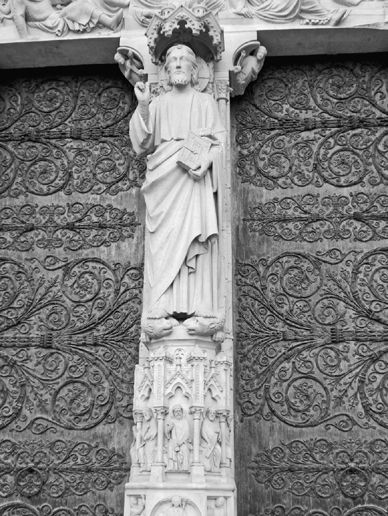
Christ as Teacher, Notre Dame, Paris. DENIS R. MCNAMARA
THE BEATITUDES
Certainly the best place to begin in order to understand Jesus’s teachings is the Sermon on the Mount, which fills the fifth, sixth, and seventh chapters of Matthew’s Gospel, and which most likely summarizes the typical instruction that Jesus gave to his followers. Matthew tells us that Jesus, seeing a large crowd gathering around him, went up a mountain, sat down, and commenced to teach. Within a Jewish context, the reference to a mountain would immediately call to mind Moses, who went up Mount Sinai to receive the Ten Commandments and the Torah from God. Therefore, Jesus is being presented here as the new Moses who will promulgate from this Galilean mountain the definitive law. This interpretation is reinforced by Matthew’s description of Jesus’s physical attitude, for sitting was the customary posture of the teacher and the lawgiver in the ancient world. I realize that this immediately poses a problem for contemporary readers, who are instinctually put off by a religion that leads with laws, rules, and prohibitions. An Irish wag once summed up the Catholicism that he was taught with this phrase: “In the beginning was the word, and the word was no!” Since the Ten Commandments have been honored mostly in the breach, why should anyone think it a good idea to introduce new and even more stringent laws? But then we attend to the first word out of the mouth of the lawgiver: “Blessed.” The Greek term in Matthew’s Gospel is makarios, which is probably best rendered with the simple word “happy.” The law that the new Moses offers is a pattern of life that promises, quite simply, to make us happy. In John’s Gospel, Jesus says to his disciples on the eve of his death, as a sort of summation of his preaching, “I have told you this so that my joy might be in you and your joy might be complete” (Jn 15:11). And in Matthew’s Gospel, Jesus speaks winsomely of his “yoke” which is, in point of fact, light and easy to bear, precisely because it brings fullness of life.
How can we think together joy and the law, two realities that seem, at first blush, mutually exclusive? We might begin by analyzing the famously slippery idea of freedom. On the more modern reading, freedom is primarily choice and self-determination, the capacity to choose between various options, without any constraint either interior or exterior. That this kind of liberty is reverenced in the modern Western cultures can be seen in the sometimes dismaying range of options available to us politically, culturally, and, above all, economically. For those who love freedom as choice, the law is, at best, something grudgingly accepted. For instance, we know that traffic rules are necessary for the relatively good order of our streets, but deep down most of us would prefer not to have them so that we could drive as we please. The same is true in regard to moral restrictions, which are accepted by many as a sort of lesser of two evils: not really desirable in themselves, but necessary for social order. But let us consider another way of construing freedom, one more in line with biblical sensibilities. On this interpretation, freedom is not primarily a choice, but rather the shaping of desire so as to make the achievement of the good first possible and then effortless.

Mount of the Beatitudes Church, Israel. WORD ON FIRE
Shakespeare was one of the freest writers in the history of the English language, by which I mean he was able to say anything he wanted to say, to express every shade of thought and nuance of feeling that his wickedly complex dramas called for. He did not achieve this mastery by speaking and writing according to the whim of his choice, but rather through subjecting himself to a whole series of masters, by studying English grammar and syntax, by listening to patterns and rhythms of speech, and by steadily immersing himself in the ocean of English vocabulary. I think it is fair to say that Michael Jordan was the freest person ever to play basketball. Whatever the game demanded—three-point shooting, two-point shooting, defense, driving and dribbling, free throws, dunking the ball—Jordan could do effortlessly. Again, he didn’t come to this freedom by choosing to play any way he wanted to play. He listened to an array of coaches, watched hours of film, studied the greatest players, practiced endlessly, learned from his mistakes, and so forth. He mastered the basics. In the cases of both Shakespeare and Jordan, law was not the enemy of freedom but precisely the condition for its possibility. What is joy but the experience of having attained the true good? Therefore in this more biblical way of looking at things joy (beatitude) is the consequence and not the enemy of law. What Jesus gives us in the Sermon on the Mount, therefore, is that new law that would discipline our desires, our minds, and our bodies so as to make real happiness possible.
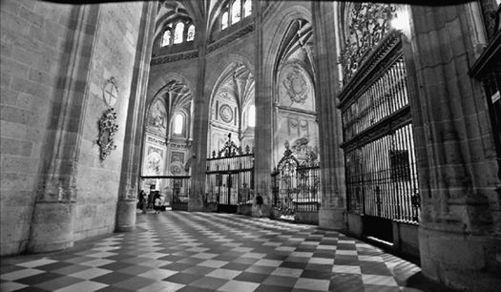
Cathedral of Segovia, interior, Spain. WORD ON FIRE
I would like to suggest a reading of the eight beatitudes that looks first at the more “positive” formulations and then, in light of those, at the more “negative” prescriptions. Jesus says, “Blessed are the merciful, for they will be shown mercy” (Mt 5:7). This stands at the heart of the matter, for mercy or tender compassion (Chesed in the Hebrew of the Old Testament) is God’s most distinctive characteristic. Saint John would give this same idea a New Testament expression in saying “God is love” (1 Jn 4:16). Saint Augustine reminded us that we are, by our very nature, ordered to God: “O Lord, you have made us for yourself, and therefore our hearts are restless until they rest in thee.” If this is true, then nothing short of God, no substitute for God, will ever finally satisfy us. But since God is tender mercy, “having” God is tantamount to exercising compassion, being merciful ourselves. And attend to the way Jesus articulates this law: those who exercise mercy will themselves receive mercy. According to the “physics” of the spiritual order, the more one draws on the divine life, the more one receives that life, precisely because it is a gift and is properly infinite. God’s life is had, as it were, on the fly: when one receives it as a gift, he must give it away, since it only exists in gift form, and when he gives it away he will find more of it flooding into his heart. If you want to be happy, Jesus is saying, this divine love, this Chesed of God, must be central to your life; it must be your beginning, your middle, and your end, your “work day and Sabbath rest.” Everything else that is good will find its place around that central desire, which is why Jesus said, “seek first the kingdom [of God] and his righteousness, and all these things will be given you besides” (Mt 6:33).
We turn now to the closely related beatitude: “Blessed are the clean of heart, for they will see God” (Mt 5:8). This means that you will be happy if there is no ambiguity in your heart (the deepest center of the self) about what is most important. The philosopher Søren Kierkegaard said that the saint is someone whose life is about one thing. He didn’t mean that the saint lives a monotonous existence; he meant that a truly holy person has ordered her heart toward pleasing God alone. Again, many interests and passions and actions can cluster around that central longing, but none of them can finally compete with it. And thus, “Blessed are they who hunger and thirst for righteousness, for they will be satisfied” (Mt 5:6). We want many things—food, drink, shelter, fame, financial security, and so on—but what, most fundamentally, do we want? What is the Hunger that defines and orders the attendant and secondary hungers? What, in Paul Tillich’s language, is your “ultimate concern”? If it is anything other than the will and purpose of God—righteousness—then you will be unhappy and unfulfilled. The last of the “positive” beatitudes is: “Blessed are the peacemakers, for they will be called children of God” (Mt 5:9). Since God is the Creator, he is that power through which all creatures are connected to one another. As we have seen in the first chapter, God is a gathering force, the unifier of all that he has made. Therefore someone who has ordered himself fundamentally toward God is, ipso facto, a peacemaker, for he will necessarily channel the metaphysical energy that draws things and people together. One of the most readily recognizable marks of sanctity—on clear display in all the saints—is just this radiation of reconciling power. This is why peacemaking will make us children of God and therefore happy.
With these more positive beatitudes in mind we can turn with increased understanding to those beatitudes that can strike us initially as perhaps confounding and counterintuitive. The simple fact of the matter is that on account of the mysterious curvature of the will that we call original sin, we deviate from the very actions and attitudes that will make us happy. In the elegant formulation of Saint Augustine, we have turned from the Creator to creatures, and as a result we are wandering in “the land of unlikeness,” which is to say, a place of spiritual aridity. Jesus recommends a series of negative prescriptions, designed to orient us wanderers aright. One of the most fundamental problems in the spiritual order is that we sense within ourselves the hunger for God, but we attempt to satisfy it with some created good that is less than God. Thomas Aquinas said that the four typical substitutes for God are wealth, pleasure, power, and honor. Sensing the void within, we attempt to fill it up with some combination of these four things, but only by emptying out the self in love can we make the space for God to fill us. The classical tradition referred to this errant desire as “concupiscence,” but I believe that we could neatly express the same idea with the more contemporary term “addiction.” When we try to satisfy the hunger for God with something less than God, we will naturally be frustrated, and then in our frustration, we will convince ourselves that we need more of that finite good, so we will struggle to achieve it, only to find ourselves again, necessarily, dissatisfied. At this point, a sort of spiritual panic sets in, and we can find ourselves turning obsessively around this creaturely good that can never in principle make us happy.
And so Jesus says: “Blessed are the poor in spirit, for theirs is the kingdom of heaven” (Mt 5:3). This is neither a romanticizing of economic poverty nor a demonization of wealth, but rather a formula for detachment. Might I suggest a somewhat variant rendition: how blessed are you if you are not attached to material things, if you have not placed the goods that wealth can buy at the center of your concern? When the Kingdom of God is your ultimate concern, not only will you not become addicted to material things; you will, in fact, be able to use them with great effectiveness for God’s purposes. Under this same rubric of detachment consider the beatitude “Blessed are they who mourn, for they will be comforted” (Mt 5:4). Again, this can sound like the worst sort of masochism, but we have to dig deeper. We could render this adage as how blessed, how “lucky” (a legitimate rendering of makarios, according to some scholars) you are if you are not addicted to good feelings. Pleasant sensations—physical, emotional, psychological—are wonderful, but since they are only a finite good, they can easily drive an addiction, as can clearly be seen in the prevalence of psychotropic drugs, gluttonous habits of consumption, and pornography in our culture. Again, Jesus’s saying hasn’t a thing to do with puritanism; it has to do with detachment and hence with spiritual freedom. Unaddicted to sensual pleasure, one can unreservedly follow the will of God, even when such a path involves psychological or physical suffering.
Jesus says, “Blessed are the meek, for they will inherit the land” (Mt 5:5). I don’t know of any culture at any time that would be tempted to embrace this beatitude as a practical program of world conquest! Meek people don’t come to positions of political or institutional influence. But once more, Jesus is not so much passing judgment on institutions of power as he is showing a path of detachment. How lucky you are if you are not attached to the finite good of worldly power. Many people up and down the centuries have felt that the acquisition of power is the key to beatitude. In the temptation scene in the Gospel of Matthew, the devil, after luring Christ with the relatively low-level temptations toward sensual pleasure and pride, brings Jesus to the top of a tall mountain and reveals to him all of the kingdoms of the world in their glory and offers them to Jesus. Matthew’s implication is that the drive to power is perhaps the strongest, most irresistible temptation of all. In the twentieth century, J. R. R. Tolkien, who had tasted at first hand the horrors of the First World War and had witnessed those of the Second, conceived a ring of power as the most tempting talisman in his Lord of the Rings trilogy. But if you are detached from worldly power, you can follow the will of God, even when that path involves extreme powerlessness. Meek—free from the addiction to ordinary power—you can become a conduit of true divine power to the world.
The last of the “negative” beatitudes is “Blessed are they who are persecuted for the sake of righteousness, for theirs is the kingdom of heaven” (Mt 5:10). We must read this, once again, in light of Thomas Aquinas’s analysis. If the call to poverty holds off the addiction to material things, and the summons to mourn counters the addiction to good feelings, and the valorization of meekness blocks the addiction to power, this last beatitude gets in the way of the addictive attachment to honor. Honor is a good thing in the measure that it is a “flag of virtue,” signaling to others the presence of some excellence, but when love of honor becomes the center of one’s concern, it, like any other finite good, becomes a source of suffering. Many people who are not terribly attracted to wealth, pleasure, or power are held captive by their desire for the approval of others, and they will, accordingly, order their lives, arrange their work, and plot their careers with the single value in mind of being noticed, honored, and endowed with titles. But this again involves the attempt to fill up the infinite longing with a finite good, and it produces, by the laws of spiritual physics, addiction. Therefore, how lucky are you if you are not attached to honor and hence are able to follow the will of God even when that path involves being ignored, dishonored, and, at the limit, persecuted.
Thomas Aquinas said that if you want to see the perfect exemplification of the beatitudes, you should look to Christ crucified. The saint specified this observation as follows: if you want beatitude (happiness), despise what Jesus despised on the cross and love what he loved on the cross. What did he despise on the cross but the four classical addictions? The crucified Jesus was utterly detached from wealth and worldly goods. He was stripped naked, and his hands, fixed to the wood of the cross, could grasp at nothing. More to it, he was detached from pleasure. On the cross, Jesus underwent the most agonizing kind of physical torment, a pain that was literally excruciating (ex cruce, from the cross), but he also experienced the extreme of psychological and even spiritual suffering (“My God, my God, why have you forsaken me?”). And he was bereft of power, even to the point of being unable to move or defend himself in any way. Finally on that terrible cross he was completely detached from the esteem of others. In a public place not far from the gate of Jerusalem, he hung from an instrument of torture, exposed to the mockery of the crowd, displayed as a common criminal. In this, he endured the ultimate of dishonor. In the most dramatic way possible, therefore, the crucified Jesus demonstrates a liberation from the four principal temptations that lead us away from God. Saint Paul expressed this accomplishment in typically vivid language: “[13] And even when you were dead [in] transgressions and the uncircumcision of your flesh, he brought you to life along with him, having forgiven us all our transgressions; [14] obliterating the bond against us, with its legal claims, which was opposed to us, he also removed it from our midst, nailing it to the cross; [15] despoiling the principalities and the powers, he made a public spectacle of them, leading them away in triumph by it” (Col 2:15).
But what did Jesus love on the cross? He loved the will of his Father. His Father had sent him, as we saw, into the farthest reaches of godforsakenness in order to bring the divine love even to that darkest place, and Jesus loved that mission to the very end. And it was precisely his detachment from the four great temptations that enabled him to walk that walk. What he loved and what he despised were in a strange balance on the cross. Poor in spirit, meek, mourning, and persecuted, he was able to be pure of heart, to seek righteousness utterly, to become the ultimate peacemaker, and to be the perfect conduit of the divine mercy to the world. Though it is supremely paradoxical to say so, the crucified Jesus is the man of beatitude, a truly happy man. And if we recall our discussion of freedom, we can say that Jesus nailed to the cross is the very icon of liberty, for he is free from those attachments that would prevent him from attaining the true good, which is doing the will of his Father.
One of the most brutally realistic and spiritually powerful depictions of the crucifixion is the central panel of the Isenheim Altarpiece painted in the late fifteenth century by the German artist Matthias Grünewald. Jesus’s body is covered with sores and wounds, his head is surrounded by a particularly brutal crown of thorns, his hands and feet are pierced, not with tiny nails, but with enormous spikes, and, perhaps most terribly, his mouth is agape in wordless agony. The viewer is spared none of the horror of this most horrible of deaths. To the right of the figure of Jesus, Grünewald has painted, in an eloquent anachronism, John the Baptist, the herald and forerunner of the Messiah. John is indicating Jesus as the Lamb of God, but he does so in the most peculiar way. Instead of pointing directly at the Lord, John’s arm and hand are oddly twisted, as though he had to contort himself in order to perform his task. One wonders whether Grünewald was suggesting that our distorted expectations of what constitutes a joyful and free life have to be twisted out of shape (and hence back into proper shape) in order for us to grasp the strange truth revealed in the crucified Christ.
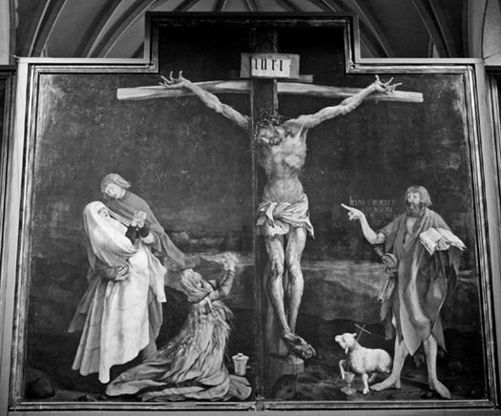
Isenheim Altarpiece by Matthias Grünewald (Unterlinden Museum, Colmar, France). WORD ON FIRE
THE PATH OF NONVIOLENCE
I have spent a good deal of time interpreting the opening verses of the Sermon on the Mount, for it is most important to be clear on the priority of joy in the teaching of Jesus. However, the beatitudes are perhaps best thought of as a kind of overture to the entire sermon, as a preparation for what is in fact the rhetorical and spiritual highpoint of Jesus’s programmatic speech, namely, the teaching on nonviolence and loving one’s enemies. In words that still take our breath away, Jesus says, “You have heard that it was said, ‘You shall love your neighbor and hate your enemy.’ But I say to you, love your enemies and pray for those who persecute you” (Mt 5:43–44). In order to understand this radical teaching, we have to be clear on what Jesus means by “love” (agape in Matthew’s Greek). Love is not a sentiment or feeling, not merely a tribal loyalty or family devotion. Love is actively willing the good of the other as other. Often we are good or kind or just to others so that they might be good, kind, or just to us in return. But this is indirect egotism, not love. And this is why loving one’s enemies is the surest test of love. If I am good to someone who is sure to repay me, then I might simply be engaging in an act of disguised or implicit self-interest. But if I am generous to someone who is my enemy, who is not the least bit interested in responding to me in kind, then I can be sure that I have truly willed his good and not my own. And this is why Jesus says, “For if you love those who love you, what recompense will you have? … And if you greet your brothers only, what is unusual about that? Do not the pagans do the same?” (Mt 5:46–47). Jesus wants his followers to rise above the imperfect forms of benevolence that obtain among the general run of human beings and to aspire to love the way that God loves: “for he makes his sun rise on the bad and the good, and causes rain to fall on the just and the unjust” (Mt 5:45). God loves those who love him and those who hate him; he loves his friends and his enemies; he gives good things to those who deserve them and also to those who don’t deserve them. If we are truly free from our attachments, especially from the attachment to approval, then we can become “sons and daughters” of this God and hence conduits of his peculiar grace. We will explore what this looks like concretely when we look, later, at the saints.
The already radical teaching on loving one’s enemies becomes even more intensely focused as Jesus turns his attention to the practice of nonviolence. Giving voice to the common consensus among law-abiding Jews, Jesus declares, “You have heard that it was said, ‘An eye for an eye and a tooth for a tooth.’ But I say to you, offer no resistance to one who is evil. When someone strikes you on [your] right cheek, turn the other one to him as well. If anyone wants to go to law with you over your tunic, hand him your cloak as well” (Mt 5:38–40). It is most important not to overlook the fact that this was, for its time, quite an enlightened, compassionate rule, for many individuals and nations would have felt justified in answering a violent affront with a devastating and disproportionate counterviolence. The seemingly brutal “eye for an eye” rule was in fact an attempt to delimit the retaliatory instinct. But, as we can see, Jesus is uneasy even with this relatively benign recommendation. I fully realize that Jesus’s instruction can sound like simple acquiescence to the power of violence, but we have to probe further. There are two classical responses to evil: fight or flight. When confronted with injustice or violence, we can answer in kind—and sometimes in our sinful world that is all that we can reasonably do. But as every playground bully and every geopolitical aggressor knows, this usually leads to an act of counterviolence, and then still another retaliation until the opponents are locked in an endless round of fighting. Gandhi expressed it this way: “an eye for an eye makes the whole world blind.” The other typical responses to aggression are running away or submitting—and sometimes, given our finite, sinful situation, that is all we can do. But, finally, we all know that ceding to violence tends only to justify the aggressor and encourage even more injustice. And therefore it appears as though, in regard to solving the problem of violence, we are locked in a no-win situation, compelled to oscillate back and forth between two deeply unsatisfactory strategies.
In his instruction on nonviolence Jesus is giving us a way out, and we will grasp this if we attend carefully to the famous example he uses: “To the person who strikes you on one cheek, offer the other one as well” (Lk 6:29). In the society of the time, one would never have used one’s left hand for any form of social interaction, since it was considered unclean. Thus, if someone strikes you on the right cheek, he is hitting you with the back of his hand, and this was the manner in which one would strike a slave or a child or a social inferior. In the face of this kind of violence, Jesus is recommending neither fighting back nor fleeing, but rather standing one’s ground. To turn the other cheek is to prevent him from hitting you the same way again. It is not to run or to acquiesce, but rather to signal to the aggressor that you refuse to accept the set of assumptions that have made his aggression possible. It is to show that you are occupying a different moral space. It is also, consequently, a manner of mirroring back to the violent person the deep injustice of what he is doing. The great promise of this approach is that it might not only stop the violence but also transform the perpetrator of it.
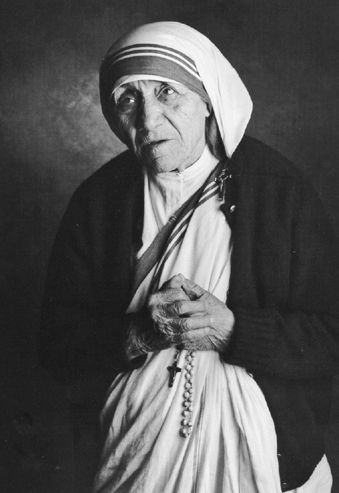
Blessed Teresa of Calcutta, 1987. MICHAEL COLLOPY
Some contemporary examples might illumine these dynamics more clearly. A story is told of Mother Teresa, the saint of the Calcutta slums. She went with a small child to a local baker and begged some bread for the hungry lad. The baker spat full in Mother Teresa’s face. Undaunted, she calmly replied, “Thank you for that gift to me. Do you have anything for the child?” Desmond Tutu, when he was a young priest in Johannesburg, was making his way along a wooden sidewalk, raised above the muddy street. He came to a narrow section of the sidewalk and was met by a white man coming from the other direction. The man said to Tutu: “Get off the sidewalk; I don’t make way for gorillas.” Tutu stepped aside, gestured broadly, and responded, “I do!” The third example I offer is by far the most powerful, at least if we measure power in terms of practical consequences. On June 2, 1979, Pope John Paul II came to Victory Square in the heart of Warsaw and celebrated Mass in the presence of hundreds of thousands of people and the entire Polish Communist government. During his homily the pope spoke of God, of freedom, and of human rights—all topics frowned upon by the Communist regime. As the pope preached, the people began to chant, “We want God; we want God; we want God.” The pope continued, and the chant went on, “We want God; we want God,” and did not stop for an astonishing fifteen minutes. It is said that during this demonstration of the people’s will, John Paul turned toward the Polish government officials and gestured, as if to say, “Do you hear?” Prescient commentators of the time, including Zbigniew Brzezinski, President Carter’s national security advisor, saw that Communism, at least in Poland, was, from that moment, moribund. In point of fact, that government did fall and a few years later the entire Soviet Communist empire disintegrated with barely a shot fired. If someone had laid out that scenario to me when I was coming of age in the 1970s, I would never have believed it. In all three cases, an offended person responded, neither with counterviolence nor with flight, but rather with a provocative gesture meant to draw the aggressor into a new spiritual consciousness. And certainly in the case of John Paul and his Polish people, this move unleashed extraordinary transformative energy.
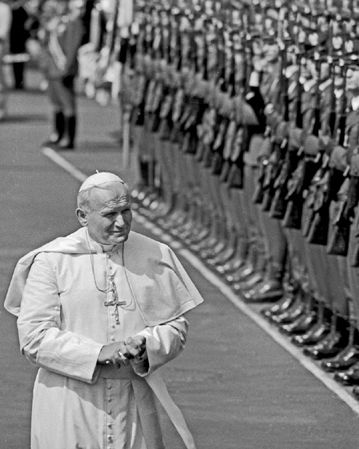
Pope John Paul II’s Pilgrimage to Poland, June 2–10, 1979. EAST NEWS/FOT. LESEZK LOZYNSKI
THE PRODIGAL SON
So far we have been considering the teaching of Jesus as it is articulated in the Sermon on the Mount. But we would be greatly remiss if we did not attend to the instruction that emerges from those startling, funny, off-putting, and strangely enlightening stories that Jesus loved to tell. I’m speaking, of course, about the parables. There are dozens of such stories sprinkled throughout the Gospels, but since space permits us to look at only one, I would like to examine what most think the greatest, the story of the father and his two sons, better known as the parable of the prodigal son. The story is about the nature of God and the manner in which we should properly relate to God, but since it is a parable, it does its work by turning our ordinary conception of the spiritual world upside down.
Jesus begins by telling us of a man and his two sons. The younger of the two approached his father with a request that was breathtaking in its rudeness and presumption: “Father, give me the share of your estate that should come to me” (Lk 15:12). Because one does not receive an inheritance before one’s father has passed away, what the child was saying to his father was, essentially, “I can’t wait for you to die!” And he was asking, with a double emphasis, for something to have as his own: “give me the share of theproperty that will belong to me.” If we picture ourselves acting in this way in relation to God, we have a problem. The God whom Jesus consistently proclaimed is, as we have seen, a God of tender mercy and superabundantly generous love, the one whose very nature is to give. And the right relation to this God of grace is to receive what is freely offered and then to give it away as a grace to others, thereby allowing more of the divine life to flow into oneself. The younger son has all of this backward, since he is both insulting his father’s generosity and trying to keep as a possession what can only be received as a gift and only “kept” by being given away.
Having taken his inheritance, the son wanders off into what is usually translated as “a distant country,” but the original Greek (chora makra) is instructive, for it means, literally, “the big emptiness.” Cut off from the source of grace, clinging desperately to what we think we are owed, we necessarily lose the little that we have. In very short order, the prodigal son finds himself destitute, starving, and alone, in fact so desperate that he hires himself out to keep and feed the pigs, a task of unsurpassable indignity for a Jew. Coming to his senses at last, the young man reasons, “How many of my father’s hired workers have more than enough food to eat, but here am I, dying from hunger” (Lk 15:17). He resolves to return home and confess his sin to his father. What we are meant to grasp is that closeness to the One Who Gives leads to sufficiency and even abundance, for the infinite life of God never runs out. As the son nears home, the father sees him from a long way off (he had obviously been looking for him) and then, throwing caution and respectability to the winds, the father comes running out to meet him. This detail would have caught the particular attention of Jesus’s listeners, since it would have been considered unconscionably unseemly for an older man, a patriarch, to run to anyone. People were expected to present themselves to him. The father embraces his son and orders his servants to “put a ring on his finger,” a kind of ring of marriage, symbolizing their restored union, and shoes on his feet (in order to restore him to dignity). When the son commences his carefully rehearsed speech of confession, the father cuts him off and declares a general celebration, because “this son of mine was dead, and has come to life again; he was lost, and has been found” (Lk 15:23). This is Jesus’s brilliant and deeply moving portrait of his heavenly Father, who does not play games of calculation and recompense, but “makes his sun rise on the bad and the good” (Mt 5:45), the Father who doesn’t know how to do anything but love.
Meanwhile the older brother is “in the field,” which is to say, in his own kind of exile. Though he has remained relatively close to his father in a physical sense, we promptly see how far he is psychologically and spiritually from him. This son hears the sounds of celebration and, discovering that it is a feast for his long-lost brother, he smolders with resentment and refuses to come in. Never easily put off, his father moves to meet him, as he had moved to greet his other son. But the older son refuses the entreaties of his father: “Look,” he says, “all these years I served you and not once did I disobey your orders; yet you never gave me even a young goat to feast on with my friends. But when your son returns who swallowed up your property with prostitutes, for him you slaughter the fatted calf” (Lk 15:29–30). The older son’s language gives him away as surely as his brother’s language had betrayed him. For all these years this son has been “working like a slave” for his father and “obeying all of his commands.” There is nothing of giving and receiving, nothing of the joy of reciprocal love, in that language. It is thoroughly marked by mercantile calculation. The father tries to lure him back into the circle of celebration with words that are among the most important in the New Testament: “My son, you are here with me always; everything I have is yours” (Lk 15:31). I don’t know a pithier description of how God relates to us anywhere in the spiritual literature of the world. We are always with God, since God is the very ground of our being, closer to us than we are to ourselves. We could not exist even for a moment without the loving press of God. And God gives all that he has to us. His whole being is for giving. Both sons, in different ways, fall out of relationship with that divine manner of existence and hence fall into deep sadness. When, on the contrary, we enter with abandon into the loop of grace—giving away in love what was given to us through love—then the celebration begins.
MATTHEW 25
Once a rabbi inquired of Jesus which of the many laws (there were well over six hundred) that governed Jewish life was the most important. With disarming simplicity and directness Jesus responded: “You shall love the Lord, your God, with all your heart, with all your soul, and with all your mind. This is the greatest and the first commandment. The second is like it: You shall love your neighbor as yourself.” The mutuality of these two loves is implicit in the entire teaching of Jesus. In the next chapter we shall see in more metaphysical detail why this is the case, but for now suffice it to say that the absolute love for God is not in competition with a radical commitment to love our fellow human beings, precisely because God is not one being among many, but the very ground of the existence of the finite world. Thomas Aquinas would state it this way: to love God is to love, necessarily, whatever participates in God, and this is to say the entire world. In his magnificent first letter Saint John expresses the same idea as follows: “If anyone says, ‘I love God,’ but hates his brother, he is a liar; for whoever does not love a brother whom he has seen cannot love God whom he has not seen” (1 Jn 4:20).
Perhaps the most powerful evocation of this principle in the teaching of Jesus is the haunting parable of the sheep and the goats contained in chapter 25 of Matthew’s Gospel. Jesus tells the crowd that when the Son of Man comes in his glory to judge the living and the dead “he will separate them one from another, as a shepherd separates the sheep from the goats” (Mt 25:31–32). To those on his right, he will say, “Come, you who are blessed by my Father. Inherit the kingdom prepared for you from the foundation of the world. For I was hungry and you gave me food, I was thirsty and you gave me drink, a stranger and you welcomed me, naked and you clothed me, ill and you cared for me, in prison and you visited me” (Mt 25:34–36). In their puzzlement, the righteous will ask when they performed all of these acts of love for the Lord, and he will reply, “Amen, I say to you, whatever you did for one of these least brothers of mine, you did for me” (Mt 25:40). Then comes the reversal. To those on his left, the Lord will say, “Depart from me, you accursed, into the eternal fire prepared for the devil and his angels. For I was hungry and you gave me no food, I was thirsty and you gave me no drink, a stranger and you gave me no welcome, naked and you gave me no clothing, ill and in prison, and you did not care for me” (Mt 25:41–43). Puzzled, the people will wonder when they neglected the Lord so thoroughly. Here comes the answer: “Amen, I say to you, what you did not do for one of these least ones, you did not do for me” (Mt 25:45). To love Christ is to love the ones whom Christ loves. The very drama of the parable is intended to stir us out of any complacency and beguile us out of any confusion on this score.
A man who understood the theology and ethics of Matthew 25 in his bones was Peter Maurin, the cofounder of the Catholic Worker Movement. Maurin was born in France in 1877, one of twenty-three children. In the course of his early education, which was supervised by the Christian Brothers, he became deeply inspired by the example of Saint Francis of Assisi. In 1909, when the French government turned aggressively against the church, Peter left his native country and settled in Canada, where for almost twenty years he lived a radical sort of Franciscan life, embracing poverty out of love for the Gospel, working as a simple laborer during the day and sleeping in skid-row shelters at night. During those vagabond years, he was struggling to develop a coherent Catholic socialphilosophy, a theory of economics and politics thoroughly informed by Matthew 25. He knew that the church had codified that section of Matthew as “the corporal and spiritual works of mercy,” among which were feeding the hungry, clothing the naked, visiting the imprisoned, burying the dead, counseling the doubtful, and praying for the living and the dead. He wondered what society would look like if those ideals were the foundation of the political and social order. He also read with great care the social teaching of the church, especially as articulated in Pope Leo XIII’s Rerum novarum of 1891 and Pope Pius XI’s Quadragesimo anno of 1931. In Pope Leo’s text Maurin found the line, “once the demands of necessity and propriety have been met, the rest that one owns belongs to the poor,” and he discovered a principle that the pope had borrowed from Thomas Aquinas, namely, that while the ownership of private property is allowed, the use of private property should always be for the common good. In Pope Pius’s encyclical Maurin discovered what has been characterized as the structuring element of all of Catholic social teaching: the principle of subsidiarity, which stipulates that in matters political and economic there ought always to be a preferential option for the most local level of authority and operation. The unambiguous application of this principle, Maurin saw, would prevent individuals and communities from abdicating their direct responsibility for practicing the corporal works of mercy. He wanted to build a society in which, in his words, “it would be easier for men to be good.”
Maurin recognized Matthew 25 as “dynamite,” from the Greek dynamus (power), a favorite word of Saint Paul, by the way. But Maurin worried that “we have taken the dynamite of the church, placed it in hermetically sealed containers and sat on the lids.” We have tended, in other words, to see the Gospel commands as a matter of private spirituality and not as society-transforming power. It is time, he concluded, “to blow up the dynamite of the church!” As a nonnative speaker of English, he was sensitive to peculiar turns of phrase that Anglophones would take for granted. He delighted in the term “go-getter,” but he wanted at the same time to undermine it: “We should turn a nation of go-getters into a nation of go-givers!”
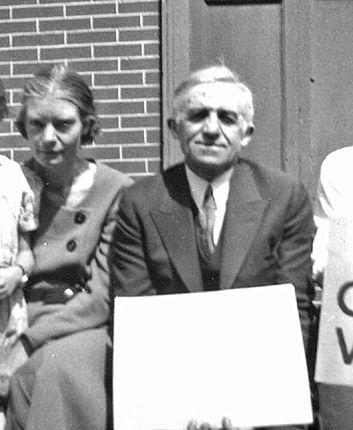
Dorothy Day and Peter Maurin. MARQUETTE UNIVERSITY ARCHIVES
In 1932, just as the Great Depression was getting under way, Peter Maurin arrived in New York City. There he met a young social activist and spiritual seeker who had recently converted to Catholicism. Her name was Dorothy Day. Dorothy had been a radical and a friend to some of the leaders in the cultural and political avant-garde of the 1920s, including the playwright Eugene O’Neill and the political agitator John Reed. But she had become fascinated with the Catholic Church, especially after the birth of her first child, when she said that she felt a gratitude so great that it corresponded to nothing in this world. When she met Peter Maurin she was looking for a way to combine her radical political commitment with her newfound Catholic faith. The vagabond philosopher was the answer to her prayers. When they met, Peter spoke, uninterrupted, for seven hours! Despite this overwhelming loquaciousness, Dorothy was entranced by Peter’s vision of a renewal of American society and his recommendation that the revolution should start with the founding of a newspaper that would present Catholic social teaching, and the establishment of “houses of hospitality” where the poor would be welcomed and where the corporal and spiritual works of mercy would be practiced. On May 1, 1933, Dorothy Day went to Washington Square Park in Greenwich Village and distributed the first edition of the Catholic Worker newspaper, selling it for one penny a copy (still the price today). Not long afterward she and Maurin set up the first Catholic Worker House of Hospitality on the Lower East Side of Manhattan and commenced to take care of the poor. Today there are such houses all over the country and indeed around the world. It is most important to see that neither of these figures could be blandly described as a “social worker.” Throughout their lives they attended Mass, assisted at Benediction, participated in retreats, prayed the Rosary, and so forth, for they saw in their radical devotion to the poor an inescapable correlation to their even more radical love of Christ.
Someone who operated very much in the spirit of Dorothy Day was a figure to whom we have already alluded and whom we will consider in detail later in the book, Mother Teresa of Calcutta. Much of Mother’s day was taken up with prayer, meditation, Mass, Eucharistic Adoration, and the Rosary, but the rest of her time, as we well know, was spent doing the grittiest work among the poorest of the poor, practicing the corporal and spiritual works of mercy, blowing up the dynamite of the church. Father Paul Murray, the Irish Dominican spiritual writer and sometime advisor to Mother Teresa, relates the following story. He was one day in deep conversation with Mother, searching out the sources of her spirituality and mission. At the end of their long talk she asked him to spread his hand out on the table and, touching his fingers one by one as she spoke, said, “You did it to me.”

Dorothy Day, 1934. MARQUETTE UNIVERSITY ARCHIVES
GO BEYOND THE MIND YOU HAVE
In his inaugural speech, as reported in the Gospel of Mark, Jesus announced the arrival of the Kingdom of God and thereupon he immediately called people to change: “Repent, and believe in the gospel” (Mk 1:15). The word that we typically render as “repent” ismetanoiete, a term that is based on the two Greek words meta (beyond) and nous (mind). With the inbreaking of the Kingdom of God, we must change our attitude, our way of thinking, our perspective on things, the manner in which we see. We have to see the world differently and in light of that new vision; we have to change the way we act. Once we envision our own existence—and indeed the being of the entire universe—as the gift of a gracious God, we gladly resolve to give our lives away as a gift in love. And when we do that, we find ourselves increased thirty-, sixty-, and a hundredfold, the divine life continuing to flood into us. Once we see that God is love, we are no longer afraid to risk the path of love. The teaching of Jesus is all about this new vision and this summons to change.