
Chapter 3
After many years of exile from the courts of Egypt where he had been raised, a Hebrew man named Moses, while tending the flock of his father-in-law on the slopes of Mount Sinai, saw an extraordinary sight: a bush that was on fire but was not being consumed. He resolved to take a closer look. As he approached, he heard a voice: “Moses! Moses! … Come no nearer! Remove the sandals from your feet, for the place where you stand is holy ground” (Ex 3:5). Then the speaker identified himself as “the God of your father … the God of Abraham, the God of Isaac, the God of Jacob” (Ex 3:6), and he gave Moses a mission to liberate his people enslaved in Egypt. When Moses asked for the name of this mysterious speaker, he received the following answer: “I am who am” (Ex 3:14). Moses was asking a reasonable enough question. He was wondering which of the many gods—deities of the river, the mountain, the various nations—this was. He was seeking to define and specify the nature of this particular heavenly power. But the answer he received frustrated him, for the divine speaker was implying that he was not one god among many, not this deity rather than that, not a reality that could, even in principle, be captured or delimited by a name. In a certain sense, God’s response amounted to the undermining of the very type of question Moses posed. His name was simply “to be,” and therefore he could never be mastered. The ancient Israelites honored this essential mysteriousness of God by designating him with the unpronounceable name of YHWH.
Following the prompting of this conversation between Moses and God, the mainstream of the Catholic theological tradition has tended not to refer to God as a being, however supreme, among many. Thomas Aquinas, arguably the greatest theologian in the Catholic tradition, rarely designates God as ens summum (the highest being); rather he prefers the names ipsum esse (to be itself) or qui est (the one who is). In fact, Aquinas goes so far as to say that God cannot be defined or situated within any genus, even the genus of “being.” This means that it is wrong to say that trees, planets, automobiles, computers, and God—despite the obvious differences among them—have at least in common their status as beings. Aquinas expresses the difference that obtains between God and creatures through the technical language of essence and existence. In everything that is not God there is a real distinction between essence (what the thing is) and existence (that the thing is); but in God no such distinction holds, for God’s act of existence is not received, delimited, or defined by anything extraneous to itself. A human being is the act of existence poured, as it were, into the receptacle of humanity, and a podium is the act of existence poured into the form of podium-ness, but God’s act of existence is not poured into any receiving element. To be God, therefore, is to be to be.
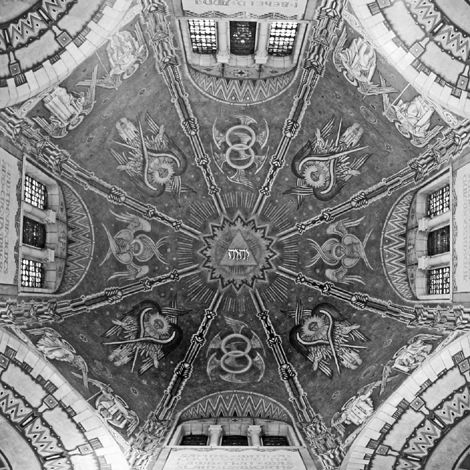
Saint Joseph Cathedral, detail, Wheeling, West Virginia. DENIS R. MCNAMARA
Saint Anselm of Canterbury, one of the greatest of the early medieval theologians, described God as “that than which nothing greater can be thought.” At first blush this seems straightforward enough: God is the highest conceivable thing. But the longer one meditates on Anselm’s description, the stranger it becomes. If God were simply the supreme being—the biggest reality among many—then God plus the world would be greater than God alone. But in that case he would not be that than which nothing greater can be thought. Zeus, for example, was, in ancient mythology, the supreme deity, but clearly Zeus plus the other gods, or Zeus plus the world of nature, would be greater than Zeus alone. Thus the God whom Anselm is describing is not like this at all. Though it is a very high paradox, the God whom Anselm describes added to the world as we know it is not greater than God alone.
This means that the true God exceeds all of our concepts, all of our language, all of our loftiest ideas. God (YHWH) is essentially mysterious, a term, by the way, derived from the Greek muein (to shut one’s mouth). How often the prophets and mystics of the Old Testament rail against idolatry, which is nothing other than reducing the true God to some creaturely object that we can know and hence try to control. The twentieth-century theologian Karl Rahner commented that “God” is the last sound we should make before falling silent, and Saint Augustine, long ago, said, “si comprehendis, non est Deus” (if you understand, that isn’t God). All of this formal theologizing is but commentary on that elusive and confounding voice from the burning bush: “I am who am.”
ARGUMENTS FOR GOD’S EXISTENCE
I have firmly fended off the tendency to turn God into an idol, but have I left us thereby in an intellectual lurch, doomed simply to remain silent about God? If God cannot be in any sense defined, how do we explain the plethora of theological books and arguments? After all, the same Thomas Aquinas who said that God cannot be placed in any genus also wrote millions of words about God. Chapter 33 of Exodus gives us a clue to the resolution of this dilemma. Moses passionately asks God to reveal his glory to him, and Yahweh acquiesces. But the Lord specifies, “I will make all my beauty pass before you … But my face you cannot see, for no man sees me and still lives” (Ex 33:19–20). God then tells Moses that while the divine glory passes by, God will place his servant in the cleft of a rock and cover Moses’s eyes. “Then I will remove my hand, so that you may see my back; but my face is not to be seen” (Ex 33:22–23). God can indeed be seen in this life, but only indirectly, through his creatures and effects. We can understand him to a degree, but only obliquely, glimpsing him, as it were, out of the corners of our eyes. We see his “back” as it is disclosed in the beauty, the intelligibility, and the contingency of the world that he has made.
Santa Sabina, Rome. WORD ON FIRE
Following this principle of indirection, Thomas Aquinas formulated five arguments for God’s existence, each one of which begins from some feature of the created order. I will develop here the one that I consider the most elemental, the demonstration that commences with the contingency of the world. Though the term is technically philosophical, “contingency” actually names something with which we are all immediately familiar: the fact that things come into being and pass out of being. Consider a majestic summer cloud that billows up and then fades away in the course of a lazy August afternoon, coming into existence and then evanescing. Now think of all of the plants and flowers that have grown up and subsequently withered away, and then of all the animals that have come into being, roamed the face of the earth, and then faded into dust. And ponder the numberless human beings who have come and gone, confirming the Psalmist’s intuition that “our years end like a sigh” (Ps 90:9). Even those things that seem most permanent—mountain ranges, the continents themselves, the oceans—have in fact emerged and will in fact fade. Indeed, if a time-lapse camera could record the entire life span of the Rocky Mountains, from the moment they began to emerge to the moment when they finally wear away, and if we could play that film at high speed, those mountains would look for all the world like that summer cloud.
The contingency of earthly things is the starting point of Aquinas’s proof, for it indicates something of great moment, namely, that such things do not contain within themselves the reason for their own existence. If they did, they would exist, simply and absolutely; they would not come and go so fleetingly. Therefore, in regard to contingent things, we have to look outside of them, to an extrinsic cause, or set of causes, in order to explain their existence. So let’s go back to that summer cloud. Instinctually, we know that it doesn’t exist through its own essence, and we therefore look for explanations. We say that it is caused by the moisture in the atmosphere, by the temperature, by the intensity of the winds, and so on, and as far as it goes, that explanation is adequate. But as any meteorologist will tell us, those factors are altogether contingent, coming into being and passing out of being. Thus we go a step further and say that these factors in turn are caused by the jet stream, which is grounded in the movement of the planet. But a moment’s reflection reveals that the jet stream comes and goes, ebbs and flows, and that the earth itself is contingent, having emerged into existence four billion years ago and being destined one day to be incinerated by the expanding sun. And so we go further, appealing to the solar system and events within the galaxy and finally perhaps to the very structures inherent in the universe. But contemporary astrophysics has disclosed to us the fundamental contingency of all of those realities, and indeed of the universe itself, which came into existence at the Big Bang some thirteen billion years ago. In our attempt to explain a contingent reality—that evanescent summer cloud—we have appealed simply to a whole series of similarly contingent realities, each one of which requires a further explanation. Thomas Aquinas argues that if we are to avoid an infinite regress of contingent causes, which finally explain nothing at all, we must come finally to some “necessary” reality, something that exists simply through the power of its own essence. This, he concludes, is what people mean when they use the word “God.” With Aquinas’s demonstration in mind, reconsider that strange answer God gives to Moses’s question: “I am who am.” The biblical God is not one contingent reality among many; he is that whose very nature it is to exist, that power through which and because of which all other things have being.
Some contemporary theologians have translated Aquinas’s abstract metaphysical language into more experiential language. The Protestant theologian Paul Tillich said that “finitude in awareness is anxiety.” He means that when we know in our bones how contingent we are, we become afraid. We exist in time, and this means that we are moving, ineluctably, toward death; we have been “thrown” into being, and this means that one day we will be thrown out of being; and this state of affairs produces fear and trembling. In the grip of this anxiety, Tillich argues, we tend to thrash about, looking for something to reassure us, searching for some firm ground on which to stand. We seek to alleviate our fears through the piling up of pleasure, wealth, power, or honor, but we discover, soon enough, that all of these worldly realities are as contingent as we are and hence cannot finally soothe us. It is at this point that the scriptural word “My soul rests in God alone” (Ps 62:1) is heard in its deepest resonance. Our fear—born of contingency—will be assuaged only by that which is not contingent. Our shaken and fragile existence will be stabilized only when placed in relation to the eternal and necessary existence of God. Tillich is, in many ways, a contemporary disciple of Saint Augustine, who said, “Lord, you have made us for yourself, and our hearts are restless till they rest in Thee.”
In 1968 a young theology professor at the University of Tübingen formulated a neat argument for God’s existence that owed a good deal to Thomas Aquinas but that also drew on more contemporary sources. The theologian’s name was Joseph Ratzinger, now Pope Benedict XVI. Ratzinger commences with the observation that finite being, as we experience it, is marked, through and through, by intelligibility, that is to say, by a formal structure that makes it understandable to an inquiring mind. In point of fact, all of the sciences—physics, chemistry, psychology, astronomy, biology, and so forth—rest on the assumption that at all levels, microscopic and macrocosmic, being can be known. The same principle was acknowledged in ancient times by Pythagoras, who said that all existing things correspond to a numeric value, and in medieval times by the scholastic philosophers who formulated the dictum omne ens est scibile (all being is knowable).
Ratzinger argues that the only finally satisfying explanation for this universal objective intelligibility is a great Intelligence who has thought the universe into being. Our language provides an intriguing clue in this regard, for we speak of our acts of knowledge as moments of “recognition,” literally a re-cognition, a thinking again what has already been thought. Ratzinger cites Einstein in support of this connection: “in the laws of nature, a mind so superior is revealed that in comparison, our minds are as something worthless.” The prologue to the Gospel of John states, “In the beginning was the Word,” and specifies that all things came to be through this divine Logos, implying thereby that the being of the universe is not dumbly there, but rather intelligently there, imbued by a creative mind with intelligible structure. The argument presented by Joseph Ratzinger is but a specification of that great revelation. One of the particular strengths of this argument is that it shows the deep compatibility between religion and science, two disciplines that so often today are seen as implacable enemies. Ratzinger shows that the physical sciences rest upon the finally mystical intuition that reality has been thought into existence and hence can be known. I say it is mystical because it cannot itself be the product of empirical or experimental investigation, but is instead the very condition for the possibility of analyzing and experimenting in the first place. This is why many theorists have speculated that the emergence of the modern sciences in the context of a Christian intellectual milieu, in which the doctrine of creation through the power of an intelligent Creator is affirmed, is not the least bit accidental.
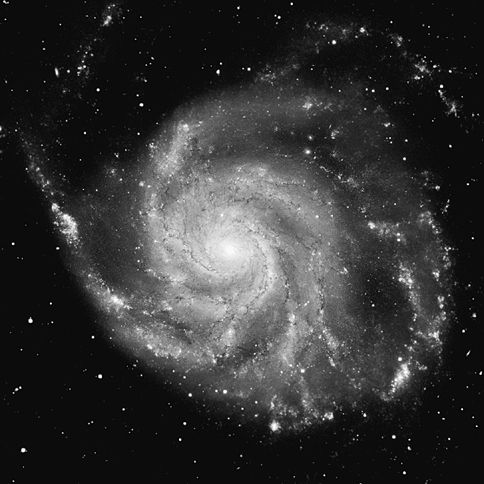
Hubble image of M101. NASA, ESA, K. KUNTZ (JHU), F. BRESOLIN (UNIVERSITY OF HAWAII), J. TRAUGER (JET PROPULSION LAB), J. MOULD (NOAO), Y.-H. CHU (UNIVERSITY OF ILLINOIS, URBANA), AND STSCL
NAMING GOD
The God whom we have been describing—the sheer power of being itself, the ground of the world’s existence and intelligibility—must be characterized as both radically immanent and radically transcendent. Being itself, the One Who Is, cannot be a worldly object, for the world is made up exclusively of particular beings. The Russian cosmonaut who, upon soaring into the heavens, radioed back to earth the news that he had found no trace of God, was simply speaking nonsense. God is neither sequestered in any particular space nor discoverable among a collection of cosmic objects. This is why the prophet Isaiah, conveying the words of Yahweh, can say, “As high as the heavens are above the earth, so high are my ways above your ways and my thoughts above your thoughts” (Is 55:9). At the same time, Being himself, the One Who Is, works his way into every nook and cranny of finite existence, since he is the source of whatever exists in the cosmos. And thus the same Isaiah who spoke of God’s radical transcendence can convey these divine words: “Can a mother forget her infant, be without tenderness for the child of her womb? Even should she forget, I will never forget you. See, upon the palms of my hands I have written your name” (Is 49:15–16). And the Psalmist could, with amazement, say to God, “Lord, you have probed me, you know me: you know when I sit and stand … before a word is on my tongue, Lord, you know it all” (Ps 139:1–4). Saint Augustine catches this uniquely divine way of being when he says that God is simultaneously “intimior intimo meo et superior summon meo,” which might be rendered roughly as “closer to me than I am to myself and higher than anything I could possibly imagine.” To be in right relationship with God, therefore, is neither to grasp at him nor to hide from him (for both are finally impossible), but rather to surrender to him in love.
In light of this analysis, the story of Adam and Eve takes on a new resonance, for we discover in that richly symbolic narrative precisely this negative spiritual dynamic of attempting to manipulate Yahweh, and failing that, running from him. According to the author of the book of Genesis, God places our first parents in a garden and walks with them in easy fellowship. This expresses God’s desire that his human creatures be fully alive, realizing their powers and finding their joy precisely through their relationship with him. But at the prompting of the serpent, Adam and Eve eat of the tree of the knowledge of good and evil, whose fruit God had forbidden them to eat. This represents the temptation toward grasping at divinity, for the determination of good and evil is a prerogative of God and not a fit object of human choice. It is fascinating to attend to the reasoning of the serpent: “You certainly will not die! No, God knows well that the moment you eat of it your eyes will be opened and you will be like gods who know what is good and what is bad” (Gn 3:4–5). The serpent, later identified as the father of lies, convinces them that God is their rival and that he is, accordingly, trying to keep something from them. In fact, Being itself has nothing whatsoever to gain from creatures and hence is not in any sense in competition with them; what he wants is to prevent them from assuming an impossible and self-defeating spiritual attitude. When this grasping at God fails, as it must, Adam and Eve attempt the other classic sinner’s move: they hide from God, concealing themselves in the underbrush of Eden. God discovers them immediately, of course, for as the ground of being, he is inescapably intimate with all his creatures. Much of the subsequent scriptural narrative is the story of human beings repeating the errant moves of our first parents, grasping and hiding, trying to manipulate God or trying to run from him. Both tactics are impossible and hence morally, psychologically, and spiritually frustrating. God wants, throughout the Bible, to lure us out of these hopeless attitudes and into the stance of friendship.
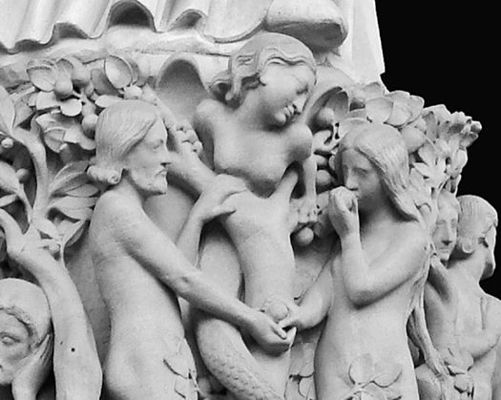
Adam and Eve, Notre Dame, Paris. DENIS R. MCNAMARA
The theological language of the tradition exists not simply to clarify our minds in regard to God but to order our spirits appropriately. Part of the genius of Catholic theology is that it uses a bevy of words to designate the transcendence of God and thus to hold off the grasping tendency, and it uses a bevy of words to designate the immanence of God and thus to hold off the hiding tendency. Let us look first at some of the anti-grasping names of God. The great theologians speak of God’s infinity, and they mean thereby that God is not definable, not like any of the particular things in the world; similarly, they speak of God’s immensity, which simply means God’s immeasurability. They affirm that God has eternity, and by this they mean not that God endures endlessly but that God does not exist in time at all. Also they assert that God is immutable, which is to say he is not characterized by the changeability that marks creatures. It is most important to note that there is really very little positive content to these attributions. I can affirm that God is indefinable, but that just means that he’s unlike anything in my experience; I can affirm that God is outside of time, but that means I have no idea what he’s like positively, for everything in my experience is temporal; I can affirm that God doesn’t change, but if I try to imagine what that is like, I’m tripped up, for I’ve never experienced anything that is not capable of change. I would like to dwell just a moment on this last example, for it has been the source of quite a bit of controversy in recent years. Some thinkers objected to the claim that God is immutable on the grounds that this attribute would render him cold and unresponsive, so unlike the God described in the Bible. In point of fact, we can draw no such conclusion from the assertion of God’s immutability, since it simply tells us that God does not change in the creaturely manner, moving from potentiality to actuality. But it does not really tell us anything about the manner of the divine being in itself. All of the qualities that we have considered so far are in service of the anti-grasping principle. Thomas Aquinas observed that, in this life, we don’t really know what God is, only what God is not.
On the other hand, if we one-sidedly emphasize the transcendence of God, we can fall into the spiritual trap of hiding from God, joining Adam and Eve in the underbrush of the garden. Much of modern secularism, by the way, can be interpreted under this rubric: for the first time in history, a culture is developing in which indifference to God is normative. And so the theologians use another set of names to designate the unavoidable quality of God. They speak, for instance, of God’s omnipotence. By this they don’t mean that God is the strongest being around; they mean that God, as the very ground of existence, presses on all things with an unconditioned power. Similarly, they assert that God is omniscient. Again, this doesn’t mean so much that God is the smartest being in existence; it means that God knows the entirety of the universe into existence and hence is inescapably and personally present to every aspect of it. Whereas for us, existence precedes knowledge (we know things because they are), for God knowledge precedes existence (things are because he knows them). Theologians speak as well of God’s omnipresence, but this should never be taken to mean that God is the vague “force” or “energy” described by devotees of the New Age. Instead it means that God transcends any particular space and hence can be construed as being present to every space. These sacred attributes hold off the tendency to avoid God by asserting one’s own power (he is more powerful), by retreating into privacy (he knows us better than we know ourselves), or by running away (there is no place that he is not).
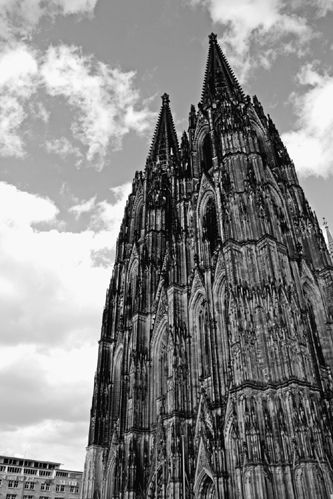
Cologne Cathedral, Germany. DENIS R. MCNAMARA
The Gothic cathedrals of the Middle Ages expressed in stone and glass this eloquent ambiguity in the assigning of attributes to God. I would draw your attention—to give just one example—to the mountainous cathedral that looms over the Rhine River in Cologne, Germany, and dominates, even today, the skyline of the city. Every line on the exterior of the building points dramatically upward; the logic of the structure compels the viewer’s gaze skyward; the sheer immensity of the structure makes it hard to take in. I can personally witness to the fact that vertigo sets in as one tries to comprehend its dimensions. All of this speaks of the transcendence, strangeness, and radical otherness of God. The building is telling us that whatever idea we have of God has to be abandoned as inadequate; the cathedral is summoning us always to look higher. But the same Cologne Cathedral, which speaks so compellingly of the divine transcendence, preaches just as convincingly the immanence of God. All over the surface of the structure—but especially around the portals—one spies plants, animals, trees, planets, the sun and moon, angels, devils, and saints—the whole panoply of creation, both natural and supernatural, vividly portrayed. All of these creatures have to do with God, and God has to do with all of them. “The heavens proclaim the glory of God,” as do the things that crawl upon the earth, and as do the unseen spirits. God is sacramentally represented in all the complexity of creation. The cathedral, in a word, is simultaneously telling us, in regard to God, “not here!” and “right here!” To grasp that tension is to have the most adequate understanding of the One Who Is.
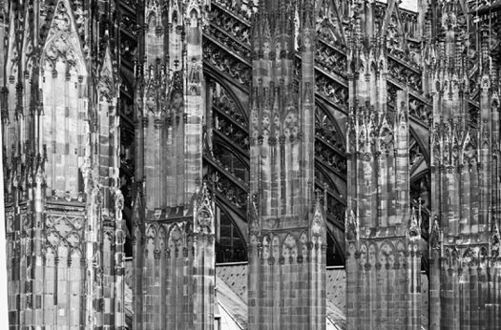
Cologne Cathedral, detail, Germany. DENIS R. MCNAMARA
THE PROVIDENT CREATOR
One of the most basic of biblical ideas is that God is the maker of all things. The opening lines of the book of Genesis speak, not so much of God’s nature, but of God’s creative action: “In the beginning, when God created the heavens and the earth …” (Gn 1:1). Now there is a puzzle in regard to this primordial action of God; namely, why did he do it? If God is God, which is to say, the perfect act of being itself, utterly happy in his own nature, why would he bother to make things at all? To answer this question is to move very close, spiritually speaking, to the heart of the matter. Precisely because God doesn’t need the world, the very existence of the world is a sign that it has been loved into being. We recall that to love is to will the good of the other as other. Since he has no needs in himself, all of God’s intention and activity in regard to what is other is therefore utterly for the sake of the other. The perfect God cannot be self-interested, and hence in regard to the universe he has made he can only be loving. Drawing on Plato, the ancient Christian theologian Dionysius the Areopagite said that since the good is diffusive of itself, the infinitely good God naturally and exuberantly expresses his goodness to the world. The fathers of the First Vatican Council echoed Dionysius in saying that God made the world not out of need but in order to “manifest his glory” and to share his life and perfection. What we see in the lives of the saints is an iconic representation of this completely generous divine manner of relating to the other.
If God is the sheer act of to be itself, then God’s creation must be ex nihilo, from nothing. To understand this idea, it might be helpful to propose a contrast. When an artist produces a sculpture, he begins with marble or clay and then shapes that substance into something aesthetically pleasing. When a chef makes a meal, she blends water, meats, vegetables, spices, and sauces into a palatable conglomeration. Both agents are making something from something; they are reordering in a creative manner a pre-existing substrate. But God, the very fullness of being itself, does not operate this way; he doesn’t shape some alien substance or matter into form; rather he brings whatever exists outside of himself into being in its entirety from nothing. Several important insights cluster around this truth. First, creatures do not so much have a relationship to God; they are a relationship to God. Nothing in a creature exists independently of, or prior to, God’s creative act, and hence no creature stands, as it were, over and against God, simply in a relationship to God. Instead every aspect of a creature’s being is already constituted by God’s creative will. This is why Meister Eckhart, the great medieval mystic, could say that the best metaphor for the spiritual life is not so much the climbing of a holy mountain in order to get to a distant God, but rather the “sinking into” God.
Second, all creatures are connected to one another by the deepest bonds precisely because every creature is coming forth, here and now, from God’s creative act. When I find my deepest center in God, I necessarily find your deepest center and that of every other creature, even of “brother sun and sister moon,” to use the language of Saint Francis.
Third, creation from nothing is a nonviolent act. In so much of the mythological tradition, the creation of the world takes place through a primal act of violence, one god defeating another, or a set of gods doing battle with their rivals. Often the physical universe is pictured as the remains of the conquered enemy. Even in the more refined philosophical accounts of Plato and Aristotle, the universe is formed through the imposition of form on recalcitrant matter. But there is none of this in the Christian conception. God does not wrestle a rival into submission, for he has no rival; nor does he intervene to shape matter according to his aggressive will, for there is no matter that confronts him. Rather, through a sheerly nonviolent, nonintrusive, non-interruptive act of speech, God gives rise to the whole of finite reality: “Let there be light, and there was light … Let the water under the sky be gathered into a single basin, so that the dry land may appear … Let the earth bring forth vegetation: every kind of plant that bears seed and every kind of fruit tree … And so it happened” (Gn 1:3, 9, 11). We can see now the deepest roots of Jesus’s ethic of nonviolent love articulated in the Sermon on the Mount. Though it seems ludicrous to our sinful minds, the recommendation to love one’s enemies and to resist evil through nonviolence is actually to dance in step with the most fundamental metaphysical rhythm of the world.
This God who continually creates the universe from nothing must also be described as provident. The Deist view—on display in both classical and modern times and especially prevalent today—is that God is the orderer of the universe, but only in a distant way, as the source of the laws and basic structures of the universe. But Christian theology has no truck with Deism. It stands, instead, with the book of Wisdom, which speaks of God’s power “stretching from end to end mightily and ordering all things sweetly” (Wis 8:1). God is not a celestial CEO, managing earthly affairs from an antiseptic distance; he holds the world in the palm of his hand, involving himself in things both great and small. Thomas Aquinas summed up this biblical perspective when he said that God’s providence “extends to particulars.” Now to give the Deists their due, all of this stress on the particularity of God’s providence does seem to pose a threat to the independence and integrity of the created order. If God is hovering fussily over the whole of reality in every detail, how could we speak, for instance, of freedom or chance? A full treatment of the thorniest of theological issues would require an entire book, but for our purposes I would draw the reader’s attention, once again, to the noncompetitive relationship that God has to the world. God’s creativity and providence are necessarily expressions of the divine love and hence of the “letting be” of the other. The providential God is not one great cause among many, interfering with the nexus of conditioned causes. We recall the language of the book of Wisdom, how “sweetly” God exercises his power, operating precisely through the realm of secondary causes. Perhaps I could illustrate this with a simple example. If asked, “How do you make a cherry pie,” one would say, presumably, “you bring together cherries, sugar, flour, water, fat, and the skill of the baker, and the heat of the oven.” Even the religious believer would not say, “You bring together cherries, sugar, flour, God, water, fat, and the skill of the baker, and the heat of the oven.” God is not one cause among many, but rather the reason there are cherries, flour, water, fat, the baker, and so on, at all. Hence, it is precisely through those causes and not in competition with them that the providential God works out his purposes.
THE PROBLEM OF EVIL
I fully realize that even those who have been following the logic of my argument so far with sympathy, even those who are predisposed to believe in God and his providence, balk when they consider the overwhelming presence of evil. To state the problem simply: if God really exists, how could there possibly be so much wickedness, corruption, and suffering in the world? In the nineteenth century, the British philosopher John Stuart Mill formulated the objection this way: if an omniscient, omnipotent, and omnibenevolent God exists, there would be no evil, for in his omniscience he would know about it, in his omnipotence he could do something about it, and in his omnibenevolence he would want to do something about it. Therefore if there is evil (and there surely is), then such a God does not exist. In the thirteenth century, Thomas Aquinas stated the dilemma even more pithily. If one of two contraries be infinite, Thomas argued, the other would be altogether destroyed; yet God is called the infinite good. Therefore if God exists there would be no evil. To make the force of these abstract observations felt, all we have to do is allow the specter of Hiroshima, the killing fields of Cambodia, the hundreds of thousands murdered in the Rwanda massacres, a child dying of leukemia, and the horrors of Auschwitz-Bierkenau to come before the mind’s eye. How can all of that suffering—which is, of course, only a tiny sampling of the full agony suffered by members the human race over time—ever be reconciled with the existence of a loving, providential God? These are extremely powerful arguments, and they constitute, to my mind, the only really serious challenges to the proposition that there is a God.

Auschwitz. WORD ON FIRE
There are three ways not so much to solve the problem as to “dissolve” it. The first is atheism: if there is no God, then the dilemma of evil simply disappears, and there is nothing to explain. The second is a mitigated theism, which says that God is not really God. Following the prompts of some popularizing theologians, many today say that God is indeed good and all-knowing, but he’s not all-powerful. Therefore, though he knows about our pain and deeply sympathizes with us over it, he cannot finally do much to stop it. And a third way of dissolving the issue is to argue that evil is not really evil, and this we find, for example, in the Buddhist assertion that suffering is an illusion born of our clinging egotism. All of these “dissolutions” are, in my judgment, too easy, for they don’t take with requisite seriousness the two horns of the dilemma: the existence of a God worthy of the name, and the objective presence of evil. We have to dig for a deeper answer.
To be sure, any “answer” that a theologian might offer to this most fundamental of existential questions will necessarily be inadequate, but I believe it is possible at least to gesture in the direction of a resolution. The first observation to make is that evil, strictly speaking, does not exist, since evil is always some sort of privation of the good, a lack of a perfection that ought to be present. Thus we speak of a cavity in a tooth, or a cancer that compromises the right functioning of an organ, or a twisting of the will as evil. Therefore it is inappropriate ever to think of God as “causing” or “creating” evil or ever to imagine evil in the Manichaean manner as an opponent standing athwart God’s purposes. We must speak, instead, of God permitting or allowing certain evils to emerge. But this affirmation seems to postpone the question rather than to answer it. Why would God “allow” such deep corruption in his creation? The classical response, articulated by Augustine, Thomas Aquinas, and an army of their followers, is that God permits evil so as to bring about a greater good. To be sure, we can see this principle verified in many cases. Some great calamity—a grave illness, a failure in business, the loss of a loved one—results, over time, in a good that would never have come about except through and because of the calamity. As the popular adage has it: God can write straight with crooked lines. Yet in the presence of truly profound evil, doesn’t this explanation seem a tad facile?
The biblical authors both defend this classical argument and understand the hesitancy about it—and this becomes particularly obvious in the book of Job. We hear of Job, an utterly righteous man, who, in one fell swoop, loses everything that he holds dear: family, profession, wealth, and health. In the wake of the disaster, three of his friends sit in silent solidarity with him for seven days. But then they begin to theologize. Following the prompts of the biblical tradition, they try to convince Job that he must have sinned in some way so as to warrant such a harsh divine punishment. And, in accordance with the principle we’ve been defending, they speculate that God is permitting the terrible evil of Job’s suffering so as to bring about the greater good of his repentance. But Job knows (and we the readers know) that he is in fact innocent, and thus he rejects the speculations of his theologically minded friends and, with an unprecedented boldness, calls God himself into the dock, challenging the provident Creator to explain himself. Here Job speaks for every believer in God who has ever suffered unjustly.
In one of the most dramatic scenes in the Bible, God speaks out of the desert whirlwind. “Who is this that obscures divine plans with words of ignorance? Gird up your loins now, like a man; I will question you, and you tell me the answers!” (Job 38:2–3). God then proceeds to take Job on a tour of the cosmos, showing his human interlocutor mystery after mystery, wonder after wonder, anomaly after anomaly. “Where were you when I founded the earth? … Who determined its size; do you know? … And who shut within doors the sea, when it burst forth from the womb … Which is the way to the dwelling place of light, and where is the abode of darkness?” (Job 38:4–5, 8, 19). God’s oration closes with an evocation of two great beasts, Leviathan and Behemoth—perhaps a whale and a hippopotamus. With an artist’s delight, God describes the power and beauty of these animals. In reference to Leviathan, he says, “any hope of capturing it will be disappointed … no one is so fierce as to dare to stir it up. Who can stand before it” (Job 41:1–2); and in regard to Behemoth, he exults, “Behold the strength in his loins, and his vigor in the sinews of his belly … He came at the beginning of God’s ways” (Job 40:16, 19). God made these creatures just as surely as he made Job, and though Job has probably never in his life even considered Behemoth and Leviathan, they are as ingredient in the complex weave of God’s providence as is Job. The overall point of God’s speech seems to be this: the suffering of any one person must be seen within the context of the infinitely subtle working out of God’s purposes throughout the whole of space and time. In a universe of numberless individuals, events, and relations, certain goods can emerge only in balance with certain evils, or to state it perhaps a bit more precisely, good and evil, within this stunningly complicated milieu, are, to a degree, relative terms. As Thomas Aquinas put it, there would be no life in the lion were it not for the deaths of an inordinate number of other animals, and there would be no virtue of the martyr without the cruelty of the tyrant.
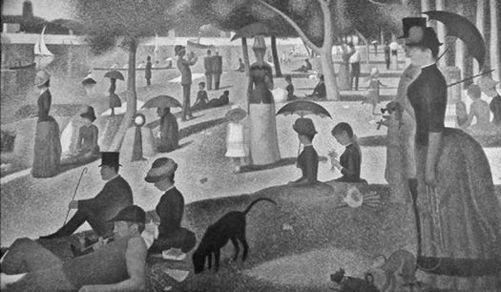
Sunday Afternoon on the Island of La Grande Jatte by Georges Seurat (Art Institute of Chicago). WORD ON FIRE
One of the most impressive paintings in the collection of the Art Institute of Chicago is Georges Seurat’s pointillist masterpiece Sunday Afternoon on the Island of La Grande Jatte. The picture is composed of millions of tiny points of color that Seurat applied to the canvas with long brushes while he sat on a high stool. If you look at the painting with your nosed pressed up against it, you see only a collection of meaningless blotches, but as you step back the points begin to blend together and figures, groups, and patterns emerge. Only when you view it from the far side of the room does the painting disclose itself as a gorgeously harmonic unity. God is like an artist, and his canvas is the whole of space and time. Most of us look at his masterpiece with our noses pressed up against it, seeing only a tiny swath, and wondering how these few points—some light and many dark—could possibly make sense. God’s speech to Job might be construed as an artist’s plea to view his work from the proper vantage point. I might propose another analogy along these lines, having to do with William James and his dog. In an essay written toward the end of his life, the great American philosopher told of his dog, who would typically enter his master’s office at the end of the workday to receive a pat on the head. The animal, James explained, would look around the cluttered room and see the thousands of books on the shelves, the many papers covering the desk, and the globe that rested in the corner. He would see them but understand them hardly at all. And if James made bold to expatiate on the meaning of these things—that the books were collections of symbols evocative of ideas, that the papers, by a similar semiotic system, conveyed intelligent messages, that the globe was a representation of the spherical planet that both master and dog inhabited—the animal would have looked at him with utter incomprehension. But then it occurred to James that we are in a similar relation to a higher mind. Is it possible that we, like the dog, see everything there is to see, but actually understand it in only the most superficial way? And is it the case that the higher intelligence could not, even in principle, begin to explain the deepest meaning of things to us, due to the limited capacity of our minds?
Still unsatisfied? Good. Though all of these images, perspectives, and insights are illuminating, none finally “solves” the problem of reconciling a loving God and a universe marked by great cruelty. For the Christian faith, the only adequate “resolution” of this dilemma is the one effected by God himself on the cross of Jesus Christ. On that cross, the darkness of the human condition met the fullness of the divine love and found itself transfigured into life. On that cross, God went to the limits of godforsakenness and made even death itself a place of hope. God, in his love, becomes the answer to the problem of evil.
THE TRINITY
Thus far almost everything I have said about God in this chapter could be echoed by a faithful Jew or Muslim, believers in the one God. So what is it, precisely, that makes the Christian doctrine of God distinctive? The answer is given every time we make the sign of the cross and invoke the three divine persons, the Father, the Son, and the Holy Spirit. We are signaling that God is one, but not monolithically so; rather in his unity he is a communion, a family of love.
Where does this doctrine come from? As is always the case with Christian teaching, we have to go back to Jesus. Jesus consistently referred to himself as one who had been sent by the Father; and in this regard he would seem little different from, say, Abraham or Moses or Isaiah. But as we have seen in the first chapter, there is something that sets Jesus apart from those figures, namely, that he spoke and acted in the very person of God. Therefore Jesus was sent by another whom he acknowledged as divine, yet he himself is divine also. The Father was clearly other than the Son he sent; nevertheless, the Son could say, “I and the Father are one” (Jn 10:30). And to make things even more complex, Jesus promised his disciples at the Last Supper that he and his Father would send an “advocate,” a Spirit who would lead the church into the fullness of Truth. It was this “breath” (pneuma) that blew through the church at the first Pentecost, sustained the early Christian community, and brings divinizing life to believers in Jesus: “no one can say, ‘Jesus is Lord,’ except by the holy Spirit” (1 Cor 12:3). Now, the first believers were all Jews, trained in the strict monotheism of Israel and holding passionately to the great Shema, the Jewish declaration of faith from the sixth chapter of the book of Deuteronomy: “Hear, O Israel! The Lord is our God, the Lord alone!” Yet they knew that the one God had revealed something new about himself in Jesus and the Holy Spirit. None of the pioneers of the Christian faith summed up this novelty more succinctly than did Saint John, who in his first letter said simply, “God is love.” He wasn’t defending the proposition that God has love, or that love is one of God’s attributes; he was saying that love names the very essence of God. And this means that God must be, in his own life, an interplay of lover (the Father), beloved (the Son), and shared love (the Holy Spirit).
What the Bible bequeathed to the great tradition was this tension, this dilemma: how to square the Shema with the claim that God is love. For the first several centuries of the church’s life, some of the greatest minds in both the east and the the west struggled to work out the right balance between the two. The discussion swung between the poles of tritheism (belief in three gods) and Monarchianism (the belief in the supreme unity of God), and no finally satisfying resolution was achieved until the fourth century when three brilliant theologians from Asia Minor—Basil, Gregory of Nazianzus, and Gregory of Nyssa—and one supreme genius from North Africa—Augustine of Hippo—brought their powers of reflection to bear on the matter. Within the confines of this short chapter, I have space to consider—however inadequately—only Augustine’s meditations.
Throughout the course of twenty years, during his intellectual prime, Augustine composed a text entitled De Trinitate (About the Trinity) in which he sought to clarify and explain the church’s doctrine of the one God in three persons. In the ninth book of that text Augustine lays out a remarkably illuminating analogy for the Trinity, which has proven over the centuries to be massively influential on other theologians. Taking his cue from the book of Genesis, Augustine speculates that, though all things reflect the Trinity to varying degrees, the best model of the Trinity would be the human person himself, the one made “in the image and likeness of God.” When we look within—and Augustine was one of the greatest masters of introspection—we find, he says, a mirror of the Trinity in the very dynamics of human consciousness. The ground of the intellect, the mysterious source from which all intellectual activity surges forth, Augustine called mens. It would be wrong to translate this simply as “mind,” for that reduces its meaning too drastically.Mens is closer to esprit in French or Geist in German, designating the full range of spiritual energy. Mens is capable of a doubling or mirroring activity by which it poses itself as an object for its own contemplation. This Augustine callsnotitia sui, or self-knowledge. Though this sounds rather abstract, we all acknowledge notitia sui whenever we say, “What was I thinking?” or whenever we engage in introspection under the guidance of a therapist or counselor, searching out our motives and bringing to consciousness our often unconscious impulses. And when mens comes to self-awareness through notitia sui, it falls in love. Again, we sense this whenever, through introspection or counseling, we come to a richer understanding of ourselves and experience, thereby, a deeper level of self-acceptance. What Augustine finds so intriguing about these dynamics is that though their components are separate from one another, though they can be clearly distinguished one from the other, they do not constitute a dividing of the mind into three. For example, when I say, “What was I thinking?” I’m certainly distinguishing mens from notitia sui, but I’m not falling into schizophrenia.
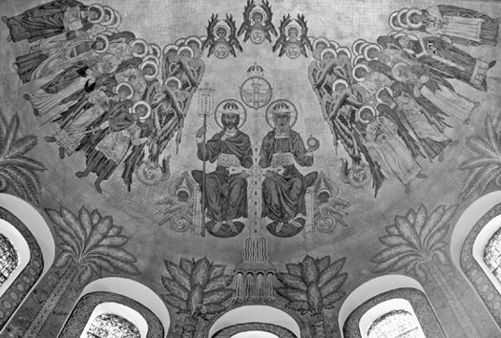
St. Monica–St. George Church, detail, Cincinnati. DENIS R. MCNAMARA
It was precisely this tensive ambiguity that makes the analogy so apt. The Father, Augustine claimed, is the mens of God, the dark, elemental ground of the divine life. The Father is capable of a perfect and utterly interior act of self-othering. The mirror or Word of the Father, his notitia sui, is the Son. When Father and Son gaze at each other, they breathe back and forth their mutual love, and this is the amor sui of God, or the Holy Spirit. Hence we have three dynamisms but not three Gods; we have a lover, a beloved, and a shared love, within the unity of one substance, not a one plus one plus one adding up to three, but a one times one times one, equaling one.
The one God of Israel—“I am who am”—is a play of subsistent relations—“God is love”—and thus we learn the deepest meaning of the verb “to be” is “to love.” It was the Son, the Father’s beloved, who became incarnate in Jesus, and it was the Holy Spirit, the love breathed back and forth between the Father and the Son, that came to dwell in the church. And the church’s mission, therefore, is to make real in the world precisely this love that God is.
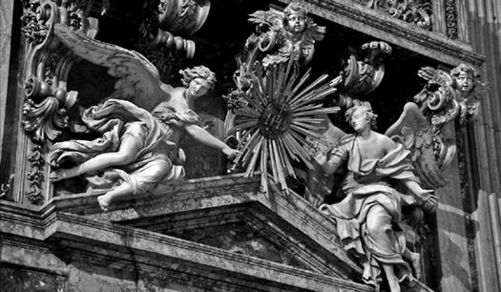
Church of the Gesù, detail, Rome. WORD ON FIRE