
Chapter 6
How strange that we believe in the church. In the Nicene Creed, Catholics profess their faith in the Father, the Son, and the Holy Spirit, the three divine persons, and that seems reasonable enough. But then they proceed to declare their belief in “one holy catholic and apostolic church.” Does this not amount to the conflation of Creator and creature? Is it not effectively blasphemous to announce one’s faith in a human institution? To answer these questions is to come to the heart of the Catholic understanding of the church, for Catholics hold that the church is not merely a human organization, simply a coming together of like-minded people, a community of purely worldly provenance and purpose. Rather, the church is a sacrament of Jesus and, as such, shares in the very being, life, and energy of Christ. According to the inexhaustibly rich metaphor proposed by Saint Paul, the church is the body of Jesus, an organism composed of interdependent cells, molecules, and organs. Christ is the head of a mystical body made up of everyone across space and time who has ever been grafted onto him through baptism. And lest we think that this organic understanding was a peculiar invention of Paul, call to mind the vivid language that Jesus himself used in order to express the relationship that obtains between himself and his followers: “I am the vine, you are branches (Jn 15:5); “remain in me” (Jn 15:4); “unless you eat the flesh of the Son of Man and drink his blood, you do not have life within you” (Jn 6:53). I could be such an admirer of Abraham Lincoln that I would be inspired to join the Abraham Lincoln society and regularly attend its meetings, but I would never be tempted to speak of eating Lincoln’s body and drinking his blood. I could admire the life and work of Mahatma Gandhi so enthusiastically that I might be moved to found a Gandhi society, but it would never occur to me to speak of being grafted onto Gandhi. But we Catholics say such radical things when we describe our relationship with Jesus.
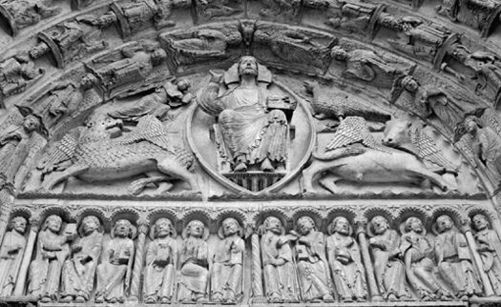
Chartres Cathedral, detail, France. WORD ON FIRE
Two great New Testament passages, which we have already considered in other contexts, come to mind here. The first is Jesus’s statement in chapter 25 of Matthew: “whatever you did for one of these least brothers of mine, you did for me.” The Lord does not say simply that if we feed the hungry and clothe the naked and visit the imprisoned we are doing ethically praiseworthy things or that God is pleased with us. We might imagine any number of religious teachers saying as much. He states instead that these acts are performed for him personally, but this can make sense only on the condition that the poor, the hungry, and the imprisoned belong to Jesus, that they are incorporate with him. The second passage is from chapter 9 of Acts. Knocked to the ground and blinded by the supernatural light, the sworn enemy of the Christian community hears the words, “Saul, Saul, why are persecuting me?” (my italics; Acts 9:4). Saul was intent on persecuting Jesus’s followers, whom he saw as deeply misguided Jews. He had never met Jesus and was confident that the leader of this rebellious band was safely in his grave. Yet this mysterious Christ insisted that Saul was harassing him personally—“I am Jesus, whom you are persecuting”—a claim that makes sense only on the condition that Jesus has identified himself with his followers in a manner so vivid and incarnate that when they suffer, he suffers.
In the apse of the Basilica of San Clemente in Rome, there is a gorgeous twelfth-century mosaic that gives visual expression to the idea we have been exploring. At the center of the composition is the crucified Jesus, the source of the church’s sacramental life. Surrounding the cross of the Lord are twelve doves, symbolizing the apostles who would fly around the world with the message of salvation. Growing from the cross and swirling around it in ordered patterns are a congeries of vines, leaves, branches, and tendrils, suggesting the mysterious organicity of the mystical body of Jesus, all the people joined to Christ and hence to one another down through the ages. And if I might press the nature symbolism a bit further, the mosaic indicates how the body of Christ includes not only the human order but in a sense the whole of creation, both seen and unseen. In his letter to the Colossians, Paul speaks of Christ as the lynchpin of the entire universe: “He is the image of the invisible God, the firstborn of all creation. For in him were created all things in heaven and on earth, the visible and the invisible … He is before all things, and in him all things hold together” (Col 1:15–17). And just after this lyrical description of Christ’s cosmic power, Paul adds, “He is the head of the body, the church” (Col 1:18). From its earliest days the Christian community saw itself as nothing less than the means by which Jesus would bind the universe back together.

Basilica of San Clemente, interior, Rome. WORD ON FIRE
At her trial on trumped-up charges, Saint Joan of Arc was asked for her understanding of the relationship between Christ and his church. This is how she responded: “About Jesus Christ and the church, I know only this: they’re simply one thing, and we shouldn’t complicate the matter.” As an articulation of the peculiarly Catholic sense of the church, it would be hard to improve on that.
EKKLESIA
As we have seen, the biblical God is a great gathering force. In his own nature he is a community of love, a unity in difference. This infinitely intense divine love gives rise to a universe of interconnected things, all joined to one another through their common center in God. God’s preoccupation, from the beginning, is the coming together of the many as one, gathering in. That which stands opposed to God, therefore, is always a power of separation. The early church father Origen of Alexandria commented “ubi divisio ibi peccatum” (where there is division, there is sin), and the English word “sin” is rooted in the German Sunde, which means “sundering” or “separating.” In the wake of sin, God conceived a rescue operation in the form of a people Israel. He gathered in the family of Abraham and shaped them according to his own heart, giving them the laws, covenants, and rituals that would unite them in love and hence make them pleasing to God and attractive to all the nations. As is argued throughout the Bible, the distinctiveness of Israel was, therefore, not against the world but precisely for the world. Jesus is none other than the fulfillment of Israel—the true covenant, the embodiment of the law, the authentic temple—and therefore he is the supreme gatherer: “when I am lifted up from the earth, I will draw everyone to myself” (Jn 12:32). His body the church is the instrument by which he continues this work up and down the centuries.
In order to understand this more fully, let us return once more to that conversation Jesus had with his disciples outside of Caesarea-Philippi. To Jesus’s peculiar question “Who do people say that I am?” Simon responded, “You are the Messiah, the Son of the living God,” and the Lord said in reply, “Blessed are you, Simon son of Jonah! … I say to you, you are Peter, and upon this rock I will build my church, and the gates of the netherworld shall not prevail against it” (Mt 16:16–18). The term behind “church” here is the Greek word ekklesia, which is derived from ek-kalein, “to call out from.” When examining the ekklesia, therefore, we should ask three questions: Who does the calling? What is one being called from? And what is one being called to?

Crucifix, Orvieto Cathedral, Italy. WORD ON FIRE
In the contemporary Western view of things, people join organizations and decide on their own terms and for their own purposes of which communities they wish to be part. But this cannot be true of the church, for members of Christ’s body have been summoned by someone else, incorporated by a higher power. Greeting the Corinthians, Paul says that he was “called to be an apostle of Christ Jesus by the will of God” (1 Cor 1:1). We notice how he uses the passive voice, “was called,” and how he characterizes himself as someone who has been sent (“apostle” comes from the Greek apostelein, “to send”). This supreme churchman, writing to a church that he helped to form, relativizes his own will and places whatever desires he has within the context of the desire of a greater will. One might join a voluntary organization, but one is called into the church of Christ. In his classic text Habits of the Heart, the sociologist Robert Bellah relates the musings of a young nurse called Sheila. When asked about her religious convictions Sheila said that she adhered to no particular faith or set of dogmas but had instead pieced together her own religion from a number of different sources and according to her whim. She had, she said, “my own little religion, which I call ‘Sheila-ism.’ ” Bellah remarked that he had stumbled here upon the distinctively American form of religion: eclectic, superficial, and above all, willful. Paul’s self-presentation in 1 Corinthians is the antithesis of Sheila-ism and the prototype of the properly ecclesial attitude: humble, alert to God’s grace, waiting to be surprised.
Now to the second question: what have church people been called from? They have been summoned out of what the Bible calls “the world,” the whole network of institutions, beliefs, behaviors, and practices that fosters division. Karl Barth referred to this as das Nichtige, the nonbeing; the Bible sees it as the tohu-va-bohu, the primal chaos out of which God brought creation; and Saint Augustine calls it “the region of unlikeness,” which is to say, that place where we lose our similitude to God. It is the realm of hatred, racism, sexism, violence, oppression, imperialism, what Augustine termed the libido dominandi (the lust to dominate). Members of the church have been pulled by the power of Christ out from all of that and branded as belonging to him. When the Israelites returned from exile, they endeavored, under the leadership of Nehemiah, to rebuild the walls of Jerusalem, left breached and burned years before by the Babylonians. And when the walls were restored, Ezra the priest read to the people from the Torah and compelled them, over the course of an entire day, to listen. Nehemiah and Ezra knew that in order to realize its purpose, Israel had to maintain its distinctiveness. It had to remember that it had been called out from the ordinary run of things.
Most of the medieval Christian cathedrals were oriented, which is to say, built, so as to face the east. The front of a cathedral is the apse, the place where the altar is situated, and this means that the façade, which faces the west, or the setting of the sun, is actually the back. This explains the fierce, imposing, battering-ram quality of the great cathedral façades: they stand like a wall or a shield against the powers of darkness. They signal what the church is against.

Notre Dame, Paris. WORD ON FIRE
Another biblical type for the church is Noah’s ark, a place of safety when the tohu-va-bohu of the flood waters wiped out life on earth. The ark was interpreted, by both the rabbis and the church fathers, as a microcosm of God’s good order maintained during a time of chaos, as a place where life was preserved behind carefully constructed walls during a season of death. And this is why the medieval architects endeavored to make the cathedrals look like great ships. The nave (from the Latin navis meaning “boat”) is surrounded by high walls, which in turn are supported by flying buttresses, which look, for all the world, like oars coming out the side of a ship. The naval suggestion is especially strong at Notre Dame Cathedral in Paris, which is situated on the Ile de la Cité, an island in the middle of the Seine. The idea is that the church is Noah’s ark, moving through the stormy waters of sin, the place of safety into which sinners have been called. So the church is shelter from the storm, a boat tossing on the waves of a dysfunctional world. If we follow the church fathers in their development of this image, we will understand that this defensiveness, this over-and-against quality, serves finally a positive purpose. According to the narrative in the book of Genesis, once the flood waters receded, Noah eagerly and immediately let out the life that he had so carefully preserved. That microcosm of God’s good order was not meant to hunker down permanently aboard the ark, but rather to flood out into the world and remake it. So the church gathers in a faithful remnant and shapes them according to God’s mind, but then it purposely scatters them abroad like seeds on fertile ground.
The documents of the Second Vatican Council speak of the universal call to holiness, that is, the summons of all the baptized to be a transforming leaven in the wider society. The Vatican II fathers wanted to inspire a generation of great Catholic lawyers, great Catholic business leaders, great Catholic nurses and physicians, great Catholic teachers and writers, in the hopes that such people would carry the holiness they learned in the church out to their areas of specialization in the secular world. This biblically based vision runs counter, of course, to our modern preference for the privatization of religion, the sequestering of the faith within the interiority of the individual conscience. In terms of the Noah story, the contemporary approach is tantamount to keeping the animals on the ark! But the life of the church is not meant to hunker down permanently behind the walls of the ship; it is meant to invade the world.
A particularly apt illustration of these principles is the extraordinary career of Karol Wojtyla, Pope John Paul II. Young Wojtyla arrived at the Jagiellonian University in Kraków in September of 1939 to commence his advanced studies. This was, sadly, the same moment when the Nazi armies poured into Poland. Once the Germans were in control, they effectively decapitated Polish society, rounding up writers, commentators, intellectuals, and priests. Almost immediately after the Nazi takeover the faculty of the Jagiellonian was either killed outright or shipped off to concentration camps. In biblical terms, this was a season of the flood, of the tohu-va-bohu. Wojtyla, all of nineteen, was forced underground, both literally and figuratively. He left his shuttered university and became a day laborer in a great quarry outside Kraków. And he also, along with a small group of friends, formed a society called the Rhapsodic Theatre, which would meet, usually at night, behind locked doors and shaded windows, to recite together, clandestinely, by candlelight or flashlight, the great works of Polish poetry and drama. Since the Nazis wanted to stamp out Polish culture, the group of young people knew that if they were caught they would be imprisoned or killed. By reading these literary works, the Rhapsodic Theatre was doing much more than preserving the Polish language and culture, because an inescapable ingredient in the plays and poems they loved was Catholicism. To read Polish literature was to remember God, creation, the fall, the prophets of Israel, the Incarnation, the redemption, the cross, eternal life, and the irreducible dignity of the human being. As a particularly intense darkness descended, Wojtyla and his friends cupped their hands around a flickering light and kept it glowing. During those terrible years, Wojtyla, having resolved to become a priest, commenced attending classes held secretly at the palace of Adam Sapieha, the archbishop of Kraków. There he studied the classical Catholic intellectual and spiritual tradition, especially the works of Thomas Aquinas and John of the Cross. Again, since the Nazis would most likely have imprisoned or murdered any of these hidden seminarians if they had discovered them, Wojtyla and his brothers were putting themselves at enormous risk as they sequestered themselves behind the walls of Sapieha’s residence. This was the time when young Karol Wojtyla entered the ark.

Karol Wojtyla. EAST NEWS/WOJTEK LASKI
In 1945 the Nazis were finally expelled from Poland, but they were succeeded by the perhaps only slightly less oppressive Communists. Father Wojtyla was ordained November 1, 1946. During the Communist period he continued to keep a low profile. He gathered around him small groups of young people whom he formed in Catholic thought, culture, and practice. These sessions took place at church, in private homes, and sometimes on kayaking trips through the mountains of southern Poland. Wojtyla also became a professor of ethics at the Catholic University of Lublin, and in that more formal setting he immersed his students in the principles of Christian morality, the chief of which is that a human being, made in the image of God, should never be treated as a means to an end. He began to see that the central problem of both Nazism and Communism was faulty anthropology, a fundamental misconception of the nature of the human being. While the Communist apparatus relentlessly inculcated false humanism all around him, Wojtyla worked to preserve the authentic humanism of the Bible and the Catholic tradition. In a word, as a churchman he knew that he had been called out of a particularly dysfunctional form of life into an infinitely richer and more satisfying one, but for many years he had to remain satisfied with pursuing that life within rather cramped confines.
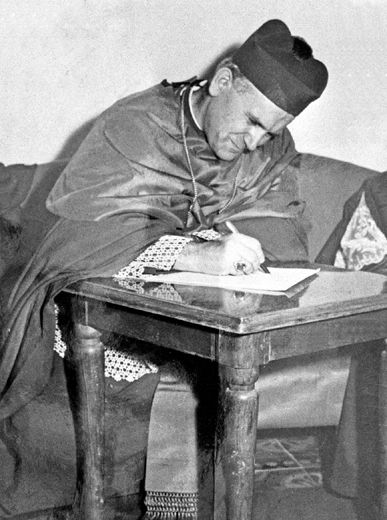
Cardinal Karol Wojtyla (John Paul II). EAST NEWS/WOJTEK LASKI
Many years passed, and then came the propitious moment. That young student of Polish theater, that young priest, became, through God’s always strange providence, the bishop of Rome, the successor of Peter. Armed with the full authority of his office and the sheer strength of his personality, John Paul II visited Poland in 1979. Despite the enormous opposition of the Communist government, despite misinformation campaigns, roadblocks, and threats, millions of Poles ventured out to hear him. And John Paul spoke of those values that he had learned from Polish literature and from the treasures of the Catholic tradition; he spoke of God and creation, of the human being made in the image of God, of Jesus Christ and his redeeming cross, of the promise of eternal life—and he thereby changed the country. At that moment, the life, long preserved during dark and dangerous years, came flooding out. And John Paul’s words served as a clarion call to the armies of people—now writers, journalists, business leaders, and politicians—whom he had shaped. So it goes in the rhythm of life of the ekklesia: stowing away on the ark followed by a world-transforming explosion of life. At the close of the book of Revelation, the final text of Scripture, the author reports a vision of the heavenly Jerusalem coming down out of heaven like a bride adorned for her husband. This is an image of the perfected church, the eschatological ekklesia. But he makes the curious observation that in this perfected Jerusalem there is no temple. One would think that in such a place, the Temple, which was the entire raison d’être of the earthly Jerusalem, would be highlighted, not eliminated. But then we recall that the purpose of the church is the transfiguration of the world, the invasion of the secular by the sacred. This is why, in its final state, the church coincides with the city, disappearing into the now sanctified arenas of business, politics, sports, commerce, and the arts. We will return to this idea when we speak, in our closing chapter, of heaven.
ONE
We have seen what the ekklesia is called out of (the region of unlikeness) and who does the calling (the sovereign voice of Christ), but what precisely is the church called to? In chapter 10 of Mark’s Gospel, we find the story of the blind man Bartimaeus. Sitting helplessly by the walls of Jericho and hearing that Jesus is passing by, Bartimaeus cries out, “Jesus, son of David, have pity on me” (Mk 10:47). Then, Mark tells us, Jesus called (kalein) him, and the people encouraged Bartimaeus, “Take courage; get up, he is calling [kalein again] you” (Mk 10:49). The Lord asks what he can do for the blind man, and Bartimaeus responds, “My teacher, let me see again.” And after Jesus cured him, Bartimaeus “followed him on the way” (Mk 10:52). This vignette, rooted in a real encounter, is also a beautiful icon of the church. For a first-century Jew, Jericho would carry with it the connotation of sin and corruption, since it was the city whose walls came down so that the conquering Israelites could enter. Therefore Bartimaeus, sitting in blindness by the walls of Jericho, evokes all of us in the region of unlikeness, lost in our sin and unable to see the world aright. Jesus calls Bartimaeus, gathering him into the community of the ekklesia, thereby giving him sight and enabling him to walk the right path. The church is that community in which we learn, through Christ, how to see and how to walk. In the ancient world when a young man joined a philosophical school, say Plato’s academy, he was not simply enrolling in a series of classes or course lectures in Platonic philosophy. He was signing on for an entire style of life, involving practices and bodily disciplines, as well as new patterns of thought. We find something very similar in the Acts of the Apostles, where the early Christian church is referred to as “the Way,” a term that catches this practical, embodied dimension of Catholic life. The church is that society, that mystical body, in which people learn to see with the eyes of Christ and to walk the path that Christ walked.
Traditional ecclesiology specifies this by speaking of the community of Jesus as “one holy catholic and apostolic,” and I would like, in the remaining pages of this chapter, to explore, however briefly, each of these dimensions.

Chora Church, interior, Istanbul. WORD ON FIRE
The church is one because its founder is one. As we have seen earlier, Jesus compels a choice precisely because he claims to speak and act in the very person of God. Jesus simply cannot be one teacher among many, and therefore those who walk in his way must be exclusively with him. Moreover, the God whom Jesus incarnates is one. As we have seen, the Israelite conception of God is fiercely monotheistic and hence it excludes any diversity or syncretism at the level of basic belief: “The Lord your God is a jealous God.” Joseph Ratzinger commented that the opening line of the Nicene Creed, Credo in unum Deum (I believe in one God), is a subversive statement because it automatically rules out any rival claimant to ultimate concern. To say that one accepts only the God of Israel and Jesus Christ is to say that one rejects as ultimate any human being, any culture, any political party, any artistic form, or any set of ideas. Søren Kierkegaard said that the saint is someone whose life is about one thing; a Christian, I would argue, is someone who, at the most fundamental level of his or her being, is centered on the one God of Jesus Christ. This helps to explain why, on the last night of his life on earth, while sitting at supper with his disciples, the core of the church, Jesus prayed, “I pray not only for them, but also for those who will believe in me through their word, so that they may all be one” (Jn 17:20–21).
What precisely are the bonds of unity within the body of Christ? What are the elements that foster Christian unity? I would first mention the creeds, which voice the one faith of the apostles. At every Sunday Mass, Catholics stand to profess together the Nicene Creed, in all of its verbal and conceptual complexity, recapitulating thereby the victories won in the early church by the advocates of the apostolic faith over those who would have compromised it. I would mention as well the Liturgy and the sacraments and devotional practices. We are one in that we participate together in common worship and in common means of accessing the divine life. We are united, too, in our commitment to our brothers and sisters through the corporal and spiritual works of mercy. And finally, we are one through our shared structure of order, which comes from the apostles, about which we will have more to say later in the chapter. Through these various means, we become saints, people whose lives are about one thing. None of this, of course, is to gainsay that there is ample room for multiplicity in the life of the church. There are a variety of liturgical rites, styles of sanctity, schools of theology, paths of spirituality, and so forth, but these diversities do not compromise the integrity of the church’s unity. Rather the play between the one and the many in church life is within the tensive harmony of the three divine persons of God.
I realize that, especially today, many are uneasy with any sort of claim to unity. In our time we put a great stress on variety, diversity, and tolerance of the other, for we have seen far too much violence and oppression visited upon the weak in the name of unity. For many in our culture the valorization of the one seems tantamount to tolerating totalitarianism. To be sure, the church does not have an altogether unblemished historical record in this regard. There are far too many examples of church people up and down the centuries who imposed unity either violently or disrespectfully and thereby undermined the very body of Christ they were attempting to build up. But the church at its best has found a creative way to deal with this problem of unity and diversity, a way grounded in the uniqueness of Jesus himself. As we have argued throughout this book, Jesus should not be construed as one religious teacher among many but as the Logos of God, the very pattern of the divine mind, the incarnation of the reason by which the entire universe was fashioned. This implies that whatever is true, whatever is good, and whatever is beautiful in nature or in human culture participates in him, reflects him, and finally leads back to him. Therefore, the church of Jesus Christ can and should embrace the positive dimensions of whatever cultural environment surrounds it.
In the third century, Origen of Alexandria, who was the head of the catechetical school in his native city, coordinated his massive knowledge of the Bible with his equally impressive expertise in Neoplatonic philosophy and produced one of the earliest and most powerful Christian theologies. He did not set the Bible over and against philosophy, but rather found echoes of the Logos in the “words” of the philosophers, and he used the latter to communicate the former to the academic audience of his time. By this intellectual tour de force, Origen set the tone for much of the theologizing done within the Catholic tradition. Saint Augustine followed Origen in the use of Platonic thought, commenting that what he learned in the books of the Platonists helped him enormously on his journey toward Christianity. Indeed, almost all of the church fathers delighted in finding what they called logoi spermatikoi (seeds of the Word) in the pagan religion and philosophy that surrounded them. In the thirteenth century, Saint Thomas Aquinas, under the tutelage of Saint Albert the Great, took in what was, at the time, the highly suspect Aristotelian philosophy and science and used it in his architectonic presentation of the Christian faith, which is, even today, stunning in its depth and complexity. In the course of his work, Aquinas also relied on the Jewish philosopher Moses Maimonides, as well as the Islamic thinkers Averroes and Avicenna and a whole congeries of classical philosophers from Epicurus and Epictetus to Plato and Cicero. In the nineteenth century, John Henry Newman, faced with the onslaught of a fierce rationalist critique of Christianity, blithely utilized the work of David Hume and John Locke in his own articulation of religious epistemology; and in the twentieth century, the German Jesuit Karl Rahner made extensive use of both Kant and Heidegger in his presentation of Catholic theology. And in its document on the church and the non-Christian religions of the world, Nostra Aetatae, the Second Vatican Council argued that there are “rays of light,” echoes of the fullness of truth, in all of the non-Christian religions.
Newman spoke of the church’s power of assimilation, by which he meant its capacity to take into itself elements from the cultural environment and adapt them to its purposes. To press the analogy, just as a healthy animal is able to take in what it can from the world around it, as well as to resist what it must, so the church uses logoi spermatikoi even as it holds off elements that are incompatible with its identity and proper functioning. Two clear indications of disease within an organism are precisely the incapacity to assimilate and the incapacity to resist, and therefore the church remains healthy in the measure that it is organic and assimilating in its unity.
One of the very best visual illustrations of the principle I’ve been describing is the church of Santa Maria Rotonda in Rome, better known as the Pantheon. The emperor Hadrian constructed the Pantheon in the early second century as a shrine to all the gods, and to my mind it sums up, better than any other building, the best of the pagan consciousness. For the more sophisticated of the pagans, the gods and goddesses disclosed in symbolic form the necessities inherent within nature and the dynamics of human life. Hence Zeus—fierce, powerful, capricious—represented the heavens; Apollo—handsome, wise, creative—stood for reason; and Venus—sensual, unpredictable, beautiful, dangerous—symbolized love. The Pantheon, with a dome so like the heavens, with its ordered harmonies mimicking the intelligibilities within nature, with its oculus that lets in the natural elements themselves, is a beautiful built form of the pagan mind. The genius of the church was that it assimilated this building to its purposes, transforming it, almost unchanged, into a place of Christian worship. At its best, the unity of the church is not totalitarian but assimilating.

Pantheon, detail, Rome. WORD ON FIRE
HOLY
We say next that the church of Jesus Christ is holy. It is holy because Christ is holy and the church is Christ’s mystical body. Holiness is deeply related to unity, since holiness is a kind of wholeness or integrity, a cohering around a center. It is fascinating how across the languages the terms for health and holiness are similar: “holy” and “whole” in English, saint and sain in French, Heil and Heiligkeit in German, santo and sano in Spanish. Holiness is the integration that results from placing God unambiguously at the center of one’s concern; it is the coming together of all of one’s faculties—mind, will, imagination, energy, body, sexuality—around the single organizing power of God. Or, to shift the metaphor, it is the suffusing of the entire self with the love of Christ. The church is a bearer of this holiness in its authentic traditions, in its Scriptures, in its sacraments (especially the Eucharist), in its Liturgy, in its doctrinal teaching, in its apostolic governance, and in its saints. In all of these expressions the church is the spotless bride of Christ, the fountain of living water, the new Jerusalem, the recovery of Eden. And by its holiness the church makes people holy. Indeed, that is its sole purpose, its raison d’être. In a wonderful text composed toward the end of her life, Thérèse of Lisieux, whom we will consider in detail later in this book, identified the holiness that animates the church as love: “If the Church was a body composed of different members, it couldn’t lack the noblest of all; it must have a Heart, and a Heart BURNING WITH LOVE. And I realized that this love alone was the true motive force which enabled the other members of the church to act; if it ceased to function, the Apostles would forget to preach the Gospel, the martyrs would refuse to shed their blood.” That love of Christ—embodied in the saints, sacraments, and structures of the church—is the holiness of which we are speaking.

Procession, Feast of St. Charles Lwanga Namugongo and Companions, Uganda. WORD ON FIRE
Now here again, I realize, many people balk. How could one possibly declare as holy a church that has been implicated in so many atrocities and outrages over the centuries? How could a holy church have supported the Crusades, the Inquisition and its attendant tortures, slavery, the persecution of Galileo and Giordano Bruno, and the burning of innocent women as witches? How could a holy church have given in to so much institutional corruption? How could it have countenanced the accumulation of so much wealth? And to bring this litany of crimes up to date, how could a holy church have permitted the sexual abuse of children by some priests and the covering up of that outrage by some bishops? The resolution of this problem hangs on a key distinction between the church in its mystical integrity and all of those sinners who are members of the church. To say that the body of Christ is holy is not to deny for a moment that that body is composed of sinful people—sometimes of the highest ecclesiastical rank—who have done cruel, stupid, and wicked things. Was the great Saint Bernard wrong, even sinful, to preach the Second Crusade? Probably. Was the Spanish church, in collusion with the Spanish government, wrong, even sinful, to launch the Inquisition? Yes. Were a number of popes mistaken, even sinful, in their implicit support of slavery? Undoubtedly. Was Cardinal Robert Bellarmine ham-handed, even cruel, in his handling of the Giordano Bruno and Galileo cases? Of course.
But none of this gainsays that the church is holy and a bearer of holiness. In the fourth century Saint Augustine did battle with the Donatists, a Christian sect that argued that those priests and bishops who had abandoned the faith during times of persecution had forfeited the grace of their ordination and were no longer worthy to preside at the Liturgy and distribute the sacraments. The holy church, the Donatists maintained, should be served exclusively by holy ministers, and only the righteous could be conduits of grace. Donatism, in a somewhat modified form, is still a lively force today, evident in the many critics who say that the bad behavior of so many churchmen and churchwomen over the centuries effectively undermines any holiness or credibility that the church might claim for itself. Very much in the Donatist spirit, these commentators hold that only sinless people can serve a holy church. Thank God Augustine held off this challenge, arguing that the grace of Christ can work even through entirely unworthy instruments. Otherwise sin would overwhelm grace—and this would be repugnant to God’s sovereignty. And Augustine was merely amplifying a statement of Saint Paul’s in his second letter to the Corinthians: “we hold this treasure in earthen vessels, that the surpassing power may be of God and not from us” (2 Cor 4:7). So the holiness of the church comes from Christ and therefore endures despite the weakness of those who are charged with bearing it to the world.
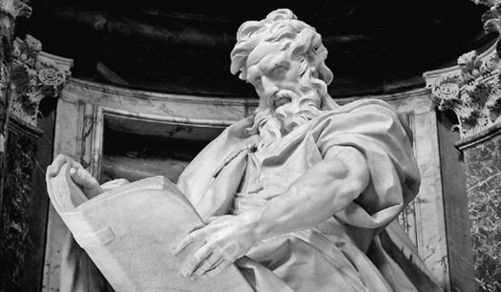
Saint Matthew, Basilica of St. John Lateran, Rome. WORD ON FIRE
CATHOLIC
The ekklesia into which Jesus calls us is also “catholic.” The word “catholic” comes from the Greek terms kata holos (according to the whole) and thus designates both the internal integrity of the church and its universal outreach. The Catholic Church has all of the gifts that Christ wants his people to have: Scripture, Liturgy, theological tradition, sacraments, the Eucharist, Mary and the saints, apostolic succession, and papal authority. From the Roman Catholic point of view, all of the non-Catholic Christian churches have sacrificed one or more of these qualities and therefore fall short of completeness or catholicity. This does not mean for a moment that Protestant and Orthodox churches might not exercise one or more of the gifts better than Catholics do. One might argue, for example, that many Protestant churches have a more developed sense of the centrality of the Bible or that the Orthodox church has a more mystical sensibility in regard to the Liturgy. But the church of Jesus Christ “subsists” in the Catholic Church, because that communion possesses full integrity; it operates “according to the whole.” A wise teacher of mine once commented on the “grandma’s attic” quality of Catholicism, by which he meant our wonderfully stubborn refusal ever to throw anything out.

St. Peter’s Basilica, interior, Vatican City. WORD ON FIRE
The other dimension of catholicity is more outward looking. It indicates the dynamism of Jesus’s church toward the evangelization of all peoples, the gathering in of the entire human race. The author of John’s Gospel was a master of irony, and one of his most delicious twists involves the sign that Pontius Pilate placed over the cross of the dying Jesus: “Iesus Nazarenus Rex Iudaeorum” (Jesus of Nazareth, King of the Jews). The Roman governor meant it as a taunt, but the sign—written out in the three major languages of that time and place, Hebrew, Latin, and Greek—in fact made Pilate, unwittingly, the first great evangelist. As we have discussed in the first chapter, the king of the Jews, on the Old Testament reading, was destined to be the king of the world—and that kingship is precisely what Pilate effectively announced. Paul’s declaration of Jesus as kyrios was simply a reiteration of Pilate’s message. Even at Calvary, where Jesus’s church had dwindled to three members, his little community was catholic for it was destined to embrace everyone. At Pentecost the disciples, gathered in the Upper Room, were filled with the Holy Spirit and, we are told, they began to preach the good news and were heard, miraculously, in the many languages of those who had gathered in Jerusalem for the Feast of Tabernacles. As the church fathers clearly saw, this phenomenon was the reversal of the curse of Babel, when the one language of the human race was divided and the people, accordingly, set against one another. Through the announcement of the Lordship of Jesus, the many languages again become one, for this message is the one that every person, across space and time, was born to hear.
The Catholic Church, at its best, has always exulted in this culture and language transcending universality. In the Middle Ages, Saint Anselm, born in Italy, could become a monk and abbot in France and finally end his life as the archbishop of Canterbury in England. And Thomas Aquinas, another Italian, could be educated in Germany and become a world-renowned professor in Paris. John Paul II embodied this spirit when he inaugurated the World Youth Days in the 1980s. The pope summoned young people from all over the world to gather together for several days of prayer and celebration, and he never wanted them to deny their national identities: the flags and songs of particular countries are a staple at World Youth Days. But he wanted to convince them that they belonged to a family that transcends their particular nationalities. He wanted them to feel in their bones their shared identity as members of Christ’s mystical body. It strikes me as altogether appropriate that the largest crowd ever gathered in human history came together around John Paul at World Youth Day in Manila in 1995 to celebrate precisely this catholicity of the church of Jesus.
This church’s catholicity has a good deal in common with its unity, and it therefore raises some of the same objections regarding totalitarianism and intolerance. Won’t a church that is convinced of its universality run roughshod over any religious group that stands in its way? Many commentators complained bitterly, for example, when John Paul II published the declaration entitled Dominus Iesus, which presented the traditional Catholic teaching that Jesus Christ is the sole source of salvation. The best way to respond to such concerns is to show how the many faiths, religions, and philosophies do, in fact, to varying degrees, already participate in the fullness of Christ’s gifts and are hence implicitly related to the Catholic Church. We have already gestured toward the significant points of contact with other Christian faiths, but there are many analogies with the non-Christian religions as well. With Jews, Catholics share a belief in the one Creator God who called Israel to be a light to the world. With Muslims, Catholics hold to the faith in the one providential God of mercy who speaks through a variety of prophets. Buddhists and Catholics come together in a keen sense of the finally ineffable quality of ultimate reality, and in their commitment to definite forms of mystical contemplation. Catholics and Hindus share a profound sense of the immanence of God to the world. All of these points of contact, all of these “rays of light,” are not only semina verbi (seeds of the word) but also semina catholicitatis (seeds of catholicity).
APOSTOLIC
Finally, the church of Jesus Christ is apostolic. This means something very simple: that the community of the church is grounded in the twelve people who were privileged to be in Jesus’s intimate company. In the first chapter of his Gospel, Saint John relates the story of two disciples of John the Baptist who were told by the Baptist himself to follow Jesus. When the Lord turns to them and asks what they want, the disciples respond with a question, “Rabbi, where are you staying?” Jesus said in reply, “Come, and you will see” (John 1:38–39). And then we hear that they stayed with him that day. The apostles were those who stayed with Jesus, who heard how he spoke and saw how he moved and reacted, who took in at close quarters his manner of being.
As I have mentioned many times throughout this book, Christianity is not a philosophy or a universal mysticism; it is, first, a relationship with Jesus of Nazareth, this particular first-century Jew from Galilee. And that is why it is a religion that is rooted in the faith of those apostles who knew him best and who apprenticed to his way. And that is why, furthermore, in the early church, apostolic pedigree, that is to say, the ability of a particular Christian community to trace its origins back to one of the apostles, was so important. Jerusalem was central because it was the church of James, and Antioch because it was the church of Peter, and Alexandria because it was associated with Mark, and so forth. The reason that Rome emerged in time as the central see of Christianity was not primarily because it was the capital of the empire, but because it was the burial place of two apostles, Peter and Paul. The Basilica of St. John Lateran in Rome is the pope’s cathedral church, which is to say, the place that contains the chair from which the bishop of Rome definitively teaches. Placed throughout the nave of the basilica are imposing statues of the twelve apostles of Jesus, forming, as it were, the structuring elements, the ribs, of the building itself—and we find this motif repeated in church architecture throughout the world, usually in the form of twelve columns that support the roof. We are being reminded of those twelve apprentices to the Master who have bequeathed their faith to us.

Basilica of St. John Lateran, interior, Rome. WORD ON FIRE
The apostles are not simply a distant memory; they live on through what we call the apostolic succession. The New Testament witnesses to the practice in the early church of the apostles placing their hands on the heads of those to whom they wished to communicate authority. These chosen few, formed by the apostles themselves, were entrusted to preserve the faith, and, in time, these successors passed on their apostolic authority to another generation, and so on, the Catholic Church holds, to the present day. Therefore the apostolicity of the church is our guarantee that we are, despite many developments and changes across the centuries, still preserving the faith that was first kindled in that company of Jesus’s friends. When I was ordained a priest, a successor of the apostles laid hands on me and thus gave me a share in his authority. Whatever capacity I have to govern, sanctify, or teach in the church comes from my participation in that apostolic charism. I realize that this talk of apostolic authority runs counter to many of our cherished assumptions, at least in the West, about democracy, the free play of ideas, freedom of expression, and so on. Why doesn’t the church democratize itself and accept the authority of the majority of its people? Again, it is most important to note that the apostolic church is not a debating society that endlessly bats around ideas or a democratic polity whose direction is simply a function of popular choice. The church is grounded in the revelation personally granted to a chosen few, who in turn passed it on to others and so forth. The church of Jesus Christ would not be itself if it denied the divinity of Jesus, the facticity of the resurrection, the existence of the Triune God, the activity of the Holy Spirit, the efficacy of the sacraments, the real presence of Jesus in the Eucharist, and so on. Mind you, every one of these tenets has been denied by church people up and down the centuries, and I frankly wonder how many would pass muster if they were voted on today.
This brings us to what is perhaps the most controversial and misunderstood dimension of the church’s apostolicity, namely, the charism of infallibility enjoyed by the pope, the successor of the prince of the apostles. It would be helpful first, I think, to state as clearly as possible what papal infallibility is not. It does not mean that the pope is omniscient; it does not mean that he can predict the future; it does not mean that he is immune from making bad practical judgments; and it certainly doesn’t mean that he is above criticism or incapable of sin. In fact, some of the saints were sharp critics of popes, and Dante places some wicked popes in the lower circles of hell. The concept of infallibility means that the pope, by a special gift of the Holy Spirit, knows who Jesus is and therefore is able to articulate correctly those doctrinal and moral teachings that flow from that knowledge. At Caesarea-Philippi, Peter, under the influence of God’s spirit, correctly confessed the identity of Jesus, and because of that confession Jesus declared him the rock upon whom the church would be built. The infallibility of Peter’s successor, when he teaches on matters of faith and morals, is grounded in that same charismatic guarantee.
I fully realize that this claim raises the hackles of contemporary people. Even with the clarifications that we have made in mind, one might still wonder whether it is healthy for anyone to claim infallible authority. Once again, John Henry Newman might prove helpful. Newman said that if it pleased God to reveal himself to his church, it should also please him to give that church a living voice of authority that could interpret the revelation down through the ages. In Newman’s time, as today, many would say that the Bible is all the authority the church needs. But Newman saw that the Bible is subject to a wide variety of interpretations and hence cannot, on its own, resolve disputes. Some argued—and still argue today—that the consensus of the church fathers and the great theologians is sufficient authority, but Newman held that those figures, as wise as they were, do not constitute a living voice that can intervene here and now to determine right and wrong. What is required is precisely what the Catholic Church claims to have: the voice of the infallible pope, which can in a magisterial and definitive way adjudicate questions regarding the interpretation of revelation.
The point of Newman’s insight is brought home if we make a comparison to a game. A game of baseball, for instance, would devolve, in very short order, into chaos were it not for the presence of an umpire who was on the field and able to make a call: safe or out, ball or strike, good or foul. Without that living voice, the flow of the game would stop and be replaced by bickering. Appeals to the rule book of baseball or to past examples of similar situations would be hopeless, for they would never serve to resolve the present and pressing question. Because of, and not despite, the umpire’s authoritative voice, the play is able to resume. The infallible pope has a similar umpiring role in the play and flow of the church’s life: in its teaching, its care for the poor, its liturgy, its art, and so forth. His voice is not meant to shut down that liveliness, just the contrary. It is meant to enhance it and to cause it to resume when it has been interrupted.
Just before entering the train that would carry him to Rome and the conclave that would elect him pope, Cardinal Angelo Roncalli commented, in regard to himself and his fellow cardinals, “we are not here to guard a museum, but to cultivate a flourishing garden of life.” The church of Jesus Christ is not a collection of cultural objets d’art, not a stuffy institutional holdover from another age; it is, as the mosaic at San Clemente suggests, a living thing, an organism, a body. Its head is Jesus himself and its lifeblood is the Holy Spirit. Its purpose is to be a conduit of the divine life to the world, a light to the nations, a new Eden.
As any serious gardener will tell you, the tending of flowers and plants is anything but a passive business. It involves cutting, pruning, weeding, and constant attention. Similarly, those who tend the life of the church must sometimes make difficult decisions, chastise those who have wandered from the straight path, and articulate unpleasant but necessary truths. The image proposed by Cardinal Roncalli is not romantic or idealistic. But it speaks beautifully of the living, evolving, unfolding quality of the mystical body.

St. Peter’s Square, Vatican City. WORD ON FIRE