
7
I always teach young players that cricket is not about averages even if it is a stats-based game. It is about how and when you score runs and take wickets.
Shane Warne
Make it 400.
Dr W.G. Grace’s instruction to the scorer, after he had scored 399
You have been invited to umpire a game of cricket in the remote highlands of Papua New Guinea. A few of the local tribesmen have gone down to Port Moresby, seen the sport played there and brought a couple of bats and balls back to their village. Enough rainforest has been cleared for a match to be staged on the fringe of it, beyond the huts, and a challenge issued to the neighbouring village.
Shortly after the match starts, a problem arises. In these highlands, as in a few other uncolonised parts of the world such as the Amazon basin, the numbering system is simple – extremely simple. The villagers count ‘one, two, three, plenty’. That is it. Without the perceived needs of materialist western societies, they do not need to go above three. If they have trapped more than three fishes or three birds, they have plenty to eat.
When a batsman hits a ball into the rainforest, the game comes to a halt, and not because the ball is lost. The problem is that you, as the umpire, signal ‘six’ but nobody knows what six means. It is all right when a batsman is bowled without scoring: you can shake your head in sympathy and tell him he has scored a bird of paradise, rather than a duck. But there is this little local difficulty when a batsman hits a boundary. The scorer has no idea what to write down in his scorebook other than ‘plenty’.
This match, in the absence of more than three numbers, quickly dissolves into being a middle practice that goes on and on and on. One batsman stays in for most of the day and hits some superlative shots, but he never has the satisfaction of reaching a fifty or a century, or of acknowledging the applause which normally greets these landmarks. When this batsman is out, the scorer records his name, the manner of dismissal and ‘plenty’ – exactly the same as for the slogger who middled one big hit into the tropical undergrowth before being bowled. In the folk memory of this village, this batsman will be long remembered for his strokeplay, but its value cannot be measured and recounted to posterity.
When the turn of the visiting village comes to bat, it is again rather unsatisfactory. They do not know their target – how many runs to chase off how many overs. In the end, as a gorgeous sun sets over the rainforest, everyone gets bored and drifts home for supper, leaving you to pull up stumps. The match is a test, but of little more than stamina, and the result is never decided.

Numbers help us to capture the details of a cricket match, very concisely too, and determine the result. They can only go so far: they cannot tell us about the state of the pitch, the weather and overhead conditions, the quality of fielding or standard of umpiring or the mindset of any of the players. Nevertheless, if you wanted to know what had happened in a game of cricket and, in addition to being given the names of the players, you had to choose between thirty words or thirty numbers, you would discover a lot more from thirty numbers.
Numbers convey the basic value of a cricketer. An outstanding batsman may be dismissed for nought in one game, but over the course of his career the numbers that he has compiled will give an approximate indication of his worth. He might not always score his runs when they are most needed, or quickly enough, but still: sooner or later, the fine cricketer scores runs or takes wickets, and these numbers are recorded once and for all. Only the fine ground-fielder, without any statistics to measure his contribution, can feel neglected.
Like chess notation, numbers enable us to pin down every move in a game. Right, this ball coming up will be the first ball of England’s second innings in the third Test. Now, and if needs be in future, we can focus on this single ball, and tell others about it. (We may also deduce that the ball was new and maybe swinging, and therefore batting was relatively difficult at this stage.)
From here it is an easy step to betting. Thanks to Love’s poem, we know that at the precise moment when England had scored three for five wickets in 1744, the odds on Kent winning were ten to four. Correspondents on England’s tours to the West Indies in the 1950s reported that spectators would bet on almost every ball, in an entirely innocent way: I bet you a few pence or cents that Rohan Kanhai or Clyde Walcott will hit a four in the next over. It is this fact that every significant moment in a cricket match – every ball – is numbered and identifiable which makes the sport so inviting to punters and bookmakers, and those with less innocent intentions.
Numbers also go a long way towards grounding the cricketer in reality. The player in another team sport who goes home and tells his family he has played brilliantly is not easily disproved. The bowler who has taken nought for plenty can call himself unlucky one day, but he cannot go on taking nought for plenty and expect to be considered much good. Numbers, being objective measurements, contradict him.
As long ago as the 1940s, baseball employed the first analyst to examine numbers and statistics, but baseball is almost binary: the ball is hit for a run or it is not. Analysts became fashionable in cricket after the publication of Michael Lewis’s Moneyball in 2003, but cricket did not prove quite so susceptible to analysis and clear-cut conclusions. In the limited-overs game, the strike-rate of batsmen and economy-rate of bowlers came to be studied much more closely. In all formats, the strengths and weaknesses of batsmen were analysed and quantified, so that Kevin Pietersen was found to average much less against left-arm spin, or Andrew Strauss and Mike Hussey much less against left-arm pace. Bowlers, captains and coaches could be informed by analysts on how to target batsmen.
But cricket was not revolutionised by the study of numbers as baseball was. The most highly trained eye – if only that – could detect these technical weaknesses just as well, and temperamental ones. Cricket is too complicated, and has too many variables, starting with the pitch, to be broken down neatly into numbers. Even a simple statistic like the percentage of matches that a player has won can be very misleading: he can be the finest wicketkeeper/batsman the world has seen, more Gilchristian than Adam Gilchrist, but if his team has no bowling to speak of, he will come bottom of the table.
The shorter the format, the easier a game is to analyse and a formula to be devised. Test cricket is too much of an ocean for anyone to have trawled all its depths, and thank goodness. Well over two thousand Tests have been played, and still the plot of every one is different.
I am not numerate, but numbers held sufficient attraction for me at about the age of ten to type out the scorecard of a match. It was a very high-scoring one: the first-class game between Cambridge University and the West Indians at Fenner’s in 1950, which was the highest-scoring match ever in terms of runs per wicket. Cambridge batted first and declared at 594 for four wickets, and the West Indians totalled 730 for three wickets by the end. I had yet to realise that a game in which seven wickets fall in three days is no sort of contest. It must have been the magnitude of the numbers which attracted me, and their natural progression: not only that of the two totals, but John Dewes scoring a hundred and David Sheppard 227 for Cambridge, then Everton Weekes 304 not out.
Ever-increasing numbers give us vicarious pleasure in the case of a favourite batsman compiling ever bigger scores. They can also give us the illusion that mankind is improving: that ascending numbers lead to the Ascent of Man. We watched mountaineers climbing ever higher peaks until they reached the summit of Mount Everest; we do not have to be mountaineers to want to see how high cricketers can go.
Headingley was packed with 25,000 on Saturday, 7 June 1952. It was the first Test of the series between England and India and of the career of the local lad, Fred Trueman, a promising fast bowler.
Running in from the Kirkstall Lane end, down the slope, Trueman dismissed Pankaj Roy with his second ball of India’s second innings, a top-edged hook to Denis Compton at slip. He bowled Madhav Mantri with his seventh ball, again for nought. At Trueman’s next ball, Vijay Manjrekar aimed a loose drive, and he too was bowled.
As Alec Bedser had dismissed another of India’s batsmen without scoring, the scoreboard stood at nought for four wickets. ‘Take a good look at it,’ England’s captain Len Hutton told his players. ‘You’ll never see another like it in a Test.’
The irony was probably lost on most of India’s players and supporters at the time. Their countrymen, about a millennium before, had invented zero.
The figure ‘0’ has a void in the middle, like no other digit, not even 6, 8 or 9. Into a void a batsman might wish to disappear after scoring nought in front of a capacity crowd.
The footballer or hockey or rugby player, if he has not scored, does not leave the field with 0 against his name. True, if the bowler has not taken a wicket, he has to contend with a zero on the scoreboard, but his shame is dissipated through having been spread over several hours of fruitless endeavour: he has come gradually to the dreaded cipher. Posting a duck on the scoreboard or television screen – a zero being the shape of a duck’s egg – goes only so far in softening the blow to the batsman who has made nought. Hence the preoccupation of all batsmen with getting off the mark.
Three is a magic number in cricket. Number three has been the most glamorous position in the batting order, and viewed as the most important, since Don Bradman made it his own. He had a hard act to follow – Charlie Macartney averaged 59 at a dashing rate for Australia at number three – but follow it he did. Simultaneously, Wally Hammond averaged 74 for England at number three. Since Bradman, Ricky Ponting has averaged 56 there in Tests; Brian Lara averaged 60 at number three, against 51 at four; Kumar Sangakkara 62; while Rahul Dravid, alone, has scored 10,000 Test runs in this position.
Three wickets in successive balls is a feat that has been celebrated since the game’s dawn, and used to be marked by the presentation of a hat. Even a bowler in the remote highlands of Papua New Guinea can take a hat-trick. Simon Barnes speculated in The Times that a hat-trick has achieved such prestige because, in part, it has religious associations, with the Holy Trinity.FN49
The first hat-trick in Test cricket was taken in the second Test at Melbourne in 1882–83, by the off-spinner Willie Bates of Lascelles Hall. Everyone knew the significance of the moment after Bates had taken two wickets in consecutive balls. England’s fielders crept closer – and for a hat-trick ball to this day, even in a Test match, reason goes out of the window and fielders take up positions the captain and coach have never visualised, usually based on standing an equal distance apart. The batsman facing Bates’s hat-trick ball was Australia’s finest hitter, George Bonnor, a Flintoff-like colossus of six feet six – only he seldom used his physique to hit the ball. England’s close fielders gambled on his tendency to block, not bash, and inched closer. Sure enough, Bonnor pushed forward to Bates, the ball bounced up and he was caught in front of the wicket close in on the leg-side. Bates was later presented with a hat made of silver by his grateful skipper, Ivo Bligh, because his trick materially helped to win the Test and level the series.
It is irrational that the achievement of taking four wickets in four balls is less prestigious. It is so much rarer that, while more than 30 hat-tricks have been taken in Tests, no instance of four wickets in four balls has to date occurred. In purely numerical terms, the feat is 33 per cent more valuable again than a hat-trick. Yet the bowler and everyone else on the fielding side appear satisfied once a hat-trick has been taken. Only as an afterthought do they think about the new batsman, still hastily putting his kit on as he comes to the crease. Ambition has been fulfilled; individual glory has been achieved. The name of the bowler, if he has taken his hat-trick in an Ashes test, is immortal. Four is not magical.
Thirteen is perceived to be the unlucky number in cricket, in England and elsewhere, if not Australia, and in ordinary life. And this superstition has a rational basis in that a first-class player through the ages has been more likely to be dismissed for 13 than for 12 – but only just.
Here are the scores, up to 20, for which batsmen have been dismissed in first-class cricket as a percentage of all dismissed innings (65,680 of them before October 2014):
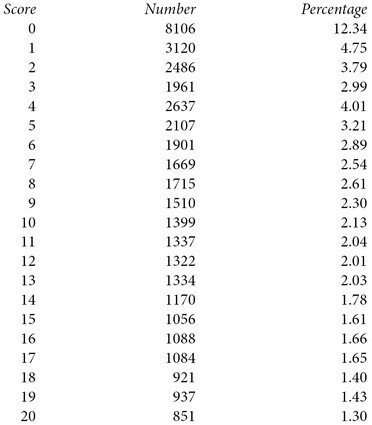
Compiled by Benedict Bermange, Sky Sports statistician
It was a relatively innocuous bouncer, of no great speed, and the bounce was true: this was, after all, a first-day pitch at the Sydney Cricket Ground. In fact, the ball arrived more slowly than Phillip Hughes had calculated, so that he had completed his hook too soon. The ball hit the left side of his neck, below the helmet, with fatal consequences.
Cricket had little or no experience to fall back on when deciding how to react to the death of Hughes two days later from a catastrophic haemorrhage. It was so shocking because it was so unprecedented – the first death of a professional batsman from a direct hit by a cricket ball since George Summers of Nottinghamshire at Lord’s in 1870, at the same tragically early age of 25.
Two numbers were seized on to become a focus of the grieving process. The next time Australian batsmen reached 63, Hughes’s score when he died, they raised their bat and helmet and looked to heaven. In the case of his teammate David Warner, in the first Test at the SCG after the accident, he put his bat and helmet down in the crease when he reached 63, and knelt to kiss the spot where Hughes had fallen.
The first Test of Australia’s series against India, which had to be rescheduled after Hughes’s funeral, had been at Adelaide. When Australia won, they gathered at the large ‘408’ which had been painted on the outfield, as Hughes had been Australia’s 408th Test cricketer, and returned there shortly afterwards to sing their team song.
Lord John Sackville was no great batsman, for all Love’s flattery, yet he had a more than tenuous link with cricket’s first individual century. Sackville’s son became the Third Duke of Dorset and fielded teams on the family estate at Sevenoaks. One of his regular players was John Minshull, also known as Minchin, and the Duke’s household accounts record the match he played against Wrotham in 1769. John Nyren wrote that Minshull was ‘as conceited as a wagtail’, but then if we had climbed cricket’s Mount Everest by scoring the first century, it might have gone to our head. A century means you have dominated your opponents. You personally have bettered the best they have to offer, even if your team goes on to lose. You can score a fifty while one of the opposition’s main bowlers is resting, but if you make a century, you have overcome all that has been thrown and bowled at you.
Something literally goes to a batsman’s head on reaching a century: the sound waves of clapping. Such occasions tell us that, in the eyes of spectators at least, cricket is more of an individual game than a team game. A crowd applauds far more loudly when a batsman reaches a landmark such as 50 or 100 or 200 than when a team does. Indeed, one of the curiosities of cricket is that the moment a team wins is often greeted with no applause at all. The winning run is scored, players shake hands, spectators pack up and leave. No wonder Minshull was conceited!
I can barely recall my only hat-trick, but until I lose consciousness for ever I will remember my only century – and my emotional, utterly irrational, response after waiting for 48 years. Having reached 99, against Warminster Sunday ‘A’, I pushed a ball on the off-side, ran a single, and kissed the umpire at the bowler’s end . . . All I can say is that I have never had occasion to kiss an umpire since.
Nobody has better described the anguish of falling short of a century than the late Peter Roebuck who, in his schooldays, had scored a hundred on the same ground where I scored mine, Hinton Charterhouse near Bath. When playing for Somerset in his mid-twenties, he passed 50 thirty times in a row, by his own account, without going on to a hundred. ‘Unless you score 100 you haven’t really asserted your mastery, the innings is not fully matured,’ Roebuck wrote in It Never Rains. ‘If you reach 100 years of age, the Queen sends you a telegram; if you hit 100 runs, opponents congratulate you and headlines proclaim you.’
When Roebuck next reached 99, in a Championship game against Kent at Maidstone, he sought a quick single, only for his partner Joel Garner to send him back.
I could feel a surging despair at that moment, a premonition of failure. Kent’s captain Chris Cowdrey woke up, brought in the field and denied me a single which I’d regarded as my right after six hours’ gruelling work under a blistering sun. Suddenly scoring a run became an impossibility. I was panic-stricken as I could see my hopes sliding away. I tried to tell myself to take my time but suddenly my body was ill at ease and my mind jumpy. Somehow it seemed inevitable I’d be out. From the moment Garner refused that single a barrier arose in my mind, a paralysis affected my judgement and my nerve. It was all so absurd. How could it happen?
All this mental torment the author would never have experienced if he had been batting in the highlands of Papua New Guinea; or if Britain had not dispensed with the Roman numeral system in the early Middle Ages. The process of converting 99 into a century might then have seemed easier. A part of scoring a hundred is to turn two digits into three, that magical number. But turning XCIX into C might be less satisfying – as scaling down – and the failure to do so less galling.
Or suppose we used the Babylonian numeral system in cricket, as in other walks of our life. For telling the time, we still have sixty seconds in a minute and sixty seconds in an hour. This sexagesimal system extends to our geometry and a circle of 360 degrees. The people of ancient Mesopotamia, who wanted to buy land that had been desert but was now irrigated by the Tigris or the Euphrates, found it a most convenient system: sixty is the lowest number which can be divided by 1, 2, 3, 4, 5 and 6. If you wanted to buy or rent some of this land from the royal treasury, the calculations would have been relatively simple.
Had this numeral system been extended to cricket, ‘the nervous nineties’ that so consumed Roebuck and many others would never have existed. Instead, the batsman’s landmarks would have been 60, 120, 180 and so forth. On a batting pitch, an individual score of sixty would not have been a major landmark – a fifty with knobs on – because the batsman could not claim to have dominated all the bowlers. Charles Bannerman would still be remembered, but for scoring the first 120 in Test cricket rather than the first century. Len Hutton’s 364 against Australia at the Oval in 1938 would be even more famous than it is, as he was the first to the landmark of 60 multiplied by six.
But cricket would have been a lesser game, I think, under the Babylonian numeral system. On a dull day, when batsmen are too much on top, spectators lean forward in their seats and fielders move closer simply because a batsman has entered the nineties. Will he follow Graham Gooch’s precept of continuing to bat in exactly the same manner as has so far served him so well? Or will he be tempted to get it over and done with as soon as he can? Paul Collingwood missed out on his maiden Test hundred when, on 96, he tried to hook a six and holed out to long-leg in Lahore in 2005–06; he missed another hundred in Brisbane in 2006–07 when, on 96 again, he decided to run down the pitch at Shane Warne for the first time in his innings, and missed; but he did reach 100 in an Edgbaston Test by striking a six over long-on, against South Africa in 2008. Having batted like a corporal, disciplined and unglamorous, Collingwood wanted to bring up three figures in cavalier style; to swop the hair shirt for robes of glory. There would have been no such flourish, in his nineties at any rate, if he had batted for Babylon.
The best individual example I have seen of how a number can form a barrier was when it impeded Sir Richard Hadlee.FN50 He was a commoner then, but a most uncommon bowler, a supreme exponent of swing and seam, the nearest to a fast-medium automaton.
Give him a juicy pitch, a new ball, choice of ends, and Hadlee was guaranteed to make the most of them. Except that on 12 February 1988, the first day of the first Test between New Zealand and England at Christchurch, when he was given these conditions, he did not strike.
Hadlee entered the match with the same number of Test wickets as Ian Botham, 373, and therefore a share of the world record. The build-up focused on how soon he would take the record-breaking wicket, and how appropriate that he would do it on his home ground, and how far ahead he would extend his lead over his rival.
Hadlee, however, did not become the world record-holder on that day. Or in that game. Or in that series. Striving too hard, he bowled for 18 overs without taking a wicket. He was bowling against English batsmen whose foibles he knew well from his time with Nottinghamshire, and on a similar pitch to Trent Bridge as it was then, and could have been expected to finish with a Michelle, or ‘five-for’; but either the expectation or cricket’s perversity was too much. Then he pulled a calf muscle and went off.
It was not until nine months later, in India, that Hadlee’s 374th wicket arrived, and with it sole ownership of the world record for most Test wickets. He was also first to reach 400 Test wickets – in his native Christchurch.
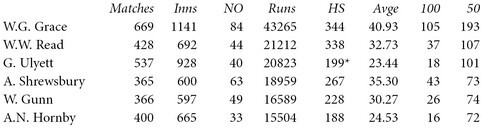
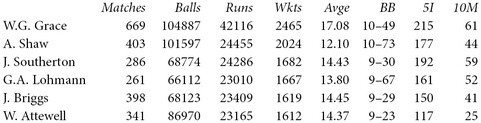
Numbers have cemented the reputations of the two most famous cricketers: W.G. Grace and Don Bradman. They show that Grace was far and away the best batsman of his time, especially considering that Arthur Shrewsbury only appeared towards the end of this period, when pitches were much improved.
Most first-class runs, as at the end of the 1895 English summer
Most first-class wickets, as at the end of the 1895 English summer
Most catches in the field over the same period
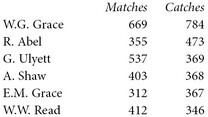
Compiled by Benedict Bermange, Sky Sports statistician
But Grace enjoyed one purple patch that nobody has equalled, not even Bradman. From 11 to 18 August 1876, Grace raised the numerical bar to new heights by scoring 839 runs in three first-class innings. Two of them were the first triple centuries.
After Minshull it had taken almost half a century for the first double century to be scored, at any level: William Ward’s 278 for MCC against Norfolk at Lord’s in 1820, in a fixture that could be called first-class except that matches of the time were not awarded any such status. To raise the bar, Ward had pioneered his own method of practice: in the nets at Lord’s he had the groundstaff bowling at him from 18 or 19 yards, so that batting in the middle felt easier. Ward also practised by batting with a walking stick, as Bradman would do, to condition his reflexes. One difference from modern practice was that in scoring his 278, he used a bat which weighed four pounds and lasted him for 50 years. After Ward, more than half a century elapsed without anyone reaching 300 at first-class level.
In July 1876, Grace warmed up by being credited with, if not actually scoring, the first 400 by an adult. It was against XXII of Grimsby, when every one of his opponents fielded. As Grace came off the field, after his United South of England XI had been dismissed for 681 off 340.1 four-ball overs, he asked the scorer how many he had got and was told 399. ‘Make it 400,’ Grace said. The only surprise, I suppose, is that he did not order the scorer to make it 405, for then he would have made the highest innings at any level, beating the 404 made by a schoolboy, Edward Tylecote, at Clifton College in Bristol.
Like many batsmen who enjoy a purple patch, Grace was in his prime at the age of 28, blending youthful energy and experience to maximum effect. Grace no longer did athletics in his off-seasons – he had won 70 trophies, mainly running races, so he claimed – and it was only by playing cricket that he became match-fit and was able to make light of his 15 stone. At Canterbury, representing MCC, Grace had to bowl and field while Kent scored 473. MCC buckled in the heat in their first innings and had to follow on. By the close of the second day they had scored 217 for four wickets and Grace was 133 not out. The Times reported on Monday, 14 August, after the three-day match had ended on the Saturday:
No one attempted to forecast the result, and few, if any, dreamt that Mr Grace would rub out the debt of arrears himself, but he did. This feat puts into the shade that of Mr Ward in 1820, whose score of 278 has till now been regarded as the most wonderful of its kind on record. The enormous total of 344 completed by Mr Grace on Saturday occupied six hours and a quarter, this giving an average of 57 runs per hour. He had to contend against all the Kent bowlers save one. Three of them went on three times and three twice. In one instance Mr Yardley bowled from the right arm and then from the left. Never was a more striking exhibition of endurance against exhaustion manifested. To explain the progress it may be well to say that play began at 12 o’clock on Saturday, and in 90 minutes the overnight total of 217 advanced to 323, and ten minutes later the arrears were pulled off. At 4.35 Mr Grace had scored just 300, and at 5 o’clock the figures 500 appeared on the telegraph . . . Now came the close of Mr Grace’s career – caught at mid-off, and great was the joy thereat. His score of 344 contained 51 fours, eight threes, 20 twos, and 76 singles. Half an hour remained for play.
When Grace wrote, or rather dictated, his memoirs, he added a few details. ‘Saturday was one of the hottest days of a very hot month, and I thought I might as well put my best foot forward.’ On the Friday, when opening MCC’s second innings, Grace had decided to hit out or get out: if the latter, he could get home by train on the Saturday, to rest on Sunday before Gloucestershire’s match against Nottinghamshire at Clifton College on Monday. Grace also recalled that he broke his bat during the first part of his 344 and had to borrow another, but its handle was too thin. ‘However, during the luncheon-hour the Hon. Spencer Ponsonby Fane very kindly got hold of some thick twine, which he wrapped round it and brought it up to the right size. Tired nature began to tell its tale during the afternoon: but relief came from the officers’ tent in the form of champagne and seltzer.’ Alcohol seems to have made an effective substitute for tea, there being no such interval then.
The start of Gloucestershire’s match on Monday at Clifton College was put back until 1 p.m. after Nottinghamshire’s players had been delayed on the train. Grace set off like one, driving the second ball of the match from Alfred Shaw, the best bowler in England, for four and cutting the third for four more. But not every side of the College ground had a fixed boundary. According to the Bristol Times and Mirror, Grace ran seven after one hit: ‘The champion drove the bowler tremendously to square-leg, right to the Pembroke-road end of the field for 7, which were run amidst great cheering.’ Professional batsmen of today are doubtless fitter but they never have to run 140 yards without stopping.
After luncheon Grace hit a six ‘right over the trees into College-road’. When he lofted a ball towards the grandstand, a lady was about to be hit by ‘a rather hot one’ until the champion’s younger brother Fred intervened ‘to jump high up and catch it’. Grace pretended he had been caught out, and took a few paces towards the pavilion ‘but returned amidst loud cheers’.
The crowd evidently expected him to go on to surpass his 344 of two days before, but after Grace had been batting for three hours, Nottinghamshire tried an occasional bowler in John Selby, soon to keep wicket in the first of all Tests. Fred Grace pulled Selby’s first ball for seven, ‘for there was no boundary on the sloping side of the College Ground in those days,’ as W.G. recalled. The champion then helped himself by pulling Selby for six. But the Nottinghamshire fielder William Barnes then moved himself to deep square-leg. When Grace tried another pull against Selby, he ‘got under the ball’ and was caught by Barnes for 177. Grace had to be content with taking eight wickets in Nottinghamshire’s second innings and leading his team to the double over a county they had never beaten before. If Gloucestershire avoided defeat against Yorkshire in their next game, they would be county champions for the first time, so proclaimed the newspapers of the day.FN51
Next morning, Grace was in Cheltenham to face Yorkshire. The old story is that the Yorkshiremen had bumped into the Nottinghamshire players at a station and been told what happened at Bristol. Yorkshire’s Tom Emmett had replied: ‘The big ’un has exhausted himself, and cannot do the century trick thrice in succession. If he does, I mean to shoot him, in the interests of the game; and I know there will be general rejoicing, amongst the professionals at least!’
The new story is that Grace seems to have placed a bet on himself to score 300 against Yorkshire. The Bristol Times and Mirror reported: ‘It was rumoured on the ground, and was probably only a rumour, that Mr W.G. Grace had offered to back himself (before starting) that he would make 300. The wicket is in splendid condition, and it is not at all improbable, barring accidents that he will do it.’ It is unlikely that a reporter on a daily provincial newspaper, in the respectable mid-Victorian era, would have reported a rumour without any substance.
On another hot day, Grace opened the batting with his elder brother, Edward or ‘E.M.’. Just as the previous game had attracted the largest crowd yet recorded at a match in Bristol, so did this game in Cheltenham, such was the excitement the champion was generating. E.M. was soon ‘neatly caught’ by mid-on, who, in those chivalrous days before a county took a twelfth man to away games, was a Gloucestershire player. Yorkshire, in need of a substitute, had been lent R.E. Bush, down to bat at number seven. The champion would not have been amused if he had been caught by one of his own players, but he might well have chortled behind his beard when this fate befell his elder brother, with whom he competed all his life.
Yorkshire’s side contained three bowlers soon to represent England. None could stem the champion’s flow. ‘Twice in succession did he drive the bowler out of bounds for four,’ reported the Bristol Times and Mirror: the victim was Allen Hill of Lascelles Hall. Next to be taken apart was George Ulyett. ‘The score having run up to 114, Ulyett changed his bowling from slow underhand to fast round hand, but without any immediate effect.’ Immediately after lunch, by when he had made 94 out of Gloucestershire’s 139 for one wicket, Grace cut the first ball from Tom Emmett – the third England bowler in the making – for two, and on-drove the next for four. In the game at Clifton College, Grace had been restrained after the interval, as if he had lunched too well, but not here.
Grace hit another seven, on this occasion off Robert Clayton: ‘The champion opened his shoulders and cut him right away to the entrance gate, for which he ran seven, amidst great cheering.’ At 168 for four, Gloucestershire were by no means on top in this crucial match but, whether assisted by champagne and seltzer or not, ‘the champion knocked the balls where he liked’ and reached 216 by the close of the opening day. Yorkshire’s bowlers were demoralised by run-scoring on a scale never seen before. Hill was reduced to the point where he refused point-blank to bowl at Grace. His captain Ephraim Lockwood also hailed from Lascelles Hall, but Hill would not be persuaded; at which point, according to another anecdote, EmmettFN52 criticised Lockwood for letting Hill get away with it.
August’s heatwave then broke, and rain made batting difficult – for mortals. Simon Rae’s biography of Grace has Gloucestershire’s last man, James Bush, coming to the wicket when the champion was ‘a few runs short of 300’ and assuring Grace that he would stay in ‘until you get your runs’ – and until Grace had won the money he had bet on himself, one might conjecture. The champion’s own account of this innings at Cheltenham was extraordinarily brief, given that it was by far the highest score ever made in Championship cricket. He confined himself to saying that he never played on a better wicket than this one at Cheltenham and that Mr Moberly batted in ‘his very best form for 103’ in their fifth-wicket stand of 261. (William Moberly, having attended Rugby School, played rugby for England, as did James Bush.) ‘Our total was 528, and my score 318 not out. Yorkshire made 127 for seven wickets.’ Such is Grace’s complete account; and, I would venture, a suspiciously bare one.
The Graphic was a weekly periodical which used large illustrations to tell its readers about the benefits that British soldiers around the world were bringing to mankind: a double-page sketch in August 1876 depicts ‘Bashi-bazouks attacking women and children’ in Serbia. After Grace’s 318, which would surely have gone on to exceed his 344 if only a teammate had stayed with him, The Graphic opined with some foresight: ‘The gigantic scores of this wonderful batsman and “all-round” cricketer, obtained against first-class bowling, fairly astonish the present generation, and will probably remain the wonder of many generations to come.’
As a professional historian, and an eminent one, C.L.R. James wondered rhetorically about Grace in Beyond a Boundary: ‘What manner of man was he? The answer can be given in a single sentence. He was in every respect that mattered a typical representative of the pre-Victorian Age . . . His humours, his combativeness, his unashamed wish to have it his own way on the field of play, his manoeuvres to encompass this, his delight when he did, his complaints when he didn’t, are the rubs and knots of an oak that was sound through and through.’
Grace left a less favourable impression on Australians after he captained the English tour of 1873–74, before Tests had been invented. An amateur, Grace negotiated a fee ten times that of the professionals, and insisted on taking his newly wedded wife, Agnes, for free, and on free food and drink. Betting by Grace and his players on the matches was prevalent, even rampant. ‘Those who have strenuously opposed any attempt to introduce the betting element into cricket had a specimen on Saturday of how a game may be marred when the players are pecuniarily interested in the result,’ the Sydney Mail reported after Grace and his team had been booed from the field. A commentator in the same newspaper is quoted by Rae: ‘The play of Grace and his team is looked upon with the utmost distrust.’ Such eyewitness accounts do not square with James’s verdict on Grace’s oaken soundness: ‘All who played with him testify that he had a heart of gold.’
Grace was unquestionably popular and the most famous sportsman in Britain, perhaps second only to the Queen as a recognised figure in the Victorian era. He was the first sportsman to be depicted by the cartoonist ‘Spy’ in Punch. The Daily Telegraph launched a National Shilling Testimonial during his annus mirabilis of 1895, when he not only became the first to score 1000 first-class runs in May (only two batsmen since have done it in May), but also reached his 100th first-class century. It raised £5,281 9s 1d, while another appeal by MCC raised more than £2,000. But what was he like, and what made him so good, apart from his technique? His contemporary Allan Steel noticed that Grace, by the 1880s, was one of only a small handful of batsmen who had adopted the revolutionary method of playing forward with bat and front pad together.
On the 150th anniversary of Grace’s birth I visited Downend. The house, with the orchard where his mother had bowled to him and taught him to play off the back foot, had disappeared long before 1998. But still standing was the house to which his family moved, across the road from Downend’s cricket ground. There I met two men past 70, cricketers in their day, who had lived all their lives in Downend; as had their parents, who had observed the Graces at close quarters.
I had been inclined towards the heart-of-oak interpretation, because James was eminent, and persuasive. Yet, talking to this pair of ancients, I realised that Grace and his family were ruled by hugely acquisitive appetites. Whatever was going – runs, wickets, food, drink, money – W.G. insatiably grabbed.
I asked the pair directly: ‘What were the Graces like?’ Both men replied with the same word at the same moment. I did not think I had heard correctly, so I asked again. No mistake. The single word they uttered was: ‘pigs’.
Archie MacLaren, benefiting from the infrastructure of cricket at Harrow, was the first to scale 400 in a first-class match. As Somerset had only recently been granted first-class status, The Times did not have its own reporter at Taunton in 1895, but relied on this agency report, replete with commas:
Dr W.G. Grace’s record for a first-class match of 344 for MCC v Kent, at Canterbury, in 1876, after standing for 19 years, has at last been beaten, and to Mr A.C. MacLaren, the old Harrovian, belongs the honour. Mr MacLaren yesterday, at Taunton, after batting all Monday and well into Tuesday, made 424, so that he exceeds Dr Grace’s figures by 80 . . . Mr MacLaren was seventh to leave at 792, when a catch in the long-field disposed of him. He played splendidly from the time he went in, and his success, following on his fine feats in the colonies with Mr Stoddart’s team, will be universally esteemed. The highest individual score ever made in any match was the 485 by Mr A.E. Stoddart for Hampstead v Stoics in 1886. In the present match Mr MacLaren was batting seven hours and threequarters, and his best hits were one six, 62 fours, 11 threes and 37 twos. After Mr MacLaren had gone the Lancashire innings was rapidly finished.
Not until the 1920s was the numerical bar raised again, fuelled by the rivalry between Victoria and New South Wales. The Victorian Bill Ponsford scored 429 against Tasmania, who had first-class status but were not considered up to the Sheffield Shield, then 437 against Queensland, who had just been admitted to the Shield. For NSW, Bradman responded by scoring 452 not out against Queensland, establishing his reputation as the greatest of run machines. The news spread, if not so quickly as today. Eventually, it reached the ears of a family who clung to cricket after being caught up in the mass slaughter of Partition.
Hanif Mohammad told me in an interview in Karachi how he came to break Bradman’s first-class record of 452 not out, and to reach 499, and fall four feet short of becoming the first to score 500 runs in one innings. He had retired from other work but still oversaw the preparation of pitches at the National Stadium in Karachi. One afternoon on England’s 1987 tour of Pakistan, he motioned to one of the groundstaff to bring a couple of wicker chairs on to the outfield, and lit a cigarette in a holder. Like Len Hutton, like most traditional opening batsmen, Hanif did everything cautiously and carefully.
By 1958 he was Pakistan’s most famous sportsman. Radio had spread his reputation among the masses, as television was to spread Imran Khan’s, and had served to unite the young nation. When Hanif had scored 337 against West Indies, in the Bridgetown Test of 1957–58, Pakistan’s government had granted him 337 square yards of land in Karachi on which to build a new home. He and his four brothers had been born in Porbandar, in a well-to-do family (his mother had been liberated enough to play badminton), then lost everything in Partition’s terrifying turmoil. They had washed up in a deserted Hindu temple in Karachi, bringing to the newest country nothing save their skills. Wazir, Hanif, Mushtaq and Sadiq Mohammad went on to score 29 Test centuries between them, in a period when Pakistan sometimes played only one or two Tests a year. Along with Raees, the five brothers scored 190 first-class centuries and took more than 1200 first-class wickets.
Most batting records are set against weak or weakened teams. Norfolk in 1820 had lost three men absent injured by the time they had their second innings, after Ward’s 278. The Kent side against which Grace scored his 344 contained twelve players, but the bowling was mostly in the hands of amateurs. Somerset in 1895 were on their last legs because they had been hit for more than 600 by Essex the day before MacLaren’s 424. When Brian Lara trumped Hanif and scored 501 not out in a four-day Championship match against Durham in 1994, it was a literally pointless exercise after Warwickshire had reached 350 and their fourth batting point, because the match was condemned to a draw.
Hanif’s feat of mountaineering came in the semi-final of the Quaid-e-Azam Trophy in January 1959 between Karachi and Bahawalpur. Bahawalpur were weak in batting but had a Test off-spinner in Zulfiqar Ahmed, who had been prominent in Pakistan’s first Test victory over England at the Oval in 1954; and they were, according to Hanif, a decent fielding side.
On the first day, Bahawalpur were rolled over for 185. Their home ground, the Dring Stadium, built according to the instructions of Colonel Dring, adviser to the Mir of Bahawalpur, had a turf pitch.FN53 This semi-final venue, the Karachi Parsi Institute ground, had a pitch made of coir matting, like all pitches in the city then. It was not unknown, whether in India, Pakistan, South Africa or Trinidad, for coir matting to be drawn tight, before being nailed down, when the home side batted; and to be loosened when the visitors’ turn came, so the ball would bounce unevenly.
In any event, the KPI pitch must have been sound when Karachi batted, for Hanif said that during this innings he learnt to drive on the up off the back foot. The outfield was like glass on the bare side of the ground where hockey was played, and by the end of the second day he had scored 255.
Over the family dinner table that evening, Hanif’s elder brother Wazir issued the challenge. Wazir, another member of the victorious Pakistan team in the Oval Test, and good enough to have hit 189 against West Indies, was now the Karachi captain and nicknamed ‘Wisden’ because he knew records by heart. He was conscious, furthermore, of the prestige that would accrue to the newest nation if Bradman’s 30-year-old record was broken by a Pakistani.
‘Now you must go for the world record of 452 by Bradman,’ Wazir told Hanif over dinner on this second evening. ‘You can have good rest tonight and go for it tomorrow.’ The key to Hanif’s batting, so he himself said, was concentration; and the key to concentration was sleep. During a match, Hanif said, he would sleep for nine hours a night.
Next morning Hanif cruised onwards to 451. He hit a two to overtake Bradman and set a new world record. ‘I waved to Wazir and naturally everyone was clapping, including the fielders, though they were tired.’ But Wazir did not declare. So Hanif kept batting until the shadows of the trees came over the KPI ground, and when the final over of the third day began, the telegraph scoreboard showed that Hanif’s score was 496.
‘One of the medium-pacers was bowling and I thought I needed four runs from the last two balls,’ Hanif remembered. ‘So when I hit the fifth ball to extra-cover – who was quite deep and misfielded – I thought I could get back for a second, and score two more runs off the last ball.
‘Then the next thing I saw was the ball going towards the keeper’s end and into his gloves, and I was run out by four feet, and I thought “Bad luck!” But as I was walking off, the boys on the scoreboard put up 499. They said the score had been going so fast that the scorers hadn’t been sure about what I’d made. Then I was very annoyed.’ If Hanif had known he had been on 498, with two balls to go, he would have played the situation differently.
Hanif did not sound annoyed as he sat in his wicker chair at the National Stadium, where Pakistan had never lost a Test match to that point. He even asked politely for my help. He said that when he had scored his 337 against West Indies, the time of his innings had been recorded as 999 minutes. Wisden, however, had marked him down for 970 minutes: still the longest Test innings to this day, but almost half an hour short of what Hanif had thought it had been, and one minute short of one thousand. The next time I was in Barbados I forgot to look in the newspaper section of the Bridgetown library. But thanks to Cozier père et fils, Tony and Craig, I can cite the archive of the Barbados Advocate: Hanif batted ‘for 16 hours, 13 minutes’ or 973 minutes in all.
The first recorded innings of 300, and 400, and 500, and 600, were all scored at Clifton College in Bristol.
When Edward Tylecote made his unbeaten 404 in a house match in 1868, it was between Classical and Modern or, roughly translated, Swots v Oiks. The Close was bedding in then, as the College had not been founded until 1862, but it should have been a well-drained ground, being situated above the Avon Gorge. W.G. Grace might not have chosen Clifton College to be his son’s school in the 1890s had the pitches not been sound.
Tylecote was a renowned sprinter, and such were the rules then on the Close that only one of his strokes was a boundary: all of his other 400 runs had to be run. I would like to know if Tylecote was one of those batsmen who kept his own score, as he went on to take a first in maths at Oxford, and to become a maths tutor there, in addition to being the first Test wicketkeeper to score a fifty.
A generation later, in 1899, Arthur Collins became the first to scale 500 and 600. A reproduced scorecard hangs on the wall of the junior house called North Town, against whom Collins scored his 628 not out. The junior house for whom he played, Clarke’s, exists no longer. The ground is only a hundred yards down the road from the junior houses, so the 13-year-old would not have had to lug his bag far after his innings – nothing like Tommy Burton, at any rate. Collins also took 11 wickets in the game, which can be viewed as a more valuable contribution than his batting, because Clarke’s won by an innings and 688 runs.
Unromantic truth be told, the ground on which Collins scored his runs is very small, tucked around a corner of the main buildings from the Close where Tylecote and Grace scored their runs. On three sides a stone wall runs sometimes only 30 yards or so from the central pitch. The one smaller cricket ground I have seen is that at Banket School in Zimbabwe, where Graeme Hick scored his first century at the age of five.
The entrance to Clifton College is no mere gate. High-arched, it is more of a mausoleum, and through it pupils to this day have to walk in silence. On the internal walls are the names of pupils killed in the two World Wars, column after column after column. In the First World War alone, 578 of Clifton’s pupils died, including Collins himself, killed in action while serving with the Royal Engineers at the First Battle of Ypres.
A statue of Field Marshal Douglas Haig, who as commander of the British Expeditionary Force for most of the war decided on the strategy of trench warfare, and another Clifton College alumnus, stands close by. Five hundred and seventy-eight deaths: that is only fifty short of one death for every run Collins scored. At this scene, of the breathless hush, 578 is the number I recall.
Numbers, and the awe that their natural progression can inspire, kick-started my career. In the records section of Wisden, no doubt for ever more, is the match in Pakistan in 1964 when Railways (910 for six declared) defeated Dera Ismail Khan not by the mere margin of 851 runs, but by an innings and 851 runs. Beyond these huge numbers, however, what was the human face of this story?
On my first England tour, in 1977–78, I went ahead of the players to travel for a couple of weeks in Pakistan. I could not get to Mohenjo-daro, which is one of the world’s wonders as the great city of Indus Valley civilisation, on that visit; but I flew to Chitral, rode on the back of a jeep over Lowarai Pass to Swat, and ended up in Dera Ismail Khan, or D.I. Khan as the locals abbreviated it, on the west bank of the Indus.
The match had happened exactly 13 years earlier, to the week, which seemed a highly appropriate time span. After this single match, D.I. Khan’s inaugural first-class game, the Pakistan board expelled them from the Ayub Trophy. Subsequently, most of their players had left town, but with the aid of an interpreter I tracked down one of their opening bowlers, Inayat Ullah, whose figures had been 59–2–279–1 (hell, I could relate to them).
Inayat lived in a mud-brick hut, without electricity, on the outskirts of town. Through the interpreter, as we sat on his floor, he told me his wife was ill. I asked him about the match and he seemed a little awkward at first, although he should not have been. D.I. Khan were a collection of club cricketers assembled for the first time and packed off to Lahore to face Railways, who were a professional outfit: in the early 1960s they and Pakistan International Airlines were the two teams that employed cricketers.
Inayat recalled his opening partner, Anwar, who was in the army and bowled a touch quicker than his own medium pace. Anwar had not been so economical, but he had been more penetrative, slightly: 46–3–295–3. As the Railways’ total mounted, Inayat recalled, Anwar had walked back to his mark, then past it, and kept walking until he hid behind the sightscreen. I warmed to this sense of humour, and proportion.
My father had possessed one autograph: that of Wally Hammond. Too shy himself, he had pressed his twin sister Rosemary to go and ask Hammond, with a piece of paper torn from a notebook. The only cricketer whose autograph I have asked for comes at the opposite end of the spectrum, but I thought Inayat Ullah’s perseverance was admirable. In the absence of back-up bowling, he could have thrown in the towel, yet he kept going for almost 60 overs, taking quite a few hits for his team. Only later did the realisation dawn that Inayat’s sadness might not have been entirely due to his wife being ill, but a legacy of his one first-class match. As D.I. Khan travelled on that train to Lahore, he must have nursed some slim hopes of making the grade as a professional cricketer, which would have set him up for life, but they died in the dust of Punjab.
In the short term, young and heedless, I took the overnight Khyber Mail, wrote up my story – an exclusive, of an historical kind – and filed it at the telex office in Rawalpindi. Satisfied, I went to dine in old Raj style at Flashman’s Hotel. Waiters in dinner jackets lined the walls, though I was the only person in the dining room. Travelling to new places, in countries that I would not otherwise have been able to visit, and dining at someone else’s expense – and paid to do so. This was the life!
Having ordered the consommé, and a beer from the local Murree brewery, I sat back and savoured. In a couple of days the England team would arrive. They were to bring a copy of The Observer. Some, like the captain Mike Brearley, were amused by my story of what was the biggest defeat ever, for in reply to Railways’ total of 910, D.I. Khan had scored only 32 and 27. As the soup and beer slipped down, I felt something itchy under my sweater – and out fell a cockroach. It landed on the carpet, in the middle of the dining room, and walked away in front of all those dinner-jacketed waiters. That’s cricket: however big the numbers, it never misses any opportunity to cut you down to size.