
7
The Rapid Debt-Repayment Plan
No investment is as secure as a repaid debt.
Austin Pryor, The Sound Mind Investing Handbook
If your kitchen is on fire, fireproofing your home is the last thing on your mind. All you can think about is getting that fire out. But while your efforts are directed specifically at the problem at hand, you are also watching to make sure fires are not appearing in other rooms of the house as well.
The same goes for debt-proofing your life. Any debt you have is tantamount to that kitchen fire. You need to devote your efforts to getting out of it! At the same time, you must do everything in your power to make sure you don’t create more debt in other areas of your life. When you get that fire out, I assure you you’ll be a lot more interested in fireproofing your house. In the same way, once you are out of debt, you will be seriously concerned about debt-proofing your life.
You Need a Get-Out-of-Debt Plan
Several methods will help you get out of debt. Some concentrate on debt with the highest interest rate; others start with the smallest debt. Some plans require you to increase all your payments from the get-go, while others work with the minimum monthly payments you have presently.
If you’re in debt, you have to get out by whatever means works for you. So put your mind into high gear and put together a plan—then stick with it. Commit to do whatever is necessary to complete the plan. (If you want to do yourself the biggest favor of all, commit to completing it in half the time.)
Above all, remember that a plan is only as good as your ability to stick with it. As with diets, all of them work in theory. The true test, however, is which plan you will stick with.
No matter how good a plan looks on paper, if the regimen is outlandish and impractical, you will not stick with it. When evaluating a get-out-of-debt plan, you should look for the following characteristics:
· It is specific.
· It is easy to prepare.
· It is simple to understand.
· It is visually pleasing and reader friendly.
· Its results can be measured.
· It has a specific finish date.
· It is self-directed.
When it comes to this kind of effort, the simpler the better. But don’t sacrifice quality on the altar of simplicity.
The Rapid Debt-Repayment Plan
Surprise! I have developed a plan that fits the above criteria. It’s a simple plan, and it’s effective because it works. I call it the Rapid Debt-Repayment Plan, or RDRP.
This plan is specifically designed for unsecured debt—not your mortgage, home equity loans, or auto loans. The plan itself would not know the difference between a secured and an unsecured debt, so if you were to include, for example, a home equity loan with your unsecured debts, the RDRP could put the home equity loan ahead of a large, high-interest credit card debt, and that would be counterproductive. Remember, one of the tenets of debt-proof living is that unsecured debt is the first thing that has to go. Secured debts are targeted for repayment at a point later in the plan.
The RDRP is simple because it has five simple rules. If you adhere closely to all five rules, you will get out of debt in record time. Just imagine how your life will change when you are completely free of your unsecured debts. That can happen more quickly than you might have dared to dream. And more than that, if you stick with it, it will happen!
Rule 1: No new debt. That’s simple. You have to stop using the credit cards or adding any new unsecured debt. Now. If you don’t stop adding to the problem, you’ll be like the homeowner with the kitchen fire—except instead of putting out the blaze that’s ready to destroy the entire structure, you’ll be pouring gasoline on it. The fire might be manageable for a while, but you’ll be on your way to a full-on raging inferno. The rule is simple: no new debt.
Rule 2: Pay the same amount every month. Make a list of the minimum payments you are required to make on all your unsecured debts this month. Include your credit card accounts, store charge cards, installment loans, student loans, and personal loans. Include any medical and dental payments—every unsecured debt for which you are currently responsible. Add them together. Look at that number. It is very important. Think of it as one single debt payment rather than a bunch of payments, some of which vary from month to month.
Pay that same amount every month until you reach $0, even if your statement arrives in the future and you notice that your required payment has dropped. Do not pay attention to that. And since you will not be adding any new purchases, the required payments won’t go up.
You may have heard and even come to believe a myth about paying off credit card and other kinds of debt. It goes like this: You will never get out of debt if you do not pay more than the minimum required payment every month. I want to assure you that you can and you will get out of debt even if you cannot pay one penny more than the amounts you are required to pay this month.
This should come as great news if all you can pay is the minimum amount. That’s all that it takes for you to get out of debt. If you can pay it this month, you can pay it next month and every month thereafter.
From now on you will not pay attention to your creditors when they reduce your minimum monthly payment, which is what we call the “falling payment” method. For example, if your payment this month to your Visa credit card account is $143, under rule 2, you will always pay $143 to that credit card until you reach $0 on that debt, even though your statement may say that you need to pay only $125, $94, or whatever as the balance declines. Remember that the bank who issued your Visa card is not at all interested in you paying that debt in full. Accepting smaller payments each month is one way they attempt to keep you on the hook and in perma-debt.
Rule 3: Line up your debts according to the number of months left to pay off. To do this, answer this question for each of your debts: How many months will it take to reach $0 if I add no new purchases and I make my “fixed” payment every month? You might assume that this would put the debt with the smallest outstanding balance at the top and the largest at the bottom, but that is not necessarily the case. And this step can be a little trickier than simply dividing the current balance by the current payment because of the way interest is calculated. For now, go ahead and arrange your debts from smallest (shortest time to payoff) to largest with the small one at the top of the list. Note: I have a calculator that is going to do all the math for you, and I’ll tell you about that in a bit.
Rule 4: Ignore the declining minimum monthly payments you will see on your statements. You will be tempted to watch your monthly statements closely, if for no other reason than to watch your progress. And there will be times when you may be tempted to pay the amount you see due on your statement rather than the fixed payment on your RDRP. Let me repeat: The amount you pay in the first month is the amount you are going to pay until your total debt reaches $0 regardless of a lower “amount due” appearing on your statement.
Rule 5: As one debt is paid, add its payment to the regular payment of the next debt in line. This is where the “rapid” kicks in because as one debt is paid, you’ll begin sending much larger payments to the next debt in line. This is where it gets exciting. Your total monthly debt payment established in rule 2 remains the same to the victorious end. This is the secret of the RDRP and getting out of debt fast.
Meet the Greens
Let me show you how this plan works using Bob and Sally Green as our fictitious subjects. Below is a list of their unsecured debts: the name of each creditor, the current balance, the interest rate (APR), and the current minimum monthly payment.
The Greens have a lot of unsecured debt, including a signature loan with a credit union, two credit card accounts, an old personal loan from Sally’s parents, as well as student debt from Bob’s college days.
Here’s a snapshot of the Greens’ unsecured debts as of this month:

Following are three charts representing three debt repayment scenarios for the Greens. We’ll call them scenarios A, B, and C.
Scenario A
In this scenario, the Greens are following rule 1—they agree to stop adding any new debt—but do not follow rule 2. Instead, they follow the payment schedule set up by their creditors that they see on their statements each month.

The Greens’ monthly unsecured debt payment is $541 (rule 1.) If they add no new debt and follow their creditors’ repayment schedules, they will end up repaying $23,822 in principal plus $29,004 in interest, for a total of more than $50,000. And it will take them 485 months to do it. That’s more than forty years.
How can that be? The culprit is something known as “falling payments.” Some creditors determine the minimum monthly payment as a percentage of the outstanding balance. This way, as you pay down the balance, the amount they require each month goes down proportionately so that the debt just goes on and on and on.
Scenario B
In scenario B, the Greens follow rules 1 and 2. They determine to add no new debt and to keep their monthly payments the same as they are right now. They will pay $541 toward their unsecured debt load every month until they are debt-free. But as one debt is paid off, the money they’ve been paying to that creditor each month is absorbed into some other area of their lives, not their RDRP.

Because in scenario B the Greens are diligent to pay the same amount of $541 toward their RDRP regardless of the lower amounts their creditors might accept as their balances fall, the Greens do improve their situation. They pay $24,321 in interest, which saves them $4,684 over scenario A, and they cut their payback time to 363 months, just slightly longer than thirty years. But is that really that much better? Now consider scenario C.
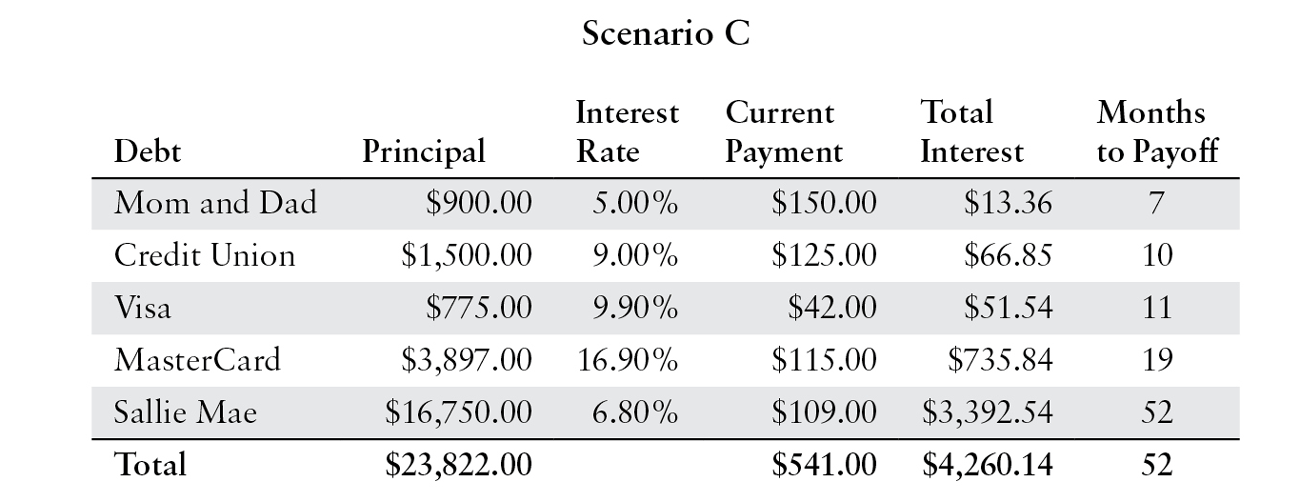
In this scenario, the Greens follow all five rules, treating them as nonnegotiables. They stop incurring new unsecured debt, and they pay the same amount of $541 every month. They put their shortest payoff debt at the top of the list, and as one debt is paid off, they take its payment and redirect it to the next debt in line, thereby accelerating the payoff plan.
In scenario C, the Greens repay $23,822 in principal plus $4,260 in interest in just fifty-two months—four years and four months.
Here’s a quick recap:

When we compare the different scenarios, we see that there are definite advantages to following all the RDRP rules. If the Greens faithfully commit to the debt-repayment plan laid out in scenario C, their payment schedule will look like the following.

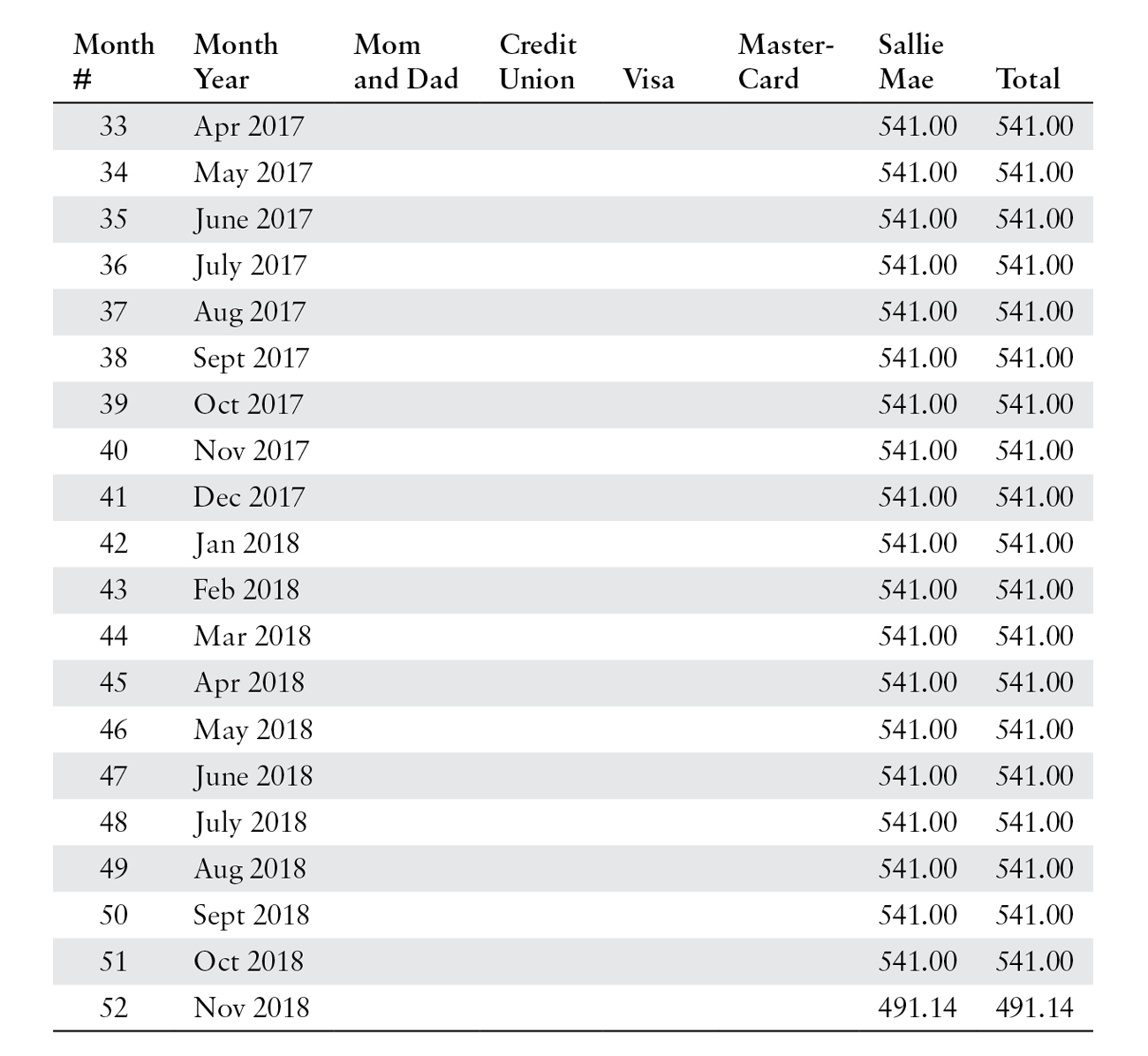
Notice that the debts are sorted so that the loan (Mom and Dad) with the fewest number of payments is in the first position. The Greens’ monthly total is still $541, the amount they commit to pay each month toward their RDRP. They also agree to no new debt. However, after the loan from Mom and Dad is paid in full, the $150 that was going there is added to the credit union payment. When the credit union loan reaches $0, both Mom and Dad’s payment and the credit union payment are added to Visa’s regular payment. The Visa debt reaches $0 in month 11, and MasterCard’s payment jumps from $115 a month to $432 a month until it is paid. Finally, the entire $541 goes to Sallie Mae to wipe out the student loan in fairly short order. According to this schedule, Bob and Sally Green become free of all unsecured debt in November 2018. They avoid paying $24,744 in interest charges (that’s money from their future paychecks they will get to keep), and they are debt-free in fifty-two months, or four years and four months.
Oh, the power of a plan. Bob and Sally can see exactly when they will be finished paying off their debts. And if they decide to accelerate their plan even more, they can simply add to the amount they pay to the first debt.
Once the Greens are debt-free in November 2018, they can immediately redirect the entire $541 to some other specific purpose—such as rapidly repaying their mortgage, contributing to an investment program, or some combination of the two.
Let’s see what will happen if the Greens (both will be thirty-nine years old when they finish paying off their debt in November 2018) redirect $541 a month ($6,492 annually) into an investment vehicle that earns 8 percent growth compounded annually (this is a realistic growth rate if they invest over a long period of time) until they retire at age sixty-five.

If the Greens invest $541 every month at a return of 8 percent compounded annually, in twenty-six years, their total investment, which includes the cash invested and their accumulated earnings, will be $522,620.89. This is representative and not a guarantee. Nor is there a ceiling on the amount of wealth these monthly contributions can grow. It is a conservative estimate.
The RDRP Calculator®
Premium members of my website DebtProofLiving.com have access to the Rapid Debt-Repayment Plan calculator and manager. Visitors to the site can see how the calculator works by clicking on the RDRP calculator demo on the home page.
The RDRP calculator prompts you to input basic data regarding your unsecured debts: current balance, interest rate, current minimum payment, and whether the payment is fixed or falling.
You may have some loans with fixed payments, in which case the payment remains the same until the balance is paid in full. Examples may be your student debt or a medical bill. Even if you pay down the balance more rapidly than required, the monthly payment will be the same next month and every month thereafter.
Credit cards, on the other hand, are typically subject to falling payments, meaning that the payment each month is a percentage (2 to 4 percent is typical) of the outstanding balance. As the balance declines or falls, so does the required monthly payment. It is critical that you check the proper method of payment for each of your unsecured debts as you input them into the RDRP calculator. Interest is calculated differently for fixed payments and for those that are subject to the falling method.
After you’ve input all your unsecured debts, click on “compute.” You will receive three sets of results that correspond to the scenarios A, B, and C above. Following this you will find your scenario comparison summary and your specific rapid debt-repayment schedule. Cast your eyes to the bottom of this schedule and you will see the exact month and year you will celebrate your personal debt-free day!
The Question
If you haven’t already asked the following question, you probably will at some point: Wouldn’t it be better to line up my debts according to interest rate, with the highest interest rate debt in the first position rather than the debt with the shortest payoff time?
Theoretically, perhaps that is the way to go. And some financial experts do in fact advise that method. But keep in mind that I designed this plan with myself in mind.
When I tackle a challenging job, I need gratification as quickly as possible—and right now would not be too soon. If I approach my debt-repayment plan with the largest interest rate as the first priority, I might be working on my largest debt. It could be many years before I reach my first zero balance. That would be like going on a diet and not losing any weight for three years . . . maybe four. Who would stick with such a plan?
I have worked these plans every which way possible and still believe that the potential difference in interest is minuscule compared to the benefit of using a plan that has a high probability of taking me across the debt-free finish line.
The difference, if any, in the long run between a plan that puts the highest interest rate debt in the first position and one that puts the debt with the shortest payoff time first is going to come down to one or two months at the end. And I say if this is a plan that has every possibility of getting you to the end, that trumps everything—even one or two additional months to get debt-free. The RDRP is a plan that works because it is something you can live with. It is both economically and emotionally sound.
Optional Rule 6: Report. Over the years, many people have reported using the RDRP successfully. I know because they write to me and tell me of their progress and when they pay off that final debt. If you are carrying unsecured debt, I hope to hear from you too. Please let me know when you cross the finish line. I do care, and I will celebrate your victory.
Just recently we received a call at the DPL office. I was out at the time, but my assistant spoke with this caller who was experiencing a particularly emotional moment. She explained that she couldn’t give her name or number, but she needed to speak with someone . . . anyone!
She had begun working on her RDRP several years previously when she had more than $24,000 in unsecured debt. She explained that just prior to calling she’d mailed the last check. Her RDRP was complete. She had made it. She needed to tell someone who would care. I’ll never know who this dear woman was, but I am still doing mental cartwheels to celebrate her accomplishment.
Turbocharge Your RDRP
One reason the RDRP is such a great tool is that it does not require you to increase any of the payments beyond the current minimums you are making right now. If you are making your current payments, you can get out of debt. I hope that is encouraging if you, like most people, assume that you need some major financial intervention—like an unexpected inheritance or a winning lottery ticket—to help you get debt-free. Now, having said that, let me suggest ways you can speed up the process.
Increase the monthly payment. If you are able (it would be advisable to stretch yourself if at all possible), increase the amount you commit to the RDRP total monthly payment. Using the Greens’ example, let’s say they could come up with an additional $159 each month, increasing their $541 monthly commitment to $700. That would change Mom and Dad’s payment from $150 to $309 (applying the full amount of $159 to the first debt). Here is how that move would affect their plan. Instead of being debt-free in fifty-two months, they would be debt-free in thirty-nine months, and their interest savings would increase to $25,875.

Increase payments occasionally. The beauty of this plan is that even the smallest windfall can be applied to a specific and noble cause—getting out of debt.
Let’s say you work overtime one month and see an additional $50 in your paycheck. You can direct that amount to the regular monthly payment of the first debt as a one-time boost. Then you can simply recalculate your plan.
To be perfectly honest, I have a feeling your creditors will be confused beyond belief by your odd payments, and that should keep you chuckling all the way to the bank! By law, credit card companies and others whose loans are considered “open-ended” must accept and apply any amount you send, at any time, even if it means a reduction in the amount of interest you will pay.
Ask for lower interest rates. I cannot guarantee results, but if you have a debt with a double-digit interest rate, it cannot hurt to ask for a reduction. I have heard from many people for whom this was remarkably effective.
For high interest credit card balances, start with customer service. Call the toll-free number on your statement or the back of your credit card and tell the person who takes your call that you are distressed by the high rate you are being charged. Point out to him or her that you are being offered considerably lower rates all the time and you are thinking about switching. If you’ve been a good customer (and you have been if you’ve been paying lots of interest over the years), chances are good that they might accommodate your request.
Transfer credit card balances to lower-rate cards. Okay, now that I’ve made the suggestion, let me quickly tell you all the reasons why this is not only risky but also potentially hazardous to your wealth. What could go wrong? Plenty. And most of it can be found in the fine print on the typical credit card application. If you choose to consider this tactic, grab a magnifying glass so you can read the ultra-fine print.
The low interest rate could be only introductory or a “teaser rate” to get you to act. Read carefully to see how quickly that 3.9 percent rate morphs into something closer to 13.9 percent or even 23.9 percent.
The low interest rate that captured your attention could be very restrictive. Does it apply to balance transfers or only to new purchases? And watch out for balance transfer fees. Some issuers charge transaction fees as high as 5 percent of the transferred amount. That is significant.
Does that new card have an annual fee? If so, there goes the benefit of switching.
What about late fees and over-limit fees? Here is where the companies are making up for what they’re “losing” on that low interest rate they are offering to give away on the front end. Read all the provisions very carefully because in many instances not only will you be hit with a huge late penalty, but you can also kiss that low interest rate good-bye. And if you are late twice, watch out. The interest could zoom to 29.99 percent or more. Look for something called the “penalty rate.”
Another caution: Too many credit inquiries can spell trouble for your credit report. Card hopping shows up as a suspicious activity. Say you apply for a real estate loan in the future. The lender may see any open credit lines and multiple applications as potential outstanding debt. Even though you may not be heavily in debt at the time, you have the potential to run it up overnight, and that would be considered a negative.
While transferring balances to lower-rate cards may be a beneficial tactic in a rare case, it is important to remember that these companies are in business for the money—not to make your life easier or to decrease the amount of interest you will end up paying. On the contrary, they are looking for excuses to charge you more. If you do not have perfect credit and do not maintain an impeccable payment schedule, they will take advantage of you.
Getting out of debt is unlike any other kind of recovery program I know of or have participated in. In other kinds of endeavors, such as weight loss, which I’m very familiar with, the joy is not in the recovery itself but in reaching the goal. Rapidly repaying debt, however, seems to be a different kind of recovery. The joy is in the recovery. The joy comes in sending those checks every month, in seeing the balances decline, in knowing that you’re traveling in a different direction than the one that got you into the trap.
Repaying debt in a conscious and reasoned manner brought me the same kind of exhilaration that spending did. I cannot explain that in rational terms; I can only testify to you that it is true. I have had many readers confirm this in their lives as well.
For readers who are not struggling with a load of unsecured debt, let me suggest that knowing how to get out of debt rapidly is an important part of the debt-proof living process. It’s something you need to know. There may come a time when an adult child, spouse, or relative needs your wisdom and encouragement to get out of debt. Perhaps you will someday find yourself in the position of counseling others in this regard. Your encouragement and effectiveness will come from your empathy and knowledge of how to lead them out of debt.
RDRP Feedback
We are just beginning our RDRP and are so excited about it. My husband has never been one to get involved when it comes to the bills (except to accumulate them), but now that I have shown him this plan, he is ready to start!—Lisa
My husband and I have finally started our RDRP. I have been literally at the point of waking up nights in a sweat because of financial worry. It has taken us a long time to take the first step of putting the plan into action, but what a freeing feeling! According to the calculations, we will be debt-free in twenty-six months. It will be a long road for us but a journey that will—and already has—taught us many lessons. Thank you for sharing your life and for the awesome calculator on your website!—Karen
Just wanted to drop you a note and say thank you for having an influence on my life. I just wrote my last credit card payment and am now debt-free except for my home. That’s my next major hurdle—to be completely debt-free. I have followed your advice for two years. You have had a major impact on my life, and I am so grateful. Thank you for caring enough to share your heartaches and experiences.—Brenda
I am a sixty-three-year-old woman, retired and on a fixed income. All my adult life I have had credit cards and revolving balances. Last year I decided to develop my Rapid Debt-Repayment Plan. I made a commitment not to charge anything else and began paying down my debts—more than $5,000. In less than one year, I have completed my plan; I am debt-free for the first time and much happier for it. Indeed, this year was my turning point.—Tracy
I must tell you that I have figured my Rapid Debt-Repayment Plan using the online calculator. You showed me how to save $7,113 in interest and cut my payoff time from 118 months to 21 months using the same amount of money I always use to pay my bills. I can’t begin to express how happy that has made me and how much it has inspired my husband to help me with becoming debt-free!—Dana
Today is independence day for our family. We are free of debt—only our home and one final round of truck payments remain. We have followed our RDRP to the letter for the past two years. I am so proud to be able to stand here and say it’s possible and what freedom you acquire when you’re finished. It’s amazing how much money is suddenly coming our way to invest and save now that the bills are paid.—Linda