
8
The Freedom Account
That which we call our necessary expenses will always grow to equal our income unless we protest to the contrary.
George Clason, The Richest Man in Babylon
Have you ever noticed that no matter the size of your apartment, condominium, house, garage, drawers, closets, hard drive, handbag, or briefcase it is mysteriously filled to capacity?
Our first apartment was three hundred square feet. We were newlyweds, didn’t have much, and were still in the cozy stage, so it wasn’t a problem. Three years later we were packed to the gills and longed for a little breathing space, so we moved into a twelve-hundred-square-foot house. Wow, so much extra room. In less time than it took to unpack, the place quickly and quite mysteriously filled to capacity.
A year later we moved into an eighteen-hundred-square-foot house that had a big family room addition and a two-car garage. Again, we were soon full to the rafters.
Twelve years later we moved into a home twice the size, and—you guessed it—we’re full. Paring down, cleaning out, and simplifying has become an unrelenting challenge. We must be in a constant mode of “protesting to the contrary” to maintain control of our possessions and our lives.
This great mystery of life operates in the area of finances as well. It goes like this: No matter what your income, your necessary expenses will be equal to it.
Think back to your last pay increase. It’s likely that before you could even enjoy the extra money it was mysteriously absorbed into this nebulous thing we call necessary expenses.
Just like the problem with stuff that fills closets, drawers, homes, and hard drives, unless you “protest to the contrary,” which means work really hard to combat it, the forces that are at work constantly to ratchet up your “necessary expenses” will send you down in defeat.
Most people, without actually thinking about it, assume that their necessary expenses are those that repeat every month. But they are wrong. Not all necessary expenses are as systematically recurring as the rent, grocery bill, telephone bill, and car payment. When we assume that those are the only necessary expenses and allow them to expand to equal our incomes, everything falls apart when the unexpected and nonrecurring expenses appear out of the blue.
This is the way most of us think: The expenses I have right now—this month—are my necessary expenses. Once they’re paid, if there’s any money left, it’s mine to spend on whatever I want. And if I have an emergency before next payday, I’ll use credit. That’s why we have credit cards, right? For emergencies.
Before the era of easy credit, people had no choice but to anticipate and plan for emergencies and irregular expenses—those that didn’t occur every month. Whether you had a lot or only a little, you never spent all of it. Preparing for rainy days meant survival.
The advent of consumer credit perpetuated a dangerous, albeit most welcomed, message that we didn’t have to worry anymore. Running out of money was no longer a possibility. Running out of cash? Sure, but that didn’t mean running out of money. The consumer credit industry assured us that if we could spend money, it was the same as having money. The message was that as long as we had the umbrella of credit, we would stay dry no matter how rainy the days became. Our incomes were now freed from all cares about tomorrow. Our paychecks in their entirety were now available to make the present just as wonderful as possible.
Credit was the new wave of the future and appeared to be far superior to the past. The convenience and security of plastic made everything else seem old-fashioned. We rolled our eyes as our grandparents lectured about how things were in the old days, the importance of frugality, and not buying on credit. We thought we were modern in our thinking. Our grandparents thought we were headed for trouble.
We learned that while an emergency was once defined as a situation in which one’s health or safety was in imminent danger, the new meaning included much more—a brake job on the family automobile, Junior’s preschool tuition, the Christmas holidays, and anything we found on sale. We turned into a nation of spoiled consumers who overconsume and overspend because we believe that what we have is ours to spend now and the purpose of credit is to be there whenever life takes us by surprise.
During my wild spending years, I practiced anticipation, but only if it was personally beneficial. I anticipated that my husband would receive regular pay increases and bonuses. I expected and acted on it. I anticipated that the home we purchased in 1975 for $38,000 would be worth—and this was only a rough estimate—between 5 and 10 million dollars someday. I anticipated king-sized tax refunds and a future free of financial worries.
On the other hand, it didn’t cross my mind that I should anticipate an urgent trip to the dentist or the cost of a new set of tires. I loved my new Cadillac, but in my wildest dreams I could not anticipate the $600 price tag tied to that first maintenance appointment or that my land yacht was no more mine than it would be in three years when the lease was up.
Not once did I anticipate the expense of clothing a family of four, but somehow I consistently managed to avoid anything close to a fashion risk. Anticipate a burned-out water heater? Get real. A trip to the emergency room to repair the damage sustained during a boy’s maiden voyage on his new bike? No way.
Thanks to available credit, I began labeling all kinds of things as emergencies and felt completely justified in doing so. The provision was there in the form of available credit, so why not take full advantage of it?
All you have to do is look at the horrible amount of debt I amassed to understand how often we ran into problems we’d not anticipated. And I must admit that the credit card companies came through quite nicely.
Most people just don’t make allowance every month for all the things that will happen on an occasional or unpredictable basis. The failure to anticipate has become a pervasive financial problem in this country, evidenced by the fact that in 2012 outstanding non-mortgage consumer debt hit an all-time high of $2.78 trillion,1 up from $1.4 trillion in 1998. That is not what the government owes; that’s what individuals owe as a result of impatience and failure to anticipate. And if we throw mortgage debt into the mix? The number becomes a staggering $11.16 trillion.2
If you are like most, your financial situation looks pretty good on paper. When you add up your necessary expenses and deduct them from your income, it looks as if you have enough. Ends should meet. On paper it might even appear that you have a surplus. Rarely does that scenario play out in real life.
Without fail, it seems, something always happens. There’s never enough money to get through the month, or if there is, it is rare. If it’s not a brake job, it’s a busted water heater or soccer sign-ups or a million other little things that catch you by surprise. So much for any surplus you’ve managed to accumulate.
The diagnosis is clear. You have a case of selective amnesia. Selective amnesia is a condition that attacks your memory in the irregular, intermittent, and unexpected expenses region. You’ve lost your ability to anticipate those things that you should anticipate as a normal part of life, and in so doing, you’ve conveniently lost your memory.
Your predictable monthly bills are not the problem. Somehow the rent or mortgage and utilities get paid, and the family is fed. Some months it’s tight, but you manage to get by. Once in a while there’s even a bit of money left. You breathe a sigh of relief, and you automatically assume every month from now on is going to be as easy. Wow. It feels great to have the bills paid. And money left over. Finally we’re getting ahead of the game. Let’s put in a pool!
Next month, to your utter amazement and complete bewilderment, everything falls apart. The car breaks down, your young soccer player breaks his arm, the quarterly insurance premium is due, three family members have birthdays, the dog gets sick, and the washing machine dies. Expenses you’ve not planned for are screaming for money you don’t have.
Selective amnesia allows us to forget that every day we are incurring expenses. We are using up and wearing out our cars, our clothes, our homes. We are clicking away at our prepaid insurance and inching ever closer to vacations, Christmas, and college educations. When these kinds of expenses come at us from out of nowhere, we collapse into a pitiful heap and bemoan the fact that once again we’ve been broadsided by an emergency. Another financial crisis.
And where do these financial crises send us? To the credit cards, of course. After all, we’ve been educated to believe that this is the purpose of a credit card. We’ve been suckered into believing that plastic was invented to rescue us from life’s financial emergencies.
Imagine this. It’s the middle of March. Spring flowers are poking their way through the ground; thoughts are turning to summer fun. You sit down with a pile of bills and your checkbook. You line them up in order of priority (past dues first, then whatever else you can work in—you know the routine). Are you thinking about next Christmas? No. It’s understandable since some of those past-due bills are from last Christmas.
Let’s try another scenario. It’s September 16. Yesterday was the final day to mail your semiannual property tax installment. How much are you thinking today about the next installment that will be due March 15? As little as possible, I have a feeling. You are just relieved that yesterday is over and you scraped together enough credit to cover the big check you had to write.
One more. It’s any day of the year. You’re driving home from work, the car is running perfectly, the weather forecast is nearly too good to be true, and you’re looking forward to a restful weekend. How much are you thinking about your brakes that are going to brake their very last time seven weeks from now?
At this point you might be thinking, “Sure, I can understand planning for Christmas and for property taxes, but you can’t expect me to plan for totally unpredictable expenses like brake jobs.” Yes, I can, and so should you.
You have to agree that every time you step your foot on that brake pedal you are using up part of your brakes’ useful life. You are in fact “spending” your brakes one day at a time. Contrary to the way you choose to think on a daily basis (or not think, as the case may be), they will not last forever. And the chances that you’ll be any more prepared financially to replace them seven weeks from now than you are today are not very good—perhaps worse, since you don’t know what else might happen between now and then.
My point is that—and let me repeat this—we regard anything that is not urgent right now as an optional expense. Only when an unexpected, irregular, or intermittent expense brings our lives to a screeching halt does it get our full attention and become essential.
So how do you handle it when a big, unexpected car repair bill or a semiannual insurance payment comes along and at the eleventh hour you finally concede that it is not optional, that it is serious? More than likely you find justification in using the credit cards. For some people, I would enlarge that to say they feel “righteous justification” because they look at their available credit line as a providential provision to take care of the problem. I have actually had people tell me that their debts are not their fault because they had to go into debt to pay for car repairs and “other big things like that.”
As a person who ran up debt rivaling the net worth of a small nation, I know about this kind of thinking because I’ve been there. Believe me, not all the debt I amassed went to pay for luxury cruises and shopping sprees on Rodeo Drive. In fact, none of it went for that.
We used credit to pay for property taxes and car repairs and Christmas and clothes—all perfectly essential expenses. The reason we went into debt for those things was because we didn’t view them as essential every month but only as they occurred. And because our regularly occurring expenses grew to equal our income, there was nothing available for the other kinds of expenses. So we relied on credit to bridge the gap.
This problem does not affect everyone in the same way. Some people do not run for credit when the unexpected, irregular, and intermittent expenses happen. Instead, they pull the funds from their meager savings or fledgling Contingency Fund. While certainly not as damaging as going into debt, their actions keep them forever stuck in a financial rut. They just cannot seem to get ahead. While they might handle the problem a bit differently—and, might I say, much more intelligently—the underlying problem is the same as it is for those who go into debt to survive, which is failing to set aside money for unexpected, irregular, and intermittent expenses.
If you see yourself in any of these scenarios, you are not alone. I have a strong suspicion that most people face this challenge because they do not accurately identify their necessary expenses. They allow their regular monthly expenses to grow to equal their income and then there is nothing available for expenses that are unexpected, irregular, or intermittent.
The antidote for selective amnesia is to find a reasonable and practical way to make every expense a recurring monthly expense—even expenses of which you’re not currently aware.
The Freedom Account
To treat my own case of selective amnesia, I developed something I call a Freedom Account. It is a simple, personal, money-management tool that makes unexpected, irregular, and intermittent expenses as ordinary, predictable, and necessary as your rent and grocery bill. A Freedom Account eliminates financial surprises.
I have written about the Freedom Account in previous books and repeatedly in my newsletter, Debt-Proof Living (formerly Cheapskate Monthly) because the Freedom Account is the heart and soul of debt recovery and debt-proof living. It is a reasonable and practical way to eliminate what many people feel is their only defense against financial emergencies: credit cards.
Like a Christmas Club Account
Perhaps you once had a Christmas club account or knew someone who did. Many banks, and even schools, offered Christmas club accounts as a way to encourage people to save for their Christmas shopping. The plan was relatively painless because you saved just a little bit throughout the year. You decided how much you would save and then authorized the club to automatically take that amount out of your paycheck or bank account before you ever saw it. You planned ahead to save for Christmas.
The fun was in forgetting about it. You knew this sneaky thing was going on behind the scenes, but you took pleasure in pretending you didn’t notice. You didn’t miss the money because of the same mysterious law that lets you disregard expenses that are unexpected, irregular, or intermittent: out of sight, out of mind.
The reward for faithful membership in the Christmas club was that big check that came in the mail right around Thanksgiving. Even though you knew you were contributing a little bit at a time, it was great fun to experience the joyful surprise. The check was always bigger than you thought it would be, and you felt somehow noble or righteous because this check was tangible proof that you’d done the right thing—you had anticipated the expense of your Christmas shopping. Contrast that feeling with how you have felt in the past when you had to shop with credit cards and you carried a big load of new debt into the next year.
Creating a personal Freedom Account takes the simple principles and joyful rewards of a Christmas club and applies them to all the expenses that will come but do not recur every month. It also makes a provision for those expenses that have a high likelihood of occurring.
I promise that if you start a Freedom Account, build it gradually, and manage it diligently, you will experience a freedom in your financial life that you have not known before.
It will be a gradual process, but eventually your Freedom Account and Contingency Fund will switch places. The Freedom Account will become your first line of defense against emergencies and unexpected expenses, while the Contingency Fund will guard you from financial ruin in the event of the mother of all emergencies: the temporary loss of your income.
Before heading into specific instructions, we need to be very clear regarding the definition of “unexpected, unpredictable, and intermittent expenses.” These are expenses that do not recur every month. Your mortgage payment, car payment, telephone bill, and grocery bill do not fall into this category because they are regular expenses that you deal with every month.
Step-by-Step Instructions
Setting up and then maintaining a Freedom Account is simple. But let me caution you to do it exactly as outlined below. I’ve tried variations and shortcuts, and I can assure you they will not work as effectively or as consistently as these simple steps.
Step 1: Make a list of expenses you do not pay on a monthly basis. This will be the most challenging step in the process. Let me encourage you to start with the obvious and work your way to the more remote. For example, if you have an automobile, maintenance and repair are irregular expenses that many of us ignore until something goes wrong.
Using your check registers for the past twelve months, your credit card statements, your tax return, or, if all else fails, your memory, make a list of expenses you do not pay on a monthly basis. These might come quarterly, every six months, or annually. They may occur so sporadically that you have no idea when they’ll pop up again, if ever.
The past year or two will be the best indicator of the future. Remember, you are searching for expenses that do not recur on a monthly basis. If you already pay a portion of your property taxes every month, that does not qualify for the Freedom Account. If you pay your life insurance premiums every six months, that does qualify.
Once you have a reasonable list (it will probably not be complete, but that’s okay—you can add and adjust later), do the math so you end up with an amount for each expense that represents 1/12 of the total projected annual expense. You will first have to reach an annual figure for a particular expense, then divide it by 12 to come up with a monthly amount.
Following is an example of five typical Freedom Account categories:
|
auto maintenance/repair |
$765/year ÷ 12 = $64 per month |
|
life insurance |
$520/year ÷ 12 = $44 per month |
|
clothing |
$480/year ÷ 12 = $40 per month |
|
property taxes |
$600/year ÷ 12 = $50 per month |
|
vacation |
$800/year ÷ 12 = $66 per month |
|
Total |
$264 per month |
Step 2: Open a second checking account. I’m assuming you have a checking account already, so open another one at the same bank or credit union. Order checks for your new account. You can save a bundle if you order from a printer, not the bank. Try Checks Unlimited (www.checksunlimited.com, 800-210-0468) or Checks-in-the-Mail (www.checksinthemail.com, 800-733-4443). Have your checks personalized as usual, but add a special line above your name that says “Freedom Account.”
Consider carefully the different types of accounts available. If the bank or credit union offers an account with check-writing privileges that also pays interest once you reach a minimum balance, consider it seriously. If a $500 or $1,000 minimum balance is required, check if you can convert to the interest-bearing account once your account reaches that level. An account that limits the number of checks you can write in a month, say ten, will work just fine.
For this to work, you must have two active checking accounts. Your regular checking account will continue to accommodate your monthly expenses and typical day-to-day needs. You will continue to deposit your paychecks and other income into your regular account.
Do not accept overdraft protection, ATM privileges, or a debit card for your Freedom Account. This is not that kind of bank account, and having those add-ons could easily tempt you to use this account in ways for which it was not designed.
Step 3: Authorize an automatic deposit. At the time you open the account, request an automatic deposit authorization form (some banks call this an automatic money transfer form) and instruct the bank to transfer the monthly total of your irregular expenses (in the example above it is $264) from your regular checking account into your Freedom Account on a specific day of the month. Think carefully about this. The selection of your transfer date is very important because, once established, you can be sure the bank will never forget to make the transfer, nor will they ever be late.
Step 4: Use a notebook or a file on your computer and/or smart phone to manage your Freedom Account. As far as the bank is concerned, you have a second checking account. But you are going to treat your new Freedom Account as a collection of subaccounts.
Prepare one page per subaccount (the categories you created in step 1), similar to the following illustration. Include five columns labeled date, description, in, out, and balance. Fill in the title of the account, and enter the amount to be deposited into that subaccount in the upper right-hand corner. Use the page to record deposits and payments for a particular expense.
Let’s go through the auto maintenance and repair subaccount in the illustration to understand how the Freedom Account works in real life.
May 5 was the launch date for this Freedom Account. The first deposit was made on that date, and $64 was added to this particular subaccount. The same deposit was made on June 5, which brought the balance to $128. Two more months went by with the same $64 deposit, bringing the balance in this subaccount to $256 on August 5.
On September 1, it was time to get the oil changed, so our account owner took her Freedom Account checkbook to the place she always has her car’s oil changed, wrote out check #101 to Jiffy Lube for $19.95, wrote the entry into the subaccount book when she got home, and did the math to come up with a new balance of $236.05. Regular monthly deposits occurred again on September 5 and October 5, bringing the new balance to $364.05.
Have you ever noticed how car trouble seems to come in waves? Some insist it comes in threes, but I’m not so sure about that. Nevertheless, it always seems to hit when you least expect it.
On October 15, our account owner had to buy two new tires. But because she had the cash available and didn’t have to rely on whatever shop she could find that would take the only credit card she could use, she shopped around. She found the best deal at Sam’s Club, so she wrote check #102 accordingly, entered $132.25 in the out column, and calculated the new balance of $231.80.
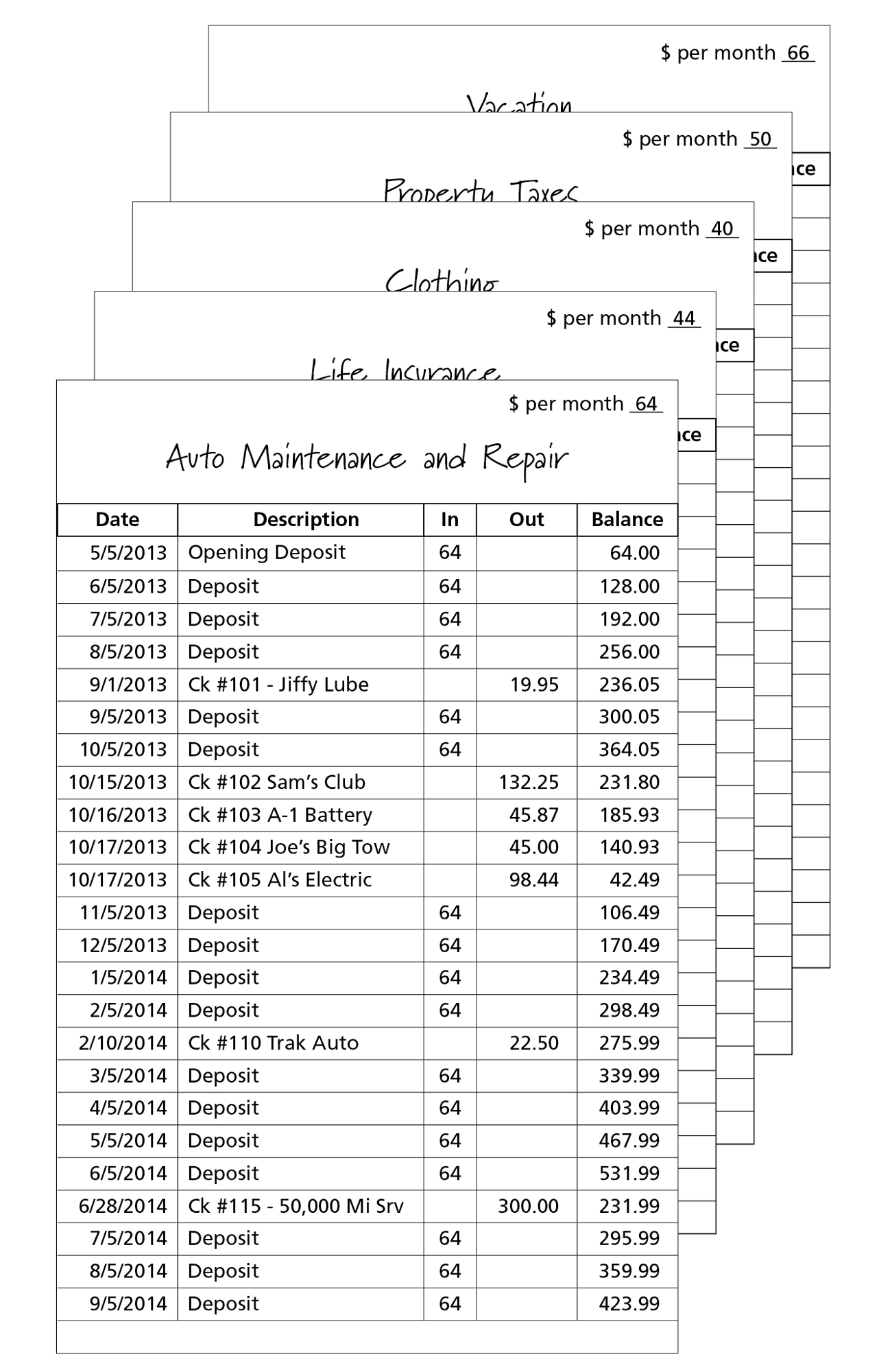
The next day the battery died, requiring a replacement to the tune of $45.87. As you may have already predicted by looking ahead on the form, the battery wasn’t the problem after all, evidenced by the fact that the next day, October 17, the car died and had to be towed by Joe’s Big Tow for $45. But does our account owner panic? Not at all. The auto maintenance and repair subaccount is properly funded and is handling expenses just the way it should. Later that day, October 17, the real problem is discovered, requiring another payment of $98.44 to the electrical shop for a new alternator. After three days of car trouble, is our account owner stressed? No. Car repairs and maintenance are a part of life. She has the money in place for such an occurrence.
The next four months are trouble-free, so the balance grows. In February, the account owner decides to save a few bucks by changing her own oil, writes out a check for $22.50 for enough oil for four changes, and calculates the new balance of $275.99.
Things continue to go well. The balance grows, and on June 28, more than enough is in the account to cover the 50,000-mile service on the car. She makes a few phone calls and finds that the prices for this kind of service, which is required to protect the warranty, vary greatly. She selects the best deal, has the work done, and pays for it with $300 from her Freedom Account. How freeing to know that the money is in place, ready to go.
To me, it is still amazing the kind of freedom and peace of mind that a simple $64 monthly deposit set aside for a specific purpose can bring to one’s life.
Step 5: Make a deposit every month without fail. Once a month, deduct the amount of your Freedom Account deposit ($264 in our example) from your regular checking account register just as if you’d written a check for that amount. Because the bank will transfer that amount, you must treat this as a regular monthly expense the same way you treat your rent and car payment. Don’t even think about forgetting, because the bank never will. You will have a mess on your hands if you bounce your own automatic deposit.
Making automatic deposits is going to feel weird in the beginning. You won’t like recording a big debit entry in your regular checkbook because it feels like you’re throwing money away. You’re spending but not getting anything in return. But nothing could be further from the truth. You are managing your money—controlling your money instead of letting it control you.
Other Irregular Expenses
Any potential expense, including those that are not as predictable as auto maintenance and repair but have a way of hitting you over the head when you can least afford it, qualify for the Freedom Account.
Insurance Deductibles Subaccount
An excellent way to keep insurance premiums low is to carry higher deductibles. But what happens if you are in an auto accident that requires you to fork over your $1,000 deductible? Ouch! Solution? A subaccount.
This subaccount should grow until its balance is equal to the annual deductibles of your health, homeowners, and auto insurance policies. If you are nervous about raising your deductibles without having the funds in place to cover them, fund the subaccount first. Then you’ll be in a good position to increase your deductibles in exchange for lower premiums.
Imagine the peace of mind you will have knowing that the deductibles are there, ready to be used if necessary, and drawing interest in the meantime. That is freedom. Once your subaccount reaches the amount you determine is adequate to cover your deductibles, you can divert future deposits into some other subaccount.
Clothing Subaccount
You cannot imagine how many families do not consider clothing when asked to list their expenses. Ironically, I have noticed that those in the worst financial shape are often the best dressed. Where does that money come from? I can only assume that many people load huge clothing expenses on credit cards or write checks using funds that were supposed to pay for groceries or utilities.
With a Freedom Account, clothing becomes a monthly expense. You may want to set up a general clothing account for the entire family or separate accounts: his clothes, her clothes, kids’ clothes, or some combination thereof.
Christmas/Holiday Subaccount
Probably nothing in the world throws more of us into a debting depression than approaching the month of December. Every January you say that this year you are going to save a little bit every month for Christmas. And do you? This year will be different. Your Freedom Account is the perfect way to join your own Christmas club.
Dream Subaccounts
What do you hope to have enough money to do or be someday? Perhaps you’d like to take a class, redecorate the master bedroom, go on a special trip, start a stamp collection, or take up skiing. If you are like most of us, these things remain a dream to be fulfilled “when we get some extra money”—which is usually never. Well, not anymore.
The Freedom Account enables you to turn those dreams into achievable goals. Let your mind run wild. Insert new pages into your Freedom Account notebook and title them accordingly: redecorate master bedroom, room addition, John’s woodworking tools, Caribbean cruise. Maybe you won’t be able to start funding these accounts right now, but little by little you will find it possible to fund more and more pages in your Freedom Account.
One added benefit of a Freedom Account is that it is a fabulous marriage tool. By having individual subaccounts, both partners can manage their own money without feeling a need to sneak around or wallow in self-pity.
Unscheduled Income
You receive unexpected and unpredictable money all the time, such as rebate checks, tax refunds, freelance payments, and gifts. It may be only a dollar here or ten dollars there, but what happens to it? You put it in your pocket and it is absorbed into your daily spending so fast that you hardly remember getting it. Larger amounts, such as tax refunds and consulting payments, usually go into the checking account with the intention they will be used in some special way. Before you know it, however, they are gone too, but who knows where?
The Freedom Account is a wonderful solution to the case of the vanishing funds. Make it a habit to deposit unscheduled income—big or small—into your Freedom Account. Selecting the subaccount to which it will be credited suddenly gives new meaning to surprise money.
Let’s say, for instance, that you misjudged your federal tax withholding, and you end up with a refund of $1,000. If you put it into your regular account, it will disappear as it slips through your fingers via the ATM machine or the latte shop. But if you immediately put it into your Freedom Account, you decide which goals to nourish.
A word of caution: You may be tempted to think of your Freedom Account as a savings or investment account. You may find yourself skipping your true savings in favor of funding your Freedom Account. But it is not a savings account. This money has been committed for a specific purpose and is meant to be spent. Prepare yourself, because this new account will give new meaning to the term ebb and flow. That’s the way it’s supposed to work. It is strictly a financial management tool. This is what money management is all about. By following these basic instructions and then customizing your Freedom Account to reflect you, your family, and your lifestyle, you will become a very skilled personal finance manager.
I heard from a man who diligently set up and funded his Freedom Account. However, his hesitation to use it became his downfall. In the beginning, when he had a minor auto repair, rather than using his Freedom Account as he should have, he thought he would be especially good and fund the expense from his pocket money. I can understand his way of thinking—that paying for the expense from his general fund forced him to leave money in his Freedom Account. But he kept doing it. Each time the righteous feeling he got from not using his Freedom Account prompted him to do it again.
Eventually, the expenses he was funding outside the account, for which he’d already set aside the money, became more than he could pay from his regular account. He had come to see his Freedom Account as some kind of sacred investment, and he couldn’t bring himself to use it. Instead, he put irregular expenses on a credit card, thinking he could somehow pay it off in the grace period and still be the “good boy” who was not touching his Freedom Account. By the time I heard from him, he was all messed up and was on the verge of dumping the whole idea as totally unmanageable.
Clearly, the problem is that this man refused to use his Freedom Account in the way it was supposed to be used. Do not let this happen with you. You created your Freedom Account to pay for things. Of course, this does not imply that you spend wildly—that if you have accumulated $1,200 in your Christmas subaccount you must spend every last penny. That’s not at all what I mean.
The point is that when Christmas comes around, you use the Freedom Account funds to cover your Christmas expenses as opposed to sneaking money out of the grocery funds. You might get away with that for a while, but I can assure you that such sloppy management will land you back from whence you’ve come—all mixed up and letting your emotions guide you rather than your newfound financial management sense.
Frequently Asked Questions
Q: Have you lost your mind? I don’t have extra money every month to fund anything new, let alone a Freedom Account.
A: Listen to yourself. You are acting as if maintaining your auto is optional or you can skip paying your insurance if you’re a little short. Do you really have a choice whether to pay your property taxes or buy clothes? You are driving a car, your taxes were paid, and you dress fairly well. Exactly how did you do that? You came up with the money somehow, and you probably have a few battle scars or credit card payments that help you remember the trouble you went through to do it.
This step is too important to pass off as something you cannot afford. I suggest you start out with the bare minimum number of accounts, limiting them to your most essential irregular expenses. You may have to reduce your spending in other areas in order to get started with a Freedom Account, but whatever the sacrifice, no matter how painful, this is one of the most important things you will ever do for yourself.
Q: Won’t I incur new expenses as a result of this new Freedom Account, expenses such as fees for checks and service charges?
A: Yes, there may be some fees. However, as your total balance (the balance the bank sees is the total of all your subaccounts) grows beyond the minimum amount required, all service fees may be waived, provided you have selected an account with that kind of benefit. You will be writing very few checks from this account, so the cost of paper checks will be minimal. I suggest that you deduct any administrative charges from your most lucrative subaccount. And should the day return when banks actually pay interest on savings accounts, credit it to that subaccount as well.
Q: How do I balance the Freedom Account each month?
A: Add together the current balances of all your subaccounts. The total should match the bank statement’s closing balance once you have made allowances for checks that haven’t cleared and deposits not posted. Reconcile it just like any other checking account. If you’ve never done this, step-by-step instructions can be found on the back of your monthly checking account statement.
Q: Couldn’t I create my own Freedom Account using my regular household account without opening another checking account?
A: You could, but I don’t recommend it. As long as the money for your Freedom Account is sitting there in your regular household checking account, it will be too easy to comingle them. And when things get a little rocky, without that automatic withdrawal from your household account into your Freedom Account, you might be tempted to skip contributing some months. The Freedom Account should be a serious business activity, not a simple no-one-knows-if-I-do and no-one-knows-if-I-don’t kind of thing.
If you’re like me, you need the discipline and pressure of an automatic withdrawal. It puts everything on a businesslike, professional level. Besides, you probably won’t pay yourself interest like the bank or credit union will. Record keeping is easier too when you have a monthly statement and access to canceled checks, copies of which are available from your bank.
Q: What happens if my Freedom Account gets too large? Shouldn’t I be investing the money?
A: Your goal is to have a full year’s funding in each of your subaccounts. That’s not going to happen overnight. Also, remember that this is not an investment vehicle; this is a money-management tool. Most of your subaccounts will be self-reducing. Subaccounts for insurance deductibles or other items that may not be self-eliminating should have a cap. For instance, your insurance deductibles may total $1,000. Once you have reached the designated amount in that subaccount, discontinue deposits until you make a withdrawal. You might have a high school reunion account. Once you’ve funded it and have attended the gala event, you can rip that page out and adjust your monthly contributions accordingly.
If you set up the Freedom Account properly, surpluses won’t be a problem. Besides, I would hardly call surplus funds a problem. You will be amazed at how financially functional you’ll become once you have the opportunity to manage your money.
Q: In the beginning, when the subaccounts have low balances, what should I do if I have an expense that is greater than the current balance in that subaccount?
A: Ideally, you should find a way to open each subaccount with a larger initial deposit to cover this situation. Example: You open your Freedom Account on October 1. Your semiannual property tax bill is due on December 10. If your monthly property tax deposit into your Freedom Account is $75, you will hardly have the $450 necessary to make the payment. You will have contributed only $225 ($75 x 3) into that particular subaccount.
You should make an initial deposit into the subaccount to jump-start the process. By contributing an additional $225 into the account on October 1 to anticipate the shortfall, the problem would be solved. As you set up your Freedom Account, you might see where a few hours of overtime or a moonlighting position for a few weeks would raise the funds necessary to launch your Freedom Account in such a way that you’ll be fully prepared for the first expense. However, even if you can’t manage the additional funding in the first month, don’t let this become an excuse not to get started.
Let’s look at another scenario. Say you have a $64 balance in your auto maintenance and repair account and you incur a $100 repair item during the first month. What should you do? Write a check out of your Freedom Account for the $64 and supplement the balance from your regular account. Do not borrow from other freedom subaccounts. While it pains me to suggest this, if you have absolutely no other way to come up with $36 (try hard—I mean really hard), it would be better this one last time to put the balance on a credit card and then pay the credit card payment from the auto maintenance and repair subaccount. I would recommend this only if the borrowed funds can be repaid within the following thirty days.
Example: Your auto maintenance and repair account has a balance of $64. Your repair bill is $100. You write a check for the $64 from your Freedom Account and pay for the balance with a credit card. By the time the bill comes, you will have made another $64 deposit into the auto maintenance and repair subaccount, allowing you to write a check from your Freedom Account to pay off the credit card in full without incurring an interest charge. Going through these steps of depositing into the Freedom Account and writing a check out of it to cover the $36 credit card bill is necessary in order to keep everything straight and your subaccount page correct.
Yes, it will take a little time to get the Freedom Account working smoothly. But don’t let a little rough water in the beginning convince you to abandon such a wonderful, life-changing tool!
Q: Would it make sense for my Freedom Account to be held in a money market fund account rather than at a bank or credit union?
A: Yes, that is an excellent idea because of the greater rate of interest you can expect in a money market fund. But remember that these accounts typically have high minimum requirements. Select one that has a low requirement if you sign up for automatic deposits, such as the USAA Money Market Fund3 (800-531-8181). There is no minimum requirement as long as you have an automatic deposit of at least $50 a month. But keep in mind that money market fund accounts have minimum withdrawal guidelines. You will not be able to write checks for less than, say, $250 (fund guidelines vary).
Freedom Account Feedback
We have no consumer debt now and a $10,000 Contingency Fund in a money market account. We will be able to pay off the mortgage in just a few more years, and we are so excited! Our Freedom Account has changed our financial life! Thank you.—Bill and Tracy
I love the Freedom Account! I set mine up this past January, and I actually have the money set aside for our property taxes. In the past, I would try to save the money and would always come up short. Then I would be forced to write a cash-advance check from my credit card. How pathetic. The first two months of having $300 a pay period transferred into the Freedom Account was really hard, but now I’m used to it. Once my car is paid off in a few months, I will set up a couple more subaccounts for household repairs and one for furniture we need. The Freedom Account is incredibly liberating! If you haven’t set one up yet, do it, even if it’s for $20 a month. Having the money socked away has really helped me, and my husband is very impressed by my change in behavior.—Lucy
Just this past month I was able to pay the six-month auto insurance premium instead of the usual three-month. I think I will have enough to do that on the other car by the time it is due. I love the freedom the Freedom Account has given us. We used to have to scrape by, and my husband would have to work overtime when the three-month premiums were due. Also, we had a $100 copay at the hospital when my daughter was born that I paid for with cash. Things certainly are looking up.—Jennifer
Back in February we had to replace our garage door. Actually, it needed to be replaced as early as the previous May, but we put it off because of the expense. It was our first major dent in the Freedom Account—$790—but boy did it feel good not to incur a charge of that amount. And we just paid a full six-month auto insurance premium out of the Freedom Account as well. The Freedom Account is such a great idea.—Elizabeth
I am proud of myself today. Our water heater went out yesterday. We shopped around and came up with the best water heater for us and the future. It, however, was not cheap! But when it came time to pay, we paid for it from our Freedom Account. It really felt great. Now back to the grindstone to rebuild that subaccount.—Marie
It’s been more than two years since I first read about the Freedom Account. I wanted to start one, but my husband was very skeptical. One year later we officially opened our Freedom Account. It is now more than a year later, and where would we be without our Freedom Account? Even my husband loves it! At first I thought it would take forever to start adding up, but before I knew it, we had enough money to cover every “surprise” bill that appeared. It makes so much sense to have a Freedom Account because you have to pay for those bills that come every six months or once a year anyway, so why not save for them instead of wiping out your checking account? We have lots of subaccounts, including ones for taxes, insurance, auto maintenance, Christmas, and even a toy fund for my husband. It has been so nice getting the car serviced and not worrying about how we are going to pay for it. Believe me, the Freedom Account has reduced stress in this family. Thank you for such a great idea.—Virginia