
14/I/28 (Supplement of Secretary on her way to Moscow).
I have now so badly got the habit of writing notes on everything that I think this journal will go on forever. I can’t realise that my job of personal secretary is ended.
When I left you at last I stood in the corridor and watched our coaches being uncoupled and how yours went off in the darkness. And it seemed as if it were a physical separation of just us two, as if you were cut away from me, or worse, that only a part of me had been cut away from you and the rest had gone on with you in the darkness in that other coach. I went into the empty coupe and felt so desolate. I didn’t want to pick up the broken threads of my individual life again after having so completely merged myself with you for the past two and one half months. Your overpowering personality still envelops me. No one has ever so completely absorbed my individuality — but at the same time you have been such a tremendous intellectual stimulus. We couldn’t have given nearly so much to one another if we had agreed in our philosophy. However, we both reason in the same way, and since you reason better because you have a really great intellect you broke down my arguments. Just the same, I think you are wrong in your ultimate conclusions about life and specifically about the social experiment in Russia. Yes, I agree with you altogether about human nature being just the same here as anywhere, but I maintain that this is the beginning of a social system which will supplant capitalism just as capitalism succeeded the feudal system. Naturally it is not so individualistic as capitalism because it is founded on a social theory that all should work for the common good (therefore eventually giving more freedom to the individual). There is only as yet a tendency to carry out this theory in practice. Russians temperamentally, as you say, are more inclined to do things together than westerners. This may still be due more to their primitive state (which would make them herd together for mutual protection) than to any conscious application of Marxian theories.
Perhaps you are right in thinking that the individual is more suppressed in Russia today by this new system, but I think this is only temporary. You can’t keep the individual down and he will come up all too soon and fight for the best of things — but meantime perhaps the concerted effort will have created better general conditions for him to develop in. I think the Soviet system as directed by the Communist Party will prove to be the best system to develop Russia. It may be slower than capitalist exploitation, but in the long run there may be less waste and a more enduring system. This seems to be just about all that has survived out of my faith. . . .
------------
When I reach Moscow, the first thing I shall do is to look up Rebecca Rachel K. and convey to her your farewell message, i.e. that you had no letter of thanks to send to Madame Kameneva, that your opinion of those svines, lice and dubs, and of this lousy god damned country is unchanged, and that you crawled across the border on your hands and knees, stopping now and then to put your thumb to your nose and shout feebly: ‘What a lousy country. What a bunch of svines. When I get back home I’m going to stay there for the rest of my life. And may the lord punish me if I ever complain again’.
_____________________________
14/I/28 (Supp. No.2 —my salary as your sec. is really paid to Moscow and I must earn it.)
I keep thinking about you, how you are faring on the road to the border. You have already reached the first border by this time. My traveling companion is a merchant. I am trying to benefit by your remarks and behaving quite properly and coldly so as not to encourage him. When I am reading or typing, I only see the outline of his figure across the way, and quite unconsciously I feel that it is you. In the afternoon, I slept a little; he was sitting reading, and in my half-conscious state, I continued for some time under the impression that you were playing solitaire. Such a pleasant, comfortable feeling that everything was all right—together in an International coupe on our way somewhere. And at that very time, no doubt, you were nearing the border, with a prayer of thankfulness on your lips; ‘Thank God, that’s over’.
Snow, snow and then more snow, but the weather is mild. At Kiev it was so foggy I could see none of the landmarks. I was dying of hunger this evening and there was no food to be bought along the road. The merchant produced bread, ham caviar and apples, we ordered tea and we had a feast. (The lord does provide.) He agrees with you about the deadness of the cities commercially due to the absence of private trade and private initiative. ‘But’ he says, ‘why should the government want this lively competition? Whom does it benefit?’ I asked him about interest on deposits; banks pay all the way from six to eight per cent depending upon the conditions of deposit.
I have just finished reading ‘Dark Laughter’ and liked it very much.1 When Anderson gets away from that jerky reminiscient style of the first few chapters and down to the story, it is very interesting and charming. You may love the American business man, but Anderson doesn’t. At Kiev, I telegraphed O’C and hope there will be some sort of reception for me at home.
And now farewell, a long farewell, to my dear boss. I hope I can live down my loneliness, but if I don’t, won’t that prove the endurance of human affections — once in a while, at least?
CONCLUSION
15/I/28 (Supp. 3, Moscow)
I slept very well on the train, although I was somewhat troubled by the illusion that I was on the boat and that you were lying in the other berth. I warned my companion not to be alarmed if I had a nightmare — this after I had aroused him once by jabbering something in English—lucky, perhaps, that he couldn’t understand English.
In the morning when I looked out, there were the beautiful forests of Moskovskaya Gubernia, deep in snow. We were due at 9:35, and would you believe it, I was already passing through the station when the clock pointed to 9:35. An ill fate pursued you, and now you are gone, everything works nicely. Moscow weather was gray, it is true, but warmer than Tiflis; the snow was melting a little. Everything seems topsy-turvy this year.
Arriving at the Lux, I looked about me as a prodigal son might after a long absence, expecting to see great changes. But no, there was still that sign on the elevator ‘Lift ne rabotayet’ (Lift does not work) and the man at the desk said O’C had not yet been given a room there. But when I saw O’C a little later in my room (Varya had cleaned up the place so that it looked quite decent and my roommate greeted me pleasantly) she announced that she is going back to England this week. Nothing seems to have been done about my place in the library. I would go with her, if I dared be so unfair as to leave so soon, if they still want me. I shall know tomorrow. Serge did not know I was coming, and when I called up he was not at home. .... Rebecca K. called up and was quite solicitous about your departure. I hope you didn’t have trouble about your papers at the Polish border—O’C says she had.
In the evening I met Serge in O’Cs room; as usual he is terribly busy, just rushing from one appointment to another. He said he thought we would be in Odessa only until the 29th, and therefore did not have time to write. He took the agreement and will send you a copy.
1. Sherwood Anderson’s novel Dark Laughter (New York: Boni & Liveright, 1925).
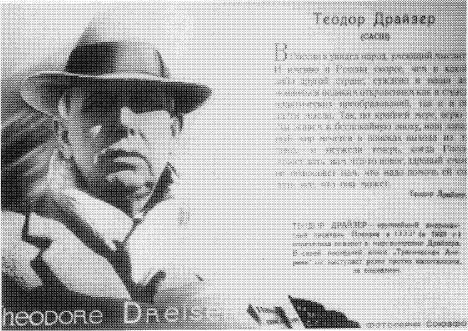
Postcard created by the Soviet government to advertise Dreiser’s visit to the Soviet Union. The translation reads as follows:
Theodore Dreiser
In Russia I saw a nation capable of thinking. It is precisely in Russia nowadays, rather than in any other country in the world, that all the great revelations both in a sense of practical reforms and in the sphere of thought are destined to appear. In any case, I believe so. We live during a turbulent epoch when our Western world is dashing around in search of a way out of the deadlock. And now, when Russia is able to give us something new, is it really possible that common sense doesn’t suggest to us that we need to help her to create all that she is capable of.
Theodore Dreiser
(From the Russian State Archives of Film and Photo Documents, Moscow; translated by Marina Tchebotaeva)