
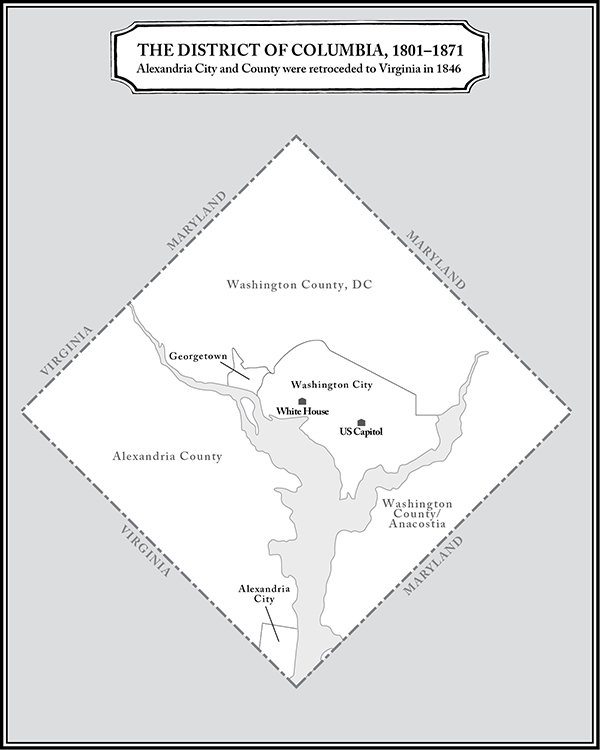
A Note on Maps of Washington City
Few reliable sources indicate how the District of Columbia appeared when it became the site of the nation’s capital. Most of the depictions created by Pierre L’Enfant, Andrew Ellicott, and their imitators present plans for the city rather than descriptive diagrams. Not until Albert Boschke’s highly detailed 1857 map of the District did any comprehensive view—as it was, rather than as it should have been—achieve widespread dissemination. After later editions of Boschke’s work and that of other cartographers, the District’s urban landscape was depicted more accurately.
Yet how the District actually looked in the beginning remained a mystery until recently. Tee Loftin, Joseph Passonneau, Don Hawkins, and the Imaging Research Center have filled in some of the gaps. Daniel Rosen’s 1801 map of Washington City (pages 26–27) draws from these sources and period accounts such as reminiscences by Christian Hines and other firsthand witnesses. This book’s 1860s map (pages 160–61) draws from the 1861 edition of the Boschke map, providing a clearer view of the downtown area where most of the capital activity occurred. For the years between, especially circa 1830, no accurate, detailed representation of the District exists. Jacksonian-era Washington still awaits its modern cartographer.
A Note on Geographical Terms
Alexandria: Tobacco port and slave-trading city founded in the eighteenth century; included in the District of Columbia from 1801 until its retrocession to the state of Virginia in 1846.
Alexandria County: Largely unincorporated land surrounding Alexandria, west of the Potomac River; included in the District of Columbia from 1801 until its retrocession to the state of Virginia in 1846; since renamed Arlington County.
District of Columbia: The ten-mile square encompassing former parts of Maryland and, until 1846, Virginia; selected by George Washington and designated by Congress as the federal capital of America.
Georgetown: Maryland port city founded in the mid-eighteenth century; included in the District of Columbia from 1801 to the present. In 1871 Congress revoked its charter and designated it as a neighborhood in the District.
Territory of the District of Columbia: Short-lived experiment, from 1871 to 1874, to reorganize the District as a US territory under the control of a federal governor.
Washington City: Independent city founded in 1802; synonymous with the federal capital for much of the nineteenth century and home to most of its key sites. Congress revoked its charter in 1871 and consolidated it into the District.
Washington County: Largely unincorporated land surrounding Washington City east of the Potomac River and a constituent part of the District starting in 1801. Congress consolidated it into the District in 1871.
Washington, DC: Name for the capital in use since the early days of the republic. Since 1871 there has been no official city of Washington—only the District of Columbia—so the term has been both misleading and redundant for nearly 150 years.
INTRODUCTION
Washington is not the official capital of America. Maps include a place called Washington, everyone refers to the seat of federal power as Washington, and the city’s homegrown politicians, celebrities, and athletes all claim to hail from Washington. But according to the law—and law is very important in the capital—such a place doesn’t exist. There is only the District of Columbia, and it’s been that way for nearly a century and a half.
A Washington City did exist once, though, and this older version of the capital, its life span from 1802 to 1871, is the primary subject of this book. But “Washington City” was always a misnomer. When that was its legal name in the nineteenth century, it was hardly a town, let alone a city. By the time it emerged as a city in the Gilded Age, Congress had abolished it and consolidated it into the District of Columbia. Thus, as with so much about the place in its early years, its planners even got the name wrong.
Familiar Origins
The usual story of the origin of the federal capital goes back to two key events: the Residence Act of 1790, by which Congress designated the general site for the future American capital, and Pierre L’Enfant’s 1791 presentation of his survey map, which outlined the street plan of that capital. The maneuvers and machinations that led to those events form part of a convoluted tale of nation building that historians have recounted well and often in recent years: political wrangling to choose a suitable site, contentious debates between surveyor and city commissioners, bureaucratic conflicts and inevitable lawsuits.*
* In a nutshell: The founders placed the national capital close to the geographical center of the country but still in the South as a concession to Southern states in exchange for the federal assumption of state debt, most of which the Northern states held.
However, the genesis of the idea of a federal capital began nearly a decade before L’Enfant presented his map. It is a tale that, if not quite the stuff of legend, at least makes for a good yarn with a decent measure of adventure and intrigue. More importantly, it helps explain why Washington City, instead of Philadelphia or New York, became the US capital and why this new capital—far from a citadel of democracy—emerged as a fiefdom ruled by national politicians, and why its citizens were denied the right to vote for those politicians.
The Intrigues of June
In the summer of 1783, all seemed to be going well for the fledgling American states in their fight for independence. The British army still occupied New York City, but a peace treaty looked to be signed in a matter of months, and the nascent republic already had a functional legislature, burgeoning industries from timber harvesting to shipbuilding, and a fateful taste for westward expansion. So it was more than a little surprising that at this moment—when the states finally emerged triumphant from their eight-year struggle against their British overlords—the army of citizens who had done so much to defeat the Royal Army turned against its own leaders and held them captive at the point of bayonets.
Discontent in the soldiers’ ranks was nothing new. From 1779 to 1781 Pennsylvania militia members and soldiers engaged in periodic riots and mutinies over inadequate pay and unfair terms of service. In March 1783, Officer John Armstrong Jr., an ally of General Horatio Gates, encouraged veteran soldiers not to disband until their demands for fair treatment were addressed. George Washington himself suppressed this challenge, which became known as the Newburgh Conspiracy—one of the most serious threats to civilian control of the army during the war—by personally stepping in to address the officers’ demands.1
Three months later a much greater conflict erupted. Congress (aka the Congress of the Confederation) had passed a resolution furloughing the soldiers of the Pennsylvania Line, drawn largely from that state. A group of sergeants wrote to Congress: “We will not accept your furloughs and demand a settlement.”2 When the legislature didn’t respond adequately to their demands, on June 17 a group of eighty to a hundred soldiers made for Philadelphia, then the locus of federal as well as state power.
Word of the soldiers’ approach stirred the fears of politicians and gave rise to rumors of what the troops would do once they got there—perhaps even joining with other bands of renegades and robbing the mighty Bank of North America to get their money!3 Key power brokers, such as finance chief Robert Morris and Representative Alexander Hamilton, demanded that John Dickinson, president of the Pennsylvania Supreme Executive Council, call out the militia to stop them. But Dickinson balked, doubting the threat of violence from the soldiers as well as the loyalty of the dodgy, homegrown militia. As historian Kenneth Bowling writes, “Pennsylvania, which had exclusive jurisdiction over affairs within its boundaries, had made its decision; Congress, which had no jurisdiction over the capital of the United States at Philadelphia, had to obey Pennsylvania’s decision.”4
Not surprisingly, Hamilton seethed, decrying the state’s “weak and disgusting position,” and charged Assistant Secretary of War William Jackson with stopping the soldiers’ march without resorting to force—a task that predictably failed. The troops arrived at their barracks in Philadelphia on Friday, June 20, ready to bring their case before the Pennsylvania State House. But their audience would consist of state legislators, not federal ones, since the national Congress didn’t meet on Saturday, and in any case “Pennsylvania was simply wealthier and more important than the federal government.”5
The night before they planned to march on the State House, however, the soldiers received a curious group of guests: Jackson, Hamilton, and Gouverneur Morris, the assistant superintendent of finance. History doesn’t record the details of who said what at the meeting, but after the national leaders left, the soldiers had grown even angrier than before, no doubt insulted by the trio’s patronizing attitude and cheap offer of buying off the men with a month’s pay in cash.6 Thus, enraged by the furloughs and inadequate pay for their lengthy service, mocked by the smug attitudes of national politicians, and nearly given a pass by their state’s leaders, the men of the Pennsylvania Line marched on the Pennsylvania legislature—straight into Hamilton’s trap.
In 1783 Hamilton hadn’t yet achieved most of his fame in the annals of the republic: champion of the Federalist Party, first secretary of the US Treasury, victim of Aaron Burr’s bullet. Instead, after his wartime service as a battalion commander, he was serving as a freshman representative from New York . . . albeit one with an unusual amount of pull and a Machiavellian sense of cunning. He could see the strategic opportunity that came with crisis, and he had a great opportunity with the crisis at hand.
The soldiers arrived at the State House on June 21, and their mutiny played out in melodramatic, almost ridiculous fashion. They marched defiantly and flashed their guns. Taverns sold liquor, drunken crowds cheered, politicians cowered. Further entreaties for Dickinson to call out the militia failed, and the Pennsylvania Line surrounded the state legislature. Some feared they might hold the politicians hostage.7
However, the troops were after the state politicians, not the federal ones, and the national body, the Congress of the Confederation, didn’t even convene on the weekend. But Hamilton knew how insulting it would be if this historic mutiny didn’t attack Congress: The underfunded national legislature would look pathetic, not even worthy of a soldiers’ march! More importantly, his idea of a strong, central American government would look laughable. So he had Elias Boudinot, president of Congress, call the legislature into session, making it appear the mutineers were assaulting the federal government and by implication the nation itself.
What exactly the members of Congress were supposed to do in a building surrounded by armed troops wasn’t clear, and in any case only thirteen members showed up, not even enough for a quorum. The scene that greeted them was more commedia dell’arte than coup d’état. Fired up by cheap booze, the soldiers swore loudly and brandished their bayonets, joined by townsfolk who added to the drinking and shouting. James Madison judged the danger as less “premeditated violence” and more “hasty excess.”8
By the time congressional leaders rounded up enough members for an official session that evening, the chaos had ebbed. The mutinous troops had returned to their barracks, leaving no violence in their wake. Despite the debauchery, no state or federal legislators sustained attack or were even kept from entering or leaving the building.9 The Pennsylvania Line had made a show of force more suitable for a village tavern than a national legislature.
For the members of Congress meeting that Saturday night, however, the identity of the villains in the story had shifted from the “grumbling band” of soldiers to the Pennsylvania leaders too scared to do anything about them. Boudinot announced that “this wound to the dignity of the Federal Government will not go unpunished.” Congress followed by ordering Washington’s own troops to quash the mutiny . . . and by fleeing the state altogether.10 Its resolutions were kept secret, however, and revealed only when the politicians had safely reached their new home: Princeton, New Jersey.
In the ensuing national debate, Hamilton performed at his best—or worst, depending on your persuasion. He claimed that the soldiers’ fury targeted Congress itself, and in the face of danger the national body wrote its steely resolutions with the mutineers laying siege to the building. Dickinson indicated that Congress never faced any real danger, but Hamilton took exception. The impassioned statesman blamed Pennsylvania as much as the soldiers for the debacle, seeing it as an attack not just on the national legislature but on the very notion of legitimate authority. In his view, this “deliberate mutiny of an incensed soldiery carried to the utmost point of outrage” involved an “armed banditti of four to five hundred men” who had the potential to “make the city a scene of plunder and massacre.”11
As historian William di Giacomantonio writes, “Hamilton converted the appearance of the episode from a demonstration against a state to one against the federal government. Observers came away with an enduring lesson that Congress required immunity from the policing powers of a state government in order to preserve its own dignity and independence.”12 But by that time the mutiny had long ended.
When Dickinson finally called out the militia, a few days after Congress skipped town, the uprising collapsed. The mutineers submitted to government authority without a shot being fired, a person injured, or property damaged.13 Indeed, for all their supposed threats of plunder and massacre, most of the mutineers received pardons. Congress addressed the soldiers’ pay and furlough concerns in July and disbanded the army in October after the Treaty of Paris ended the Revolution.
For all their bluster, the soldiers turned out to be dupes, pawns in the hands of clever political operators who used them to advance their own strategy. Hamilton and his allies, especially, used the spectacle of the splendid little mutiny to advance the cause of increasing the power and privilege of the central government. Although no proof exists that Hamilton himself engineered the revolt, his opponents suspected greater machinations behind his strategy and accused him and his followers of deceit in raising fears that mutineers and armed mobs would subject a weak Congress to attack. Madison saw “profound darkness” behind the affair, and Judge James Mercer placed the blame on unnamed but strongly implied “Capital movers in this nefarious business.”14
In the end, as with most issues in his political career, Hamilton won. But it wasn’t easy relocating the capital or convincing a wary public to support a powerful central government—indeed, it took another four years of struggle.15 By the time of the 1787 adoption of the Constitution, Hamilton got his way: Congress planned a ten-mile-square federal district, in which the federal government would have exclusive jurisdiction, to prevent “the folly of dependence upon any state for the protection of the national capital.”16 Three years later, the Residence Act of 1790 established the new American capital along the Potomac River between Maryland and Virginia—the exact site chosen by George Washington—and it opened for business within ten years. In 1801, under the District of Columbia Organic Act, Congress gained full control over the capital and organized its constituent cities and counties—and its residents lost their federal voting rights with no recourse to Congress or any other elected body.
At the time of these historic changes, the memory of the Philadelphia mutiny of 1783 had faded only partly, and was still used as an object lesson of how any threat to public order could overwhelm a weak legislature. The story, if anything, grew even more exaggerated: The rogue troops had become “enraged assassins”; John Dickinson, a spineless ninny, dithered while the soldiers and their allied street mobs attacked with ferocity; and Congress did the only sensible thing it could by escaping town before anarchy prevailed. Even today, this view of the mutiny prevails for most historians who mention it.17
Many factors ultimately led to the conception of Washington—constitutional, political, sectional—but the mutiny provided the earliest reason for relocating the capital from Philadelphia and the only one that involved fear. The threat was clear: The nation’s leaders always stood in jeopardy, and the only way to ensure their safety was to keep the locals on a tight leash.
Despite this foundation, for most of the history of Washington City, residents of the capital could still vote for their local officials because Congress adopted a rather relaxed, even indifferent policy toward the District. After all, it could overrule any municipal policies it didn’t like. The appointed commissioners, who had ruled so maladroitly in the 1790s, were replaced in 1802 by popularly elected Washington City councilors and a presidentially appointed mayor, and in 1820 the locals got to vote for mayor too. This partial enfranchisement held until the tumultuous days of Reconstruction, when a new version of the city arose with a Republican-majority Congress and large black voting population. As we’ll see, this dramatic shift in the political calculus had an unexpected effect, which eventually resulted in the total abrogation of local voting rights and the disenfranchisement of District residents for a century.
The City of Angles
In the meantime, however, the creation of Washington presented a strange capstone to the struggle for American independence. The logic of the Revolution primarily involved securing individual rights by checking the powers of the state—the right to prevent unfair taxation in the years leading up to the War of Independence; the rights to “life, liberty, and the pursuit of happiness” embodied in the Declaration of Independence; the separation of powers laid out in the Constitution; the enumeration of individual liberties in the Bill of Rights. Yet, at the very time these concepts were codified into law, their antithesis was on the drawing boards just upriver from George Washington’s plantation.
Contrary to the blueprints of a nation designed around the popular control of government, the federal Leviathan wielded absolute power over its own turf. Against the idea that all people have self-evident liberties that cannot be taken from them by the state, the residents of Washington couldn’t vote for their national leaders. Unlike Jefferson’s idea of a rustic capital to guide a nation of sovereign states and “yeoman farmers,” Washington would embody a vast, centralized bureaucracy, imagined as a massive neoclassical metropolis with giant radial avenues and boulevards. Some even sketched plans for giant statues like those toppled by the revolutionaries a dozen years before.
Backed by all this federal power, Washington should have emerged as a hub of national power and pride—or at least an object of jealousy for those whose cities had been denied the same prestige and largesse. Instead, Hamilton’s Federalists squandered their chance to realize their grand design for the capital, overwhelmed by greedy landowners and incompetent city planners. By the time the city was ready for business at the turn of the nineteenth century, their archrivals in the Democratic-Republican party controlled its levers of power. True to form, Jefferson and his successors had such contempt for Federalist notions of what the District should be like, that whether through neglect or disregard they adopted many policies to ensure the city would fail in embryo.
Even some Federalists later had second thoughts about the whole enterprise. Timothy Pickering, still mulling the lessons of the 1783 mutiny, noted in his journal that if John Dickinson had managed to call up his militia, “Philadelphia would have remained the capital of the United States; America would have saved not only the millions it had wasted by building Washington, DC, but would also have avoided the disastrous measures adopted during the presidencies of Thomas Jefferson and James Madison.”18
So, instead of a functional municipal government and coherent social planning, what sprang up was a place of near-complete dysfunction. In its early years, real estate bubbles inflated and burst, development was random and scattered, and everything from roads to streetlights either didn’t exist or didn’t work. By the middle of the nineteenth century, the town only faintly resembled L’Enfant’s conception of it, with a great deal of ugliness on view—open sewers doubling as canals, slums doubling as workers’ housing, unfinished monuments doubling as city attractions—not to mention an abundance of con men, prostitutes, slave traders, cockfighters, and, of course, politicians. The men and women who lived within the city’s sharp angles struggled for decades against its disorder and built it into something worthy of its namesake only near the end of the nineteenth century, by which time the city had experienced many crippling decades of corruption and mismanagement. The capital’s emergence as a world icon proved painfully awkward, embarrassing, and slow.
Unearthing Washington City
This book doesn’t present the familiar story of Washington so well known to readers of popular history: the horse trading between North and South to create the capital, the Old World stylings of L’Enfant’s blueprint, the high-minded rhetoric of politicians, the various doings of presidents and potentates, the grand architectural projects. Such a narrative is warm and comforting, like an old friend spinning a tale by firelight—the heroes of the Revolution engaged in a grand project for the ages, forging a city founded on their ideals. This book takes no interest in roasting these tasty chestnuts of American history.
Instead, this book presents an alternative history of Washington City that shows the actual character of the capital: what it looked like, how it functioned, who controlled its power—and why. In the story, we’ll see how the national capital, founded on noble ideals and with a few sparkling public buildings, devolved into an urban dystopia by the time of the Civil War, when British novelist Anthony Trollope memorably described it as “the empire of King Mud,” both literally and figuratively, “the Augean stables through which some American Hercules must turn a purifying river before the American people can justly boast either of their capital or of their government.”19
This book aims to reimagine this forgotten city, a place of dramatic contrasts—landed wealth and desperate poverty, civic liberty and racial oppression, genteel society and shocking squalor. The narrative begins in the 1790s and ends in 1878, describing in between how a visitor might have experienced the town, traversing its miles of unfinished roads that led through swamps and farmland, gambling on cards or cocks in the dusty streets, watching nightly battles between volunteer firefighters, and plunging into the chaotic markets, taverns, and slave depots that held as much importance to the city’s social world as its drawing rooms, parlors, and assembly halls.
These days, Washington, DC, scarcely resembles the squalid little town that limped along through the early decades of American history. Bordellos and gambling halls have given way to superblocks. Towering neoclassical monuments dot the landscape. L’Enfant’s urban design has taken full shape with magnificent boulevards and avenues. The city has emerged as the urban showpiece, focus of national politics, and center of world power that Hamilton and his cohorts once imagined it could be.
To many Americans, though, the city remains a fearsome metropolis, a place forever to be criticized, satirized, and campaigned against. Such antipathy is nothing new. From the beginning, Americans cast a wary eye on their capital, whether for its concentration of federal power, its suspicious cosmopolitanism, or its pretensions to glory. Indeed, without the original sin of Hamilton’s “deliberate distortions” of an obscure mutiny, the place might never have come into existence—no concentration of federal power, no supreme federal district, no citizens stripped of their votes. If we still suspect our capital of dark designs, our fears are embedded in the city’s DNA.