
ONE
The new American capital came with quite a pedigree when it opened for business in the summer of 1800: plotted by and named for a conquering hero and president, designed and surveyed to grand effect by a talented Frenchman, and redesigned by a man who mapped a good part of the early nation. What George Washington, Pierre L’Enfant, and Andrew Ellicott couldn’t have imagined, though, was just how dismal the place would turn out to be in its first decades or how much work would have to go into making it a place worth living in, or even visiting.
William Thornton, designer of the US Capitol, had predicted that this proud new citadel of the republic would quickly become home to some 160,000 people and would flourish in accord with the fledgling country’s inevitable growth. He was right about the country—but Washington City was another matter. At the turn of the nineteenth century, it barely held three thousand people and could scarcely bear comparison to any other national capital of the era.1
Certainly, no other such place had “avenues” consisting of little more than alleys of cleared forest,2 roads with mud furrows “cavernous enough to hide robbers”3 and strewn with garbage and the refuse of cows and hogs,4 swamps that incubated mosquitoes carrying malaria and other diseases, or a landscape littered mostly with “brick kilns and temporary huts for labourers,”5 or a near-complete lack of civic amenities, from a water supply and police force to street lighting and even sidewalks. Disgusted by the whole enterprise, Pierre L’Enfant ultimately called the place a “mere contemptible hamlet,”6 and his contemporaries weren’t much kinder. Treasury Secretary Oliver Wolcott observed, “The people are poor, and as far as I can judge they live like fishes by eating each other.”7
But how could a place with so much promise spend its inaugural decades as a shadow of what it was meant to be, a phantom city fallen to ruin without ever having risen? The roots of this trouble lay within the land itself and the people who came to dominate it.
A Trojan Capital
The Residence Act of 1790 gave President Washington the authority to select the site for the American capital, which he did about sixteen miles upstream from his Mount Vernon estate, offering a variety of reasons for locating it here (as we’ll see in the next chapter). Amid this landscape landowners had carved out a few agricultural tracts and plantations with idiosyncratic, often romantic names: The Adventure, Chance, Flint’s Discovery, The Hogpen Enlarged, Jamaica, The Nock, Orme’s Luck, Port Royal, The Vineyard, and Widow’s Mite, among others.8 Unfortunately, these whimsical labels applied to terrain so overworked by more than a century of tobacco exploitation that much of it lay in ruin, little more than abandoned fields, collapsing barns, and pastures without fences amid plentiful forestland.9 Hardly a logical place on which to build a national capital from scratch.

The names and property holdings of the original capital proprietors.
The creators of this new city, however, didn’t let that stop them. Envisioning a site on which a great capital could rise, L’Enfant admired the tract of Daniel Carroll, pronouncing Jenkins Hill at its center “a pedestal awaiting a monument”10—his way of describing an eighty-eight-foot-high mound covered with trees. More warily, Ellicott remarked that the site had “no more proportion to the country about Philadelphia and Germantown, for either wealth or fertility, than a crane does to a stall-fed ox.”11
The capital mostly rose on ground ceded from Maryland, one of the few bastions of Catholicism in early America. Daniel Carroll’s domain had roots in an eighteen-hundred-acre property grant from Lord Baltimore in 1663,12 and his family was just this side of legendary, producing a US senator, the country’s first Roman Catholic bishop, and signers of the Declaration of Independence and Constitution. However, keeping track of all their doings posed a bit of a problem, even for later historians, since, like all good aristocratic families, they desperately lacked originality: No fewer than four of them were named Daniel, and about as many shared the name Charles.13
One of these Daniel Carrolls (“of Duddington”) was more than happy to relinquish his five hundred acres of what some called New Troy† to the American government in 1791. He’d been trying for more than two decades to attract developer interest to his land, and now the US capital itself would sit on his front porch and the city center would rise around it. Carroll celebrated his victory by becoming a property speculator.
† How this inauspicious moniker ever came to identify the land around what is now Capitol Hill is a bit of a mystery, although its prescience impresses. The British played the role of the Greeks in 1814 by burning it to the ground. It was just one of the classical pretensions in the area. A smaller, neighboring estate was named Rome and a large creek the Tiber.
The Bubble Economy
While today’s history books present the early history of Washington City as a careful exercise in political negotiation, high-minded ideals, and daring architectural planning, something much more prosaic—and, to modern eyes, depressing—drove the development of the capital: housing bubbles.
Carroll wasn’t alone in thinking his plantation held almost infinite value; his fellow landowners felt the same about theirs. In March 1791, they cut a deal with the commissioners overseeing the development of the capital, letting the government pay them for half their lots and retaining the rest for their own profit. When an auction took place in October of the same year, they appeared to have hit the jackpot. The going rate became $265 per full lot, more than five times its previous value.14 A speculative frenzy began as the humble planters imagined themselves as lords holding sway over what surely would become the choicest turf in America.
However, despite the auction’s promise of raising huge sums for the government and the landowners, only thirty-one lots sold.15 But Carroll didn’t let this stop him, as the appeal of charging exorbitant prices for exhausted agricultural land and forests proved irresistible. Whether he had any buyers at the beginning didn’t much matter because it would be only a matter of time before the real boom began. He proudly kept his holdings on Jenkins Hill—i.e., Capitol Hill—among the most expensive in town. His fellow profiteers followed his example by keeping their prices high as well, perhaps fantasizing about all the starry-eyed patriots who would pay top dollar for old tobacco barns and mudflats.
But there weren’t enough rubes in America to make the proprietors rich. Real estate sales remained sluggish, and the growth of the future capital site sagged. Instead of recognizing the situation and lowering their prices like proper businessmen, the planters held out and capital development slackened even more. By 1793 the nascent city desperately needed financing, and what little development there was ended up being haphazard and piecemeal.16 The means of finding new investment capital fell to the city commissioners. One of them was Daniel Carroll of Rock Creek, uncle of Daniel Carroll of Duddington.
Magic Mushrooms
George Washington had selected this Daniel Carroll and his two equally respected fellow commissioners, Thomas Johnson and David Stuart, to manage the surveying of the capital site and to oversee its development and growth.17 As commission leader, Johnson in particular had a reputation for probity and acumen as a US Supreme Court justice and former Maryland governor. But the capital was desperate for financing, and he knew he had to entertain almost any new idea or source of cash to get the city built.
When twenty-eight-year-old Boston merchant James Greenleaf presented an offer to purchase three thousand lots of real estate from the government—later doubling the offer—Johnson had his opportunity. In exchange for Greenleaf’s beneficence, he would give the venture capitalist the bargain rate of $66 per lot with a payback period of seven years, instead of the usual rate of $300 per lot over three years—a 78 percent discount. As a bonus, Greenleaf and his partners, John Nicholson and Robert Morris, would agree to build ten homes a year in the capital and deposit $2,660 a month into the commissioners’ coffers. Greenleaf also would purchase $13,300 worth of Maryland land holdings that Johnson was trying to unload.18 All in all, the commissioner judged it a fair deal for the city and a lucrative deal for himself. It was hard to imagine its failure; Morris himself had helped finance the Revolution!
But Johnson had a surprise waiting for him. Greenleaf hadn’t secured the bank loan from Holland to buy the property, nor had he imagined the scale of the chicanery that Greenleaf and his partners had engineered. Instead of improving the capital property, they looked to mortgage their unpaid-for Washington City lots to obtain a further loan to purchase six million acres of Appalachian wilderness, a colossal tract of land that held just as much promise to the Greenleaf syndicate, and yielded roughly the same results, as Florida swampland did to later generations of investors.19To achieve this end, the men established a web of financial trickery, sweetheart deals, and bluff and intrigue that historians still have a hard time unraveling two centuries later.
Some knew better. Greenleaf’s brother-in-law, famed lexicographer Noah Webster, described his relative’s employees as little more than “rogues and whores,” and in 1795 George Washington questioned the intelligence of his commissioners in accepting the credit of such speculators in lieu of real bank deposits, especially when they brazenly had resold some of their unpurchased lots at a handsome profit.20 Increasingly frustrated, the president wrote to Carroll that “the continual disappointments” of the speculators “are really painful.”21
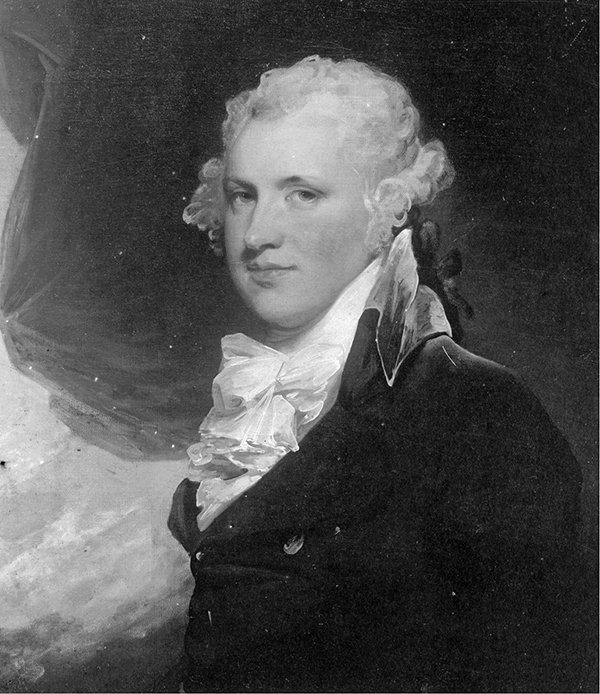
Financial trickster and Ponzi schemer James Greenleaf.
What Greenleaf lacked in ethics, he made up for in rhetoric. To anyone questioning his motives, he hyperventilated about the rise of the “New Jerusalem,” a veritable City of God to tower over the republic. All this hot air didn’t convince everyone, but it was enough to fire up Thomas Law, a former officer of the East India Company, to offer as much as $133,000 to purchase property around Capitol Hill, which of course Greenleaf had never legally acquired.22 The deal went sour, and Law soon found himself deep in litigation with the syndicate, which even held claim to the first mansion where he lived (at 6th and N Streets SW) as it made off with much of his fortune.23 But Law was a different kind of speculator. Unlike his counterparts’ houses, Law had paid for his in pounds sterling instead of credit. He followed all the building requirements and built them solidly (most notably the “10 Buildings” row houses in Southeast DC). By contrast, after Nicholson and Morris held a barbecue for two hundred people to celebrate their own development taking shape on New Jersey Avenue (the “20 Buildings”), they never bothered completing the structures, which remained unfinished and eventually collapsed.24
By this point the syndicate was running out of options. The money it received from buyers like Law didn’t go to reimburse the federal government but rather to private creditors on whose loans it had defaulted. As Greenleaf’s rhetoric became loftier, the pyramid scheme grew larger and more byzantine, until it collapsed in 1797 when his organization finally went bankrupt.25 The syndicate controlled up to a third of all the available lots in town, though, so countless legal battles remained, and turmoil resulted: Illegitimate owners sold unimproved lots. Rival claimants struggled for control of overlapping or identical properties. Federal officials seized ownership of some lots and re-auctioned them, sometimes to the same people who had defaulted on paying for them in the first place. A litigious nightmare resulted for anyone attempting to venture into Washington City real estate. Court battles continued for decades. Even if land was available with clean title, prices were still outlandish, and, thanks to European wars and financial crises throughout the 1790s, little investment capital was available to pay for it anyway. As a result of the legal quagmire, even into the 1840s, buyers could take hold of the disputed tracts for less than a penny per square foot or forty-seven dollars per lot—for anyone foolhardy enough to take the risk.26
Not surprisingly, very little was built. Some isolated tracts did emerge, with bland names like the Six Buildings and the Seven Buildings, but the original plantation owners continued to sit on roughly half the lots available in town, unhappily for most of them, it turned out.27 Daniel Carroll of Duddington saw his income dwindle and his estate wither, and in 1820 he declared bankruptcy. He spent most of his later years as a recluse in his Duddington estate, dying in 1849. (One of his few successful developments, Carroll Row, lasted much longer, first as a row of fashionable boardinghouses, then as a Union prison in the Civil War.)28
The real victim of the speculative frenzy, though, was the capital itself. After all the financial tumult, the city, enormous on paper, contained very few actual buildings, and those that did exist were often half-built, following the “magic appearance of uninhabited structures like mushrooms after a shower.”29 As Secretary Wolcott observed, immense sums “have been squandered in buildings which are but partly finished” and in the end never were.30 The English writer Charles Janson added that speculation was “the life of the American,” and, apart from the buildings set aside for government use:
the remainder of this boasted city is a mere wilderness of wood and stunted shrubs, the occupants of barren land. Strangers, after viewing the offices of state, are apt to enquire for the city, while they are in its very centre . . . some of the few houses which were then building [ten years ago], are now falling to ruin, the unfortunate owner having been ruined before he could get them roofed.31
Janson wrote these words in 1806, nearly a decade after the Greenleaf syndicate had collapsed, eight years after its principals had been locked up in a Philadelphia debtors prison, and five years after the federal government officially had moved to the District.32
The Wrath of Mr. Burnes
Thanks in part to Daniel Carroll’s attempted profiteering on Capitol Hill, the site that the founders intended for the center of town sat mired in lawsuits and speculative chaos. The most reasonable alternative for the builders lay westward, around what L’Enfant had imagined as the “Grand Avenue” between the Capitol and the Executive Mansion.33 But an angry old farmer stood in their way.
David Burnes and his contingent of slaves grew rye, tobacco, wheat, oats, and corn on 527 hardscrabble acres bundled into tracts with evocative names like The Gleaning, Elinor, Burnes’s Discovery, and the less exciting Resurvey on Part of Beall’s Levels.34 Some of it contained arable land, part of it sat on a floodplain, and the rest was swamps or mudflats—not an obvious place to build a city.
The crotchety Burnes had a long list of grievances going back to the birth of the capital. George Washington had tried to induce him to surrender his land on the cheap, often through land agents and subterfuge. Burnes constantly battled with the commissioners over the valuation of his property, and he resisted the creation of a new city in the middle of his homestead. A second lieutenant during the Revolution, Burnes also didn’t particularly like Washington, dismissing him as the “Geographer General.”35

Humble residence of planter David Burnes, who sowed trouble for city founders.
More than anything, though, he fumed about the deal that the land proprietors had cut with the government back in 1791 and which he had signed. While the planters did receive $66.67 for each lot used for public buildings—and half the future proceeds of lots auctioned to the public—they got nothing for any streets, avenues, and alleys that cut through their land.36 Few expected, then, that the transit corridors would end up as huge as they emerged on the L’Enfant plan, up to 160 feet wide, devouring even more of the proprietors’ land but giving them nothing in return. The placement of 17th Street near his ramshackle cottage especially rankled him since it led to Commissioners Wharf, one of the first on the Tiber, a fitting symbol of the type of development and politicians he scorned. The most important one soon would be living just a few blocks north, in what Burnes called the “President’s Palace.”37
Signs of Burnes’s wrath arose practically everywhere in the 1790s: open grievances against the commissioners, threats to sue the government, public indignation at the taking down of his fences to clear more land for avenues, and newspaper postings that served as the early American equivalent of “Get off my lawn! ”:
I hereby forewarn all persons from hunting with Dog or Gun, within my inclosures or along my shores; likewise, cutting down Timbers, Saplings, Bushes, or Wood of any Kind, carrying off and burning Fence logs, any old wood on the shores, or in the woods. If I should find any person trespassing as above, I will write to my attorney, and suits will be commenced against the trespassers in the general Courts.38
Burnes proved so stubborn that Jefferson thought city planners needed an alternative to the L’Enfant plan to deal with the bullheaded planter. In fact, Burnes continued to plant crops on Pennsylvania Avenue long after it was sited as the key road linking the White House and the Capitol, making it difficult to build a town center while corn was growing there.39 Only after his death in 1799 did the full development of his holdings become possible, when they emerged as a viable site for the urban growth that should have been occurring on Capitol Hill. In an ironic twist, the daughter of this bitter old farmer, Marcia Burnes Van Ness, later became one of the capital’s great society hostesses and one of the richest women in the country.40
Jerry-Buildings
As if dealing with angry farmers and rampant real estate speculation wasn’t enough, builders found themselves confronted by a set of construction rules that assumed acres of wilderness would magically transform into stylish row houses and Georgian manors overnight. The regulations were supposed to make the capital look grand and upstanding, like Georgetown and Alexandria, the other prominent parts of the District of Columbia. But no one could graft the tasteful look of those old port towns onto forest groves and fallow farmland easily, no matter how rigorous the building codes—and in 1791 these rules weren’t just rigorous, they were rigid: Only sturdy structures of brick and stone were to be erected, and no vulgar wood-framed houses. Buildings had to stand at least thirty-five feet tall but not taller than forty if on a major road. They had to lie “parallel thereto and . . . advanced to the line of the street.” Tasteful row housing was the favored style.41
The first test of the regulations came in August 1791, when Daniel Carroll of Rock Creek set about creating a handsome new estate for his nephew, Daniel Carroll of Duddington, helpfully called Duddington.42 The mansion mistakenly wound up seven feet in the path of New Jersey Avenue, a clear violation of a rule outlawing building walls projecting onto public throughways. To correct this transgression, L’Enfant quickly had those walls razed—and Duddington Daniel Carroll seethed. The error had been his own fault, but the French architect took the blame. L’Enfant first received a reprimand, and then, thanks to the efforts of Uncle Daniel and other city commissioners, who had unsuccessfully tried to make L’Enfant submit to their authority in this and other matters, Washington fired him.43 The government paid Carroll an indemnity of four thousand dollars, and Duddington soon rose in proud Federal style.44 It was only the first example of how the rigidity of the rules in Washington varied inversely to the power of those they affected.
Yet imposing such conditions mostly proved a failure because, without incentives or assistance with building codes or costs—such as those provided to real estate speculators—private builders hardly erected any structures. On noticing the capital’s glacial growth, and realizing its pace was due in part to their own rules, government administrators decided to act. According to James Sterling Young, they changed the regulations to allow for wooden and single-story dwellings, which had an unexpectedly dreadful effect:
a mushrooming of workers’ shantytowns, one such appearing on the very grounds of the executive mansion . . . jerry-built houses which, being too expensive for resident laborers, remained unoccupied and fell victim to vandals and the elements. When the government arrived in 1800 . . . The commissioners then reported 372 dwellings as “habitable,” but, as a cabinet officer noted, “most of them are small miserable huts.”45
By that point nothing the government did helped, and the capital grew uglier. Countless visitors found its ramshackle appearance and its emptiness shocking, one of them reporting in 1796 that “a spectator can scarcely perceive any thing like a town.”46 But financial and regulatory problems weren’t the only factors holding the city back. Other difficulties related to the curious beliefs of the Founding Fathers in general, and Thomas Jefferson in particular.
A City of Yeoman Farmers
Planters and their society dominated the Potomac region, like much of the Upper South, emphasizing social caste and proper etiquette while employing draconian methods to turn a profit—foremost among them slavery. Jefferson served as a leading exponent of these beliefs and saw the country as a nation of “yeoman farmers,” in which the virtue of American government derived from the strength of its agricultural society as long as there were vacant lands left to exploit.47 He predictably held a wary view of urban growth.
Ever since serving as secretary of state in the Washington administration, Jefferson thought the capital should be a humble little “federal town” in dramatic contrast to Washington’s view of a highly urbanized and muscular “grand capital city” and “Metropolis of America.”48 Moreover, the letters that he wrote to Washington regarding the shape of the capital contained no endorsement of the L’Enfant plan; he preferred a more traditional grid system.49 While in Europe, Jefferson could do little to prevent the capital plan from taking shape other than arguing against its imperial outlines from the comfort of a Paris salon. But that soon changed.
Pyramid Schemes
The Jeffersonians (i.e., the Democratic-Republican Party) employed more than just pastoral ideology to guide their strategy. Good old-fashioned partisan politics also played a role. Since America was predominantly rural, Jefferson and his followers exploited the straw-man image of the corrupted, European metropolis against their Federalist rivals . . . who just happened to represent the most urbanized parts of the country. It also helped that the adversaries of the Democratic-Republicans kept giving them ripe opportunities to make political mischief.
A prime opportunity came in the late 1790s, when the federal government, seeing construction funds depleted on the hugely expensive Capitol and Executive Mansion, had to chip in and fund its less-than-humble abodes. In the kind of political firestorm that often repeated itself in American history, federal loan guarantees of $300,000 to complete the buildings provoked one of the country’s first antigovernment reactions. Jefferson’s faction raised hell and organized protest rallies, and indignant newspaper editors wrote scathing editorials laced with doggerel that decried
the ship of state on rocky ground
and fools to pay for Federal Towns.50
The situation worsened after George Washington died in 1799 and his Federalist followers proposed a 150-foot-high mausoleum to honor the fallen president.
The Federalist Congress rubber-stamped a weird, giant pyramid with a planned cost of $200,000, and Jefferson’s anti-Federalists used the ensuing public controversy to their advantage.51 The man from Monticello thus swept to power in one of the great electoral victories in American history and swiftly ended the mausoleum project.
The effect of this public reaction was a paradox. The outcry targeted leaders who wanted to enlarge the scope of federal power and spend freely on great public monuments. But despite rhetoric to the contrary, the Jeffersonians arrogated federal power anyway and, other than the mausoleum, built those monuments in full. What suffered was the rest of the city where it all took place. While American voters certainly weren’t demanding that Washington City’s streets remain unpaved, its garbage go uncollected, or its streets lay enveloped in darkness, that’s ultimately what happened. Jefferson’s party took power in 1801 and closed the tap for urban improvements for several long, bleak decades.
While he did secure the funding for the Navy Yard on the Eastern Branch, in most other areas the third president cut spending and kept the capital’s areas of settlement disconnected from one another, preventing them from forming a coherent urban grid. Behind the scenes, he pushed against congressional bills meant to improve the District’s infrastructure and follow the centralized contours of the L’Enfant plan. From the viewpoint of British diplomat Augustus John Foster, Jefferson’s attitude toward the city had the effect of forcing members of Congress to rely on visiting the president’s house for their “amusement and relief” from public affairs, or else be forced “to live like bears.”52
Capital Sorrows
Jefferson’s successors James Madison and James Monroe continued his policies in the first decades of the nineteenth century. It was a miserable time for the District, rife with incompetent city planning and blatant federal indifference, as the capital engendered little sense of community or civic purpose beyond the creation of government bureaucracy. Outside of the political class, the small, itinerant population struggled with living conditions that were as socially alienated as they were economically strained—and prone to occasional bouts of horrific violence. As a fitting symbol of the era, one of the town’s biggest spectacles wasn’t a noble ceremony or parade but a public execution gone wrong.
In 1802, James McGirk, an Irish immigrant and bricklayer, came home one evening after a round of heavy drinking and beat his pregnant wife so severely that she died along with their unborn twins. He was tried, found guilty, and sentenced to be hanged at the foot of the Capitol, where an ardent crowd gathered to watch the spectacle.53 However, after the executioner tied the rope around his neck, but before the hood could be drawn over his head, McGirk suddenly leaped off the platform. With his body swaying and the crowd looking on in horror, the authorities tried to pull him back to the platform to prevent the suicide, but it was too late. After McGirk was cut down, the crowd swooped in and eagerly cut the noose into pieces (said to be helpful in curing headaches, toothaches,and other maladies).54 They showed rather less respect to his corpse: first buried in a local cemetery, then dug up by living relatives of the dead in nearby plots and dumped into a ravine, retrieved from the ravine by the murderer’s friends, reburied in the cemetery, and finally dug up again and deposited in a quagmire under thorn bushes.
This wasn’t surprising—topographically, that is—since Washington City’s physical landscape could be just as forbidding as its social counterpart, teeming with ravines, quagmires, and other undeveloped land. Magnificent houses stood next to rude shacks,55decent housing was hard to find under what some called “pioneer conditions,”56 and the analogy to a patchwork quilt—pockets of random buildings separated by huge stretches of empty land—was so common that it was taken for granted.57 In an unexpected twist, the one place where a decent number of buildings had sprouted, Greenleaf’s Point, took its name from the charlatan who had done so much to impede the city’s development.58 (The area’s previous name had been Turkey Buzzard Point, a fitting description of the Washington speculator.)
Without any guidance from the federal government, capital development proceeded on a pell-mell path led, once again, by the greed of the original landowners. Amazingly, even after the first speculative bubble popped and few buyers could be found, these men still possessed the ludicrous idea of selling their land for obscene prices. Each vied with the others to turn his own thinly populated sliver into the focus of development. This competition had the counterintuitive effect of ensuring that much of the region remained countryside and what settlement took place in the capital remained mired in “village conditions.”59 In Benjamin Latrobe’s words, “The proprietors of the soil, on which the town is to be spread, are rivals and enemies, and each opposes every project which appears more advantageous to his neighbor than to himself. Speculators, of all degrees of honesty and of desperation, made a game of hazard of the scheme.”60
Critics saw these problems as an embarrassment not only to the region but to the nation as a whole and called for the relocation of the seat of government to a more sensible spot like New York or Philadelphia. Fearful of being stripped of their would-be urban showpiece, the leaders of Virginia and Maryland stepped in to offer loans for capital improvements.61 Their unexpected largesse improved prospects for growth in certain pockets, but overall the District remained, according to John Reps, “a kind of archipelago of neighborhoods separated from one another almost as if divided by water instead of expanses of undeveloped land.”62
But Pierre L’Enfant hadn’t designed the city as an island chain.
L’Enfant’s Tattered Plan
The French architect had instead imagined the capital as an ideal metropolis, enlivened with triumphal arches, gardens, theaters, museums, a victory column, a national pantheon, a massive central fountain, and a shopping arcade to rival the Palais Royale in Paris.63It was a fantastic vision, but though politicians were satisfied with the utopia on paper, they had no effective means of executing it. By its nature, L’Enfant’s glorious blueprint couldn’t address the boring nuts and bolts of urban planning: adequate investment capital, a broad tax base, reliable funding for infrastructure, and a leadership committed to solving civic problems. Struggles with these issues, along with speculative madness and political haymaking, wrenched the plan away from its charming baroque assumptions and grounded it firmly in the mud of urban reality.

Pierre L’Enfant’s idealized plan for the city, before Andrew Ellicott reimagined it.
Quite literally, a lot of real mud lay in the new center of town. Instead of the Capitol and Jenkins Hill acting as the nexus of commerce and housing, a boggy tract of mediocre farmland, once owned by America’s angriest farmer, would be the place where the center would rise. As other new pockets of growth emerged, they spread the town’s points of interest across even wider distances, making Washington City, for all its pretensions to centralized authority, a strangely decentralized place.
In what’s now Foggy Bottom, German immigrant Jacob Funk had created Hamburgh, aka Funkstown, in 1765, subdividing it into lots from 19th to 24th Streets within a few blocks of the Potomac. Even from the beginning, Funk had designed it with speculation in mind.64 But aside from a brewery and a glassblower, it offered little in the way of business, and few people wanted to live in a place where swamps and mudflats bred mosquitoes that spread malaria and yellow fever and the summertime weather created a tropical sauna of nearly unbearable heat and humidity.65 Even by the 1840s the area had only sixty households.66
Several miles south of the town center, the Navy Yard hosted America’s seminal military fleet. In 1799 George Washington had sited the yard two miles up from the confluence of the Potomac on the Eastern Branch, and by 1806 the yard was thriving by building, equipping, and repairing warships. Employees received the unheard-of perk of daily “refreshments” drawn from hundred-barrel lots of whiskey.67 These refreshments made it a popular place to work, and the yard soon became the chief manufacturing site in the District. Another business thrived there too: whoring. According to Charles Janson, the yard densely featured “Tippling shops and houses of rendezvous for sailors and their doxies, with a number of the lowest order of traders.”68
To the west, Charles Carroll intended Carrollsburg, near the junction of the Potomac and the Eastern Branch, to be a budding townsite, but it ended up more a potential settlement than an actual one. Nearby, on land at the tip of the rivers’ confluence, Greenleaf’s Point still had occupants during the early nineteenth century. However, as a fitting tribute to the speculator who gave it his name, the fifty or so houses there were mostly ill-kempt, a handful occupied by squatters, and the warehouse and wharf that offered a few outward signs of industry were disused if not abandoned.69
North of the point and south of the Capitol, the neighborhood now known as Southwest was called The Island starting in the 1810s on account of the Washington City Canal acting as a moat between it and the rest of the city. Spec houses clustered here, but mostly The Island offered a ragtag assortment of workers’ shanties, industrial facilities, and grand plantations slowly being sold and subdivided, just as their owners were selling their slaves and subdividing their families (about which more is covered in chapter four).70
Farther north, and due west of the Capitol, L’Enfant had planned the Mall as a central feature of the city, a “grand and majestic avenue” stretching for a mile and standing four hundred feet wide, bounded by the expansive lawns of ambassadors’ residences, peppered with gardens, a pond, groves of trees, a luxury shopping district, arcades, and triumphal arches.71 Sadly, it looked nothing like that. Other than storage sheds, hardly any buildings rose on it at all, and swamps choked most of the terrain.72 The rest remained a mishmash of private garden plots, lumber and firewood yards, and dumps for “rubbish of an offensive and unsightly kind.”73 As the cofounder of the National Institute (predecessor to the Smithsonian) put it, the Mall was “a magnificent Sahara of solitude and waste—appropriated as a cow pasture and frog pond, and decorated with a stone-cutter’s yard, a slaughter-house and pig-pens.”74
Practically the only major sites on the L’Enfant map that developed as planned were the Capitol and the Executive Mansion, still the focus of the town’s energies and funding. Although the president’s house increased in esteem over the years, at the time it provoked divergent views. Some lauded the “pleasing” and “captivating” qualities of the Georgian manor, while others dismissed it as too big and unfurnished, or too “cold and damp in winter.”75 The house of the legislature, by contrast, earned much high praise. Frances Trollope—mother of Anthony, a novelist in her own right and otherwise a bitter critic of America—recalled her “admiration and surprise” at seeing a building of such “beauty and majesty.”76 Other writers, also otherwise hostile, used terms such as “dazzling whiteness,” “a creation of fairy-land,” and “the eighth wonder of the world” to describe it.77
Apart from these well-financed federal structures—which also included the departments of State and Treasury, Post Office, and Patent Office—the rest of the capital continued to languish, its infrastructure and civic amenities either dilapidated or simply nonexistent. As Charles Dickens later wrote in American Notes, to create such a city as this required a perverse sort of inspiration:
plant a great deal of coarse turf in every place where it ought not to be; erect three handsome buildings in stone and marble, anywhere, but the more entirely out of everybody’s way the better . . . make it scorching hot in the morning, and freezing cold in the afternoon, with an occasional tornado of wind and dust; leave a brick-field without the bricks, in all central places where a street may naturally be expected; and that’s Washington.78
Road Rage
Nothing symbolized the sorry state of the capital better than its streets. What looked so elegant on L’Enfant’s blueprint—a web of radial baroque avenues overlapping a rectangular street grid—in practice became a confusing network of ragged and rutted strips of mud. Historian Constance Green wrote of the challenges of traversing the roads: “At night the journey was utterly dangerous; pot-holes and tree stumps threatened to overturn carriages; most of the thoroughfares lay in utter darkness.”79 For politicians heading home from the Capitol in the dark, walking presented an occupational hazard: “At times they slipped into the gutter or stumbled against a bank of earth. But even when with care they kept their feet from straying, they fell over barrels or a pile of bricks.”80 In one case, the deplorable condition of the District’s roads almost changed the course of history, when the carriage of James A. Bayard Sr. of Delaware nearly overturned in the cratered muck.81 He survived, though, and cast the key vote in the 1801 House decision that made Thomas Jefferson the president in 1801 after an electoral college tie. Otherwise, Aaron Burr—future killer of Alexander Hamilton and alleged treasonist—might have won.
Pennsylvania Avenue, the most important road in town, was among the worst thoroughfares. Tasteful drawings that promoted the District depicted the avenue as a lovely promenade lined with poplars—which Jefferson ordered planted in neat rows as in Paris—but in reality it was barely more than a quagmire.82 This “deep morass covered with elder brushes” was, for most of its length, a muddy concourse cutting through the forest. In spring it often flooded, and the rest of the time street children scampered about in search of handouts for sweeping dust from the crossings.83 It was ridiculously expensive to maintain because, at 160 feet wide, “To pave it was like attempting to pave a field.”84 Not until 1834 did the avenue finally get a decent roadbed to provide for a minimal level of usability.
However, just about the time that macadam covered Pennsylvania Avenue, the few dozen whale-oil lamps lighting it went dark due to high fuel prices, and they wouldn’t be turned back on until the next decade.85 Thus, as the District’s two glittering monuments, the White House and Capitol, rose proudly at either end, the main drag connecting them was a pothole-choked mire littered with bricks and tree stumps, unwise to cross during the day and unsafe to cross at night.
The Tap Runs Dry
As with its battered system of thoroughfares, the basic services and amenities that other cities took for granted either came late to the District or didn’t come at all. Buildings were designed poorly and then left to stand empty until they fell apart. Farmers still were seeding crops near major roads and impeding traffic. Most roads didn’t have sidewalks. Livestock wandered freely. No sewer system served the city. Flu and other diseases broke out with disturbing regularity.86 The minimal population had settled largely around the old Burnes tract and a few far-flung locations, but most travel took place across wide distances on foot or by horseback.87
Like many cities of the era, the District couldn’t afford a modern waterworks, so a “pump mender” got the water out of the ground in lieu of an actual engineer or water department.88 This arrangement proved searingly inadequate when fires erupted89 and consumed the mostly wood-framed structures with ease . . . usually while volunteer firefighters—in the absence of a commissioned department—watched helplessly.
Major crimes were uncommon, but petty crimes ran rampant.90 Along with fending off low-rent thieves and burglars, the few law enforcement officers (basically a marshal and a sheriff) checked volunteer fire companies’ fire buckets and issued health regulations to prevent the spread of infectious diseases, all the more challenging in a place littered with swampland and pools of stagnant water.91
All in all, Washington’s “grand capital city” resembled a dysfunctional village. The president’s and the legislature’s houses loomed formidably, to be sure, along with a few other stately federal buildings, but everything else was crumbling or absent. According to Charles Hurd, two things existed in abundance: “ample space to disperse the slops and garbage thrown into the streets, and plenty of mud to absorb the droppings of horses, cattle and hogs that had the run of the streets.”92
For most cities, then or now, such decrepit conditions would have led to a mayoral recall, voter revolt, political conflict, or at least a few protest marches. But the dismal state of civic amenities didn’t lead to any of these outcomes. Without being able to vote for their national leaders, hold their government accountable, or challenge it in any way, the voters of Washington City had no choice but to take what scraps the members of Congress deigned to give them, which most of the time was very little.
Politics in Extremis
Visitors could tell the town was in bad shape even before they arrived, because it was so hard to get there. A network of turnpikes—wide, graded roads allowing for the interstate transport of goods and material such as crops, livestock, alcohol, and fuel—was interlacing much of the Northeast and the mid-Atlantic region. But Washington City remained virtually stranded, again like an island chain. The District had faced problems with constructing turnpikes to tie the region to the western frontier since its founding.93Functional roads went only to Maryland and the South, and the “western route proved impossible to develop in the face of undisguised hostility from Baltimore,”94 which had little interest in a new economic competitor springing up practically in its backyard.
Maryland’s biggest city served as the source of other painful contrasts too. Baltimore streets glowed with gas lighting around 1820, while Washington City’s denizens still were fumbling around in the dark, lurching from one distant corner lit by whale oil to another. The District didn’t see gas light until 1848, long after the new technology had become widespread in other cities. Earlier attempts to establish a municipal gas company also failed because local government “had no desire to encourage an innovation so dangerous, so offensive and one likely to injure the business of candle makers and oil dealers.”95
In the same parochial fashion, Washington’s hackmen fought against the development of sidewalks for fear that, if it were easier to walk down the road, fewer people would pay for horse-drawn transit. On account of their lobbying efforts, along with the usual mix of political cowardice and civic apathy, no omnibus line or other regular public transport existed in the District’s first three decades.96
The town also offered limited or no means of education to its residents. Although the inglorious rise of the capital took place before the large-scale development of government-run schools, the District largely ignored the expansion of public schooling in other major cities of the time. Even as late as 1839, one study showed that, of the 5,200 children in the capital, around a thousand went either to private or “pauper” schools, but the rest—80 percent—had no means of education beyond what they could learn on their own.97 Higher education didn’t fare much better. The creation of a national university, which some had proposed at the same time as the formation of the District itself, foundered when Congress couldn’t find the funds to build one but stubbornly refused offers of private assistance. The desperate solution of a lottery to raise funds also flopped when the lottery operator ended up in jail.98
Financial Mud Pit
The fiscal problems were manifold: Local government revenue came mostly from property taxes and license fees, but federal property—the only kind worth anything—was off-limits. A justice of the peace appointed by the president, not a local official, assessed real estate values. Redundant city and county taxes exposed residents to double taxation, and half of the entire budget went to road and bridge maintenance.99
That last point was the core problem. With a few exceptions, Congress left the full cost of grading and leveling roads to the local government, which couldn’t afford it. In the first twenty years of the capital’s life, Congress provided a pittance of $15,000 for work on Pennsylvania Avenue and the roads around the White House. Road maintenance in 1821 alone ran to $43,000. Local leaders had no choice but to take the town further into debt to pay for it.100
Fiscal challenges led to fiscal emergencies, and these, combined with national recessions and the “panics” of bank runs, left the District starving for cash. Money shortages prompted banks to offer paper not backed by specie and prompted local officials to issue the equivalent of IOUs, sometimes down to a penny.101
Throughout these decades the attitude that congressmen took was curious. They represented their own, often distant constituencies, but they had to live and work in Washington City for part of the year. Only a deep-seated and rabid antigovernment hostility or a serious case of masochism could explain how they could tolerate a place so often on the verge of fiscal collapse or why they kept funding to a minimum even as they “floundered through oceans of mud to reach the Capitol from lodgings jammed to the eaves.”102 In 1822, Senator John Eaton of Tennessee called for the federal government to take a larger share of maintaining Pennsylvania Avenue since it was unusable by humans or horses. The burden had been falling on taxpayers already being taxed at wartime levels, and the critical roadway was still a wreck. Congress responded by dribbling some money into the District’s common fund, but the meager show of support had little effect.103
Requiem for a Dreamer
Meanwhile, L’Enfant was faring even worse than the city he had planned. Instead of leaving the place that had done so much to make his reputation, then forever broke him, he hung around, increasingly miserable, living off friends and sometimes lodging at Rhodes Tavern. Latrobe described the “picture of famine, L’Enfant and his dog . . . He is too proud to receive any assistance, and it is very doubtful in what manner he subsists.”104 L’Enfant claimed that the federal government owed him up to $100,000,105 and, while occasional offers would have provided a fraction of that amount, he refused all recompense until he was paid in full. That never happened, of course, and he cut a bleak figure in Washington City, where people might recognize this “quiet, harmless, and unoffending . . . Old Major,” then in his sixties, whose “broken shoes [and] rent pantaloons” made him more suitable for a Greek tragedy than a revolutionary epic.106
By the time he died in 1825, the capital L’Enfant had designed also looked moribund. Along with a crumbling infrastructure, few civic amenities, and a feeble transit network, the town lacked any significant mercantile house or means of profitable commerce except for the keeping of boardinghouses, many of which ended up as brothels (about which more later).107 The only commodity it had in abundance was politicians.
The aggregation of numerous factors—economic, fiscal, political, psychological—meant that, however much its creators, promoters, and residents wished otherwise, Washington City still hadn’t become a real city. Not only did it lag far behind other nearby urban areas such as Baltimore and Philadelphia, it even trailed the other towns in the District, Georgetown and Alexandria, which its founders expected it to eclipse quickly. Every year of decline brought louder calls to move the national capital elsewhere.
The numbers told the tale. Even as the rest of America was exploding with dynamic growth, the capital remained its own little island chain, and could barely hold back the tide or keep from drowning in a sea of apathy and red ink. Its population rarely grew by more than a thousand people a year from 1800 until the Civil War,108 and from 1800 to 1830 the country’s four most urbanized counties outpaced it by 115 to 300 percent. Even the mostly rural nation as a whole grew 12 percent more.109
Visiting Washington City in 1804, Irish poet Thomas Moore gazed upon the condition of the town and, like so many critics, summed it up mordantly:
This embryo capital, where Fancy sees
Squares in morasses, obelisks in trees;
Where second-sighted seers e’en now adorn
With shrines unbuilt and heroes yet unborn
Though now but woods—and Jefferson—they see
Where streets should run and sages ought to be.110