
FIVE
In the hardscrabble landscape of Washington City, as slaves, free blacks, and white mechanics toiled at their respective labors, the capital elite were busy enjoying the fruits of their leisure. At one memorable party in 1820, miles from town at a hillside villa, the views evoked “a Tivoli grandeur of atmosphere and Roman landscape . . . like the sybil’s rhapsodies to the eye and the soul.” A splendid array of the highest echelons of society held court: Maryland planters, country gentlemen, and the District gentry.1 The guests drank punch by a woodside spring then feasted and sang songs. President Monroe himself laughed with delight, “beating time with his fork” to the lively tunes. Amid the revels, the lord of the house arrived by carriage, his white horse charging through the clover like a thunderbolt. Out stepped the master of ceremonies—Tom Law.2
But appearances deceived. The man throwing the resplendent party was anything but rich. Nearly broke, he couldn’t even pay his wife alimony. Luckily, the spectacle so delighted and mesmerized his guests that they couldn’t help but offer “ready money” to the star-crossed Mr. Law to help him stay afloat—as a gift, of course, not charity.3
Law’s troubles began with the Greenleaf syndicate and the city canal project, and he remained financially unstable for the rest of his life. But he seemed as though he should be wealthy, and that’s what counted. In that respect, he had plenty of company, for most upper-class Washingtonians were well practiced in the arts of guile and deception, developing elaborate codes, etiquette, and manners to create a rigid social pecking order that hid behind a veil of grace and whimsy. Seemingly inconsequential details—from the kind of forks on the dinner table to the method of inviting someone to a party—teemed with meaning and purpose, showing how the elite sorted and ranked themselves. The company they kept, from their elegant soirees to their secret societies, said a lot about how Washington City really operated inside its grand public buildings and palatial mansions. Here, a flair for wit and charm could wield more power than a flush bank account, and a well-deployed smile could conceal the most baleful thoughts or ruthless ambition.
Edge of the Vortex
The guests at Tom Law’s party provided a good microcosm of Washington City’s upper caste. Its nucleus was the rich planters who owned land and slaves in the District, along with established countryside families who held property dating from the days of Lord Baltimore (and who intermarried like European royalty to preserve their dynasties) and old-time Georgetown landowners and merchants who formed the core of the local elite before the capital was built.4 But there were other, less expected figures too, including British critics and authors, smartly dressed foreign diplomats, and journalists in favor with the ruling class.
The town’s biggest names included Robert Brent, who served as the town’s first mayor; Thomas Peter, who built the elegant Tudor Place mansion; William Seaton, who ran the National Intelligencer and served as mayor in the 1820s; John Tayloe, whose slaves tarried underground in his Octagon house; and Elisha Riggs, who set up the eponymous Georgetown bank.5 But the women of Washington City’s elite society were arguably its most important operators, planning its functions, arranging its liaisons, enforcing its codes, and recording its history. Indeed, Mary Bagot, Margaret Bayard Smith, Mary Boardman Crowninshield, and Harriet Martineau stood as some of the District’s most incisive writers, chronicling social life in their often voluminous journals and letters.
Martineau in particular—an English intellectual who wrote books on politics, economics, and sociology—proved herself a fine and thoughtful critic of America and a bold supporter of women’s rights, secularism, and abolition. (She even traveled south to inform the locals their support for slavery was “inconsistent with the law of God.” The Southerners offered a quick response: “They would hang me: they would cut my tongue out, and cast it on a dunghill.”)6 What attracted her to the provincial aristocracy of the District of Columbia is anyone’s guess, but the considerable time she spent in Washington City gave her work perspective and insight lacking in the more superficial dismissals of the capital from the likes of Charles Dickens and Anthony Trollope. Her overview of DC society was especially acute. It was
singularly compounded from the largest variety of elements—foreign ambassadors, the American government, members of Congress . . . flippant young belles, “pious” wives . . . grave judges, saucy travellers, pert newspaper reporters, melancholy Indian chiefs, and timid New England ladies, trembling on the edge of the vortex,—all this was wholly unlike any thing that is to be seen in any other city in the world; for all these are mixed up together in daily intercourse, like the higher circle of a little village, and there is nothing else. You have this or nothing; you pass your days among these people, or you spend them alone.7
Not overly fond of the capital, Martineau saw it as a place for those “who love dissipation . . . It is dreary to those whose pursuits and affections are domestic.”8 Despite this view, a lot of the high-society action took place in salons and drawing rooms—the few spaces in the early republic that provided women with domains in which they could exercise social power and influence. By contrast, in the public eye, young ladies of distinction couldn’t walk through town without a male escort, and precise codes of gender segregation held sway at prominent events like balls and banquets.9An independent figure such as Anne Royall obviously broke the mold, but she never belonged to the social set—especially when she revealed secrets like purebred ladies’ affection for drinking wine every day, often to excess.10 Gender conventions began to change in the 1830s, as women became more involved in American politics, especially with the Whig Party, but most elite women still focused much of their attention on private affairs.11
The queen of her class was undoubtedly Marcia Burnes, who reigned over her own segment of blue-blooded society . . . despite her embarrassing origin as the daughter of the District’s angriest farmer, Davy Burnes. Many in the elite conveniently forgot this fact when she became the wife of John Peter Van Ness, a House representative, general of the city militia, and mayor of Washington City in the 1830s. As Marcia Van Ness, she combined her husband’s ties to the District’s political brass with her own substantial real estate holdings to become the socialite par excellence. At her parties, ladies and gentlemen commingled with a sense of “freedom and equality,”12 and the Van Ness mansion became the focal point for top-shelf amusements. Its social functions attracted presidents, politicians, and diplomats; its rose gardens featured secluded “lovers’ walks” for venturesome paramours; and its elaborate Spanish tile decor, Turkish carpets, and woodwork and tapestries “were the wonder and gossip of their day.”13 Even Anne Royall, a severe critic as any, compared Mrs. Van Ness favorably to John Milton’s Eve.14
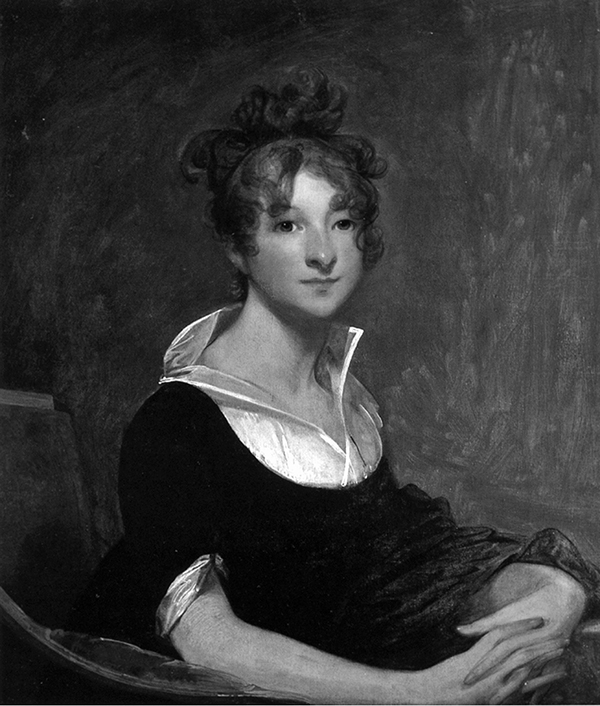
Gilbert Stuart’s portrait of David Burnes’s daughter at age twenty-three, the future socialite and philanthropist Marcia Van Ness.
Visual Discord
The Van Nesses’ peers also built great mansions throughout town, many of them next to the modest dwellings of the poor and working class,15 regardless of the visual or moral contradictions. Such structures included anything from modest Federal-style houses to such grand estates as Commodore David Porter’s Meridian Hill, which was “set in a hundred and ten acres of grounds and required the employment of enough servants, grooms and gardeners to people a small village.”16 (Despite its grandeur, Porter didn’t long enjoy it: He was court-martialed seven years after he built the estate and fled to become the commander of the Mexican Navy.)
Plantation tracts and colossal estates like Porter’s obviously wouldn’t last long in a modern city, but Washington City wasn’t anything like a real city in its early days. The rural landholders of Virginia and Maryland stamped their provincial character all over the capital, from the large houses built with stables, gardens, carriage houses, kitchens, and slave quarters, to the style of their hospitality and the fashion of their parties, to their rigid emphasis on class order and place-holding in society.17 These phenomena only added to the visual mishmash of Washington City: plantations suitable for Chesapeake tobacco farming, public buildings echoing ancient Rome, a street layout in the style of Baroque France, shambling log cabins like those on the western frontier, and wretched shacks and hovels as bad as any urban slum in America.
Reign of the Gourmands
Other contrasts emerged as well. Common folk had to content themselves with diets consisting mostly of bread, cabbage, and sweet potatoes, but upper-crusters had a cornucopia of delights with which to stuff themselves. Attorney General William Wirt mentions in one letter to his wife how he gorged on a range of delights: a small ham, a goose, two chickens, various vegetables, beans, sweetmeats, cheeses, peaches, and pears, crowning the feast with a fine glass of claret.18 Society banquets featured all kinds of game, side dishes, and desserts, with particular attention to one local delicacy: the canvasback duck. English diplomat Sir Augustus John Foster gushed wildly over this waterfowl in his book on America, hailing them as “the most delicious eating, and I have frequently seen four dishes of them served up at the same time on the same table.”19 Mary Bagot described another favorite, turtle, as being served “in the shell steamed with a little pepper & butter”—which might sound appetizing until you consider that her companion sourced the creature from a roadside ditch.20
To eat the likes of turtle (roadkill or otherwise), guests were provided with glittering silver forks, which were as much a status symbol as a fine wardrobe or handsome carriage. Although presidents such as John Adams and Thomas Jefferson dined with these refined “French forks,” other bluebloods such as Charles Carroll saw them as an improper indulgence and Mary Crowninshield complained about how heavy and clumsy they were.21 More humble Americans had a darker view, as some feared the new republic would be “stuck to death with four-prong’d forks” and others vowed never to cast a ballot for a presidential candidate who ate with such fancy utensils.22
The Jam and Squeeze
Thomas Jefferson, master of the fork and other things French, ironically proved much more democratic when it came to entertaining. He invited small groups of no more than fourteen to the White House and seated them without regard to rank or custom, breaking up cliques to force people to mingle with one another in lively conversations.23 But Jefferson was an anomaly, and in later years presidents and their congressional counterparts refined and tightened social codes to the point where rank became paramount and White House dinners became dreary rituals, thick with rigid etiquette.24
Private affairs were a bit more animated but still required a lengthy, formal process of invitation, acceptance, and scheduling as precise as it was inflexible. Librarian of Congress George Watterston provides this overview to the rather elaborate procedure:
The cards of invitation to those parties are sent out about nine days before they are to be given, and if the invitation be to dinner, the person invited must return a written acceptance of the invitation, or an apology for declining. . . . The guest appears at the hour designated, generally about six o’clock, P.M.; for it is deemed uncivil to attend too early or too late on such an occasion. At soirees, or evening parties, the company usually assemble at from nine to eleven o’clock, and retire at from twelve to two o’clock.25
At these large nighttime parties, known as “jams” or “squeezes,”26 plenty of elegant gentlemen and ladies knew how to make a fine impression—even as others just wanted to make a splash with personal style bordering on the ridiculous. Men might wear ballooning “Cossack” trousers with “Hessian” boots adorned with gold tassels, or dress coats with “enormous collars and short waists” or “tight-fitting pantaloons, silk stockings and pumps.” Women with a flair for “scantiness” might wear dresses that stopped at the ankle and sport silk stockings with slippers ornamented with rosettes and tiny buckles.27
At the fashionable balls, they all stepped lively to country dances, quadrilles, minuets, and the basket dance, a forerunner to the modern square dance. The musicians were usually black, both free and enslaved, as were most of the servants. They doled out ice cream, lemonade, port wine, and desserts to the ravenous gourmands, who in their gluttony might appear “with one hand bearing well-filled glasses, and in the other sustaining a plate heaped up with cake.”28
The cream of society’s crop made an even greater effort to entertain their cronies. George Custis—son of Martha Washington by her first husband and adopted by George Washington—built a dancing pavilion at his estate at Arlington and held elaborate picnics on the grounds. At one event he presented a full-dress performance of a play he wrote, Pocahontas; or, the First Settlers of Virginia, with dresses, props, and scenery provided by the federal Indian Bureau, “to aid the aboriginal effect.”29 With its elaborate manor house, gardens, and hundreds of slaves, the massive estate also hosted the 1831 wedding of his daughter, Mary. It was a grand social affair in which she wed a lieutenant in the US Army who happened to be one of her third cousins: Robert E. Lee.
“The Natural Best”
The capital elite didn’t just eat canvasback ducks and dress up for fancy balls and weddings. Some joined secret societies, establishing fraternal, business, and sometimes political connections with those deemed worthy. The most famous group were the Freemasons. They claimed their secret heritage dated back millennia to Biblical times, but Masonry really took off in America only during and after the revolutionary era, when such figures as Benjamin Franklin and George Washington associated themselves with it. The group stated its aim as spreading republican ideals and serving as “priests, teachers, and missionaries of liberty, virtue, and true religion.” They claimed to be meritocratic, elevating the so-called “natural aristoi” to positions of prominence without regard to birth and wealth.30 In practice, though, membership amounted to an effective way to establish credentials within the tight circle of the wealthy and powerful.31 Some well-heeled artisans joined, but the lower orders were excluded because admitting them would “inevitably bring the Craft into the greatest Disgrace imaginable.”32
Masons favored public spectacle and acknowledgment in splashy parades and honorary processions through town, but they also favored privacy and countless arcane codes, systems, and rituals—including, for the higher levels, forcing initiates to crawl over a pile of garbage or drink wine from a skull.33 Nonetheless, for the first few American decades, they did well, providing education, charity, and funerals for their members34—and for their proponents, such as Anne Royall, who would have had a tough time surviving the lean years without such charity. At the same time they dampened potentially noxious strains of religious conflict and tribalism that had weakened many failed republics. Their proudest public display came in 1793, when President Washington laid the cornerstone of the US Capitol in a ceremony thick with Masonic ritual, followed by chanting, prayers, and an artillery volley.35
In theory, Freemasonry tried to limit partisan strife and bridge political, ethnic, and religious divides between gentlemen. That it failed and itself became a political issue represented just one of the bitter little ironies that animated the tumultuous 1820s and 1830s. During that time, with the rise of Jacksonian democracy, the Masons’ secretive rituals and bizarre symbolism invited a backlash, even though Jackson himself belonged to the order. The group already had a dangerous reputation for being cosmopolitan, elitist, and potentially irreligious, but when a handful of its members decided to kidnap New Yorker William Morgan, who had threatened to expose their secrets, and he was later found dead, the masses revolted. Freemasonry became a “hydra-headed monster,” an enemy ofChristians and republicans everywhere, and the Anti-Masonic Party formed.36 The party attacked social privilege and decried the secret order as evil, murderous, monarchical, antirepublican, elitist, and barbaric; and “We aim, therefore, at its annihilation.”37
Such a potentially revolutionary (or reactionary) group should have made the Washington City elites quake in their Hessian boots, and no doubt many of the town’s top citizens did—but not all. The first and only presidential candidate of the Anti-Masons was William Wirt, the insatiable attorney general who had stuffed himself with that lengthy grocery list of dishes among elite company. But his candidacy made for dish of a different sort: Wirt, once a Mason, now had to justify all those inconvenient social bonds in accepting the party’s nomination. He tried to ride the democratic wave as best he could, calling Freemasonry a “noxious institution” that would “sacrifice its victims with pleasure and with impunity” by silencing the opposition with “mysterious terrors”38—which of course he knew only too well but wasn’t at liberty to reveal since, of course, he had taken the Masonic oath.
Wirt told the Anti-Masonic convention what it wanted to hear, but really he was maneuvering to become the anti-Jackson candidate. When Henry Clay got the nod instead, Wirt had doubts about remaining with the Anti-Masons and tried to reject the nomination several times, but his new radical friends wouldn’t hear of it. “I cannot think of a rational or patriotic motive they can have for continuing me in the field,” he complained in a private letter.39 But he was stuck . . . and running for president, like it or not. In the 1832 election, he won a single state: Vermont.§
§ He made a more ghoulish appearance in 2005 when his skull turned up in the office of a District councilman. Apparently, in the 1970s a grave robber had rifled through the coffins of the family vault, stolen Wirt’s cranium, and then presumably sold it to a dealer in macabre relics. It has since returned to the Wirt vault at Congressional Cemetery. (Mark W. Grabowski, et al., “Cemetery Vandalism: The Strange Case of William Wirt,” Washington History 22 (2010): 57–68)
Society Improvements
If we take Wirt as an example, the District elite had a hard time navigating the new political landscape of the 1830s. Nothing about their lifestyle—acres of land, great mansions, legions of slaves, indulgent dining, Cossack trousers, silk stockings—related even remotely to the common man or woman. Their secret societies, incantations, and mysticism only proved how they had removed themselves from the day-to-day existence of those who labored in the trenches, scraped by in the poorhouse, or stood on the auction block. But the top shelf had to display some sympathy to those below them in rank. The French Revolution, inspired by the American one, had long before showed them that. Many remained indifferent to the plight of less wealthy citizens, but some participated in charitable societies that counterbalanced private societies like the Masons that were causing so much trouble. The more notable organizations included:
· • American Historical Society (old papers and artifacts)
· • Columbia Horticultural Society (flowers and gardens)
· • Columbian Institute (art and science)
· • Female Union Benevolent Society (poor women)
· • Howard Society (job training for the poor)
· • Navy Yard Beneficial Society (sailors’ families)
· • Temperance societies (alcohol prohibition)
· • Union Literary Debating Society (public speaking)
· • Washington City Benevolent Society (poverty relief)
· • Washington Relief Society (aiding poor immigrants)40
Perhaps the most well-regarded philanthropist was Marcia Van Ness, who was as devoted to public service as she was to her private social world, if not more so. She cofounded and directed the Washington Female Orphan Asylum after the 1814 British invasion to care for the town’s many destitute children,41 offering the land for the asylum’s building and donating food, clothing, furniture, and other supplies. She continued her good works until 1832, when cholera hit Washington City and killed many of its citizens. One of them was Van Ness herself, who died from the plague while nursing its victims.42
Phoenix in Brick
The most community-minded figure among the elite, however, had the least claim to be there. Cash-poor from the real estate bubble and facing constant struggles with the city canal, Tom Law remained only a nominal member of the upper class in the early nineteenth century. But he persevered and found himself in the right place at the right time when the capital needed help.
It never needed more help than after it burned in 1814. With many of the federal buildings in ruin, politicians from Pennsylvania and other states tried to use the District’s sorry condition as an excuse to move the national capital elsewhere. “The appearance of our public buildings is enough to make one cut his throat,” said one Virginian.43 While Congress was debating what to do, Law took the lead in raising $500,000 in loans for the construction of a temporary building to house the legislature, which had been laying down the law in Blodgett’s Hotel while its chambers were in ruins.44 Some later claimed Law’s efforts for this new “Brick Capitol” kept the seat of government in Washington City, but in practice Congress had already decided to rebuild the Capitol when the brick version opened for business.45 Still, a rosy halo formed over him as one of the saviors of the capital, and he imagined the future growth and glory of the rebuilt city:
At this methought a peal of victory rung
And a new edifice in splendor sprung,
Like phoenix from its ashes, and a sound
Of triumph and rejoicing rose around.46
It wasn’t the first time he waxed poetic, nor was it the last time he tried to help his adopted city. But who was this failed real estate baron, struggling canal builder, legendary partier, and would-be poet, and why did he care so much about Washington City?
The Poetical Ludubrian
Law came to America with an impeccable English pedigree and legacy. His father, Edmund Law, bishop of Carlisle, had written the trailblazing Theory of Religion, which excited many ecclesiastical debates in the old country. His most famous brother was Edmund Law, later attorney general and speaker of the House of Lords.47 Unlike his relatives, Law found his calling overseas, alighting for India at age seventeen and remaining in the employ of the East India Company for nearly two decades. As revenue collector for the state of Bihar, he transformed an onerous system of taxation and introduced the concept of private property rights independent of lands owned by the crown. As newspaper editor William Duane said of him, “Mr. Law’s revolution without bloodshed eventually changed the whole moral and social condition of Hindostan.”48 Law returned to England in 1791, fighting the East India Company over a claim against a paymaster in his employ and for whom he had vouched. In the first of many financial twists of fate, Law was held responsible for the £10,000 claim, a fifth of his total fortune. He filed suit against the company and left for America in 1794 to start over.
Arriving in the new republic, he immediately discovered the potential riches on offer. Oddly, for someone who already had plenty of money and never showed a weakness for greed during the rest of his life, Law swooned at the prospect of speculation, with the capital itself his drug: “I shall certainly go to Washington City & my heart & my mind are full of it—You may say that I had rather sell my horses or books or any thing rather than part with a foot at present of Washington City.”49
In town only a year, the socially adept thirty-seven-year-old wed the first lady’s nineteen-year-old granddaughter, Eliza Parke Custis. A few years later, a young Thomas Twining visited from Britain and observed Law hard at work building spec houses: “The clearing of ground and building of small houses, amongst the woods of the Potomac, seemed an uncongenial occupation for a man of so accomplished a mind. . . . America, of all countries, seemed the least suited to the activity or leisure of such a person.” Twining had a foreboding about his friend, thinking that “his inexperience in commercial affairs, amidst rivals so experienced and intelligent, might expose him to litigation and disappointment, and involve a considerable diminution of his fortune.”50 The young man’s prophecy proved true.
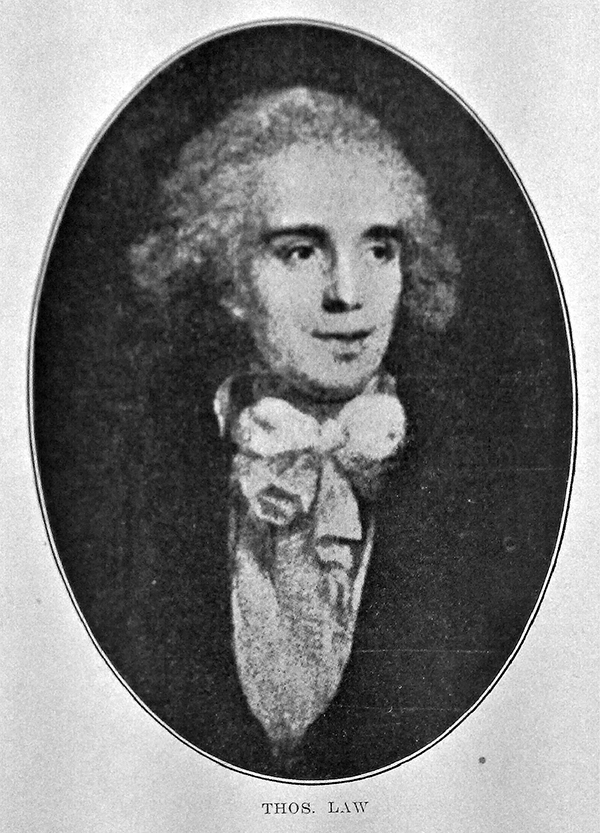
The ever-optimistic, often financially troubled Thomas Law.
Even as Law was busy losing money on real estate, he was investing even more of it elsewhere. In 1797, near the Eastern Branch, he helped create the first and largest manufacturing operation in Washington City, a sugar refinery.51 Law planned to import sugar from India using non-slave labor to establish a thriving business in America while encouraging India to free the bondsmen who worked the sugar plantations there.52 Sadly, that noble idea resulted four years later in “a very large but perfectly empty warehouse, and a wharf graced by not a single vessel.”53
But Law kept trying. In 1798 he became a director of the District’s first bank, then designed and advocated a plan for a national currency, which fell on deaf congressional ears.54 For decades after, he wrote a column in the National Intelligencer, under the pseudonym “Homo,” pushing for a national banking system, publicly financed debt, and an agricultural society, among other points.55 In 1814 he wrote to President Madison recommending the establishment of a university and military college, since Congress was treating the District with an “opprobrium of neglect.”56
Three years later, Law helped found the Columbian Institute, which Congress chartered in 1818 to promote math, science, literature, and art. He summoned all the top names in town, including Benjamin Latrobe, William Seaton, and William Thornton to help him run the institution, a forerunner to the modern museums in the District today, which collected an array of books, minerals, shrubs, and trees.57 The institute also built at the foot of the Capitol a fine botanical garden, which collected specimens of plants, fossils, and minerals from around the world—perhaps its greatest endeavor. The Columbian Institute closed its doors in 1838, but its collection formed the core of the National Institute, which later became part of the Smithsonian.
Any good philanthropist might have pursued the founding of institutions or the funding of civic improvements, but Law, despite his tenuous status as a “rich man,” followed all manner of whims and curiosities too. He had a flair for what he called “poetical ludubria” and indulged it when the short-lived United States Theatre opened in Washington City in 1800 by writing a prologue to the main play with a gentle poke at his audience:
Those ruddy cheeks evince the air is fine,
And those fat sides show on the best you dine.
Well faith, we’ve form’d a tolerable stage;
Here’s room for comic glee or tragic rage;
But there [pointing at the crowd] the city populates so quick,
I fear you’ve stowed yourselves away too thick!58
Wordsworth it wasn’t, but Law cut a charming figure as a patron of the theater, both in verse and purse, and helped fund other arty endeavors, such as the Washington Dancing Assembly. Law’s charisma was substantial enough that even his respected biographer Allen Clark abandoned objectivity and wildly praised him as “the scion of Britsh aristocracy, a lord of India, bright in speech, elegant in manner, and handsome . . . Tom Law, paragon of manly perfection”!59
More unusual, considering the circles in which he moved, was his association with freethinkers and the Unitarian Church. He generously funded the latter and commented that people should “seek salvation according to the dictates of their own conscience,” thereby denying the authority of established churches.60Defying the racist attitudes of the era, this associate of wealthy planters called presciently in his newspaper column for the abolition of slavery as a way to prevent civil war. He publicly acknowledged and supported his three mixed-race sons from a previous marriage in India, who became prominent figures in the District and, like their father, were “generous, kind-hearted, and most intelligent . . . free from all aristocratic pride.”61
Needless to say, many of Law’s peers didn’t know what to make of him. Margaret Bayard Smith saw him as generous to a fault, “connected with the most respectable people,” always raising money for some good cause or other, but still—“it is impossible to describe this man; he is one of the strangest I ever met with.”62 She was right: He was a true oddball. Not only did he declaim in verse whatever random subject crossed his mind, but he impulsively went skinny-dipping and strutted around in the nude afterward.63He had a curious knack for kneading bread in his hands while lost in deep thought on a walk and had such a terrible memory that when a random notion hit, he would “wildly rush about, exclaiming, ‘Pen and ink, pen and ink, an idea, I have an idea, quick!’ ”64 He read and spoke Persian and encouraged his guests to smoke a hookah with him by the riverside.65Yet despite all his eccentricities, his top-shelf friends, perhaps amused by him, helped him fund his lifestyle and his civic projects—if only because at his grand picnics he made sure to indulge them in “cold meat, bread & cheese & oceans of wine, punch & brandy.”66
Whether using his own cash or his friends’, Law funded or helped start a great many projects that otherwise would have died in Congress. His own returns from those projects were usually quite meager, and he managed to lose money on many of them. Ultimately, apart from the District’s major public buildings, Law invested more in the capital than the federal government did throughout the course of thirty years, a fact both remarkable and depressing.67
The Great Castle
Holding a core collection derived from the institutions that Law and his peers helped fund, the greatest emblem of private philanthropy in the capital was and still is the Smithsonian Institution. In 1826 English scientist James Smithson left a bequest for an institution to be founded in America for “the increase and diffusion of knowledge among men.”68 Smithson never visited the United States, yet to the new country he left his fortune (though it took a dozen years for the will to be settled). The $500,000 bequest arrived in the United States in 1838 in the form of 105 bags of gold bullion coins sent by packet boat. Leading politicians had all kinds of ideas about what the money should fund, so Congress dithered for eight years trying to figure out what to do with it. In 1846 the legislature accepted the money to fund a facility that would include a museum with art and science displays, a library, lecture halls, and research labs.69 Six years later a great icon of red sandstone emerged, rich with turrets and battlements, known appropriately as The Castle.
A visual anomaly as much as the Capitol and White House, the Smithsonian stood out as a lone Gothic sentry along the barren landscape of the Mall. Citizens starved for scenic beauty even used the Institution’s grounds as an ad hoc resort.70 But the building’s magnificence made the rest of the Mall look shabby and decrepit by comparison. This was especially apparent when anyone compared The Castle’s lovely neo-medieval form with the architectural attempt, just west, to honor George Washington with a great public monument. Indeed, no other building represented so colossally the failure of federal politicians to aid a worthy cause than the Washington Monument.
Monumental Struggles
Congress had been searching for a way to honor the nation’s first president since the failure of the giant pyramid project at the end of the eighteenth century. The obvious solution to some was to preserve his house at Mount Vernon, which certainly needed the help, as Harriet Martineau observed in the mid-1830s:
The land appears to be quite impoverished; the fences and gates are in bad order; much of the road was swampy, and the poor young lambs, shivering in the biting wind, seemed to look round for shelter and care. The conservatories were almost in ruins, scarcely a single pane of glass being unbroken; and the house looked as if it had not been painted on the outside for years.71
Members of the legislature, however, cared less about the fate of the general’s estate than of his body, which was buried there.
Congress had wanted to entomb Washington in the Capitol almost as soon as he died, and they even built a crypt on the lower level to house the remains. On the centenary of Washington’s birth, in 1832, Congress formed a Centennial Committee to devise a way to commandeer the body from Mount Vernon and spirit it to the Capitol. But certain Virginians would have none of it, vowing to “contend to the last for the body,” and one Georgia congressman even warned of “the severance of this union” should Washington’s cadaver be swiped from its vault at Mount Vernon.72
In the end, John A. Washington, the president’s great-nephew, helped stop the congressional action. But just in case, Virginia passed legislation preventing the removal of the body, and leading politicians, North Carolina senator Willie Mangum among them, demanded the governor dispatch the state militia to stop the federal grave robbers at gunpoint.73
The attempt at “honoring” Washington didn’t end there. Just after the jockeying for his body ended, Congress decided to commission a sculpture of the president, giving Horatio Greenough the task of creating a huge marble statue. The giant, twenty-ton carving arrived by boat in 1841 but shocked Washingtonians with its vulgarity. Greenough depicted the president as Zeus, enthroned and clad in a toga. Naked from the waist up, the great general looked angry, pointing at the sky for no particular reason. Congress didn’t know what to do with the monstrosity, placing it first in the Rotunda and then exiling it to the east Capitol grounds, a wooden barn, the Capitol basement, and the Naval Academy.74 (It now sits in the Smithsonian’s American History Museum.)

Horatio Greenough’s unloved statue of George Washington, depicting him as Zeus in a toga.
Congress had racked up three failures in trying to honor a national hero. Still, the attempts continued—and in even more colossal form. In 1833 a group of civic-minded citizens created the Washington National Monument Society, Chief Justice John Marshall its president. The society held a design competition, which in 1836 Robert Mills won with a proposal for a five-hundred-foot neoclassical obelisk rising from a colonnaded base. The society didn’t care for the base but accepted the obelisk and began raising funds for the monument,75 to be located near the spot where L’Enfant once imagined a statue of Washington on horseback.
But raising funds for the monument proved slow going, and it took more than a decade for construction to begin. On July 4, 1848, the Masonic lodge of Washington City laid the cornerstone for the monument. But instead of sitting at the intersection of the axes aligned to the Capitol and the White House, the obelisk rose off-center, one hundred yards south, where the ground was higher, the soil not so marshy.76 Construction continued apace for six years but then ground to a halt when the society ran out of money in 1854. The nativist Know-Nothing Party took over the society through violence and intimidation (about which more in the next chapter), and, though Congress rescinded its $200,000 donation, it did nothing to stop the interloping agitators from destroying the society’s reputation. The result: a drab stump of granite that over the course of nearly three decades symbolized the repeated failures of Congress, and by implication the struggles of the capital itself.

The granite stump of the Washington Monument, which stood unfinished for nearly three decades.
Capitol Captives
In contrast to the bumbling of the national legislature, the philanthropy of wealthy Washingtonians helped keep the capital from collapsing or sliding into total poverty and structural decay. The rich dealt with such problems because of the total lack of charity and good works from the town’s other elite society—the politicians from around the country who congregated in Washington City but didn’t consider it their home. These out-of-towners held power in the capital, but, despite being “public” figures, they lived lives even more removed from the average Washingtonian than did the planters and grande dames. It began with how they lived and with whom they chose to associate.
The seeds of the politicians’ isolation germinated when the capital moved to Washington City in 1800. Few legislators wanted to live in the barren, undeveloped village year-round, so they looked for only temporary accommodation. Some entrepreneurs opened hotels, but most of these met with failure. Taverns made a poor choice because boarders had to share beds with random bunkmates—not an option for congressmen who needed privacy and workspace.77 The answer came in the Washington boardinghouse.

William Thornton described the early US Capitol, before it was remodeled, as a “large sugar dish between two tea canisters.”
This form of collective housing represented the only viable option for most legislators, almost all of them initially living in eight boardinghouses on Capitol Hill. Around these three-story brick structures sprang up businesses and facilities that catered to every whim and need of their guests: barbers, bathhouses, bookstores, churches, clothiers, groceries, libraries, liquor stores, post offices, restaurants, schools, stables, and tailors.78 Most of the time, though, the politicians just hung out in the House and Senate chambers where they aired their windy speeches.
A legislator might live in a boardinghouse with anywhere from two to seventeen or more boarders, often from his region or state. Proprietors advertised in newspapers their houses’ spacious kitchens, fine gardens, and proximity to the Capitol. Lodging didn’t come cheap, though, and they jacked up their prices whenever their customers came to town.79 Their residents didn’t have much choice but to accept the steep rates, so keeping a boardinghouse became one of the few profitable businesses in the District.80 In his 1822Washington Directory, Judah Delano fills the first eight pages of his guide with nothing but the names of Senate and House members, their states of origin, and the names of the boardinghouses where they lodged.81
Fortresses of Solitude
More than a few writers referred to the cloistered congressional life as monk-like, since the members lived, ate, socialized, killed time, and talked politics only among their kind.82 Each house “had an invisible drawbridge and portcullis. One was a fortress for New Yorkers or the same party, another for Pennsylvanians, another for Ohioans.”83 They ignored non-politicians in the same house and often broke into smaller cliques based on state, party, or sectional interests, voting that way in Congress too. Their herd mentality held so strong that if a member defied his “fraternity” he was more or less excommunicated. Margaret Bayard Smith recalls one such apostate, who, after casting his vote against the wishes of his messmates, “looked wretchedly, tears running down his cheeks,” and begged forgiveness; another who did the same was shunned by his fellows: “we let him continue with us, sit at the same table with us, but we do not speak to him. He is beneath anything but contempt, and he is an old man.”84
This incestuous climate fed upon itself, until even the leisure and social life of congressmen became politicized with gossip and innuendo. As James Sterling Young writes in his pioneering study of the life of politicians in the early District, “Who was and was not invited to a tea, a dinner, or a reception, who accepted and who declined, who was and was not calling upon whom, became matters pregnant with social significance.”85 But there was nothing genteel about the ways of those politicians in their private boys’ club. On the floors of Congress they brought their hunting dogs (particularly John Randolph); they drank, whittled, yelled at friends in the gallery, took snuff, chewed tobacco, and spat anywhere they wanted.86 Their boardinghouses sometimes looked even rougher around the edges. Anne Royall recalls a few houses known for their bullies and thugs: “It is out of the question even to have a card delivered to any member in the house without endangering life.”87
These raw, aggressive attitudes came at a cost, though. The local elite weren’t exactly rushing to welcome low-mannered congressmen to their balls and salons. As Constance McLaughlin Green writes, “cultivated Washingtonians felt no obligation to open their drawing rooms to congressmen of very modest political, and still less social, savoir-faire.”88
Vortex of Ruin
Members of the executive branch, from cabinet secretaries to clerks, also clustered in houses and boardinghouses around the White House and the departments of State, War, Treasury, and Navy. They kept to themselves and had their own schools, churches, library, banks, and theater. With the president as the nucleus of their orbit, they had their own salons too, at which conversation, games, music, and poetry readings took place as well as celebrity visits by the likes of James Fenimore Cooper and Washington Irving.89Throughout the executive branch, in the so-called “Court end of the city,” the need to be stylish and fashionable affected every rank and class.” Even midlevel bureaucrats had to participate:
although their salaries are small and their means limited, they fancy it would be unpardonable not to ape those above them and be what is called fashionable, and thus they plunge into the vortex of ruin. They give evening parties, pay morning visits with cards in their own carriages, or any they can procure, give routs [nighttime parties], go to assemblies, and, in short, exhibit every folly their superiors think proper to practice because it is said to be haut ton, and they cannot think of being unfashionable, whatever may be the result.90
But they avoided social commerce with their counterparts on Capitol Hill, from whom they kept a wary distance.91 James Madison’s secretary of the Treasury, like those who worked for him, wasn’t unusual in steering clear of congressmen: “Mr. Gallatin leaves no cards, makes no visits, scarcely ever invites a member to dine, or even has a tea party.”92 The high-minded pursuit of separating the branches of government wasn’t the only factor that encouraged such distance: Many members of the executive branch considered themselves superior to the rubes in Congress and to people in general. As visiting critic William Faux saw it, “no men in the world are more aristocratical than the heads of departments; they spurn, and cannot even speak to, common men, unless it be to purchase popularity cheaply.”93
Thus Washington City’s political elite comprised separate, warring tribes, each with its own redoubts and its own enclaves, its own tightly knit society and social codes, its own suspicions and hostility to outsiders. The same insularity applied to justices on the Supreme Court, who worked in the basement courtroom in the Capitol and all lived and dined at the same boardinghouse on Capitol Hill, an arrangement that lasted until 1845.94 Each political clan kept to itself, its members trusting only those who slept, dined, worked, and relaxed in the same company. Some commingled with the elite in town, but many didn’t, and far fewer of them socialized in any meaningful way with the slaves, free blacks, and white mechanics who made up the bulk of the District’s population. As for the small middle class in town, it was more of a merchant class and consisted of shopkeepers, clerks, artisans, and the like, but it never cohered as a unified group. Its upper order sought out the company of the elite, while its lower order were considered mechanics who had made a bit of money. The old social divisions remained.95
Nobody’s Constituents
Ultimately, national politicians considered themselves outsiders, not responsible for correcting the problems that their policies obviously had caused. The capital “was not ‘our’ community in the eyes of the governing politicians; it was ‘theirs’—the townspeople’s.”96As a result, Congress regularly refused to upkeep the town’s roads, streetlamps, sidewalks, sanitation, schools, and city canal, telling Washington City to tax itself—which it did heavily. But such efforts couldn’t come to much when the prized real estate lay off-limits to taxation: the public buildings and the houses of the Congress and the president.
The capital remained a shambling mess throughout the first half of the nineteenth century, but the politicians, ironically, had the audacity to complain about it, calling the town “a hateful place . . . splendid misery . . . [producing] nothing but absolute loathing and disgust.”97 When local business leaders tried to jump-start the capital’s anemic economy with a new railroad link in the middle of the century, Congress balked. Said one senator, “Washington was not intended to be a great business mart.”98 Instead, it was run by leaders indifferent to its plight and beholden to voters of other, increasingly distant states. As one irate letter-writer put it in the National Intelligencer: “Every member takes care of the needs of his constituents, but we are the constituents of no one.”99
The situation reached such a crisis point that by 1835, with the legislature still withholding essential funds needed to modernize the town, Senator Samuel Southard admitted in a report to Congress that Washington City had exhausted its resources.100 In response, he reasoned that the legislature should assume some of the city’s debts and help pay for elementary services like road paving and lighting, sidewalks, poverty relief, and other functions. The stingy legislators needed to debate these urgent topics for a few more years, but at least they relieved the District’s canal debt101and kept the American capital from going broke and being sold to the Dutch.
Walled off in its own fortress, Congress had crippled the growth and development of the capital, ensuring its abysmal physical condition and that it had few successful enterprises beyond slave trading and boardinghouses. Indeed, if it weren’t for local elite society—with its elaborate social codes, gluttonous dining habits, fancy soirees, and extravagant outfits—Washington City couldn’t have taken care of orphans, helped the poor, trained people for jobs, promoted art and science, or established museums and gardens. Thus the capital consisted of two distinct high societies: the elected one that completely dismissed the interests of the people it lorded over and the unelected one that didn’t.
Twilight of an Englishman
Tom Law had a hard time of it in his final years, though you’d never know it from his cheerful demeanor and irrepressible charm. He and his young wife, Eliza, separated in 1804 and divorced seven years later, leaving great recriminations between the two and alimony payments for him for several decades afterward.102 These, as we’ve seen, he couldn’t afford, and he had to seek the assistance of friends and relatives to pay them. In the early 1820s, English critics Charles Janson and William Faux separately published salacious gossip that his wife had cuckolded him while she was “attached to the military, at the marine barracks in Washington . . . dressed à la militiaire in company with the officers.”103 Law skillfully fought the charge in print, but it only added to a reputation that he was as maladroit with women as he was with money.
But the worst was yet to come. In August 1822 his daughter, Eliza Rogers, died unexpectedly at the age of twenty-six, and less than two months later his son John, an attorney and city councilmember, followed her. Another son, Edmund, also a city councilmember, died at the end of the decade, and even his young ex-wife preceded him to the grave.104 That shocking number of deaths in fewer than ten years, more than his financial failures or any other challenges, finally seemed to break his spirit. One Washingtonian saw him at a restaurant near the end of his life, recalling him “as a grave, sweet old man . . . who read a poem of his own composing, which served as a dessert after the oysters.”
Look not in public places for a wife;
Be not deluded by the charms of sight.
Retirement only gives the friend for life
Who shares your grief and doubles your delight.105
Law died in 1834, at age seventy-seven, and was buried in an unmarked grave in Rock Creek Cemetery.106 Like his gravesite, most of his endeavors have long since disappeared, including his spec developments, canal, theater, sugar refinery, scientific institute, country estate, and temporary capitol. Almost all that remains is the house that he and Eliza shared after their marriage. Located in the southwest quadrant of town, the Thomas Law House stands out among the sea of drab condos built in the frenzy of 1950s and 1960s urban renewal, which leveled so many other old estates but left this smart, elegant, unpretentious home as a fitting if lonely tribute to its long-forgotten owner.

Thomas Law House, one of the last remnants of Law’s life in Washington City.