
SIX
The gentlemen of Washington City did more than just attend balls, feast with abandon, raise funds for charity, and live in their elite cocoons. They had other concerns too—such as trying to kill each other. The code duello, an elaborate honor code, enabled a gentleman whose pride or dignity was impugned to murder his adversary freely, as long as he did so with the proper etiquette and ceremony.
Dueling was only the tip of the sword of the varieties of violence in the Chesapeake, which spanned a broad range of socially tolerated mayhem in an era dominated by male bravado and almost cartoonish virility. Mobs rampaged, street gangs battled, and blood sport entertained, usually in combination with alcohol and social pressure, to create a heady climate of brutality that held sway from the colonial era all the way to the Civil War. Thomas Twining noticed how the region reveled in fighting, dueling, and “cruel sports,” with eye-gouging and “other barbarities” among the specialties.1 Not just criminals out for blood took part. All creeds and classes participated in the bloodletting, using violence as a tool of dominance to keep pariahs in line and to enforce racial, social, and cultural codes. They often did so with a wink and a nod from the proper legal authorities, who had neither the inclination nor the means to fund an effective system of law and order. Disorder resulted and verged on anarchy during times of open conflict, when citizens could maim and mangle each other at will.
The Rules of Honor
Dueling represented the most acceptable form of social violence because this kind of attempted homicide “did not lower the would-be murderer in the respect and esteem of the elite of Washington society.”2 Treasury Secretary Alexander Hamilton and Vice President Aaron Burr fought the country’s most famous duel in 1804 in New Jersey, but countless other contests in the years after drew considerable attention as well, provided the adversaries had sufficient social standing to merit it. Indeed, some of the most esteemed gentlemen in the nation, and particularly in the South, became its most visible champions.3
By the early nineteenth century, refined dueling etiquette in the Chesapeake went something like this: One gentleman offended another by an insult real or imagined. The aggrieved party posted a note in a newspaper or other public place declaring his nemesis, say, “an unprincipaled villain and a coward.”4 The other party responded in kind, and the technical legwork began as the gentlemen and their allies, or “seconds,” proposed a date and time, weapons (usually pistols), and choice of venue. All very formal and precise, it adhered to the code duello as the parties understood it. With the appropriate rules and ceremony, honor would be satisfied, regardless of whether it resulted in death or grievous injury.
The parties usually picked the dueling ground outside Bladensburg as their venue. Enclosed by hills with a little brook running through it,5 the site made a stirring and romantic spot for mortal combat. More importantly, while Maryland had laws against its own citizens dueling, it said nothing about Washingtonians doing the same on the state’s turf. In reality, the combatants were unlikely to be caught and arrested anyway: The District had no effective law against dueling,6 and tradition kept them going back to the Maryland border to uphold the demands of honor, year after year.

The dueling ground at Bladensburg, Maryland, where gentlemen cordially met to kill each other.
The Power of Custom
Perhaps the most famous battle between American naval commodores took place not at sea but in a Bladensburg forest clearing. The challenger of the duel, James Barron, had commanded the USS Chesapeake, which in 1807 the British HMS Leopard had attacked and boarded in order to seize four deserters from the Royal Navy. The shameful encounter led to Barron’s court-martial, after which the US Navy barred him from command for five years and resisted his appeals for reinstatement thereafter. Barron never forgot the humiliation and nursed a grudge against Stephen Decatur, the naval officer who had served on the court-martial and worked to keep him from commanding a ship afterward.7
Commodore Decatur, one of the most accomplished and legendary officers the US Navy ever produced, commanded a squadron against the Barbary states, fought in the War of 1812, and had a mansion near the president’s. Decatur and his wife were planning a wedding reception in their elegant home for President Monroe’s daughter even as Barron and Decatur were quietly exchanging notes in preparation for their duel. Barron felt Decatur had ruined his career and good name and demanded satisfaction; Decatur argued that his motives were strictly professional, not personal, but recognized the necessity of the contest. He had fought five duels before, killing an Englishman in one of them. Even though he philosophically opposed duels, he had no choice but to participate in them, due to the social demands of the dueling code, backed by “the omnipotence of public opinion.”8 The president had the power to stop the actions of such men in the military, but as William Faux saw it, “such is the power of custom, that he cannot and dare not do it.”9
Separated by only eight yards, the commodores each shot the other in the hip, but Barron’s bullet hit one of Decatur’s major arteries. Decatur died on the evening of March 22, 1820, in excruciating pain. Barron lived for another thirty years. Thus, thanks to the near-random result of a socially sanctioned gunfight, a mediocre seaman who had embarrassed his country lived to a ripe old age, while “one of the first officers of our navy, the pride of his country, the noble-hearted gentleman”10 expired early at age forty-one.
Blacklegs and Dressing Gowns
Not all duels took place at Bladensburg, nor did honor always have anything to do with dignity. One such counterexample occurred in April 1826 between Secretary of State Henry Clay and Virginia senator John Randolph. In one of Randolph’s signature tirades in the Senate, he had quoted a foreign minister’s denunciation of the John Quincy Adams administration, of which Clay was a key part, as a “puritanic, diplomatic, black-legged coalition” and dared anyone to take issue with that opinion.11 According to the code, Clay had no choice but to challenge the senator to a gunfight. After some hemming and hawing on Randolph’s part, the men met in a forest basin on the Virginia side of the Potomac, their loyal seconds acting as intermediaries and weapons loaders.
But instead of wearing a garment appropriate to the solemnity of the occasion, Randolph arrived in his flannel dressing gown, a billowy robe that fit him like a tent. The seconds were outraged by this flagrant disregard for the decorum of the contest, but Clay let it go. Then Randolph’s hair-triggered gun fired into the ground by mistake, and one of Clay’s allies threatened to call off the duel and leave. But again, Clay wasn’t bothered. The contest finally began: Randolph took the first shot and fired gallantly into the air. But Clay, ironically known as “The Great Pacificator,” took time to respond with his own, potentially fatal shot. He slowly counted down and took careful aim at the “vast circumference” of the senator in his “unseemly garment.”12 He pulled the trigger and shot a hole in it.
As Clay said later, “I might as well have tried to shoot at a pair of tongs as at Randolph.” The senator had spread his legs under his gown to keep the bullet from striking him. He had played a sneaky trick, unbecoming of a gentleman, but it was technically okay since the dueling code said nothing about housecoats and wide stances. Dignity suffered, but honor was satisfied. With that unpleasant business out of the way, the men met cheerfully and later exchanged calling cards, and “social relations were thus formally and courteously restored.”13
Hero of Anarchy
Events took a rather less genteel turn two years later when Andrew Jackson became president in 1828. “Old Hickory,” an accomplished gunfighter and military man, carried lead in his chest from a prior shooting and served as a living symbol of the duelist triumphant. Under his reign, dueling drew in a wider class of people than just the elite, becoming “democratized” while also becoming cruder and bloodier as social climbers used one-on-one warfare to draw out and murder their rivals and make quick names for themselves.14 Social critics such as Philip Hone took alarm at dueling’s rapid rise and expansion. “Sanguinary semi-barbarous conflicts” appeared constantly in the news, as the combatants tried desperately to “write their title to fame in blood.”15 No longer were single-shot pistols the preferred weapons; instead, combatants used revolvers, shotguns, and even bowie knives to enforce their own idea of the duel, which increasingly resembled the bloody brawl that it was instead of the dignified contest it pretended to be.16
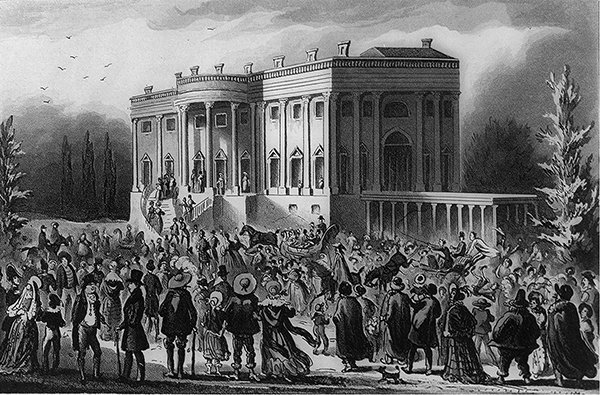
Andrew Jackson’s 1829 inaugural party at the White House, at which drunken revelers incited a riot.
Jackson perfectly embodied this increasingly democratic, increasingly malicious era. Exceeding any other figure of his time, his personality and actions—more than his politics—made him greatly popular, and he became a sort of “anarchic hero”17 to a wide swath of Americans. Nowhere did this become more evident than at his inauguration celebration. It began as a friendly levee at the White House, its doors thrown open to the people. However, executive staff made the mistake of providing the crowd with buckets and tubs of punch and other liquor, potentially serving up to twenty thousand people. Soon, according to Margaret Bayard Smith, a “rabble mob” began smashing glass and china and almost killed their hero by accident. He was “literally nearly pressed to death and almost suffocated and torn to pieces by the people in their eagerness to shake hands.”18 The madness of the crowd reminded Smith of the worst aspects of the French Revolution. As Supreme Court Justice Joseph Story observed: “The reign of ‘King Mob’ seemed triumphant.”19
Happy Animalism
The inauguration riot was hardly unusual. Civil disturbances around the nation in the Jacksonian age were common. Historian Paul Gilje, in his study Rioting in America, saw the violence growing out of the democratic, egalitarian impulses of the era.20 The voting franchise expanded to wider classes of white men (though still not blacks and women) who used guns and fisticuffs to express their anger, fear, and resentment.
The chaos increased throughout Jackson’s presidency until 1834, the “great riot year,” with scores of battles involving anyone from gamblers and bankers to immigrants and anti-abolitionists.21 These included Irish labor riots in New England, antibank riots in Baltimore and Portsmouth, anti-Mormon riots in Missouri, anti-Catholic and antiblack riots in the Northeast, and even an antiballoonist riot in Philadelphia.22 The next year descended into even greater chaos with 147 riots fueled by similar grievances and loathing, including mobs lynching gamblers, abolitionists rioting in order to free slaves, Catholics attacking anti-Catholics (and vice versa), and, strangest of all, an anti–free love riot in New Hampshire.23
As electoral battles between Jackson’s Democrats and rival Whigs turned nasty across the nation, strongmen at the polls told citizens for whom to vote, using verbal intimidation and outright attack to keep people from choosing the wrong side. In some cities, according to one historian, during Election Day’s “genial mayhem [of] swearing, swilling and fighting, the black eyes and bloody noses and torn coats made this a time that tried men’s bodies by smart raps and sound kicks” as the political process devolved into a “hell of happy animalism.”24 Jackson himself nearly fell victim to the chaos of the era when an attacker tried to kill him outside the White House in early 1835—the first assassination attempt in American history. After the would-be murderer failed twice to shoot him, Jackson subdued the man by beating him with his walking cane.
By 1837 the conflict so disturbed a young Abraham Lincoln that he saw an “ill omen” in the “increasing disregard for law which pervades the country” as “Accounts of outrages committed by mobs form the every-day news of the times.”25 Hezekiah Niles, the important but little-remembered journalist who published the Niles Weekly Register in Baltimore, took a more direct view:
Society seems everywhere unhinged, and the demon of “blood and slaughter” has been let loose upon us! . . . mobs growing out of local matters—and a great collection of acts of violence of a private, or personal nature, ending in death . . . We have executions, and murders, and riots to the utmost limits of the union. The character of our countrymen seems suddenly changed, and thousands interpret the law in their own way.26
Riots Almighty
A black witness to the Chesapeake violence, Michael Shiner, kept a journal from his time as a slave and then as a free man, now preserved in the Library of Congress (and transcribed here from his colloquial shorthand). Born in Maryland in 1805, he spent the next thirty-five years as the property of the chief clerk of the Washington Navy Yard, Thomas Howard Sr.27 Howard hired out Shiner to the Navy, where Shiner worked in the paint shop while also recording the details of what he saw around him, from ship construction and working conditions to mob attacks and racial hostility. In one 1828 instance of the latter, twenty young thugs surrounded and attacked him, during which “I had Christmas in me [as they] lit me up torch-like fashion with the firecrackers.” A justice of the peace arrived in the middle of the mayhem, but instead of stopping the violence, he said “You scamp, what are you doing here?” and punched Shiner, who managed to escape into an alley. Later that year, Shiner had to flee from a vicious gang of sailors who took him for a runaway slave.28
Even when not being physically attacked, Shiner revealed just how threatening life could be for a common laborer in Washington City and for a slave in particular. Dangers that he faced or witnessed included falling overboard and nearly drowning in ice-cold river water, watching a fellow worker accidentally decapitated, and desperately trying and succeeding to free his wife and children from the confines of a Franklin & Armfield slave pen.29
In 1835 Shiner witnessed the Snow Riot. His fellow Navy Yard mechanics, on a break from their labor strike, attacked Beverly Snow’s restaurant and destroyed it “Root and Branch.” Later, they also nearly destroyed a jailhouse where a slave was being held under suspicion of trying to kill his master. Thanks to feeble law enforcement, the mob “raged with great vigor” until the secretary of the Navy detached a column of Marines to protect the jail. After the disturbance, instead of punishing the rioters, President Jackson inquired about their concerns and wondered if there was “anything he could do for them in an honorable way to promote their happiness.” As a first step, he promised the thugs that “by the eternal God in this City” he would crack down on any “negroes [who] had violated any law whatever” and punish them severely for it.30
The eternal god of the city, however, had nothing on Andrew Jackson. The belligerent-in-chief cast himself as the stalwart tribune of democracy, someone who didn’t need to follow the tired old rules of legal procedure when guided by his own sense of purpose, a man above the law who stood as the fulfillment of a righteous society rather than as a threat to it. Not surprisingly, a lot of his followers felt the same way. They rioted not against but in favor of the status quo in order to enforce their own sense of justice without worrying what the law had to say about it.31
Liquid Aggression
Shiner wasn’t always a victim of his time. Sometimes he perpetrated the kind of violence he observed—before inevitably falling victim to it again. Alcohol often provided the fuel for conflict. After a heavy bout of drinking mysterious liquors called “Tom Cat” and “Run from the Gun,” Shiner and another black worker got into a “tussle,” during which Shiner threw him in a mud hole. Another time, he flung a man into a basement, “going crazy” with drink, before Marines wrestled him down and stuck a bayonet in his shoulder. Yet another drunken escapade resulted in Shiner getting mauled with stones and brickbats, arrested, and sent to navy lockup. Ultimately he escaped from lockup and went back at work as usual.32
None of Shiner’s alcoholic tumults would have surprised Frederick Douglass, who saw liquor and slavery as inseparable. Slaveholders routinely used alcohol as a means to suppress rebellion and numb potential escapees into compliance. “In order to make a man a slave . . . it is necessary to silence or drown his mind,” said Douglass. Other abolitionists and temperance supporters saw “Rum and Negro hate” as two sides of the same coin and worked to eradicate drinking altogether to dampen the spark that seemed to ignite so much racial violence.33
For their reward, the temperance advocates became a new target for the rioters, who saw any steps toward black self-improvement as a threat and made a special effort to destroy assembly halls that hosted temperance meetings, just as they did black businesses, schools, and churches—of course leaving brothels and dance halls alone.34 A danger to the old order, black temperance found many supporters across the region, Michael Shiner among them. In 1836 he quit drinking, and “I never have had a drop of liquor in my mouth since that time.”35
A Frenzy of Spirits
It wasn’t so easy for others to stave off the power of liquor, however. Taverns offered a wide array of spirits, gambling, and other amusements, and they also featured dances, balls, and assemblies, with anything from a “wonderful mathematical dog [to] a collection of the works of some distinguished artist.” They housed the Orphans Court and circuit courts in the early days, hosted political protests and rallies and nominating conventions for municipal politics, and offered an ideal place to celebrate George Washington’s birthday in high style.36 John Adams stepped into the City Tavern in 1800 to offer no fewer than seventeen toasts to the health of the country,37 and later politicos stumped for votes over glasses of rum and whiskey. Drinking hard liquor and politicking went hand in hand, and election-day drunkenness was common.38 William Henry Harrison won the presidency in 1840 with a campaign that boasted of his supposed log-cabin origins and taste for hard cider.
Non-political figures also drew crowds. Georgetown’s Union Tavern hosted Talleyrand, Napoleon’s brother Jerome Bonaparte, King Louis Philippe, inventor Robert Fulton, and Washington Irving.39 Such figures lodged at taverns when few other accommodations were available in the District, and some continued to do so after proper hotels were built. The most prominent taverns provided little reason for visitors to go anywhere else. The Columbian Tavern, for example, advertised “good Beds and Boarding, with a variety of Liquors [and] Dinners dressed at the shortest notice,” while others like Tunnicliff’s and Rhodes acted as hubs for social activity and even a dancing assembly.40
But alcohol was still their prime draw. Americans drank more alcohol in the first third of the 1800s than at any other time in the history of the country. In 1830 the average American drank some five gallons of hard alcohol per year,41 more than one shot of high-proof liquor a day. It’s no accident, then, that the country’s most brutal decade outside of wartime followed. “Violence often came in bottles,” and countless conflicts occurred in and around taverns, occasionally punctuated by murder.42 At the time, heavy drinking counted as a pursuit of proper manhood, and booze became the elixir of brotherhood and camaraderie, especially for the working class.43 But this potent mix of drinking, violence, and social communion had grave consequences. It deformed everything from the way people interacted and communicated to how they solved problems and had fun.
Killing Games
“Fun” often meant watching animals tear one another apart. Blood sport was a prime source of antebellum entertainment. Taverns featured fights between men, dogs, and even rats44 for the amusement and wagering of spectators. Providing such battles was technically illegal, but again the laws were rarely enforced and countless creatures became carcasses to satisfy drinkers’ gambling lust. Baltimore even featured spectacles like bull and bear baiting,45 in which a large beast in chains had to fight off a team of hunting dogs while bettors wagered on which creatures would survive. As early as the 1780s, English critic J. F. D. Smyth noticed how locals in the Chesapeake devoured all manner of “sport, gaming, and dissipation” as well as “that most barbarous of all diversions, that peculiar species of cruelty, cock-fighting.”46
Indeed, if the capital was known for one blood sport, it was cockfighting. In this contest, owners of gamecocks would place their prized roosters into rings known as cockpits. The birds were fitted with little weapons around their legs, such as knives or gaffs—“sharp blades of finely tempered steel”—with which they could hack their rivals to death. Aficionados of the sport obsessed over the various breeds and types of birds, their proper fighting weights, and their various colors and plumages. Not surprisingly, arch duelist Andrew Jackson was a fan of cockfighting and even attended one public event in Bladensburg, which for once hosted a bloody contest between chickens instead of humans. The birds came from Jackson’s own stock in Tennessee, and the president put great faith in them. But they never fought that day: The contest was canceled due to the sorry condition of their rival cocks, which were in no state to battle after a lengthy ride cooped up in a stagecoach.47
Many fowl fights occurred in taverns, though not all did. In Virginia, when local courts were in session, courthouse squares became popular sites for cockfighting, along with gambling, slave auctions, debt collection, and religious ceremonies.48 Across the Potomac in Georgetown, cockfighting had been banned since 1796,49 so its practitioners relocated to the Washington City circle at 23rd Street north of Funkstown. Christian Hines, in his recollections, reports that the site became the preferred place for blood sport of the human and animal varieties. During one match, a group of local cockfight fanatics tried to drive away interlopers from Georgetown using cudgels. Many suffered injuries, but one man made it all the way back home with a creative bit of self-protection: using a fence rail to deflect the blows of his attackers and beat them to the ground.50
The Rise of Fistiana
Although common, human fighting didn’t become widely popular as a sport per se until the 1840s. One of its earliest guides, Patrick Timony’s American Fistiana, lays out the rules for bare-knuckled combat and presents letters between famous boxers as a prelude to their battle. They read curiously like overtures to a duel. In one case, the challenger, James Sullivan, contends that reigning champ Tom Hyer “assailed [him] in a most cowardly manner” inside a saloon. Hyer disputes the charge by claiming Sullivan attacked him first, and he pledges to show no mercy to anyone who improperly assails him. The fight was on.51
Hyer’s father, Jacob, was the first widely recognized American champion of the sport, but it didn’t really take off until his son got into the ring with Sullivan. The match occurred in 1849 in a no-man’s-land on the Eastern Shore of Maryland—a day trip from the capital—where federal and state jurisdiction was disputed, making it something like boxing’s own Bladensburg. That didn’t prevent authorities from trying to shut down the affair, but the boxers, along with a rowdy crowd of two hundred, escaped their clutches with an elaborate caper involving oyster boats.52
The match began with the two parties “coming to the scratch,” that is, getting into the ring or field of combat. Soon they pummeled each other with rawboned vigor in a contest that a modern pugilist might consider unorthodox: Sullivan demonstrated “superior wrestling” moves in the first round. The men pounded each other mercilessly “with the rapidity of two cocks” in the second. Both were “clotted with gore” and barely able to stand in the ninth. Hyer tried to wrench Sullivan’s arm from its socket in the fifteenth, and Hyer smashed his rival with both fists in the sixteenth, which finally did the trick. Hyer prevailed when Sullivan couldn’t make it back to the scratch, which in the setting sun had become a gory crimson mess. The triumph was total: Hyer had won a stunning ten thousand dollars in a mere seventeen minutes, and the “hurricane fight” became greatly influential in making sportsmen in the Chesapeake and across the nation take notice of a new kind of blood sport, one that by comparison made cockfighting look almost humane.53
Serving Not to Protect
Boxing was one of several violent, technically illegal activities that occurred in the District due to the lack of an effective police force to stop them. In the early days of Washington City, the constables—a group of four, one per city ward—worked mainly during the day, keeping an eye out for disorderly persons; inspecting taverns, markets, and other public facilities; and rounding up wandering pigs and livestock.54 As the town grew, however, this force became inadequate. By the mid-1830s, only a dozen officers patrolled an area that by the previous census had become home to nearly forty thousand people. After a group of hooligans caused a minor riot on the grounds of the White House—and with robberies, burglaries, and arson on the uptick—Congress established the Auxiliary Guard as a nighttime force in 1842.55 Along with chasing thieves and firebugs, the guard was supposed to suppress riots and monitor the firehouse gangs that plagued the town. But with only fifteen men on duty, the guard never became an effective force of law and order, concentrating instead on harassing slaves and free blacks.
Unfortunately there was precedent for this brutal activity. Washington City originally paid its first constables fifty cents for each time they whipped a slave accused of violating the law.56 Not surprisingly, one of the chief duties of the Auxiliary Guard was to hunt down any blacks out after curfew or presumably violating city ordinances.57 The guard could arrest or fine them or flog them at the city jail, which had a whipping post for that very purpose.58 The pattern was then set wherein the skeleton police force had a limited effect on controlling urban crime but a major effect on keeping blacks living in terror of being arrested, jailed, and put to the lash.
Officers of the Auxiliary Guard developed a lasting reputation, however, for sleeping at their posts, smoking cigars, and drinking heavily rather than walking their beats.59 When they did feel like enforcing the law, most used noisy rattles instead of whistles and carried clubs with iron spearheads instead of guns.60 By contrast, urban murderers were resorting to lethal force: From 1846 to 1860 their use of guns doubled throughout America to become the weapon of choice in a third of all killings.61 Criminals shot and maimed a number of District officers and ran riot throughout town, committing what newspapers called “outrages of a most audacious and alarming character.”62 In response, members of Congress and the city council passed new laws, reorganized the police, and made fiery speeches decrying the free rein of miscreants, but nothing they did had much effect. The police were too few, their budgets too small, and they were fighting a mania of antebellum mayhem that afflicted both criminals and law abiders alike. In 1849 this was evident even during Christmas:
Long before daylight began the fusillade by gun, pistol and cracker, the blowing of whistles and small horns, the beating of small drums and tin pans . . . At the same time there were bonfires blazing in different parts of the city . . . Primitive were the instruments used. The old-fashioned horse pistol, some with flint lock, the half-dollar brass pistol and Colt’s revolver, then known as the pepper box, were for shooting purposes.63
One rotund fellow had the misfortune of resembling Santa Claus. After spotting him on a street corner, a crowd of a hundred hooligans surrounded him, mocked him with vulgar rhymes, and then chased him back to his house while pelting him with firecrackers.64
Ragged Parades
The local militia system wasn’t much better than the guard. A law from 1803 provided for an armed citizenry to protect the town, but in later years this militia often operated without arms and equipment. Any effort to make the town folk perform their civic duty met with griping over “oppression and tyranny.”65 In one case, a group of local businessmen became so annoyed with militia drills that they organized a counterparade, with brooms for guns, a “general” who wielded a horse’s shinbone as a sword, and old smokestacks dragged along like cannons.66
The real militia degenerated to the point where, in 1835, their attempt to present a proper parade resembled the ridiculous pantomime of those who had mocked them, prompting Michael Shiner’s derision:
They were the raggediest white people that ever I saw in my life, and their uniforms were of old rags . . . and they had drums and fifes and they had clarinets. Their drums were composed of old tin pans and old pots and all kinds of old sheet iron, and their flutes, clarinets and fifes and bugles were composed of ram’s horn and oyster horns.67
A month later, the Snow rioters went on a rampage. The poorly trained and equipped militia could do nothing to stop them, which proved only how defenseless the capital was in the face of mob rule.¶ If not for the last-ditch efforts of the US military, the rioters would have completed the work started by the British in 1814 and incinerated the capital. The old militia system soon died, and the town had no effective means of civic order throughout 1836. A few companies were organized the next year, but they did little to provide for the basic security and safety of residents.68 Even Georgetown and Alexandria had basic police services, as did countless other towns in the Chesapeake, but Washington City stood almost alone in its unguarded, helpless condition in the face of riot and disorder.
¶ The federal response to mobs also depended on whom they were rioting against. The test case came in winter 1834, when rival groups of Irish mechanics digging the C&O Canal in Maryland violently went on strike. Unlike the gentle treatment he would show the Snow rioters, Andrew Jackson dealt with the workers by calling out federal troops. The US forces teamed with the state militia to arrest thirty rioters and throw them in jail, and a military presence remained on the canal the rest of the winter. The aggressive federal reaction was revealing—attacking the lives and property of citizens was one thing; attacking the property of the government was quite another. (Richard B. Morris, “Andrew Jackson, Strikebreaker,” American Historical Review 55:1 (1949): 63–64)
The Right to Riot
Members of Congress didn’t help matters. The legislature hadn’t even passed a law against rioting in the District and often watched feebly as violent events occurred on its watch. (By contrast, neighboring Maryland and other states not only had laws against riot and civil disorder but also an effective state militia with which to enforce them.) In 1848, when a simple law against DC rioting was suggested, some Southern congressmen argued residents had a “right to riot” in certain cases—against, say, abolitionists and other such threats.69 The bill died. But at least the politicians deserved credit for a rare lack of hypocrisy, since they ranked among the most belligerent figures in town.
It was probably inevitable that the political boys’ club—which encouraged chewing tobacco, whittling, yelling, and spitting—also embraced more violent behavior. Marked by aggressive bravado and occasional threats of bodily harm, the atmosphere was already threatening and no doubt worsened with members’ drinking. In the 1830s, politicians attacked each other physically no fewer than eight times. These conflicts ranged from a policy debate that turned into a fistfight—when one member called another “the tool of tools”—to actual murder threats on the House floor, which resulted in most congressmen carrying concealed daggers, bowie knives, and guns for protection.70
Even out-of-towners got into altercations with the local politicians. On visiting the District in 1832, former Tennessee (and future Texas) governor Sam Houston spotted his nemesis, Congressman William Stanbery, on Pennsylvania Avenue and severely beat him with a hickory cane. Stanbery pulled out a pistol and tried to shoot him, but the gun failed to fire, so Houston beat him some more until he was unable to speak. For this assault, a DC court fined the governor five hundred dollars.71
Others still resorted to the increasingly antiquated practice of dueling. In 1838 one of the last major contests pitted Maine’s Jonathan Cilley against Kentucky’s William Graves, the latter an exceptional shot. The event took place at Bladensburg as usual, but this time the duelists used rifles instead of pistols. After each man twice missed his mark, the parties took a third shot, and Graves hit Cilley in the groin and killed him.72
However, instead of the usual hosannas in praise of satisfied honor, the event sparked outrage. Northerners lionized Cilley, condemned Graves, and flooded Congress with petitions demanding an end to what they called “Murder Most Foul.” Many Southerners resisted the change, but few in Congress wanted to go on record in favor of dueling,73 especially as the practice was falling into disrepute thanks to the worsening climate of violence in general. After much debate, the legislators finally passed a measure in 1839 that not only made issuing or accepting a challenge to a duel illegal in the District but also wisely provided criminal penalties for doing so.74 The law had plenty of holes in it, and it wasn’t fully enforced, but it did provide a good legal justification for politicians to avoid mortal combat and gave an official stamp of disapproval to socially sanctioned murder. It did not, however, prevent politicians from fighting each other without guns.
Incendiarism
For some residents of Washington City, dueling and mob riots didn’t happen often enough, and they required a more regular schedule of violent action. Firehouse gangs fit the bill by providing their members a chance to engage in fisticuffs and skirmishes with their enemies—as well as an opportunity to extinguish fires or even set them occasionally.

One of the early hook-and-ladder companies in DC.
In the early days of the capital, fighting the town’s fires was a responsible, respected, unpaid occupation. Households had leather buckets to help put out fires, and each ward had its own volunteer fire company.75 Their members came from the working and middle classes and had stirring names like Union, Franklin, Alert, Star, Eagle, Vigilance, Perseverance, and Columbia.76 Although the companies served ably for several decades, the older, more experienced men began dropping out in the 1830s because they had to do double duty with the town militia and found it a challenge to battle blazes across the vast distances of the capital. Into that void stepped rowdy gangs of teenage boys, who within a decade transformed the venerable companies into veritable gangs.77
Gang rivalries that had existed from the earliest days of the capital were initially petty, mostly limited to neighborhood fights and rock throwing in Frogtown, English Hill, or The Island.78 Some of the more notable groups included the Gumballs, Round Tops, Never Sweats, Razors, Blood-tubs, Chunkers, and Rams.79 (The last of these had its headquarters on Capitol Hill, though history doesn’t reveal whether any of its members also served in Congress.) When the gangs took over the fire companies, though, they suddenly had access to fancy equipment and engines, and suddenly commanded a great deal more attention. The capital soon divided into warring fiefdoms, each based around a firehouse.
The gangs naturally proved better at fighting one another than fighting fires. If one engine house arrived on the scene of a blaze in their ward first, they might put it out. But just as often, buildings burned down if two or more companies arrived at a fire at the same time, as each group tried to prevent its rivals from extinguishing it—by hoisting a barrel over a over a street hydrant and sitting on it80—while the structure blazed. Sometimes the battles became violent, and a street fight that began with rocks and other small missiles grew into a full-fledged riot.81 In 1844, exactly that happened right in front of the White House as various thugs battled one another with “stones, fence rails, and other dangerous weapons.”82 If authorities caught and tried the rioters, they usually received small fines (five dollars in one case) and often served no jail time.83 Even worse, some gangsters even started fires in order to create chaos and enjoy a run with the fire engine—and then had the nerve to take credit for putting the blazes out.84
Newspapers carried all-too-frequent reports of “incendiarism,” which told of the latest antics of the gangs in their efforts to start or extinguish local fires: “the fire-bells ring out, and the gangs of boys who have taken charge of the respective engines of the city are all on the qui vive [lookout] to run roaring and swearing through the streets . . . Who is to be burnt up next Saturday night no one knows, only some one must furnish the required food for excitement of undisciplined boys.”85
Amid the turmoil, authorities had few means to stop the gangs. Although professional departments were rare in the antebellum South, Washington City lagged behind even Alexandria and other area cities in the organization and control of its firefighters.86Congress tried to attract more mature firemen by promising them exemption from militia duty, but the measure proved worthless when the militia system collapsed.87 By the 1850s the fire company gangs had grown more powerful, extending their mayhem into local politics and using their pull to keep officials from regulating them. (But some still courted irony when even their own firehouses burned down.)88 It took until 1856 for Washington City to establish basic safety and operational standards for volunteer firefighters, and a professional, salaried fire department didn’t come into existence until the Civil War.89
Tourists from Mobtown
Some of the firehouse lads had ties to Washington’s most notorious political party, the Know-Nothings, a virulently anti-Catholic and anti-immigrant group that meddled in District politics, usually for the worse. The most visible sign of their menace was the beleaguered Washington Monument, planned for decades but unfinished due to slow fund-raising and, later, their overt lawbreaking. In early 1854 they broke into the monument site at night, locked up the watchman, removed a memorial block of marble donated by Pope Pius IX, defaced and broke the stone, and threw the pieces into the Potomac. Soon after, they took control of the Washington National Monument Society by holding a sham “public meeting” in which they elected their own officers to its board and seized possession of its books and property.90 This bold act of thuggery aroused such public ire that Congress withdrew its funding, and other donors followed suit. The Know-Nothings added several shoddy layers to the monument but gave up control of the society a few years later. The obelisk, however, remained an embarrassing granite stump for another quarter of a century.
Nearby Baltimore had an even worse problem with the Know-Nothings, who matched their anti-immigrant hysteria with armed intimidation at the polls and seized city government in several disputed elections. (In so doing, they offered cheeky campaign slogans that reminded voters of the tools they had used to menace voters, such as “Come up and vote: there is room for awl.”)91 The Know-Nothings found firm and brutal allies in the thugs that filled the ranks of the firehouse gangs,92 who in turn spread so much turmoil that the violence spread beyond Baltimore and into the capital itself.
The gangsters’ use of violence had deep roots in the Maryland city, going back to 1812 and before. Even Alexis de Tocqueville had heard of its fearsome riots on a trip to America.93 The gangs caused unchecked havoc in subsequent years and gave Baltimore the well-deserved nickname of “Mobtown.”94 One visitor estimated that Baltimore had “a greater number of black-guards, for its population, than any other city in the Union.”95
Baltimore’s gangsters had many colorful names: the Rip Raps, Rough Skins, Ranters, Rattlers, Black Snakes, Thunderbolts, Little Fellows, Blood Tubs, and Decaturs.96 But it was the Plug Uglies who took a break from their Maryland violence in 1857 and paid a visit to Washington City. Their local allies in the Know-Nothing Party joined them in an effort to intimidate the District’s voters and prevent those deemed “foreigners” from voting.97 The joint force attacked a naturalized citizen trying to vote in one ward, wounding the ward commissioner in the fracas, and then fired a volley of pistol shots at other voters.98 As Michael Shiner saw it, the out-of-town rioters “raised such an excitement that the mayor and the whole police force could not stop them.”99 Desperate for help and unable to control the mayhem, Mayor William Magruder wrote to President Buchanan that hooligans armed with “firearms, clubs, knives, and stones” had managed to drive the voters from the polls, chased off the election commissioners, and were threatening further violence.100
At the president’s behest, the secretary of the Navy had to call out the Marines again, as in 1835, but this time the rioters didn’t disperse so easily. Some in the crowd seized control of a “six pounder swivel gun”—a cannon—and hurled stones and fired revolvers at the Marines who tried to capture it.101 According to Shiner, “one of the Marines was shot in the face and severely wounded, and it was supposed that the Marines fired through a mistake of order, and there was several people killed and wounded.”102 When the carnage ended, eight people lay dead, twenty-one injured, almost all of them citizens of Washington City. The Plug Uglies escaped back to Baltimore that night.103
The election riot of 1857 offered yet another example of how the town had no real defense against disorder. A visiting goon squad easily overwhelmed the capital’s police force to indulge in a bit of mob tourism. To quell the protests of residents over the threat of such violence, six months after the riot the city council authorized expanding the daytime police force by the grand number of just ten men, for a total of fifty-seven officers—twenty-seven policemen during the day and thirty Auxiliary Guardsmen at night—to patrol a city of sixty thousand people.104 A Senate committee summed up the terrible state of affairs in an 1858 report:
The police force is both feeble and inefficient. Riot and bloodshed are of daily occurrence. Innocent and unoffending persons are shot, stabbed, and otherwise shamefully mistreated, and not unfrequently the offender is not even arrested. It is hardly necessary to add, that such acts are a disgrace to a civilized society, and, if not put down, must result in disastrous consequences to society, and bring a lasting reproach on this Federal city.105
But Congress had little interest in turning the DC police into an effective crime-fighting force. This impasse derived from its usual lack of action in passing legislation that could help the District in any way and from legislators’ inability to approve almost anything because of the growing enmity among them. Indeed, by the middle of the 1850s, the “riot and bloodshed” on the capital’s streets had once again moved into the halls of Congress itself.
House of Combat
The most infamous bloodletting was the assault by South Carolina congressman Preston Brooks on Massachusetts senator Charles Sumner in 1856. The attack developed from the ongoing battle over the admission of Kansas as a free or slave state, which produced great invective between abolitionists of the North and slavery apologists in the South. Infuriated by Sumner’s speeches against human bondage, Brooks found him at his desk in the Senate and, in his own words, took action:
I struck him with my cane and give him about 30 first-rate stripes with a gutta percha cane which had been given me a few months before . . . Every lick went where I intended it. For about the first five or six licks he offered to make a fight, but I plied him so rapidly that he did not touch me. Towards the last he bellowed like a calf. I wore my cane out completely but saved the Head which is gold. The fragments of the cane are begged for as sacred relics.106
Brooks did in fact become a hero to the South, just as Sumner became a martyr to the North, drenched in his own blood and nearly dying in the assault. Northerners saw Brooks as a demonic figure and called for quick justice, but he received no jail time for his attack and was reelected to the House after he made the voluntary gesture of resigning from it. (Before Brooks could retake his seat, however, he died of a respiratory disease. By contrast, Sumner recovered, lived long enough to see the South lose the Civil War, and helped oversee Reconstruction.)
Another brawl occurred two years later, again over slavery, as Brooks’s ally Laurence Keitt called Galusha Grow a “black Republican puppy.” Grow responded by calling his accuser a “negro-driver.” Keitt tried to choke Grow, and the House exploded into a melee of bodies and fists flying. The speaker wielded the ceremonial House mace as a weapon, and one congressman even tried to brain people with a heavy stone spittoon. The fracas finally ended when one member tried to grab another by the hair to punch him in the face but pulled off his toupee instead. The chamber erupted in laughter, and the internecine battle ended—for the moment.107 But no amount of mirth could make people forget that, throughout six decades, the violence between “gentlemen” had degenerated in Congress just as it had around the country. What had begun with mortal contests to preserve honor had devolved into a grotesque spectacle of cane beatings and open brawling.

The infamous 1858 battle in Congress that included punching, choking, and even toupee pulling.
Final Pages of a Diarist
As the 1850s ended, Michael Shiner surprisingly managed to steer clear of much of the era’s violence. He saw plenty of mayhem on the streets, but he personally experienced less of it as the years passed—or at least he grew less fond of writing about it in his journal. Quitting drinking helped him avoid conflict more easily, as did his manumission in 1840. Like some other urban bondsmen, he paid for his freedom through years of labor in the slave-hiring system, but afterward he continued to work at the Navy Yard until he was age sixty-five, living another ten years after that. During that time, he rose to prominence as a successful businessman, a leader in Republican Party politics, and a well-known figure in the black community.108 His journal provides but a glimpse of the Civil War and the years that followed. What remains, then, are his vivid anecdotes of an earlier era of socially sanctioned violence—a time when duelists, mobs, and gangs ruled by gun, club, and knife, and community bonds frayed and civil order nearly collapsed.