
Chapter 3
Epinets as a Tool for the Study of Network Structure
We show how epinets ground the analysis of social network phenomena such as brokerage and closure: epinets associated with coordination, communication, and collaboration phenomena constitute the “epistemic glue” that renders social network structures robustly identifiable and causally relevant. “Coordination” and “collaboration”—important capabilities or propensities of cohesive social networks—are enabled by an epistemic coherence that epinets help us to unpack and render precise. Epinets also bring into relief informational and epistemic properties of “brokerage” and the epistemic operations that are necessarily embedded in brokers. We empirically examine the logical and epistemic preconditions for co-mobilization and coordination, finding that they are lacking in a situation in which we would expect them to be found, on the basis of the network’s structure. We introduce a language for analyzing coordination and co-mobilization, which we use to describe the epistemic properties of agents who are pivotal to coordination and co-mobilization (“coordinators” and “mobilizers”) and to describe those of the central propositions that form the epistemic core of coordination and co-mobilization processes (“coordinata”). We extend our epistemic approach to the analysis of status, where the EDL allows us to make more precise distinctions among levels of knownness and fame of connected agents.
. . .
Social capital—the advantages an agent accrues by virtue of her position in a social network—“works” through a host of mechanisms loosely categorized under the rubrics of brokerage and closure (Coleman 1988c; Burt 1992, 2005). Brokers “broker” ideas, trust, and goodwill by establishing a bidirectional channel that bridges at least two disconnected subnetworks, each of which is in some sense internally cohesive.
The cohesiveness of the brokered subnetworks is critical to what brokering means: if there are no identifiable, separate subnetworks to be spanned, there is no brokerage. A broker can broker ideas between economic sociologists and neoclassical economists only if these two groups are sufficiently cohesive to be identifiable (and self-identifying) as subnetworks in the broader community of social scientists, and if the broker somehow succeeds in channeling information credibly from one group to the other. Of course, information and knowledge (“ideas”) are not the only brokerable epistemic objects. One can broker trust, awareness, higher-order knowledge, and confidence, all of which can be understood as more complicated—yet intelligible—epistemic objects.
Closure “closes” the network footprint of an agent who has relationships with other agents, who in turn have relationships with one another. The advantages of closure depend on the specific structure and topology of the network and on the cohesiveness of the subnetwork that is “closed” by closure. High-closure networks “echo” (Burt 2005) the actions and words of the individual agent, making it more difficult for her to unilaterally deviate from the network’s implicit and explicit norms and commitments. Cohesion is critical to how closure closes or forecloses the network footprint of the agent because it is only by virtue of a commonly held set of beliefs, norms, and commitments that individual deviations and departures can be measured, monitored, and sanctioned.
Cohesion and the Realization of Social Capital from Brokerage and Closure
Cohesion is critical to understanding both brokerage and closure. We use the term “cohesion” rather than “tie density” or “agent connectedness” or “network diameter,” purposely. Cohesion is not tainted (yet) by reductive structural analyses and simplifying representations, yet it has an air of rigor. An “air of rigor” does not mean “rigor,” however, and this is where the analysis of epinets can contribute.
At the cost of some complexity, epistemic representations of networked agents allow us to illuminate brokerage and closure in a way that makes the cohesion required for each more precise. Epistemically, cohesion is coherence among the interactive epistemic states of two or more agents. Alice and Bob are cohesive in the epistemic sense if what Alice thinks about a matter of mutual relevance, what Bob thinks, what he thinks Alice thinks, what she thinks Bob thinks, what she thinks he thinks she thinks, and so forth, are all coherent.
We have defined cohesion as coherence, but have not yet defined coherence. Here we have several options. Recall that we used propositions and propositional beliefs (It is raining) as arguments of epistemic states (Alice knows it is raining). Propositions, unlike names of objects and collections of “states of the world,” can stand in relationships of logical entailment, negation, and independence relative to one another. Thus, it is possible to define cohesion in terms of coherence among epistemic states, provided that we have a satisfactory account of coherence. In this regard, we have at least two options.
One option is to limit coherence to deductive logical consistency and compatibility and to limit “logical” to first-order logic. This has the advantage that we can “do” network epistemics in the same way we “do” game theory: by establishing an informational base from which we can prove various hypotheses as deductive theorems. It has the disadvantage that everyday human discourse is not structured by deductive logic alone, but makes use of several other forms of inference. First-order logic also has several well-known lacunae in terms of being able to represent certain eminently sensible patterns of judgment that humans reliably produce.
A second option is to define coherence as logical consistency and compatibility but to expand what we mean by logic to include deductive, inductive, and abductive forms of logical inference among the set of syntactical rules by which we adjudicate coherence—as well as “fuzzy” and “deviant” logics, including three- and four-valued logics. This option has the advantage of making epistemic network analysis more intuitive and congenial as a tool for making empirical inquiries. However, it also reduces the sharpness of the predictions we can make as a result of understanding the epistemic structure of a network—the interactive belief hierarchies it forms around one or more relevant propositions.
We pursue here the first option on grounds of parsimony; however, without loss of generality of the epistemic approach, we can augment the extension of “logic” to include other forms of inference and other logics altogether.
Understood as the logical coherence of first- and higher-order beliefs regarding the truth value of mutually relevant propositions, epistemic cohesion is necessary but not sufficient for adequately analyzing “network cohesion.” The kind of cohesion worthy of characterizing an identifiable group is more than just the logical coherence of interpersonal beliefs about a set of propositions.
For instance, Alice and Bob are friends. They interact copiously at the level of gossip and sporting events. On these topics, their beliefs may synchronize perfectly: each knows the scores of the last 10 Wimbledon finals and knows the other knows them and so forth. But they may not be able to successfully coordinate their actions in certain domains because they belong to different disciplines. Alice is an economist; Bob is a programmer. She represents human behavior in terms of choices, preferences, and beliefs. He thinks of humans as imperfect executors of algorithmic routines and procedures. To her, a person’s preferences do not change—though that person’s beliefs about how best to satisfy them might; he, on the other hand, sees the very essence of humanity in a person’s ability to change the algorithms that describe his or her behavior in adaptive ways. Producing a joint article on the mathematical analysis of behavior will be a difficult enterprise for Alice and Bob, both in the sense that it will be laborious and in the sense that the probability is small that a truly collaborative and successful piece of joint work will result.
Many of the difficulties Alice and Bob will encounter undertaking such a project arise from the fact that they differ radically in their interpretations of what appear to be “the same” sense data. These differences, along with Alice’s and Bob’s ignorance and sometimes obliviousness of them, will give rise to repeated failures of coordination. They will violate each other’s expectations when they try to interact around the meaning of a particular word (“decisions,” say).
The coordinative difficulties that Alice and Bob will encounter are not limited to concepts and “the meaning of theoretical terms.” Given their different backgrounds, they will likely follow different communication norms, particularly those of argumentation, justification, validity, and persuasiveness. She may insist on provability from a set of axioms as a norm or goal of justification. He may care about provability but not about any particular set of axioms. The two will attempt to communicate, but will find that they can neither agree to a set of norms of justification nor successfully agree to disagree about them since these norms are a prerequisite to further communication.
This is not a case in which private games, being too dangerous, can be salvaged by a third party acting as a monitor (Burt and Knez 1995), because this particular game is a language game. Charlie, connected individually to both Alice and Bob through regular interactions in different domains (ballet and golf, say) but significantly different from each of them in terms of epistemic commitments, will not be able to exercise the right kind of monitoring and sanctioning of agreements that Alice and Bob have made to each other in the domain of “uses of language and justification norms.” This is not because Charlie will not “see” that some failure of coordination has occurred but rather because he will ascribe and impute agency and responsibility for that problem in a language that is alien and therefore binding to neither Alice nor Bob.
The interactive epistemic preconditions for shared understanding are likely brought into sharpest relief by the “natural language” school of analytic philosophy that culminated in the works of Austin (1961, 1962) and Grice (1968, 1969) and particularly in Grice’s (1969) work on “conversational implicature” and the role of a cooperative principle of communication that must be common knowledge among interlocutors if they are to understand each other. Grice argued that the way to make sense of what people say to one another in many—perhaps most—settings is to ascribe to them shared, common knowledge of a cooperative principle that allows them to ascribe meaning to each other’s words. This principle comprises a set of maxims: informativeness (say neither no more nor no less than necessary; be neither cryptic nor redundant; make your contribution relevant to the subject and context of the conversation), validity and sincerity (do not say what you believe to be untrue; do not say anything for which you lack sufficient evidence), and expressivity (avoid ambiguity and obscurity of expression).
In this case, proposition P is conversationally implied to agent B by proposition Q uttered by agent A iff the maxims of cooperative communication, together with proposition P, logically entail proposition Q. For example, if a bellman sees a guest loaded down with luggage and with a quizzical look on her face, and says to her, “It is to the left” to indicate the drop-off room, the speech act works for three reasons: (1) it fits the shared background that both guest and bellman know (and that each knows the other knows); (2) the fact that the drop-off room is to the left follows from the utterance; and (3) both interlocutors hold common knowledge of the norms of conversational implicature, which allows them to interpret the utterance as informative and relevant (she looks quizzical and has luggage in her hands), efficient (short), and valid (it is true, and he knows she knows he has reason to know where the drop-off room is).
Conversational implicature—the fabric not only of lay social interactions but also of the ritualized interactions of academic research and teaching—gives us a way of further unpacking the epistemic glue that holds various disciplinary subfields together. The statement “This does not satisfy the completeness axiom”—uttered by one rational choice theorist to another in a seminar in which the first presents a new model of choice under uncertainty—“works” because each understands (and knows the other understands) both the nature of the completeness axiom in rational choice theory and its relevance to the model at hand.
The same utterance, however, would not work if one of the interlocutors were a network sociologist trying to “describe” the behavior of a social agent with no intent to build an axiomatic model or to criticize the axiomatic base of another. The epistemic preconditions for felicitous conversational inferences—inferences that work to the effect desired by both interlocutors—can thus be traced to a base of shared propositions (axioms, methodological principles) that enable speakers to make sense of each other’s speech acts via some version of a cooperation principle that is itself common knowledge among them.
The Epistemic Structure of Cohesion: Co-mobilization and Coordination
What makes a network the one it is must be related to the distribution and commonality of certain types of knowledge and information among the agents that make up the group to which the network corresponds. And however we define “ties” among networked agents—interaction frequency, self-reported perception of friendship, objectively ascertained patterns of collaboration—they matter to the dynamics of the network to the extent that they matter to its epistemic structure.
We are concerned with making the epistemic conception of a network more accessible to both analytical modeling and empirical study. To do so, we focus on the epistemic preconditions for two processes central to social groups generally and social networks in particular: co-mobilization and coordination. Whatever makes a group cohesive must make coordination and co-mobilization among its members easier—that is, more likely to happen, in a shorter period of time and at a lower average and total expected cost.
Co-mobilization. Co-mobilization is a kind of coordinative process, but it has a simpler epistemic structure than does coordination (Chwe 1999, 2000). In a co-mobilization scenario, several people must decide, independently, whether or not to mobilize—say to oust a dictator or CEO or some other dominant agent. Everyone would prefer to see the dominant agent (DA) fall (or leave) rather than remain in power (or stay). But no one wants to be the only one, or one of a very few, to mobilize: the probability of a violent reaction from the DA is too great and the private consequences too costly. Thus, each agent operates according to a simple private rule: I will go if (at least n percent of the) others go.
If Alice and Bob are among the would-be mobilizers and their threshold for mobilizing is low (each will mobilize if at least one other person does so), then what is required for both Alice and Bob to mobilize is for each to know that the other will operate according to the rule R: I will mobilize if at least one other person mobilizes. Mutual knowledge of R (that is, level 2 almost-common knowledge), in other words, suffices for co-mobilization because it turns the conditional rule R into a biconditional rule: I will mobilize iff at least one other person mobilizes; that is, I will mobilize if at least one other person mobilizes and At least one other person will mobilize if I mobilize.
Note that this is not a necessary condition for co-mobilization, especially given how we define knowledge: Alice may believe with probability p (p-believe) that Bob will mobilize if she does, and Bob (with probability q), may q-believe that Alice will mobilize if he does; moreover, although the probabilities in question are jointly too low to justify co-mobilization, some mishap—such as an action by Alice that leads Bob to overestimate q—may cause some action by Bob that induces Alice to overestimate p, resulting in co-mobilization in spite of the fact that neither knows the other will follow R.
Mutual knowledge of the private mobilization rule R, then—including each agent’s co-mobilization threshold—is an all-else-equal sufficient condition for co-mobilization. “Sufficient” means logically sufficient, which need not be equivalent to causal or material sufficiency. Whether or not logical sufficiency is a good proxy for material and causal sufficiency is an empirical question, and its pursuit is enabled by mapping the epistemic networks in co-mobilization scenarios and the correlation between the epinets of the relevant subnetwork and the probability that it will co-mobilize.
For instance, perhaps Alice knows that Belinda intends to follow rule R and has a co-mobilization threshold of 1, but she does not trust Belinda’s ability to follow that rule in practice because of “weakness of the will” or poor connectivity between normative thought and purposive action. Such issues can be addressed by introducing modal and subjunctive epistemic structures (Alice’s beliefs about what Belinda would do if certain events were to come to pass), which we introduce in Chapter 4 to support our analysis of the epistemics of trust. But suppose for now that intertemporal coherence of preferences and performative rationality are valid assumptions regarding networked agents. Then we can posit that co-mobilizability is a good behavioral measure of the cohesiveness of a network, and that a sound epistemic precondition of co-mobilizability is mutual knowledge of co-mobilization rules and thresholds. This allows us to link an epistemic measure of network cohesiveness (mutual knowledge) to a behavioral measure of it (the ability of network agents to co-mobilize in a situation of common interest).
Chwe (1999) studied how the topology of a network influences the probability of achieving co-mobilization as a function of individual agents’ co-mobilization thresholds. If each agent is connected to at most two other agents, for instance, and the co-mobilization threshold of each agent is 3 or greater, then, given that each agent follows rule R with a threshold of 3 or higher, the network will never mobilize in spite of all agents’ mutual knowledge of R and their co-mobilization thresholds. This adds an important qualifier to the relevance of mutual knowledge for co-mobilization: even in the presence of mutual knowledge, co-mobilization is dependent on network structure. If agents in a network know this, however, and if they also know the structure of the network—or even their own small neighborhood in it—then they can seek to adapt by enlarging their own subnetwork to the point where co-mobilization can occur if other agents also engage in or respond favorably to such “network prospecting.”
Suppose that this prospecting requires some form of co-mobilization, such as investing in a common web site, answering invitations to connect, and sharing personal information. Then mutual knowledge of personal network structure (I know your subnetwork and you know my subnetwork) will facilitate the mobilization required for each agent to engage in the prospecting required to determine if the structure of his/her personal subnetwork, rather than the preferences of everyone in the network, is the factor impeding co-mobilization (and eventual removal of the DA).
If the network is fully connected and knowledge of an agent’s subnetwork entails holding true beliefs about it, then the condition that the personal subnetwork structure be mutual knowledge among network agents requires that every agent know the structure of the entire network (which comprises the collective personal subnetworks). This, again, is a logical condition that functions as a network self-discovery protocol, as illustrated in Figure 3.1. If the neighborhoods of agents A and E overlap that of agent D, and if agents A and E know their own neighborhoods and the neighborhoods of the agents to whom they are connected, then both will come to know of each other’s neighborhood as well as the neighborhood of agent D, who is in their respective neighborhoods. Their knowledge of the network will therefore expand incrementally as agents come to know the neighborhoods of agents that overlap with their own.
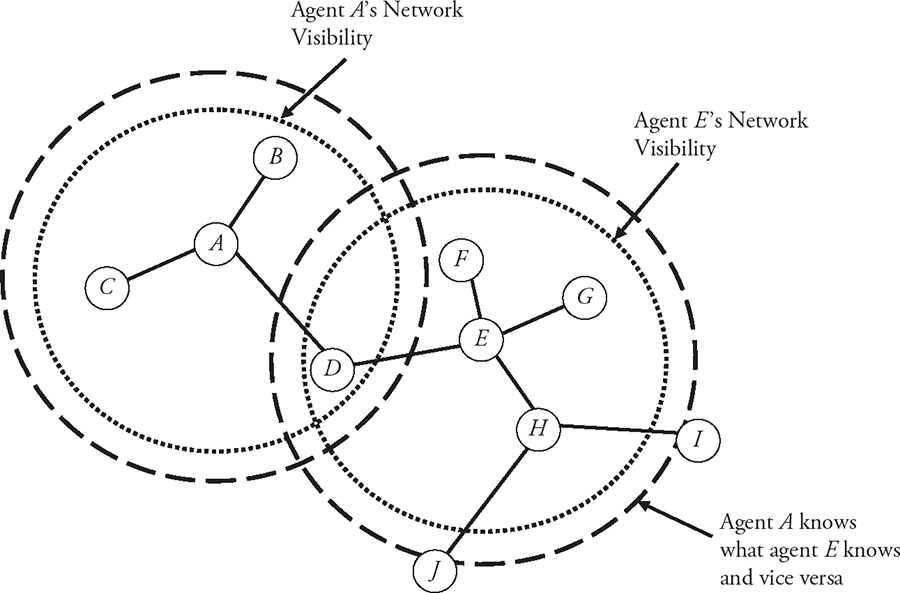
FIGURE 3.1 Network Self-Discovery Protocol
Whether or not agents know the structure of their own networks is an empirical question (which we take up soon) whose investigation can shed light on the link between the epistemic states of networked agents and the probability of collective action enabled by these states.
Coordination. Coordination problems are varied, as are their epistemic preconditions. Consider the “simple” problem of confirming the time and place of a meeting arranged through an e-mail exchange—a problem formally posed by Rubinstein (1989) in his “e-mail game” model but also one that arises daily between interacting agents. Alex proposes to Beth that the two of them meet at five o’clock on Thursday afternoon in Harvard Square. She writes back electronically to confirm. If Alex receives her confirmation, he knows that she knows he intends to meet her at the appointed time and place and, provided that she knows he knows that she also knows this—which he does not—she will be there. He does not know this because she does not know that he has opened and read her e-mail confirmation, and he knows that she does not know this. Suppose now that he confirms her confirmation. Once again, he does not know that she has received and opened his e-mail, so he does not know that she knows of his confirmation. And so forth.
Full common knowledge is required for both Alex and Beth to be in epistemic states that warrant certainty—at least about intent—regarding their meeting. And full common knowledge is not achievable by a series of e-mail exchanges, which will never be able to re-create the epistemic landscape of a face-to-face meeting. Logically speaking, given all of the epistemic and logical requirements for coordination, Alex and Beth will not meet.
However, meetings set up successfully by e-mail are commonplace and often require no more than one confirmation because there is common knowledge of the fact that the communication channel—e-mail—is sufficiently reliable for one confirmation to represent an epistemic shortcut that proxies for full-common knowledge. Real human agents, in contrast to idealized rational agents, treat e-mail exchanges similarly to face-to-face communication, which establishes common knowledge in virtue of co-presence. And, if asked, agents can rationalize this shortcut based on the reliability of the communication channel, which itself is common knowledge.
Morris and Shin (1993) realized that coordination problems are solvable even by idealized rational agents, provided they make their decisions on the basis of the expected value of the gains and losses of coordinative successes and failures. For Alex, the downside to showing up at the appointed time and place and not finding Beth has to be weighed against the probability he assigns to her not having received his message, which may be further decomposed into the probability of a technical glitch that prevented his e-mail from reaching her inbox and the probability that she did not open his message and read it (but which may exclude the probability that she has a sudden lapse of memory or that she derives pleasure from standing him up). In turn, the expected value of these coordination failure costs should be weighed against the expected value of successfully meeting at the appointed time and place, and both weighted by the probability that the meeting will take place conditional on his background knowledge and the nature of their messages exchanged to date.
As Morris and Shin also pointed out, the communication protocol and channel between the agents are relevant to such cost-benefit calculations. Alex’s estimate of the reliability of the communication channel to Beth should increase with every confirmation message he successfully receives from her. Moreover, if it is common knowledge that their communication channel has high reliability, then their subjective probabilities regarding a successful outcome may be high enough, conditional on even a single confirmation. Although there are scenarios in which such common knowledge is not a good assumption (Alex is backpacking in the Amazon with an iPhone or is walking in Manhattan with a BlackBerry), high-reliability communication protocols and channels—and the common knowledge thereof—can serve to substantively improve the chances of coordination.
Of course, the successful confirmation of the meeting is not the only coordination problem that Alex and Beth must resolve. Harvard Square is a large place and, even with the best of intentions, two people can easily slip by each other unnoticed. Nevertheless, there are several more narrowly circumscribed places that stand out because they are intimately and uniquely associated with it: the Harvard Bookstore, the newsstand at the intersection of Massachusetts Avenue and JFK Street, the four entrances to Harvard Yard.
There are at least two more potential focal points, bringing the total to eight. If the eight points are sufficiently far apart and Alex and Beth pick different points, subsequently searching the alternatives in some sequence, they can still fail to meet in spite of having solved the problems of credible confirmation. If, on the other hand, Alex knows that Beth will pick the newsstand as the meeting place—perhaps because she has mentioned it to him in the past—and if Beth also knows that Alex knows this and he knows that she knows that he knows, then the two still have good odds of meeting up at the appointed time. Once again, a finite almost-common knowledge hierarchy of interactive beliefs (level 3 in this case) takes the place of the full common knowledge normally required for the successful realization of the jointly optimal outcome in the coordination game.
Not all coordination problems are created equal, however, and each is resolved according to background rules and epistemic preconditions that are specific to the problem statement. This contingency of coordinative processes on epistemic preconditions is an opportunity for empirical inquiry (although it may frustrate a priori game-theoretic modeling of coordination). To the extent that coordinatability is a good proxy for a network’s cohesion (being the degree to which the agents in a network can successfully coordinate on the achievement of outcomes that are valuable to the network as a whole), and given that the epistemic preconditions for coordination are dependent both on the specific group of agents trying to coordinate and on what they are trying to coordinate, we should be able to make inferences about coordinatability by measuring interactive epistemic states and make inferences about network cohesion from the (inferred) coordinatability of a network, given specific domains in which coordination is desirable.
Cliques, Central Agents, and Coordinata. The epistemic approach to network cohesion also unpacks questions regarding specific network and subnetwork structures and topologies and their effects on social capital. “Cliques” and “hub-and-spoke” networks, which feature central agents that are densely connected to a large number of agents that are sparsely connected, are obvious candidates for an epistemic analysis, representing basic building blocks for the analysis of network structure.
Whatever makes a clique—a fully connected subgraph of a network—a clique in the vernacular sense of a set of people who are “in the know” about a mutually salient issue as evidenced by their ability to coordinate their actions for joint gains, must necessarily lean on some enhanced ability of clique members to coordinate and co-mobilize. This implies that members know more about each other’s state of knowledge and state of knowledge about each other’s knowledge than do nonclique members. Recognizing these logical links allows us to ask the question: “Are fully connected subgraphs of friendship-interaction-collaboration networks better at achieving co-mobilization and coordination by virtue of sharing higher-level (interactive) epistemic states?”
Central agents “know and are known by” others in their network, but that is hardly the entire epistemic story of their network advantage. In the epistemic plane, one can focus on the role of a multiply connected agent (the leader, the DA, the broker) as a network mobilizer or a network coordinator.
A network mobilizer has valid insight into (1) the structure of the network, (2) others’ perceptions of that structure, and (3) the set of mobilization rules (R) and thresholds (S) that are “mutual knowledge” among various subnetworks comprising the network, as illustrated in Figure 3.2. In the figure, the mobilizer’s knowledge (mobilization rules and thresholds for network agents) is shown above the semicircle that intersects agent A, and the network structure is shown below. Agent A understands how to mobilize sparsely connected groups to act cohesively by making the “right introductions”—those that decrease barriers to mobilization for the greatest number of agents in the network. (A mobilization barrier is the difference between the minimum number of others that must mobilize for an agent to mobilize and the actual number of others the agent knows will mobilize if he does.) Agent A will also understand the precise nature of the “co-mobilization rules” of specific other agents whose connectedness makes them good mobilizers in turn.

FIGURE 3.2 Mobilizer (Agent A): Epinet of Enabling Epistemic States
A network coordinator, as illustrated in Figure 3.3, knows enough about what other agents know and about what they know that others (including the coordinator) know to make predictions about which of several possible focal points of relevant coordination games are salient to coordination of the network as a whole. Once again, the coordinator’s (i.e., agent A’s) epistemic state in the figure is shown above the semicircle, and the structure of the network is shown below.
Armed with a suitable instrument for measuring higher-level epistemic agreement and disagreement among network agents, we can ask, “Does centrality confer on the central agent(s) the kind of epistemic advantages that are sufficient conditions for mobilizing and coordinating networks, and, if so, under what conditions?” We do not, as is typically done, simply assume that centrality confers these advantages, and infer an agent’s social capital directly from his/her network position.
Coordinata are propositions (such as proposition P in Figure 3.3) that refer to objects and events that are salient to the network as a whole and thereby serve as focal points for its members in coordination games. Epinets explicitly model coordinata as nodes in the epistemic network (along with agents) having edges that represent the believes or knows relation. Thus, as described in Chapter 2, if A knows B knows P (or AkBkP), for example, then there exists an arc that spans agents A, B, and proposition P. This allows us to specify the propositions that matter to the coordinatability and mobilizability of a network, to specify the epistemic preconditions for coordination, and to measure the degree of departure of the epistemic network from these preconditions in much the same way that the modeling of human agents specifies choice functions and decision rules under assumptions of rationality, and then measures systematic departures from rationality.

FIGURE 3.3 Coordinator (Agent A): Epinet of Enabling Epistemic States
Unlike traditional game-theoretic analyses, epinets operate at the level of propositions rather than events. They require the modeler to make explicit the epistemic state space of the network (including all higher-order and interactive beliefs) as part of the modeling process rather than assume that the logical preconditions for Nash and correlated equilibria are already in place. By taking a syntactic view of the state space (rather than the semantic view of game-theoretic analyses), epinets also help to resolve ambiguities that can arise from different agents using different language systems to refer to the same raw feelings or qualia (e.g., Shin 1993).
The language system used to represent propositions in epinets is itself one of the variables that must be specified by the researcher—in advance of any further modeling. It is true that ambiguity still lurks concerning the ways in which words attach to objects and properties and in the ways in which sentences attach to events and states of affairs—even once a language system and a set of salient propositions are specified. But this ambiguity is no longer hidden by the (semantic) formalism that classically assumes that all agents have the same interpretation of “the same” event.
Understanding Social Networks via Epinets: A Study of Faculty Networks
If cohesion (of the kind that fosters coordinated collective action) is central to the accretion and use of social capital, and if the epistemic imagery of cohesion is to be an explanation-generating engine for social network processes, then it is essential that the empirical tools for probing the epistemic structure of networks be built, assembled, and sharpened to suitable degrees. In particular, take “cohesion” to mean “epistemic coherence” of level 1 beliefs (what you and I know or think to be true), level 2 beliefs (what I think you think regarding the truth value of some proposition P), and level 3 beliefs (what I think you think I think about the truth value of P). In this case, cohesion can be measured and made precise. For some proposition P whose truth value is independently known, Alice and Bob form a cohesive dyad where Alice knows P (which means that P is true by the definition of the knows operator), knows that Bob knows P, and knows that he knows she knows P; at the same time, Bob knows P, knows that Alice knows P, and knows that she knows he knows P.
Cohesiveness can be a matter of degree and is tracked by epistemic coherence. Alice may know P and know that Bob knows it, but she may not know that Bob knows she knows it and vice versa. This epistemic gap allows Alice and Bob to act cohesively in some situations but not in others: a difference in measured individual states that makes a difference to predicted joint action. We show that epistemic coherence of this kind underscores the behaviors that we might expect of cohesive network structures by enabling networked agents to co-mobilize, coordinate, and thereby cooperate and collaborate successfully in specific domains. In this way, we show that epistemic coherence should be developed into a full-fledged instrument for performing network spectroscopy.
Faculty Networks. We developed a questionnaire to measure both the social network and associated epinets related to “issues”—represented by propositions with well-defined truth values—that are relevant to coordination and co-mobilization of the networked agents surveyed. Using this instrument, we constructed faculty interaction, collaboration, and friendship networks in a disciplinary department of a North American management school (twelve of fifteen faculty participated; eleven provided usable responses), and we measured the betweenness, degree, and eigenvector centrality of each faculty member in each network.1 The results in Figure 3.4, which graph respondents’ level 1 beliefs about alters in the interaction, collaboration, and friendship networks, provide an image of these networks in a language that is familiar to social network researchers.
We then added an epistemic twist to the standard network-mapping process, asking each respondent to answer a set of questions regarding his or her level 2 knowledge (what s/he thinks his/her alters think about their tie), and level 3 knowledge (what s/he thinks his/her alters think s/he thinks about their tie). These results are shown in Figure 3.5, in which the epinet’s edges link faculty possessing interactive knowledge at levels 2 and 3 (i.e., NC 2 and NC 3). The epinets indicate that different members of the network have level 2 and level 3 beliefs about the network structure that are often different from true level 1 beliefs and different from each other: what Abe thinks the network of friendship, interaction, and collaboration ties “is” can be quite different from what he thinks Cam thinks it is, and both may think differently from what Abe thinks Cam thinks Abe thinks it is.
To the extent that a mobilizer or coordinator of the department should have valid views of other agents’ image of the network in order to solve problems of coordination and co-mobilization, and to the extent that “valid” is taken to mean “logically coherent with the views of other agents in the network,” these findings point to a lack of cohesion between what any one agent in the network knows (level 1) and what s/he believes others know (level 2) and what s/he believes others believe s/he knows (level 3).
Faculty-Relevant Propositions: The Substrate(s) of Epinets. To be precise about network coordinatability and mobilizability, we need to be specific about focal points in potential coordination games (and “issues” in mobilization scenarios). Networks do not coordinate in general or in a content-free fashion: they coordinate (or co-mobilize) around issues and events, which are represented via propositions that refer to them. We therefore asked our questionnaire respondents to indicate their state of knowledge regarding the truth value of propositions referring to certain issues of common and immediate concern, including changes to a PhD program run by the department, as well as their beliefs regarding other faculty members’ beliefs regarding the truth value of these propositions, and their beliefs regarding other faculty members’ beliefs regarding their own beliefs about the truth value of these propositions. The questions had unambiguous and uncontroversial “true/false” answers (corresponding to the truth values of the propositions in question), which could be independently verified by reference to existing documents.

Figure 3.4 Faculty Interaction, Collaboration, and Friendship Networks (Level 1)
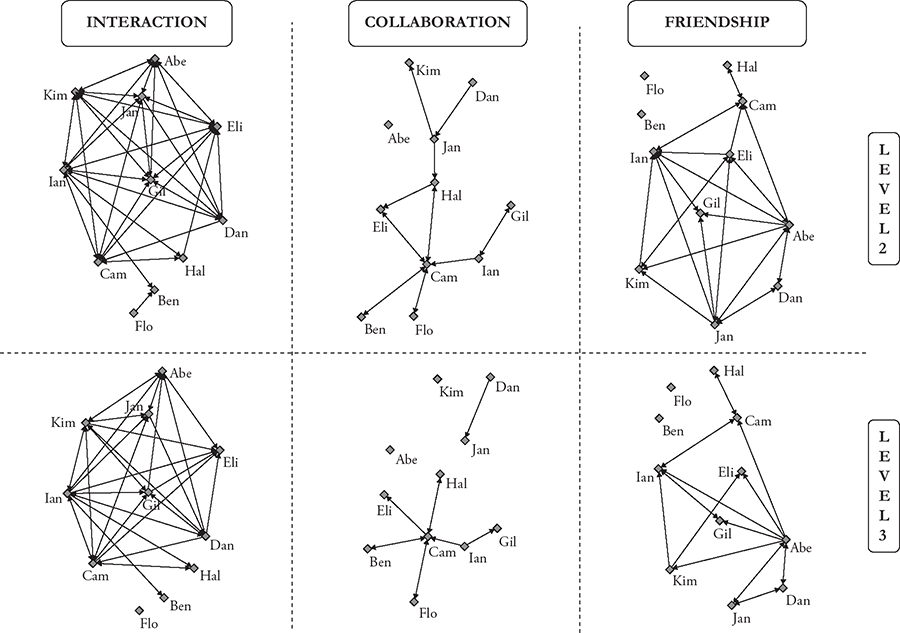
Figure 3.5 Faculty Interaction, Collaboration, and Friendship Networks (Levels 2 and 3)
Epinets for the five propositions (a through e) related to the PhD program are shown in Figures 3.6 through 3.8. Figure 3.6 lists the five propositions and presents the epinet for faculty members’ level 1 beliefs regarding them. Figures 3.7 and 3.8 present the epinets for faculty members’ level 2 beliefs (what each thinks his/her alters think about the issue) and level 3 beliefs (what each thinks his/her alters think s/he thinks about the issue) for each proposition separately. There are, again, significant discrepancies among the epistemic networks at different levels. Indeed, here we find substantial evidence of inaccurate level 2 and level 3 beliefs (i.e., AkP but BkAkQ). Although there are no inaccurate level 2 or level 3 beliefs regarding proposition a, there are inaccuracies regarding propositions b and d with respect to Abe who ~kP(b, d), but who others think knows P(b, d), and regarding proposition c with respect to and Ian who kP (c) ∈T, but who others think knows P (c) ∈F, as well as widespread inaccuracies in level 2 and level 3 beliefs regarding proposition e.

FIGURE 3.6 Level 1 Epinet: PhD Program Propositions (a)–(e)
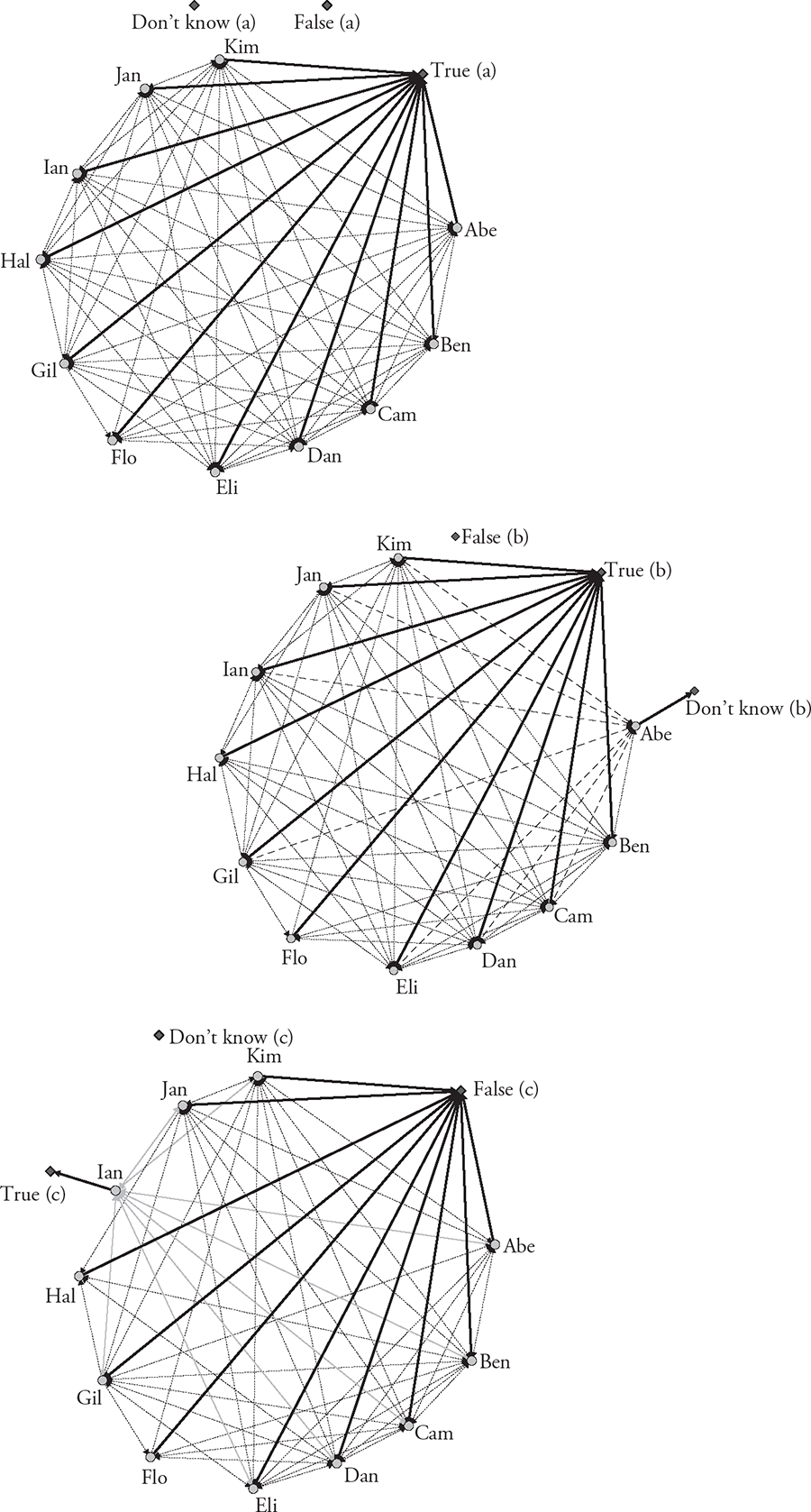
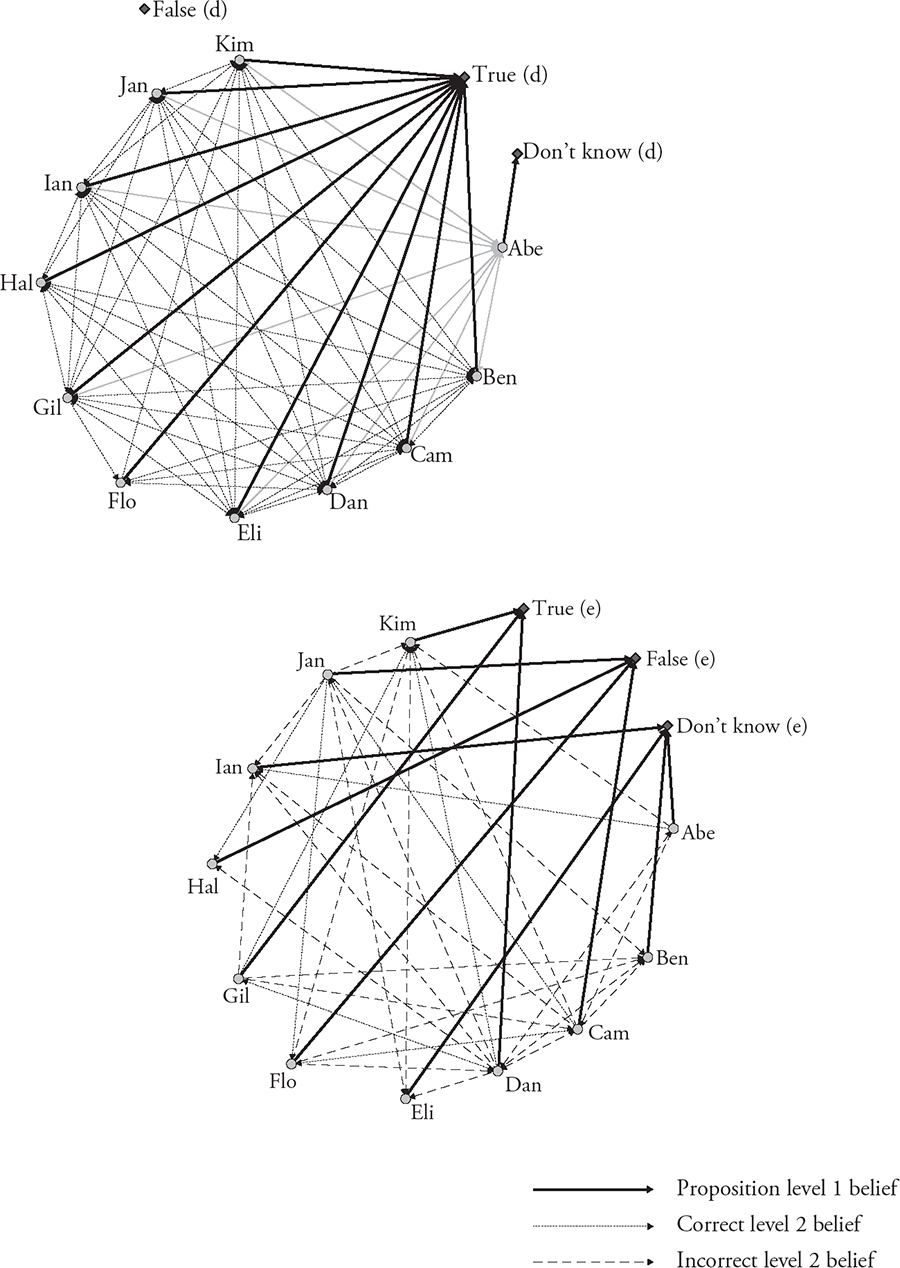
FIGURE 3.7 Level 2 Epinets: Propositions (a)–(e)

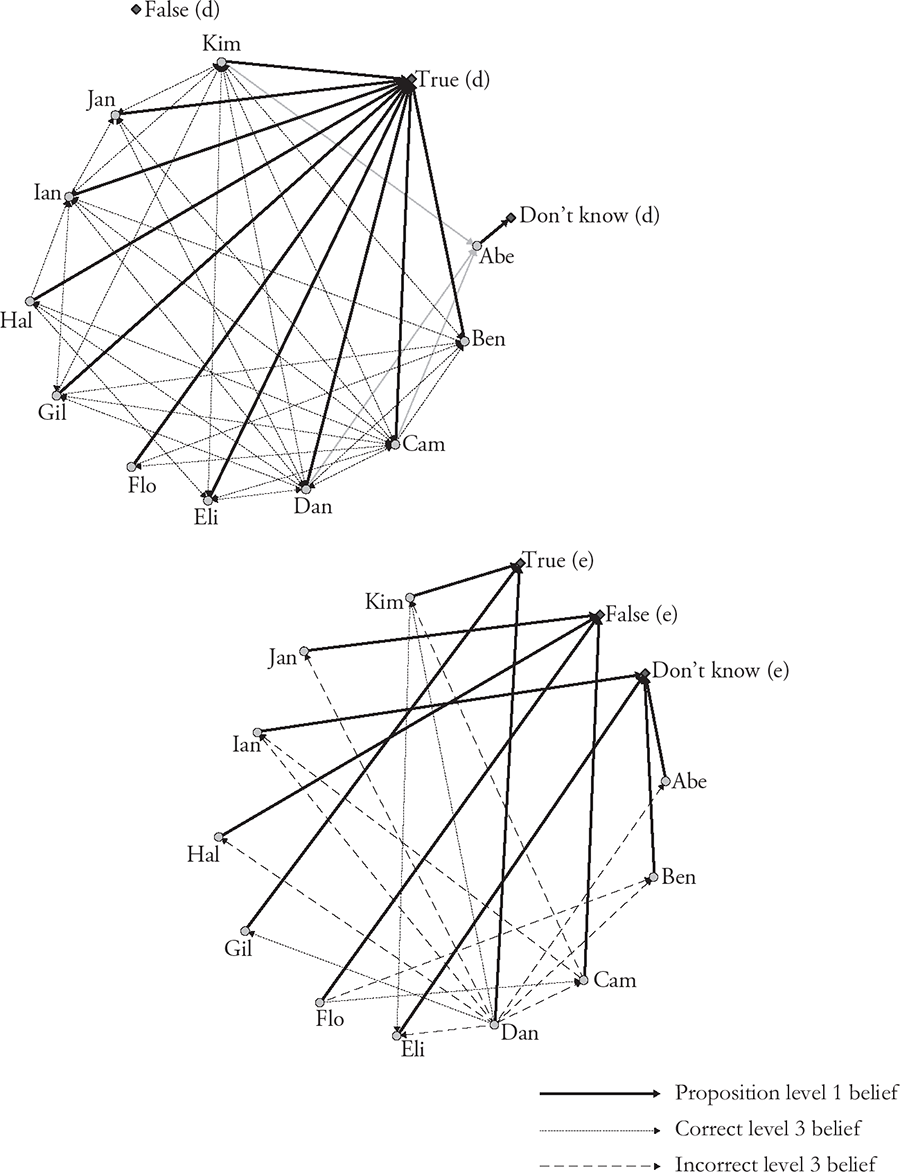
FIGURE 3.8 Level 3 Epinets: Propositions (a)–(e)
If we take coherent level 1 and level 2 beliefs to be a proxy for the instantiation of epistemic preconditions for successful mobilization of the network around an issue, and coherent level 1, level 2, and level 3 beliefs to be proxies for epistemic preconditions for the successful coordination of the network around focal points categorized by the events to which the propositions refer, we see that—even in a relatively densely connected network made up of agents who are expected to be sophisticated in terms of both network effects (several are social network theorists) and epistemic preconditions for equilibrium selection in coordination games (several are applied economists with backgrounds in game theory)—the structure of the network belies a level of epistemic cohesion that does not bode well for the coordinatability and mobilizability of the network as a whole.
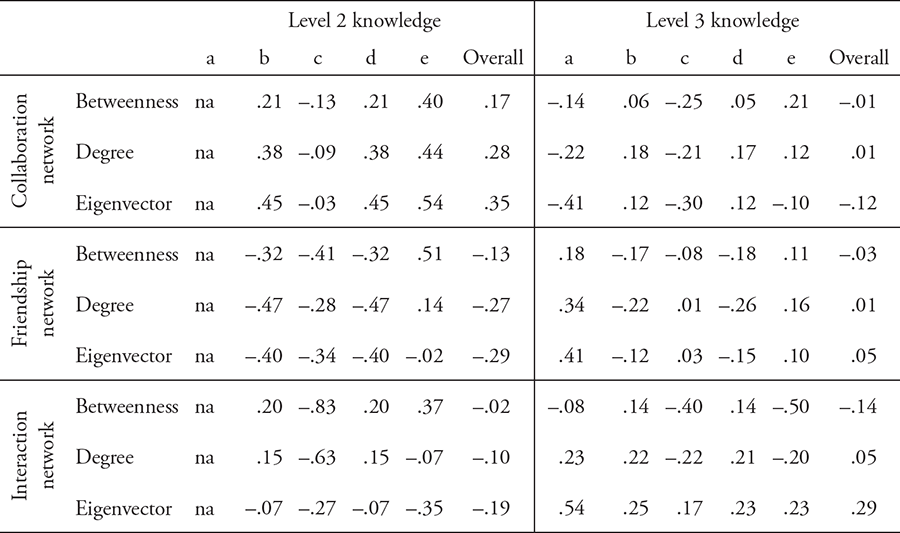
Centrality, Cliques, and Coherence. The data were further analyzed to address two additional questions. First, to what extent does network centrality (measured using betweenness, degree, and eigenvector measures) confer advantages of (1) accurate level 2 mutual knowledge about other agents’ beliefs, and (2) accurate level 3 almost-common knowledge about other agents’ knowledge of a focal agent’s own beliefs? To answer this question, we correlated our questionnaire respondents’ network centrality with their level 2 and level 3 knowledge regarding the five propositions regarding the departmental PhD program noted previously.
Level 2 knowledge (NC 2) was measured for each faculty member, A, on an issue-by-issue basis as the number of other faculty members, B, for which AkBkP & BkAkP was true—that is, for which A and B correctly identified each other’s responses (whether true or false). Level 3 knowledge (NC 3) was measured for each faculty member, A, as the number of other faculty members, B, for which AkBkAkP & BkAkBkP was true—that is, for which A and B knew that each had correctly identified the other’s responses (again, whether true or false). This analysis examined commonly held assumptions about the role of central agents in mobilizing and coordinating social networks, for which accurate level 2 knowledge and level 3 knowledge are epistemic preconditions.
Our findings are shown in Table 3.1 for both level 2 and level 3 knowledge regimes regarding the five propositions (a through e) related to the PhD program. Central faculty in the collaboration network tend to exhibit higher accuracy of level 2 beliefs (they are more likely to know what other faculty believe) but not of level 3 beliefs (they are not more likely to know what other faculty believe they know). Overall, there is little association between faculty members’ network centrality and the accuracy of their higher-level beliefs in any of the networks. As well as pointing to a method for studying the epistemic structure of various kinds of networks, these findings suggest that an agent’s network centrality may not be, as is widely held, a good proxy for his/her degree of being “in the know” if we are careful enough to define “in the know” as level 2 or level 3 interactive knowledge.
TABLE 3.1 Correlations of Network Centrality and Level 2 and Level 3 Knowledge, Propositions (a)-(e)
Our second question was to what extent do the cliques of the interaction, friendship, and collaboration networks also comprise “social pockets” of coherent levels 1, 2, and 3 knowledge. To answer this question, we examined clique coherence by identifying all of the cliques comprising the interaction, friendship, and collaboration networks (i.e., fully connected subgraphs of the respective networks)2 and comparing the coherence of intra-clique and network-wide knowledge for each. We measured a clique’s knowledge coherence, on a proposition-by-proposition basis, as the proportion of dyads sharing common knowledge at level 2 and level 3 (i.e., NC 2 and NC 3) with respect to each of the propositions related to the PhD program.
More formally, we computed coherence as t(NCn)/(k × (k − 1)/2, where t(NCn) is the number of dyads sharing knowledge at level n, and k is the number of vertices in the subnetwork. A value of 1 (or 100 percent) indicates that the clique corresponds to a mutual knowledge neighborhood (for NC 2) or to a common knowledge neighborhood (for NC 3). Thus, a 100 percent match represents a state of the world in which each clique member agrees on the proposition, knows this fact (level 2), and knows that each other clique member knows this fact (level 3).
Table 3.2 lists the cliques making up each network, gives their level 2 and level 3 coherence for each proposition, and compares each one to the overall network. Both the cliques and the network as a whole generally showed high mutual knowledge (NC 2) for issues a through d but not e. As a result, with several exceptions (e.g., the Abe-Dan-Jan friendship clique), the cliques were not more “in the know” in terms of level 2 knowledge and only the Dan-Gil-Kim interaction clique outperformed the overall network on all five propositions. Indeed, with 97 percent level 2 coherence across the five propositions, this clique corresponded to a mutual knowledge neighborhood in the epistemic network.
Level 3 coherence is far weaker, although several of the interaction network cliques did achieve moderate level 3 coherence and outperformed the network as a whole. The Dan-Gil-Kim clique, in particular, had 87 percent level 3 coherence across the five propositions, but this level corresponded only weakly to an almost-common knowledge neighborhood in the epistemic network. Nevertheless, this clique was remarkable for several reasons. First, it comprised peripheral faculty. Second, although their coherence on issue e was relatively high, their shared beliefs were incorrect. Had their beliefs served as a set of focal points for this clique’s members, they would have coordinated on the wrong signal. These findings suggest a further caution in interpreting network-level topological features—cliques in this case—as being too strongly indicative of networked agents’ proclivity to act in a synergistic fashion either to co-mobilize or to coordinate.
Taken together, the findings suggest that network-topological and structural features alone should not be taken as universal predictors of network cohesion or as variables that predict an informational advantage accruing to centrality. Neither clique membership nor agent centrality may confer the informational advantages that should accrue to the central and the tightly connected. If such an advantage is critical to the brokerage and closure that constitute social capital, then a different, augmented view of the epistemic conditions of social capital formation and maintenance is required. The network researcher’s “tool kit,” accordingly, should be expanded to include measures of the epistemic states of networked agents (individual, collective, and interactive), and the “networker’s tool kit” should be expanded to include operators and operations that function at the level of epinets and not just at the level of ties among agents.
Interpretation, Misattribution, and Oblivion
We have thus far constructed and untangled epinets anchored by propositions that refer clearly to events or objects, that have well-defined truth values that can be independently ascertained by reference to an independent source (such as a memorandum that serves as distributed knowledge), and about which networked agents have simple beliefs (true, false, true with probability p). In such cases, we showed how the degree of coherence of interactive belief hierarchies can be used to assess the degree of cohesion of the network and the coordinatability and co-mobilizability of its members.
The epinet approach to describing relationships and interactions among human agents linked by various kinds of ties is also useful when describing situations (1) in which various subnetworks coalesce around propositions that have ill-defined truth values that may depend on interpretations shared by different subnetworks regarding the referents of these propositions or the definitions of their subjects and objects; and (2) in which some or many of the agents in the network are oblivious to certain propositions or to the state of affairs to which they refer.
Such situations can pose problems for formalistic approaches to describing interactions, which specify either complete “event spaces” whose constitution is common knowledge among agents in the network, or propositions that unambiguously refer to such events and therefore have easily ascertainable truth values and can be combined and recombined using first-order logic. These situations can also cause trouble for empirical approaches, which employ questionnaires that impart knowledge to the respondents whose knowledge they are in fact meant to measure—asking agent A about proposition P makes it impossible to determine whether or not agent A is in fact ignorant of the truth value of the proposition or, rather, oblivious of the possibility that the proposition is true.
Table 3.2 Clique versus Network Belief Coherence, Propositions (a)–(e)

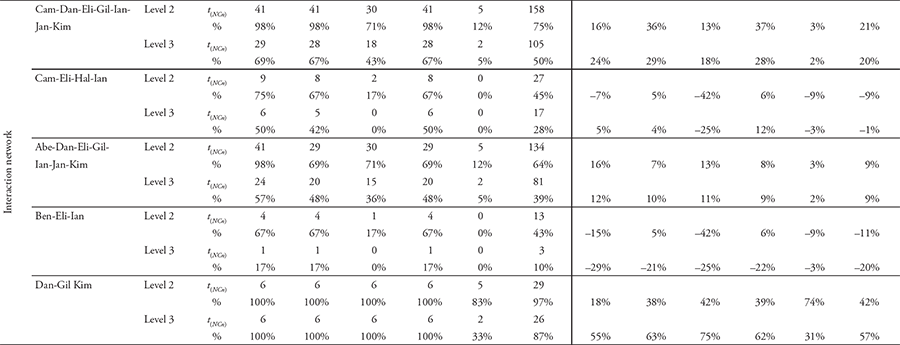
NOTE: t(NCn) is the number of dyads sharing knowledge at the indicated level, and % indicates the percentage of all dyads sharing knowledge.
These problems are inherent to the research programs in question: they are wired into the analytical fabric on which researchers predicate their activities. This means that any disciplined attempt to deal with them in a coherent framework must relax at least some of the constraints of the paradigms in which they have originated. This is precisely what epinets allow us to do. In particular, by relaxing conditions of agent-level informational omniscience and perfect recall as precursors to any model of interactions with interdependent outcomes, we can build epistemic portraits of interactions among agents and model the structure and dynamics of the resulting network at the level of epistemic moves—actions that change the network’s informational landscape (a topic of Chapter 5). At the same time, the notions of “awareness” (knowing that you know something) and “oblivion” (not knowing that you do not know something) make it possible for us to posit individual and collective interactive epistemic states that are more accommodating to intuition and realistic descriptors of what agents in a network actually know and believe.
In particular, we introduce a syntactic state space comprising propositions over which agents can have an expanded set of epistemic states—including “interpretations” of a proposition, almost-common knowledge of various degrees, oblivion, and “oblivious knowledge” (an agent knows P but does not know, at time T, that she knows it, perhaps because she has temporarily forgotten P and it is therefore not immediately salient to her). This allows us to describe an expanded set of epistemic moves and maneuvers that networked agents can perform to change the informational and epistemic state of the network as a whole.
Consider Figure 3.9. Alice (A) and Bob (B) each have their own interpretation of an epistemically simple proposition, P, and each believes the other “knows” his/her and not the other’s interpretation. If P is (as in our empirical study) the proposition A new PhD program structure has been put forth by x, Alice knows that there is a proposal on the table to be considered, discussed, and modified, and Bob knows that there is a proposal on the table to be ratified by time T. Alice also believes that Bob knows that there is a proposal on the table to be considered, discussed, and modified, and Bob believes that Alice knows that there is a proposal on the table to be ratified by time T.
Moreover, there is a proposition, Q, that relates to a request for comments regarding the proposal, of which Bob is oblivious (does not know it and does not know he does not know it because the department chair accidently left him off the “cc” list on the e-mail making the request). Q might lend inferential support to Alice’s interpretation of P and lend differential inferential support to her interpretation as against Bob’s interpretation, but it need not do so: even if Bob knew Q, he might still believe that his own interpretation of P is the correct one, depending on his view of an informal request for comments and of the degree to which these comments are binding or otherwise on those who make them.
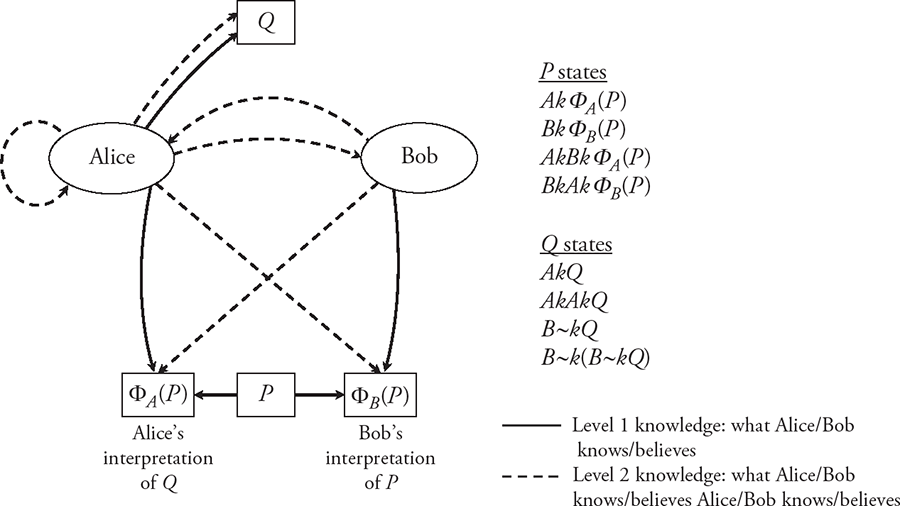
FIGURE 3.9 Complex Epistemic States
An epistemic game theorist might be inclined to cut through the inferential and interpretative quagmires of natural language and simply create a contracted state space of events (proposal ratified by time T, proposal not ratified by time T), ascribe personal probabilities of these events to Alice and Bob, impose coherence conditions on these probabilities (they should sum up to 1), and have Alice and Bob conditionalize their posterior expectations of that event on new information that emerges from the group communication process surrounding the proposal. This modeling strategy, however, hides the degree to which natural language predicates like “ratify” are subject to interpretation (e.g., How binding? How irreversible?), and an expansion of the state space is required to accommodate various eventualities arising from differences in interpretation. More important, this accommodation also hides the nuanced epistemic space changes that accompany the dialogical games surrounding a complex proposal, which a syntactic representation (based on propositions and interpretations) reveals.
A Case of Misattribution: The “Paradigm War” in Organizational Studies. The use of “interpretations” in the expanded epistemic state space of networked agents is critical in the mapping of more complicated dialogical games, such as those played by researchers and scholars in the context of journal articles that ostensibly instantiate a communicative community. One particularly telling example arises from an episode of trans-disciplinary dialogue in organizational studies that has come to be referred to as the “paradigm war” (Pfeffer 1993, 1995; Van Maanen 1995a, 1995b). In this episode, researchers with different conceptual and methodological commitments attempted to debate the epistemological foundations of “the field,” which comprises phenomena and problem statements drawn from many different spheres of managerial and organizational practice (Moldoveanu 2009).
The dialogical game that ensued featured a set of interactive beliefs and knowledge structures that attributed certain commitments to various “camps” (Moldoveanu and Baum 2002). These attributions were based on appropriation of terms and definitions (realism, constructivism, relativism, dogmatism) from the literatures of epistemology and philosophy of science and on the use of these distinctions and concepts to attribute certain epistemological stances and commitments to one another. The attributions can be modeled in an epinet (see Figure 3.10) as a set of propositions that “look” epistemically simple (i.e., admitting simply defined truth values) but are in fact complex, theory-laden interpretations of definitions supplied by a field of study (the philosophy of science) that is itself an evolving dialogical game with radically different norms of justification, inference, and dialogical practice.
The camps represented in the paradigm war were loosely formed around focal groups of researchers committed to data gathering and analysis (qualitative/quantitative) and justification and explanation (hypothetico-deductivists/inductivists; formal modeling/informal modeling), which harness existing epistemological stances (realism/constructivism) as justification for these practices. However, the discussants’ understanding of the epistemological foundations of their own work bore only a loose resemblance to the use of these terms in the philosophy of science literature, which made it important to consider the consequences of interpretations and misinterpretations as well as those of attributions and misattributions in the ensuing dialogical game.
Researchers from the realist camp, it turned out, ended up portraying realism (loosely, a commitment to the terms of a theory or model as representing real objects and events and to the link between the truth value of hypotheses and the realness of the terms of the model from which hypotheses are derived as theorems) as closely resembling positivism (a commitment to models that contain only quantities and qualities that are directly perceptible by the senses). This led researchers in the “constructivist camp” to claim an epistemological high ground on the basis of a set of logical problems that had arisen in regard to positivism as a theory of knowledge and of a view of themselves as being more realistic in their modeling assumptions (where the common language term “realistic” had been falsely conflated with “realism” as an epistemological commitment).
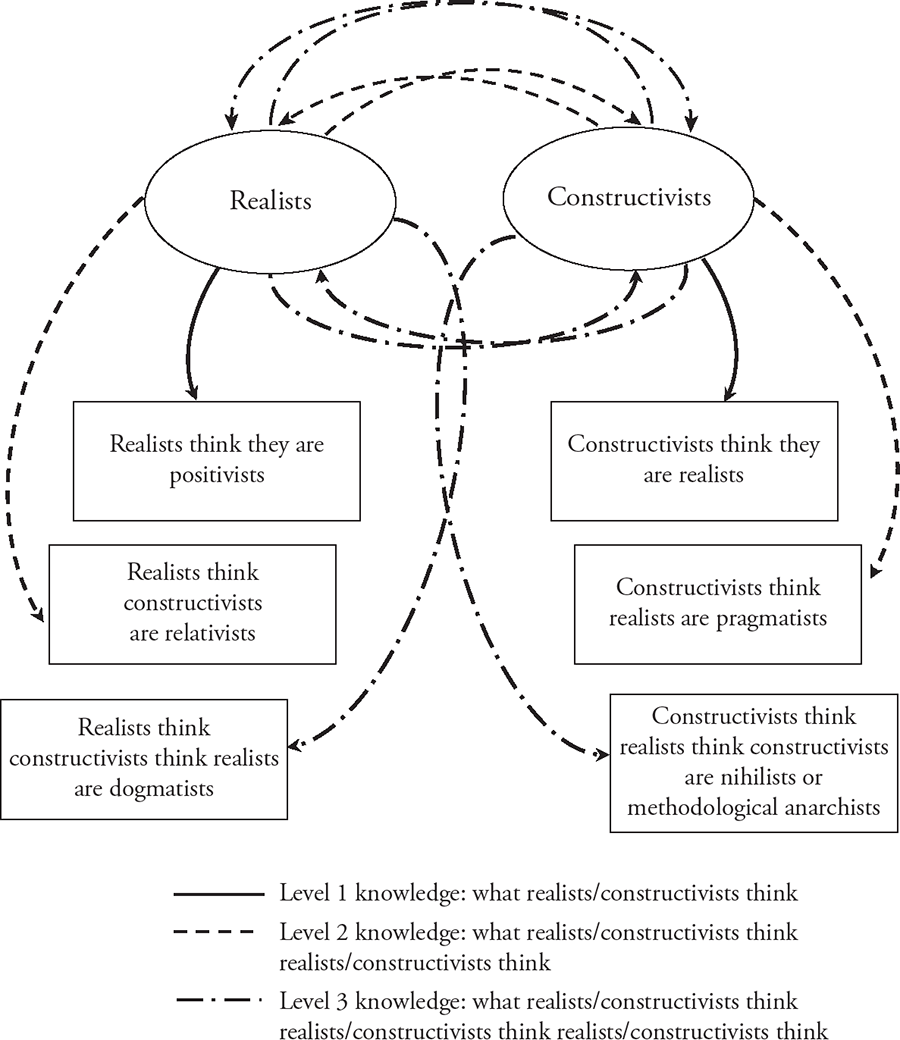
Figure 3.10 “Paradigm Wars” Interactive Belief Hierarchy
source: Adapted from Moldoveanu and Baum, 2002.
Researchers in the realist camp, in turn, focused on the insistence of constructivists that a representation is an emergent phenomenon resulting from an interaction of an observer (the researcher) and a subject (the topic of research) in order to claim that constructivism is a form of relativism (which makes the truth value of any hypothesis or explanation relative to the researcher’s conceptual and perceptual frame of reference). The realists used this claim to charge the constructivists with a form of incoherence (always a pejorative in academia) that they perceived to be at the core of all relativist stances (because to the extent that relativism relies on the tenet All truth values assigned to descriptive sentences are relative, that tenet must itself be either relative if it is to be meaningful at all or false otherwise).
Interpretation matters in each of these instances: to understand the structure and dynamics of the dialogical game unfolding among researchers of different methodological persuasions, we must parse not only the propositions that researchers use to refer to their own and each other’s commitments but the content of these propositions as well—the precise set of associations, references, and truth conditions that researchers use to make sense of these propositions.
It is also not the case that such dialogical games are epi-phenomenal, that they do not make a difference in the behavior of the researchers as agents in a network (in this case the larger network of researchers studying organizations). To the contrary, the models of self and other that emerge serve as coordinata (focal points in coordination games) for subnetworks of researchers who vote on tenure and promotion cases that welcome new networked agents or deny them entry, and who use these dialogically emergent identities to plan and organize conferences, give advice to granting agencies on research funding, and discuss matters of strategic and operational importance with executives. Thus, interpretation—and the complex epistemic states that arise from interpretative processes—matters as more than just idle talk (or journal article writing) in ways that are inextricably linked to the nature and function of the interpretations they produce.
The Case of Status: Between Oblivion and Glory. Epinets centrally feature propositions that carry meaning made up of both denotation and connotation, and they can therefore express both judgments of value and judgments of fact. As a result, they can be used to texture what we currently understand by status—yet another important feature of social networks. Many social network analyses invoke status as an explanans or an independent variable that measures an essential property of a social arrangement (e.g., Benjamin and Podolny 1999).
Status-based explanations of network effects have the basic structure of positive feedback explanations more generally: the haves get more overtime, with repeated interactions, than the have-nots get, and the disparity continuously increases. This explanatory mechanism owes its form largely to the centrality measures used to quantify status (e.g., Bonacich centrality (Bonacich 1987)), which explicitly weight the connectedness of an agent by the connectedness of the other agents to whom she is linked. Changing one’s status, by this definition, is a costly and risky process, as it involves either forming ties to well-connected network agents (who may have little or no incentive to respond to overtures from unknowns) or modifying the centrality measures of these agents relative to those of the agents to whom one is connected (which is often not a controllable process).
Despite the apparent resistance of an agent’s status to change that can be causally attributed to his/her actions, there are often fashions, fads, and paradigms that emerge, grow, and fade out in established industries that are not necessarily disrupted by demand shocks or technological change. The status of the image-creating agents representing them tracks their ebbs and flows. Such changes seem difficult to explain based only on tie formation and decay mechanisms operating on a network topology. One can, after all, have qualitatively different degrees of status (ranging from knownness to glory), and one may be known for attributes that are “good” and so desirable, or “bad” and to be avoided. Being known for X is easily represented in epinets but not so easily in models that simply specify the presence and strength of inter-agent ties.
Status depends in part on a property for which the agent has acquired and retained his/her status. If status is “fame,” for instance, then a critical property of that fame (aside from the network positions of the agents to whom one is famous) is what, precisely one is famous for—that is, the P-ness of the famous agent. A California vineyard that makes Chardonnay may be famous for the “oakyness” of its vintages and accordingly competes with other “oaky” California Chardonnays that make up its reference or comparison class. Should next year’s vintage turn out “buttery,” however, the vineyard will likely be charged with an error, which may affect its status among other Chardonnay vintners to a greater or lesser degree. Should the error persist, the reference or comparison class for the vintner will also likely change and perhaps become Burgundy Chardonnays, which are famed for being buttery.
There is a link between one’s degree of fame and what one is famous for. This link can be manipulated by a network agent to effect endogenous change in his network status by playing with the semantic structure of P. Suppose that A is fAP famous for P and fAQ famous for Q and that the subsets gAP and gAQ of G are disjoint. Then A is ( fAP + fAQ) famous for the composite property P and Q. A, however, can only socially aggregate his fame constituencies if he can successfully justify the semantic aggregation of the individual properties P and Q—that is, if he can show that the composite property P and Q is meaningfully different from P and from Q. To do this, A could show how his P-ness matters to the agents that make up gAQ and how his Q-ness matters to the agents that make up gAP. Ideally, A would show that his Q-ness is causally essential to his P-ness and vice versa.
A common example is a high-status automaker (e.g., BMW, Porsche) entering the sport utility vehicle (SUV) market with high-performance products (e.g., X5, Cayenne) based on power plants and transmissions developed for its sedans and coupes. In the process, the automaker restructures the image of SUV consumers and thus gleans from its entrenched position and image a reputation in the new market for all-terrain performance that helps it sell more vehicles with advanced transmission technology (e.g., AWD) in the sedan and coupe markets.
More formally, epinets can be used to reveal the propositional and value-laden structure of the status of an agent in a network, as follows.
Reach of Agent A. The fraction f or subset g of all agents in the network who are epistemically connected to A—that is, whose epistemic states change in response to a signal emitted by A. A stock analyst’s estimate of the true market value of Apple, for instance, may change the epistemic states of some investors regarding that value, depending on their degree of confidence in the analyst’s estimate. Changes in A’s epistemic states do not necessarily lead to isomorphic changes in the epistemic states of agents in her reach.
For instance, if B is in the reach of A, BkP, and B discovers that AkP, then B might change his epistemic state from kP to k(~P). If B has reason to believe that A is self-deceived or a deceiver (as may be the case with our stock analyst), he is still in A’s epistemic reach, even though the change in A’s epistemic state is obviously negatively correlated with the intended epistemic import of B’s announcement. Reach, then, is a weak epistemic link in that it does not guarantee an epistemic state change in the recipient of a signal that is perfectly correlated with the epistemic state of the transmitter of the signal, or the epistemic state of the transmitter that is consistent with the signal being accurate.
Clout of Agent A. The fraction f or subset g of agents in network G that change epistemic state from ~Kp to Kp because of the discovery that AK p, or from K p to K (~p) because of the discovery that Ak(~p)—that is, for whom it is true that K (A K p) → BK p & K (AK (~p)) → BK (~p). A weatherman’s announcement of tomorrow’s forecast, for instance, changes the epistemic states of those tuning into the announcement: it changes their estimates of the truth value of propositions such as It will rain tomorrow. Clout reaches further than “reach” in the quantification of the epistemic influence of a network agent. It captures the network epistemic effects of opinion leaders and experts whose signals have high degrees of credibility (or, alternatively, who enjoy the greatest level of confidence of those in their reach) and therefore whose experiences can provide warrants for propositional beliefs held by network agents to be true.
Knownness of Agent A. The fraction f or subset g of agents in G who know of A: BK A—that is, who know P = (I know or am acquainted with A). A’s knownness captures the name recognition of A in G. Philipp Kohlschreiber, for example, may have a high knownness among dedicated tennis fans, while Juan Martín del Potro may be highly known to both tennis fans and sports fans more generally as the winner of the 2009 U.S. Open tennis championships. Note that clout need not imply knownness: a stock analyst working for an investment bank of repute may not herself be known in the investor community, but the credibility of her pronouncements is safeguarded by the reputation of the bank that employs her. Knownness may also be associated with more complicated propositional structures and, in particular, with value-laden propositions. A may be known for being a mass murderer or a highly successful high-technology entrepreneur. In this case, the knowledge by acquaintance (“that is A”) at the core of knownness may be replaced by a more specific association of A with some property X for which A is known.
To distinguish between this more specific collective epistemic state and knownness, we need a more textured concept, which follows.
Fame (Infamy) of Agent A. The fraction f or subset g of agents in G who know that A has positive property P, BK(Pi) (negative property N, BK(Ni)). Fame (infamy) is equivalent to knownness for P (knownness for N). Thus, we refer to a successful serial entrepreneur as famous in the sense that she is known for being a successful serial entrepreneur, and we refer to an organized crime boss as infamous in the sense that he is known for being an organized crime boss. The P-ness (N-ness) of A is the key feature distinguishing knownness from fame or infamy—epistemic states that are dependent on semantic properties of P: minimally, positivity and negativity.
Renown of Agent A. The fraction f of agents in G who know A, know all of the agents who know A (and know that these agents know A): BKA & BK({L}: LKA), where {L} is the set of agents (with cardinality). Renown is a higher-order epistemic state that characterizes the relationship between an agent A and a network G. The actor Brad Pitt may be known for being known, even if those who know him for being known do not know him for something (i.e., even if they have not seen any of his movies). Pitt’s second-level knownness—his renown—therefore need not be correlated with any specific judgment of fact or value about him. It is simply the case that he enjoys not only name recognition but also recognition for and of the fact that he enjoys it. As in the case of knownness, we need a more textured epistemic property to capture the notion of being known for being known for a particular quality or attribute.
Glory (Notoriety) of Agent A. The fraction f (or subset g) of agents in G who know all of the agents that know that A has positive property P (negative property N): jK(l: lK(PA)) (jK(l: lK(NA))). Glory (infamy), then, is renown for P(N).
The network epistemic states just presented can be combined to understand in a precise way an agent’s status. Bill Gates, Microsoft cofounder and chairman, for instance, is known to a large subset g of the North American population (the network G); he is famous for (P = starting up Microsoft) to a subset h of g; he is infamous for (N = trying to corner the desktop software market) to a subset j of g (which may or may not be a proper subset of h); he is renown to a large subset k of g who know about all of those who know of him; he is glorious for (P = starting up Microsoft) to a subset l of h who know about those that make up h; and he is notorious to a subset m of j for (N = trying to corner the desktop software market). He has clout with regard to software industry–related issues with a large number of (sometimes uninformed and unsophisticated) investors and technology analysts in the software and electronics sectors, and he has clout with a smaller number of software and computer technology executives (with whom he has credibility and of whom he knows that he has credibility with them). Together, these network-epistemic variables can be used to characterize the “status footprint” of an agent and to specify in detail the epistemic relationships and influences that the agent is part of or capable of entering and exerting, respectively.
Measurement Implications. These new concepts and distinctions enable us to take an epistemically textured view of measures of network influence that have in the past been related only to the topology of ties and the position of an agent in the network—that is, centrality measures (Wasserman and Faust 1994; Jackson 2005). In particular, they allow us to distinguish among the differences that differences in agent centrality make in their influence in the network.
Degree centrality measures the proportion of agents in the network to whom an agent is connected. It is therefore a measure of “connectedness.” But how “connected” a person is depends to a large extent on what exactly is meant by a connection. At the very least, a meaningful tie should have something to do with “knowing and being known,” which in turn, can be unpacked into knownness and renown. One’s connectedness in a network is a meaningful (partial) measure of one’s influence provided that those connections contribute to one’s knowledge of other agents and knownness of other agents, as well as contribute to one’s knownness for being known in the network. Human agents engage in many interactions that do not confer on them the knownness property—they remain indistinguishable strangers to one another. It is therefore useful to qualify simple degree centrality measures with the more textured epistemic language of status and influence to articulate more precisely which differences in degree centrality make a difference in the influence of a network agent.
Closeness centrality is a measure of the accessibility of the network to an agent in a situation in which network distance significantly attenuates interpersonal connection: Alice is far closer (affectively or informationally) to her friends than to her friends’ friends’ friends (provided she does not know her friends’ friends or her friends’ friends’ friends directly), and her proximity to people from whom she is separated by two or more degrees decays rapidly as a function of the number of degrees of separation.
One way to unpack accessibility as meaningful to Alice’s influence in the network is to consider the reach and clout that she has there—the degree to which she can communicate with and change the minds of various network agents. Reach may be a function of Alice’s closeness measure—think of rumor mills. However, it need not be—think of expert networks selectively tuned into certain network agents via e-mail alerts and filters, or professional groups selectively focused on particular areas of study and practice, with only agents having overcome barriers to entry such as training and certification “cleared” to communicate freely with other members of the same group.
In each case, clout adds further resolving power to closeness as an influence measure by specifying the epistemic import that an agent’s signals have for the epistemic states of other agents in the same network. Clout is an epistemic certifier for signals emanating from the agents who have it. As in the case of reach, an agent’s clout may or may not directly correlate with her closeness centrality: acknowledged experts in a field of knowledge or a professional practice may have clout in their network by virtue of their track record of professional or research practice (publication record, citedness, word-of-mouth fame acquired through participation in conferences).
Betweenness centrality measures the (mathematical) probability that the shortest path connecting any two agents in a fully connected network passes through a particular agent. It is an intuitive measure of the informational advantage that an agent gains by virtue of his/her connectedness: being “in the know” in a situation in which information functions as “social currency” should be correlated with being “along the greatest proportion of trajectories” in the network connecting one agent to another. However, as with other centrality measures, the causal import of betweenness centrality to the network advantage of a high-centrality agent depends on the precise definition of the connecting ties that define the network in the first place. We have argued that the epistemic dimension of a tie—the set of individual and interactive beliefs of the two connected agents—is critically important in the definition of that tie.
Ties based on coherent interactive hierarchies of higher-level beliefs are bound to be more “conductive” of relevant information than ties based on superficial interactions (no matter how frequent) that are not characterized by such coherence. Moreover, an agent’s clout is in itself a key indicator of the degree to which information transmitted by that agent to any other agent is evaluated as valid and worthy of further communication. In Chapter 4, we introduce the concept of superconductive geodesics and paths through a social network based on the (modal and subjunctive) epistemic state of trust (in agents’ integrity and competence). These distinctions should help to qualify and refine inferences about an agent’s “network advantage” made on the basis of purely topological features such as his/her betweenness centrality.
Eigenvector centrality measures the degree to which an agent is connected to agents who are themselves well connected. Thus, eigenvector-central agents are connected to the well-connected. This measure is recursive: one can also be well connected to those who are well connected to the well-connected and so forth.3 “Connected” is conflated with “influential” in a way that can be greatly helped by notions such as renown, fame, glory, and clout. To the extent that “connection to the well-connected” confers on the so connected the kind of epistemic influence (clout) that is desired for true influence to be inferred, it is useful as an explanatory variable for an agent’s network position.
However, one can achieve “instant” clout—and therefore influence—in a network on the basis of a well-broadcast discovery that makes the subject famous (in our sense) overnight (for example, the “discovery” of cold fusion by Pons and Fleischmann in the late 1990s), and make the subject just as instantly notorious (for example, the forgetfulness and oblivion in the aftermath of failures of other laboratories to reliably repeat Pons and Fleischmann’s studies). When we measure the topological and structural features of an agent’s position in a network as proxies for his/her influence, we run the risk of measuring either too little or too much (not any and not all ties and connections matter to what we are after) or of inferring too much (certain ties matter only against the background of certain distributions of information and certain collective and interactive epistemic states of the networked agents). Understanding the epistemic preconditions for influence and connectedness provides an adaptively useful set of filters on the variables we heed when “measuring networks.”
Summary
We have shown how epinets can be used to describe the zones and regions of coherence, agreement, and cohesion that undergird social structures and social networks. Also, we have shown how coherent epistemic states can safeguard inferences about network coordinatability and mobilizability and help us predict who will co-mobilize and coordinate and who will act as mobilizers and coordinators. We have moreover shown how to use epinets in empirical settings to test for the degree to which networked s agents are coordinatable or co-mobilizable, and to analyze the epistemic conditions that enable an agent to function as a mobilizer or coordinator of his or her network. Using the syntactical approach to epistemic state spaces, we have demonstrated how subtle linguistic phenomena like conversational implicature, interpretation, and attribution can be unpacked and analyzed in the conceptual space that epinets create.
We further extended the notion of an epinet to show how a networked agent’s status, renown, fame, and glory can be textured and refined by using the epistemic states of the agents comprising the network as important qualifiers. The epinet representation thus tracks the outcome of each exchange of information among agents in the network to the agents’ resulting epistemic states, which in turn makes it possible either to build more descriptively accurate models of the dynamics of the interaction—“epistemic moves” (which we explore in Chapter 5)—or to measure the network using more accurate and realistic instruments.