
CHAPTER 18
Now—after 150 years of history with concomitant mathematical accomplishments—quantification is firmly set, ensconced in our minds and thoughts. It is our very view of life, our Weltanschauung (worldview). Since my opening words in Chapter 1, we have traced how this worldview came about.
But, explaining the ineffable is difficult. The story of quantification is complex and occasioned by dynamic events, and only truly known thorough a carefully reasoned narrative that follows a coherent argument. No glib explanation or simple description can give it due. I hope that, through this telling, I have succeeded.
Most of the events of this story happened during a relatively short time frame in world history. With antecedents noted throughout the eighteenth century, our story begins (roughly) late in that period with events leading up to the Congress of Vienna (ending the drawn-out French Revolution and the era of Napoleon) and was not entirely complete until the outbreak of WWI in 1914: the so-called long century. This 130-year-long period brought forth a torrent of breathtaking advancements in mathematics and statistics, and, in particular, the ability to measure uncertainty through the developments of probability theory.
We have seen that the contemporaneous history provided an encouraging context for the intellectual advances. As I have said throughout the previous chapters, the astounding mathematical inventions happened because they could happen. History gave a kind of tacit assent to the quantitative developments. Thus, we can only understand the mathematical accomplishments by knowing their historical context: social, political, educational, and cultural. This is just what we have done in following our route to quantification.
Further, the developments were mostly attributed to a relatively few (about fifty or so) remarkable men and women working at the time. As we have seen in chronicling their achievements, our principals were individuals of almost unimaginably high intellect. It is much to our good fortune that they lived in the same era and worked on common problems in probability and statistics—a simply remarkable fact.
Quantification has come into our lives so elementally and indispensably that we have changed fundamentally. It is how we view things, and it is what we accept as true. Our Truth is explained by quantification. It defines who we are.
The consequence of this new perspective has been for us to change our behavior, in both interacting with our environment and in our relationships with other people. We have a worldview defined by our inclination to view natural and everyday phenomena through a lens of measurable events. It is a rethought ontology. We see things more expansively in both time and space, and, more boldly, in terms of impact.
As we have seen through this story, our worldview is now fully one of quantification, and it holds primacy in our lives, bringing us to an entirely new perspective on what we know about the world and how we know it. By it, we are changed in what we each think about ourselves.
* * * * * *
Let us consider a “thought experiment.” A thought experiment is an investigation into a scientific question that is carried out only in the imagination. Sometimes the question is even stated as a hypothesis, but there is no data or empirical verification. Nonetheless, it is more than mere conjecture, because a methodology is employed, even if only in the scientist’s imagination. This is informed speculation. Thought experiments can be important and useful because they can carry ideas forward when it is not possible to actually perform a physical experiment. Such thought experiments are common in physics, theoretical mathematics, and philosophy. People who are known to have carried them out include historical luminaries like Galileo, Descartes, Newton, and Leibniz, as well as dozens of modern scholars.
One of the most famous scientific experiments in history may actually have been a thought experiment. In 1589, Galileo supposedly dropped cannonballs of different weights from the top of the Leaning Tower of Pisa to see whether they would fall at the same rate. But we have no record to verify that Galileo in fact performed the experiments other than as thought experiments.
The only written account is given by someone we saw earlier, Lagrange, in his Mécanique Analytique. There, he says Galileo described his actions as “rhetoric” in De motu (Of Motion), which is itself an unpublished text. Thus, Galileo’s actually having climbed the steps of the tower and the rest of it is unverified. We know, too, from other contexts, that Galileo had conducted prior thought experiments. Therefore, from the information we have, Galileo’s experiments with cannonballs on the nature of gravity—while important and certainly famous—may not have physically taken place at all, but instead were his “thought experiments.”
Here, I’ll carry out two thought experiments. The first is to imagine that quantification had not taken place and we had not transformed our worldview to it. In the second, I imagine our current quantified worldview but project it into the future, to speculate on how we might evolve in a next step.
Thought Experiment No. 1: “Quantification has not taken place and we have not transformed our worldview to it.”
In this thought experiment, we are in present times but without quantification as a worldview. I am not suggesting that we imagine ourselves in the eighteenth century or at a time before the beginning of quantification. We live today, even in this thought experiment. Significantly, however, we do not have reliable predictions, regressions, conditional probabilities, Bayesian thinking, the method of least squares, or even a means to calculate correlational relationships.
As a consequence, nearly all of the dramatic inventions of the nineteenth and twentieth centuries would not exist or would be rudimentary versions of themselves, something like Pascal’s wooden Pascaline calculating machine. As hard as it is to even imagine, we would not be living in the Age of the Chip. Cars, television, telephones, and many other modern inventions would still have been invented, but even those that require electricity (which we would have) would work only as mechanical devices; they would not perform with their current chip-enhanced capabilities. And, in this scenario, the Internet would not exist.
If this sounds like regressing to the Stone Age, remember that this world was everyone’s reality only fifty or sixty years ago. An interesting side question, apart from our thought experiment, is to ask someone old enough to have lived in those days—say, most folks over fifty years of age—whether he or she is happier today than before these inventions. This would be a complex consideration, no doubt.
Clearly, humankind is greatly advantaged with these inventions. Consider developments in disease diagnosis and treatment, for example. But not all modern advances are ipso facto beneficial. Along with them come some deleterious effects. For instance, psychological stress is increased because of social media, wherein the anonymous sender of information can describe themselves as living the perfect life, leaving the receiver to worry that he or she is missing out on something important. And private information, everything from the personal details of your life to confidential financial records, can be covertly obtained. These concerns are indeed serious.
Without a quantified worldview, we would rely upon habits, incomplete (or unknown) information, superstition, and whims as the means to make our decisions, big or small. When looking back at something, we would be at a loss to understand how events might be interrelated in a meaningful way. Fate would still play a large role in our thinking. Independence of thought would be less. Actions taken would be more haphazard.
I conclude this thought experiment by deducing that quantification—the worldview that gives us a numerical perspective on all things—is, overall, a huge plus in our lives. It brings us advantages and conveniences that we would not have otherwise had. It is hardly an absolute good, but certainly more so than not.
Thus concludes Thought Experiment No. 1.
Thought Experiment No. 2: “From our current quantified worldview, project into the future to speculate on how we might evolve in a next step.”
In this thought experiment, our worldview is our present version: one in which we have quantification at its core. We view things from a perspective of knowing that correlations and probability are calculable events, although rare is the circumstance that we would actually have the data or the inclination to do so. Still, we base decisions on what we may believe to be a correlational relationship or on the probability of a perceived outcome. I am mindful that this thought experiment is distinct from making predictions about the future; hence, I will avoid sliding into the projections of a futurist. Serious futurists attempt to make predictions of what could happen someday, which could be either close at hand or far off. Of course, they have a lot to offer in their conversations, and we can learn much from them.
Here, I am less ambitious. I merely project quantification as our worldview into the future.
With quantification carried forward, then, I expect three effects. First among them is the continuance of developments in statistics and probability theory, which, although likely, is by itself hardly a remarkable observation. However, it is important because it naturally leads to the conclusion of their yielding more precise and reliable predictions. In other words, we will know the outcomes of quantification more exactly, and we will have greater confidence in them.
Possibly, maybe even likely, the future developments will allow us to move predictions into fields that are now only incompletely known. For instance, we may be able to reliably predict natural disasters, such as earthquakes, so that emergency measures can be started sooner, even ahead of the event. Or, possibly, our predictions into human behavior will be more accurate. For instance, maybe we will be able to better predict characteristics for harmful addiction and dependency of all kinds and bring useful, effective treatments to those at risk. Clearly, this would be good for humankind—but, more importantly, it would benefit each particular person, possibly in life-changing ways.
Second, with the procedures for quantifying events and behaviors becoming more advanced and moving into new areas, the entirety of quantification as our worldview will become more foundational to our thinking and decision-making—that is to say, we will not erode in quantification as an outlook.
This prediction leads to my third conclusion in this thought experiment: namely, our increased reliance upon probability and statistics as a part of our routine behaviors. We will exist ever more in the realm of quantification. In fact, for as far as I can anticipate, we will depend more and more upon our worldview being that of quantification.
Thus concludes Thought Experiment No. 2.
* * * * * *
A quantified worldview allows for us to achieve a peace in our lives, following our notion of what we believe to be true—our Truth. In the end, we live with eternal hope, even optimism, for we know that forever things will always get better. I mean this statement in the best sense possible. We are hopeful beings—and we individually strive to be better.
Such a life-sustaining peace is seen in one of the most beautiful poems in English, given us by Shakespeare through his character King Lear (Figure 18.1 shows a page from the only surviving manuscript in Shakespeare’s handwriting). At this point in the play The Tragedy of King Lear, the king is old, frail, and beaten. Knowing he will spend the rest of his life in prison, he has a vision of true happiness:
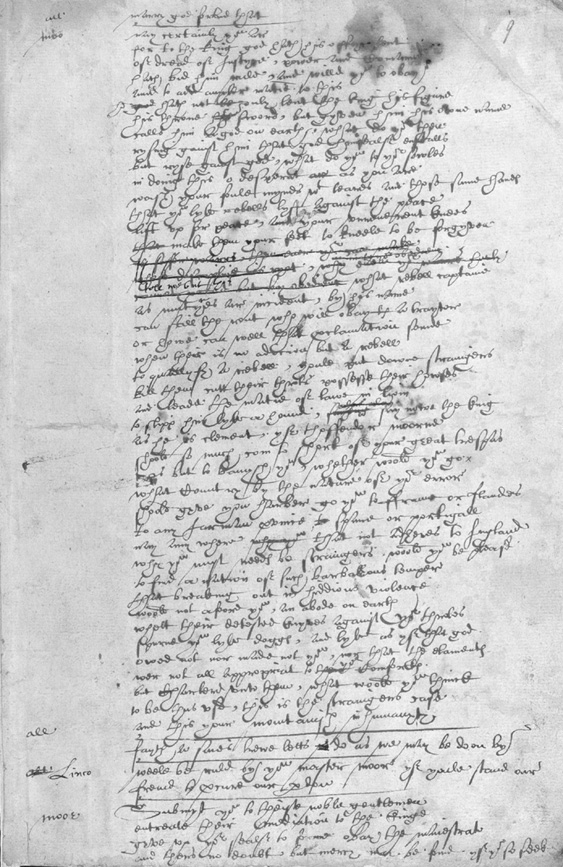
Figure 18.1 Page from only surviving manuscript in Shakespeare’s handwriting, sometime between 1603 to 1606
(Source: http://commons.wikimedia.org/wiki/Category:Public_domain)
And pray, and sing, and tell old tales, and laugh
At gilded butterflies, and hear poor rogues
Talk of court news; and we’ll talk with them too,
Who loses and who wins, who’s in, who’s out;
And take upon’s the mystery of things,
As if we were God’s spies: and we’ll wear out
In a walled prison, packs and sects of great ones
That ebb and flow by the moon.
(King Lear, act 5, scene 3)
Dominus illuminatio mea (“The Lord is my light”)
Motto of the University of Oxford, and opening words of Psalm 27