
Christianity and the Roman Empire
Developments within the Jewish world: the genesis of Christianity
In order to determine the role of Christianity in the Roman Empire it is first necessary to give a general outline of the course of Jewish history preceding the birth of Christ. As a result of internal tensions, the temple-state of Israel had at an early stage split into two parts, Israel and Judaea. It lost its independence when both kingdoms collapsed under the expansion of, first, the Late Assyrian Empire (722 BC) and, thereafter, the Babylonians (597 BC). Part of the Jewish population was even driven into exile in present-day Iraq.
It was precisely in their milieu that cultural traditionalism could flourish, yet now with a new religious element: the oppression of life in exile was seen as Yahweh’s punishment for the Jews’ deviation from strict monotheism and the loose life lived by many believers. Therefore, the need for repentance and for strict compliance with the religious laws as articulated in the first part of the Old Testament, the so-called ‘five books of Moses’ or Pentateuch, was stressed. Indeed, perhaps these texts were codified only now. Such men as Isaiah, Jeremiah and Ezekiel vehemently attacked degenerated Judaism and pointed the way to its regeneration, sometimes prophesying that a ‘Messiah’ or ‘anointed one’ would arise, a king who would renew the bond between the people of Israel and their God and make them mighty once again.
Having lost their own sovereign state, many Jews who had not been deported left for more challenging places in the region and thus spread all over the Near East. Often gaining a leading role in the big commercial towns of the region, they were envied by the local populations. Their prosperity and their obviously different religion made them easy scapegoats when a community, feeling the need to relieve internal tensions, took their anger out on ‘foreigners’.
Meanwhile, the Persians conquered Babylon and allowed the departed Jews to return to their homeland. The orthodox believers, having suffered for the good cause during their ‘Babylonian Exile’, naturally wanted to be the leaders of the newly restored kingdom. They soon found they were not the only ones with definite ideas; others made clear that they, too, were dedicated to Judaism, though perhaps not as devotedly and strictly as the former exiles. Moreover, other religions were now practised in the Jewish state as well, for in the fourth and third centuries BC the entire Near East came under the influence of Greek culture.1 In the course of the second century, the greater part of the Jewish elite was Hellenized. To counter this process, all sorts of orthodox groupings in Jewish society tried to gain greater power: the ‘Hassidics’, the ‘pious ones’, and later the Pharisees, and especially the zealot sect of the ‘Essenes’ cherished strongly ritualistic beliefs paired with an intense hatred of foreigners.
External threats in the second and first centuries BC, first from the Hellenist rulers who picked up the fragments of the imperial dream of Alexander the Great, and later from the Romans, reinforced the need felt by faithful Jews for a charismatic leader, a ‘Messiah’, who would bring salvation and make Israel independent again. All kinds of visions of an approaching ‘end of time’ and a glorious new beginning now connected with the need to be cleansed of sin, as has become clear from the discovery and analysis of the so-called Dead Sea Scrolls in 1947 and the following decades. This fascinating corpus of texts has proved the existence of a group of Jews living at Qumran, on the edge of the Dead Sea, in the century preceding the birth of Christ. According to their texts, they held ideas which were later to be presented as typically Christian as well.
From Jews – and Gentiles – to Christians: the role of Jesus of Nazareth and his followers
Some 2,000 years ago, in that Jewish world, a world of bickering prophets and rival sects, a man stood up and preached and, soon, was hailed as a prophet, though in all probability he was the illiterate son of a simple country artisan in a small farming village. His followers, a tiny band at first, but soon a growing group, were probably dissatisfied men, who felt their world was changing in unacceptable ways, as their very own leaders, the Jerusalem elite, gave in to the attractions of the new, Greek culture that had reached even their lands.2 They felt this Hellenized world impinged on their cultural and religious independence and, therefore, denounced it as decadent, depraved even. They eagerly looked for someone who would restore the original purity of their religion: a ‘Messiah’, a ‘man anointed by God’. They found him in Jesus of Nazareth.3
Jesus’s followers not only saw him as a ‘Messiah’, they also hailed him as the new ‘King of the Jews’. They were prepared to die for his – for God’s – cause: martyrdom for these Jews was a sign of election, a challenge to the foreign aggressors and a step on the way to realizing Yahweh’s kingdom. Those who grouped themselves around Jesus of Nazareth included not only a small number of faithful disciples, later known as ‘apostles’, but also an increasing crowd of people both from the Jewish faith and from other Near Eastern religions, called heathens, or ‘gentiles’ by the Jews. After Jesus’s death, they became known as Christians, the people who followed the man who was now referred to as ‘Chreistos’, the Greek word for the Hebrew ‘Anointed One’ – Greek being, of course, the language of culture in the larger part of the Near East, including Israel.
As Jesus could not write, we do not have his own words to tell us what he thought and taught. We only know what some of his disciples, probably writing long after his death, felt that they should tell about him – not recording his life’s history, but edifyingly presenting his teachings as they percieved them and wanted to present them to those who never had heard him in person. Thus, his disciples interpreted his message: as a call for charity, especially towards the poorest, as a plea for belief in the one true, invisible God, as a warning against the futile attractions of earthly life, and as a view of a better world to come.
Only the few testimonies written by his closest followers tell us what attracted people to the new Messiah. In the record of Jesus’s teachings written by Matthew, we read the following:
When he [i.e. Jesus] saw the crowds he went up a mountain. There he sat down, and when his disciples had gathered around him he began to address them. And this is the teaching he gave:
Blessed are the poor in spirit: the kingdom of Heaven is theirs.
Blessed are the sorrowful; they shall find consolation.
Blessed are the gentle; they shall have the earth for their possession.
Blessed are those who hunger and thirst to see right prevail; they shall be satisfied.
Blessed are those who show mercy; mercy shall be shown to them.
Blessed are those whose hearts are pure; they shall see God.
Blessed are the peacemakers; they shall be called God’s children.
Blessed are those who are persecuted in the cause of right; the kingdom of Heaven is theirs.
Another disciple, Luke, gave his own version of what happened on that occasion. He presents Jesus as saying:
to you who are listening I say: love your enemies; do good to those who hate you; bless those who curse you; pray for those who treat you spitefully. If anyone hits you on the cheek, offer the other also; if anyone takes your coat, let him have your shirt as well. Give to everyone who asks you; if anyone takes what is yours, do not demand it back.
Treat others as you would like them to treat you … you must love your enemies and do good, and lend without expecting any return; and you will have a rich reward: you will be sons of the Most High, because he himself is kind to the ungrateful and the wicked. Be compassionate as your Father is compassionate.
Do not judge, and you will not be judged; do not condemn, and you will not be condemned; pardon, and you will be pardoned; give, and gifts will be given you.4
But whatever the spiritual quality of these words, there is no corroborating evidence that they represent historical fact. Even the ‘Gospel of St Thomas’, the one text that is quite likely to represent Jesus’s original words more trustworthily than the three so-called synoptic gospels recognized by the Christian churches, is not a history at all. Indeed, not only do we not really know what Jesus said, our knowledge of him as a historical person is scant, too.5 The oldest text accepted as ‘gospel’ by the Christians, that of Mark, does not even have his birth story,6 nor indeed do we have his exact year of birth. We do know, however, that, during his lifetime, the Romans conquered most of the Near East and soon held sway over Israel as well. They saw Jesus as a bothersome rebel, one of the many prophets whose agitation made the Jews such an unruly people. A number of factions among the Jews themselves also viewed Jesus and his disciples as a threat: some were afraid he would overturn the power of Jerusalem’s priestly elite, others felt they did not need a new king at all, and feared that his actions, enraging the Romans, would only increase Roman pressure on their society. Therefore, the Nazarene was accused of being an enemy of the state. A trial ensued and once he was found guilty it was decided that he should be put to death. According to tradition, he was crucified in AD 33.
Everything else that is told about Jesus largely stems from the descriptions of his life that were recorded after his death. For example, what eventually became ‘the tradition’, the three synoptic gospels of Matthew, Mark and Luke recognized by the Christian churches, were all written at least 50 years later. As testimonies to their writers’ faith, they are fascinating and to Christians entirely convincing. As historically trustworthy sources on which, moreover, the Christian churches have long based their claims to power, they are to be read with the greatest caution.
Yet, to Jesus’s followers, these texts, together with the Jewish Old Testament, came to constitute the second, but more important part of the Bible. The majority of Jews, of course, who did not acknowledge Jesus as the Messiah, do not accept this ‘New Testament’ either. Meanwhile, in the decades and centuries that followed, a number of texts providing information and interpretations that, for one reason or another, displeased those of Christ’s followers who now became leaders of the Christian communities were destroyed. As a result, some of the oldest writings documenting Jesus’s teaching virtually disappeared, though some of them, like that of Thomas and, also, of Barnabas, have been discovered in the twentieth century, providing new and sometimes startlingly different perspectives on early Christianity.
In short, the life and thoughts of Jesus of Nazareth are trapped in stories that try to make sense of and give sense to the ideas of a man his followers wanted to hold up to the world as the ‘anointed one’, the Christ, who had purified religion, offering a sure path to god. The situation famously mirrors the one that had occurred some 500 years earlier, when the disciples of Siddharta Gautama, the Buddha, the ‘enlightened one’, had created the tales that now tell us what his followers wanted posterity to remember; rather than writing records of what he actually did say, these stories inevitably conceal the historical person. Some 600 years later, the very same thing happened when the followers of Muhammad started recording his sayings, and the stories of his life that seemed to support them. He, of course, was that other great religious reformer, purifier, who called himself, significantly, the ‘seal of the prophets’, thus firmly establishing himself in the Judaeo-Christian tradition.
Despite the grave scientific problems surrounding our historical knowledge of Jesus – problems that need and indeed do not upset those who truly believe – the Christian Near East, for the past 1,900 years, and Europe, for more than 1,500 years, have created their culture around this man and founded their society upon the ideas that his followers have codified. It is, therefore, necessary to know what we can, with some certainty, say about Christianity.
First of all, one has to accept that the words of Jesus, insofar as they can be reconstructed at all,7 will have referred to a Jewish world and to Judaism which, in itself, is a religion steeped in traditions it shared with the major religious systems of the Near East.8
We also know that the teachings of the Christian churches, as they evolved in the three centuries following Jesus’s death, little resemble the words he may have spoken. The changing exigencies of time and place resulted in a traditional body of knowledge, a christology and, indeed, a theology, that served the needs of a creed fast becoming an institutional religion, a power structure moreover.
Finally, we should acknowledge that Christianity, especially Roman Christianity and the reformed varieties thereof, for all their association with Europe – indeed, for all their cultural Europeanization that came about between the fourth and tenth centuries – has remained a very non-European religion.
Not only did some of the second-generation ‘Christians’ – the name was only used after Jesus’s death – try to liberate their belief from Judaism, many soon felt the need to engage in competition on the religious market of the region, a need born from the necessity to survive through strength of numbers or the proselytizing urge. They had to systematize their own religion, and, consequently, fill in the gaps it showed, with so few facts to go by; these had to be filled if they wanted to win over those still seeking a religion to satisfy their needs. In doing so, they could not help being influenced by the very religions that seemed both successful and attractive and subconsciously or in good conscience introduced elements from them.
Thus, Jesus came to be born from a virgin, an image spread widely in the major religions of the Near East.9 That he first saw the light in a grotto – the manger is a later version – and, being both man and god, went on to spend his life helping mankind combat the evil it carried, was probably borrowed from the highly popular cult of the Persian god Mithras. Mithraism, adopted by Roman soldiers in the eastern parts of the empire, had travelled westward with the army to conquer the entire Roman world: Mithraic temples have even been found along the imperial frontier on the Rhine and also in Britain.10 Indeed, Mithraism was, many scholars argue, one of Christianity’s greatest competitors. Meanwhile, the very notion of a man who dies only to be resurrected again, originated in the ancient cult of the Babylonian deity Marduk, whose liturgy, annually celebrated in the month of Nissan, enacted that scene.11
While Judaism was strictly patriarchic and, therefore, at least officially, did not allow the concept of a female god – though, again, in various periods of their history, the Jews did adore goddesses – the Christians knew very well that alienating half of their potential following was not in their best interest. While stressing Jesus’s unique position as man-god precluded introducing any female counterpart, they did introduce the cult of his mother, the Virgin Mary. Among other things, Mary took on all the attributes created by a far more ancient cult, that of the Egyptian goddess Isis, which had gained enormous popularity in the Roman Empire – particularly amongst women.12 Divine Isis, mother of the god Horus, is always shown with her child on her lap, giving him her breast to suck. Often, she was depicted standing upon the moon, surrounded by stars. Not only did these images become Christian icons, the ancient Egyptian litanies prayed or sung to the goddess were also translated to be used to invoke the Virgin.13
Thus, the mythobiography of Christ – and his mother – slowly evolved, largely to appeal to the mass of potential Christians and, indeed, to those who needed such stories and images to be able to believe in the first place. Yet, the leaders of the early Church fully realized that they had to create a rather more refined discourse to win over the Roman elite – another necessity for the Church’s survival and growth. In debates with Roman intellectuals throughout the second and third centuries, they developed a Christian cosmology that, by and large, based itself on the favourite philosophy of the Romans, neo-Platonism. The abstract notions about man and the cosmos of neo-Platonism were, in a sense, personalized to fit in with the Christian idea of a personal god, of his creative act and of his divine-human son.
At the same time though, Christianity was unavoidably engaged in a debate with another, potentially far more disruptive set of ideas, nowadays collectively referred to as ‘gnostic’. All over the Near East, people in search of salvation were influenced by preachers, writers who offered them ‘gnosis’, wisdom, as the path thereunto; the path, however, was beset with many difficulties because creation itself was both good and evil and, therefore, man had to choose wisely indeed in order to reach his goal, to overcome the evil within him. In presenting Christ as the one road to salvation, the Christians were, in a very real way, involved in this search and, thus inevitably, in debates with all those who offered rival interpretations and opportunities – including, quite probably, Buddhist monks who travelled westward to preach their own way.
In short, Christianity, originating in the Near East, that commercial and cultural crossroads between the Mediterranean and Asia, inevitably developed in a complex interaction with all the other religions of the Near East and, also, those further east. It could not have been otherwise as is, perhaps, tellingly shown by the parallel development of a later creed, that of the prophet Mani. Born in third-century Syria, of Jewish-Christian parents, in a short time he gained followers from Persia across to Spain. Manichaeism, too, shows the complexity of religious interaction in, precisely, the Near East. Though Mani was heavily indebted to Christianity, he freely took ideas from Persian Zoroastrianism – that, itself, at earlier times had influenced Mithraism and, thus, Christianity – but also adopted Buddhist notions.14 No wonder then, that many who looked for faith found his teachings attractive, as did the young Augustine, in north African Hippo. When, in later life, he converted to Christianity, to become one of its leading lights up to the present day, he did so precisely in an intricate dialogue with the Manichaeism he rejected, meanwhile incorporating some of it into his own version of his new-found faith.15
Religions in the Roman Empire
The writer Minucius Felix, who lived in the second half of the second century AD, told how the Roman Empire, which incorporated more and more different cultures because of its expansionist politics, also embraced a multitude of religions. In his dialogue Octaviushe analysed the way the Romans themselves accepted everything which appeared salutary to them.16 However, he also criticized a number of what were, according to him, the more banal and untrustworthy cults: for instance, the mystery cults proliferating in the oriental parts of the Roman Empire.17 Showing the acuity of a twentieth-century religious anthropologist, he particularly targeted the extremely popular cult of Isis, which had come to the imperial capital from Egypt:
Hence it is that … we see each people having its own individual rites and worshipping the local Gods – the Eleusinains Ceres, the Phrygians the Great Mother, the Epidaurians Aesculapius, the Chaldaeans Baal, the Syrians Astarte, the Taurians Diana, the Gauls Mercury – the Romans one and all…. In captured fortresses, even in the first flush of victory, they reverence the conquered deities. Everywhere they entertain the gods and adopt them as their own; they raise altars even to the unknown deities, and to the spirits of the dead. Thus it is that they adopt the sacred rites of all nations, and withal have earned dominion….
Consider the sacred rites of the mysteries. You find tragic deaths, dooms, funerals, mourning and lamentations of woebegone gods. Isis, with her Dog-head and shaven priests, mourning, bewailing, and searching for her lost son; her miserable votaries beating their breasts and mimicking the sorrows of the unhappy mother. Then, when the stripling is found, Isis rejoices, her priests jump for joy, the Dog-head glories in his discovery…. Is it not absurd either to mourn your object of worship, or to worship your object of mourning? Yet these old Egyptian rites have now found their way to Rome, so that you may play the fool to the swallow and sistrum of Isis, the scattered limbs and the empty tomb of your Serapis and Osiris.18
The Roman authorities could accept these creeds as long as they had posed no grave political threat. Thus, the cult of the Indian-Persian god Mithras, whose birth in a cave, last supper before death and ascension to heaven were depicted on the walls of countless underground temples all over the empire, was hugely popular among the soldiers of Rome from the first century AD onwards – they had encountered it from the Near East and were instrumental in its subsequent spreading – and, if only for that reason, it was even favoured by the emperors themselves, whose power almost totally depended on the army. However, some cults were deemed positively threatening such as, for instance, the one founded by the Jewish-Christian prophet Mani, whose teaching, stressing the battle between good and evil, became very popular in the third century AD, spreading from the Near East all the way to Spain. Many of these new religions showed a drift towards monotheism. Like Judaism, which had been gaining influence outside Israel, these cults, too, tended towards the belief in one God. It was this particular tendency that the emperors vigorously opposed, as stated in Diocletian’s edict of AD 296:
Excessive idleness … sometimes drives people to join with others in devising certain superstitious doctrines of the most worthless and depraved kind. In so doing, they overstep the bounds imposed on humans…. Wherefore it is our vigorous determination to punish the stubborn depraved minds of these most worthless people.
We take note that … those Manichaeans have set up new and unheard-of sects in opposition to the older creeds, with the intent of driving out to the benefit of their depraved doctrine what was formerly granted to us by divine favour. We have heard that these men have but recently sprung up and advanced, like strange and unexpected portents, from the Persian people, our enemy, to this part of the world, where they are perpetuating many outrages, disturbing the tranquility of the peoples and also introducing the gravest harm to the communities.
And it is to be feared that … they may try, with the accursed customs and perverse laws of the Persians to infect men of a more innocent nature, namely the temperate and tranquil Roman people as well as our entire empire with what one might call their malevolent poisons….
Therefore, we instruct that their followers, and particularly the fanatics, shall suffer a capital penalty, and we ordain that their property be confiscated for our fisc.
A sect of ‘hopeless outlaws’
Amidst all these competing sects, the Christians, too, developed into a prominent religious movement all over the Near East, on the Asian periphery of the Roman Empire. Perhaps precisely because they creatively incorporated a great number of the characteristics of their competitors, they succeeded in becoming one of the region’s major religions within the time span of only one century, between c.AD 40 and 140, i.e. ‘after Christ’s birth’, or Anno Domini, the Christian chronology, which, however, was introduced in western Europe only in the eighth century.
Christianity soon spread all over the Roman Empire.19 Of major importance was the preaching of the apostle Paul who, in the fifth and sixth decades of the first century AD, told his audiences, first in Asia Minor and then in imperial Rome itself that Christianity was not a religion for former Jews only, but indeed was open to every person. He and a number of his fellow apostles used the safe and easy communications provided by the empire to travel over vast distances, divulging the word of their teacher and bring the ‘good news’ to all who wanted to listen. When, in AD 70, Jerusalem was taken by the Romans again, the temple destroyed and the Jewish state effectively dismantled, Christianity – and, for that matter, Judaism itself – were freed of the constraints of ancient Israel; certainly for Christianity this meant it could present itself as a religion that, though it might have originated in Judaism, offered salvation to the gentiles as well.
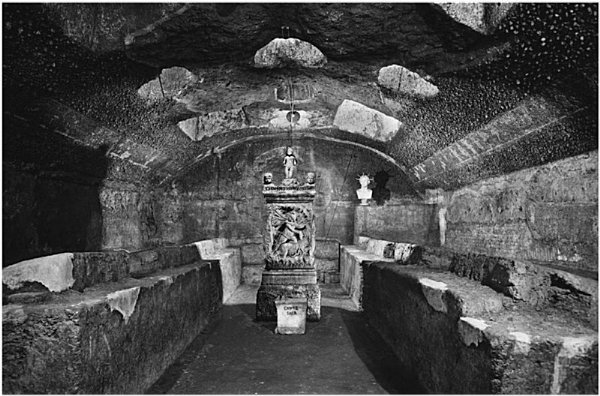
Plate 3.1 A shrine dedicated to the service of Mithras, one of the great competitors of Jesus, the Christ. In the centre is the altar table, showing the winged god riding his bull; around the walls are seats for the believers who gathered here to share their sacramental meal. The shrine is located under the Christian church of San Clemente, Rome.
Photo: Alinari
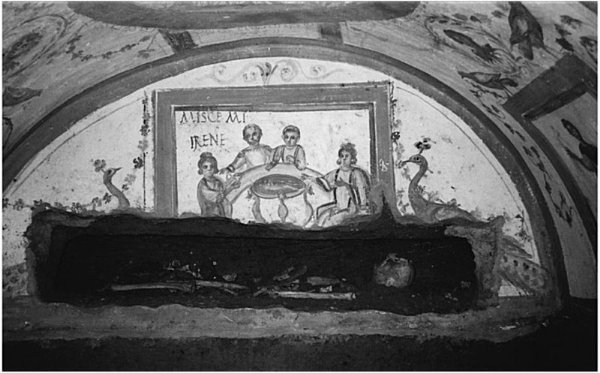
Plate 3.2 A fresco depicting a ‘meal of fraternal love’ or ‘Agape’, the cultic meal of the early Christians, found in one of the Roman catacombs.
Photo: Marc de Kleine, Nijmegen
At first, many Romans looked upon Christianity with contempt, as a sect that succeeded in winning over mainly slaves and women, and was mostly practised underground; an obscure religion to which people surrendered in perhaps good but always foolish faith. And yet, such was the power of the Christian message that from the second century AD the entire Roman Empire, i.e. all the world around the Mediterranean, gradually took on a Christian character.20
At least three elements of Christianity were attractive to a wider strata of society: revelation, which allowed even the uneducated to grasp vital truths;21 conversion, which gave the Christians the kind of moral excellence formerly attainable only by those who could afford the costly Graeco-Roman education that was supposed to be the model road towards perfection; and lastly, of course, the highly appealing idea of salvation, of a life after death, given to each and every believer, however sinful, because of the redeeming offer made by Christ of his own life, symbolized in the wine and bread of the Eucharist – another food ritual. It gave the Christians a sense of a personal relationship with a personal God, and a perspective from which to judge and, in many cases, endure the vicissitudes of life on earth, so painful to many. No wonder many were won over by this fundamental vision of man’s equality before an impartial God who would justly judge each according to his merits, as well as by the feeling of belonging, the sense of community created by this non-local, indeed ‘universal’ sect.
Minucius Felix listed the objections raised against the Christians: their origins in the lowest social strata, their secrecy, their refusal to worship Roman deities and, politically even more unacceptable, the deified emperors, as well as their contempt for this life and their belief in a resurrection of soul and body alike. The propaganda against the Christians was determined, at least in part, by a lack of familiarity with their symbols and rites, which had largely developed underground. However, much of it was the result of pure malice:
Is it not deplorable that a faction … of abandoned, hopeless outlaws makes attacks against the gods? They gather together ignorant persons from the lowest dregs, and credulous women, easily deceived as their sex is, and organize a rabble of unholy conspirators, leagued together in nocturnal associations and by ritual fasts and barbarous foods, not for the purpose of some sacred rite but for the sake of sacrilege – a secret tribe that shuns the light, silent in public but talkative in secret places. They despise the temples … they spit upon the gods, they ridicule our sacred rites … they pity our priests; half-naked themselves, they despise offices and official robes. What amazing folly! What incredible arrogance! They despise present tortures yet dread uncertain future ones; while they fear to die after death, they have no fear of it in the meantime; deceptive hope soothes away their terror with the solace of a life to come…. This plot must be completely rooted out and execrated. They recognize one another by secret signs and tokens; they love one another almost before they are acquainted. Everywhere a kind of religion of lust is also associated with them, and they call themselves promiscuously brothers and sisters, so that ordinary fornication, through the medium of a sacred name, becomes incest….
[They] say that a man put to death for a crime and the lethal wooden cross are objects of their veneration….
What is told of the initiation of neophytes is as detestable as it is notorious. An infant covered with spelt to deceive the unsuspecting is set before the one to be initiated in the rites. The neophyte is induced to strike what seems to be harmless blows on the surface of the spelt, and this infant is killed … its blood – oh, shocking – they greedily lap up….
Furthermore, they threaten the whole world and the universe itself and its stars with fire, and work for its destruction …; they say that they are reborn after death from the cinders and ashes.22
At first, the Roman authorities were not overly worried, regarding the Christians as yet another crazy sect. Soon, however, they were irked by some of the tenets of the Christians’ faith, especially its abhorrence of emperor worship, and began to persecute them. Until AD 250, only individual Christians were prosecuted as enemies of the state. Later, their religion as such was made illegal, and bloody, large-scale prosecutions started, which also affected related sects like the Manichaeans.

CARTHAGE, AD 180: ARGUMENTS AGAINST AND FOR THE RELIGION OF THE CHRISTIANS
The governor of Roman North Africa, proconsul Vigellius Saturninus, whose seat was in the ancient Phoenician town of Carthage, interrogates six Christians brought before him – three men and three women. The act of interrogation reads as follows:
The proconsul Saturninus said: ‘You can secure the indulgence of our lord the emperor if you return to your senses.’
Speratus said: ‘We have never done any wrong; we have lent ourselves to no injustice; we have never spoken ill of anyone.…’
The proconsul Saturninus said: ‘We, also, are religious, and our religion is simple; and we swear by the genius of our lord the emperor and pray for his welfare, as you ought to do.…’
Speratus said: ‘The empire of this world I do not recognize; but rather I serve that God whom no man has seen nor can see with human eyes. I have not committed theft; if I buy anything, I pay the tax.…’
The proconsul Saturninus said to the others: ‘Cease to be of this persuasion…. Do not participate in this madness.’
Cittinus said: ‘We have none other to fear except only our Lord God who is in heaven.’
Donata said: ‘Honour to Caesar as to Caesar, but fear to God.’
Vestia said: ‘I am a Christian.’
Secunda said: ‘What I am, that I wish to be.’
The proconsul Saturninus said to Speratus: ‘Do you persist in being a Christian?’
Speratus said: ‘I am a Christian.’ And they all concurred with him.
The proconsul Saturninus said: ‘Do you desire some time to reconsider?’
Speratus said: ‘In a matter so just, there is no reconsidering.’
The proconsul Saturninus said: ‘What are the things in your box?’
Speratus said: ‘The Books, and the letters of Paul, a just man.’
The proconsul Saturninus said: ‘Take a postponement of thirty days and reconsider.’
Speratus said again: ‘I am a Christian.’ And they all concurred with him.
The proconsul Saturninus read out the decree from the tablet: ‘… it is my decision that they be punished with the sword.’
Speratus said: ‘We give thanks to God.’
Nartzalus said: ‘Today we are martyrs in heaven: thanks be to God.’23
In AD 197, the Roman scholar Tertullian wrote his Apologeticum, an extensive apologia for the Christians. He analysed their actions, practices and way of life, dismissed all false accusations, and stated, finally, that the principal objection to them was not their religion but their refusal to recognize the emperor’s authority as divine. In passing, he actually reversed the accusation, saying the Romans themselves feared their rulers more than their gods:
‘You do not,’ say you, ‘worship the gods; you do not offer sacrifice for the emperors.’ It follows by parity of reasoning that we do not sacrifice for others because we do not for ourselves: it follows from our not worshipping the gods. So we are accused of sacrilege and treason at once. That is the chief of the case against us, the whole of it, in fact….
So now we have come to the second charge, the charge of treason against a majesty more august. For it is with greater fear and shrewder timidity that you watch Caesar than the Olympian Jove himself…. So that in this too you show more fear for the rule of a man. In fact, among you perjury by all the gods together comes quicker than by thegenius of a simple Caesar…. So that is why the Christians are public enemies: because they will not give the emperors vain, false, and rash honours….
We invoke the eternal God, the true God, the living God, for the safety of the emperors…. Nothing is more foreign to us than the state. One state we recognize for all: the universe.24
Thus, Christianity had already defined itself as a universal religion, recognizing no political boundaries: it meant its empire to be of the whole world.
Towards an empire Roman as well as Christian
In the course of the fourth century AD, all official connections between the Roman state and the old religions slowly came to an end. In AD 313, Emperor Constantine (c.AD 280–337) and his associate in the eastern part of the empire promulgated what later became known as the ‘Decree of Milan’. This was actually a series of orders addressed to the most important civil servants, commanding them to end the prosecution of the Christians and to grant them freedom to practise their religion on a par with the worshippers of the other creeds that flourished in the Roman Empire.
Reading the ‘Decree of Milan’, the preference that most of Constantine’s successors would finally give to the new religion can already be noticed, despite the text’s attempt to treat all religions impartially:
When I, Constantine Augustus, as well as I, Licinius Augustus … were considering everything that pertained to the public welfare and security, we thought that, among other things which we saw would be for the good of many, those regulations pertaining to the reverence of the Divinity ought certainly to be made first, so that we might grant to the Christians and to all others full authority to observe that religion which each preferred; whence any Divinity whatsoever in the seat of the heavens may be propitious and kindly disposed to us and all who are placed under our rule … so that the supreme Deity, to whose worship we freely yield our hearts, may show in all things His usual favour and benevolence.
Therefore, your Worship should know that it has pleased us to remove all conditions whatsoever, which were in the rescripts formerly given to you officially, concerning the Christians, and now any one of these who wishes to observe the Christian religion may do so freely and openly, without any disturbance or molestation…. your Worship will know that we have also conceded to other religions the right of open and free observance of their worship for the sake of the peace of our times, that each one may have the free opportunity to worship as he pleases; this regulation is made that we may not seem to detract aught from any dignity or any religion.25
As a result of the decree, all property previously confiscated from the Christians was returned to them, with the state indemnifying those who had acquired such property. Thus, not only was the religion of the Christians given equality with other religions, it gained an economic base which the new Church used to extend its institutional power. The role of the old religions was gradually eroded and, at the same time, the flourishing Christian community and its leadership were given the chance to strengthen their own position. On the one hand, measures were taken that definitely limited the appeal of the traditional creeds:
No person at all, of any class or order whatsoever of men or officials … whether he is powerful by the accident of birth or is humble in descent, legal status and fortune, shall sacrifice an innocent victim to senseless statues in any place at all or in any city. He shall not, through more secret wickedness, venerate his household god with fire, hisgenius with wine, his Penates with fragrant essences … But if anyone should dare … he shall be reported in accordance with the example of a person guilty of high treason.26
On the other hand, many privileges were accorded to the new religion. In AD 313, Constantine decreed that:
Since it appears from many things that the setting at naught of divine worship, through which the highest reverence for the most holy power of heaven is preserved, has brought great dangers to the state, and that the lawful restoration and maintenance of this have bestowed good fortune on the Roman name and extraordinary prosperity on all the affairs of mankind – for it is divine Providence which bestows these blessings – it is our decision that those men who, with due holiness and devotion … offer their services in the performance of divine worship, should receive rewards for their labours … Wherefore it is my will that those persons in the Catholic Church … who devote their service to this holy worship – those who are customarily named clerics – shall once and for all be kept completely exempt from all compulsory public services … nor be disturbed in any way from devoting themselves completely to serving their own law. For when they render supreme service to the deity, it seems that they confer the greatest possible benefits upon the state.27
Eventually – or so the story goes – Constantine himself became a Christian: on his deathbed, in AD 337, he was baptized.28 Historians disagree as to whether this was the result of political opportunism or of religious conviction, although it seems likely that political necessity and a sense of the sociocultural irreversibility of the Christianization process heightened the emperor’s own sensibility.29
Meanwhile, in the process of its rise to cultural and political pre-eminence, the Christian Church inevitably lost some of its pristine qualities. Initially, the idea of ‘gnosis’, referred to above, of an inner enlightenment attainable by everyone who strove after it in a life that was, of necessity, torn between matter and spirit, between evil and good, had greatly influenced early Christianity. As it stressed individual responsibility rather than living life according to the rules of a stifling authority, the authoritarian structures now developing within the Church did not look kindly upon it. Indeed, gnostic ideas were declared heterodox, or even heretic. Many historians have also argued that, in this period, the largely egalitarian relationship between men and women that had characterized the early Church also disappeared.30
Inevitably, Christianity was soon rocked by fierce factional strife. Specifically, the doctrine of the divinity of the human Christ and the concept of Holy Trinity, of God the Father, his Son and the Holy Spirit, were hotly debated, if only because many felt unconvinced by the theological and philosophical basis of these notions. Obviously, either for personal or political reasons, the emperors could and would not tolerate such heated discussions, which led to open fights and even outright schisms. Therefore, they frequently attended the councils during which the Christians tried, usually in vain, to reconcile their differences. They also supported those Church leaders who persecuted dissenting Christians, trying to root out heterodox ideas. Hence, Constantine himself was present at the famous Council of Nicea in AD 325. Eusebius, the emperor’s contemporary and biographer, describes the drama in his Vita Constantini, III, vi–x, passim:
Constantine summoned a general synod, inviting the bishops in all parts with honorary letters to be present … at that time there were to be seen congregated in one place persons widely differing from one another not only in spirit but also in physical appearance, and in the regions, places, and provinces from which they came … from all the churches which had filled all Europe, Africa and Asia…. Present among the body were more than 250 bishops … for the council which was to put an end to the controversies.
The Council ended with the promulgation of the famous Nicene Creed, a text meant to reconcile the participants and, thus, to restore unity. Increasingly, the Church, aided by the state, tried to formalize and control public discourse in religious matters, in order to establish an orthodox doctrine. Indeed, Church councils’ decisions were always presented as consensual.31 It all helped to develop a society with an overtly pyramidal, authoritarian pattern of relationships.
However, precisely because the ecclesiastical leadership increasingly ruled out discussion, arguments continued unabated. Later, in AD 380 and 381, Emperor Theodosius determined that:
It is our will that all peoples ruled by our Clemency shall practise that religion which the divine Peter the Apostle transmitted to the Romans; that is, according to the apostolic discipline and the evangelical doctrine, we shall believe in the single deity of the Father, the Son, and the Holy Spirit, under the concept of equal majesty and of the Holy Trinity. We order that those persons who follow this rule shall embrace the name of Catholic Christians. The rest, however, whom we judge demented and insane, shall have the infamy of heretical dogmas, their meeting places shall not receive the name of churches, and they shall be smitten first by divine vengeance and secondly by retribution of our hostility….
The contamination of the Photian pestilence, the poison of the Arian sacrilege, the crime of the Dunomian perfidy, and the sectarian monstrosities … shall be abolished even from the hearing of men.32
Meanwhile, as a result of Constantine’s politically inspired decisions, Christianity became the religion of the Roman state. Inevitably, ever more people now felt called on to embrace the new faith. Even members of the elite now converted, out of conviction or from a wish to hold on to their positions.33 Consequently, Christianity became thoroughly saturated with those elements from the old ‘heathen’ culture that did not openly conflict with it, such as classical rhetoric, aspects of philosophy, mainly of a neo-Platonist bent, and many themes and forms from architecture and the visual arts: the Christian church was modelled on the Roman basilica, and Christ himself was often depicted as ‘the good shepherd’, like the hugely popular Greek god Dionysios, to give but two examples. In the end, even the Christian calendar and the veneration of saints and relics showed many aspects of the older, pagan cults.
Thus, all around the Mediterranean – including, therefore, a large part of Europe – a situation developed in which only one religion governed the society and came to pervade the wider culture of this world empire; it was, indeed, a new phenomenon in world history. Moreover, this religion was not polytheistic but monotheistic, requiring everyone to submit completely to an unseen yet personal God. Faith, not reason, was its central principle. Anything humans had invented but that Church leaders considered to conflict with professed religion was now condemned as heresy, unless it could somehow be fitted into the new theological system.
Indeed, the new religious elite wanted to extirpate completely the power that all sorts of cults and religions, usually older than Christianity, still held over the population. In this aim, they knew the emperors, who had increasingly chosen to attach themselves to Christianity, would be on their side. For the rulers of the Romans strove to maximize the unity of thought and action among their subjects; therefore, they gladly supported policies of cultural homogenization. In a decree of AD 357, the Emperor Constantius Augustus told his people:
No one shall consult a soothsayer or astrologer or diviner. The evil teaching of augurs and practitioners of magic shall become silent. The Chaldeans and magicians and all the rest … shall not attempt anything of this sort. The curiosity of all men for divination shall forever cease.34
Of course, this did not mean such practices really disappeared. On the contrary, many Christian priests consciously or unconsciously took over the functions of the old magicians and sorcerers, precisely because the population needed a priesthood who could communicate with and if necessary placate the incomprehensible forces of nature.
Gradually, everyday life became structured according to the Church’s rules. All sorts of advantages were accorded to the new religion and its followers. Also, many elements of the older cultures were integrated into Christian practice in the interest of cultural and, thus, social homogenization. This can be seen from imperial decrees of AD 386 and 392:
On the day of the Sun, which our ancestors rightly called the Lord’s Day [Constantine had ordered this in AD 321], the prosecution of all litigation, court business and suits, shall be entirely suspended. No person shall demand the payment of a public or private debt, nor shall there be any cognizance of controversies before arbitrators…. Contests in the circuses shall be prohibited on the festal days of the Sun … in order that no concourse of people to the spectacles may divert men from the reverend mysteries of the Christian law.35
The emperors, most of whom by now had been educated within a Christian culture themselves, were increasingly severe with the adherents of the older cults, not primarily because they opposed them from a religious point of view but because such cults posed a threat to public stability, offering opposition groups an alternative ideology. In AD 395, and again in later years, they ordered that:
If any images still stand in the temples and shrines, and if they received or do now receive the worship of pagans anywhere, they shall be torn from their foundations…. The buildings themselves of the temples which are located in cities or towns or outside the towns shall be confiscated to public use. Altars shall be destroyed in all places.36
In AD 425, an imperial edict was promulgated that clearly showed how much had changed in less than a century after Constantine’s decision: it was patently obvious that Christianity had become victorious. All ideas diverging from accepted doctrine were now forcefully suppressed. Moreover, the emperor had given the pope – the bishop of Rome who, as the successor of the apostle Peter, claimed supremacy in the Church’s hierarchy – his unambiguous support as the only spiritual leader of all Christendom:
We command that the Manichaeans, heretics, schismatics, astrologers, and every sect inimical to the Catholics shall be banished from the very sight of the City of Rome, in order that it may not be contaminated by the contagious presence of the criminals. An admonition, moreover, must he especially issued concerning those persons who by perverse persuasion withdraw from the communion of the venerable Pope, and by whose schism the rest of the common people also are corrupted.37
However, this edict also shows that, whatever power the Church had acquired, it still had not managed to force everyone in the Roman Empire into the straitjacket of Christianity.
Rome and its neighbours in the fourth and fifth centuries AD: ‘decline and fall’? The division and loss of the political empire – the survival of the cultural empire
Certainly from the first century AD onwards, the Roman Empire, parallel with its territorial growth had become increasingly economically dependent on natural resources and manpower that had to be imported from outside its borders. In particular, slaves, who were needed to keep the system going, could be obtained only by wars of conquest – indeed, such wars had always been and still were the ‘motor’ of Roman imperialism; when, by the end of the second century AD, the empire had reached its greatest size because further expansion proved militarily and financially unfeasible, slaves had to be purchased from barbarian middlemen beyond the frontiers. An indication of the ‘problem’ is that by the end of the first century AD, in Italy alone 2 million of its 6 million inhabitants were slaves; this meant that a fresh supply of 150,000 new slaves was needed annually.
Strangely, perhaps, as a result of this situation, the Roman economy became a powerful stimulus to the economies of neighbouring regions. In northern and central Europe, for example, the provisions needed by the empire’s enormous armies led to increased cattle-rearing among the German tribes beyond the Rhine, who provided leather for tents, boots, saddles and other horse gear. Archaeological finds also testify to a growing demand for luxury goods in the areas that provided the empire with raw materials and slaves. Such finds also evidence technological improvements in the various border regions, which were perhaps influenced by intensified contacts with the Roman world, as shown by the beautiful filigree, gem-encrusted jewellery discovered in a chieftain’s grave at Sutton Hoo, in England.
As indicated above, for as long as we know, central Eurasia was the home of a great many nomadic-pastoralist communities. Especially when climate conditions worsened, they started moving, in tribes but also in more loosely constructed bands, gathered around an inspiring and successful leader who promised them booty. From the middle of the first millennium BC, another period of almost continuous movement set in, that lasted until the end of the first millennium AD. It can be called appropriately ‘The Age of Migration’. To Rome, these migrating groups, fighting, regrouping, sometimes settling for a protracted period, then moving again, were uncivilized, barbarians even. Obviously, this is one perspective only. Actually, they were societies of whose culture we know little because, mostly, they did not write. Often, in the process of moving and settling and moving again, they did come to form what one might call ethnic identities, acquiring a common language, constructing a common history, praying to common gods. However, when new groups came out of central Eurasia, these identities might be destroyed or, rather, reformed. It was, in a sense, a Domino-process that constantly repeated itself, changing both the worlds of Europe beyond the imperial frontier and Roman culture and society itself.
By the second century AD, Romans became particularly aware that peoples in northern and central Europe had begun moving again, partly due to population increases, and partly due to climate changes – which affected their incipient agrarian economies – and social instability on the eastern periphery of Europe: the region of present-day Poland and western Russia. This led to the Longobards crossing the Danube in the latter part of the century, and the Franks, Frisians and Saxons emerging at the Rhine border, and sometimes crossing it during the first half of the third century. Often, these were war bands of uncertain ethnogenesis; they confederated because they saw possibilities in the weakening of Roman authority in the frontier regions.
Further east, a heterogeneous congeries of Germanic tribes as well as even more loosely organized, roving groups made up of a wide range of ethnic elements, probably originating from the Vistula basin, now entered written history as ‘the Goths’, the name given them by the terrified people of south-east Europe,38 who were first confronted with their attacks in the late second and early third centuries.39 They settled near the Roman border on the Danube and soon even converted to Christianity. There, Bishop Wulfila or Ulfilas (c.AD 310–82/3) decided to give his people the Bible in Gothic. Its earliest known manuscript copy, probably produced in the sixth century, was written in beautiful silver letters on purple vellum; this Codex Argenteus is now kept in the University Library at Uppsala. Wulfila had to invent an alphabet to achieve his aim, for his people’s culture was as yet without writing.40
Actually, there never was an original, distinct Goth culture. During two centuries of raids, invasions, settlements, removals and resettlements, the mixture of nomadic elements, Germanic influences and the Graeco-Roman culture of the Balkans and the Black Sea coast came to constitute something that could be called a Goth civilization which was then introduced into western Europe.
When the Huns advanced over the Eurasian steppe by the end of the fourth century, the Goths were forced to penetrate further into the relative safety of the Roman Empire. They eventually conquered the wealthiest regions of its western part. Some of their bands set up a kingdom in northern Italy, based at Ravenna, where the monumental remains of a marvellous mixture of Roman and Germanic cultural elements can still be seen. Others founded a kingdom in southern France, based at Toulouse; they adapted easily to the local Gallo-Roman culture.
In Iberia, present-day Spain, too, the existing Roman elements mixed with the German heritage of the Goths, resulted, among other things, in a thriving intellectual life that lasted until the coming of new conquerors in the seventh century. It produced such great spirits as Isidore, archbishop of Seville (c.560–636), a major scholar in various fields. He wrote a ‘History of the Goths’ that, significantly, starts with a Laus Spaniae (a ‘praise of Spain’), indicating that the Goth conquerors wished to merge with the existing, Romanized population; it was a first expression of Spanish ‘national’ feeling. He also compiled a history of the world, a treatise on astronomy and cosmography and, most important perhaps, a fascinating work called Etymologiae, one of Europe’s first encyclopedias and a foundation of philosophy and scholarship for centuries to come.
The coming of the Huns also led to the migration of peoples in western Europe. One year, at the beginning of the fifth century, the Burgundians crossed the frozen Rhine, settling around Worms, Speyer and Strasbourg. Later, their army was destroyed by the hordes from Asia. This disaster, told and retold countless times in heroic songs by Burgundian bards who embellished and added to it, finally resulted in the famous Nibelungenlied, providing Europe with a fecund legend that was set to music by Richard Wagner in the nineteenth century – although he incorporated a lot of material from Norse and Icelandic sagas as well – and, in the early twentieth century, filmed in silent but evocative images by the Austrian film maker Fritz Lang.
Meanwhile, the keepers of the empire, the Christian emperors of the fourth and fifth centuries, had to accept that not even the new religion would provide the divine protection they had so dearly hoped for. The pressure on the borders from outside increased. Soon, the tribes and peoples who were driven from central and eastern Europe and central Asia by the mostly climatic changes that affected their agriculture and cattle-raising became a threat more than ever before.41
We know now that internal developments also caused ‘the Fall of Rome’.42 The empire’s structural flaws were becoming glaringly manifest. Its very size was, perhaps, one of the main reasons for its demise; also, the bureaucracy and economy were unable to adequately mobilize the forces needed to police the state and to defend its frontiers; moreover, communications between the capital and the provinces took too long; finally, on the peripheries there was increasing distrust of the parasitic, wasteful centre, Rome, with its continuous demands for money and goods. As central power and, thus, authority waned, regional differences turned out to be centripetal after all. Consequently, the regions that once had been incorporated in the empire now gradually went their own way; in the process, the cultural varieties that had continued to exist underneath the Roman veneer became visible again. In the east, Greek had remained the common language, while in the west Latin had gradually gained the upper hand.
Other factors were at work, too. Thus, in the decades after AD 160 and, again, in the years following AD 541, a wave of epidemics swept over the empire. It was both the result of economic problems that debilitated general health and, thus, the power to resist, while, of course, in its turn it caused further, long-term agricultural recession; the ensuing poverty affected the population and led to continuing demographic and economic decline, though the effects were different in various parts of the empire. By and large, the new situation was most noticeable in the centres of Roman power and culture, the cities.43 As the rule of the emperors gradually became weaker, many members of the urban elites who implemented state power on the regional and local level acquired greater political independence; however, they also began to look upon the Church as the one institution that could guarantee the old values, a process that can be witnessed, for example, among the urban elites of Roman Gaul.44 In many towns, the Christian bishops, by now expert in governing large communities, even took over as secular rulers.
By the end of the third century AD, under attack from all sides, and with its inner structure weakening, the empire could no longer be ruled with economic, military and organizational unity, precisely when it needed this unity most. Unity was indeed lost when central government was no longer able to effectively defend the borders. Therefore, considerations of a logistic-military nature led to the decision to formally divide the empire into an eastern and a western half, to be ruled in concord by two emperors. Though, in retrospect, this decision may seem foolish and though it did prove fateful, at the time it was the logical thing to do.
From the fourth century onwards, a Greek or Byzantine Empire developed in what formerly had been Greece and Asia Minor. It considered itself the true heir to ancient Rome, creating a vision of its capital, Byzantium, as the ‘new Rome’ even though it was renamed Constantinople in AD330.45 The western Roman Empire, the imperium occidentalis, the empire of the Occident, became known as the Latin Empire because of the dominant cultural language. Though Rome remained its capital, for long periods such northern cities as Milan and Ravenna fulfilled that function, too.
During the last centuries of its existence, the Roman Empire, by now permanently divided, was increasingly forced to adopt a policy of accommodation; gradually, not only were foreign peoples allowed to enter the empire, they were also assimilated into Roman culture. Often, the foreign war bands were positively hailed, providing the soldiers that the great senatorial, land-owning families of the empire needed to fulfil the role they increasingly took upon themselves, i.e. defending and policing the region they dominated, now that imperial authority was weakening. This, of course, contributed to the Romanization of the immigrants.
Consequently, by the late fourth and early fifth centuries, certainly in the northern and western parts of the empire, imperial power was mostly controlled by non-Roman generals and finally passed outright into the hands of newcomers. One such, Theodosius, though a descendant of the Visigoths, a people who only shortly before had been described as a ‘barbaric’ tribe, could yet become ruler of the western empire in AD 381. Showing that a loss of memory can be politically expedient, the orator Themistius praised this upstart as the saviour of the old culture, saying: ‘The Barbarians have still not defeated the Romans for after all, form triumphed over formlessness, order over chaos, courage over fear, obedience over disobedience’.46 However, the ideas of this intellectual, who swam with the tide and yet managed to nicely articulate the essence of Roman culture in the face of this powerful new leader, were not shared by all ‘real’ Romans. In AD 399, the somewhat more conservative orator Synesius addressed Emperor Arcadius as follows: ‘That these fair-haired people, who arrange their hair in Euboian styles, are our slaves in private but our rulers in public is outrageous, a shocking spectacle’.47 These words betray an attitude that people in Europe would frequently display when they wanted to brand others, migrants, as a ‘danger’ to their own position and culture.
Meanwhile, a certain defeatism came to characterize the empire’s inhabitants. The Christian scholar St Jerome (331/47–419/20) wrote:
I come now to the frail fortunes of human life, and my soul shudders to recount the downfall of our age. For twenty years now and more the blood of Romans has every day been shed between Constantinople and the Julian Alps. Scythia, Thrace, Macedonia, Thessaly, Dardania, Dacia, Epirus, Dalmatia, and all the provinces of Pannonia, have been sacked, pillaged and plundered by Goths and Sarmatians, Quadians and Alans, Huns and Vandals and Marcomanni. How many matrons, and how many of God’s virgins, ladies of gentle birth and high position, have been made the sport of these beasts! Bishops have been taken prisoners, presbyters and other clergymen of different orders murdered. Churches have been overthrown, horses stabled at Christ’s altar, the relics of martyrs dug up…. The Roman world is failing, and yet we hold our heads erect instead of bowing our necks.48
This attitude of proud resignation did not prevent the end of the empire. In August of the year AD 410, the Goth leader Alaric laid siege to Rome, conquering and sacking it. The ‘eternal’ symbol of the unity and power of the Roman Empire was, for the time being, destroyed. But St Jerome’s words indicate the chance of survival which he ascribed to a world no longer Roman but still Christian.
Nor was he mistaken. At the end of the fifth century, some of the war bands who had settled within the empire in the region of the Rhine, Moselle, Somme and Loire were united under one Chlodwig, who shook off the yoke of the Romanized rulers of that region and established a kingdom, utilizing the traditional instrument of German politics, the creation of a partly fictive tribal structure with its basis in equally fictive family relationships, sometimes stretching back to the times of heroes and gods, to create a ‘people’ now called the Franks.
But as so many Germanic war leaders and their followers had done before him, Chlodwig converted to Christianity; according to tradition, he was baptized in Rheims on Christmas night in AD 497. He may have been persuaded to do so because Christian missionaries assured him such a move would bring him the power and wealth associated with the old empire. Certainly, his descendants used this argument to style themselves the successors of the Roman emperors – and Rheims remained the place where, if possible, French kings were crowned until the French Revolution, 1,500 years later. But whatever Chlodwig’s motives, he linked himself and his people with the culture of the Romans, as did a great number of the Germanic tribes who continued to enter the empire that was now definitely lost.
Empire and language
By the fifth century AD, the linguistic map of Europe had become very complicated. During many centuries of migration, numerous tribes and ‘nations’ had brought their languages to this part of the world. By and large, most languages originally stemmed from the so-called ‘proto-Indo-European’, spoken by the semi-nomadic peoples inhabiting the southern Russian steppes, northern Turkey and northern Iran sometime during the millennia between 7,000 and 5,000 BC.49 Although this ‘original’ language does not exist any more and, moreover, its nature and its ‘originality’ are still hotly debated, efforts at reconstruction have revealed some of its cultural characteristics, which show that the society which used it was a patriarchic one, subsisting both on agriculture and pasturing.
A number of tribes or more loosely formed bands from this linguistic-cultural ‘pool’ had begun to migrate to the Danube area between 5,000 and 3,500 BC and reached the Adriatic region somewhere before 2,000 BC. Meanwhile, they had also moved into Iran and India, where their language developed into the Indo-Iranian tongues, among which are old Persian and Sanskrit, the language of India’s oldest and holiest books, the Vedas – though, admittedly, unlike most Europeans, Indians even now have great problems in accepting the idea that the most venerated elements of their culture, its ancient, sacred language and its religious ideas and customs, were quite probably imported or at least heavily influenced by peoples from central Eurasia; indeed, many Indians claim a more national, indigenous origin.50
In Europe, the spread and development of the Indo-European languages closely followed the pattern of two millennia of migration and conquest before the beginning of the Christian era. In Greece, the Greek language has been attested from the fifteenth centuryBC onwards. In the end, it became the lingua franca, the language commonly used in the eastern Mediterranean from the third century BC until the seventh century AD, when it was superseded there by Arabic.
The first Indo-European people to spread their language over central and western Europe were the Celts, during the last millennium BC. As the German tribes came in from western Russia, partly by way of Scandinavia, Celtic was largely marginalized; it remained the language of the western periphery of Europe: Ireland, Wales, Cornwall and Brittany.
But while the Germanic languages were formed – Gothic, now lost, and the Anglo-Saxon, Scandinavian and German varieties – they also encountered a powerful competitor. Around the Adriatic basin, the Italic languages had evolved, among which Latin soon became the tongue of conquerors. For as the Roman Empire consolidated its hold over ever greater parts of south-west Europe, the spoken or ‘vulgar’ version of Latin became predominant because it was the language of the political and cultural elite and, soon, also of the new, Christian Church. Indeed, the spreading of the Christian message was obviously favoured greatly by the communication possibilities provided by that highly unified cultural and linguistic structure which was the Roman Empire with its Graeco-Latin civilization. In its turn, the spreading of Christianity resulted in the spreading of a Latinized language as well.
Eventually, this complex situation gave birth to the so-called ‘Romance’ languages, the regional, vernacularized varieties of Latin: Italian, Sardinian, French, Occitan, Spanish, Catalan, Portuguese and, of course, Romanian. These gradually supplanted the languages previously spoken in these regions, whether of yet older Indo-European origin or, as in the case of the only survivor, Basque, even dating back to pre-Indo-European times.
Looking at the map of the Roman Empire in the fourth and fifth centuries AD, one must conclude that the military limes had become, to a large extent, a cultural, linguistic frontier, too. South-west of it, the Romance tongues continued to predominate and while in the north-western corner the Germanic languages – English, Frisian, Dutch and German – consolidated themselves, in later centuries there has been considerable interaction with, especially, Latin and later French. North and east of the frontier, the other Germanic languages flourished largely uninfluenced, though further east a last wave of invasions in the sixth and seventh centuries AD brought the Baltic and Slavonic branch of Indo-European to central Europe and the Balkans; it first branched out into a number of dialects from which, eventually, separate languages stemmed, among them Polish, Czech, Slovak, Serbian, Croat, Bulgarian and, of course, Russian.
Thus, it seems that the secret success of any language is muscle, first, and perhaps, mission and money, second. Greek marched with the armies of Alexander, Latin spread with the legions of the Romans and the missionaries of the Christians and, in later times, Arabic would conquer three continents in the wake of Islamic traders and troops, while, of course, Spanish began its victory in the sixteenth century in the wake of a global conquest both material and spiritual. To a far lesser extent, from the seventeenth century onwards, the Dutch and the French established their language overseas as well. Last, but not least, English first started on its road around the world when the British built their empire.
Dossier: Charity and/or solidarity?
The centre of the southern German town of Augsburg is picture-perfect, but as in so many German cities, few not born there realize that what they now see has been meticulously restored after, as in this case, heavy and very destructive Allied bombing during the last years of the Second World War.
The town was, perhaps, most famous during the period we term the Renaissance which, although the phenomenon was first born in Italy, manifested itself north of the Alps as well, albeit mostly in the late fifteenth and in the sixteenth century. The wealth generated by people operating the commercial system that linked trans-Alpine trade to the economy of the wider Danube and Rhine region enabled the great Augsburg merchants to indulge in the building of huge mansions and the collection of all kinds of art and other treasures.
Some felt their prosperity to be a blessing conferred by God that needed to be reciprocated, for, according to Christian belief, God’s love for mankind should be mirrored in man’s love for his neighbour. One of these was Jacob Fugger the Younger, who was from a family which had made its fortune in textile manufacture, trade and banking. Reputedly the richest man in the German lands, in 1514 he ordered the building of so-called ‘Fuggerei’, to help those of his fellow citizens who were poor through no fault of their own. It is the oldest continuously inhabited social housing estate in the world. Those who live in its 140 apartments, for an annual rent of less than one euro, are requested, as in the original deed, to daily recite the Lord’s Prayer, the Hail Mary and the Nicene Creed.

Plate 3.3 View of the housing provided by the Fugger banking family for the poor of Augsburg.
Source: akg-images
Actually, charity – or, rather, ‘caritas’ – though rooted in Jewish customs of alms-giving, in early Christianity was raised to the status of one of the three so-called ‘theological virtues’, which also included faith and hope. According to the Apostle Paul, it was the most important of the three. It should not be translated as ‘love’, for, as Thomas Aquinas argued, ‘amor’ is a passion, an emotion, whereas charity resides in the will. From this one might conclude that it is part of a rational vision of (the needs of) society.
From its beginnings the early, as yet undivided Church propagated the giving of alms, often in the form of consumables, through the institution of the ‘diaconia’, an office attached to each parish in the (urban) Christian world whose leaders took over the distribution of food as practised by the ancient Roman ‘annona’. But in 325 AD, the council of Nicaea ordered that in each cathedral town a hospital should be built as well, for the care of the sick. In the countryside, most of the hundreds of abbeys and other monasteries, besides dispensing alms, usually operated a hospital, too.
Over the next centuries, and certainly after the gradual collapse of civic authority in the Roman Empire, the Church not only appropriated many of its erstwhile functions in the field of government, legislation and education, but also all kinds of charitable activities. The ecclesiastical authorities set up orphanages, leper houses, poor houses and homes for the aged, as well as hospices for the pilgrims who flocked to the major sites of Christendom: the Holy Land, of course, where the Jerusalem hospital, built and paid for by the Knights of the Order of St John, was one of the greatest in Christendom, but also Rome and other sanctuaries such as Compostela in north-western Spain.
Even as, from the eleventh and twelfth century onwards, state bureaucracies slowly started reclaiming the erstwhile ‘secular’ functions which had devolved to the Church, it remained responsible for direct relief, not only because the new states had not as yet developed the kind of fiscal systems that would have provided the money for such efforts, but also precisely because charity was still considered the most fundamental form of Christian piety.
Consequently, the upkeep and enlargement of these institutions was mostly paid for by the rich and powerful, who thus sought to secure the place in Heaven which they felt to be deservedly theirs. Obviously, the act of charity also was a way in which elites negotiated with the poor. To show their charity beyond the actual act, donors often had themselves depicted in the paintings and frescos adorning the walls of their endowments; mostly, the central figure would be the Virgin Mary, offering the poor and the sick a place under her mantle, or, in later iconography, a young woman feeding them with the milk from her breast.
Few, if any, felt that perhaps one should try to change society in such a way that the root causes of poverty would be eliminated. Society was as God had willed it. Yet, economic elites and, of course, governments did realize that pauperism especially, evident in the omnipresence of beggars and vagrants, presented a fundamental threat to social and political stability and had to be somehow contained. Various kinds of ‘poor laws’ were therefore enacted, in England from the 1490s onwards, and also in continental states. Sometimes, the able-bodied poor were forced to enter workhouses, which produced goods sold at a profit for the community’s good – though this often meant for the good of the men and women who ran these institutions as private businesses.
A great change occurred when, with the various Reformations of the sixteenth century, in Britain, the Northern Netherlands, Scandinavia and the better part of the Holy Roman Empire, the Roman Catholic Church lost its power. Since, at least partly, these Reformations also had been favoured or, indeed, instigated by the various governments who wanted to appropriate the Church’s great wealth for the crown or for distribution among the secular elites, the question now arose as to who should pay for the continued care of the sick and needy. Often, part of the sequestered properties was set aside to endow secular charitable institutions such as, for example, in the Dutch Republic and Sweden, mostly under the governance of urban or state authorities.
Meanwhile, state power increased. Moreover, states increasingly relied for that power on their subjects especially since, from the sixteenth century onwards, inter-state warfare became more ferocious and involved ever increasing amounts of troops. Soon, governments realized that some kind of aid for those who had helped them survive was in order. In the 1450s, if only to secure the support of his subjects, the duke of Milan ordered the building of the ‘Ospedale Maggiore’, ‘for the sustenance of the poor of Christ’. In the 1670s, Louis XIV of France, arguably the man whose megalomania caused some of Europe’s longest and bloodiest wars, established the so-called ‘Hotel des Invalides’, a grand institution to house men wounded in the service of France – though one can easily see that in doing so the Sun King yet again sought to aggrandize his own name with another prestigious building to adorn his capital. A few years later, Queen Mary of England, Scotland and Ireland ordered the building of a royal hospital for seamen around her little palace in Greenwich; its frescoed decorations glorify England’s mastery of the seas.
During the eighteenth century, with the religious world view of the elites of Europe very slowly decreasing, and the call for an ‘enlightened’, i.e. rational analysis of and solution to all the problems of society increasing, ever more institutions of social relief were founded on a secular basis. By the 1790s, the leaders of the first French Republic, the outcome of a revolution that sought to abolish the entire ‘ancien régime’, realized that as part of their policy the state should now take over the care of the sick, not as an act of charity, but of social responsibility – though it soon became clear that hospitals were very hard to operate without the age-long expertise of, especially, the nuns who had devoted their lives to this very cause.
Only very slowly did European governments develop and implement state-financed social policies – which, amongst other things, also meant establishing medical schools and the training of nurses. Especially liberal politicians, who ruled Europe during the better part of the nineteenth century, still felt that, essentially, this was not a responsibility of society at large and, therefore, should not result in interventionist state legislation. Rather, people should seek recourse in self-help, through the setting-up of mutual aid institutions.

Plate 3.4 The ‘Hotel des Invalides’ in Paris, built by Louis XIV of France in the late seventeenth century for the soldiers wounded during his many wars.
Source: Roger-Viollet / Topfoto
Whereas this was, for a long time, the sociopolitical view of the men who ruled Great Britain, in France and even in Bismarck’s conservative Germany various forms of social legislation were enacted, primarily creating old age and disability pensions. Following the First World War and, increasingly so, after the Second World War, changing views of society as well as the economic growth that increased state revenue slowly resulted in an ever more complex system of social security. It variously encompassed disability income insurance, unemployment insurance, health care, housing subsidies, etc., always partly funded through (income-dependent) taxation. Thus, the ‘welfare state’ was created – a phenomenon that by and large has been uniquely European, even in the rather different forms it assumed in the socialist societies of the second half of the twentieth century. Yet, there always have been people who feel that these policies have turned the state into a new Leviathan, or even Moloch.
However, by the 1980s, when the end of the post-war decades of prosperity dawned, economists started wondering whether the system was financially sustainable. For a long time, the message that it actually was not was electorally undeliverable. Many people had come to think of all these benefits as their entitled, natural right. However, around the turn of the century, some European governments decided that, given the prospect of decreasing economic growth – and, indeed, the necessity of increasing expenditure on other elements of public policy, such as energy – the long-term viability of the state’s social fabric could only be ensured by demolishing parts of it. Germany in particular seems to have been successful in retaining what is essential to its own vision of a socially just society while adapting it to altered financial circumstances. Other European governments still struggle with the opposition such policies obviously provokes.