
Part II
The Christian world-view: the survival of classical culture within the context of Christianity and Europe
It is important to note that, within the time span of three centuries, the small sect of the Christians, originating in a very localized, tribal, religious tradition, Judaism, developed into a fully fledged church. Moreover, it came to encompass the entire Roman Empire and was deemed so influential that the emperors not only adopted it but also sought to dominate it, showering it with land grants and exempting its priests from public service. Yet this very church, while accepting these privileges, for a long time shied away from the State, arguing that a true believer could not well serve two masters. On the other hand, the Christian Church soon adopted the organizational structure of the State, the Roman State, creating its own hierarchy of authorities culminating in the bishops, the patriarchs and the pope, as well as adopting the structure of the Roman public meeting place, the ‘basilica’, as the model for its churches. Indeed, as the institutions that sustained the empire grew weaker, the leaders of the Church often felt forced to step in where civic authorities failed to cope, offering protection and security to the people and, thus, assuming secular power as well.
It is interesting to wonder what happened, meanwhile, to that pseudo-geographical concept, Europe, a concept that, in fact, entailed a world-view, a cultural representation of the Graeco-Roman world?1 For an inhabitant of the Roman Empire such as Augustine (AD 354–430), a patrician’s son from Thagaste in North Africa who converted to Christianity and later became a saint of the new Church, the world actually consisted of two parts: an eastern part, which coincided with the continent of Asia, which to him was the Near East, and a western part, which consisted of Europe and Africa, separated but not divided by the Mediterranean: ‘The reason why Europe and Africa have been made into two continents lies in this, that all the water from the ocean comes between the two, flowing between their lands and forming the great sea for us.’2 Obviously, Augustine had no great use for the concept of Europe. Even though he knew that another world existed beyond its frontiers, what counted for him was the Roman Empire, the huge, culturally unified world that encircled what was known as Mare Nostrum, ‘our sea’.
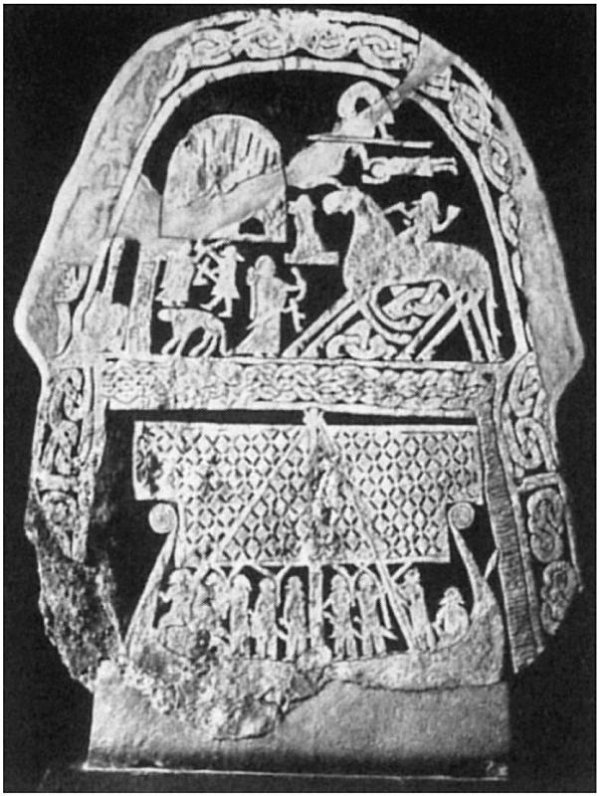
Plate 4.1 A Germanic limestone tombstone, from the eighth century, from Alskog Tjangvide on the island of Gotland, Sweden, showing another cosmology. Its runic inscription dedicates it to the memory of one Jurulv, murdered by relatives. The stone shows the ‘Ship of the Dead’, below, and in the upper part the deceased’s arrival, on Odin’s eight-legged horse, at Valhalla, the home of the Gods – a great hall like the ones actually built in north-western Europe at that time.
Source: Centre for Art Historical Documentation, Nijmegen, the Netherlands
Not only Augustine converted to the new religion. So, increasingly, did many of the empire’s citizens. In the process, Christianity inevitably developed in the crucible of existing cultures, consciously and unconsciously feeding on many of its elements. Consequently, the new religion soon provided an attractive and, for many, convincing mix of characteristics of other popular religions and systems of thinking. Among these were the teachings connected with the Indian-Persian god Mithras, and also the cult of the Invincible Sun God, who for many years had been the Emperor Constantine’s tutelary deity: the rites celebrating the birth of Mithras and the feast of the Sun both helped to shape the Christian feast of ‘Christmas’, as the birth of the Saviour and the return of Light. Equally influential was the worship of the Egyptian goddess Isis who, often painted and sculpted as a mother-goddess with the child Osiris in her lap, clearly became a model for the representation of the Virgin Mary. And, of course, there were the ideas of a number of Greek philosophers, including Aristotle and Plato, popular among the Graeco-Roman elites precisely in the period during which the Christian Church tried to convince and convert them as well.
In the cultural synthesis that ensued, the view people had of the world changed, both in a physical and in a metaphysical sense.

MOUNT SINAI, AD 547: KOSMAS EXPLAINS THE CHRISTIAN COSMOGRAPHY
In about AD 547, the Greek Kosmas, who had become a monk after a life of travelling and trading as far as India, wrote his Kristianike Topographia (Christian Topography). A ninth-century copy of the text is in the Vatican Library in Rome. It is illustrated with the earliest Christian map, or, rather, representation of the world.
In this work, Kosmas tried to reconcile pagan geography and the information about the physical world known to him with the notions that Christian Holy Scripture seemed to dictate. Kosmas’s view of the world seems to run counter to the global world-view that had been central to learned Ptolemaic cosmology. From now on, for more than a thousand years, all Europeans bar a small, scholarly elite thought of the earth as a flat world, a vast expanse of land in an even vaster expanse of water, contained under the vault of heaven. It is, of course, what we (think we) see if we go outside and look around. Indeed, like Kosmas himself, the majority of the clergy, too, was convinced that this was the way God had created the world. Obviously, this view entailed specific explanations of the nature of the relations between land and sea, earth and heaven, and the movements of the heavenly bodies.
We have said that the figure of the earth is lengthwise from east to west and breadthwise from north to south, and that it is divided into two parts: this part which we, the men of the present day, inhabit, and which is all round encircled by the intermedial sea, called the ocean by the Pagans, and that part which encircles the ocean, and has its extremities bound together with those of the heaven, and which men at one time inhabited to eastward, before the flood in the days of Noah occurred, and in which also Paradise is situated….
The northern and western parts of the earth which we inhabit are of very great elevation, while the southern parts are proportionally depressed. For to what extent of its breadth the earth is imperceptibly depressed, it is found to have an elevation of like area in the northern and western parts, while the ocean beyond is of unusual depth. But in the southern and eastern parts the ocean beyond is not of unusual but of the medium depth. When these facts are considered, one can see why those who sail to the north and west are called lingerers. It is because they are mounting up and in mounting up they sail more slowly, while in returning they descend from high places to low, and thus sail fast, and in a few days bring their voyage to an end …
The eastern and southern parts again, as low-lying and over-heated by the sun, are extremely hot, while the northern and western, from their great elevation and distance from the sun, are extremely cold, and in consequence the inhabitants have very pale complexions, and must keep themselves warm against the cold …
Since then the heaven and the earth comprise the universe, we assert that the earth has been founded on its own stability by the Creator, according once more to the divine scripture, and that it does not rest on any body….
We therefore first depict along with the earth the heaven, which is vaulted and which has its extremities bound together with the extremities of the earth. To the best of our ability we have endeavoured to delineate it on its western side and its eastern; for these two sides are walls, extending from below to the vaults above. There is also the firmament which, in the middle, is bound together with the first heaven, and which, on its upper side, has the waters according to divine scripture itself …
To the extremities on the four sides of the earth the heaven is fastened at its own four extremities, making the figure of a cube, that is to say, a quadrangular figure, while up above it curves round in the form of an oblong vault and becomes as it were a vast canopy. And in the middle the firmament is made fast to it, and thus two places are formed.
From the earth to the firmament is the first place, this world, namely, in which are the angels and men and all the present state of existence. From the firmament again to the vault above is the second place – the Kingdom of Heaven, into which Christ, first of all, entered, after his ascension, having prepared for us a new and living way.
Since the heavenly bodies then, according to divine scripture, are moved in their orbits by invisible powers, and run their course through the north, and pass below the elevated part of the earth, it is possible, with such a configuration, for eclipses of the moon and the sun to be produced. For the angelic powers, by moving the figures on rational principles and in regular order, and with greater speed than lies in us to apprehend, produce these phenomena, plying their labours by night and by day without ever pausing.3
On Kosmas’s map, the nether world is, by and large, the same as the world of the Christians: Europe and the Holy Land, or rather the Christian Near East, symbolically centred around Jerusalem and Rome, with Asia and Africa only sketchily represented, not least, obviously, because so little of it was actually known.4
Obviously, a confrontation between the cosmos as seen through the eyes of the holy book of the Christians and the knowledge and world-view of the ‘Ancients’, long held by the elite of the Roman Empire and their intellectual successors, was inevitable, the more so as views did not differ only as to physical nature, but also as to the nature of creation itself – was it the work of a personal God, or of an impersonal, natural force? Over the centuries, the resulting tension became a structural element in European culture and, right up to the twentieth century, continued to elicit debate and, indeed, feed doubts among those who were raised within the world of Christendom. Consequently, Europe’s intellectual history has comprised alternating periods of time when men harked back to classical civilization, and when they emphasized an original Christian purity, which gradually became more and more idealized. Always, when tension became too great, a synthesis that would reconcile both ideas was sought. However, a system that pleased and convinced everyone was not found.
Three forms of tension, voiced most clearly in the (always overlapping) fields of philosophy, religion and science seem to have been perennial: between the immortal soul and the mortal body, between good and evil and, intertwined with the first two, between faith, in the unreasoned authority of a higher power, and reason, as the essential capacity of the free-willed human being to finally understand every problem with which the cosmos presented him.
Long before the genesis of Christianity, one of the central questions that had been asked repeatedly was: is everything in the universe, including man, who considers himself a thinking and free agent, actually material? The Greek philosopher Demokritos (c.470–360 BC) had already answered in the affirmative. In his atom theory, he proposed that everything that existed consisted of a more or less complex series of smaller parts. More importantly, he also argued that the human ‘spirit’, or soul, was no more than that and would, therefore, die with the rest of the material body.
Such concepts, of course, were diametrically opposed to the notion of bodily resurrection which was precisely the idea the Church needed to neutralize the second fundamental tension. Christ and his followers had actually fought the presence of misery and injustice on earth, of ‘evil’, evident to so many, with the promise of a life of eternal goodness and happiness in the hereafter to which both body and soul would be resurrected if man had made his peace with God. Although this notion appealed to many, there were those who still asked themselves why a God who was presented as all-good as well as all-powerful and who, moreover, had promised man resurrection had permitted evil to enter the world in the first place.
In the first four centuries of the Christian era, the discussions between Christians and other intellectuals in the Roman world resulted in all sorts of ideas and even theories that hoped to solve this dilemma. As outlined above, some of these, collectively known asgnosis, or knowledge, argued that good and evil, spirit and matter, were essential characteristics of man and, therefore, of God, who had created man. According to these Gnostics, salvation could be achieved only through understanding these characteristics and accepting their consequences. However, this rather personalized way of thinking, popular among a number of Christians ever since, was anathema to the religious establishment.
Within Christianity, what in the end became accepted tradition was largely based on the ideas of the patrician from Thagaste in his major theological-philosophical works, the Confessiones and the De Civitate Dei (‘On the City of God’). Augustine, despite being attracted to gnosticism in his youth, finally concluded that man exists because he thinks, considers and doubts. Next, Augustine asked himself how man came into existence and then argued that this resulted from the creation by an eternal God who stands outside and above the cosmos, having created both space, that is, motion, and time, as well as matter. Augustine’s ideas show the influences of the Graeco-Roman culture in which he was raised and in which Christianity had developed as a new system of thought, seeking to synthesize what, according to many, cannot be synthesized – religion, or belief, especially as the unconditional surrender to a revealed God, and science, as a series of concepts trying, through reasoned argument, to explain the physical reality of the world and of man. To Augustine, the world, and in it both the Church – which he saw as the only road to salvation – as well as its members, were all imperfect though still indicated the perfection they would realize when they turned to God.
The teaching of Augustine owed quite a lot to the philosophy of Plato (428–348 BC), principally as it had been assimilated and reformulated by Plotinus (c.AD 204–70). As a result of studying Plato’s philosophy, Christian intellectuals constructed a way of thinking and living that appealed to the cultural elite as well as to the masses. Several of Plato’s concepts were interpreted in such a way that the more intellectual opponents of Christianity let themselves be convinced. After all, in his Symposium, the Athenian philosopher had stipulated that there are two worlds: the world of the imperfect body in which people operate with their impressions and senses, and which they can therefore know, and the world of ‘Ideas’, the higher principles which, although man is partly unaware of them, exist in every human being. In his Timaios, Plato had articulated his views on creation: ‘Ideas’ are the thoughts of the Nous (the Intellect or the Divine Soul), in which the Hen (the One) has become conscious. These ‘Ideas’ manifest themselves in the Psyche (the Soul) of the world but also in the souls of individual people, who thus become animate matter.
Inevitably, however, Christian intellectuals also had to come to terms with Aristotle, Plato’s most distinguished student. As often happens with students, he had in many ways defied his teacher. Arguing that the ‘Ideas’ were only ‘names’, not ‘real things’, Aristotle did talk of ‘forms’ in which undefined matter, ‘substance’, was given shape, resulting in physical nature. The ‘pure form’, which sets everything in motion, is the ‘prime mover’, pure thought – God, who thinks himself and therefore creates himself. Combining what they felt was useful and convincing in the two schools, the Christian thinkers-theologians of the first three centuries AD reworked the essence of this Platonic-Aristotelian body of ideas in a Christian sense.
Although the founding fathers of Christianity relied heavily on the philosophical speculations of the ancient Greeks, they were not at all happy with the notions the Greek philosophers had deduced from their study of physical nature. Man would not reach his destination, the Heavenly City as envisaged by St Augustine, by futilely delving into the secrets of microcosm or macrocosm. Indeed, these were not his to know. Nor were they of any use in man’s efforts to ameliorate a life on earth that only served as preparationfor a better life in the hereafter; indeed, the suffering inherent in that life was a necessary component of that preparation.
Meanwhile, the Christian intellectuals, in creating their synthesis, were opposed by such forceful critics as the scholar Porphyry (AD 234–301/6), Plotinus’s student. He denounced the new movement as completely irrational and unphilosophical in his Contra Christianos, an attack against which Augustine, for instance, could defend himself only with some difficulty. However, as the Christian emperors intervened in theological debate, regarding discussions on cosmology and philosophy, they decided not to tolerate any destabilization of the religion of their choice: the works of men like Porphyry were publicly burnt on Constantine’s orders.5
Of course, the ins and outs of these learned discussions eluded the majority of Christians. However, they were readily convinced by the notion of the existence of good and evil, and by the idea that man could escape his own inclination towards evil and, hence, injustice and misery only by submitting to God, whom one must love as one did one’s neighbour. Moreover, they soon accepted it was only possible to obtain God’s mercy and, thus, salvation by obeying the teachings and rules of the Church which God’s son, Christ, had established on earth. These, then, were the foundations of the views of man and the world held by most ‘Europeans’ for almost the following nearly 2,000 years.
Meanwhile, in the prolonged ‘crisis’ that marked the end of the political unity of the Roman world in the fourth and fifth centuries, both in the eastern and the western empire intellectuals felt the need to articulate their own identity, to define a common fate. Whether poets, chroniclers or Church authorities, they all were part of the political elite and wrote their works in the service of State or Church.6
In the western empire – the region on which this book will mainly concentrate – this common fate gradually became linked to Christianity, now increasingly seen as the one basic characteristic and indeed the redeeming characteristic of a geographically well-defined world, which by and large coincided with (western) Europe.
Soon, the bishops of Rome, or ‘the popes’, saw their newly gained power over the Christian world threatened by their main competitors within the Church, the Christian patriarchs of Constantinople. Fundamentally, their claim to supremacy was founded on a passage in the gospel of Matthew –Chapter 16, Verses 18–19 – wherein the disciple Simon acknowledges Jesus as God’s son. Jesus then tells Simon that as Peter, ‘the Rock’, he will be the foundation stone of Christ’s Church, with the power ‘to bind and loose both in heaven and earth’. Hence, a tradition arose in which Peter was proclaimed to have been Christ’s first Vicar on Earth and the first bishop of Rome. From the fourth century onwards, St Peter’s grave, reputedly situated in a Roman cemetery below the seventeenth-century marble altar under a huge baroque bronze canopy that now fills the enormous space beneath the cupola of St Peter’s in Rome, became a centre of pilgrimage for many believers. However, their religious supremacy was by no means absolute, not even in the western empire, although they tried to turn it into an independent religious and cultural region over which, as by divine right, they now claimed political dominion as well. As there was no gospel text to base this claim on, the popes invented the so-called ‘Donation of Constantine’, which had purportedly given them secular rule over the western half of the Roman Empire when the emperor himself had left for the eastern part.
Despite these power struggles, the bishops of Rome – the historical continuity of their line is much disputed – often came out victorious in the many doctrinal disputes with other Christian groups in the Mediterranean-Christian world. However, though they now claimed both spiritual and temporal control over the entire Church, their power, such as it was, was effectively limited to the Roman parts of western Europe. Increasingly, though, from the fifth century onwards they sent out missionaries to Christianize the worlds beyond the old Roman frontier, thus soon extending their power to northern and central Europe as well, bringing to those regions a new culture. I will try to indicate what that culture was, and how it was spread to become, in the end, the foundation of European culture as we know it.
As the old Greek notion of Europe – a world, a society defined by its geography and climate – was incorporated into Christian thought during the early centuries of the Christian era, the conversion of the old Graeco-Roman elite, schooled in the ideals of paideia, ensured that the concepts of man and civilization, which had been attached to this world, now became part of Christian culture as well. Soon, the educated Christians interpreted the central text of the Christians, the Bible, and especially the Old Testament, with the Greek geographical names and the concepts implicit therein at the back of their mind.
After all, this readership, the elite of the Christian faithful, had to try to understand why the world as they knew it, the world around ‘our sea’, was so varied, especially in its different races and cultures. More specifically, the political and cultural leaders needed to show why their civilization was the most important and therefore worth defending and, even, expanding.
This resulted in a fascinating religious-cultural construction. It was based on a story told in Genesis, the first book of the Old Testament: the story of Noah who, with his family and a specimen of each of the animal species, was the only one to survive the great flood that destroyed mankind. In Christian thinking, his three sons now were identified with the inhabitants of the three known worlds. Thus, Shem became the patriarch of the Semites, the inhabitants of Asia. Ham, who, having mocked his father for his drunkenness, had been cursed for it, became the patriarch of the Hamites, the inhabitants of Africa; at a much later date Europeans used the story to argue the inherent cursedness of the Africans and, thus, their natural slavery. Finally, Japheth became the patriarch of the Japhites, the inhabitants of Europe.7 In most European texts describing the earth – for example, the seventh-century Historia Brittonum – these are the three groups who populate the three continents, i.e. the entire world. At the same time, in his seventh-century encyclopedia, Isidore of Seville, the leading intellectual light of the Visigoth kingdom of Spain, argued that the people living in his specific part of the world were especially blessed by God. For their world, unlike the worlds of Africa and Asia, was the ‘Christian world’.8 Inevitably, it was also the world of civilization, because it had first been the Roman world. Moreover, not only the Romans but all those who had come into contact with the Roman Empire, such as the Franks – and, of course, the Visigoths to whom Isidore himself belonged – were the progeny of one of Japheth’s descendants, Alanus.9
One religion for all: the fusion of Christianity and Europe
Indeed, many of the ‘barbaric’ tribes who had been migrating into western Europe had absorbed the conquered region’s culture, religious as well as linguistic, for example in adopting Latin or one of its regional variants. The process can best be witnessed in the elites of these peoples who, even if they may not always have accepted Roman-Christian religion and culture out of conviction, quickly realized that it was an effective means of retaining or even increasing their power.
By AD 403, the Christian intellectual Prudentius had already internalized a fascinating teleological vision of history in which, even before the birth of Christ, the Roman Empire had developed as an ideal political and cultural unity precisely because, at a later stage and according to God’s plan, it had to provide the basis for the spreading of the Christian message that would ultimately save mankind. For Prudentius, the Roman Empire’s borders inevitably coincided with those of the Christian world: there, faith and reason would now merge. This, of course, is a significant pronouncement on the two elements which, according to Prudentius, had been introduced into European life by the Christian and Roman cultures, respectively. However, observing that ‘Life, but not merit, is given to everyone’, he also asserted that ‘an abyss separates the Roman forms of life from the barbaric, just as man is separated from the animals, the mute from those who speak’.10
Indeed, the tribes and peoples from northern and eastern Europe who continued to advance on the prosperous south-west between the fourth and tenth centuries, settling within the Roman-Christian world, often were viewed with disdain by those who had already been Romanized at an earlier stage. One of these tribes were the Longobards, who conquered northern and central Italy and were soon felt to threaten the Pope’s position. Consequently, in AD 739, Pope Gregory III sought the help of the Frankish leader, Charles Martel who, formally speaking, usurped the throne that had been held by the Merovingian kings, the descendants of Chlodwig,11 and therefore needed the Pope’s help to legitimize and even sanctify his rule. A papal chronicler wrote:
The province subject to Roman government was smitten by the wicked Longobards and their King, Liutprand. Coming to Rome, he pitched his tents in the field of Nero, ravaged the Campagna, and forced many Roman nobles to shave and dress in the Lombard fashion. Therefore the man of God [i.e. Pope Gregory III], oppressed with grief on every side, took the holy keys from the grave of the blessed Apostle Peter and sent them by sea to the land Francia, to the most wise Charles [i.e. Charles Martel], who then ruled the Frankish kingdom, by his ambassadors, the most holy Bishop Anastasius and the priest Sergius, to ask the most excellent Charles to free them from this great oppression by the Longobards.12
After one or two generations, the erstwhile foes had mostly been assimilated into Roman-Christian culture. Soon, they internalized its merits and virtues to such an extent that one of their chroniclers could clearly, albeit idealistically, describe his situation as follows:
The Longobards … have abandoned their barbaric savagery, perhaps because they married natives and begot children who derived something of the mildness and wisdom of the Romans from the blood of their mothers and from the properties of the country and climate. Even now they retain the elegant Latin speech and polished manners. In the government of their cities and the service of their commonwealth they still copy the skilful methods of the ancient Romans. They are so eager for freedom that they recoil from excess of power and are ruled by the will of consuls rather than of dictators [imperantes]. And as it is known that there are three estates among them, consisting of captains, vavasours and people, consuls are chosen, in order that arrogance may be suppressed, not from one estate alone, but from every estate; and lest they be seized with a lust for power, they are changed nearly every year. Hence it happens that almost all the land is divided between the cities … and it is almost impossible to find any noble or magnate, even in so wide an area, who does not obey the orders of his city. The cities … do not scorn to promote to knighthood and to offices of various ranks young men of inferior condition, and workers engaged in low, even manual trades, whom other peoples thrust out like the plague from the freer and more honourable pursuits. Hence it happens that they far surpass all other cities in the world in wealth and power.13
Meanwhile, Christianity itself had become as expansionist as the Roman Empire had ever been. In about AD 550, St Prosper of Aquitaine argued that ‘Christ’s mercy was not satisfied only to reach the borders of Rome: it has already brought many peoples who were never compelled by Rome’s arms to submit to the lordship of the Church of Christ’.14 This argument highlights an important development. With the demise of the Roman Empire, the Christian Church felt it had become its heir in many respects. Having adopted its bureaucratic structure, it had gained great organizational strength. Now, it also took on the civilizing ideology of the Romans, proclaiming that to a world of ‘barbarians’, a world of tribal chiefs and their loosely organized kingdoms, it would bring such important, albeit mundane services as literacy and legislation, which helped create centralized power besides, of course, promising them eternal salvation.
It was precisely the Roman popes who felt they could use the fading memory of a once powerful empire to build a new one. For example, in AD 597, Pope Gregory the Great sent the monk Augustine to England, not because, as the story went, he was struck by the angelic beauty of the blond boys sold in the Roman slave market but because he remembered that ‘Anglia’ had once been a thriving part of the Roman Empire. Relying on the structures, cultural and political, that still remained, might not Roman missionaries induce the local rulers to submit to the Church’s growing dominion?15 Gregory was not disappointed. Within less than 20 years, the monks sent by the Pope had helped the Anglo-Saxon kings to codify more than 90 laws,16 not forgetting to ensure the position of the new religion.
Indeed, in the process of Christian expansion that took place between the fourth and tenth centuries and went far beyond the former Roman frontier, a new ‘cultural space’ came into existence, hesitantly at first but gradually more noticeably. In the eighth century, Christianity, and with it Graeco-Roman culture, reached present-day central Germany. Here, among the ‘wild tribes of Germania’, Boniface (c.674–754), coming from England, preached a new religion. He had first travelled to Thuringen via ‘Bavaria and the border areas of Germania’s unknown areas’ to convert the heathen tribes there. Later, while in Rome, the Pope honoured him with ‘a book in which were written the holy laws of the Church, laid down by the synods of bishops, and an order … that he teach the people entrusted to him according to these examples’. And so he tried. Finishing Boniface’s biography, the monk Willibald was able to record the saint’s successes: ‘and so it happened that the message of his sermons became known everywhere, to such an extent that his name resounded almost all over Europe’.17 Christianity and Europe slowly but surely became ‘one’. The process was not an easy one. Boniface, for one, paid for it with his death – but gained his martyrdom and sainthood.
The rise of a new empire: Frankish statecraft and Christian arguments
The various tribes who had settled in central and western Europe during the last centuries of Roman rule soon developed some sort of state-structure. However, at least until the twelfth century, power in these early states was actually exercised by regional or even local lords and their soldiers, rather than by central authorities, if only because to be effective in an illiterate society any order had to be given by mouth, and its effects checked personally. And illiterate the new, post-Roman culture certainly was.
Often, the conquerors or war leaders gave land grants to those members of their family or followers who had aided them, thus creating a lineage-system society. They also confirmed the possessions of those families of the indigenous, older, senatorial aristocracy who had not opposed them; the latter, however, enjoyed their income, derived from the farming population, not so much by right of kinship with the new ruler, but under an older tributary tradition that had developed in the Roman Empire. Soon, these two systems merged. For even though the power relationships in these proto-states were, at the beginning, highly personalized, over the following centuries the situation was slowly stabilized and formalized. Increasingly, the new landowners, too, rather than invoking an ever more distant connection with the original conqueror and his successors, ruled their subjects by right of birth, and by right of the political-administrative functions they had acquired within the state, which often became hereditary. By and large, the farming population of Europe retained its freedom, though, of course, the new rulers eagerly adapted the pre-existing systems of taxation and ‘corvées’ – or forced labour – to their own use.
Inevitably, sometimes, the new ruling families gradually lost part of their power to the magnates of their state, precisely because, in trying to defend the independence of their new states, they often needed to buy military support by again granting the magnates lands from the princely domain.
However, within those regions of Europe that had formerly been part of the Roman Empire, the new central rulers seem to have retained some of their authority, because it was now based on the residual Roman notion of a state governed by a lawful sovereign who dispensed justice to the state’s subjects.18 Often, though, this was enforced by some kind of divine right, invoked through a supposed relationship with ancient heroes, or demigods, even though this pagan notion was Christianized as well, with the kings now being anointed by the senior priest of their state. Indeed, it was by virtue of this fiction that until the end of the seventeenth century, both the English and the French kings, after their coronation-cum-anointing, would lay their supposedly healing hands on hundreds or even thousands of people suffering from such illnesses as scrofula.
Inevitably, both the ruling princes as well as the magnates sought to increase their power by means of dynastic alliances or simple conquest. As indicated above, on the territory of Roman Gaul, the leaders of the Franks successfully did so. However, despite the successes of the Merovingian dynasty, the ensuing process of unification by which the remains of the western empire which largely came to coincide with the world of Roman Christendom is always identified with Charles (c.742–814) – whose epithet ‘the Great’ was added later. He was the energetic and apparently charismatic member of the Carolingian family who, having deposed the Merovingian kings, used the tradition of their authority and skilfully manipulated the Frankish nobles to greatly expand their royal authority.19 This was, however, achieved, perhaps, at the cost of granting them more royal land and even certain sovereign rights in the field of local jurisdiction.
Charlemagne himself, succeeding to power in a kingdom that encompassed large parts of present-day France, Belgium, Switzerland and the south of the Netherlands, soon succeeded in also gaining power over western and central Germany, northern Italy and northern Spain, in the process establishing Christianity among all the tribes that he subdued.
Realizing that a strong kingdom could exist only on the basis of a strong economy, Charlemagne continued an economic policy adopted by his predecessors.20 He knew, as they had known, that a strong economy could not rely on agriculture only, certainly not if it were to produce the surplus and hence the fiscal revenue the Frankish kings needed for their expansionist policy. Trade had to be revived and to stimulate it, a common, stable, reliable currency had to be introduced if he were to reach his aim. Therefore, he encouraged Frankish trade through the network of major trading towns that stretched from the northern Netherlands to northern Germany and Scandinavia and, from there, to the eastern coasts of the Baltic Sea, whence trade routes led through Russia, along the Volga basin, to the Black Sea. In this seemingly improbable way, Frankish trade reached the markets of the Near East and central Asia and, thus, the silver the Frankish rulers needed to reform the coinage was obtained. Of course, Charlemagne also tried to revitalize trade between the Mediterranean coasts of Europe and the trading centres of northern Africa and the Levant. In this, too, he was successful. During his reign, both the wealth and the power of the Frankish kingdom grew.
Without anyone being aware of it, Frankish policy was considerably helped by the fact that in the fourth and fifth centuries, another climate change had occurred. Europe now became drier, and water seems to have been in short supply – folklore and legends talk about this problem. However, with the seas less stormy, and the Alpine passes open for longer periods of the year, both sea trade and overland trade could only profit from the new situation.
To further enhance his authority and thus his power, in the year 800, Charlemagne went to Rome, the holy city of Christianity, there to be rewarded by the Pope with the imperial crown. Thus, he became the first in a long line of ‘Holy Roman Emperors’ which ended only when, in 1806, Napoleon I of France decided to dismantle the Holy Roman Empire. To contribute to a growing sense of European identity, what happened in Rome more than 1,200 years before was soon interpreted as follows:
After handing over the empire to Christ’s vicar, Constantine went to Thrace, where Europe ends, and established a city there named after him. That was where the seat of the empire was until the time of Charles, in whose person Pope Adrian transferred the empire from the Greeks to the Germans.21
Thus, in historiography the Roman popes were accorded the power to bestow the imperial crown and title on whomever they wished, in this case transferring the heritage of Rome from the east, from Constantinople, to the west, to Charles’s seat at Aachen, where the new emperor built a chapel deliberately echoing Roman ecclesiastical architecture – specifically and significantly harking back to the great octagonal church built by Constantine over the grave of Christ in Jerusalem.
To many – or at least to the intellectual elite of the west – it seemed as if the glory of the former Roman Empire had been resurrected, as if a true renovatio imperii had been realized. The two founts of ideal power, the terrestrial, realized in the ‘universal’ State, and the celestial, realized in the ‘universal’ Church, were again in communion. The Church, embodied in the Pope, Christ’s Vicar on Earth and established in Rome, and the State, embodied in the emperor who sought his legitimacy at least partly in that state par excellence, the Roman Empire, were now locked in a holy alliance. Of course, the spiritual support of the Church of Rome and the military power of the empire were of mutual benefit to Pope and emperor – as long as they did not compete for actual supremacy both in religious and secular matters. Yet, however profitable it might seem in the short run, the collaboration between two such power institutions could not but be problematic in the long run.
Those who articulated imperial propaganda were the men of the Church. It was they who now controlled the imperial court – as the ruler’s trusted collaborators – rather than the regional magnates, who were his competitors. Thus, the intellectuals of Charlemagne’s time, mainly monks and priests,22 proclaimed that God supported this young king from a young people and blessed his victories, the obvious reward for the emperor’s piety and his policy of the Christianization of civilization. What could be more meaningful now than to define the area over which he claimed dominion as ‘Europe’ and thus present it once again as a logical, complete unity?23 Soon, Charlemagne’s principal confidant, Alcuin (c.735–804), and the emperor’s biographer, Einhard (c.770–840), presented him as the man who did indeed wield the regnum Europae.24
However, Charlemagne not only embarked on a policy of Christianization, thus broadening the power of this ecclesiastical court elite, but he also attempted to preserve what little was left in the west of Graeco-Roman civilization. Indeed, though he could not have done so without the help of his clerical advisors, it was he himself who had the vision to make this culture into a way of life for his court as well as for the warrior elite who administered his realm. The obvious reason was, of course, that Charlemagne and his supporters needed an ideology that would give cohesion and unity to the constantly expanding Frankish Empire.25
Thus, the Frankish kings situated themselves in the tradition of the ancient Roman emperors and proclaimed themselves the rightful heirs to their empire, as is shown from a letter which, in 871 AD, one of Charlemagne’s successors, Emperor Louis II, sent to his colleague and ‘competitor’, the Byzantine basileus Basil I. The latter, as well as his ancestors, in trying to uphold the fiction of the one, undivided Roman Empire, were willing to recognize the rulers of the barbarians in the west only when they acceded to be the ‘representatives’ of the only true Christian emperors, who, as Constantine’s successors, ruled in Byzantium. Now, the arguments used by the Franks were mostly derived from the Bible and the merit the Carolingian kings had earned by their own conversion to Christianity and their policies of converting other peoples. However, historical and cultural arguments were also used in another way. The policy of the Jews towards Christ is interpreted negatively, and the bond between the Franks on the one hand, and Rome and Latin on the other – the city and the language of civilization – are emphasized. Note, too, how the Byzantines’ use of Greek and their ‘abandonment’ of Rome are held against them. In fact, the text presents all the elements that would determine the self-image of the Europeans in the west for centuries to come:
the Frankish race has borne the Lord much very fertile fruit, not only by being quick to believe, but also by converting others to the way of salvation. Hence the Lord rightly warned you: ‘The Kingdom of God shall be taken from you and given to a nation which bears him fruit’ [Matthew 21.43] God was able, out of stones, to raise up children for Abraham [Matthew 3.9], and so he could also, out of the hardness of the Franks, raise up heirs to the Roman Empire. If we belong to Christ, we are, according to the Apostle, the seed of Abraham [Paul to the Galatians 3.29]; and if we belong to Christ, we can, by his grace, do everything which those who belong to Christ can do. As we, through our faith in Christ, are the seed of Abraham, and as the Jews for their treachery have ceased to be the sons of Abraham, we have received the government of the Roman Empire for our right thinking or orthodoxy. The Greeks for their cacodoxy, that is, wrong thinking, have ceased to be Emperors of the Romans – not only have they deserted the city and capital of the Empire, but they have also abandoned Roman nationality and even the Latin language. They have migrated to another capital city [i.e. Byzantium] and taken up a completely different nationality and language.26
Culture and cohesion: the role of ideology and education in the shaping of Carolingian Europe, or the ‘First Renaissance’?
The influence of scholars like Alcuin strongly persuaded Charlemagne to advance the cause of education all over his empire. Senior clergymen were urged to take the lead but the court nobles, who ruled the various parts of the realm, were asked to provide their establishments with schools – for the children of servants as well as for the sons of the free men who wanted an education.
The new educational ideal was clearly founded in a Christian way of life, since a better understanding of Holy Scripture would result in morally better and hence more civilized behaviour. Probably in AD 794 or 796, Charlemagne wrote to the well-known Epistola de litteris colendis(‘Memorandum on the cultivation of learning’) Abbot Baugulf of Fulda, admonishing this prelate and all the others who received similar orders as follows:
Be it known to You, whose devotion is pleasing to God, that we and our loyal servants have considered it profitable that the bishoprics and monasteries committed by Christ’s favour to our guidance should in addition to following the monastic way of life and living together under a holy rule, offer earnest instruction in the study of literature to those who, by the gift of God, are capable of learning, according to the capacity of each of them. Observing a rule imparts order and grace to honourable conduct, and perseverance in teaching and learning does the same for correct speech: so that those who are eager to please God by rightly living may not neglect to please Him by speaking correctly….
For although correct conduct may be better than knowledge, nevertheless knowledge precedes conduct…. Because of failure to learn, the uninstructed tongue could only faultily express what devout piety was faithfully dictating to the mind. Hence we began to fear that, there being too little skill in writing, there might also be far too little wisdom in understanding the Holy Scriptures…. Therefore we exhort you … not to neglect the study of letters…. Let men be chosen for this work who have the will and ability to learn and the desire to instruct others. And let this be done with a zeal as great as the earnestness with which we command it. We wish you, as befits soldiers of the Church, to be devout in thought and erudite in speech, chaste in your strict conduct and learned in your eloquence, so that if anyone seeks to see you out of reverence for the Lord or because of your noble and holy life, he may both be edified by your appearance and enlightened by the wisdom he perceives in your reading and singing, and may go home joyfully rendering thanks to Almighty God.27
Arguing, as some critics have done, that this educational policy only benefited the Church and the clergy seems to be a misreading the emperor’s own political intentions to create a truly educated elite that would contribute both to cultural and religious unity and, hence, to the better governability and welfare of the empire. The emperor’s ideas can be observed from a number of statements. Thus, addressing the clergy of his realm, he wrote:
Therefore, because we take care constantly to improve the condition of our churches, we have striven with watchful zeal to advance the cause of learning, which has been almost forgotten by our ancestors; and, by our example, also we invite those whom we can to master the study of the liberal arts. Accordingly, God aiding us in all things, we have already corrected carefully all the books of the Old and New Testaments, corrupted by the ignorance of the copyists.
In AD 789, he admonished a number of his senior officials to ‘join and associate to themselves not only children of servile condition, but also sons of free men. And let schools be established in which boys may learn to read’.28 Of course, the ability to read, the teaching of reading even, presupposes texts that can be read. We know that Charlemagne ordered books from all parts of his realm to be collected in the imperial library at Aachen.29 His biographer also tells us in the twenty-ninth chapter of the Vita Karoli, that the Emperor ordered the codification of German tribal laws as well as of the German heroic songs, both of which until then had only been transmitted orally.
Through the efforts of Charlemagne and his ecclesiastical advisers, the culture of the elite of the Christian Church slowly, and in a modified form, became the culture of the secular upper class as well. In the process, the Frankish state, which now covered a considerable part of western Europe, gradually acquired a character that was Germanic as well as Christian and, in fact, also Roman, with the remnants of Greek civilization being received mainly through the filter of Rome and through Latin. However, in a sense, this old, revived culture was now shared by a greater population than it had reached during Roman times since, under Charlemagne, a policy of expansion and colonization was initiated which pushed the borders of the Frankish Empire increasingly northwards and eastwards. Moreover, even though the Picts and the Frisians, the Goths and the Wends, the Balts and the Slavs were not subjected, they too came under the cultural influence of the Frankish Empire.
Admittedly, the political unity that such a large part of present-day western Europe had achieved under Charlemagne was lost again soon after his death. Yet western Europe’s expansionist policies into central Europe continued. Often undertaken with the Church’s wholehearted cooperation, these policies were pursued by the emperor’s successors from the late ninth century onwards, specifically by the rulers of the German states that emerged from the break-up of Charlemagne’s empire, until, in the fourteenth century, the limit of this expansion was reached: in the Baltic area, in Poland and in the Balkans. There, western European expansion encountered a formidable contestant for the possession of these regions: Greek Christianity, backed by the Byzantine emperors. Soon, the elites surrounding the Pope and emperor in the west decided that Graeco-Byzantine culture was decidedly ‘different’ and, even, a hostile and threatening force, despite its Christian character. Therefore, this region became an uncertain border area, disputed and, consequently, divided culturally, religiously and politically. Here, for centuries peoples have been confronted with choices that still tear them apart today.30
With the spread of Roman Christianity through missionaries who were supported equally by the popes, the Holy Roman Emperors and the various European princes, the Roman Church took on the organization of religious life in the entire area to the west of the invisible line stretching from the Baltic to the Balkans.31 A truly transcontinental Church was now created. It became visible in the persons and the power of bishops and priests, in the monasteries and cathedral schools that educated the elites who now came to share and cherish the same norms and values all over this vast region. Consequently, in northern and central Europe, too, the Church and, with it, the cultured elite, began to refer to Rome as the one and only centre, as the south and west had done for some centuries already. These regions, though they had never submitted to the Roman Empire, now adopted a common, Christian ideology, and became part of its discourse. Gradually, this ideology was presented ever more outspokenly as a universal ideology, as, unquestionably, even the very essence of civilization.
To foster this communal ideology, the Church of Rome needed to give the hugely diverse peoples and tribes of Europe a common history. In this new history, in which all sorts of older legends about people’s origins were adjusted or rewritten, the roots of the secular world – of power and culture – were traced back to the ancient Romans. The Romans, in their turn, were linked by their ancestor, Aeneas, to his forefathers, the Trojans, who were, en passant, identified with Greek culture, that could thus be made part of Europe’s cultural ancestry. On the other hand, the roots of the religious world, the world where God’s plan of salvation was played out, were inevitably traced to the Bible, to the Old and the New Testaments. However, in both spheres – secular and religious – the process that history was presented as having reached its fulfilment in Europe, in the West – or, as the historian Otto von Freising (d. 1158) wrote: ‘As I said earlier, all human powers and possibilities, in this case, wisdom, come from the East, from Babylon, in order to be completed in the West’.32
In this one, simple sentence, the specific elements which were now seen as constituting Christian – ‘European’ – culture were clearly identified: power, to be understood as the result of human knowledge, wisdom, which in its turn was to be understood as the product of learning – and both, of course, the gift of God. Significantly, for Otto, the origin of this wisdom lay in Asia. Not, as one might have expected, in the Holy Land, but even further east in Mesopotamia where, it was assumed, God had first created man, had given him the powers of knowledge and had placed him in the garden of Eden.
To implement this ideology, which consisted of a history as well as a vision of the future, a specific curriculum – taught in Latin – had been devised, in which the seven artes liberales were divided into the trivium, the three fundamental subjects of grammatica, rhetorica and dialectica, and thequadrivium, the four more complex subjects of arithmetica, geometrica, astronomia and musica. In the centuries following the reign of Charlemagne, the teaching programme of the school attached to the imperial palace at Aachen became the prototype for numerous schools founded by the clergy all over Europe. These establishments now became the real centres of European culture.33 As a result, Latin rapidly gained the character of a ‘universal’ language, facilitating communication between scholars in this nascent ‘western world’; thus, language too contributed in no small degree to the genesis of a common culture in this region.
Still, to term the complex policy sketched above a ‘first Renaissance’, as has been done, is perhaps to misjudge it. It may seem like an attempt at a cultural renovatio of the old Roman Empire, but the actual aim was, mostly, pragmatic, i.e. to create the foundations of a Christian, Frankish Empire. Given the fact that this policy was instigated and executed by the Church, it did not aim at an ‘objective’, independent appreciation of ancient, Graeco-Roman culture in its own right – if only because many of its manifestations were condemned as pagan. Yet, in the process, many individual scholars, though all clerics, did preserve the better part of that pagan, classical culture for posterity.
Meanwhile, Roman Christianity ceased to be the religion and culture of an elite only. Indeed, it was practised by most people in the western part of Europe, although almost always in combination with numerous pre-Christian customs and all sorts of beliefs whichthe Church termed ‘superstition’ or, again, pagan. These included ways of thinking which for one reason or another were anathema to the ecclesiastical authorities, ranging from what was seen as sorcery and witchcraft – though a distinction was made between white and black magic – to soothsaying and alchemy, as well as various forms of astrology and kabala. Still, it is quite clear that well into the seventeenth century, i.e. for nearly 1,000 years, it was the clergy who continued to act both as the official, Church-appointed mediators between man and the divine as well as assuming the roles formerly played by the druids of the Celts or the priests of the German gods, often performing age-old rites which had been condemned by their own Church.
Indeed, as by now the majority of people in the Carolingian Empire were of Germanic origin, a ‘Germanization’ of Christianity was inevitable. The Church accepted this situation in a rational as well as emotional and psychological way, Christianizing many Germanic cultural phenomena: such festivals as the ones celebrating mid-winter and the subsequent return of light were fused with the holy day of the nativity of Christ to become an ever more complex Christmas feast. Such customs as, for instance, the festive annual markets were linked to the holy day commemorating the consecration of the local church, to sacralize and Christianize a secular occasion, and give the Church power over it. Even certain people, such as local seers, miracle workers or heroic rulers were often canonized, their cults being turned into the feasts of Christian saints.34 In this way the various regional cultures were effectively merged into the one Christian culture.35 Precisely because those cultural elements that most strongly influenced people’s emotions – though they might be considered pagan and profane by the elite – were now brought under ecclesiastical influence, the diffusion of the basic ideas of Christianity was much facilitated.
Yet, religious and cultural uniformity were never completely realized. Indeed, deviant ideas, branded as heresies, were constantly formulated, showing that the Church was not able to provide all the answers to people’s spiritual and material needs. Whether because of religious or intellectual scruples, or for economic, political and social reasons, individuals and groups would formulate and advocate alternative views of man, society and salvation, calling into doubt the certainties, the order and the security provided, at a cost, by the Church. Often, these people would try to reach the masses, using the vernacular instead of Latin, the language of the Church, which remained incomprehensible to most people in Europe. Thus, criticism, dissent and heterodoxy contributed to the growth of regional cultures, undermining the pretended unity of the Christian world.36
The impact of monasteries
The basic institutional structure of the Church as it had developed in the last centuries of the Roman Empire – fundamentally the system of bishoprics and, increasingly, the supremacy of the Roman papacy – continued to exist in most countries of western Europe that developed on territory formerly under Roman rule. Moreover, it was exported beyond that territory as Christianity itself spread to the north and east through the missionary efforts of its clergy and, often, the zeal of regional magnates and princes. Yet Christianity would not have become a major religious and cultural factor without the contribution of another of the Church’s institutions, the monastery.
The monastic tradition – which, of course, is not unique to Christianity but also characterizes Hinduism and Buddhism – had its origins in the very regions where Christianity was born, i.e. in Palestine, Syria and Egypt. Retreating from the worries of the world into a private sphere of prayer and introspection, men and women used to go into the desert to live the solitary life of a hermit, or congregated into small communities devoted to pious contemplation. The ‘first’ Christian monastery proper – with separate establishments for males and females – was founded by St Pachomius in the Nile valley in the fourth century AD. Soon, many of these communities decided to adopt a common rule, to give cohesion to their congregation.
It was not long before the monastic tradition moved to the north, to the Byzantine Empire – even nowadays, Mount Athos in northern Greece is a veritable cluster of monasteries – and to the west, to northern Africa and to Europe. Mostly, these communities were looked upon with awe and reverence by common people and rulers alike, even when times were violent and devastation reigned. They were seen as places that belonged to God, where men and women communicated with heaven, setting an example to a world that would not or could not live a life of continuous piety.37
The mainstream tradition of western monasticism originated with Benedict of Nursia (c.480–543/7) – a Roman of noble ancestry who had entered the Church and, disappointed with its growing power and wealth, ended up founding a monastery on Monte Cassino – who decided to adapt an earlier, anonymous set of guidelines to structure his community. In the following centuries, this rule, later known as the ‘Benedictine Rule’, was adopted by hundreds of monasteries all over Europe, finding wide though not exclusive acceptance.
Benedict’s ideas resulted in a variety of monastic manifestations. As to the monastery’s formal organization, mature men wishing to enter, or boys influenced and inspired by their elders to do so, were usually obliged to spend some time in the ‘novitiate’ before being allowed to take the vows of chastity, obedience and poverty that constituted the essence of monkhood. Collectively, the community of monks in a given monastery elected an abbot, who ruled the establishment until he died, consulting the community when necessary. In female monasteries, the same rules prevailed.
The fundamentals of Benedictine life can be summed up in the two actions of praying and working. Prayer, seven times a day during the span of 24 hours, was combined with contemplation, through the study of theology and the reading of devotional literature and, soon, with a life of learning in general. To this end, the monastic scriptoria, where monks painstakingly copied the texts the Church needed, began to manufacture bibles and other texts for daily devotional use.38 But monasteries also began to collect or transcribe texts of general literary and scientific interest, and to produce original scholarship. Codifying and commenting on the Gospels and on the wisdom of the fathers of the Church but also on the ideas of all those who had somehow contributed to humanity’s welfare. Now, as indicated above, the European intellectual elite soon felt that somehow this had to include the works of those scholars and writers who had lived before the advance of Christianity. Indeed, there were even monks who stressed the need to preserve pre-Christian poetry as important and valuable for the development of a Christian culture,39 although the often explicit sexual contents of, for example, Roman literature led to the expurgation or even elimination of a good many texts. Although it is unlikely that a number of texts that scrutinized the secrets of nature, of God’s creation, all too closely were destroyed, over the centuries the Christian monks have been the major force in helping to preserve the manuscripts that contained the cultural heritage of antiquity.40 In the twelfth century, the abbey of Cluny, in France, one of the grandest and wealthiest in Christendom, owned some 570 volumes – or codices – of manuscripts, while the cathedral of Durham, in England, had a library of 546 books, and the cathedral of Bamberg, in Germany, preserved 365 texts.41
Inevitably, being centres of learning, with important libraries, many monasteries became centres of education as well, producing scholars who, for centuries, have been influential in almost all fields of European culture. Thus, the magnificent monastery of St Gallen, in Switzerland, and later the abbey of Cluny, to name but two, attracted students from all over Europe, as did the schools attached to the cathedrals (these were the churches where a bishop resided, enthroned in his ‘cathedra’ or bishop’s throne).
By pursuing a monastic career, some European women, whose opportunities in a secular, male-dominated society were severely restricted, were able to contribute to culture in a major way. The lady Hroswitha, abbess of the monastery of Gandersheim (c.930–70), left an important oeuvre of Latin poems on religious themes, an epic devoted to the Emperor Otto I and a series of plays which make her the first playwright of the post-classical European world.42 The lady Hildegard (1098–1179), abbess of the Benedictine monastery of Bingen, also rightly gained fame in a number of fields: as a seer and a visionary, whose literary works are of great beauty and show her to have been thoroughly conversant with classical literature and philosophy; as an exorcist, who left fascinating texts with medical-magical ideas and conjurations; and also as a musical theorist.43
Besides daily prayer and, for those who were capable of it, scholarly endeavour, work in these monasteries was understood to be daily, manual labour in the fields, providing sustenance for each monk or nun and, thus, making the monastery as independent as possible of the world and its numerous distracting influences. Consequently, though individual poverty was part of ‘the Rule’, institutional wealth was soon in evidence all over monastic Europe. The majority of monasteries became very rich indeed, both through their own industry and through the often considerable bequests and donations, in money and landed property, from the faithful who wanted the monastic clergy to pray for their souls or to engage the support of these increasingly powerful institutions in all kinds of political machinations. Many monasteries became grand agricultural enterprises that were often worked by numerous tenant farmers who further increased the abbey’s wealth with their rents. The more vigorous male monastic orders often chose to settle in agriculturally unpromising regions where, through the reclamation of vast stretches of waste land – for example, in parts of France and England, in the northern Netherlands, and in Pomerania and Silesia – they changed the countryside, thus altering Europe’s visual aspect as well as its ecology.44 While contributing to a ‘Christianization’ of the landscape, through their cultural influence they altered the European mind as well.
Dossier: Charlemagne: the Father of Europe?
During the last years of the Second World War, Adolf Hitler ordered his generals to do their best to defend the German town of Aachen – Aix-la-Chapelle – against the Allied forces. To no avail, for the city centre was heavily bombed. Why was the Nazi leader so concerned? The town had not only seen the coronation of 38 Holy Roman Emperors, it had been chosen for that purpose precisely because it had served as the ‘capital’ of the first European empire, the one created by Carolus Magnus, a.k.a. Charlemagne (742/747/749–814). Miraculously, the chapel/cathedral, built sometime in the last decade of the eighth century, where the sacred ritual had taken place for so many centuries, survived, along with the gilded and jewelled shrine of the emperor, as well as his marble throne.45
Hitler and before him that other megalomaniac ruler, Napoleon, were not the first nor, indeed, the last politicians to find inspiration in the first ‘European’ emperor. When, after the Second World War, an increasing number of European states felt that cooperation – in the use of natural resources, in the creation of a common market, etc. – would be the one means of ensuring that no such ‘total war’ would ever occur again, they searched the past for a historical figure who could be used as a symbol of European unity. It was not easy to find one. When people settled for Charlemagne, and even branded him ‘the Father of Europe’, others felt the choice was historically indefensible. As is often the case, scholarship offered arguments for both sides. So then, who was Charlemagne and, more importantly, what had been his role in and significance for the world later called Europe?
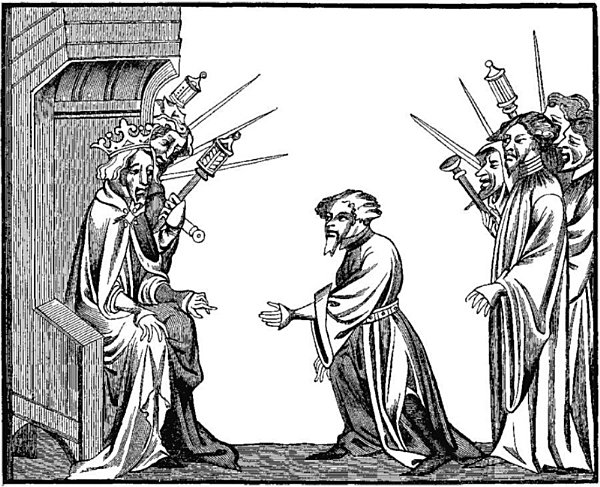
Plate 4.2 Charlemagne receiving the oath of fidelity from one of the nobles he employed to govern his realm in his name, as represented in a much later medieval chronicle.
Though the exact year of his birth is still discussed, Charles, or rather Karl/Karolus, was born in the fifth decade of the eighth century. A few years after his birth, his father, a powerful nobleman named Pippin, nicknamed ‘the Short’, had become king of the Franks – not, as long assumed, a distinct Germanic tribe but rather a conglomerate of peoples living in the border region of what is now the Netherlands, Belgium, northern France, Luxemburg and Germany. For a long time, they had been ruled by members of the so-called Merovingian family. However, in 751 Pippin had dared depose the then king, and, moreover, succeeded in convincing the pope to come to ‘Francia’ to anoint and crown him. Thus, Charles was raised expecting to become king himself though he knew that, according to custom, his brother Karloman would share the kingdom with him. Whether Charles had a hand in it or not, Karloman suddenly died, and a united Francia fell to him.
During the following years, the new king set out on a number of annual campaigns to enlarge his realm, both to increase his own power and, assumedly, to satisfy his nobles who, if not placated with the spoils of conquest, might have questioned his right to rule. Soon, the better part of what is now France was under Charles’s sway, though his attempts to enlarge Francia beyond the Pyrenees failed. More significantly, he also had crossed the Alps, finally incorporating the wealthy kingdom of the Lombardians in the Po region. Charles also directed his troops eastward, beyond the Rhine towards the Weser River, subjecting the Saxon tribes living there in what, even according to some contemporaries, were unnecessarily bloody wars.
In a move towards the region that is now eastern Bavaria, Austria and Hungary, Charles conquered the headquarters of the Avar tribes as well. The loot they had amassed during their raids was enormous, and now helped the Frankish king to finance more peaceful policies, such as a treaty with the king of Mercia in England, that brought Francia all kind of commercial advantages. Some of it must also have been used to finance a few, visionary as well as huge, infrastructural works that would have benefited both trade and the speedy manoeuvring of troops, such as the bridge built over the Rhine at Mainz (that, however, burned down in 813) and the channel that was to link the upper reaches of the Rhine to the upper Main-Danube region. It would have connected the North Sea to the Black Sea but was only was realized in the nineteenth century.
Soon, Charles’s growing power was deemed a danger by the one remaining ‘emperor of the Romans’, the ‘basileus’ in Byzantium, the more so since the Frankish upstart laid claims to territories which the Byzantine government felt to be its own. After negotiations to bring about a dynastic union failed, the situation got worse. If only to prevent it from becoming a real problem, Charles entered into a diplomatic – and commercial – relationship with Byzantium’s eastern neighbour, Harun al-Rashid, the ‘Ruler of the Believers’, the Caliph in Baghdad. The king may also have wanted to create a basis of friendship that would ensure pilgrims from Europe had continued access to the Holy Land which, of course, would greatly enhance his status in Christendom. As a sign of goodwill, Harun sent Charles a white elephant that became a wonder in the West.
Charles advised or, whenever they did not comply, forced those of his new subjects who had not yet converted to Christianity to do so. Thus, he gained the support of the Church and of the papacy. This he needed not only to establish his own, God-given legitimacy, but also because he could not expect to govern his, by the 790s, huge empire without the help of the clergy. They were, by and large, the only educated group and, consequently, the men who knew how to administer an ever larger and, hence, complex polity.
Besides giving the Church new subjects, Charles also gave it new riches, establishing abbeys and monasteries and endowing them with all kinds of treasure won from the peoples he subjugated. His biographer, a man named Einhard, proudly relates how the king showered gold, silver and precious stones on the most revered church in Christendom, St Peter’s in Rome. All this wealth enabled the Church to educate people, primarily, of course, those who entered its service. It also enabled the clergy – both monks and secular priests – to continue, on a larger scale than in previous centuries, their role as keepers of a learned and artistic patrimony, not only the one inherited from the Romans, but also the one created by churchmen themselves. If only for this reason, the Carolingian era sometimes is seen as a ‘renaissance’.
By the end of the 790s, Charles, now in his late fifties, needed to concern himself with the future. He never envisaged Francia to continue as a single state for, according to Frankish custom, he knew that all his sons would succeed him. Already he had given them parts of his empire to rule. Precisely that situation presumably also dictated his decision that, as the father of kings, he himself should have a title which suggested and ideologically ensured an even greater than royal power. He also must have felt that the imperial dignity would be useful in the ongoing struggles with Byzantium. Thus, on the morning of Christmas of the Year of our Lord 800, Charles was in Rome, ascending the steps of St Peter’s basilica, to be crowned emperor by a pope who could not but comply, since his own position amongst the warring aristocracy and clergy of the Eternal City largely depended on the king’s support.
But if Charles never thought in terms of ‘Europe’, why, then, do we still name him its father? Well, it would indeed be better not to use the term. Rather, we should analyse and interpret his legacy. Though Charles, as a person, was a strong, even charismatic ruler, his only surviving son who finally succeeded him, was not – nor, indeed, were his grandsons. More importantly, Charles had not succeeded in creating a centralized government that could function irrespective of the personal qualities, or lack of them, of the monarch. Neither can we expect him to have been able to do so, in a largely illiterate society that was basically a conglomerate of numerous local, oral communities. Precisely to somehow hold these together, Charles had used the Church, whose power reached down into the very capillaries of his world. But in doing so, he had immeasurably enlarged the Church’s powers, allowing it to dictate to the men and women of Francia its vision of what was right or wrong, virtue or sin, civilized or barbaric. If anything, Charles was the begetter of a world that was becoming more Christian than ever before.