
Preface
The first edition of this work was an extension of a much shorter book, Nuts and Bolts for the Social Sciences. By and large, the extension was in breadth, not in depth. Many more topics were covered, but at more or less the same level of analysis. This revised edition covers roughly the same topics as the first, but provides, I hope, greater insight.
To make room for the substantial amount of new material, while keeping the book within a manageable size, Part IV – “Lessons from the natural sciences” – has been eliminated. Some discussions in that Part have been incorporated into the new Chapter 11, “Reinforcement and selection,” and Chapter 20. A new chapter on “Transmutations” is added. The chapters in Part V on collective belief formation, collective action, collective decision making, institutions and constitutions, as well as the Conclusion, are entirely rewritten. Most chapters in Part II are also substantially modified. Parts I and III are also revised, but less heavily.
The revisions and additions draw on five books I have published in the meantime: Agir contre soi (2007), Le désintéressement (2009), Alexis de Tocqueville: The First Social Scientist (2009), L'irrationalité (2010), and Securities Against Misrule (2013). They also reflect a deeper immersion in Seneca, Tocqueville, Bentham, and Proust, as well as a belated first reading of The Theory of Moral Sentiments, Hume's History of England, and Gibbon's Decline and Fall of the Roman Empire. A number of books on the American war in Vietnam opened my eyes to the importance of stupidity, however intelligent, in human affairs.
In revising the book, I have given free rein to associations and digressions. My role models in this respect are Montaigne's Essays, The Psychology of Interpersonal Relations by Fritz Heider, The Strategy of Conflict by Thomas Schelling, and The New Rhetoric by Chaim Perelman and Lucie-Olbrechts-Tyteca. However different in substance, these books have in common a playful obsession with revealing details, even seemingly trivial ones, superimposed on the analytical structure.
A distinctive feature of this edition will appear when Chapter 9 is read in conjunction with the Conclusion. One might call it the naturalization of social scientists, in the sense that I understand many writings by social scientists as instances of the kind of spurious pattern seeking that both natural and social scientists have found to characterize human beings much more generally. I cannot stress enough that this explanation of their explanations is not intended to refute them (this would amount to “the genetic fallacy”). Refutations must follow standard methodological procedures. Yet I believe that the sheer mass of substandard social science – what I call soft and hard obscurantism – calls for an explanation.
My quotations from Proust are taken from the translation by Scott-Moncrieff, occasionally modified either for a more literal rendering or for greater transparency. I thank Herbert Gintis, Aanund Hylland, Yuen Foong Khong, George Loewenstein, Karl Ove Moene, David Stasavage, Adrian Vermeule and Adam Waytz for their comments on an earlier draft.
I dedicate the revised edition to the memory of Aaron Swartz, for his commitment to the public good.
Part I
This book relies on a specific view about explanation in the social sciences. Although not primarily a work of philosophy of social science, it draws upon and advocates certain methodological ideas about how to explain social phenomena. In the first three chapters, these ideas are set out explicitly. In the rest of the book they mostly form part of the implicit background, although from time to time, notably in the Conclusion, they return to the center of the stage.
I argue that all explanation is causal. To explain a phenomenon (an explanandum) is to cite an earlier phenomenon (the explanans) that caused it. When advocating causal explanation, I do not intend to exclude the possibility of intentional explanation of behavior. Intentions can serve as causes. A particular variety of intentional explanation is rational-choice explanation, which will be extensively discussed in later chapters. Many intentional explanations, however, rest on the assumption that agents are, in one way or another, irrational.1 In itself, irrationality is just a negative or residual idea, everything that is not rational. For the idea to have any explanatory purchase, we need to appeal to specific forms of irrationality with specific implications for behavior. In Chapter 14, for instance, I enumerate and illustrate eleven mechanisms that can generate irrational behavior.
Sometimes, scientists explain phenomena by their consequences rather than by their causes. They might say, for instance, that blood feuds are explained by the fact that they keep populations down at sustainable levels. This might seem a metaphysical impossibility: how can the existence or occurrence of something at one point in time be explained by something that has not yet come into existence? As we shall see in Chapter 11, the problem can be restated so as to make explanation by consequences a meaningful concept. In the biological sciences, evolutionary explanation offers an example. In the social sciences, however, successful instances of such explanations are few and far between. The blood-feud example is definitely not one of them.
The natural sciences, especially physics and chemistry, offer explanations by law. Laws are general propositions that allow us to infer the truth of one statement at one time from the truth of another statement at some earlier time. Thus when we know the positions and the velocity of the planets at one time, the laws of planetary motion enable us to deduce and predict their positions at any later (or earlier) time. This kind of explanation is deterministic: given the antecedents, only one consequent (or antecedent) is possible. The social sciences offer few if any law-like explanations of this kind. The relation between explanans and explanandum is not one-one or many-one, but one-many or many-many. Many social scientists try to model this relation by using statistical methods. Statistical explanations are incomplete by themselves, however, since they ultimately have to rely on intuitions about plausible causal mechanisms.
1 At this first occurrence in the book of the word “agent” it may be worthwhile to note that many scholars prefer “actor.” Perhaps economists think in terms of agents, sociologists in terms of actors. Although it does not really matter which term we use, I prefer “agent” because it suggests agency; “actor,” by contrast, suggests an audience that may or may not be present.
1
Explanation: general
The main task of the social sciences is to explain social phenomena. It is not the only task, but it is the most important one, to which others are subordinated or on which they depend. The basic type of explanandum is an event. To explain it is to give an account of why it happened, by citing an earlier event as its cause. Thus we may explain Ronald Reagan's victory in the 1980 presidential elections by Jimmy Carter's failed attempt to rescue the Americans held hostage in Iran.1 Or we might explain the outbreak of World War II by citing any number of earlier events, from the Munich agreement to the signing of the Versailles Treaty. Even though in both cases the fine structure of the causal explanation will obviously be more complex, they do embody the basic event-event pattern of explanation. In a tradition originating with David Hume, it is often referred to as the “billiard-ball” model of causal explanation. One event, ball A hitting ball B, is the cause of – and thus explains – another event, namely, ball B's beginning to move.
Those who are familiar with the typical kind of explanation in the social sciences may not recognize this pattern, or not see it as privileged. In one way or another, social scientists tend to put more emphasis on facts, or states of affairs, than on events. The sentence “At 9 A.M. the road was slippery” states a fact. The sentence “At 9 A.M. the car went off the road” states an event. As this example suggests, one might offer a fact-event explanation to account for a car accident.2 Conversely, one might propose an event-fact explanation to account for a given state of affairs, as when asserting that the attack on the World Trade Center in 2001 explains the pervasive state of fear of many Americans. Finally, standard social-science explanations often have a fact-fact pattern. To take an example at random, it has been claimed that the level of education of women explains per capita income in the developing world.
Let us consider the explanation of one particular fact, that 65 percent of Americans favor, or say that they favor, the death penalty.3 In principle, this issue can be restated in terms of events: How did these Americans come to favor the death penalty? What were the formative events – interactions with parents, peers, or teachers – that caused this attitude to emerge? In practice, social scientists are usually not interested in this question. Rather than trying to explain a brute statistic of this kind, they want to understand changes in attitudes over time or differences in attitudes across populations. The reason, perhaps, is that they do not think the brute fact very informative. If one asks whether 65 percent is much or little, the obvious retort is, “Compared to what?” Compared to the attitudes of Americans around 1990, when about 80 percent favored the death penalty, it is a low number. Compared to the attitudes in some European countries, it is a high number.
Longitudinal studies consider variations over time in the dependent variable. Cross-sectional studies consider variations across populations. In either case, the explanandum is transformed. Rather than trying to explain the phenomenon “in and of itself,” we try to explain how it varies in time or space. The success of an explanation is measured, in part, by how much of the variation it can account for.4 Complete success would explain all observed variation. In a cross-national study we might find, for instance, that the percentage of individuals favoring the death penalty was strictly proportional to the number of homicides per 100,000 inhabitants. Although this finding would provide no explanation of the absolute numbers, it would offer a perfect explanation of the difference among them.5 In practice, of course, perfect success is never achieved, but the same point holds. Explanations of variation do not say anything about the explanandum “in and of itself.”
An example may be taken from the study of voting behavior. As we shall see later (Chapter 14), it is not clear why voters bother to vote at all in national elections, when it is morally certain that a single vote will make no difference. Yet a substantial fraction of the electorate do turn out on voting day. Why do they bother? Instead of trying to solve this mystery, empirical social scientists usually address a different question: Why does turnout vary across elections? One hypothesis is that voters are less likely to turn out in inclement weather, because rain or cold makes it more attractive to stay home. If the data match this hypothesis, as indicated by line C in Figure 1.1, one might claim to have explained (at least part of) the variation in turnout. Yet one would not have offered any explanation of why the line C intersects the vertical axis at P rather than at Q or R. It is as if one took the first decimal as given and focused on explaining the second. For predictive purposes, this might be all one needs. For explanatory purposes, it is unsatisfactory. The “brute event” that 45 percent or more of the electorate usually turn out to vote is an interesting one, which cries out for an explanation. I discuss it in several later chapters.
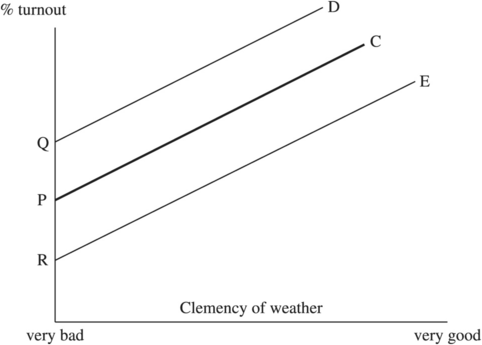 Figure 1.1
The ideal procedure, in an event-event perspective, would be the following. Consider two elections, A and B. For each of them, identify the events that cause a given percentage of voters to turn out. Once we have thus explained the turnout in election A and the turnout in election B, the explanation of the difference (if any) follows automatically, as a by-product. As a bonus, we might also be able to explain whether identical turnouts in A and B are accidental, that is, due to differences that exactly offset each other, or not. In practice, this procedure might be too demanding. The data or the available theories might not allow us to explain the phenomena “in and of themselves.” We should be aware, however, that if we do resort to explanations of variation, we are engaging in a second-best explanatory practice.
Sometimes, social scientists try to explain non-events. Why do many people fail to claim social benefits they are entitled to? Why did nobody call the police in the Kitty Genovese case?6 Considering the first question, the explanation might be that the individuals in question decide not to claim their benefits, because of fear of stigma or concerns with self-image. Since making a decision is an event, this would provide a fully satisfactory account. If it fails, social scientists would, once again, look at the differences between those who are entitled to benefits and claim them and those who are and do not. Suppose the only difference is that the latter are unaware of their entitlement. As an explanation, this is helpful but insufficient. To go beyond it, we would want to explain why some entitled individuals are unaware of their entitlement. To discover that because they are illiterate, they are unable to read the letters informing them about their rights would also be helpful but insufficient. At some point in the explanatory regress, we must either come to a positive event, such as a conscious decision not to become literate or a conscious decision by officials to withhold information, or turn to those who do seek the benefits to which they are entitled. Once we have explained the behavior of the latter, the explanation why others fail to seek their benefit will emerge as a by-product.
Considering the Kitty Genovese case, there is no variation in behavior to explain, since nobody called the police. Some accounts of the case indicate that several of the observers decided not to call the police. In terms of proximate causes this provides a fully satisfactory account, although we might want to know the reasons for their decision. Was it because they feared “getting involved” or because each observer assumed that someone else would call the police (“Too many shepherds make a poor guard”)? Some of the observers, however, apparently did not even think about calling the police. One man and his wife watched the episode for its entertainment value, while another man said he was tired and went to bed. To explain why they did not react more strongly one might cite their shallow emotions, but that, too, would be to account for a negative explanandum by citing a negative explanans. Once again, their behavior can only be explained as a by-product or residual. If we have a satisfactory explanation of why some individuals thought about calling the police, even if in the end they decided not to, we shall have the only explanation we are likely to get of why some did not even think about it.
In the rest of this book I shall often relax this purist or rigorist approach of what counts as a relevant explanandum and an appropriate explanation. The insistence on event-focused explanations is a bit like the principle of methodological individualism, which is another premise of the book. In principle, explanations in the social sciences should refer only to individuals and their actions. In practice, social scientists nevertheless refer to supraindividual entities such as households, firms, or nations, either as a harmless shorthand or as a second-best approach forced upon them by lack of data or of fine-grained theories.7 These two justifications also apply to the use of facts as explananda or as explanantia, to explanations of variation rather than of the phenomena “in and of themselves,” and to the analysis of negative explananda (non-events or non-facts). The purpose of the preceding discussion is not to hold social scientists to pointless or impossible standards, but to argue that at the level of first principles the event-based approach is intrinsically superior. If scholars keep that fact in mind they may, at least sometimes, come up with better and more fruitful explanations. When we try to explain the decisions made at the Federal Convention of 1787, the recorded votes of the state delegations are useful, but incomplete. Historians have improved our understanding by identifying the votes cast by individual members of these delegations. Explanations of why the German National Assembly in 1933 and the French National Assembly in 1940 abdicated their powers gain much in power and focus when we can trace the changing and interacting motivations of individual deputies.
Sometimes, methodological individualism should force us to lower our sights. Social scientists are naturally drawn to big questions, yet some questions may be too big to allow for an answer. We may be able to explain the rise of Calvinism, but not the existence of some form of religion in virtually all societies. We may be able to explain the emergence of capitalist forms of agriculture in eighteenth-century England, but not the “transition from feudalism to capitalism” in Europe as a whole. Discussions of “the Axial age” and “modernity” also flounder, among other reasons, for lack of identifiable agents and their motivations. If social scientists are enjoined to use the microscope rather than the telescope, some questions may of course elude them forever. The loss in breadth is offset, or more than offset, by the gain in depth.
Sometimes, we might want to explain an event (or rather a pattern of events) by its consequences rather than by its causes. I do not have in mind explanation by intended consequences, since intentions exist prior to the choices or actions they explain. Rather, the idea is that events may be explained by their actual consequences, typically, their beneficial consequences for someone or something. As a cause must precede its effect, this idea might seem to be incompatible with causal explanation. Yet causal explanation can also take the form of explanation by consequences, if there is a loop from the consequences back to their causes. A child may initially cry simply because it feels pain, but if the crying also gets it attention from the parents, it may start crying more than it would have done otherwise. I argue in Chapter 11 that this kind of explanation is somewhat marginal in the study of human behavior. In most of the book, I shall be concerned with the simple variety of causal explanation in which the explanans – which might include beliefs and intentions oriented toward the future – precedes the occurrence of the explanandum.8
In addition to the fully respectable form of functional explanation that rests on specific feedback mechanisms, there are more disreputable forms that simply point to the production of consequences that are beneficial in some respect and then without further argument assume that these suffice to explain the behavior that causes them. When the explanandum is a token, such as a single action or event, this kind of explanation fails for purely metaphysical reasons. To take an example from biology, we cannot explain the occurrence of a neutral or harmful mutation by observing that it was a necessary condition for a further, advantageous one. In a rare moment of methodological sobriety, Marx refers to the speculative distortions by which “later history is made the goal of earlier history, e.g. the goal ascribed to the discovery of America is to further the eruption of the French Revolution.” In a less sober moment, he wrote that “The anatomy of man is the key to the anatomy of the ape.”
When the explanandum is a type, such as a recurrent pattern of behavior, it may or may not be valid. Yet as long as it is not supported by a specific feedback mechanism, we should treat it as if it were invalid. Anthropologists have argued, for instance, that revenge behavior has beneficial consequences of various kinds, ranging from population control to decentralized norm enforcement (Chapter 21 offers many other examples). Assuming that these benefits are in fact produced, they might still obtain by accident. To show that they arise non-accidentally, that is, that they sustain the revenge behavior that causes them, the demonstration of a feedback mechanism is indispensable. And even when one is provided, the initial occurrence of the explanandum must be due to something else.
The structure of explanations
Let me now turn to a more detailed account of explanation in the social sciences (and, to some extent, more generally). The first step is easily overlooked: before we try to explain a fact or an event we have to establish that the fact is a fact or that the event actually did take place. As Montaigne wrote, “I realize that if you ask people to account for ‘facts,’ they usually spend more time finding reasons for them than finding out whether they are true … They skip over the facts but carefully deduce inferences. They normally begin thus: ‘How does this come about?’ But does it do so? That is what they ought to be asking.”
Thus before trying to explain, say, why there are more suicides in one country than in another, we have to make sure that the latter does not tend, perhaps for religious reasons, to underreport suicides. Before we try to explain why Spain has a higher unemployment rate than France, we have to make sure that the reported differences are not due to different definitions of unemployment or to the presence of a large underground economy in Spain. If we want to explain why youth unemployment is higher in France than in the United Kingdom, we need to decide whether the explanandum is the rate of unemployment among young people who are actively searching for jobs or the rate among young people overall, including students. If we compare unemployment in Europe and the United States, we have to decide whether the explanandum is the unemployed in the literal sense, which includes the incarcerated population, or in the technical sense, which only includes those searching for work.9 Before we try to explain why revenge takes the form of “tit for tat” (I or one of mine kill you or one of yours each time you or yours kill one of mine), we should verify that this is actually what we observe rather than, say, “two tits for a tat” (I kill two of yours each time you or yours kill one of mine). Much of science, including social science, tries to explain things we all know, but science can also make a contribution by establishing that some of the things we think we know simply are not so. In that case, social science may also try to explain why we think we know things that are not so, adding as it were a piece of knowledge to replace the one that has been taken away.10
Suppose now that we have a well-established explanandum for which there is no well-established explanation – a puzzle. The puzzle may be a surprising or counterintuitive fact, or simply an unexplained correlation. One small-scale example is “Why are more theology books stolen from Oxford libraries than books on other subjects?” Another small-scale example, which I shall explore in more detail shortly, is “Why do more Broadway shows receive standing ovations today than twenty years ago?”
Ideally, explanatory puzzles should be addressed in the five-step sequence spelled out in the following. In practice, however, steps (1), (2), and (3) often occur in a different order. We may play around with different hypotheses until one of them emerges as the most promising, and then look around for a theory that would justify it. If steps (4) and (5) are carried out properly, we may still have a high level of confidence in the preferred hypothesis. Yet for reasons I discuss in the next chapter, scholars might want to limit their freedom to pick and choose among hypotheses.
1.Choose the theory – a set of interrelated causal propositions – that holds out the greatest promise of a successful explanation.
2.Specify a hypothesis that applies the theory to the puzzle, in the sense that the explanandum follows logically from the hypothesis.
3.Identify or imagine plausible accounts that might provide alternative explanations, also in the sense that the explanandum follows logically from each of them.
4.For each of these rival accounts, refute it by pointing to additional testable implications that are in fact not observed.
5.Strengthen the proposed hypothesis by showing that it has additional testable implications, preferably of “novel facts,” that are in fact observed.
These procedures define the hypothetico-deductive method. In a given case, they might take the form shown in Figure 1.2. I shall illustrate it by the puzzle of increasing frequency of standing ovations on Broadway. It is not based on systematic observations or controlled experiments, but on my casual impressions confirmed by newspaper reports. For the present purposes, however, the shaky status of the explanandum does not matter. If there are in fact more standing ovations on Broadway than there were twenty years ago, how could we go about explaining it?
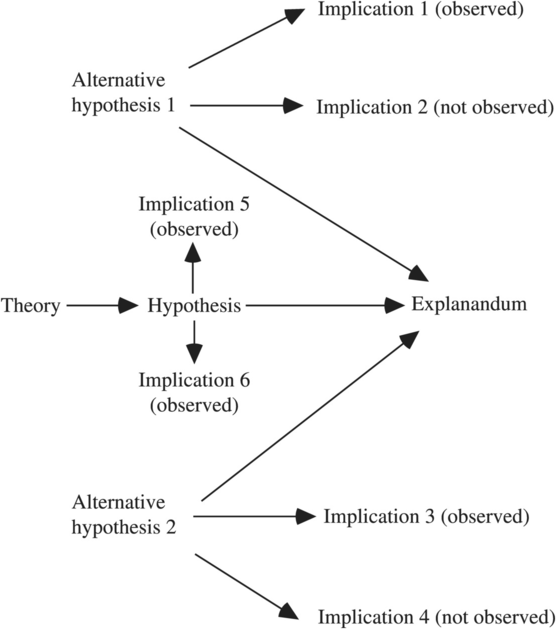 Figure 1.2
I shall consider an explanation in terms of the rising prices of Broadway tickets. One newspaper reports the playwright Arthur Miller as saying, “I guess the audience just feels having paid $75 to sit down, it's their time to stand up. I don't mean to be a cynic but it probably all changed when the price went up.” When people have to pay $75 or more for a seat, many cannot admit to themselves that the show was poor or mediocre, and that they have wasted their money. To confirm to themselves that they had a good time, they applaud wildly.
More formally, the explanation is sought in the hypothesis “When people have paid a great deal of money or effort to obtain a good, they tend (other things being equal) to value it more highly than when they paid less for it.”11 As Montaigne wrote, “where our expenditure is concerned we are good at keeping accounts: our outgoings cost us so much trouble, and we value them precisely because they do so; our opinion will never allow itself to be undervalued. What gives value to a diamond is its cost; to virtue, its difficulty; to penance, its suffering; to medicines, their bitter taste.” Given the factual premise of rising prices, this hypothesis passes the minimal test that any proposed explanation must satisfy: If it is true, we can infer the explanandum. But this is a truly minimal test, which many propositions could pass.12 To strengthen our belief in this particular explanation, we must show that it is supported from below, from above, and laterally.
An explanation is supported from below if we can deduce and verify observable facts from the hypothesis over and above the fact that the hypothesis is intended to explain. It must have “excess explanatory power.” In the case of the Broadway shows, we would expect fewer standing ovations in shows whose prices for some reason have not gone up.13 Also, we would expect fewer standing ovations if large numbers of tickets to a show are sold to firms and given by them to their employees. (This would count as a “novel fact.”) Even if these tickets are expensive, the spectators have not paid for them out of their own pocket and hence do not need to tell themselves that they are getting their money's worth.
An explanation is supported from above if the explanatory hypothesis can be deduced from a more general theory.14 In the present case, the explanatory proposition is a specification of the theory of cognitive dissonance proposed by Leon Festinger. The theory says that when a person experiences an internal inconsistency or dissonance among her beliefs and values, we can expect some kind of mental readjustment that will eliminate or reduce the dissonance. Typically, the adjustment will choose the path of least resistance. A person who has spent $75 to see a show that turns out to be bad cannot easily make herself believe that she paid less than that amount. It is easier to persuade herself that the show was in fact quite good. Any show is likely to be good in some respect, and by emphasizing that dimension over others spectators can enhance their overall appreciation.
Although not without problems, the theory of cognitive dissonance is pretty well supported. Some of the support is from cases that are very different from the one we are considering here, as when a person who has just bought a car avidly seeks out ads for that very brand of car, to bolster his conviction that he made a good decision. Some of the support arises from quite similar cases, as when the painful and humiliating initiation rituals of college fraternities and sororities induce strong feelings of loyalty. I am not saying that people would consciously tell themselves, “Because I suffered so much to join this group, it must be a good group to belong to.” The mechanism by which the suffering induces loyalty must be an unconscious one.
An explanation receives lateral support if we can think of and then refute alternative explanations that also pass the minimal test. Perhaps there are more standing ovations because today's audiences, arriving in busloads from New Jersey, are less sophisticated than the traditional audience of blasé New York denizens. Or perhaps it is because shows are better than they used to be. For each of these alternatives, we must think of and then disconfirm additional facts that would obtain if they were correct. If standing ovations are more frequent because audiences are more impressionable, we would expect them also to have been frequent in out-of-town performances twenty years ago. If shows are better than they used to be, we would expect this to be reflected in how well they are reviewed and how long they play before folding.
In this procedure, the advocate for the original hypotheses also has to be the devil's advocate. One has consistently to think against oneself – to make matters as difficult for oneself as one can. We should select the strongest and most plausible alternative rival explanations, rather than accounts that can easily be refuted. For similar reasons, when seeking to demonstrate the excess explanatory power of the hypothesis, we should try to deduce and confirm implications that are novel, counterintuitive, and as different from the original explanandum as possible. These two criteria – refuting the most plausible alternatives and generating novel facts – are decisive for the credibility of an explanation. Support from above helps but can never be decisive. In the long run it is the theory that is supported by the successful explanations it generates, not the other way around. Emilio Segrè, a Nobel Prize winner in physics, said that some winners confer honor on the Prize whereas others derive honor from it. The latter are, however, parasitic on the former. Similarly, a theory is parasitic on the number of successful explanations it generates. If it is able to confer support on a given explanation, it is only because it has received support from earlier explanations.
What explanation is not
Statements that purport to explain an event must be distinguished from seven other types of statement.
First, causal explanations must be distinguished from true causal statements. To cite a cause is not enough: the causal mechanism must also be provided, or at least suggested. In everyday language, in good novels, in good historical writings, and in many social scientific analyses, the mechanism is not explicitly cited. Instead, it is suggested by the way in which the cause is described. Any given event can be described in many ways. In (good) narrative explanations, it is tacitly presupposed that only causally relevant features of the event are used to identify it. If told that a person died as a result of having eaten rotten food, we assume that the mechanism was food poisoning. If told that he died as a result of eating food to which he was allergic, we assume that the mechanism was an allergic reaction. Suppose now that he actually died because of food poisoning, but that he was also allergic to the food in question, lobster. To say that he died because he ate food to which he had an allergy would be true, but misleading. To say that he died because he ate lobster would be true, but uninformative. It would suggest no causal mechanism at all and be consistent with many, such as that he was killed by someone who had taken an oath to kill the next lobster eater he observed.
Second, causal explanations must be distinguished from statements about correlations. Sometimes, we are in a position to say that an event of a certain type is invariably or usually followed by an event of another kind. This does not allow us to say that events of the first type cause events of the second, because there is another possibility: the two might be common effects of a third event. In his Life of Johnson, Boswell reports that a certain Macaulay, although “with a prejudice against prejudice,” affirmed that when a ship arrived at St. Kilda in the Hebrides, “all the inhabitants are seized with a cold.” While some offered a causal explanation of this (alleged) fact, a correspondent of Boswell's informed him that “the situation of St. Kilda renders a North-East Wind indispensable before a stranger can land. The wind, not the stranger, occasions an epidemick cold.” Or consider the finding that children in contested custody cases are more disturbed than children whose parents have reached a private custody agreement. It could be that the custody dispute itself explains the difference, by causing pain and guilt in the children. It could also be, however, that custody disputes are more likely to occur when the parents are bitterly hostile toward each other and that children of two such parents tend to be disturbed. To distinguish between the two interpretations, we would have to measure suffering before and after the divorce. A third possibility is canvassed later.
Here is a more complex example, my favorite example, in fact, of this kind of ambiguity. In Democracy in America, Alexis de Tocqueville discussed the alleged causal connection between marrying for love and having an unhappy marriage. He points out that this connection obtains only in societies in which such marriages are the exception and arranged marriages the rule. Only stubborn people will go against the current, and two stubborn persons are not likely to have a very happy marriage.15 In addition, people who go against the current are treated badly by their more conformist peers, inducing bitterness and unhappiness. Of these arguments, the first rests on a non-causal correlation, due to a “third factor,” between marrying for love and unhappiness. The second points to a true causal connection, but not the one that the critics of love marriages to whom Tocqueville addressed his argument had in mind. Marrying for love causes unhappiness only in a context where this practice is exceptional. Biologists often refer to such effects as “frequency dependent.”16
In addition to the “third-factor” problem, correlation may leave us uncertain about the direction of causality. Consider an old joke:
PSYCHOLOGIST:You should be kind to Johnny. He comes from a broken home.
TEACHER:I'm not surprised. Johnny could break any home.
Or as the comedian Sam Levinson said, “Insanity is hereditary. You can get it from your children.” The implication is that a disturbed child may cause the parents to divorce rather than that a divorce causes the disturbance. Similarly, a negative correlation between how much the parents know about what their adolescent children are doing and the children's tendency to get into trouble need not show that parental monitoring works, but only that teenagers intent on getting into trouble are unlikely to keep their parents informed about what they are doing.
Life under Stalin often exhibited such reverse causality. The caption of a cartoon in the satirical Krokodil magazine was a brief dialogue: “How come, friend, that you are so often ill?” “I know a doctor” was the answer – not because the doctor made him ill, but because he could issue a much sought-after certificate of illness. Another cartoon showed a store manager talking politely to a customer, while the check-out clerk and a woman look on. “He's a courteous man, our store manager,” says the clerk. “When he sells cloth, he calls all the customers by name and patronymic.” “Does he really know all the customers?” “Of course. If he doesn't know someone, he doesn't sell to them.”
Third, causal explanations must be distinguished from statements about necessitation. To explain an event is to give an account of why it happened as it happened. That it might also have happened in some other way, and would have happened in some other way had it not happened the way it did, does not provide an answer to the same question. Consider a person who suffers from cancer of the pancreas, which is certain to kill her within a year. When the pain becomes unendurable, she kills herself. To explain why she died within a certain period, it is pointless to say that she had to die in that period because she had cancer.17 If all we know about the case are the onset of cancer, the limited life span of persons with that type of cancer, and the death of the person, it is plausible to infer that she died because of the cancer. We have the earlier event and a causal mechanism sufficient to bring about the later event. But the mechanism is not necessary: it could be preempted by another. (In the example the preempting cause is itself an effect of the preempted cause, but this need not be the case; she might also die in a car accident.) To find out what actually happened, we need more finely grained knowledge. The quest never ends: right up to the last second, some other cause could preempt the cancer.18
Statements about necessitation are sometimes called “structural explanations.” Tocqueville's analysis of the French Revolution is an example. In his published book on the topic, he cites a number of events and trends from the fifteenth century to the 1780s and asserts that the revolution, against this background, was “inevitable.” By this he probably meant (1) that any number of small or medium-sized events would have been sufficient to trigger it and (2) that it was a virtual certainty that some triggering events would occur, although not necessarily the ones that actually did happen or when they happened. We may be able to predict the collapse of a house of cards, but not the particular wind gust that will make it fall. Although Tocqueville left notes for a second volume in which he intended to account for the revolution as it did happen, one might argue that if he successfully established (1) and (2), there was no need to take this further step. The problem with this line of reasoning is that in many interesting social-science questions (and in contrast to the cancer example), claims such as (1) and (2) are very hard to establish by methods untainted by hindsight.19 A stronger argument can be made when similar events happen independently of each other at the same time, suggesting that they were “in the air.” The study of simultaneous and independent rumors provides an example.
Fourth, causal explanation must be distinguished from storytelling. A genuine explanation accounts for what happened, as it happened. To tell a story is to account for what happened as it might have happened (and perhaps did happen). I have just argued that scientific explanations differ from accounts of what had to happen. I am now saying that they also differ from accounts of what may have happened. The point may seem trivial, or strange. Why would anyone want to come up with a purely conjectural account of an event? Is there any place in science for speculations of this sort? The answer is yes – but their place must not be confused with that of explanation.
Storytelling can suggest new, parsimonious explanations. Suppose that someone asserts that self-sacrificing or helping behavior is conclusive proof that not all action is self-interested, and that emotional behavior is conclusive proof that not all action is rational. One might conclude that there are three irreducibly different forms of 'font-size:10.0pt;font-family: "inherit",serif;color:#5D6CEB'>20 A just-so story can be the first step in the construction of a successful explanation.
At the same time, storytelling can be misleading and harmful if it is mistaken for genuine explanation. With two exceptions stated in the next paragraph, “as-if” explanations do not actually explain anything. Consider for instance the common claim that we can use the rational-choice model to explain behavior, even though we know that people cannot perform the complex mental calculations embodied in the model (or in the mathematical appendixes of the articles in which the model is set out). As long as the model provides predictions with a good fit with the observed behavior, we are entitled (it is claimed) to assume that agents act “as if” they are rational. This is the operationalist or instrumentalist view of explanation, which originated in physics and was later adopted by Milton Friedman for the social sciences (see Chapter 11). The reason, it is claimed, we can assume that a good billiards player knows the law of physics and can carry out complex calculations in his head is that this assumption enables us to predict and explain his behavior with great accuracy. To ask whether the assumption is true is to miss the point.
This argument may be valid in some situations, in which the agents can learn by trial and error over time. It is valid, however, precisely because we can point to a mechanism that brings about non-intentionally the same outcome that a superrational agent could have calculated intentionally. In the absence of such a mechanism, we might still accept the instrumentalist view if the assumption enabled us to predict behavior with very great accuracy. The law of gravitation seemed mysterious for a long time, as it seemed to be based on the unintelligible idea of action at a distance. Yet because it made possible predictions that were accurate to many decimal points, Newton's theory was uncontroversially accepted until the advent of the theory of general relativity. The mysterious workings of quantum mechanics are also accepted, albeit not always without qualms, because they allow for predictions with even more incredible accuracy.
Rational-choice social science can rely on neither of these two supports. There is no general non-intentional mechanism that can simulate or mimic rationality. Reinforcement learning (Chapter 11) may do it in some cases, although in others it produces systematic deviations from rationality. Some kind of social analog to natural selection might do it in other cases, at least roughly, if the rate of change of the environment is less than the speed of adjustment (Chapter 11). In one-shot situations or in rapidly changing environments, I do not know of any mechanism that would simulate rationality. At the same time, the empirical support for rational-choice explanations of complex phenomena tends to be quite weak. This is of course a sweeping statement. Rather than having to explain what I mean by “weak,” let me simply point to the high level of disagreement among competent scholars about the explanatory force of competing hypotheses. Even in economics, in some ways the most developed among the social sciences, there are fundamental, persistent disagreements among “schools.” We never observe the kind of many-decimal-points precision that would put controversy to rest.
Fifth, causal explanations must be distinguished from statistical explanations. Although many explanations in the social sciences have the latter form, they are unsatisfactory in the sense that they cannot account for individual events. To apply statistical generalizations to individual cases is a grave error, not only in science but also in everyday life.21 Suppose it is true that men tend to be more aggressive than women. To tell an angry man that his anger is caused by his male hormones rather than argue that it is unjustified by the occasion is to commit both an intellectual and a moral fallacy. The intellectual fallacy is to assume that a generalization valid for most cases is valid in each case.22 The moral fallacy is to treat an interlocutor as governed by biological mechanisms rather than as open to reason and argument.
Although statistical explanations are always second best, in practice we may not be able to do any better. It is important to note, however, that they are inevitably guided by the first-best ideal of causal explanation. It appears to be a statistical fact that citizens in democracies live longer than citizens in non-democratic regimes. Before we conclude that the political regime explains longevity, we might want to control for other variables that might be responsible for the outcome. It might be that more democracies than non-democracies have property X, and that it is really X that is responsible for life expectancy. But as there are indefinitely many such properties, how do we know which to control for? The obvious answer is that we need to be guided by a causal hypothesis. It seems plausible, for instance, that citizens in industrialized societies might live longer than citizens of less developed societies. If industrial societies also tend to be more democratic than non-industrial regimes, that could account for the observed facts. To make sure that it is democracy rather than industrialization that is the causal factor, we have to compare democratic and non-democratic regimes at the same level of industrialization, and see whether a difference persists. Once we feel reasonably confident that we have controlled for other plausible causes, we may also try to find out how – by which causal chain or mechanism – the regime type affects life span. I discuss this second step in the next chapter. Here, I only want to note that our confidence is inevitably based on causal intuitions about what are (and what are not) plausible “third factors” for which we need to control.23
Sixth, causal explanations must be distinguished from why-explanations, that is, answers to “why-questions.” Suppose we read a scholarly article and see to our surprise that the author does not refer to an important and relevant article, causing us to ask ourselves, “Why does he not cite it?” Our curiosity may be perfectly satisfied if we learn that he was in fact unaware of that earlier work (although we might also want to know why he had not explored the literature more thoroughly). But “He did not cite it because he was not aware of it” is not a causal explanation. If read as a causal explanation it would imply, absurdly, citing a non-event to explain another non-event. (“The reason they never married is that they never met.”) Suppose, however, that we discover that the author was aware of the article but decided not to cite it because he himself had not been cited in it. In that case the answer to the why-question also provides a causal explanation. There is an event, the decision to not cite the article, caused by an earlier event, the anger triggered by not being cited.
Although why-explanations of non-events do not provide a causal account, they are perfectly respectable. They satisfy our curiosity, and substitute understanding for puzzlement. I pursue the question in Chapter 10.
Finally, causal explanations must be distinguished from predictions. Sometimes we can explain without being able to predict, and sometimes predict without being able to explain. True, in many cases one and the same theory will enable us to do both, but I believe that in the social sciences this is the exception rather than the rule.
I postpone the main discussion of why we can have explanatory power without strong predictive power to the next chapter. In brief preview, the reason is that in many cases we can identify a causal mechanism after the fact, but not predict before the fact which of several possible mechanisms will be triggered. The special case of biological explanation is somewhat different. As further discussed in Chapter 11, evolution is fueled by the twin mechanisms of random mutations and (more or less) deterministic selection. Given some feature or behavioral pattern of an organism, we can explain its origin by appealing to a random change in the genetic material and its persistence by its favorable impact on reproductive fitness. Yet prior to the occurrence of the mutation, no one could have predicted it. Moreover, as the occurrence of one mutation constrains the subsequent mutations that can occur, we may not even be able to predict that a given mutation will occur sooner or later. Hence structural explanations are unlikely to be successful in biology. The phenomenon of convergence – different species’ developing similar adaptations because they are under similar environmental pressures – has a structural flavor but does not allow us to say that the adaptations were inevitable.
Conversely, we may have predictive power without explanatory power. To predict that consumers will buy less of a good when its price goes up, there is no need to form a hypothesis to explain their behavior. Whatever the springs of individual action – rational, traditional, or simply random – we can predict that overall people will buy less of the good simply because they can afford less of it (Chapter 10). Here there are several mechanisms that are constrained to lead to the same outcome, so that for predictive purposes there is no need to choose among them. Yet for explanatory purposes, the mechanism is what matters. It provides understanding, whereas prediction offers at most control.
Also, for predictive purposes the distinction among correlation, necessitation, and explanation becomes pointless. If there is a law-like regularity between one type of event and another, it does not matter – for predictive purposes – whether it is due to a causal relation between them or to their being common effects of a third cause. In either case we can use the occurrence of the first event to predict the occurrence of the second. Nobody believes that the first symptoms of a deadly disease cause the later death, yet they are regularly used to predict that event. Similarly, if knowing a person's medical condition allows us to predict that he will not be alive one year from now, the prediction is not falsified if he dies of a car accident or if he takes his life because the illness is too painful.
Bibliographical note
The general view of explanation and causation on which I rely is set out in more detail in J. Elster, D. Føllesdal, and L. Walløe, Rationale Argumentation (Berlin: Gruyter, 1988). For applications to human action I refer the reader to D. Davidson, Essays on Actions and Events (Oxford University Press, 1980). My criticism of functional explanation is set out in various places, notably in Explaining Technical Change (Cambridge University Press, 1983). The classical version of the Kitty Genovese case is A. M. Rosenthal, Thirty-Eight Witnesses (Berkeley: University of California Press, 1999), corrected by R. Manning, M. Levine, and A. Collins, “The Kitty Genovese murder and the social psychology of helping,” American Psychologist 62 (2007), 555–62. An outstanding “micro-political” account of the abdication from power by the German and French assemblies is I. Ermakoff, Ruling Oneself Out (Duke University Press, 2008). The attempt to provide micro-foundations for consumer behavior is M. Browning and P. A. Chiappori, “Efficient intra-household allocations,” Econometrica 66 (1998), 1241–78. A convenient access to Festinger's views is in L. Festinger, S. Schachter, and M. Gazzaniga (eds.), Extending Psychological Frontiers: Selected Works of Leon Festinger (New York: Russell Sage, 1989). The observation on Jefferson and sea-shells is taken from C. Calomiris and S. Haber, Fragile by Design (Princeton University Press, 2014), p. 480. The examples of “child-to-parent” effects are from two stimulating books by J. R. Harris, The Nurture Assumption: Why Children Turn Out the Way They Do (New York: Free Press, 1998) and No Two Alike (New York: Norton, 2006). The captions to the Krokodil cartoons are cited from S. Fitzpatrick, Everyday Stalinism (University of Chicago Press, 1999), p. 65. I discuss Tocqueville's views on causality in “Patterns of causal analysis in Tocqueville's Democracy in America,” Rationality and Society 3 (1991), 277–97, and his views on the French Revolution in “Tocqueville on 1789,” in C. Welch (ed.), The Cambridge Companion to Tocqueville (Cambridge University Press, 2006). Milton Friedman's defense of “as-if” rationality in “The methodology of positive economics” (1953) is reprinted in M. Brodbeck (ed.), Readings in the Philosophy of the Social Sciences (London: Macmillan, 1969). For an empirical criticism of his argument, see T. Allen and C. Carroll, “Individual learning about consumption,” Macroeconomic Dynamics 5 (2001), 255–71. A defense of the “as-if” approach in political science is R. Morton, Methods and Models: A Guide to the Empirical Analysis of Formal Models in Political Science (Cambridge University Press, 1999). Like most other defenders of the approach, she does not offer a reason why we should believe in the “as-if” fiction. A partial exception is D. Satz and J. Ferejohn, “Rational choice and social theory,” Journal of Philosophy 91 (1994), 71–87. The discussion of why-questions draws on B. Hansson, “Why explanations,” Theoria 72 (2006), 23–59. The independence of the law of demand from motivational assumptions was noted in G. Becker, “Irrational behavior in economic theory,” Journal of Political Economy 70 (1962), 1–13.
1 To anticipate a distinction discussed later, note that Carter did not fail to attempt but attempted and failed. A non-action such as a failure to attempt cannot have causal efficacy, except in the indirect sense that if others perceive or infer that the agent fails to act, they may take actions that they otherwise would not have or decide not to act when they otherwise would have acted.
2 The voter turnout example discussed later provides another illustration.
3 Answers fluctuate. Also, the number of people who favor the death penalty for murder goes down drastically when life imprisonment without parole is stated as the alternative.
4 Economists sometimes say that they are interested only in what happens “at the margin.”
5 Strictly speaking, the causal chain might go in the other direction, from attitudes to behavior, but in this case that hypothesis is implausible.
6 The version of this episode that has entered the literature is the following. For more than half an hour on March 27, 1964, thirty-eight respectable, law-abiding citizens in Queens, New York, watched a killer stalk and stab a woman in three separate attacks in Kew Gardens. Twice their chatter and the sudden glow of their bedroom lights interrupted him and frightened him off. Each time he returned, sought her out, and stabbed her again. Not one person telephoned the police during the assault; one witness called after the woman was dead. Although recent research has shown that the version is factually incorrect, the general phenomenon of bystander passivity is well documented (Chapter 12). In references to the case in later chapters I assume the erroneous version, which has become part of the folklore of scholarship. I shall put “Kitty Genovese” in quotation marks, however, to remind the reader that it is a proxy for a more general and better documented class of phenomena.
7 Two economists, correctly observing that “neo-classical utility theory applies to individuals and not to households,” set out to explain consumer behavior by appealing only to the preferences of individuals instead of the traditional household-centered approach. Nevertheless, they assume that family decisions are Pareto-efficient, implying that bargaining never breaks down. In real households, however, wives and husbands or parents and children often fail to reach Pareto-efficient decisions, because they do not agree on the division of the jointly created surplus. I mention this not as an objection to their work, which does indeed go beyond the traditional models, but to show that it can be difficult to apply methodological individualism in the absolutely literal sense.
8 For some purposes, it may be useful to distinguish among causal, intentional, and functional explanation. Physics employs only causal explanation; biology additionally admits functional explanation; and the social sciences further admit intentional explanation. At the most fundamental level, though, all explanation is causal.
9 In either of the last two cases, some individuals may take up a career as criminals or students because they do not think they would get a job if they tried. For some purposes, one might want to count these among the unemployed; for other purposes, not.
10 Just as science can help explain popular beliefs in non-facts, it can help explain popular beliefs in false explanations. For instance, most of those who suffer from arthritis believe arthritic pain is triggered by bad weather. Studies suggest, however, that there is no such connection. Perhaps we should drop the search for the causal link between bad weather and arthritic pain and instead try to explain why arthritics believe there is one. Most likely they were once told there was a connection and subsequently paid more attention to instances that confirmed the belief than to those that did not.
11 A similar idea is sometimes used to defend the high fees of psychotherapists: patients would not believe in the therapy unless they paid a lot for it. But no therapists to my knowledge state that they donate 50 percent of their fee to Red Cross.
12 The human mind seems to have a tendency to turn this minimal requirement into a sufficient one. Once we have hit upon an account that may be true, we often do not pause to test it further or to consider alternative accounts. The choice of an account may be due to the idea of post hoc ergo propter hoc (after it, therefore because of it), or to an inference from the fact that a given account is more plausible than others to the conclusion that it is more likely than not to be correct. Summarizing Jefferson's objection to Voltaire's explanation of the production of sea-shells, two recent authors write that “science would progress better from honestly recognizing its ignorance … than from accepting the most reasonable [among several] far-fetched views.”
13 We would not necessarily expect fewer people to rise to their feet in the cheaper sections. They might feel foolish sitting when others are rising; also, they might have to get up to see the actors who would otherwise be blocked from view by those standing in front of them.
14 More accurately: if it is a specification of a more general theory. The relation between a general theory and a specific explanatory hypothesis is rarely a deductive one. For one thing, there may be some slack in the theory itself (see Chapter 2). For another, a given theory can usually be operationalized in many different ways.
15 Here the “third factor” is a character trait, stubbornness, rather than an event.
16 The first mechanism is a selection effect, the second a genuine aftereffect. The distinction applies quite widely. If we ask why someone in a certain state (e.g. being in a certain occupation, being unemployed, or being hospitalized for mental illness) is more likely to remain in that state the longer she has already been there, either mechanism (or both) might be at work. The long-term unemployed, for instance, might form a subset of the population with skills for which there is little demand; alternatively, all employed individuals might be equally likely to lose their jobs, but once they lose them, the state of being unemployed changes them (or the perception of them by employers) so that their likelihood of reentering the labor market declines over time. The “labeling theory” of mental illness or crime rests on the (dubious) assumption that aftereffects dominate selection effects.
17 James Fitzjames Stephen writes that “the law is perfectly clear that, if by reason of [an] assault [a man] died in the spring of a disease which must have killed him, say, in the summer, the assault was the cause of his death.”
18 Causal preemption should be distinguished from causal overdetermination. The latter is illustrated by a person's being hit simultaneously by two bullets, each of which would have been sufficient to kill her. The former is illustrated by a person's being killed by one bullet, preempting the operation of another fired a few seconds later.
19 The American Revolution is perhaps a more plausible candidate for a structural explanation. An acute neutral observer such as the French minister Choiseul observed as early as 1765 that the independence of the American colonies was inevitable. For a detached French commentator such as Raymond Aron, the independence of Algeria was also a foregone conclusion well before it came about. The French Revolution is more akin to the collapse of Communism – inevitable mainly in hindsight.
20 In this particular case, the just-so stories happen to be false, since people also help others in one-shot interactions and getting angry may cause others to refrain from interacting with them.
21 The converse fallacy – using an individual case to generate or support a generalization – is equally to be avoided. Proust wrote that the housekeeper Françoise in the Narrator's family “was as likely to take the particular for the general as the general for the particular.” This combination can be pernicious. Suppose you observe a member of group X telling a lie. Generalizing, you form the belief that members of group X tend to lie. Next, observing another member of the group, you assume he is lying. Finally, the (unverified) assumption is used as further evidence for the generalization.
22 An example is the recent American practice of “evidence-based sentencing,” where the evidence refers not to the particular case but to statistics about the risk of recidivism for members of the group to which the defendant belongs.
23 For instance, there is no plausible causal mechanism that should make us control for the population size of democratic and non-democratic regimes. Although one cannot exclude a causal link between population size and average life span, social science has not established any such connection; nor can I imagine a non-contrived one.