
2
Opening the black box
Philosophers of science often argue that an explanation must rest on a general law. To explain an event is to cite a set of initial conditions together with a statement to the effect that whenever those conditions obtain an event of that type follows. In this chapter I offer two objections to this idea, one moderate and relatively uncontroversial, the other more radical and open to dispute.
The first objection is that even if we can establish a general law from which we can deduce the explanandum (the second objection denies that we can always do this), this does not always amount to an explanation. Once again, we may refer to the distinction between explanation on the one hand and correlation and necessitation on the other. A general law to the effect that certain symptoms of a disease are always followed by death may not explain why the person died. A general law based on the fundamental nature of the disease does not explain the death if the disease was preempted by a suicide or a car accident.
To get around these problems, it is often argued that we should replace the idea of a general law with that of a mechanism. Actually, as I use the term “mechanism” in a special sense later, I shall use the phrase “causal chain” to denote what I have in mind here.1 Rather than trying to explain an event E by the statement “Whenever events C1, C2, …, Cn occur, an event of type E follows,” one may try to establish the causal chain that leads from the causes C1, C2, …, Cn, up to E. This step is often referred to as “opening the black box.” Suppose we know that heavy smokers are much more likely than others to get lung cancer. This fact might be due to the fact either that smoking is a cause of lung cancer or that people disposed to smoking also are disposed to the cancer (perhaps genes predisposing for lung cancer are linked to genes that make some people more readily addicted to nicotine).2 To establish the former explanation, we will have to exhibit a chain of physiological cause-effect relations that begins with heavy smoking and ends with lung cancer. The final explanation will be more fine-grained, have more causal links, and be more convincing than the black-box statement “Smoking causes cancer.”
Or suppose that somebody asserted that high unemployment causes wars of aggression and adduced evidence for a law-like connection between the two phenomena. Once again, how can we know that this is a causal effect and not a mere correlation? Perhaps high fertility rates, which cause unemployment, also motivate political leaders to initiate aggressive wars? Unsuccessful wars would at least cut down the population size, and successful ones would provide new territories for expansion and migration. To eliminate this possibility, we would first control for fertility rates (and other plausible “third factors”) and see whether the connection remains. If it does, we would still not be satisfied until we are provided with a glimpse inside the black box and told how high unemployment causes wars. Is it because unemployment induces political leaders to seek new markets through wars? Or because they believe that unemployment creates social unrest that must be channeled toward an external enemy, to prevent revolutionary movements at home? Or because they believe that the armaments industry can absorb unemployment? Or could it be that the unemployed tend to vote for populist leaders who are likely to eschew diplomacy and instead use wars to resolve conflicts?
Consider the last proposal in more detail. Why would the unemployed vote for irresponsible populist leaders rather than for politicians from one of the established parties? Once again, one can imagine a number of ways of opening this particular black box. Perhaps the natural clientele of populist politicians are more likely to vote when they are unemployed, because their opportunity cost of voting (that is, the value of their time) is less than it is when they have a job. Or perhaps populist leaders are more likely to propose instant solutions to the unemployment problem. Or perhaps they offer policies that would punish those whom the unemployed believe to be responsible for their plight or to benefit from it, be they capitalists or an economically successful ethnic minority.
Consider the last proposal in more detail. Why would the unemployed want to punish capitalists or affluent minorities? Is that not just another black-box statement? One way of spelling it out would be by asserting that the unemployed are motivated by material self-interest. If the state could confiscate the wealth of these elites, the funds could be used for redistribution to benefit the unemployed. Or perhaps they are motivated by a desire for revenge, which would incite them to punish the elite even if they would not benefit in material terms. If the rich are seen as engaging in ruthless downsizing to increase their profits, those who lose their jobs can use the ballot box to get even. Or the unemployed might simply be envious of the clever minority members who succeed where they failed and use the ballot box to cut them down to size.
As far as I know, high unemployment does not cause wars of aggression. The whole exercise is hypothetical. Yet I believe it supports the idea that the credibility of an explanation increases with the extent to which general laws are spelled out in terms of a causal chain. At the level of general laws we can never be sure that we have controlled for all relevant “third factors.” There may always be some cause lurking in the wings that would account for both the explanandum and its alleged cause. If we increase the number of links in the causal chain, we reduce this danger.
The danger cannot, however, be eliminated. Specifying a causal chain does not mean giving up on general laws altogether, only going from general laws at a high level of abstraction to laws at a lower level of abstraction. We might, for instance, replace the universal law “High unemployment causes wars” by the less abstract laws “Populist leaders are war prone” and “The unemployed vote for populist leaders.” The latter law, in turn, might be replaced by the conjunction of “The unemployed are envious of rich minorities” and “Those who envy rich minorities vote for populist leaders.” As with any other law, these might turn out to be mere correlations. If being envious of rich minorities and being unemployed are common effects of a joint cause, the electoral success of war-prone leaders would be due not to unemployment but to a factor causally correlated with it. Yet at this more fine-grained level, there are fewer factors to control for. The better we focus the causal story, the easier it is to make sure that we are not dealing with mere correlation.
Explanations in terms of (very) general laws are also unsatisfactory because they are too opaque.3 Even if presented with an ironclad case for a universal link between unemployment and wars of aggression and a persuasive argument that all remotely plausible “third factors” have been controlled for, we would still want to know how unemployment causes wars. We might believe that the explanation is correct, and yet not be satisfied with it. As I noted in the previous chapter, this was the status of explanations relying on the law of gravitation before general relativity. Action at a distance was so mysterious that many refused to believe it could be the last word. As the law allowed for correct predictions to many decimal points, skeptics had to accept that things happened “as if” it were true, although they would not accept the existence of a force that could “act where it was not.”
Mechanisms
Readers may well have said to themselves that the instances of alleged universal laws in this exercise are pretty implausible. I agree. In part, their lack of plausibility may be due to the limits of my imagination in concocting the examples, but I believe there are deeper reasons too. There are simply very few well-established general laws in the social sciences. The “law of demand” – when prices go up, consumers buy less – is well supported, but as laws go it is pretty weak.4 The law of gravitation, for instance, says not only that as the distance between two objects increases the attractive force between them decreases: it tells us by how much it decreases (inversely with the square of the distance). There is nothing like the law of gravitation in the social sciences.5
The law of demand and Engel's law, according to which the fraction of income used on food declines as income increases, are what we might call weak laws. For any change (up or down) in the independent variable they allow us to predict the direction or the sign of a change (up or down) in the dependent variable. They do not allow us, however, to predict the magnitude of the change. Although weak, such laws have some content, since they allow us to rule out a whole range of possible values of the dependent variable. They do not help us, however, to single out the value that will be realized within the non-excluded range.
The law of demand is not only weak, but also badly suited for explanatory purposes. As we saw in Chapter 1, it is compatible with several assumptions about how consumers behave. To explain why consumers buy less of a good when it becomes more expensive we would have to adopt and test a specific assumption about individual consumer reactions to price changes. Specifically, we have to rely on what I call mechanisms. Roughly speaking, mechanisms are frequently occurring and easily recognizable causal patterns that are triggered under generally unknown conditions or with indeterminate consequences. They allow us to explain, but not to predict. It has been argued, for instance, that for every child who becomes alcoholic in response to an alcoholic environment, another eschews alcohol in response to the same environment. Both reactions embody mechanisms: doing what your parents do and doing the opposite of what they do. We cannot tell ahead of time what will become of the child of an alcoholic, but if he or she turns out either a teetotaler or an alcoholic we may suspect we know why.
I do not claim that there is any kind of objective indeterminacy at work here; indeed that concept has little meaning outside quantum mechanics. I am claiming only that we can often explain behavior by showing it to be an instance of a general causal pattern, even if we cannot explain why that pattern occurred. The mechanisms of conformism (for instance, doing what your parents do) and of anti-conformism (doing the opposite of what they do) are both very general. If we can show the behavior of a child with an alcoholic parent to be an instance of one or the other mechanism, we have provided an explanation of the behavior. One might object that as long as we have not shown why the child became (say) an alcoholic rather than a teetotaler we have not explained anything. I would certainly agree that an account showing why one rather than the other outcome occurred would be a better one, and I do not deny that we might sometimes be able to provide one. But to subsume an individual instance under a more general causal pattern is also to provide an explanation. To know that the child became an alcoholic as a result of conformism is to remove some of the opaqueness of the outcome, although some will remain as long as we do not also explain why the child was subject to conformism.
I said that a mechanism is “a frequently occurring and easily recognizable causal pattern.” Proverbial folk wisdom has identified many such patterns.6 In my preferred definition, “A proverb has been passed down through many generations. It sums up, in one short phrase, a general principle, or common situation, and when you say it, everyone knows exactly what you mean.” Moreover, proverbs often state mechanisms (in the sense used here) rather than general laws. Consider, in particular, the striking tendency for proverbs to occur in mutually exclusive pairs. On the one hand, we have “Absence makes the heart grow fonder,” but on the other “Out of sight, out of mind.” On the one hand we may think that forbidden fruit tastes best, but on the other that the grapes beyond our reach are sour. On the one hand, “Like attracts like,” but on the other “Opposites attract each other.” On the one hand, “Like father, like son,” but on the other “Mean father, prodigal son.” On the one hand, “Haste makes waste,” but on the other “He who hesitates is lost.” On the one hand, “To remember a misfortune is to renew it,” but on the other “The remembrance of past perils is pleasant.” (As noted later, the last two are in fact not mutually exclusive.) Many other examples could be cited.
Many pairs of opposite mechanisms do not appear to be captured by proverbs. Consider for instance what we may call the spillover–compensation pair. If a person who works very hard at the job goes on vacation, would we expect her to carry over the same frenetic pace to her leisure activities (spillover effect) or on the contrary to relax utterly (compensation effect)? Or would we expect citizens in democracies to be prone or averse to religion? If they carry over the habit of deciding for themselves from the political to the religious sphere (spillover), we would expect weak religious beliefs. If the lack of a superior authority in politics leads them to seek authority elsewhere (compensation), a democratic political regime would rather tend to favor religion. A contemporary question, which still seems to be undecided, is whether violence on television stimulates real-life violence (spillover) or attenuates it (compensation).
Similar mechanisms can apply to relations among individuals. Consider the question of explaining donations to charity. One individual may be mainly concerned with the efficiency of giving. If others give little, his donation will make more of an impact and hence he is more likely to give; if others give much his donation matters less and he may not make any. Another donor may be more concerned with fairness (among donors). If others give little, she cannot see why she should give more; conversely if others give much she may feel compelled to follow suit. The same pair of mechanisms may apply in collective-action situations. As a popular movement grows, some individuals may drop out because they do not believe they make much of a difference any more, whereas others may join because they do not feel they should stay on the sidelines while others are paying the cost (Chapter 23).
Or consider a saying by La Fontaine to which I shall return several times in this book, “Everyone believes very easily what they fear and what they desire.”7 Although the statement is implausible if read literally, as a universal law it is a useful reminder that in addition to the well-known phenomenon of wishful thinking, there is a less-well-understood propensity to what we might call countermotivated thinking. In À la recherche du temps perdu, the Narrator reflects on the similarity between his jealousy toward Albertine and Swann's jealousy toward Odette (for the latter, see Chapter 7):
I had long since been prepared, by the strong impression made on my imagination and my faculty for emotion by the example of Swann, to believe in the truth of what I feared rather than of what I should have wished. And so the comfort brought me by Albertine's affirmations [of being faithful to him] came near to being jeopardized for a moment, because I was reminded of the story of Odette. But I told myself that, if it was only right to allow for the worst, not only when, in order to understand Swann's sufferings, I had tried to put myself in his place, but now, when I myself was concerned, in seeking the truth as though it referred to some one else, still I must not, out of cruelty to myself, a soldier who chooses the post not where he can be of most use but where he is most exposed, end in the mistake of regarding one supposition as more true than the rest, simply because it was more painful.
The first sentence I have italicized is an echo of La Fontaine. The second italicized sentence describes the phenomenon of second-order wishful thinking, the belief that one's counterwishful thinking may be due to overcorrection of wishful thinking because of “cruelty to oneself.”
Consider, finally, the proverbial claims “Too many shepherds make a poor guard” and “Too many cooks make the soup too salty.” Again, the value of the proverbs is not to state a universal law, but to suggest mechanisms. The first proverb might be true if each shepherd believes that everybody else is keeping watch (remember the “Kitty Genovese” case), and the second if each cook believes that nobody else is adding salt to the soup.
Even proverbs that are not matched with an opposite proverb often express mechanisms rather than laws. The proverb “The best swimmers drown” would be absurd if taken to mean that the propensity to drown invariably increases with swimming skill. Yet for some swimmers it may indeed be the case that their confidence in their swimming skill increases more rapidly than their skill, causing them to take unwarranted risks (“Pride goes before a fall”). The proverb “People who listen at doors rarely hear anything favorable about themselves” alerts us to the possibility that people who listen at doors may have other disagreeable (and more observable) behavioral traits, but, as we shall see in Chapter 12, such correlations are far from perfect.
When defining mechanisms, I also said that they “are triggered under generally unknown conditions or with indeterminate consequences.” Most of the proverbial mechanisms that I have cited so far fall into the first category. We do not know which conditions will trigger conformism or anti-conformism, wishful thinking or counterwishful (countermotivated) thinking, adaptive preferences (sour grapes) or counteradaptive preferences (the grass is greener). We know that at most one member of each pair will be realized, but we cannot tell which. The qualification “at most” is important, because some people may not be subject to either member of these mechanism pairs. Genuine autonomy means being neither conformist nor anti-conformist. (In fact, many anti-conformists conform to one another.) Some people accept that they may not be able to achieve their highest aims, without seeking peace of mind by denigrating these aims.
In other cases, proverbs suggest the simultaneous triggering of two mechanisms with oppositely directed effects on the outcome. In that case, the indeterminacy lies in determining the net effect of the mechanisms rather than in determining which of them (if any) will be triggered. Consider for instance “Necessity is the mother of invention” and “It is expensive to be poor.” The first proverb asserts a causal link between poverty and a strong desire for innovation, the second a link between poverty and few opportunities for innovation. Because behavior is shaped by desires as well as by opportunities (Chapter 10), we cannot in general tell whether the net impact of poverty on innovation is positive or negative. Or consider the pair of proverbs mentioned earlier, “To remember a misfortune is to renew it” versus “The remembrance of past perils is pleasant.” The first proverb relies on what has been called an “endowment effect”: the memory of a bad experience is a bad experience.8 The second relies on a “contrast effect”: the memory of a bad experience enhances the value of the present.9 In general we cannot tell whether the net effect of an early bad experience on later welfare will be positive or negative.
Once again, we are not restricted to proverbs. Consider for instance two non-proverbial mechanisms involved in what has been called “the psychology of tyranny.” If the tyrant steps up the oppression of the subjects, two effects are likely to occur. On the one hand, harsher punishments will deter them from resistance or rebellion. On the other hand, the more he behaves as a tyrant the more they will hate him, increasing the likelihood of resistance.
If hatred dominates fear, oppression will backfire. Gibbon wrote that the “wanton and ill-timed cruelty” of the Emperor Maximin “instead of striking terror, inspired hatred.” In countries occupied by Germans during World War II, members of the resistance sometimes exploited this mechanism when they killed German soldiers to provoke a reprisal, on the assumption that the deterrence effect would be dominated by the “tyranny effect.”10 After September 11, 2001, the United States learned the truth of Seneca's dictum: “a cruel king increases the number of his enemies by destroying them; for the parents and children of those who are put to death, and their relatives and friends, step into the place of each victim.” Echoing this statement, John Paul Vann objected to the American strategy in Vietnam that the bombing and shelling “kills many, many more civilians than it ever does VC [Viet Cong] and as a result makes more VC.” In the issue of Le Monde dated January 21, 2014 the headline of an article on the uprising in Kiev reads, “The adoption of repressive laws that were intended to put an end to the contestation, provokes an escalation.”
In other cases the net effect is indeterminate. Commenting on the persecution of heretics under Henry VIII, Hume writes that “those severe executions, which in another disposition of men's minds, would have sufficed to suppress [the new doctrine], now served only to diffuse it the more among the people, and to inspire them with horror against the unrelenting persecutors.” The indeterminacy is illustrated in a cartoon from the London Observer on January 4, 2009. It shows a young boy on a heap of rubble in Gaza, watching Israeli bombers and asking himself “Is this going to make me more or less likely to fire rockets at Israel when I grow up?”11
For another instance of indeterminacy, consider the case of a person who faces a barrier or impediment to her goal. This threat to her freedom of action may induce what psychologists call “reactance” – a motivation to recover or reestablish the freedom. The effects of the barrier and the consequent reactance oppose each other, and in general we cannot tell which will be the stronger.12 As an illustration, think of the effect of hiding from a small boy a drum his parents do not want him to play with. I return to the mechanism of reactance in Chapter 9.
Even when we know the net effect, we may not be able to explain it. Suppose we were somehow able to observe and measure a zero net effect of the endowment and contrast effects with regard to a good experience in the past. This outcome might come about in two ways. Although the three-star French meal I had last year reduced my pleasure from later meals in more ordinary French restaurants, this negative effect on my welfare is exactly offset by the memory of what a great meal it was. Yet the observation of a zero net effect is also perfectly consistent with both endowment and contrast effects of zero – as well as with both effects being very and equally strong. As long as we do not know which is the case, we cannot claim to have explained the outcome. To assess the strength of each effect, we might look at the outcome in a situation in which the other is not expected to occur. If, as seems plausible, my pleasure from Greek cooking is unaffected by the three-star French meal, we can identify the strength of the pure endowment effect.
A related indeterminacy can arise with regard to the first type of mechanisms, those that are triggered under “generally unknown conditions.” Consider again the case of an alcoholic parent. If we look at the whole population of alcoholics (or a large representative sample), suppose that their children on average drink neither more nor less than the children of non-alcoholics. Disregarding for simplicity the influence of genetic factors, this hypothetical finding might be understood in two ways. On the one hand, it could be that children of alcoholics are neither conformist nor anti-conformist: that is, their drinking behavior might be shaped by the same causes as that of children of non-alcoholics. On the other hand, it could be that half the children of alcoholics are conformist and the other half anti-conformist, leaving a net effect of zero.
Similarly, theories of voting behavior have identified both an underdog mechanism and a bandwagon mechanism. Those subject to the former tend to vote for the candidate who is behind in preelection polls, whereas those subject to the latter vote for the front-runner. If the two types are evenly mixed, there might be no noticeable net effect, so that the polls would be good predictors of the actual vote. A lack of influence of polls on voting in the aggregate would not show, however, that individuals are unaffected by the polls. Weak aggregate effects of TV violence on real-life violence could mask strong opposite effects on subgroups. In all these cases, a neutral aggregate could reflect either a homogeneous population of unaffected individuals or a heterogeneous population of individuals who are all strongly affected but in opposite directions. The need to dispel this ambiguity provides yet another argument for methodological individualism. To explain behavior at the aggregate level, we must look at the behavior of the individual components.
Macro-mechanisms
I have been considering what we might call “atomic” mechanisms – elementary psychological reactions that cannot be reduced to other mechanisms at the same level. One might well ask how far these psychological mechanisms will take us in explaining social phenomena. The answer is that we can use atomic mechanisms as building blocks in more complex “molecular” mechanisms or macro-mechanisms. I offer examples throughout the book, and a general discussion in the Conclusion. Here, I give a brief preview.
Again, we may begin with proverbs. Two proverbs say, “The fear is often greater than the danger” and “Fear increases the danger.” Taken together, they imply that excessive fear may create its own justification. An English proverb says that “there is a black sheep in every flock.” A French proverb tells us that “it takes only one bad sheep to spoil a flock.” Taking them together, we may infer that every flock will be spoiled.13
Leaving proverbs behind, let us consider another case. For centuries or millennia, elites have been wary of democracy as a regime form because they thought it would allow for all sorts of dangerous and licentious behavior. Yet opportunities for dangerous behavior will not by themselves produce such 's claim. He thought that to satisfy a need for authority for which politics did not provide, democratic citizens would turn to religion, which tends to limit and restrain what the citizens desire.14 The critics of democracy got it wrong, he argued, because they focused only on opportunities while neglecting desires. Although he stated this argument as if it yielded a universal law, it is more plausibly understood in terms of mechanisms. For one thing, if the spillover effect rather than the compensation effect is at work, the lack of political authority will weaken religion rather than strengthen it. For another, even if the spillover effect is at work, we cannot conclude anything about the net effect. If the opportunity set is greatly expanded and the desires only weakly restrained, the net effect of democracy may be to increase rather than reduce the incidence of the behavior in question. It is not difficult to think of examples.
The two pairs of mechanisms are summarily represented in Figure 2.1. If the influence of democracy on religion is mediated by the compensation effect rather than the spillover effect, democratic societies will be religious. If the negative effect of democracy on desires (mediated by religion) is strong enough to offset the positive effect of democracy on opportunities, democratic citizens will behave moderately.15
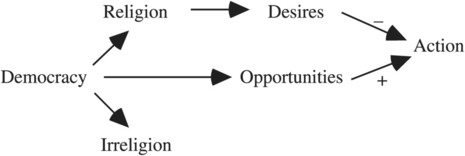 Figure 2.1
Mechanisms and laws
Often, explaining by mechanisms is the best we can do, but sometimes we can do better. Once we have identified a mechanism that is “triggered under generally unknown conditions,” we may be able to identify the triggering conditions. In that case, the mechanism will be replaced by a law, albeit usually a weak one in the sense defined earlier.
Common sense assumes that a gift will make the recipient feel grateful. If he does not, we blame him. The classical moralists – from Montaigne to La Bruyère – argued that gifts tend to make recipients resentful rather than grateful. It seems that both common sense and the moralists are on to something, but they do not tell us when we can expect the one or the other outcome. A moralist from classical antiquity, Publilius Syrus, stated triggering conditions: a small gift creates an obligation, a large one an enemy.16 By appealing to the size of the gift as a triggering condition, we have transformed the pair of mechanisms into a law-like statement. To cite another example, we might be able to state when a tension between a desire and a belief (“cognitive dissonance”) is resolved by modifying the belief and when it is resolved by modifying the desire.17 Purely factual beliefs may be too recalcitrant to be easily modified (Chapter 7). The person who paid $75 for a ticket to a Broadway show cannot easily fool himself into thinking he only paid $40. As noted, he may be able, however, to find some attractive aspects of the show and persuade himself that these are more important than the ones in which it is deficient.
Earlier, I mentioned the contrast between the “forbidden fruit” mechanism and the “sour grapes” mechanism. In some cases, we may be able to predict which will be triggered. In an experiment, subjects in one condition were asked to rank four records according to their attractiveness and told that the next day they would receive one of them, chosen at random. Subjects in another condition ranked the records and were told that the next day they would be able to choose one of them. The next day, all subjects were told that the record they had ranked third had, for some unknown reason, become unavailable and asked to rank the four records again, as part of an attempt to discover how listening to a record for the second time might affect one's evaluation of it. As predicted by reactance theory, subjects in the first condition displayed the “sour grapes” effect by downgrading the value of the unavailable option whereas those in the second showed the “forbidden fruit” effect by upgrading it. I return to this puzzling example in Chapter 9.
Let me consider, however, a more complex example. With regard to the pair of proverbs “Absence makes the heart grow fonder” and “Out of sight, out of mind,” there is actually a third proverb suggesting a triggering condition: “A short absence can do much good.” La Rochefoucauld proposed a different condition: “Absence lessens moderate passions and intensifies great ones, as the wind blows out a candle but fans up a fire.”18 These plausible propositions are not very strong laws. To be able to predict the course of passion, we would have to know what counts as a short absence (three weeks?) and as a strong passion (one that keeps you awake at night?). Also, we would have to specify how duration of absence and strength of passion interact to generate increase or decrease of passion during an absence. Let me pursue the last issue.
Interaction among causes
In general, the social sciences are not very good at explaining how causes interact to produce a joint effect. Most commonly, one assumes that each cause contributes separately to the effect (an “additive model”). To explain income, for instance, one may assume that it is caused in part by parental income and in part by parental education, and then use statistical methods to determine the relative contributions of these two causes. For the example I have discussed, this approach might not be adequate. The duration of the absence might not make a separate contribution to the strength of the post-absence emotion; rather its effect might depend on the strength of the pre-absence emotion. This interaction effect is shown in Figure 2.2.
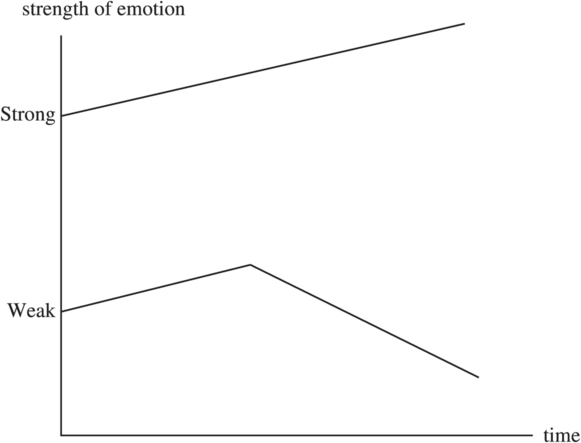 Figure 2.2
Some scholars argue, though, that the world – or at least the part of it they study – simply does not exhibit many interactions of this kind. It is rarely the case, they claim, that for low levels of independent variable X the dependent variable Z increases (decreases) with dependent variable Y, whereas for high levels of X an increase in Y causes a decrease (increase) in Z. The hypothesized relation in Figure 2.2 would (if it exists) be an exception. At most, they argue, what we find is that at low levels of X, Y has little effect on Z, whereas it does have an effect at higher levels of X. In explaining income, for instance, one may assume that parental income contributes more or less at different levels of parental education. This kind of interaction can be captured by a multiplicative interaction term so that Z is a function of X, Y, and XY. By contrast, the reversal of the causal effect of Y on Z at higher levels of X cannot be captured in this way. In Chapter 4 I discuss a case in which the reversal is highly plausible. Following Bentham, I argue that aptitude for public office is a multiplicative function of the official's virtue, ability, and energy. For low levels of virtue, the two other variables have a negative effect on that aptitude; for high levels, a positive effect.
The existence of an interaction effect may be subject to the same kind of indeterminacy that we find in mechanisms more generally. Consider the interaction between age and basic political attitudes as causes of extremism. One might guess that the youth organizations will be to the left of the parties themselves, giving the Young Conservatives a lighter shade of blue. Alternatively, the youth organizations of the political parties will be more extreme than the parties themselves, in which case the Young Conservatives would have a darker shade of blue. (The young Socialists would be to the left of the party on either hypothesis.) Both guesses seem plausible, and both patterns have in fact been observed. Or consider the interaction between preconsumption mood and drug consumption as causes of postconsumption mood. One might guess that drugs such as alcohol or cocaine are mood lifters, attenuating depressions and turning contentment into euphoria. But one might also suspect drugs to be mood multipliers, making bad moods worse and good moods better. Again, both guesses seem plausible and both patterns are observed. In both cases, the first mechanism is compatible with an additive model, whereas the second implies a reversal effect.
When faced with recalcitrant data adding an interaction term, or “curve fitting,” is not the only possible response. There is an alternative strategy, that of “data mining.” In a curve-fitting exercise, one keeps the dependent and independent variables fixed and shops around, as it were, for a mathematical function that will give a good statistical fit. In a data-mining exercise, one keeps the mathematical function fixed (usually a simple additive model) and shops around for independent variables that have a good fit with the dependent variable. Suppose that by a “good fit” we mean a correlation that would only have a 5 percent probability of occurring by chance. In any study of a complex social phenomenon such as income, one can easily list a dozen variables that might conceivably affect it.19 Also, there are probably half a dozen different ways of conceptualizing income. It would be very unlikely if none of the independent variables showed a correlation at the 5 percent level with one of the definitions of income.20 The laws of probability tell us that the most improbable coincidence would be if improbable coincidences never occurred.21
Once a scholar has identified a suitable mathematical function or a suitable set of dependent or independent variables, she can begin to look for a causal story to provide an intuition to back the findings. When she writes up the results for publication, the sequence is often reversed. She will state that she started with a causal theory; then looked for the most plausible way of transforming it into a formal hypothesis; and then found it confirmed by the data.22 This is bogus science. In the natural sciences there is no need for the “logic of justification” to match or reflect “the logic of discovery.” Once a hypothesis is stated in its final form, its genesis is irrelevant. What matters are its downstream consequences, not its upstream origins. This is so because the hypothesis can be tested on an indefinite number of observations over and above those that inspired the scholar to think of it in the first place. In the social sciences (and in the humanities), most explanations use a finite data set. Because procedures of data collection often are non-standardized, scholars may not be able to test their hypotheses against new data. And if procedures are standardized, the data may fail to reflect a changing reality. It is impossible to explain consumption patterns, for instance, without taking account of new products and of the changing prices of old ones.
There is no doubt that sharp practices of this kind occur. I do not know how common they are, only that they are sufficiently widespread to cause thoughtful social scientists to worry. The main cause of the problem is perhaps our inadequate understanding of multifactorial causality. If we had strong intuitions about how several causes can interact to produce an effect, there would be no need to rely on the mechanical procedure of “adding an interaction term” when an additive model fails. Yet because our intuitions are weak, we do not really know what to look for, and then tinkering with models seems the only alternative – at least if we retain the ambitious goal of providing law-like explanations. Given the dangers of tinkering, perhaps we should lower our ambitions instead.
Bibliographical note
Many of the ideas in this chapter are adapted from Chapter 1 of my Alchemies of the Mind (Cambridge University Press, 1999). There I also cite works by Raymond Boudon, Nancy Cartwright, and Paul Veyne that advocate similar proposals. A recent statement is P. Hedström, Dissecting the Social (Cambridge University Press, 2005). The observation by John Paul Vann is in N. Sheehan, A Bright Shining Lie (New York: The Modern Library, 2009), p. 111. Useful ways of thinking about psychological mechanisms include F. Heider, The Psychology of Interpersonal Relations (Hillsdale, NJ: Lawrence Erlbaum, 1958), and R. Abelson, Statistics as Principled Argument (Hillsdale, NJ: Lawrence Erlbaum, 1995). The latter also offers wise and witty remarks about the pitfalls and fallacies of statistical analysis. On these issues, two books by David Freedman are indispensable: Statistical Models (Cambridge University Press, 2005) and Statistical Models and Causal Inference (Cambridge University Press, 2009). A standard brief exposition of the idea that science explains by general laws is C. Hempel, Philosophy of Natural Science (Englewood Cliffs, NJ: Prentice-Hall, 1966). The principle of methodological individualism is thoroughly covered in Part 4 of M. Brodbeck (ed.), Readings in the Philosophy of the Social Sciences (London: Macmillan, 1969), and in Part 6 of M. Martin and L. McIntyre (eds.), Readings in the Philosophy of Social Science (Cambridge, MA: MIT Press, 1994); see also K. Arrow, “Methodological individualism and social knowledge,” American Economic Review: Papers and Proceedings 84 (1994), 1–9. I have written more systematically on proverbs in “Science et sagesse: le rôle des proverbes dans la connaissance de l'homme et de la société,” in J. Baechler (ed.), L'acteur et ses raisons: Mélanges Raymond Boudon (Paris: Presses Universitaires de France, 2000). The idea of the “psychology of tyranny” is taken from J. Roemer, “Rationalizing revolutionary ideology,” Econometrica 53 (1985), 85–108. The study of subjects who were promised records is J. Brehm et al., “The attractiveness of an eliminated choice alternative,” Journal of Experimental Social Psychology 2 (1966), 301–13. A general introduction to reactance theory is R. Wicklund, Freedom and Reactance (New York: Wiley, 1974). Skepticism about interaction that induces reversal effects is found in R. Hastie and R. Dawes, Rational Choice in an Uncertain World (Thousand Oaks, CA: SAGE, 2001), Chapter 3. The pervasive presence of unlikely coincidences is the subject of D. Sand, The Improbability Principle (New York: Scientific American, 2014). The footnoted story of the 6 percent significant correlations is told in R. R. McCrae and P. T. Costa, “The paradox of parental influence,” in C. Perris, W. A. Arrindell, and M. Eisemann (eds.), Parenting and Psychopathology (New York: Wiley), pp. 113–14. The footnoted example of the impact of bad weather on stock market traders is taken from P. Kennedy, “Oh no! I got the wrong sign! What should I do?” Journal of Economic Education 36 (2005), 77–92, which also contains useful comments on the costs (and benefits!) of data mining more generally.
1 In some of my earlier writings I used “mechanism” to denote what I now call “causal chains.” In more recent work I began to use “mechanism” in the sense defined later in this chapter. I should probably have chosen a different terminology, but it is too late now.
2 As noted later, the second explanation was at one point seriously proposed.
3 Some mathematicians are unhappy with the computer-generated proof of the four-color theorem, because they do not provide an intuitive understanding of why it is true.
4 Moreover, for some goods demand goes up when prices go up. Consumers may be attracted to a good because it is expensive (the “Veblen effect”) or buy less of a good such as bread when its price falls because they can afford to replace some of it by higher-quality goods such as meat (the “Giffen effect”).
5 To be sure, it is often said that the strength of altruistic feelings toward others varies inversely with their social distance from the agent. Yet the idea of “social distance” is more like a metaphor than like a concept, and in any case “varies inversely” is much less precise than “varies inversely with the square of the distance.”
6 As we shall see in Chapter 12, however, proverbs are not always wise.
7 If one person fears and another person hopes for the same event, they may converge on the unfounded belief that it will occur, while more sober persons discard it. I give several examples in later chapters of such cognitive alliances of motivational opposites.
8 Conversely, the memory of a good experience is a good experience. Thus Tennyson: “'Tis better to have loved and lost than never to have loved at all.”
9 Conversely, the memory of a good experience devalues the present. Thus Donne: “'Tis better to be foul than to have been fair.”
10 Sometimes the hatred found a different target. In three villages in Central and Northern Italy where the Germans undertook savage reprisals in 1944, some villagers were still hostile to the partisans fifty years later because they were seen as indirectly or even “truly” responsible for the massacre. When A causes B to kill C, relatives and friends of C may direct their anger at A rather than B. In the resistance movements that were fighting German occupational troops, both mechanisms were observed.
11 In 2014, the Shejaiya Brigade of Hamas allegedly issued a combat manual encouraging its fighters to deploy in densely populated areas and stating that “the destruction of civilian homes” in Gaza by Israeli bombing was welcome because it “increases the hatred of the citizens towards the attackers.” Whether or not the allegation is correct, the strategy is not without precedent. It can backfire in two ways, either if the civilians’ fear dominates their hatred or if their hatred is directed at those who cause civilians to be killed by the enemy rather than at the enemy (see previous footnote).
12 A special feature of this example is that one of the two competing effects (the reactance) is induced by the other (the barrier). In the other examples, the two effects are caused simultaneously by a common cause (e.g. the tyrant's oppression).
13 I am taking a bit of a liberty with these proverbs. In its literal meaning the French phrase une brebis galeuse refers to a sheep with a skin disease caused by an arachnidan parasite.
14 Tocqueville did not explain their espousal of religion by its social benefits, but, consistently with methodological individualism, by the need of individuals to have some authority in their lives. If the citizen “has no faith, he must serve, and if he is free, he must believe.”
15 Other examples may be cited of peoples refraining from doing what the laws allow them to do. Montesquieu wrote that “We know that though the people of Rome assumed the right of raising plebeians to public offices, yet they never would exert this power; and though at Athens the magistrates were allowed, by the law of Aristides, to be elected from all the different classes of inhabitants, there never was a case, says Xenophon, when the common people petitioned for employments which could endanger either their security or their glory.” Gibbon asserts that “the Lombards possessed freedom to elect their sovereign, and sense to decline the frequent use of that dangerous privilege.” Unlike Tocqueville, neither Montesquieu nor Gibbon offers a mechanism to explain why these peoples pulled their punches.
16 I am cheating a bit here, to get the example right, since Syrus refers to loans rather than to gifts. Although it seems plausible that both the loan and the gift of a large sum of money can make the recipient feel resentful, they probably do so in different ways.
17 Recall, however, that the tension may be left unresolved.
18 To an observation by Darcy (in Pride and Prejudice), “I have been used to consider poetry as the food of love,” Elizabeth Bennet responds, “Of a fine, stout, healthy love it may. Every thing nourishes what is strong already. But if it be only a slight, thin sort of inclination, I am convinced that one good sonnet will starve it entirely away.”
19 Thus in one longitudinal study of the relation between maternal practices and child outcomes, only 35 of 552 correlations were statistically significant “at the p < 0.05 level” (meaning that there was one chance in twenty that they obtained by chance), a fact only evident to those who read the appendixes of the book. In the reprint edition, these were deleted.
20 Theory may suggest that bad weather depresses stock market traders, causing them to sell. Scholars report, however, the opposite result when bad weather is defined as 100 percent cloud cover. By changing the definition of bad weather to cloud cover above 80 percent, the sign of the correlation magically reverses.
21 I have two personal experiences. The first time I visited New York I bought tickets for two Broadway shows, one built around the music of Fats Waller and the other around that of Duke Ellington. There were few tickets left, so I had to take what I could get – which, in both shows, was row H, seat 130. This was merely uncanny, but another coincidence felt more significant. There are two experiences I have only had once. One is being invited to a dinner party and then forgetting I'd been invited. The other is being invited to a dinner party and then having the host call me up half an hour before I was supposed to be there, to tell me he had to cancel because of illness. The coincidence, which made me think for a second that someone was watching over me, is that this was one and the same party.
22 Hence there are three problems about using correlation as a guide to causality. First, the correlation may arise purely by chance and have no causal interpretation. Second, the correlation may have an indirect causal interpretation if the two correlated phenomena are common effects of a “third factor.” Third, the direction of causality might be ambiguous.