
Part III
Although I shall largely use “action,” “behavior,” “decision,” and “choice” as synonymous terms, it can be useful to distinguish among them. The broadest category is behavior, understood as any bodily movement whose origin is internal to the agent, not external (as when he is carried away by a landslide). Action is intentional behavior, caused by the desires and beliefs of the agent. Thus reflex behaviors are not actions; having an erection is not an action (but it may be induced by one, such as taking Viagra); falling asleep is not an action (but may be induced by taking a sleeping pill).
An action may or may not be preceded by a conscious decision. When Pascal said that we are “automata as well as minds” and Leibniz that “we are empirical in three-quarters of our actions,” they referred to the habitual and unthinking character of much everyday behavior. When I drive to work along my usual route I do not consciously decide to turn right here and left there. The very first time or times I drove to work, however, the actions were preceded by explicit decisions. In fact, they were preceded by an explicit choice among alternative paths. Although all choices are decisions, the converse is not true. When I decide to pick up the book I have been reading, I need not have any explicit alternative in mind. I see the book on the table; the sight reminds me that I have enjoyed reading it; and I decide to pick it up. No choice is involved.
The focus in Part III is on choice. I believe that the concept of choice is the most fundamental idea in the social sciences. In Part II, I considered the subjective precursors of choice: preferences (desires, motivations), beliefs, emotions, and prejudices, as well as some precursors of these precursors. In the following chapters, I consider the mechanisms by which these precursors generate choices and, usually, actions. I say “usually,” because not all choices lead to actions. One may choose not to do something, for example, not to save a drowning person if the intervention would be at some risk to oneself. If the person drowns and no third parties are involved, I have no causal responsibility for the outcome. I may have a moral and, in some countries, a legal responsibility, but that is another matter.1 But suppose there is a third party present or, as in the “Kitty Genovese” case, many parties. If the third party observes that I am in a position to help the drowning person and that I do not, he or she might reasonably draw the inference that the situation is less serious than it would otherwise have seemed and, as a result, also abstain from helping. In that case, my choice to do nothing would have caused another person to choose to do nothing. Thus choices can have causal efficacy even when they do not generate an action.
Constraints and selection offer two alternative paths to the explanation of behavior. In Chapters 10 and 11 I consider the explanatory power of these two objective factors. When subjective factors are constant over time or invariant across agents, changes or differences in the constraints they face may explain changes or differences in behavior. More generally, subjective factors and constraints interact, in complex ways, to produce actions. Selection mechanisms rely on (mostly) random variation and (mostly) deterministic selection among the randomly generated variants, without the intervention of choice. Yet in some cases the sources of variation and the mechanisms of selection also include choice. Whereas selection is hugely important in biology, I believe it is marginal in the social sciences. Because humans are animals, some basic action tendencies are shaped by natural selection, but with few exceptions they can be modulated or suppressed by individual or collective choice.
Chapters 13 through 15 are organized around rational-choice theory and its alternatives. In these chapters, I deal with individual actions only. In Chapters 18 and 19, I consider rational-choice explanations in interactions among several agents. As I discuss in Chapter 14 and in the Conclusion, I have come to be more skeptical of rational-choice explanations of action than I used to be. Yet although much behavior is irrational in one way or another, there is a sense in which rationality remains primary. Human beings want to be rational. We do not take pride in our lapses from rationality. Rather, we try to avoid them or correct them, unless our amour-propre prevents us from recognizing them (Chapter 9).
I conclude Part III by considering the production of works of art, mainly novels and plays, as actions that can be explained along the same lines as other actions. (Some observations on this topic are also offered in Chapter 10.) The advantage of this approach is that there is a fact of the matter by virtue of which a given explanation, if right, is right and, if wrong, is wrong.
1 In the United States, there is no duty to be a Good Samaritan, except under narrowly circumscribed conditions. In continental Europe, “non-assistance to a person in danger” can be severely punished if the risk to the Samaritan of helping is small compared to the danger of the person in need of help. Some American legal scholars argue that the American law is more efficient, since a general duty to assist would create an incentive for potential rescuers to avoid locations where rescues are likely to be needed, because of the threat of liability. This may or (more likely) may not be so; what does seem certain is that the American system did not come into being for efficiency reasons, nor did it come into being for other reasons and then continue in effect because of its efficiency properties.
10
To characterize and explain behavior, we sometimes say, “He did the best he could.” Here, “the best” is defined by the agent's desires or preferences. What the agent “could do” is defined by his opportunities and his abilities. An opportunity, according to the Oxford English Dictionary, is “a time, condition, or set of circumstances permitting or favorable to a particular action or purpose.” An ability is the “quality in a person or thing which makes an action possible; suitable or sufficient power or proficiency.” While not unambiguous, the definitions suggest that an opportunity is an enabling factor external to the agent, whereas an ability is an enabling factor internal to him or her.
Typically, an agent needs both opportunities and abilities to realize her desires. If I have a horse and need to get somewhere in hurry, but do not know how to ride, I am likely be thrown off. If I have the skill and the desire, but lack a horse, I will not be going anywhere. (“A horse, a horse, my kingdom for a horse!”) A basketball player will not score if others do not provide him with an opportunity, by passing the ball to him, or if he is too unskilled to profit from his opportunities.
In military parlance, the idea of capabilities usually includes both opportunities and abilities, typically related to action in a multiplicative rather than additive fashion. A commander has to estimate both the weaponry available to the enemy and the skill to use it. Advanced materiel in the hands of soldiers not trained to use it may be worthless. Some philosophers argue that capabilities – defined as “a person's opportunity and ability to generate valuable outcomes” (Wikipedia) – should be the central concept in a theory of distributive justice. For some purposes, capabilities may indeed be the most relevant factor. For my purposes, I want to consider the two components of capabilities separately.
In most of the cases I shall discuss, desires, opportunities, and abilities are jointly sufficient and individually necessary to produce an action. If we observe that an agent does not perform some action and we want to know why (see Chapter 1 on “why-explanations” of non-events), the absence of any one of the three factors might provide the answer. Citing the absence of more than one factor would provide an overdetermined explanation. In Democracy in America, Tocqueville provides a striking example when he argues that all three factors were absent. As other observers have been, he was puzzled by what he perceived as the low intellectual and moral quality of elected politicians in the United States. He argued that American citizens had neither the opportunity to select good leaders (because qualified persons do not to stand for office), nor a desire to do so (because of envy of superior individuals), nor the ability (because of lack of cognitive discernment).1 In other cases, two factors may be absent. As I discuss later, both Tocqueville and James Madison cite the absence of two factors – desires and opportunities – to account for certain non-events (see Chapter 1).
In standard cases, desires, opportunities, and abilities are given independently of each other. Sometimes, however, the factors may be related through a common cause, or one of them may directly influence another. I shall give examples of both cases.
Desires and opportunities
Opportunities are the options or means available to the agent. If we ask, “Why did he do it?,” the answer “Because it was his best option” provides a rudimentary rational-choice account of the behavior. In many cases, more is needed to provide a satisfactory rational-choice explanation. These complications will concern us in Chapter 13. Here, I discuss how far the simple desire–opportunity framework can get us, and some limitations of that framework. In particular, the usually tacit assumption that agents are aware of the opportunities open to them is not always justified.
There is another, equivalent way of looking at the matter. In understanding behavior, we may begin with all the abstractly possible actions the individual might undertake. The action that we actually observe can be seen as the result of two successive filtering operations. The first filter is made up of all the opportunity constraints – physical, economic, legal, and others – that the agent faces. The actions consistent with all these constraints constitute the opportunity set.2 The second filter is a mechanism that determines which action within the opportunity set will actually be carried out. Here, I am assuming that the agent chooses the action that will have the best consequences, as assessed by his desires (or preferences). In later chapters, we shall consider other second-filter mechanisms.
The filter approach suggests the following question: what if the constraints are so strong that there is nothing for the second filter to work on? Can it happen that the constraints uniquely determine one and only one action that is consistent with all of them? The rich and the poor alike have the opportunity to sleep under the bridges in Paris, but the poor may have no other opportunity.3 For a poor consumer, economic and calorific constraints might jointly determine a unique bundle of goods.4 Those who defend the idea of structuralism in the social sciences may be understood as saying that constraints typically are so strong as to leave very little or no scope for choice.5 Why this should be so, however, remains mysterious. One cannot argue, for example, that the rich and powerful make sure that the poor and oppressed have no other option than to work for them, since this statement presupposes that the rich and powerful, at least, do have a choice (see next paragraph).
The constraints may also be so strong that no action satisfies them all. In that case, the constraints may provide a why-explanation of a non-event. Time constraints and space constraints, for instance, may jointly preclude action. In mid-nineteenth-century Massachusetts, “polls were closed at sunset, to disfranchise, according to Democrats, Cambridge laborers who worked in Boston but had to vote in their place of residence. When they returned home the polls were closed.” Note that the explanation also cites the choice of the Republicans to prevent Democrats from voting.
Even when behavior is the joint result of desires and opportunities, variation in behavior over time may be largely explained by opportunities. Alcohol consumption is, in general, determined both by the strength of people's desire to drink, compared to their other desires, and by what they can afford. When alcohol prices rise steeply, for instance, in wartime, consumption falls sharply.
One explanation could be in terms of indifference curves (Figure 10.1). Suppose that the consumer has to allocate her income between alcohol and some bundle of ordinary consumption goods. The relative prices and her income are initially such that she faces the opportunity set inside the triangle OAA′. Assuming she spends all her income, we can limit ourselves to the budget line AA′.6 The strength of her desires for alcohol versus the consumption bundle is shown in the shape of the indifference curves I, I′, and I′′. The term reflects the idea that the consumer is indifferent among all the combinations of alcohol and other goods that lie on any given curve, while preferring any combination on a higher curve to any on a lower curve.7 To choose the best among the options available to her, the consumer must pick the point on the budget line that is tangent to an indifference curve, since this will be the highest among the curves that include a combination she can afford. In Figure 10.1, this yields alcohol consumption OX.
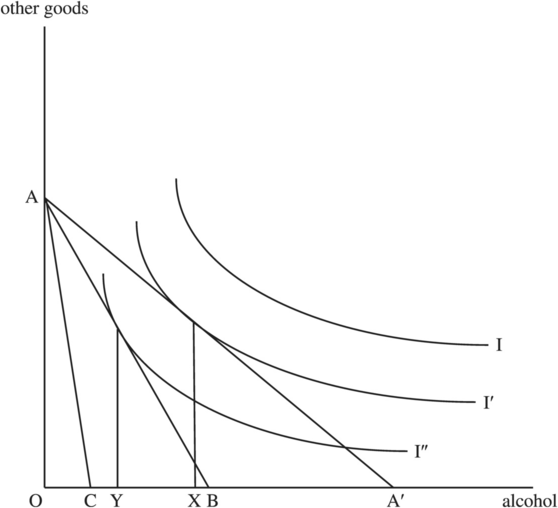 Figure 10.1
Suppose now that the price of alcohol goes up so that the consumer faces the budget line AB. As the point of tangency has moved to the left, the consumer will now consume OY. We could carry through the same reasoning if a further price increase shifts the budget line to AC. Yet even if we know nothing about the shape of the indifference curves, we can predict that in this situation the consumer will not consume more than OC, which would be the case if she spent all her income on alcohol. The opportunity set by itself can explain a great deal of the variation over time. The second filter, in fact, could be anything – optimizing behavior, an irresistible craving for alcohol, custom, or whatever – the consumer would still be severely restricted by the first filter.
I chose this particular example to discuss the question of allegedly “irresistible” desires, such as the desire of drug addicts, heavy smokers, or alcoholics for the substance to which they are addicted. Are drugs more like insulin, which a diabetic will buy at any price, or more like sugar, of which consumers routinely purchase less when the price goes up? As proof that they are more like sugar, one often cites the fact that drug consumption goes down when prices go up. Yet as we have seen, that might simply be due to the inability of the addict to consume beyond his budget. (The diabetic, too, might be unable to purchase the insulin he needs if the price goes up.) Thus it seems that the fall of alcohol consumption during wartime is often due to its unavailability, leaving the question of irresistible versus resistible desires unresolved. We do know on other grounds, however, that alcohol consumption is price sensitive. Even when consumers can afford to maintain their previous level of consumption at higher prices, they do not.
One can also argue that opportunities are more basic in a further respect: they are easier to observe, not only by social scientists, but also by other individuals in society. In military strategy, a basic dictum is that one should plan on the basis of the opponent's (verifiable) opportunities, not on his (unverifiable) intentions.8 If we have reason to believe that the opponent might have hostile intentions, the dictum can lead to worst-case assumptions: the opponent will hurt us if he can. The situation is complicated by the fact that our belief in the hostile intentions of the opponent may be grounded in a perception that he believes we have the means and perhaps the intention of hurting him. In this morass of subjectivity, objective opportunities may seem to provide the only firm basis for planning. In strategic debates over the Vietnam War, Lieutenant General Goodpaster protested to Secretary McNamara in the fall of 1964, “Sir, you are trying to program the enemy and that is one thing we must never try to do. We can't do his thinking for him.”
Still another reason why opportunities may appear more fundamental than desires has to do with the possibility of influencing behavior. It is usually easier to change people's circumstances and opportunities than to change their minds.9 This is a cost–benefit argument about the dollar effectiveness of alternative policies – not an argument about relative explanatory power. Even if the government has a good theory, allowing for explanation as well as prediction, it may not allow for much control, since the elements on which it can act may not be the causally important ones. Suppose that the government is persuaded that weak economic performance can be traced back to risk-averse businesspeople and to strong unions. It may be fully convinced that the mental attitude of managers is the more important cause yet be unable to do anything about it. By contrast, as the Reagan and Thatcher years showed, unions can be broken by government action.
For an important example, consider suicidal behavior. To commit suicide, the desire to kill oneself is not enough: one must also find the means to do it. The high suicide rate among doctors, for instance, may be due in part to their easy access to lethal drugs, which are the favored means of suicide in this group.10 Although the government may try to limit suicidal intentions, by providing help lines or persuading the media to play down the reporting of suicides, which can trigger suicide by contagion, the most effective results are obtained by making access to the means of suicide more difficult.11 Policies include barriers that make it more difficult to jump from bridges or tall buildings, more rigorous control of certain prescription drugs, restrictions on the sale of handguns, the replacement of lethal carbon monoxide by natural gas in kitchen ovens, and the installation of catalytic converters that reduce the carbon monoxide emissions in motor vehicle exhausts. In the future, we may see the banning of “suicide help” internet sites. (Strictly speaking, this measure would not eliminate any opportunities, only knowledge about them.) The simple switch from bottles to blister packs has contributed to the reduction of the number of suicides and severe liver damage from paracetamol poisoning. Although strong, the urge to kill oneself is so short-lived that by the time one has managed to open all the blisters it may have subsided. Reducing the maximum number of tablets that can be available in individual preparations has also reduced the likelihood of severe poisonings. By the time one has done the round of pharmacies to buy enough bottles, the urge may have subsided.12 In China, interrogations of officials suspected of corruption are held in rooms at the ground level, to prevent them from killing themselves by jumping out of the window (Financial Times, October 17, 2014).
To be sure, a determined individual will usually find a way. When one common means of taking one's life is removed, the ensuing drop in the suicide rate may to some extent be a temporary one. Yet in some cases at least, the effect seems to have been lasting, as one would expect. If the urge to kill oneself is fleeting rather than firmly anchored, it might be gone by the time one manages to get hold of a suitable means.13 Hence merely delaying (rather than blocking) access to means could be effective in preventing impulsive suicides. The requirement of a waiting time before the purchase of a handgun could reduce suicide as well as homicide rates.14 I pursue this issue in Chapter 15.
A more complex example of desire–opportunity interactions may be taken from Madison's analysis of factions in The Federalist # 10. He argues that to prevent a factious majority from oppressing the minority, “Either the existence of the same passion or interest in a majority at the same time must be prevented, or the majority, having such coexistent passion or interest, must be rendered, by their number and local situation, unable to concert and carry into effect schemes of oppression. If the impulse and the opportunity be suffered to coincide, we well know that neither moral nor religious motives can be relied on as an adequate control.” Objectively, the members of a factious majority have the opportunity to oppress the minority. Yet, as Madison goes on to argue, concerted action may be difficult if they do not know they have that opportunity. If you extend the size of the republic, “you make it less probable that a majority of the whole will have a common motive to invade the rights of other citizens; or if such a common motive exists, it will be more difficult for all who feel it to discover their own strength, and to act in unison with each other.”15 Madison's argument is, as it were, double-barreled: not only will a large republic prevent factious majorities from arising, but it will also prevent concerted action were one such majority to arise. Conversely, in small republics such majorities are not only more likely to arise, but also more likely to organize themselves.
In Tocqueville's Democracy in America we find a large number of arguments with this “not only” structure. As an example, consider his discussion of the impact of slavery on slaveowners. In the first place, slavery is unprofitable, compared to free labor. “The free worker receives wages, the slave receives an upbringing, food, medicine, and clothes; the master spends his money little by little in small sums to support the slave; he scarcely notices. The workman's wages are paid all at once and seem only to enrich the man who receives them; but in fact the slave has cost more than the free man, and his labor is less productive.”16 But “the influence of slavery extends even further, penetrating the master's soul and giving a particular turn to his ideas and tastes.” Because work is associated with slavery, the southern whites scorn “not only work itself but also enterprises in which work is necessary to success.” They lack both the opportunities and the desire to get rich: “Slavery … not only prevents the white men from making their fortunes but even diverts them from wishing to do so.” If Tocqueville is right, a classic debate over the economic stagnation of slave societies is spurious. There is no need to ask whether lack of investment desires or lack of investment opportunities provides the correct explanation: both sides could be right.
In other contexts, Tocqueville argues that in some societies the lack of desire may provide why-explanations of non-events that, in others, are explained by lack of opportunities. Comparing ancient and modern (American) slaves, he writes that in “Antiquity, people sought to prevent the slave from breaking his chains; nowadays they seek to sap his desire to do so … It was noticed long ago, moreover, that the presence of the freed Negro was vaguely disquieting to the souls of the unfree, in whom it aroused the first glimmering of an idea of their rights. In most cases, therefore, Americans in the South stripped masters of their prerogative to free their slaves.” In a striking anticipation of Tocqueville's argument, a Virginia politician said that “If the blacks see all of their color slaves, it will seem to them a disposition of Providence and they will be content.” For the same reason, many whites wanted free blacks to be deported to an African colony, where they would be out of sight and out of the mind of the slaves.
The argument has a wide application. Writing in 1800, Governor Monroe of Virginia was puzzled by the slave insurrection that took place that year. “It seemed strange that the slaves should embark in this novel and unexampled enterprise of their own accord, [as] their treatment has been more favorable since the revolution.” He concluded that external agitators must have been at work. In his book on the ancien régime, Tocqueville solved the puzzle: “The evil one endures patiently because it seems inevitable becomes unbearable the moment its elimination becomes conceivable. Then, every abuse that is eliminated seems only to reveal the others that remain, and makes their sting that much more painful. The ill has diminished, to be sure, but sensitivity to it has increased.” Roughly a hundred years later, The Wall Street Journal was still puzzled, when it wrote (July 18, 1966) that it “is surprising, although to an extent understandable, that the more civil rights is piled onto the statute books, the more Federal money poured into attempts at Negro betterment – the more the anger rises.”17 It is possible, though, that the 1800 and 1966 examples reflect the tendency for desires to rise faster than the means of satisfying them. Although this idea is often attributed to Tocqueville, it is not what he argued.
Relations between desires and opportunities
Some of the arguments made by Madison and Tocqueville have a common structure: one and the same third variable shapes both desires and opportunities, which jointly shape action (or prevent it, as the case may be). In the abstract, there are four possibilities (plus and minus signs indicate positive and negative causal effects) (see Figure 10.2).
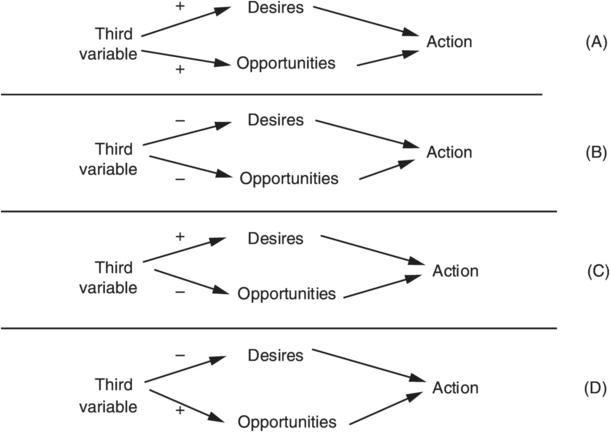 Figure 10.2
Case (A) is illustrated by Madison's analysis of direct democracies or small republics.
Case (B) is exemplified by his argument in favor of large republics and by Tocqueville's analysis of the effects of slavery on the slaveowner.
Case (C) is observed in the many cases in which lack of resources has the dual effect of increasing the incentive to improve one's situation and of reducing one's opportunity to do so. Although it is said that “necessity is the mother of invention,” that is true only to the extent that hardship increases the motivation to innovate. But since innovation often requires resources (which might therefore be called “the father of invention”), the motivation by itself may not lead anywhere. Innovation often requires costly investments with an uncertain and delayed pay-off – but this is exactly what firms on the brink of bankruptcy cannot afford. Prosperous firms can afford to innovate but may not bother to do so. As the economist John Hicks said, “The greatest of all monopoly profits is a quiet life.”
Similarly, while the desire to emigrate is enhanced by poverty in one's home country, the same poverty may block access to the means of emigration because of the costs of travel. Until the early nineteenth century, emigrants to the United States could use their bodies as collateral. Their future employers would pay for the trip in exchange for a period of indentured servitude. Today, smugglers of humans can rely on fear of the Immigration and Naturalization Service to prevent illegal immigrants from reneging on their promise to repay travel costs out of their income from labor in the receiving country. But when the Irish fled their famine in the 1840s, the poorest stayed home to die.
A further instance of case (C) is found in the study of peasant rebellions: although the poor peasants have the greatest incentive to rebel, they may not have the resources to do so. Participation in collective action requires the ability to take time off from productive activities, which is precisely what the impoverished peasant cannot afford. The middle peasants who have managed to save a bit can afford to join a rebellion, but their motivation is less acute. Marx argued that civilization arose in the temperate zones because only there did the desire for improvement meet with opportunities for improvement. Where nature is too lavish there is no desire, and where it is too scanty there are no opportunities. There may be a range of resources within which both desires and opportunities are sufficiently developed to generate action, but a priori nothing can be said about how wide or narrow it is, or whether it even exists.
We have seen an instance of case (D) in Chapter 2. The upper part of Figure 2.1 shows how Tocqueville argued that democracy (by the intermediary of religion) inhibited the desire to engage in the disorderly behavior for which democratic institutions such as freedom of the press and freedom of association provided an opportunity. A more commonplace observation by Tocqueville relies on the conjunction of (C) and (D), with young or old age as the third variable: “In America most rich men began by being poor; almost all men of leisure were busy in their youth; as a result, at the age when one might have a taste for study, one has not the time; and when time is available, the taste has gone.”
Desires and opportunities may also affect each other directly: consider first case (E) in Figure 10.3. In Chapter 2 I touched on some of the ways in which opportunities can affect desires: people may end up desiring most what they can get or prefer what they have to what they do not. Again we may quote Tocqueville on slavery: “Is it a blessing of God, or a last malediction, this disposition of the soul that gives men a sort of depraved taste for the cause of their afflictions?” This mechanism suggests a further reason for thinking opportunities more basic than preferences. Opportunities and desires jointly are the proximate causes of action, but at the same time desires are partly shaped by opportunities through the mechanism of adaptive preference formation.
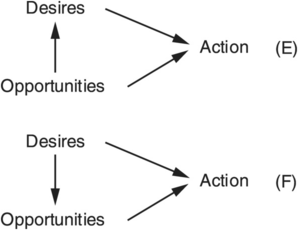 Figure 10.3
One might ask, though, whether this mechanism matters for behavior, since, by definition, options that are not in the opportunity set will not be chosen. Suppose the agent initially ranks options in the order A, B, C, D and then learns that A is unavailable. By adaptive preference formation, she now ranks them in the order B, A, C, D. She will choose B, as she would have had her preferences remained the same. Suppose, however, that the new ranking is C, B, A, D, inducing the choice of C. This might occur through a process of “overadaptation” to the limited opportunities. Tocqueville claimed this was a peculiar characteristic of the Frenchman: “He goes beyond the spirit of servitude as soon as he has entered it.” More likely, we are dealing with a general tendency observed in many status societies. Also, the new preference ranking might be B, C, D, A. If beautiful women reject my advances, I may console myself by the thought that by virtue of their narcissism they are actually the least desirable partners (see the previous chapter). Although my choice of partner may be unaffected, my behavior toward beautiful women in general may change (see the comments on self-poisoning of the mind in Chapter 9).
Consider finally case (F), in which the opportunity set is shaped (specifically: limited) by the agent's desire. I discuss many examples in Chapter 15, where I consider how agents can commit themselves ahead of time by deliberately limiting their future opportunities for choice. In those cases, they do so to preempt or prevent irrational or emotional decisions. Artists may limit their choice set for other reasons. Montaigne wrote that “just as the voice of the trumpet rings out clearer and stronger for being forced through a narrow tube so too a saying leaps forth much more vigorously when compressed into the rhythms of poetry.” Proust, commenting on how his mother was forced to interrupt a conversation, writes that “she managed to extract from this constraint itself a further refinement of thought, as great poets do when the tyranny of rhyme forces them into the discovery of their finest lines.”
Kant formulated the idea quite generally:
It is advisable … to remind ourselves that in all the free arts there is yet a need for something in the order of a constraint (etwas zwangsmässiges), or, as it is called, a mechanism. Without this the spirit which in art must be free and which alone animates the work, would have no body at all and would evaporate completely. This reminder is needed (in poetry, for example, correctness and richness of language, as well as prosody and meter) because some of the more recent educators believe that they promote a free art best if they remove all constraint (Zwang) from it and convert it from labor into mere play.
Perhaps Marx had the last sentence in mind when he made the following polemical remark:
In the sweat of thy brow shalt thou labor! was Jehovah's curse on Adam. And this is labor for Smith, a curse. “Tranquility” appears as the adequate state, as identical with “freedom” and “happiness.” It seems quite far from [Adam Smith's] mind that the individual, “in his normal state of health, strength, activity, skill, facility,” also needs a normal portion of work and the suspension of tranquility. Certainly, labor obtains its measure from the outside, through the aim to be attained and the obstacles to be overcome in attaining it. But Smith has no inkling that this overcoming of obstacles is in itself a liberating activity. [Labor] becomes attractive work, the individual's self-realization [Selbstverwirklichung], which in no way means that it becomes mere fun, mere amusement, as Fourier with grisette-like naiveté, conceives it. Really free working e.g. composing, is at the same time precisely the most damned seriousness, the most intense exertion.
I assume that the constraints or obstacles are chosen by the artist, not imposed by the medium, as in silent movies before 1927, or by a principal, as when Stravinsky, asked to write music for a ballet, replied: “I accept: how many minutes?” Imposed constraints may also liberate creativity, but do not illustrate the desire–opportunity interaction that is my topic here.
These observations provide a natural transition from opportunities to abilities. In the arts, ability cannot thrive without opportunity constraints; conversely, overcoming these constraints requires ability.
Abilities
Ability and desire may be sufficient to generate action, if no external enabling factors are needed. A singer who desires to hit the high C needs only the ability to do so. I shall disregard such cases, and limit myself to cases where ability and desire interact with opportunities.
Earlier, I noted that ability can act as a multiplier on given opportunities. On ten opportunities to score, a good basketball player may succeed on six and an average player only on four. In addition, ability may act as a multiplier on the number of opportunities. Compared to a baseline of average ability, the multiplier may be greater than 1 if teammates pass the ball more frequently to a good player, providing him with more opportunities to score. It may also be less than 1, if the opposing team follows the good player so closely that he receives fewer passes than average players do. If both effects occur, the net effect on the opportunities can be indeterminate. The possibilities are shown in Figure 10.4.
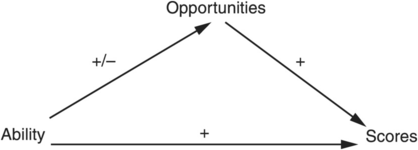 Figure 10.4
Even if the net effect on opportunities is negative, however, the net effect on scores may be positive, if the greater ability to score more than compensates for the smaller number of opportunities to score. Moreover, even if the net effect on his scores is negative, his team may benefit if the players assigned to follow him thereby lose some opportunities to score for the opposing team.
To illustrate an aspect of this issue, consider a famous article that tried to refute the claim that one sometimes observes a “hot hand” in basketball. Basketball players, coaches, and fans all tend to believe that a player can be “on a roll” where he can do no wrong, scoring from the most difficult positions. The authors argued that the belief was a myth, due to a misunderstanding of the operation of chance. Statistical analyses showed that the outcome of shots was largely independent of the outcome of the previous attempt. The finding might, however, be compatible with the existence of a hot hand if the opposing team, correctly observing that the player is on a roll, neutralizes his higher ability to score by reducing his opportunities.18
In many contexts, higher ability obviously increases opportunities. A good applicant to college may be accepted at five institutions, whereas a less able student may be accepted at one or none. As in individual sports, the situation is competitive, but applicants have no opportunity to affect the opportunities of their rivals. Some societies and subcultures seem to punish excellence by ostracizing outstanding individuals or blocking all doors to them. I give some examples in Chapters 24 and 25.
The relation between desires and abilities can take several forms: a strong desire can reduce the ability, a weak ability can reduce the desire, and a strong ability can enhance the desire.
The first effect is illustrated by an example cited by Montaigne: an “excellent bowman was condemned to death, but offered a chance to live if he would agree to demonstrate some noteworthy proof of his skill. He refused to make an assay, fearing that the excessive strain on his will would make his hand go wrong and that instead of saving his life he would also lose the reputation that he had acquired as an archer.” It has often been noted, in fact, that archery and rifle shooting require an almost Zen-like deceleration of the heart rate, to enable the performer to release the string or pull the trigger between the beats. If the stakes are high, this state may be hard to achieve.
The second effect is illustrated by a variety of the “sour-grapes” mechanism. As we have seen, the lack of opportunity to do X may stifle the desire to do X. The lack of ability to do X (given the opportunity) may have the same effect. We tend naturally to upgrade the importance and value of the activities at which we excel, and to downgrade those in which we do poorly. Since for each person in any pair of individuals there is probably one activity at which he or she is better than the other, this transmutation or “life lie” (Chapter 9) may counteract envy. In the long run, though, our amour-propre may be undermined by the lack of appreciation by others of our trivial achievements.
The third effect is illustrated by artists who suffer from excessive ability: they prefer to do what only they can do, at the expense of their art. The jazz singer Sarah Vaughan is one example of the dangers of virtuosity, and there are many others. In much of ancient philosophy – Aristotle and Seneca are examples – it was a given that human beings should cultivate and deploy only the faculties that only human beings possess. Marx took over this idea, when he asserted that self-realization through creative work (see earlier quotation) is the essence – “the species-being” – of humanity.19 Although these are normative rather than explanatory claims, they can explain behavior if agents take them to heart and act upon them.
Abilities can also have opportunities as their object. Having an opportunity is useless if you do not know that you have it. Agents may be more or less able to identify the opportunities. A doctor who has not followed the medical literature since graduating from medical school will be less able to identify opportunities for intervention than one who has kept up to date. New drugs, for instance, may have appeared on the market. Also, having an opportunity is useless if you do not know the consequences of choosing it. Agents may be more or less able to estimate these consequences. The same example illustrates this point, if, for instance, the first doctor is unaware of the side effects of a given drug. These cognitive abilities differ from what we usually think of as physical skills, such as the ability to perform complicated surgery or the ability to score on a basketball shot.
Bibliographical note
The constraints on voting in Massachusetts are cited from C. Williamson, American Suffrage (Princeton University Press, 1960), p. 273. The idea of “irresistible desires” is effectively demolished by G. Watson, “Disordered appetites: addiction, compulsion, and dependence,” in J. Elster (ed.), Addiction: Entries and Exits (New York: Russell Sage, 1999). The claim that all individuals have the same preferences and differ only in the opportunities they face is notably associated with G. Stigler and G. Becker, “De gustibus non est disputandum,” American Economic Review 67 (1977), 76–90. I take the idea of strategic misrepresentation of opportunities by Roman army commanders from S. Phang, Roman Military Service (Cambridge University Press, 2008), p. 68. The idea of adaptive preferences and notably of overadaptation to constraints is due to P. Veyne, Le pain et le cirque (Paris: Seuil, 1976) (partial translation in Bread and Circuses [New York: Penguin, 1982]). The decline in the (overall) suicide rate that followed the switch from coal gas to natural gas in Britain is documented in N. Kreiman, “The coal gas story,” British Journal of Social and Preventive Medicine 30 (1976), 86–93. The extent to which reduced access to one means of suicide induces greater use of other means is discussed in C. Cantor and P. Baume, “Access to methods of suicide: what impact?” Australian and New Zealand Journal of Psychiatry 32 (1998), 8–14. The two examples of the effect of the packing of paracetamol are taken from D. Gunnell et al. (1997), “Use of paracetamol for suicide and non-fatal poisoning in the UK and France: are restrictions on availability justified?” Journal of Epidemiology and Community Health 51 (1997), 175–79, and J. Turvill, A. Burroughs, and K. Moore, “Change in occurrence of paracetamol overdose in UK after introduction of blister packs,” The Lancet 355 (2000), 2048–9. Madison's use of the opportunity–desire distinction is analyzed by M. White, Philosophy, The Federalist, and the Constitution (New York: Oxford University Press, 1987). I discuss Tocqueville's use of the opportunity–ability–desire distinction in Chapter 5 of Alexis de Tocqueville: The First Social Scientist (Cambridge University Press, 2009). The observations on slavery in the Old South are from A. Taylor, The Internal Enemy (New York: Norton, 2013), pp. 100, 402. Studies of “salutary constraints” in the arts include Chapter 3 of my Ulysses Unbound (Cambridge University Press, 2000) and T. Osborne, “Rationality, choice, and modernism,” Rationality and Society 23 (2011), 175–97. The study of the “hot hand” in basketball is T. Gilovich, R. Vallone, and A. Tversky, “The hot hand in basketball: on the misperception of random sequences,” Cognitive Psychology 17 (1985), 295–314, critically discussed in K. Korb and M. Stillwell, “The story of the hot hand: powerful myth or powerless critique?” International Conference on Cognitive Science (2003). For what Paul Veyne calls the “zoological snobbism” of Aristotle and Seneca, see his annotations to Sénèque (Paris: Robert Laffont, 1993), pp. 814, 925, 1178. I discuss the dangers of virtuosity in jazz in Ulysses Unbound, pp. 247–52.
1 The factors may not be independent of each other. If the voters wanted good leaders and had the competence to identify them, more might have been forthcoming. Later I cite several interaction effects of this kind. Note also that the second and third explanation are in some tension: to reject outstanding individuals out of envy, citizens must be able to identify them.
2 When I refer to legal constraints, I do not mean the effect of laws in making certain actions more costly than others (that belongs to the second filter), but to their effect in making them possible or impossible. I cannot vote at times other than election days or get married outside the legally determined venues.
3 If the opportunity set is described in finer grain, the poor may have the choice as to which bridge to sleep under. This is a general point: for any description of the options one may be able to specify a situation in which the agent has only one feasible option, but for any situation one may find a description under which there is more than one.
4 Typically, however, there are several strategies for surviving at subsistence level. Unlike the choice of which bridge to sleep under, these often differ in non-trivial ways. One of the flaws in Marx's labor theory of value stems from his failure to understand this fact.
5 Another, unrelated idea of structuralism was considered in Chapter 1.
6 I ignore, in other words, that the person might work overtime, make her own liquor, or buy smuggled goods. In policy applications, these issues are important.
7 The shape of the curves corresponds to the fact that the more alcohol the agent is currently consuming, the more alcohol she needs to compensate (to remain at the same level of welfare) for a given cut in the consumption bundle.
8 Overestimations of Soviet and Iraqi military might remind us, however, that even opportunities can be hard to verify. Just as agents may have an incentive to misrepresent their intentions and preferences, they may have an incentive to misrepresent their opportunities, by making an opponent believe that they have more or fewer means at their disposal than they really have. In Roman armies, “a common military stratagem was to enlarge or reduce the size of the camp in order to intimidate the enemy with the prospect of a larger force or to encourage the enemy to underestimate the force.”
9 In addition, as argued later, the best way to change their minds may be to change their circumstances.
10 Surprisingly, police officers’ easy access to guns does not make them more suicide prone than others.
11 When suicide rates fell radically in Britain in the 1970s, the change was initially attributed to the helplines established by the Samaritan Centres but later explained by the shift from lethal coal gas to the less lethal natural gas in domestic ovens.
12 “In one study of people who survived a suicide attempt, almost half reported that the whole process, from the first suicidal thought to the final act, took 10 minutes or less” (New York Times, March 10, 2015).
13 I do not think the increased cost of locating a means could deter suicide. There may be cost–benefit considerations involved in a decision to kill oneself, such as weighing the pain the agent will inflict on others against his or her own relief from pain, but the cost of finding an appropriate means will not, for a determined individual, make a difference.
14 As a matter of fact, most of the American states that impose a cooling-off period before the purchase of a handgun do so to give the authorities time to see whether the prospective buyer has a criminal record or a history of mental illness, not to create a cooling-down period for the buyer.
15 The argument I have italicized refers to what later came to be called pluralistic ignorance (Chapter 22).
16 This argument is uncharacteristically opaque. A simpler argument is that except for certain branches of agriculture slavery is unprofitable because it creates no incentive for slaves to apply themselves to their work.
17 In some cases, reforms create demands for more reforms because they are seen as a sign of weakness on the part of the government. This mechanism differs from, but may coexist with, the tendency for reforms to make the unreformed parts of the system more intolerable.
18 The authors anticipate this objection by asserting that their claim also holds for free throws, which the opposing team is unable to block. Their answer does not affect my conceptual point. In any case, I agree with critics who observed that the uncontroversial existence of “cold hands” (perhaps literally due to a cold) implies the existence of hot hands as well.
19 The assertion is somewhat paradoxical, since it seems to devalue the activity of reading the books, looking at the paintings, or listening to the musical pieces that are the vehicles of self-realization. At most, the audience would consist of fellow artists.