
9
We are usually conscious of our desires and emotions. There are exceptions, to which I have referred and to which I shall refer again, but by and large these motivations operate in full transparency and with full awareness. By contrast, the motivations I shall refer to as (mental) needs operate “behind the back” of the agent.1 He is unaware of them, and might deplore or resist their operation if he were aware of them. In the present chapter I catalogue and illustrate some of these needs and their effects. The term “transmutation” refers to the alchemy-like character of some of the operations I shall describe, not only the turning of lead into gold (“sweet lemons”), but also of gold into lead (“sour grapes”). Some operations also involve the creation of new mental states out of whole cloth. Although I have discussed some of these processes in earlier chapters and shall discuss others in later ones, I consider them together here to present a (relatively) full picture.2
The needs have causal efficacy because, when unsatisfied, they induce some kind of psychic discomfort that can be alleviated only by a mental alchemy. To verify this operation, which is unobservable in itself, we must consider the implications for observable facts, along the lines of the explanation of standing ovations on Broadway that appealed to the need for the reduction of cognitive dissonance (Chapter 1).
Let me first list the needs to be discussed, with in some cases the names of their foremost expositors:
the need to justify one's choices by good reasons (Otto Neurath);
the need for cognitive consonance (Leon Festinger);
the need to believe that the world has meaning and order;
the need for autonomy (Jack Brehm);
the need for novelty;
the need to maintain one's amour-propre (La Rochefoucauld);
the need to see oneself as guided by a motivation that is highly ranked in the hierarchy of motivations (Proust).
To introduce these ideas, I offer a concocted example. Suppose I am very vain, but fool myself into thinking that I am not. La Bruyère said that “Men are very vain, and hate to be seen as such.” He probably meant seen by others, but one may reasonably extend his idea to an aversion to be seen as vain by oneself. Suppose also that my vanity makes me want to lose weight, but that my need to see myself as guided by a highly ranked motivation makes me believe I want to do so for reasons of health. However, because of my need for consonance, I cannot see myself as motivated by those reasons without also taking additional steps, such as to stop smoking. (If I acknowledged my vanity I would have no reason to stop and in fact have a reason to persist, since smoking makes it easier to lose weight.) The sequence can be shown in Figure 9.1.
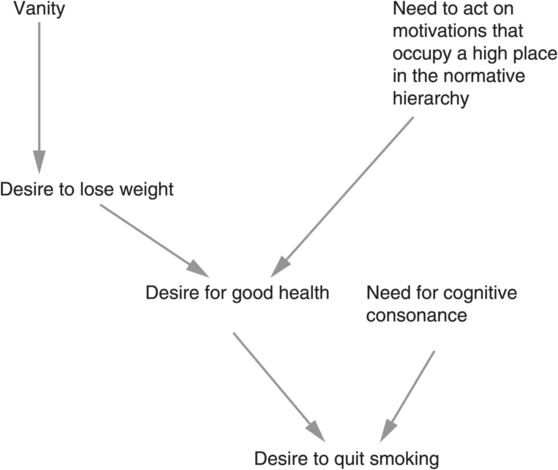 Figure 9.1
As I said, the example is concocted, but it illustrates the principle of transmutation: under the normative pressure from the hierarchy of motivations, my vanity is transmuted into a concern for my health. It also illustrates the idea that one cannot fool oneself in an opportunistic manner. Doing so would entail a loss of internal credibility, just as the opportunistic use in public of principled arguments – using them only when they coincide with the agent's interest – entails a loss of external credibility.
The need to act for good reasons
As I note in Chapter 14, human beings desire to be rational. They also feel a need to have a sufficient reason for what they are doing. The desire and the need do not induce the same actions, since sometimes it is rational to decide without a reason, for instance by flipping a coin. Buridan's ass needed to have a reason for choosing one of two identical haystacks, and starved to death because he could not find one. Less dramatically, and more plausibly, Thomas Schelling tells of an occasion in which he had decided to buy an encyclopedia for his children. At the bookstore, he was presented with two attractive encyclopedias and, finding it difficult to choose between the two, ended up buying neither, despite the fact that had only one encyclopedia been available he would have bought it.3 I give other examples in Chapter 14, where I also discuss how the need for reasons can give rise to the phenomenon of hyperrationality. Otto Neurath used the term “pseudorationalism” for the same phenomenon. Stating an idea to which I return in that chapter, he asserted that “[the] pseudorationalists do true rationalism a disservice if they pretend to have adequate insight exactly where strict rationalism excludes it on purely logical grounds. Rationalism sees its chief triumph in the clear recognition of the limits of actual insight.”
The need to reduce cognitive dissonance
I have already referred to the theory of cognitive dissonance, without going into details of its modus operandi. Although the word “cognitive” might suggest a conflict between two beliefs, the idea is more general. The coexistence of any two conscious states – beliefs, desires, emotions – can generate an unpleasant tension that can be resolved by adding or subtracting states or by changing one of the dissonance-creating states.4 Leon Festinger, the originator of the theory, recounts that it was inspired by a conflict between a belief and an emotion. In the wake of an earthquake in India in 1934, the sociologist Prasad observed the puzzling fact of rumors of impending new disasters.5 Festinger stated the puzzle and its solution as follows: “Certainly the belief that horrible disasters were about to occur is not a very pleasant belief, and we may ask why rumors that were ‘anxiety provoking’ arose and were so widely accepted. Finally a possible answer to this question occurred to us – an answer that held promise of having rather general application: perhaps these rumors predicting even worse disasters to come were not ‘anxiety provoking’ at all but were rather ‘anxiety justifying.’” In other words, the dissonance between the felt anxiety and the lack of obvious reasons for being anxious was reduced by the belief that there was in fact something to be anxious about.
This example is not compelling, since the increase in anxiety caused by the belief that something bad was about to happen would presumably more than offset the decrease in anxiety caused by the dissonance reduction. Be that as it may, the theory has offered many convincing explanations of puzzling phenomena.6
An example will show that the need for consonance can be closely related to the need to have reasons for acting. In a classical experiment, two groups of subjects are asked to write an essay offering arguments for the position on the pro-life versus pro-choice issue that they do not favor. The subjects in one group are paid a considerable sum of money for participating, whereas the others are asked to do so as a favor to the experimenter. After writing the essay, those in the second group but not those in the first display a more favorable attitude toward the position they have been arguing for. The explanation, plausibly, is that all the subjects desire to have a reason for what they are doing. Members of the first group can simply cite the money as their reason.7 Members of the second group can cite their (adjusted) beliefs as the reason why they argue the way they do.8
I have already mentioned the dissonance-reducing mechanism “It's so expensive (or unpleasant) that it must be good,” illustrated by the standing ovations on Broadway, painful initiation rites in college, and (Proust's example) the visitors who persuade themselves that the sight of the sea and the sound of its waves are really enjoyable by taking an expensive hotel room with a view on the sea. I have also mentioned the tendency to upgrade – either before the choice or after – an option that is only slightly preferred to the others, to eliminate the unpleasant thought that a unchosen option might actually be superior. Rather than adding more examples from the scholarly literature on dissonance reduction, I shall discuss one fictitious case and one fictional case of tension between a desire to get X and a belief that X is unavailable. Such cases are ubiquitous, and the tensions to which they give rise can be very unpleasant. Often, the tension is resolved when the desire simply goes away. The agent may still wish he could be or have X, but he no longer has a causally efficacious want to get X. When some fifty years ago I realized that I did not have what it takes to be a first-class mathematician, my want to achieve that goal was simply extinguished. Yet I still think of it as perhaps the highest calling, as shown by the fact that I spend an absurd proportion of my time reading about mathematical achievements I only dimly understand.
Here I explore two reactions that take the form of alchemical transmutations. I shall do so by a fictitious example of a process as banal as it is common: rejected declarations of love or of marriage. I consider two persons, Peter and Ann. He wants to marry her; she refuses. We might then consider the scenarios in Figure 9.2.
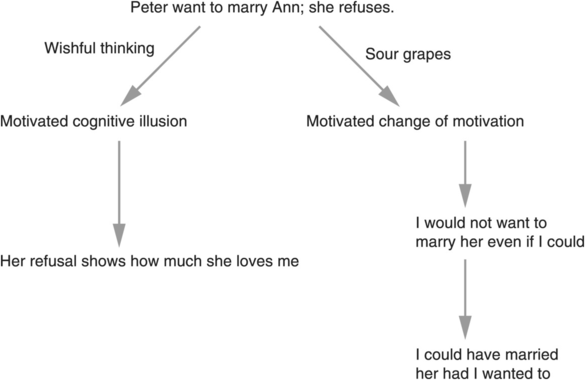 Figure 9.2
Peter's interpretation of Ann's refusal as a sign of her love for him is similar to how Stendhal, in his unrequited love for Méthilde Dembowski, interpreted her refusals. As his biographer writes, “So much anger, scruples, defense, severity [on her part] could only be proof of [her] love [for him]: one does not protest so strongly against anything but an all-powerful feeling.”9 This piece of wishful thinking, or perhaps self-deception, is manifestly irrational.
Yet this is not the only way of reducing dissonance. When there is a tension between a desire (or a judgment of desirability) and a belief, something has to give for the dissonance to be reduced, but what gives could be the desire as well as the belief. Which reaction is observed will presumably depend, among other things, on the ease of transmutation. In the example of the standing ovations on Broadway, the hard constraints on wishful thinking channeled the dissonance reduction into a different form, that of making the show appear as more enjoyable. In Peter's case, the constraints on wishful thinking might also be so hard that the more feasible reaction is a sour-grapes mechanism: downgrading her desirability as a marriage partner.
In itself, the downgrading is not irrational. As I will argue in Chapter 13, desires and preferences are not subject to assessments in terms of rationality or irrationality. Yet it might seem puzzling to claim that one transmutation, wishful thinking, is irrational, while another, sour grapes, is not. Since they are both induced by causal mechanisms operating “behind the back” of the agent, would not both be irrational? The answer depends on how we define rationality. One might indeed define it so that the sour grapes mechanism is no less irrational than wishful thinking, by emphasizing the heteronomous character of both transmutations. I believe, however, that for the explanatory purposes to which I shall harness the idea of rationality, this suggestion is unhelpful. Whereas the assumption of rationality can yield sharp predictions about what, in a given case, counts as a rational belief, the assumption of autonomy cannot.
Even if a sour-grapes reaction is not itself irrational, I believe it is often accompanied by irrational belief formation. Having taken the first step of making Ann appear to be an undesirable marriage partner, Peter might need to free himself from the obvious self-suspicion of being subject to a sour-grapes reaction by taking the further step of persuading himself that he could easily have married her had he wanted to.10 As an independent example of this pattern – that is, not a fictitious one invented for the purpose of making a conceptual point – I shall offer a fictional case, Proust's analysis of the richly comical character Legrandin, whose outwardly anti-snob attitude hides deep inward snobbery.
The Narrator cites his grandmother's surprise at “the furious invective which [Legrandin] was always launching at the aristocracy, at fashionable life, and ‘snobbishness’ – ‘undoubtedly’. He would say, ‘the sin of which Saint Paul is thinking when he speaks of the sin for which there is no forgiveness.’” From the context, it seems that the grandmother thought that he “doth protest too much.” If so, this impression is confirmed later, when the Narrator innocently asks Legrandin whether he knows the Guermantes family, the epitome of the high aristocracy. The acuity of the Narrator's analysis of Legrandin's response justifies, I hope, a lengthy quotation:
[At] the sound of the word Guermantes, I saw in the middle of each of our friend's blue eyes a little brown dimple appear, as though they had been stabbed by some invisible pinpoint, while the rest of his pupils, reacted by secreting an azure overflow. His fringed eyelids darkened, and drooped. His mouth, which had been stiffened and seared with bitter lines, was the first to recover, and smiled, while his eyes still seemed full of pain, like the eyes of a good-looking martyr whose body bristles with arrows. “No, I do not know them,” he said, but instead of uttering so simple a piece of information, a reply in which there was so little that could astonish me, in the natural and conversational tone which would have befitted it, he recited it with a separate stress upon each word, leaning forward, bowing his head, with at once the vehemence which a man gives, so as to be believed, to a highly improbable statement (as though the fact that he did not know the Guermantes could be due only to some strange accident of fortune) and with the emphasis of a man who, finding himself unable to keep silence about what is to him a painful situation, chooses to proclaim it aloud, so as to convince his hearers that the confession he is making is one that causes him no embarrassment, but is easy, agreeable, spontaneous, that the situation in question, in this case the absence of relations with the Guermantes family, might very well have been not forced upon, but actually designed by Legrandin himself, might arise from some family tradition, some moral principle or mystical vow which expressly forbade his seeking their society.
“No,” he resumed, explaining by his words the tone in which they were uttered. “No, I do not know them; I have never wished to know them; I have always made a point of preserving complete independence; at heart, as you know, I am a bit of a Jacobin. People are always coming to me about it, telling me I am mistaken in not going to Guermantes, that I make myself seem ill-bred, uncivilized, an old bear. But that's not the sort of reputation that can frighten me; it's too true!”
If I asked him, “Do you know the Guermantes family?” Legrandin the talker would reply, “No, I have never cared to know them.” But unfortunately the talker was now subordinated to another Legrandin, whom he kept carefully hidden in his breast, whom he would never consciously exhibit, because this other could tell stories about our own Legrandin and about his snobbishness which would have ruined his reputation for ever; and this other Legrandin had replied to me already in that wounded look, that stiffened smile, the undue gravity of his tone in uttering those few words, in the thousand arrows by which our own Legrandin had instantaneously been stabbed and sickened, like a Saint Sebastian of snobbery: “Oh, how you hurt me! No, I do not know the Guermantes family. Do not remind me of the great sorrow of my life.” And since this other, this irrepressible, dominant, despotic Legrandin, if he lacked our Legrandin's charming vocabulary, showed an infinitely greater promptness in expressing himself, by means of what are called “reflexes,” it followed that, when Legrandin the talker attempted to silence him, he would already have spoken, and it would be useless for our friend to deplore the bad impression which the revelations of his alter ego must have caused, since he could do no more now than endeavor to mitigate them.
À la recherche du temps perdu offers many other examples of the transmutation of “I cannot have it” to “I do not want to have it.”11 Although it does not seem that Proust was aware of Nietzsche as a predecessor,12 his description is strikingly similar to the latter's idea of a “transvaluation of all values.” Nietzsche describes the “workshop” of this alchemy as follows:
It is a careful, crafty, light rumor-mongering and whispering from every nook and cranny. It seems to me that people are lying; a sugary mildness clings to every sound. Weakness is going to be falsified into something of merit … And powerlessness which does not retaliate is being falsified into “goodness,” anxious baseness into “humility,” submission before those one hates to “obedience” (of course, obedience to the one who, they say, commands this submission – they call him God). The inoffensiveness of the weak man – cowardice itself, in which he is rich, his standing at the door, his inevitable need to wait around – here acquires a good name, like “patience,” and is called virtue itself. That incapacity for revenge is called the lack of desire for revenge, perhaps even forgiveness.
The need to find meaning and order in the world
People have a strong need to find meaning, order, and patterns in the world. As the giveaway phrase goes, “It is no accident that …” The mind abhors accidents. I shall focus on three variations on this theme: the imputation of intentional agency, the use of objective teleology, and the reliance on analogy.
The tendency to seek an explanation of events in terms of an intention to bring them about is pervasive, even when – as in the cases I shall discuss – there is no evidence for intentional agency. Conspiracy theories offer numerous examples. Three caveats are necessary. First, history shows many examples of actual conspiracies, such as the Gunpowder Plot or the Babington Plot (the conspiracy to assassinate Queen Elizabeth I). Hence some conspiracy theories may be true, and others, if not true, may be held rationally. Second, some conspiracy theories are entertained for their consumption value or entertainment value, without the full mental endorsement that is needed if they are to serve as premises for action. Third, the propagators of such theories may know that they are false, yet spread them in the expectation – which may be quite rational – that the recipients will believe them. Thus, assuming the leaders of Hamas to be minimally rational and well informed, they probably do not believe in Article 22 of their Charter, stating that Jews were “behind the French Revolution, the Communist revolution and most of the revolutions we heard and hear about, here and there. With their money they formed secret societies, such as Freemasons, Rotary Clubs, the Lions and others in different parts of the world for the purpose of sabotaging societies and achieving Zionist interests. With their money they were able to control imperialistic countries and instigate them to colonize many countries in order to enable them to exploit their resources and spread corruption there.” It seems plausible, nevertheless, that the general public in the Middle East sincerely believes in the existence of a Zionist conspiracy and that many, for this reason, are willing to kill or be killed in fighting it.
Although the best-known study of conspiracy theories in politics is titled “The paranoid style in American politics,” I shall cite an example from French history that I know better. In eighteenth- and early nineteenth-century France, the population could never accept that a dearth of grain might be due only to bad weather and a bad harvest. In the words of Georges Lefebvre, “The people were never willing to admit that the forces of nature alone might be responsible for their poverty and distress”; instead they sought an explanation in terms of agency. The usual assumption was that hoarders, who were indifferent to the welfare of the people, had bought grain to drive the price up. Sometimes, the lack of grain was even explained in terms of the desire of malevolent elites to starve the people, as part of ongoing class warfare. In the Great Fear that swept over France in July 1789, many interpreted the fact that it broke out simultaneously and independently in six or seven regions as evidence of an aristocratic conspiracy. The inference to a common cause was correct, but the cause was misidentified. Since the dearth of grain was especially acute just before harvest time and since harvest took place more or less at the same time throughout France, this common cause produced the same effect everywhere. In a similar episode from the early nineteenth century, the government exhibited the same mindset, when it took the simultaneous eruption of similar rumors as evidence of a nationwide conspiracy to drum up popular unrest. Once again, there was a common cause – the nationwide harvest.
Commenting on an episode in the English Civil War, Hume observed that “whatever hardships [the troops] underwent, though perhaps derived from inevitable necessity, were ascribed to a settled design of oppressing them.” This tendency to interpret causal necessity as intentional design is often observed in popular and even professional views of the causes of cancer and other diseases. Two steps may be involved. First, there is well-documented tendency (Chapter 7) to perceive patterns in random events. Second, there is the tendency to seek the cause of patterns, whether real or spurious, in agency. Rather than looking for non-human causes of cancer, such as the emission of radon from the earth, we first look for the cause in pollution, industrial waste, and pesticides. Commenting on this tendency, a writer on cancer refers to the “comfort in believing that humans, through their own devices, have increased the likelihood of cancer. What free-willed creatures have created can conceivably be undone. Failing that, there is at least a culprit to blame.” The last sentence is consistent with my argument here. The preceding sentence suggests an explanation in terms of wishful thinking (Chapter 7) rather than the need for meaning. The writer adds that the explanations in terms of man-made causes “fit so perfectly with the rest of our world-view that there was little incentive to look deeper … If we or someone we knew ever got cancer we were quick to wonder whether corporate America was to blame.”
Natural and social scientists are people too, with the same cognitive needs as the rest of us. In 2010, a White House advisory group issued a report on Reducing Environmental Cancer Risk, which concluded that the number of cancer cases associated with industrial carcinogens “has been grossly underestimated.” Critics charged that the report ignored other major environmental causes of cancer – smoking, diet, infection, geophysical sources of radiation, and the like – to focus on pollutants and occupational exposures. The issues are technical and controversial, and well beyond my competence. It seems, though, that the report is heavily biased toward speculation about unknown but possible man-made causes.
In his history of the French ancien régime, Alexis de Tocqueville also fell into an “agency trap” when he imputed a divide-and-conquer strategy to the successive kings. He observed, correctly, that the tax exemption granted to the nobles removed any occasions on which they might make common cause with the bourgeoisie, and asserted, also correctly, that this fragmentation of the elite worked out to the benefit of the kings. He also claimed that the “kings were able to create [their] unchecked power only by dividing the classes and isolating each of them amid its own peculiar prejudices, jealousies, and hatreds so as never to have to deal with more than one at a time.” He did not even try, however, to substantiate the alleged agency of the kings. He seems to have inferred agency and intention from objective benefits. His need to find meaning and patterns made him overlook the role of non-explanatory or accidental benefits. Agency provides meaning; accidents do not.
By “objective teleology” I mean the tendency to explain events or facts in terms of their objective consequences (or alleged consequences). This tendency can be hard to distinguish from the previous one, because, as I just noted, we often infer subjective intentions from objective consequences, especially if the latter work out to the benefit of an agent.13 Yet sometimes the mere observation of benefits seems to suffice for explanation. The fact that wars benefit the munitions industry has often been used, and not only in the novels by Eric Ambler and Graham Greene, to support the idea that the activities of the “merchants of death” explain wars. Maybe they do, but the benefits in themselves prove nothing. Another instance of the tendency is the idea of “objective complicity,” a form of strict liability. The best-known examples are from the Stalinist period, when individuals were shot for voicing opinions that objectively (in the subjective view of the leader) served the interests of the class enemy. After the “événements” in May 1968, Jean-Paul Sartre used the same argument against the Stalinists, when he accused the French Communist Party of objective complicity with de Gaulle's government. Speaking after the Watts riots in 1965, Martin Luther King asserted that “the purpose of the slum is to confuse those who have no power and perpetuate their powerlessness.” Although he may simply have intended to identify the effects of the slum, the teleological language is symptomatic.
This tendency to explain by consequences may itself have a deep-seated explanation. According to one summary, “a ready recourse to [teleological] explanations has long been observed in young children and has been thought to be increasingly restrained in us as our acquisition of causal mechanical ideas and knowledge proceeds. However, recent research suggests that the inclination to these explanations is never truly overcome but instead remains a default mode among adults and becomes salient again in patients with Alzheimer's disease.” For instance, under pressure to give a quick response, college-educated adults accepted the claim that “fungi grow in forests to help decomposition.” They will not go as far as to accept that we have noses to provide support for our glasses or two kidneys to allow one of them to be transplanted, but less obviously absurd claims may provide a “mental click” that is easily confused with the click of explanation.
In this respect, too, (some) social scientists behave like the people who (other) social scientists are studying. The objective teleology then takes the form of functional explanation, a mode of scientific reasoning I often criticize in this book. In The Theory of Moral Sentiments, Adam Smith frequently appeals to objective teleology, as when he says that “every thing is contrived for advancing the two great purposes of nature, the support of the individual, and the propagation of the species.” In his vaguely deistic mode of thinking, it is possible that the verb “contrived” had a divine subject. In other cases, the explanation is offered in an unambiguous agent-less mode, citing free-floating intentions and verbs without subjects. A text by Michel Foucault on the effects of the prison system is representative:
But perhaps one should reverse the problem and ask oneself what is served by the failure of the prison: what is the use of these different phenomena that are continually being criticized; the maintenance of delinquency, the encouragement of recidivism, the transformation of the occasional offender into a habitual delinquent, the organization of a closed milieu of delinquency. Perhaps one should look for what is hidden beneath the apparent cynicism of the penal institution, which, after purging the convicts by means of their sentence, continues to follow them by a whole series of “brandings” (a surveillance that was once de jure and which is today de facto; the police record that has taken the place of the convict's passport) and which thus pursues as a “delinquent” someone who has acquitted himself of his punishment as an offender? Can we not see here a consequence rather than a contradiction? If so, one would be forced to suppose that the prison, and no doubt punishment in general, is not intended to eliminate offences, but rather to distinguish them, to distribute them, to use them; that it is not so much that they render docile those who are liable to transgress the law, but that they tend to assimilate the transgression of the laws in a general tactics of subjection. Penality would then appear to be a way of handling illegalities, of laying down the limits of tolerance, of giving free rein to some, of putting pressure on others, of excluding a particular section, of making another useful, of neutralizing certain individuals and of profiting from others.
If we translate the rhetorical questions and insinuating statements into ordinary assertions, the text illustrates how the need for meaning can transform prison failure, which may have occurred for all sorts of accidental reasons, such as lack of resources and bad planning, into a seamless pattern of oppression without oppressors. Teleology provides meaning; accidents do not.
Finally, the “hermeneutics of suspicion,” to which I referred in Chapter 4 and shall discuss again in Chapter 16, illustrates objective teleology in the interpretation of texts. The benefits that accrue to a character in a novel serve to explain her behavior. The impression that a text makes on the reader serves to explain the strategy of the author.
Analogies, like agency and benefits, can also produce a mental click that is easily confused with the click of explanation. We notice that a situation or event X has property A, that another situation or event Y has property A and property B, and infer that object or event X also has property B. Because of what might be called the first law of pseudo-science – everything is a little bit like everything else – the mind will almost always be able to find some similarity. The property B may be stated either as a factual or as a normative proposition. In the latter case, the fact that doing B was successful (or unsuccessful) in situation Y is used to argue directly for (or against) doing B in X. In the former case, the belief that X has factual property B may be used as a premise for action (or inaction). Often, however, the statement that X has factual property B is the end of the story – no action is called for.
Although I shall focus on how analogies can provide meaning and order in the social or physical universe, it is not always easy to separate this role from other psychological functions of analogies.
(i)In some cases, analogies are used instrumentally, to persuade others of a conclusion that the agent has reached on other grounds. I shall ignore this case, to focus on analogies that are causally efficacious in shaping or supporting the agent's own beliefs.
(ii)In other cases, pure wishful thinking (Chapter 7) is at work. We choose analogies that support the conclusion we would like to be true. The conclusion triggers the search for an analogy that supports it, by a characteristic form of backward reasoning.
(iii)In still other cases, we use an analogy to bolster a conclusion that we have reached on other grounds. If a “bottom-up” (evidence-based) analysis yields a conclusion as somewhat probable, but not certain, we may experience cognitive dissonance that can be reduced by supplementing the evidence with a “top-down” analogy. The examination of the evidence generates a conclusion, the uncertain or tentative character of which triggers the search for an analogy.
(iv)In the cases I consider here, an analogy spontaneously comes to mind, and we adopt it without examining the evidence, that is, without asking whether X really has property B. Once we have adopted it, we tend to ignore evidence that might suggest that X does not have property B.
The causes of spontaneous adoption of analogies vary. In the most thorough analysis of the analogies used to argue for and against various options during the American war in Vietnam, the author cites the availability and representativeness heuristics (Chapter 14), the recency effect (Chapter 6), and “surface commonalities” or, as cognitive psychologists call them, “mere appearance.” Because surface similarities provide order and meaning, they can trigger a spurious form of satisfaction. Commenting on alleged parallels between successive episodes in pre-revolutionary France, an historian observes that “the repetition of motifs and patterns … may provide a pleasing interpretative tapestry, but it is basically unhistorical” (my italics). By implication, the proper historical approach is to disencumber the mind, as far as possible, of ready-made schemata. An analytical philosopher described the mindset of a non-analytical author as “essentially magical thought, the primitive conception that similarities must point to powers, and analogies in thought stand for a kind of causation” and added that “as magical, it is also at a deep level comforting” (my italics). He preferred the bleakness of analytical philosophy.
In any given case, several causes may be at work and reinforce each other. The availability and recency heuristics may suggest analogies whose appeal is enhanced by surface commonalities; conversely, lack of such commonalities may undermine them. I shall offer some examples from the discussions among decision makers during the American war in Vietnam that illustrate both possibilities. Although the appeal to analogies is common in many wartime situations, the Vietnam War seems to have generated an exceptionally large number of analogies (see Table 3.1).
Robert McNamara's analogy with the Cuban crisis, which represented what an historian calls “his only real experience with the planning and direction of military force,” was not taken seriously in private discussions (see Table 3.1). Similarly, few (except for President Johnson) listened to Walt Rostow's argument for bombing the oil storage facilities in North Vietnam, based on an analogy with his own experience in planning the strategy of bombing German oil facilities at the end of World War II. Nor does anyone seem to have listened to the Chairman of the Joint Chiefs of Staff, Earl Wheeler, when he argued that the Tet Offensive was only a temporary setback, on an analogy with the Battle of the Bulge (where he had served). By contrast, the Korean analogy, which the availability heuristic triggered in many decision makers with experience from the Korean War, seemed to offer enough surface similarities to make a “pleasing tapestry.” Intrinsically, as George Ball pointed out, the analogy was severely halting, yet the similarities caused other members of the Johnson administration to dismiss the differences as “nuances.”
The law, too, relies heavily on analogical thinking. Montaigne observed that “Just as no event and no form completely resembles another, neither does any completely differ … All things are connected by some similarity; yet every example limps and any correspondence which we draw from experience is always feeble and imperfect; we can nevertheless find some corner or other by which to link our comparisons. And that is how laws serve us: they can be adapted to each one of our concerns by means of some twisted, forced or oblique interpretation.” He seems to imply that the “concerns” (affaires) precede and motivate the analogies, as in case (ii) above. This pattern certainly occurs, but there is no reason to think that legal analogies are always motivated. Consider the decision by the US Supreme Court in Tanner v. United States (1987). The Court considered a jury trial in which seven jurors had regularly consumed alcohol during the noon recess, and found that this fact did not constitute grounds for overturning the verdict: “However severe their effect and improper their use, drugs or alcohol voluntarily ingested by a juror seems no more an ‘outside influence’ than a virus, poorly prepared food, or a lack of sleep.” I have no reason to think – although it is possible – that the choice of these far-fetched analogies was dictated by the desire to reach a particular conclusion. They may just have occurred spontaneously to the judges. The Court could equally well, however, have focused on a difference between ingesting alcohol and catching a virus, namely that only the first is done voluntarily. As suggested by the quotation from Montaigne, the second law of pseudo-science could be, “Everything is a little bit different from everything else.”
Analogies may satisfy a need. Intellectually, they are worthless, unless the hypotheses they inspire are examined on their merits. They can cause great harm when used as premises for policy or legal decisions. Politicians can certainly learn from history, but not by identifying macro-analogies. Instead, they should study history to understand human nature and the particularities of local conditions. If American politicians had known that China was the historical archenemy of Vietnam, they would not have used the illusion of a monolithic Communist bloc as a premise for their actions in 1963–1964 and later.14 Rather than being guided by the first law of pseudo-science, analysts and decision-makers should adopt Bishop Butler's dictum, “Everything is what it is and not another thing,” or follow William Blake's maxim, “Art and Science cannot exist but in minutely organized particulars.” Yet particulars do not offer meaning and coherence; analogies do.15
Once again, scientists, too, can be affected by this form of pattern seeking. The cabinet of horrors of science is replete with analogies.16 The analogy with society and biological organisms, for instance, has been used to support the idea that societies, like organisms, are self-regulating entities with built-in homeostatic correction mechanisms, such as revolutions. In the nineteenth century, scholars debated what, in society, would correspond to the cell in the organism, without asking themselves whether there was any reason to expect any analogy at all. The explanation of market competition by an analogy with natural selection has failed dismally (Chapter 11). A currently fashionable analogy is between genes and “memes.” Other writers have used physical rather than organic analogies and looked for the social equivalent of Newton's laws or the force of gravity. Bertrand Russell said that “the fundamental concept in social science is Power, in the same sense in which Energy is the fundamental concept in physics” (my italics). Physicists such as Niels Bohr and Ilya Prigogine tried, unsuccessfully, to apply their ideas to social phenomena. Scholars who argue that the social sciences can have an impact on the object they study routinely invoke Heisenberg's uncertainty principle, as if the profundity of his principle could turn their truism into something equally profound. Within the social sciences, too, scholars have tried, unsuccessfully, to graft ideas from one discipline onto another. Examples include analogies between power and money, between phonemes and “mythemes,” between gothic cathedrals and scholastic treatises, between individual precommitment and constitution making, and between physical capital and social capital.17
I am not denying that analogies can be useful in suggesting hypotheses. The Rutherford–Bohr model of the atom on an analogy with the solar system was useful as a ladder, which later physicists could kick away behind themselves. The idea of viewing the genetic material on an analogy with language proved successful, although some hypotheses suggested by the analogy were falsified. The analogy between utility or profit maximization and the maximization of biological fitness led to a fruitful marriage of game theory and biology. However, the origin of a fruitful hypothesis is irrelevant for its validity. Ideas are to be judged by their descendants, not by their ancestors.
The need for autonomy
Earlier, I referred to the phenomenon of reactance. Like its cousin, cognitive dissonance reduction, it relies on psychological mechanisms that can be hard to identify with precision. Here, I first cite a number of instances of reactance, beginning with one already mentioned, and then discuss the possible causes. Except for the last two examples, the cases are taken from the psychological literature on reactance, either from laboratory experiments or from field studies.
(1)When a choice option is eliminated, subjects tend to rank it more highly than before.18
(2)When toddlers can see comparable toys behind two barriers, one low and another higher, they show more interest in the toys behind the high barrier.19
(3)Similarly, children find candies more attractive when they are placed further away from them rather than within their reach.
(4)When seats belts are made mandatory, some drivers are less likely to use them.20
(5)When subjects in a swimming-pool environment are given sheets saying either “Don't litter” or “Help keep your pool clean,” a larger proportion of those who received the first injunction littered the sheets rather than putting them in a trash can.
(6)When people make phone calls from a public phone booth, they tend to make longer calls if they can see that another person is waiting to make a call.
(7)Similarly, when drivers are about to leave a parking lot, they tend to do so more slowly if they can see that other drivers are circling to take their spot.
(8)In some New York taxis, customers who use credit cards are presented with a screen that provide them with the options of tipping 20 percent, 25 percent or 30 percent – well above normal tipping rates. Compared to “traditional” taxis, these are twice as likely to receive a tip of zero. At the same time, the average size of tips increases by about 10 percent.
(9)Some jurors refuse to ignore evidence that the judge finds inadmissible because he tells them to ignore it.
(10)Some patients refuse to take their medication because the doctor tells them to take it.
(11)Some doctors do not adhere to the recommendations of medical authorities. According to one study, doctors’ “resistance to imposed activities (cookbook medicine)” is an important barrier to the implementation of diabetes guidelines in the Netherlands.
(12)The psychoanalyst Jacques Lacan refers to “that resistance of amour-propre [unlike the resistance of the unconscious], to use the term in all the depth given to it by La Rochefoucauld, and which is often expressed thus: I can't bear the thought of being freed by anyone other than myself.”
(13)In a biography of François Mitterrand, we read that, “In the 1950s, as Interior Minister, he had once received the Algerian nationalist leader, Ferhat Abbas. After Abbas had waited in an anteroom for an hour and a half, an aide went in to find the cause of the delay. Mitterrand was reading the cartoons in France Soir. It was not that he had intended a political snub. Nor was it just rudeness or thoughtlessness or egoism – though it was certainly all those things too. The explanation was less rational. He had a visceral reaction against any kind of restriction – whether in politics, private life or the realm of ideas. Punctuality was a straitjacket he refused to accept.”
Everyday language has a word for such reactions: willful, defined by the Oxford English Dictionary as “asserting or disposed to assert one's will against persuasion, instruction, or command.” We have all observed this phenomenon, in others and in ourselves. The puzzle is why people form these preferences (cases 1–3) or choose these behaviors (cases 4–13). What's in it for the person? According to the psychological theory of reactance, when an individual's freedom to choose is eliminated or threatened, she is motivated to restore or confirm the freedom, resulting in enhanced attraction of eliminated alternatives and a tendency to choose threatened alternatives. Whereas all the examples fit this abstract account, the concrete mechanisms differ.
In the first three examples, no interpersonal interaction is involved. In case (1), the subjects in the “choice” condition were told that their third-ranked option had been eliminated “for some unknown reason,” hence they had no reason to resent the restriction of the choice set. They might nevertheless deplore the loss of an option, even one they would not have chosen. As Isaiah Berlin wrote, “It is the actual doors that are open that determine the extent of someone's freedom, and not his own preferences.” If people value freedom in this sense, they might indeed react to the loss of even a low-ranked option. The puzzle is why the reaction would take the form of upgrading the value of that option. To my knowledge, the psychological literature does not address that question, and I cannot propose an answer.
In cases (2) and (3), the explanation seems to be (I am reconstructing it) that the scenarios implicitly suggest that the child will take the easiest path to the goal, and that he reacts to that suggestion as an obstacle to his autonomy. If this is indeed the correct explanation, it offers an interesting contrast with the principle of rational choice, which can be seen, at least in part, as a generalization of the principle of least effort (Chapter 13).
Cases (4)–(13), which do rely on interpersonal interactions, are easier to understand: people do not like to feel crowded, and are willing to give up some other good to avoid the feeling. The person in the phone booth or the driver leaving the parking spot might, if nobody was waiting for their place, have acted more expeditiously and achieved her ends (e.g. getting back in time for dinner) better. Yet knowing that others want them to leave as soon as possible, they slow down to convince themselves that they are not acting under pressure, but freely and autonomously. The other examples provide variations on this basic theme, the most interesting being perhaps that of Mitterrand, who felt his autonomy threatened by an appointment he had presumably made himself in a fully autonomous way. He behaved like the witty Count Chalvet in Stendhal's Le rouge et le noir: “‘Oh, I am an Independent’ he was saying to a gentleman wearing three badges whom he was evidently mocking. ‘Why should I be of the same opinion today that I was six weeks ago? Why, my opinion would be my tyrant.’”
The need for novelty
Desires can also be affected by an unconscious need for novelty or change. In H. C. Andersen's tale “What Father Does Is Always Right,” the farmer goes to the market in the morning to sell or exchange his horse. First, he meets a man with a cow, which he likes so much that he exchanges the horse for it. In successive transactions, the cow is then exchanged for a sheep, the sheep for a goose, the goose for a hen, and, finally, the hen for a sack of rotten apples. The farmer's road to ruin is paved with stepwise improvements. Each time the farmer believes himself to be better off by the exchange, but the net result of all the exchanges is disastrous.
More formally, imagine a person who regularly (although not consciously) adjusts his desires so that he prefers more strongly the commodity of which he currently has less. Suppose he is exposed to the following sequence of two-commodity bundles: (1/2, 3/2), (3/4, 1/2), (1/4, 3/4), (3/8, 1/4) … Then if at a given time he is consuming bundle n in the sequence and for the next period is offered the choice between bundle n and bundle n + 1, he will always choose the latter since it offers more of the commodity of which he currently has less. But since the sequence converges to zero, these local improvements bring about overall ruin. The effect is similar to that in which an agent can be bled to death by cycling preferences (Chapter 13), but the mechanism is different.
We can also observe the need for novelty in artists (and the publics of artists) who confuse creativity and originality. Rather than following the imperative “Enchant me!,” artists respond to Diaghilev's command “Astonish me!” The use of randomization in the arts is but one of many examples of the sterile search for originality. The search may, to be sure, be an effect of one-upmanship rather than responding to an inner need, but I conjecture that in many cases it is a compensatory response to a failure of creativity.
The need to maintain amour-propre
Here I shall add a few comments to the discussion of amour-propre, self-love, in Chapter 5. As I understand the idea of amour-propre discussed by the seventeenth-century French moralists, it refers to a person's need to maintain a good image of herself, in her own eyes and in the eyes of others. In other words, the person constantly acts for an external or an internal audience. Whereas the idea of an external audience is clear enough, that of an internal audience is more like a metaphor. It is related to the “warm glow” that I discussed previously, the pleasure we feel when we do something to benefit others, unbeknownst to them and in the absence of observers.
The search for the approval of an external audience is easy to document. In Chapter 5 I cited Bentham's dismissive reference to claims that the refusal of Necker, the minister of Louis XVI, to be paid for his services was “a sophisticated means to satisfy his greed.” As all his contemporaries knew, and as even his adoring daughter Mme de Staël admitted, his show of disinterestedness was due only to his monumental vanity. George Washington, too, desired intensely to be viewed as disinterested, although when unobserved he departed from his high standards. One may have instrumental reasons to build a reputation for disinterestedness, but Necker and Washington did so because of the intrinsic satisfaction it provided.
The effects of the internal audience are, by the nature of the case, more difficult to document. One telltale sign is the reluctance to admit a mistake.21 Earlier I cited La Rochefoucauld's comment on how painful it is to disapprove of what we once approved. Some scholars seem constitutionally incapable of saying, “I was wrong.” Another instance is summarized in Seneca's observation, “Those whom they injure, they also hate” and in a French proverb, “Who has offended can never forgive.”22 In such cases, we may observe a transmutation, a rewriting of the script, by which the victim becomes a perpetrator. A possible explanation of the sunk-cost fallacy (see Chapter 14) is that we would rather persist in a venture that has acquired negative net present value than to admit that we should not have embarked on it. Strictly speaking, of course, embarking on it may not have been an error at the time, but the hindsight fallacy might lead us to think that if it had negative present value today it would have had so from the outset.
Conversely, amour-propre induces a tendency to think that our choices must be good because they are ours, leading us to overvalue the restaurant meals we order or the friends we make. Less trivially, members or officials in an institution naturally come to think of it as an important one, and resist attempts to reduce its importance. Constituent assemblies that also exercise legislative functions may for that reason (among others) tend to give more importance in the constitution to the legislature than do assemblies that have constitution making as their only task.23 The mixed legislative/constituent assemblies in Poland (1921) and in France (1946) created highly legislative-centric constitutions.
Other effects of amour-propre include our tendency to believe that others spend more time thinking about us than they actually do, and our tendency to believe that others will act to promote our interest rather than their own. George Eliot says about Mr. Casaubon in Middlemarch that he was “the centre of his own world [and] liable to think that others were providentially made for him, and especially to consider them in the light of their fitness for the author of [his magnum opus] a ‘Key to all Mythologies.’” The performance of others may also impinge on our amour-propre, enhancing it if it is inferior to ours and threatening it if it is superior. Thus what I shall call the “first-order pain of envy” may cause us to rewrite the script in ways I discuss in the next section.
The need to see oneself as guided by a motivation that is highly ranked in the hierarchy of motivations
People may be praised or blamed for what they do. They may also be praised and blamed for the motivations on which they act. In his essay on Coriolanus, Plutarch wrote that “one great reason for the odium he incurred with the populace in the discussions about their debts was, that he trampled upon the poor, not for money's sake, but out of pride and insolence.” In other words, greed may have been seen as a more acceptable motivation than pride and insolence. The distinction is reflected in the phrase, “adding insult to injury.”
In any given society or subculture, there is a normative hierarchy of motivations. Some motivations are highly ranked, others are more lowly. In classical Athens, they were ranked in roughly the following order: concern for the public interest, anger, self-interest, hubris (the “infliction of dishonor for the pleasure of expressing a sense of superiority”), and envy.24 A man might counter a charge of hubris by saying that he was drunk or angry. Also, among the Athenians, the desire to seek revenge for an insult was stronger and more highly respected than the desire to seek revenge for an injury; in modern societies, the opposite may be true. (“Sticks and stones will break my bones, but words will never harm me.”) In most contemporary Western societies, anger and the desire for vengeance probably occupy a lower place in the hierarchy than the pursuit of self-interest. Tocqueville claimed that among the Americans he observed, the pursuit of private interest was ranked above public-interested motivations. This may remain true for contemporary Americans. In the United States today, therefore, motivations might perhaps be ranked as follows: self-interest, public interest, anger, and envy. In societies characterized by “amoral familism,” the desire to promote the public interest might be ranked at the very bottom of the hierarchy, and the desire to take revenge for a slight, even a slight one, at the top. These impressionistic rankings may of course be questioned. What does not seem questionable, however, is the existence in all societies or groups of such hierarchies.
The normative hierarchies induce two effects, mediated by, respectively, the external and the internal audience. The first, which is easier to observe if not necessarily the most important, arises because people have an incentive to misrepresent their motivations to other people. The effect is obvious and richly documented. Here, I focus on the effect that arises when people internalize the hierarchy and want to look good in their own eyes. In the concocted example I presented at the beginning of the chapter, the higher status of the concern for health compared to vanity was responsible for the transmutation. I shall now offer two non-concocted examples, taken from studies of nineteenth- and twentieth-century America.
Commenting on America around 1830, but phrasing the argument in more general terms, Tocqueville wrote that:
In a democracy, ordinary citizens see a man step forth from their ranks and within a few years achieve wealth and power. This spectacle fills them with astonishment and envy. They try to understand how a man who only yesterday was their equal today enjoys the right to rule over them. To attribute his rise to talent and virtue is inconvenient, because it requires them to admit that they are less virtuous and clever than he. They therefore ascribe primary responsibility to some number of his vices, and often they have reason to do so. This results in I know not what odious mingling of the ideas of baseness and power, unworthiness and success, utility and dishonor.
The sentence I have italicized refers to the operation of amour-propre. Because the feeling of inferiority is so painful, citizens tell themselves a story to alleviate it. According to the story, the superior individual achieved his position by immoral or illegal means, and perhaps even at their expense.25 As a by-product, the emotion of envy is replaced by indignation or anger. So far, the analysis does not refer to any normative hierarchy. I suggest, however, that an additional mechanism can be at work: because of the low status of envy in the motivational hierarchy, noted by Plutarch, Adam Smith, and no doubt many others, individuals are motivated to transmute the emotion into one that occupies a higher status. The first-order pain of envy is triggered by the thought, “I am inferior.” The second-order pain is triggered by the thought, “I am envious.” Thus when Morris Zapp in David Lodge's novel Small World receives a letter from a rival saying he has met a wonderful woman and asking him to reserve a hotel room for them, he says to himself that the “letter reads like the effusion of some infatuated teenager. Morris will not admit to himself that there may be a trace of envy in his harsh assessment. He prefers to identify his response as righteous indignation at being more or less compelled to take part in the deception” of the rival's wife.
Tocqueville's claim that the Americans he observed ranked private interest above the public interest also seems to be valid for recent times. Although American citizens spontaneously perform a number of disinterested actions, they do not always acknowledge their motivation to others or to themselves. Instead, they come up with all sorts of excuses for doing good. Thus one study found that “although people actually engage in many acts of genuine compassion, they are loathe to acknowledge that these acts may have been motivated by genuine compassion or kindness. Instead, people offer pragmatic or instrumental reasons for them, saying things such as ‘It gave me something to do’ or ‘It got me out of the house.’ Indeed, the people … seemed to go out of their way to stress that they were not a ‘bleeding heart,’ ‘goody two-shoes,’ or ‘do-gooder.’”
The reluctance to present oneself as animated by disinterested motives might also be due, however, to the suspicion that others might disbelieve the claim. To illustrate the point, and also provide some evidence about the normative hierarchy in classical Athens, let me cite a comment on the Athenian “sycophants.” These were professional accusers who initiated lawsuits for private gain, either because they could hope for a share of the fine or because they hoped that even innocent plaintiffs would settle in private rather than risk litigation. As sycophants were regarded (according to Aristotle) with hatred, it was important for them to misrepresent their motivation. According to one scholar, it was more effective to disguise their interest as passion than to try to pass themselves off as motivated by impartial motives: “When a citizen appeared in court as a public accuser his first anxiety was … to dispel any suspicion that he was a sycophant. He could stress his public-spiritedness, but that tends to make ordinary folk even more suspicious, and usually there was a much more cogent argument to deploy: he could declare that the accused was his personal enemy and that he was using his citizen right to prosecute for revenge and not for gain.”
Self-poisoning of the mind
Many of the transmutations I have discussed make the agent better off in some respect. The statement by a character in Ibsen's The Wild Duck, “if you take the life lie from an average man, you take away his happiness as well,” is not always true, but it accurately captures many cases familiar from everyday life and from world literature. Examples include getting rid of the first-order and second-order pains of envy, rewriting the script so that a failure appears to be the effect of the malign behavior of others, the retail deprecation of the wealthy and the beautiful, and the wholesale deprecation of wealth and beauty.
Yet the benign effect of illusions and delusions cannot be the whole story. Wishful thinking can make us feel good here and now, but we can fall flat on our face if we use motivated beliefs as premises for action. (Pissing in your pants to keep warm has only a momentary effect.) People who are so strongly subject to reactance that they never accept doing what others suggest to them may miss out on many opportunities. As noted earlier in the chapter, the search for novelty may cause people to “improve themselves to ruin.” In Chapter 4, I observed that cognitive dissonance reduction can induce preference changes that make the agent worse off, as judged by the pre-reduction preferences.
I shall now present two episodes from Proust. In both, we observe the transmutation of “I cannot have it” into “I do not want it,” but with opposite effects on the happiness of the agents. The first occurs when the Narrator observes the behavior of two bourgeois wives toward an old, rich, and titled lady who stays at the same hotel:
Whenever the wives of the notary and the magistrate saw her in the dining-room at meal-times they put up their glasses and gave her an insolent scrutiny, as minute and distrustful as if she had been some dish with a pretentious name but a suspicious appearance which, after the negative result of a systematic study, must be sent away with a lofty wave of the hand and a grimace of disgust. No doubt by this behavior they meant only to show that, if there were things in the world which they themselves lacked – in this instance, certain prerogatives which the old lady enjoyed, and the privilege of her acquaintance – it was not because they could not, but because they did not want to acquire them. But they had succeeded in convincing themselves that this really was what they felt; and it is the suppression of all desire for, of all curiosity as to forms of life which are unfamiliar, of all hope of pleasing new people (for which, in the women, had been substituted a feigned contempt, an artificial cheerfulness) that had the awkward result of obliging them to label their discontent satisfaction, and lie everlastingly to themselves, two conditions for their being unhappy … The atmosphere of the microcosm in which the old lady isolated herself was not poisoned with virulent bitterness, as was that of the group in which the wives of the notary and magistrate sat chattering with impotent rage.
The second episode involves the absurdly self-contented father of the Narrator's friend Bloch.
[He] lived in the world of approximations, where people salute the empty air and arrive at wrong judgments. Inexactitude, incompetence do not modify their assurance; quite the contrary. It is the propitious miracle of amour-propre that, since few of us are in a position to enjoy the society of distinguished people, or to form intellectual friendships, those to whom they are denied still believe themselves to be the best endowed of men, because the optics of our social tiers make every grade of society seem the best to him who occupies it, and beholds as less favored than himself, less fortunate and therefore to be pitied, the greater men whom he names and calumniates without knowing, judges and despises without understanding them. Even in cases where the multiplication of his modest personal advantages by his amour-propre would not suffice to assure a man the dose of happiness, superior to that accorded to others, which is essential to him, envy is always there to make up the balance. It is true that if envy finds expression in scornful phrases, we must translate “I have no wish to know him” by “I have no means of knowing him.” That is the intellectual sense. But the emotional sense is indeed, ‘I have no wish to know him’. The speaker knows that it is not true, but he does not, all the same, say it simply to deceive; he says it because it is what he feels, and that is sufficient to bridge the gulf between them, that is to say to make him happy.
Although the reference to envy is hard to understand,26 the overall idea is clear: the upgrading of one's own small advantages may, if necessary, be supplemented by the downgrading of the greater advantages of others, to produce happiness.
The bourgeois wives are subject to the ressentiment that Max Scheler, inspired by Nietzsche, called a “self-poisoning of the mind.” Scheler claimed, though, that the reaction is “chiefly confined to those [who] fruitlessly resent the sting of authority.” The passage from Proust suggests that the idea has broader application.
Bibliographical note
The present chapter draws heavily on Chapter V of my Alchemies of the Mind (Cambridge University Press, 1999) and, especially, on Chapter 3 of L'irrationalité (Paris: Seuil, 2010). The article by Otto Neurath, “The lost wanderers of Descartes and the auxiliary motive,” is reproduced as Chapter 1 of his Philosophical Papers 1913–1946 (Dordrecht: Reidel, 1983). The claim that an agent may reduce his dissonance by first increasing it is in L. Festinger, A Theory of Cognitive Dissonance (Stanford University Press, 1957), p. 129. I discuss Proust's examples of transmutation at greater length in Chapter 15 of L'irrationalité and in “Self-poisoning of the mind,” Philosophical Transactions of the Royal Society B 365 (1010), 221–26. The observation on Stendhal's unhappy love affair is in M. Crouzet, Stendhal (Paris: Flammarion, 1990), p. 292. Studies of conspiracy theories in France include G. Lefebvre, La grande peur de 1789 (Paris: Armand Colin, 1988), S. Kaplan, “The famine plot persuasion in eighteenth-century France,” Transactions of the American Philosophical Society 72 (1982), 1–79, and F. Ploux, De bouche à oreille: naissance et propagation des rumeurs dans la France du XIXe siècle (Paris: Aubier, 2003). My comments on agency bias in the explanation of cancer are based on G. Johnson, The Cancer Chronicles (New York: Knopf, 2013) and on D. Holzman, “President's cancer panel stirs up environmental health community,” Journal of the National Cancer Institute 102 (2010), 1106–13. The quotation from William Buckley is in R. Perlstein, Before the Storm (New York: Nation Books, 2001), p. 155. The passage on the human mind's propensity to teleological reasoning is taken from the editorial introduction to A. Vayda and B. Walters (eds.), Causal Explanation for Social Scientists (Lanham, MD: Altamira, 2011). The comment on the pleasure and comfort provided by analogies are from J. H. M. Salmon, Society in Crisis (London: Routledge, 1979), p. 14 and from a review by Bernard Williams of a book by Lucien Goldmann, reprinted in his Essays and Reviews 1959–2002 (Princeton University Press, 2014), p. 80. The discussion of analogies in debates over the Vietnam War owes much to Y. Khong, Analogies at War: Korea, Munich, Dien Bien Phu, and the Vietnam Decisions of 1965 (Princeton University Press, 1992). Rostow's analogy between the Vietnam War and World War II is in D. Milne, America's Rasputin: Walt Rostow and the Vietnam War (New York: Hill and Wang, 2008), pp. 170–1. The comment on McNamara's limited experience is in H. McMaster, Dereliction of Duty (New York: Harper, 1997), p. 328. The reference to the reactance of doctors is in R. Dijkstra et al., “Perceived barriers to implementation of diabetes guidelines in the Netherlands,” Netherlands Journal of Medicine 56 (2000), 80–5. The findings about reactance induced by suggested taxi tips are in K. Haggag and G. Paci, “Default tips,” working paper (Department of Economics, Columbia University, 2013). The biography of Mitterrand is by Philip Short, Mitterrand: A Study in Ambiguity (London: The Bodley Head, 2013). An envy-based explanation of anti-Semitism is in B. Netanyahu, The Origins of the Inquisition (New York: Random House, 1995), p. 989. The passage on Athenian sycophants is from M. H. Hansen, The Athenian Democracy in the Age of Demosthenes (Oxford: Blackwell, 1991), p. 195. The definition of hubris is from N. R. E. Fisher, Hybris (Warminster: Aris and Phillips, 1992). The passage asserting that people may be loathe to acknowledge that their acts are motivated by kindness is in R. Wuthnow, Acts of Compassion (Princeton University Press, 1991), cited from D. Miller, “The norm of self-interest,” American Psychologist 54 (1999), 1053–60.
1 This phrase, coined by Hegel, referred to the unintended consequences of social action (Chapter 17), but is equally apt in cases where the mind plays tricks on itself. Intentional action can be subverted by subintentional as well as by supraintentional causality.
2 I shall use “motivation” as a general term to denote conscious desires and emotions, as well as unconscious needs. Hence when I refer to “motivated motivations,” it is mostly in the sense of needs-generated conscious desires or emotions.
3 If he had chosen one at random, he might have come to see it as preferable, by attaching more importance to the dimensions – number of illustrations and of subjects covered, etc. – on which it was superior.
4 The nature of this tension is rarely specified, and may vary from case to case.
5 Since many of these rumors were about new earthquakes, they might arise from a rational understanding of the prevalence of aftershocks. Some of them, however, concerned cyclones, hurricanes and other phenomena with no rational connection to earthquakes. In his discussion of the rumors of new disasters created by the great earthquake on July 21, 365 AD, Gibbon pointed to a different connection: the disaster revealed the anger of the gods, who could be expected to call down further calamities on the people. This mechanism may also have been at work in India.
6 By and large, dissonance reduction is supposed to be an unconscious process. In the first statement of the theory, we find, however, a passage which imputes to the unconscious the capacity for deploying the kind of indirect strategy (“one step backward, two steps forward”) that is the hallmark of the conscious mind: “What may one say concerning the seeking out of new information on the part of a person whose dissonance is near to the limit which can exist? Under such circumstances a person may actively seek out, and expose himself to, dissonance-increasing information. If he can increase the dissonance to the point where it is greater than the resistance to change of one or another cluster of cognitions, he will then change the cognitive elements involved, thus markedly reducing and perhaps eliminating the dissonance which is now so great” (my italics). He does not cite any examples, nor do I think there are any.
7 Punishment for not participating would also be a sufficient reason. This explains why citizens under Communism might consistently have a system of double bookkeeping without their inner rejections of the system being undermined by their overt enthusiasm.
8 In Pascal's wager, the reason for acting as if one believed is so overwhelmingly strong – the prospect of eternal bliss – that the believer need not look for another explanation of his behavior.
9 More recently, Freudian psychology has contributed to the tendency to refuse to take answers to questions or accusations at face value. Someone who reacts angrily to an unfounded accusation may see his anger interpreted as evidence for the charge: every protest is “too much.” This tendency may perhaps count among the harms caused by the theory (see the Conclusion).
10 According to Aristotle, Thales of Miletia sought to liberate himself from the same suspicion by the more robust means of taking action: “[Thales] was reproached for his poverty, which was supposed to show that philosophy was of no use. According to the story, he knew by his skill in the stars while it was yet winter that there would be a great harvest of olives in the coming year; so, having a little money, he gave deposits for the use of all the olive-presses in Chios and Miletus, which he hired at a low price because no one bid against him. When the harvest time came, and many were wanted all at once and of a sudden, he let them out at any rate which he pleased, and made a quantity of money. Thus he showed the world that philosophers can easily be rich if they like, but that their ambition is of another sort.” In Montaigne's version, when Thales condemned money making, he “was accused of sour grapes like the fox.”
11 The opposite effect can be observed in schoolchildren when they transmute “I do not want to do my homework” into “My homework is so difficult that I cannot do it.” In such cases, Seneca observed, “The reason is unwillingness, the excuse, inability.”
12 Both Nietzsche and Proust, however, were influenced by La Rochefoucauld. They may well have read the following Maxim: “The scorn for riches displayed by the philosophers was a secret desire to recompense their own merit for the injustice of Fortune by scorning those very benefits she had denied them; it was a private way of remaining unsullied by poverty; a devious path toward the high respect they could not command by wealth.” Note, however, that this explanation of the philosopher's scorn for riches does not apply to Thales.
13 The inference can also be made when the alleged consequences harm someone else. Thus in 1962, William Buckley warned the leader of the John Birch Society against accusing American leftists of wanting to bring about a Communist America: “ I hope the Society thrives, provided, of course, it resists such false assumptions as that a man's subjective motives can automatically be deduced from the objective consequences of his acts.” In his view, some leftists were misguided, not ill-intentioned.
14 The Asia specialists in the State Department told them so, but were overruled by CIA and the Department of Defense, as well as by the head of their department. In the words of one historian, “Talk of hereditary enemies was nothing [Secretary of State] Rusk cared to hear, for it did not fit the cold war scenario, in which such old-fashioned items as nationalism and geography faded into the deep background.” The Americans made the same mistake about the Vietnamese as the English had made about the Americans two centuries earlier. In the words of David Ramsay, writing in 1789, “the British supposing the Americans, to be influenced by the considerations which bias men in the languid scenes of tranquil life, and not reflecting on the sacrifices which enthusiastic patriotism is willing to make,” thought they could bring the colonies to their knees by devastating their possessions.
15 Also, the path of particularism is thorny and painful. Absorbing the history, culture and language of another country takes a decade or more. As Tocqueville noted, “general ideas … make it unnecessary to waste time delving into particular cases.” This source of the attraction of analogies must be distinguished, however, from their ability to satisfy the need for meaning.
16 Wikipedia has an entry on “parallelomania,” which reads in part as follows: “In historical analysis, biblical criticism and comparative mythology, parallelomania refers to a phenomenon where authors perceive apparent similarities and construct parallels and analogies without historical basis. The concept was introduced to scholarly circles in 1961 by Rabbi Samuel Sandmel.”
17 These analogies have been offered by, respectively, Talcott Parsons, Claude Lévi-Strauss, Pierre Bourdieu, me, and Robert Putnam.
18 The laboratory demonstration of this effect cited in Chapter 2 might be replicated in field studies. Thus when a presidential candidate retires from the race, his or her popularity score should go up.
19 The effect was observed only for boys, not for girls, suggesting that, for whatever reason, these two-year-old girls were less motivated than boys by challenges.
20 Other drivers are of course more likely to do so. They may, however, be subject to a different counterproductive effect, if the enhanced safety makes them drive more recklessly. For this reason, Chicago-style economists have objected to the mandatory use of seatbelts. Because of their tendency to see preferences as fixed and stable, they have not cited reactance as an objection.
21 It is of course even more difficult to admit mistakes before an external audience.
22 Aristotle claimed that we love those whom we help because we helped them, perhaps another effect of amour-propre.
23 Among the other reasons is that if the framers aspire to be elected to the first ordinary legislature, they might want that body to be powerful. Also, because they know more about the legislature than about the other branches of government, they might easily come to exaggerate its importance.
24 When Iago says, “If Cassio do remain, he hath a daily beauty in his life that makes me ugly,” he is being unusually, perhaps implausibly frank.
25 It has been persuasively argued that the same transmutation is at the origin of anti-Semitism.
26 Proust's reference to the downgrading tendency of envy is distinctly idiosyncratic. Envy presupposes the recognition of the value of the envied object, not the denial of its value. The action tendency of envy is to destroy what you cannot get, not to denigrate it. Other passages show that Proust was perfectly aware of this standard understanding.