
Part III
Social interaction can take many forms. (1) The outcome, for each agent, depends on the outcomes for others. This interdependence of outcomes can arise if the material or psychic welfare of others affects my own psychic welfare (Chapter 5). (2) The outcome of each can depend on the actions of all. This interdependence reflects general social causality (Chapter 17), illustrated in such phenomena as (human-made) global warming. (3) The action of each depends on the (anticipated) actions of all. This interdependence is the specific topic of game theory (Chapters 18 and 19), which also integrates (1) and (2) within its framework. (4) The beliefs of each depend on the actions of all. This interdependence can arise by a variety of mechanisms, such as “pluralistic ignorance” or “informational cascades” (Chapter 22). (5) The preferences of each depend on the actions of all. This interdependence is perhaps the least well-understood aspect of social interaction. Although I touch on some aspects of the question at various places, notably in Chapter 21, I offer no comprehensive account.
These interdependencies can arise through decentralized action by individuals who stand in no organized relation to each other (Chapter 23). Much of social life has more structure, however. Many outcomes occur through procedures of collective decision making – arguing, voting, and bargaining – through which groups of individuals reach decisions that are binding on them all (Chapter 24). Finally, institutions and constitutions create rules to put the incentives of individuals and goals of organizations in line with each other as well as constraints that have the dual effect of limiting and enabling the social agents (Chapter 25).
17
Unintended consequences of individual behavior
Things do not always turn out the way we intend. Many events occur unintentionally. Sometimes, the causes are trivial, as when we press the accelerator instead of the brake or hit the “delete” button by mistake. Some mechanisms are more systematic, however. While there can hardly be a “general theory of unintended consequences,” one can at least begin to compile a catalogue. I consider cases in which the consequences are not only unintended, but also unforeseen. Anticipated “side effects of action” are not intended for their own sake, especially if they are negative, but I shall not count them as “unintended consequences of action.”
Unintended consequences can arise from individual behavior as well as from social interaction. Beginning with the former, we can use a simple extension of the desire–opportunity framework that was set out in Chapter 10 (see Figure 10.1).
While actions are shaped by desires (or preferences), they can also shape desires. Thus in addition to the intended outcome of an action, there is sometimes an unintended one: a change of desire. Addiction is a good example. Under the influence of addictive drugs, people begin to discount the future more heavily, thus weakening the deterrence effect of the long-term harm from addiction. Had this effect been anticipated, it might have prevented the agent from embarking on the “primrose path” to addiction, but typically it is not. Similar phenomena are observed in more ordinary situations. I go to the party intending to have only two drinks so that I can drive home, but after the second drink my resolve dissolves in alcohol and I take a third one. Had I known, I might have taken one drink only.
The “endowment effect,” an implication of loss aversion (Chapter 14), also illustrates choice-induced but unintended preference change.1 Many goods acquire greater subjective value for the owner than they had before she bought them, as shown by the fact that her minimal selling price typically exceeds her maximal buying price by a factor ranging from 2 to 4. Experiments show that prospective buyers underestimate the minimal resale price they would accept, showing that the preference change is indeed unforeseen. Another mechanism that could produce this “bolstering effect,” the tendency, that is, to cast one's choices in a positive light once they have been made, is offered by the theory of cognitive dissonance (see Figure 17.1).
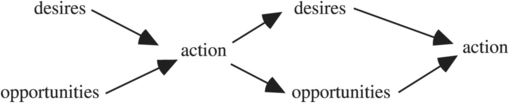 Figure 17.1
As an example of how action may shape opportunities in unintended and unforeseen ways, consider the bully who is able to get his way in transactions with others because they usually prefer to yield rather than stand up to him. An unintended consequence of his behavior may be that others shun him, so that he has fewer opportunities for transactions with them. He does well in each encounter, but he has fewer of them. The latter consequence may be not only unintended and unforeseen, but unperceived. As far as he can see, bullying works.2 If he does notice the negative effects of his behavior, he might still persist in it if the positive effects outweigh them. In that case, the negative consequences will be foreseen but not intended for their own sake.
Often the choice of one option today will remove certain options from the feasible set in the future. This effect may be foreseen: my budget constraint may allow me to buy one car, but not two. Sometimes, however, the agent may not know that the choice has irreversible consequences. A peasant may have a piece of land on which there are some trees and some fields. To get more land for cultivation, and wood to burn, she cuts down the trees. The deforestation causes erosion, leaving her with less land for cultivation than she began with. In a set of cases that I shall discuss shortly, erosion may be the outcome of collective behavior, if for instance erosion occurs on the farmer's plot if and only if both she and her two neighbors carry out deforestation. But it is also possible and quite common for an individual single-handedly and unknowingly to undermine her future opportunities for action. The culprit is a cognitive deficit: the agent cannot predict future consequences of present behavior. In other cases, it may occur through a motivational deficit: the agent attaches low weight to the (known and certain) future consequences compared to immediate gains (Chapter 6).
Externalities
Let me now turn to unintended consequences of interaction, a theme that was one of the key ideas of the emerging social sciences, notably in the Scottish Enlightenment. In Adam Ferguson's memorable phrase, history is “the result of human action, but not the execution of any human design.” His contemporary, Adam Smith, referred to an “invisible hand” that shapes human affairs. Half a century later, Hegel invoked the “cunning of reason” to explain the progress of freedom in history. About the same time, Tocqueville made a similar claim that in the progress of democracy, “everyone played a part: those who strove to ensure democracy's success as well as those who never dreamt of serving it; those who fought for it as well as those who declared themselves as its enemies.” A few years later, Marx referred to people's “alienation” from their own action, claiming that “this fixation of social activity, this consolidation of what we ourselves produce as a material power above us, growing out of our control, thwarting our expectations, bringing to naught our calculations, is one of the chief factors in historical development up till now.”
Among these writers only Adam Smith and Marx provided specific mechanisms for the production of unintended consequences. In modern language, they emphasized how externalities of behavior may aggregate to produce outcomes neither intended nor foreseen by the agents. In stylized form, imagine that each of many identical agents takes a certain action to promote his interest. As a by-product of that action, he also imposes a small cost or confers a small benefit (a negative or positive externality) on each of the other agents (and on himself). Each agent, then, is the target of many such actions. Adding up the effects, and then adding the sum to the private benefit of the agent caused by his action, we get the final outcome that the agents generate through their actions. Since we assume that they are identical, their initial states, the states they individually intend to bring about, and the states they collectively do bring about may each be represented by a single number, x, y, and z, respectively.3
Suppose first that z > y > x, a positive externality. This was Adam Smith's main interest: when an agent directs his “industry in such a manner as its produce may be of the greatest value, he intends only his own gain, and he is in this, as in many other cases, led by an invisible hand to promote an end which was no part of his intention. Nor is it always the worse for society that it was no part of it. By pursuing his own interest he frequently promotes that of the society more effectually than when he really intends to promote it.” In market competition the aim of each firm is to make a profit by producing more cheaply than the rivals, but in doing so they also benefit the customers. The customers, too, might in their capacity as workers or managers be in a similar position to benefit others through their competitive efforts. The result has been spectacular secular growth. The effect may or may not have been foreseen but was certainly “no part of” their intention.
Suppose next that y > z > x, a weak negative externality. The agents are made better off as a result of their effort, but, because of the costs they impose on each other, not as much as they expected to be. People commuting to work by car may be better off than they would be by using public transportation if the latter is poorly developed, but congestion or pollution prevents them from benefiting as much as they expected. If the externality is produced by congestion, they can hardly fail to notice it. If, however, it is produced by pollution, it might take a while before they understand that they are mutually harming themselves rather than being victims of (say) factory pollution.
Suppose finally that y > x > z, a strong negative externality. The agents are all made worse off as a result of everybody's trying to become better off. This was one of Marx's main charges against the decentralized capitalist economy. His main account of capitalist crises, the “theory of the falling rate of profit,” had this general structure. To maintain or increase profits, he argued, each capitalist has an incentive to replace labor by machinery. When all capitalists do so simultaneously, however, they are collectively sawing off the branch they are sitting on, since the ultimate source of profit is the surplus value generated by labor. The argument is seductive but on closer analysis turns out to be wrong in all sorts of ways. More interesting is another observation that Marx made in passing and that later become a cornerstone of the theory of unemployment produced by John Maynard Keynes. Each capitalist, Marx noted, has an ambiguous relation to the workers. On the one hand, she wants the workers she employs to have low wages, since that makes for high profits. On the other hand, she wants all other workers to have high wages, since that makes for high demand for her products. Although it is possible for any one capitalist to have both of these desires satisfied, it is logically impossible for this to be the case for all capitalists simultaneously. This is a “contradiction of capitalism” that Keynes spelled out as follows. In a situation of falling profit, each capitalist responds by laying off workers, thus saving on the wage bill. Yet since the demand of workers directly or indirectly is what sustains the firms, the effect of all capitalists’ simultaneously laying off workers will be a further reduction in profit, causing more lay-offs or bankruptcies.
There are many cases of this general kind. Overfishing, deforestation, and overgrazing (“the tragedy of the commons”) may be individually rational, but collectively suboptimal or even disastrous. If each family in a developing country produces many children as insurance against poverty in old age, overpopulation will generate more poverty. In a water crisis, each individual who uses water for non-essential purposes causes a slight increase in the probability that the authorities may cut the water supply for a few hours each day, affecting essential purposes as well. These consequences may or may not be foreseen. A crucial feature of this category of unintended consequences is that even when they are foreseen, the behavior will be the same. As I explain in the next chapter, it is a dominant strategy: it is rational to choose it regardless of what others are doing.
Internalities
A partially similar argument applies to “internalities,” defined as the benefit or harm a person's choice at one time may confer on the welfare he derives from later choices. Metaphorically speaking, internalities are externalities that a person imposes on his “later selves.” In the discussion of child custody summarized in Figure 13.3, I argued that time spent with the child creates a positive internality for the parent. Addiction provides an important example of negative internalities. The more a person has consumed in the past of an addictive substance, the less pleasure she derives from current consumption. This “tolerance” effect may also occur with non-addictive goods. Even if you love butter pecan ice cream, you are likely to be satiated if you have it five times a day. In addiction, however, past consumption has a further effect. While it makes current consumption less pleasurable than it would have been had the agent not consumed in the past, it also increases the welfare difference between consuming and not consuming in the present (“withdrawal”). Schematically, see Figure 17.2.
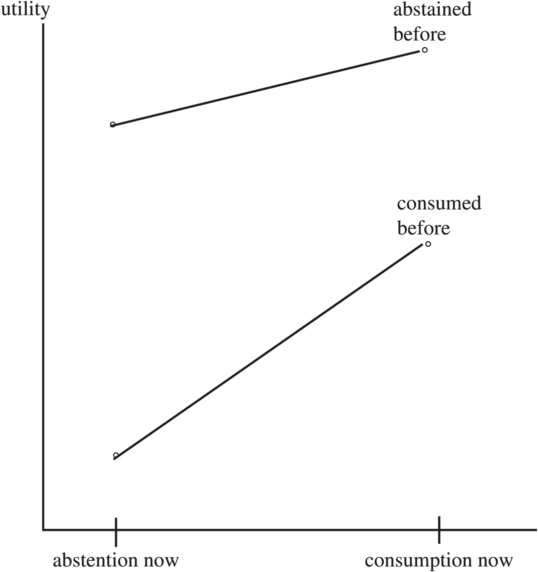 Figure 17.2
Thus regardless of whether she has abstained or consumed in the past, the agent is better off in the present by consuming than by not consuming. Consumption is a dominant strategy. At the same time, repeated consumption makes her worse off at all times (except for a few times in the beginning) than repeated abstention, just as the dominant strategy of having many children can make everybody worse off. There are of course obvious differences between externalities and internalities. One is the temporal asymmetry: whereas all individuals can harm one another, later selves cannot hurt earlier selves.4 Another is that the successive selves are really just time slices of one decision maker, whereas different individuals are not spatially distinct parts of one superorganism. Once the person (the one and only) understands that his present choices have a negative effect on the welfare he can derive from later choices, he has an incentive to change his behavior. Whether the incentive is strong enough depends on the severity of the withdrawal symptoms and on the extent to which the agent discounts future welfare. Some agents who would never have taken the first step had they known the consequences may choose not to quit once they are hooked.
The younger sibling syndrome
Unintended consequences of social action can also be produced by what I shall call the younger sibling mechanism. Before I explain this phrase, let me illustrate it with a famous example from economic theory, the “cobweb,” also called the “hog cycle” because it was first put forward as an explanation of cyclical fluctuations in hog production. It has a much wider application, however. Fluctuations in the shipbuilding industry have often had the same pattern, with a seller's market followed by overinvestment and glut. When students make career choices on the basis of current demand for graduates, they may collectively undo the basis for their decisions.
Hog farmers must decide one year ahead of time how much they want to put on the market in the next year, a decision that is determined by the price they expect hogs to fetch and the cost of producing them. An increase in expected price will induce farmers to produce more, as reflected in the upward-sloping supply curve in Figure 17.3.
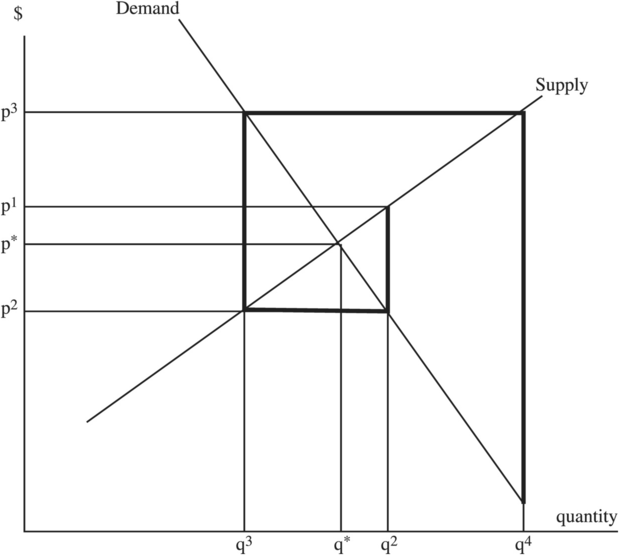 Figure 17.3
Assume that in year 1 the price for hogs is p1. Expecting that prices will remain the same in year 2, farmers put q2 on the market next year. At this volume, however, the market-clearing price is p2 rather than p1. Expecting that prices will remain at that level in year 3, farmers produce volume q3 for that year. The market-clearing price will be p3, inducing farmers to produce q4 in year 4, and so on. In this case, prices and volumes form an outward spiral or “cobweb” pattern indicated by the bold lines in the diagram. Pleasant surprises alternate with unpleasant ones, but the expected outcome never occurs. If the relative slopes of the supply and demand curves are modified, the result could be an inward spiral converging to the equilibrium price p* and equilibrium volume q*.
There is something irrational about the behavior of the farmers. Each of them believes that he is free to vary his output to maximize his profits, while tacitly assuming that others are just mechanically doing what they did last year. While perhaps irrational, the behavior is certainly intelligible. A French philosopher, Maurice Merleau-Ponty, said that our spontaneous tendency is to view other people as “younger siblings.”5 We do not easily impute to others the same capacity for deliberation and reflection that introspection tells us that we possess ourselves, nor for that matter our inner turmoil, doubts, and anguishes (see Chapter 22). The idea of viewing others as being just as strategic and calculating as we are ourselves does not seem to come naturally.
Three examples from voting behavior can also illustrate the idea. Suppose I am a member of the left wing of the Socialist Party in my country. I would much prefer to have the Socialists rather than the Communists in power, but since the polls predict a solid Socialist majority I vote Communist to make my party move to the left. I do not, however, pause to ask myself whether other left-wingers might think along the same lines. If many of them do, the Communists might win. The intention to produce the top-ranked outcome (a Socialist victory with a strong Communist showing) may generate the third-ranked outcome (a Communist victory). In what is probably a more common scenario, if many voters stay home because they are confident that their party will win, it may lose. Finally, recall the Chirac example from Chapter 14. A possible explanation for his disastrous calling of early elections may have been his failure to anticipate that the voters would infer his beliefs from his decision rather than simply behave, mechanically, as they said in the polls that they would.
In some cases, agents may be able to learn from their mistakes and form approximately rational expectations (Chapter 6). For a case in which learning is irrelevant, consider a student who is deliberating over the choice between law school and medical school. Assuming that she is motivated only by expected earnings, she will compare current incomes in the two professions to form her expectations about what she might earn three or six years hence. Once she has finished her studies in the chosen career, she may find that her income is substantially less than she expected, for the reasons underlying the cobweb model. Even if she understands where she went wrong, the understanding is irrelevant, since there is no repeat occasion on which she can use it.
The failure to see others as intentional and maximizing agents is observed when legislators or administrators propose policies that are undermined because agents adjust to them. According to Roman law, the stealing of a single horse or ox made a man a cattle thief, whereas it would not be a crime if he stole fewer than four pigs or ten sheep. A commentator on the law wrote that “in such a state of the law one would expect thefts of three pigs or eight sheep to become abnormally common.” Today, this effect is observed in France, where firms with fewer than fifty employees are exempt from many burdensome administrative regulations. As a result, there are 24 percent fewer firms of between fifty and fifty-four employees than companies of between forty-five and forty-nine.6 To promote security of employment, many countries have adopted legislation making it illegal to lay off workers who have been employed, say, two years or more. Employers rationally respond by outsourcing or by offering workers temporary contracts, thus reducing security of employment. Cities may build highways to reduce congestion, only to find that because more people take their cars to work the roads are just as jammed as before and more pollution is generated. The government may try to limit immigration to those who are married to a person who is already legally in the country, with the effect of inducing people to marry just for this purpose. Draft exemptions for students create an incentive to go to college. During the Vietnam War, dentists in Los Angeles charged between $1,000 and $2,000 to put braces on recruits who did not need them, because the law provided exemption for anyone under orthodontic care.
The younger sibling syndrome can have important social consequences, as some examples will bring out. Tocqueville notes that in the decades preceding the French Revolution, the upper classes publicly denounced the vices of the regime and its devastating impact on the people, as if the latter were deaf to what they were saying, “This reminds me of the sentiment of Mme Duchâtelet, who according to Voltaire's secretary did not mind undressing in front of her menservants, unpersuaded as she was that valets were men.” The secretary, in his memoirs, wrote in fact that “great ladies regarded their lackeys only as automata.” This simultaneous show of contempt toward the lower classes and denunciation of their misery prepared minds for the Revolution. Similarly, to explain the Virginia slave rebellion of 1800, to which I referred in Chapter 10, Federalists cited the fact that the doctrine of liberty and equality had “been most imprudently propagated for several years at our tables while our servants were standing behind our chairs.” More recently, the argument behind the “Phillips curve,” according to which the government can choose, if it so desires, to realize low unemployment at the cost of high inflation, presupposes that the social actors are unaware of this policy. When governments tried to achieve this end, however, strategic behavior by rational trade unions and other actors undermined their efforts and produced instead “stagflation” – high inflation and high unemployment.
The Vietnam War can also be used to illustrate the younger sibling syndrome. On several occasions, American decision makers failed to see that both the South Vietnamese and the North Vietnamese governments would adapt strategically to their choices. The Americans sent ground troops to the South on the assumption that their ally would maintain its forces at an unchanged level. Instead, the government reduced its troops, leaving the sum of American and South Vietnamese troops more or less unchanged. (The US ambassador to Saigon warned against this possibility, but was overridden by the generals.) Similarly, the US bombed oil installations in North Vietnam on the assumption that the bombing would bring the country to its knees. Instead, China and the Soviet Union made up for the losses.7
Unlike the unintended consequences produced by externalities, those generated by the younger sibling mechanism may end when the agents understand it. There are no dominant strategies in the cases I have described, only strategies that are optimal on the (usually implicit) assumption that others are less rational than one is. Once all agents view each other as rational, their behavior may converge to a fully predictable outcome. All hog farmers will expect the equilibrium price to prevail. Acting on that expectation, they will produce the equilibrium volume. Their shared belief is self-fulfilling. This idea is the topic of the next chapter.
Bibliographical note
The impact of addiction on time discounting is documented in L. Gordano et al., “Mild opioid deprivation increases the degree that opioid-dependent outpatients discount delayed heroin and money,” Psychopharmacology 63 (2002), 174–82. The note offering a model of Andersen's tale is inspired by C. C. von Weiszäcker, “Notes on endogenous change of tastes,” Journal of Economic Theory 3 (1971), 345–72. For a discussion of Marx on unintended consequences, see my Making Sense of Marx (Cambridge University Press, 1985), Chapter 1.3.2 and passim. The addiction model derives from G. Becker and K. Murphy, “A theory of rational addiction,” Journal of Political Economy 96 (1988), 675–700. A superb conceptual study of unintended consequences is T. Schelling, Micromotives and Macrobehavior (New York: Norton, 1978). For the idea of internalities, see R. Herrnstein et al., “Utility maximization and melioration: internalities in individual choice,” Journal of Behavioral Decision Making 6 (1993), 149–85.
1 By accident, the term “endowment effect” has come to be used both for the tendency to overvalue items in one's possession and for the utility a person may derive in the present from utility in the past. The two meanings are entirely unrelated.
2 This limited perspective is shared by some social scientists, who argue that emotions such as anger can be “rational,” or at least adaptive, because they enable agents to get their way in encounters with others.
3 Many economists would not count all the phenomena I list here as externalities. They would include pollution, but not market-generated effects such as Keynesian unemployment. For my purposes, however, what matters is what they have in common: in pursuit of a benefit for himself, each individual imposes a small cost or benefit on everybody else and on himself. A firm laying off workers or cutting wages will cause a small reduction in the demand for its own products – but only a small one. If Henry Ford ever said “I want to pay my workers enough so they can afford to buy my cars,” he was confused.
4 Nor benefit them: “Why should I do anything for future generations. They have never done anything for me” (Groucho Marx).
5 He actually wrote “younger brother.”
6 French firms are subject to fifteen such numerical thresholds, each of which generates obligations for the employers. With twenty or more employees, a firm has to hire at least 6 percent disabled workers; with two hundred or more it has to provide a room for the trade union, and so on.
7 The assumption rested on Walt Rostow's analogy with the bombing of Germany at the end of World War II, ignoring the fact that the Germans had no other source to which they could turn.