
18
Strategic interaction with simultaneous choices
The invention of game theory may come to be seen as the most important single advance of the social sciences in the twentieth century. The value of the theory is partly explanatory, but mainly conceptual. In some cases it allows us to explain behavior that previously appeared as puzzling. More important, it illuminates the structure of social interaction. Once you see the world through the lenses of game theory – or “the theory of interdependent decisions,” as it might better be called – nothing looks quite the same again.
I first consider games in which agents make simultaneous decisions. The goal is to understand whether and how n agents or players may achieve an unenforced coordination of their strategies. Often, we shall look at the special case of n = 2. A strategy can be the simple choice of an action, as when a poker player decides to bluff after looking at his hand. It can also be the choice of a rule, as when he decides to bluff only when he is dealt the seven of hearts. Finally, a player can use a mixed strategy, that is, assign probabilities to the possible actions and choose one of them with the assigned probability. In shooting a penalty, a soccer player might, for instance, mentally flip a coin between aiming at the right or the left side of the goal. The goal keeper might use the same procedure to decide whether to go to the right or the left.
The players may be able to communicate with each other, but not to enter into binding agreements. (They can make promises, but the decision whether to keep the promise will only recreate the game.) To any n-tuple of strategies, one chosen by each agent, there corresponds an outcome. Each agent ranks the possible outcomes according to his or her preference order. When needed, we shall assume that the conditions for representing preferences as cardinal utilities are satisfied (Chapter 13). The reward structure is the function that to any n-tuple of strategies assigns an n-tuple of utilities. Although the word “reward” may suggest a monetary outcome, the word will be used to refer to psychological outcomes (utilities and ultimately preferences). When the monetary or material reward structure and the psychological reward structure diverge, only the latter is relevant.
As briefly mentioned in the last chapter, an agent may have a strategy that is dominant in the sense that regardless of what others do, it yields a better outcome for her than what she would get if she chose any other strategy. Her outcome may depend on what others do, but her choice does not. In other cases, there is genuine interdependence of choices. If others drive on the left side of the road, my best response is to drive left too; if they drive on the right, my best response is to drive right.
An equilibrium is an n-tuple of strategies with the property that no player can, by deviating from his equilibrium strategy, unilaterally bring about an outcome that he strictly prefers to the equilibrium outcome. Equivalently, in equilibrium the strategy chosen by each player is a best response to the strategies chosen by the others, in the weak sense that he can do no better than choosing his equilibrium strategy if others choose theirs. The strategy need not, however, be optimal in the strong sense that he would do worse by deviating unilaterally. In the general case, a game may have several equilibria. We shall see some examples shortly. Assume, however, that there is only one equilibrium. Assume moreover that the reward structure and the rationality of all players are common knowledge.1 Under these assumptions, we can predict that all agents will choose their equilibrium strategy, since it is the only one that is based on rational beliefs about what others will do.
Some games with a unique equilibrium turn upon the existence of dominant strategies. The phrase “turn upon the existence of dominant strategies” can mean one of two things, illustrated in panels A and B of Figure 18.1.2 In an accident involving two cars, both are harmed. In an accident involving a pedestrian and a car, only the former is harmed. Car–car accidents occur if at least one driver is careless. If both are careless, the outcome is worse. Car–pedestrian accidents occur only if both are careless. Taking due care is costly. From these premises, it follows that in the car–car case, taking care is the dominant strategy for each driver. In the car–pedestrian case, no care is dominant for the driver. The pedestrian has no dominant strategy, since due care is the best response to no care and no care the best response to due care. Since he knows that the driver has no care as a dominant strategy and, being rational, will choose it, the pedestrian will nevertheless choose due care.3
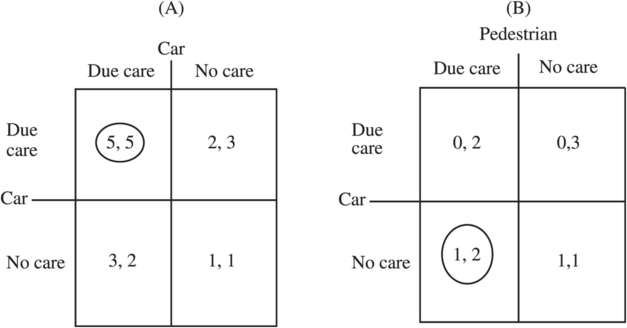 Figure 18.1
Games in which all players have dominant strategies are quite common and empirically important, as we shall see. Theoretically, they are somewhat trivial, except when they are repeated over time. Games in which some players have dominant strategies that can induce clear-cut choices in others are less common but also important. They have stronger informational requirements, however, since in our example the pedestrian needs to know the possible outcomes for the driver as well as for himself, whereas the two drivers only need to know their own outcomes. Often, we can impute dominant strategies to others without much trouble. We do not usually, for instance, look both ways before crossing a one-way street because we assume that the fear of drivers of being liable for an accident will make them obey the one-way rule.
A special class of games has coordination equilibria, often called “conventions,” in which each player not only has no incentive to deviate unilaterally, but also would prefer that nobody else does so. In an equilibrium in which everybody drives on the right side of the road, an accident might occur if I deviate or if anyone else does. In this case, the equilibrium is not unique, since driving on the left side has the same properties.4 Often it does not matter what we do as long as we all do the same thing. The meanings of words are arbitrary, but once they are fixed, they become conventions. In other cases, it does matter what we do, but it is more important that we all do the same thing. I return to some examples shortly.
Two duopoly examples
Some games have unique equilibria that do not turn upon the existence of dominant strategies. Duopoly behavior is an example (see Figure 18.2). When two firms dominate a market, lower production by one firm will induce higher prices and an expansion of production by the other firm. In other words, each firm has a “best response” schedule that tells it how much to produce as a function of the output of the other firm. In equilibrium, the output of each firm is a best response to the output of the other. This statement does not imply that they could not do better. If they formed a cartel and restricted their production to below-equilibrium levels, both would earn greater profits. Yet these collectively optimal levels of production are not best responses to each other. The firms are, in fact, facing a Prisoner's Dilemma (defined in Figure 18.2).
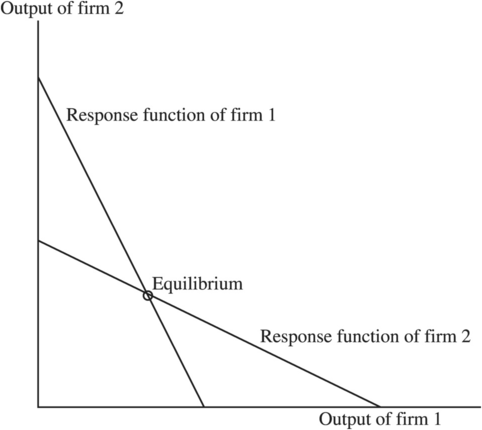 Figure 18.2
For another case of duopoly, consider two ice cream vendors on a beach, trying to find the best location for their stalls on the assumption that customers (assumed to be evenly distributed across the shoreline) will go to the closer stall. There is no dominant strategy. If one of them puts up a stall some distance left of the middle of the beach, the best response of the other is to position himself immediately to the right, to which the best response of the first is to move right again, and so on, until their stalls are beside each other at the middle of the beach. This unique equilibrium is obviously not the best for the customers in the aggregate. For them, the best outcome is one in which each stall is positioned halfway between the middle and one end of the beach. Although this outcome is just as good for the sellers as the equilibrium outcome, these positions are not best responses to each other. This model has also been applied to explain the tendency for political parties (in a two-party system) to move toward the middle of the political spectrum.
Suppose, however, that when both stalls are at the middle customers close to the ends abstain from buying ice cream because it would melt by the time they walked back. If no customer is willing to walk more than half the length of the beach, one-quarter to get to the stall and one-quarter to get back, the optimal consumer outcome is also the unique equilibrium since neither has an incentive to relocate. Suppose the beach is 1,000 meters long. If the seller at 750 meters moves his stall to 700 meters, he will lose the fifty customers between 950 and 1,000 meters who are not willing to walk more than 500 meters and gain the twenty-five customers between 475 and 500 meters to whom his stall is now closer than the other – a net loss. A similar argument might also explain why political parties never converge fully to the middle, since extremists at either end might prefer to abstain rather than vote for a centrist party. In addition, as I noted at the end of Chapter 11, it is simply not plausible to view vote maximization as the only aim of political parties.
Some frequently occurring games
A few simple interaction structures, with pay-offs as in Figure 18.3, occur very often in a great variety of contexts. C and D stand for “cooperation” and “defection.” In the Telephone Game the column player is the one who first called. In the Focal Point Game, A and B can be any pair of actions such that both players would prefer to coordinate on either than not to coordinate but are indifferent between the two ways of coordinating.
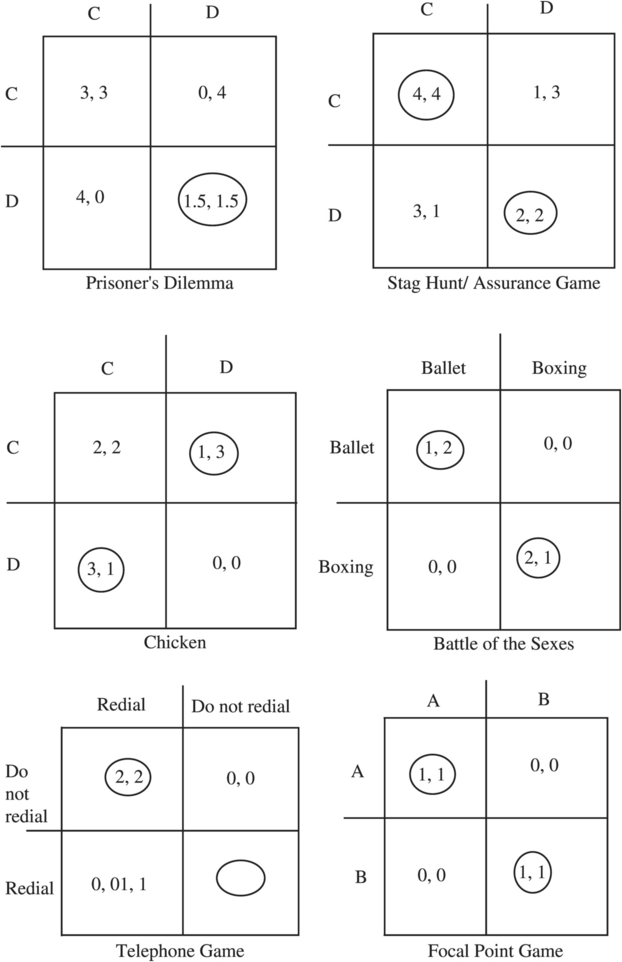 Figure 18.3
The games illuminate the structure of the two central issues of social interaction – cooperation and coordination. In a society with no cooperation for mutual benefit, life would be “solitary, poor, nasty, brutish, and short” (Hobbes). That it would be predictably bad is a meager consolation. In a society where people were unable to coordinate their behavior, unintended consequences would abound and life would be like “a tale told by an idiot, full of sound and fury, signifying nothing” (Macbeth). Both cooperation and coordination sometimes succeed, but often fail abysmally. Game theory can illuminate the successes as well as the failures.
The Prisoner's Dilemma (PD), the Stag Hunt, and Chicken involve in one way or another the choice between cooperation and defection (non-cooperation). The Prisoner's Dilemma is so called because the following story was used to illustrate it in an early discussion. Each of two prisoners, who have been involved in the same crime but are now in separate cells, is told that if he informs on the other but she does not inform on him, he will go free and she will go to prison for ten years; if neither informs on the other, both will go to prison for one year; and if both inform on each other, both will go to prison for five years.5 Under these circumstances, informing is a dominant strategy, although both would be better off if neither informed. The outcome is generated by a combination of the “free-rider temptation” (going free) and the “fear of being suckered” (getting ten years).
The negative externalities discussed in the last chapter can also be viewed as many-person PDs. Some other examples follow. For each worker (assuming selfish motivations) it is better to be non-unionized than to join a union, even when it is better for all if all join and gain higher pay. For each firm in a cartel it is better to break out and produce a high volume to exploit the high prices caused by the output restrictions of the other firms, but when all do that, prices fall to the competitive level; profit maximization by each firm undermines the maximization of joint profits. The Organization of Petroleum Exporting Countries (OPEC) cartel is vulnerable in the same way. Other examples are situations in which everybody has to run as fast as he can to stay in the same place, such as the arms race between the United States and the former Soviet Union, political advertising, or students writing papers for a teacher who “grades on the curve.” I offer many other examples in Chapter 23.
The idea of the Stag Hunt is often imputed to Jean-Jacques Rousseau, although his language was somewhat opaque.6 In more stylized form, it involves two hunters who can choose between hunting a stag (C) or a hare (D). Each can catch a hare by himself, but the joint effort of both is necessary (and sufficient) to catch a stag. Half a stag is worth more than a hare. It takes more time and effort to catch hares when both are trying because the noises the hunters make scare them away. As in the Prisoner's Dilemma, there is a risk of being a sucker, hunting a stag while the other goes for a hare. There is no free-rider temptation, however. The game has two equilibria, in the upper left-hand and lower right-hand cells.
Although the first equilibrium is clearly better, it may not be realized. To see why this might happen we can drop the assumption that the pay-off structure is common knowledge and allow the agents to have mistaken beliefs about the pay-off structure of other agents. Actions taken on these beliefs will form an equilibrium in a weak sense if, for each agent, the actions taken by the others confirm his beliefs about them. Assume, for instance, that in a Stag Hunt each agent falsely believes the others to have PD preferences. Given that belief, the rational action is to defect, thus confirming the belief of the others that he has PD preferences. This society might end up with high levels of tax evasion and corruption. I return to such cases of “pluralistic ignorance” in Chapter 22. In another society, where people correctly believe others to have Stag Hunt preferences, a good equilibrium will emerge in which people pay their taxes and do not offer or take bribes. “Cultures of corruption” might be a belief-dependent, not a motivation-dependent, phenomenon.
International control of infectious diseases can have the structure of a Stag Hunt. If only one country fails to take the appropriate measures, others will not be able to protect themselves.7 For another example, consider counterterrorist measures. If only one of two nations invests in such measures, it benefits the other as well as itself. If the costs exceed the benefits to itself, it will not invest unilaterally. Yet if both invest, the ability to pool information may lead to a greater security level for each than it could achieve by exploiting the investment of the other.
In these examples, the pay-off structure arises from the causal nature of the situation. In the Stag Hunt and the disease control case, the “threshold technology” implies that individual efforts are pointless. In the counterterrorism case, the underlying cause is something like economies of scale: ten units of effort have more than twice the effect of five units. In other cases, the pay-off structure is due to the fact that the agents care for other things than their own material rewards. In such cases, it is more common to refer to the game as an Assurance Game (AG). Even if the material pay-off structure is that of a PD, each individual may be willing to cooperate if he is assured that others will. The desire to be fair, or the reluctance to be a free rider, may overcome the temptation to exploit the cooperation of others. Alternatively, altruistic preferences may transform a PD into an AG.
Let us interpret the pay-offs in the PD in Figure 18.3 as monetary rewards and assume that each person's utility equals his monetary reward plus half the monetary reward of the other. In that case, the utility pay-off will be as in Figure 18.4 – an AG. The PD may also be transformed into an AG by a third mechanism, if an outside party attaches a penalty to the choice of the non-cooperative strategy D. If we again interpret the pay-offs in the PD in Figure 18.3 as monetary rewards, and assume that this is all the agents care about, deducting 1.25 from the reward to defection will turn it into an AG. A labor union might, for instance, impose formal or informal sanctions on non-unionized workers. Finally, one might transform a PD into an AG by rewarding cooperation, for example, by offering a bonus or bribe of 1.25 to cooperators. Promises of reward have to be respected, however, whereas a threat does not have to be carried out if it works. If the free-rider pay-off is very high, the benefits from cooperation may not be large enough to fund the bribes.8 In some cases, though, rewards are used. Workers who join a union may benefit not only from higher wages, which sometimes accrue equally to non-unionized workers, but also from pension plans and cheap vacations offered only to members. Again, I refer to Chapter 23 for details and examples.
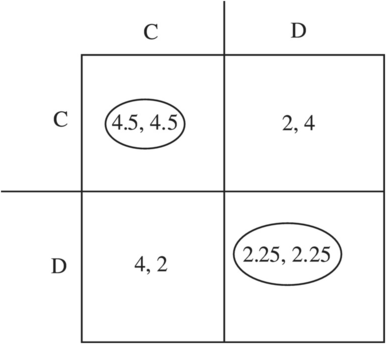 Figure 18.4
The game of Chicken is named after a teenage ritual from the 1955 movie Rebel Without a Cause. Los Angeles teenagers drive stolen cars to a cliff and play a game in which two boys simultaneously drive their cars off the edge of the cliff, stopping at the last possible moment. The boy who stops first is “chicken” and loses. In another variant, two cars drive toward each other and the one who swerves first is “chicken.” In each of the two equilibria, each agent does the opposite of the other. Even with common knowledge of the pay-off structure and of the rationality of the agent, we cannot predict which of the equilibria (if any) will be chosen. From the point of view of rational choice, the situation is indeterminate (see Chapter 13). In the second (“swerve”) version of the game, a player might try to break the indeterminacy by (visibly) blindfolding himself, thus inducing the other to swerve. Yet this creates the same predicament with the two options being “blindfolding” and “not blindfolding” rather than “swerving” and “not swerving.”9 It is a deeply frustrating situation.
On one understanding of the arms race, it has the structure of Chicken. The Cuban missile crisis is often cited as a case in which the two superpowers were locked in a Chicken-like confrontation and the USSR “blinked first.” Another example is that of two farmers who use the same irrigation system for their fields. The system can be adequately maintained by one person, but both farmers gain equal benefit from it. If one farmer does not do his share of maintenance, it may still be in the other farmer's interest to do so. The “Kitty Genovese” case can also be seen in this perspective, if we assume that each neighbor would prefer to intervene if and only if nobody else did.
Turning now to questions of coordination, consider first the Battle of the Sexes. The stereotype behind the story is the following. A man and his wife want to go out for the evening. They have decided to go either to a ballet or to a boxing match after work and to settle the final choice over the telephone. His phone breaks down, however, so they have to decide by tacit coordination. They have a common interest in being together, but divergent interests about where to go. As does the game of Chicken, this game has two equilibria, coordinating on the ballet or on the boxing match. And as in that game, there is no way common knowledge of the pay-off structure and of rationality will tell the couple where to meet. Once again, the situation is indeterminate.
Games of this kind arise when coordination can take many forms, all of which are better for all agents than no coordination at all, but each of which is preferred by some agents to the others.10 In social and political life, this seems to be the rule rather than the exception. All citizens may prefer any political constitution (within a certain range of possible regimes) to no constitution at all, because long-term stability is important in enabling them to plan ahead. When the law is fixed and hard to change, one can regulate one's behavior according to it. Yet each interest group may prefer a specific constitution in the range over the others: creditors lobby for a ban on paper money in the constitution, each political party favors the electoral system that will favor it, those with a strong candidate for the presidency want that office to be strong, and so on (see Chapter 25).
Multiple coordination equilibria also arise when different societies initially develop different standards of weight, length, or volume and later discover the potential benefits of a common solution. Continental Europe and the Anglo-Saxon world retain separate standards in these areas. Unlike the case of multiple constitutional solutions, the obstacle to agreement is not permanent divergence of interest, but short-term transition costs. The choice of standard might also, however, be a game of Chicken. Assume, implausibly, that the standard is written into the constitution as an entrenched clause (immune to amendment). Each country will then have an incentive to commit itself before the other does.
The Telephone Game is defined by the need for a rule to tell the parties what to do when a phone conversation is accidentally interrupted. There are two coordination equilibria: the redialing is done by the person who made the call in the first place or by the person who received it. Either rule is better than having both redial or neither. Yet in this case, unlike the Battle of the Sexes, one equilibrium is better for both than the other. It is more efficient to have the caller do the redialing, since he is more likely to know which number to call. Rational, fully informed agents will converge on the superior coordination equilibrium. This statement ignores, however, the cost of redialing. If the cost is large, the game becomes a Battle of the Sexes.
Consider finally the Focal Point Game, which can be illustrated by a variant of the Battle of the Sexes. The spouses have agreed to watch a movie that is playing both in movie theater A and movie theater B but have postponed the choice of venue. We assume that neither is closer or otherwise more convenient than the other. As in the Battle of the Sexes, information, rationality, and common knowledge by themselves will not tell them where to go. There might, however, be a psychological cue in the situation that will serve as a “focal point” for coordination. If the couple had their first date in theater A, this might make them converge to that location. In this case, the cue is a purely private event. In other cases, cues might be shared by a large population. Among New Yorkers, for instance, folklore says that if you get separated from your companion you meet at noon under the main clock at Grand Central Station. And even when there is no folklore, many people would still go to the railway station, since in many cities the railway station is the most important building of which there is only one.11 Its uniqueness renders it attractive as a focal point. Noontime has the same property.12
This focal point effect is easily demonstrated in experiments. If you ask all members of a group to write down a positive integer (whole number) on a piece of paper and tell them that they will get a reward if all write down the same number, they invariably converge on 1. There is a unique smallest integer, but no unique largest one. In other contexts, 0 may emerge as the unique focal point. In debates during the Cold War whether the United States might use tactical nuclear weapons without triggering an escalation into full-blown nuclear war, various ideas were suggested for a “bright line” that would allow limited use. In the end, it was decided that no use was the only focal point.
Pascal made a similar observation about the importance of custom: “Why do we follow old laws and old opinions? Because they are better? No, but they are unique, and remove the sources of diversity.” Elsewhere he wrote
The most unreasonable things in the world become the most reasonable because men are so unbalanced. What could be less reasonable than to choose as ruler of a state the oldest son of a queen? We do not choose as captain of a ship the most highly born of those aboard. Such a law would be ridiculous and unjust, but because men are, and always will be, as they are, it becomes reasonable and just, for who else could be chosen? The most virtuous and able man? That sets us straight away at daggers drawn, with everyone claiming to be most virtuous and able. Let us then attach this qualification to something incontrovertible. He is the king's eldest son: that is quite clear, there is no argument about it. Reason cannot do any better, because civil war is the greatest of evils.
Other countries, from the Roman Empire onward, were exposed to constant civil wars because of the absence of a rule of succession. In the choice of king in the French Restoration, Talleyrand successfully argued that the legitimate heir of the last king of France was the unique focal point that could prevent divisive conflicts. As he wrote in his memoirs, “An imposed King would be the result of force or intrigue; either would be insufficient. To establish a durable system that will be accepted without opposition, one must act on a principle.” Later, Marx argued that the Republic of 1848 owed its existence to the fact that it was the second-best option for each of the two branches of the royal family. Tocqueville made a similar observation to explain the stability of the rule of Napoleon III. Democracy, too, can be seen as a focal-point solution. When there are many competing qualitative grounds on which people can claim superiority – wisdom, wealth, virtue, birth – the quantitative solution of majority rule acquires unique salience. Former colonial countries in which tribes speak different languages may choose the language of the colonizer for official purposes. Litigating parties easily converge on a proposal that is everybody's second-best option.
In June 1989, the reburial of Imre Nagy provided a focal point for 250,000 people to march in the streets of Budapest to signal their disaffection with the regime. To call for a demonstration would have been dangerous for the organizers, but the spontaneous convergence on Heroes’ Square needed no coordinator. In conflict situations, focal points can have quite different effects. In the Crimean War the French General Pélissier decided to stage the second attack on Sebastopol on June 18, 1855, because he wanted to please Napoleon III by gaining a victory on the anniversary of the Battle of Waterloo. As this date and its importance to the French were common knowledge, the Russians were able to anticipate and defeat him.
One lesson from this survey is that a given real-world situation can be modeled as several different games, depending on additional assumptions. The arms race has been modeled as a PD, as Chicken, and as an AG. Joining the labor union may be a PD or an AG. Redialing has been seen as a Battle of the Sexes or as a Telephone Game. Coordination of weights and measures could be a game of Chicken or Battle of the Sexes. The fine grain of interaction structures may not be immediately visible. By forcing us to be explicit about the nature of the interaction, game theory can reveal unsuspected subtleties or perversities.
Sequential games
Let me turn more briefly to games in which agents make sequential decisions (I discuss such games at greater length in the next chapter) and begin by a simple example that demonstrates the power of game theory to clarify interaction structures that were only dimly understood earlier.13
In Figure 18.5, two armies are confronting each other at the border of their countries. General I can either retreat, leaving the status quo (3, 3) in place, or invade. If he invades, General II can either fight, with outcome (2, 1), or concede a contested piece of territory with outcome (4, 2). Before General I makes his decision, General II may be able to communicate an intention to fight if attacked, hoping to induce General I to choose (3, 3) rather than (2, 1). However, this threat is not credible. General I knows that once he invades, it will be in General II's interest to concede rather than to fight. The unique equilibrium outcome is (4, 2). This equilibrium concept is not the static “best-response” concept we have been discussing so far. Rather, it is a dynamic concept that begins with the later stages of the game and works back to the earlier ones. (The technical term is “backward induction.”) First, we ask what it would be rational for General II to do if General I invaded. The answer, “Concede,” leads to the outcome (4, 2). General I's choice, therefore, is between a course of action leading to (3, 3) and one leading to (4, 2). Being rational, he chooses the latter.
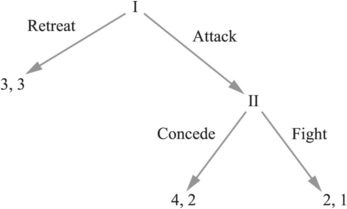 Figure 18.5
Promises as well as threats need to be credible of they are to affect behavior. Allowing for communication in the Trust Game (Chapter 20), for instance, the trustee might try to induce the investor to make a large transfer by promising to make a large back transfer. If there is nothing to hold him to his word, the promise is not credible. Economic reform in China was vulnerable to this problem. When the government introduced market reforms in agriculture in the 1980s, it promised the farmers fifteen-year leases on the land to give them an incentive to improve it. Since there is no way of holding an autocratic government to its promise, many farmers disbelieved it and used the profits for consumption instead. An autocratic government is unable to make itself unable to interfere (see chapter 24).
The notion of credibility is central in the “second-generation” game theory that began around 1975. (The first generation began around 1945.) Once we take the idea seriously, we are led to ask how agents might invest in credibility to lend efficacy to their threats and promises. There are several mechanisms. One is by reputation-building, for instance by investing in a reputation for being somewhat or occasionally irrational. Thus President Nixon, encouraged by Henry Kissinger, deliberately cultivated an erratic style to make the Soviets believe he might act against the American interest if they provoked him. Also, people might carry out threats when it is not in their interest to do so in order to build a reputation for toughness that will make others believe their threats on later occasions. I return to these questions in Chapter 24.
Another mechanism is precommitment, discussed in Chapter 14 and Chapter 15. There, precommitment was viewed as a second-best rational response to the agent's proclivity to behave irrationally. In the strategic context, precommitment can be fully rational. In the game depicted in Figure 18.5, General II might build a “Doomsday machine” that would automatically launch a nuclear attack on the other country in the case of invasion. If both the existence of this machine and the fact that its operation is outside the control of country II were common knowledge, it would deter the invasion. Alternatively, General II might use the strategy of “burning his bridges,” that is, of cutting off any possibility of retreat. If General II has no option but to fight if attacked, General I will obtain a payoff of 2 if he attacks – less than he would obtain by retreating. Less can be more, and beat more.
Time inconsistency
The generic meaning of “time inconsistency” is that an agent at one point in time forms or communicates an intention to do something at a later time, yet when that later time arrives has no incentive to carry it out, with no changes having occurred but the sheer passage of time. In other words, the intention itself is internally flawed or incoherent. The incoherence reflects an inability to project (Chapter 14).
There are two specific mechanisms that can generate time inconsistency, one intrapersonal and the other interpersonal. The first is illustrated by non-exponential discounting of the future (Chapter 6), and the second by the non-credible threats and promises that I have discussed in this chapter and to which I return in Chapter 24. Although these two sources of time inconsistency have little in common, some of the remedies are the same. Specifically, people can use extrapsychic precommitment devices both to protect themselves against their future selves and to get their way with other people. When people use precommitment devices against themselves, it is sometimes because they anticipate that they might succumb to passion or other visceral factors, and sometimes they believe that they might undergo preference reversal as the result of the sheer passing of time. The failure to stop smoking or drinking illustrates the former case, that of beginning to exercise or to save the latter. When they use precommitment devices in interaction with others, it may be to enhance the credibility of threats and promises, but also for the reasons I spell out in the beginning of the next chapter.
Time inconsistency must be distinguished from time inconstancy, and notably from changing time preferences. Formal preferences no less than material preferences are subject to change under the influence of external or internal causes. As one grows older, food preferences may change because of reduced sensitivity to one of the four or five basic tastes. As part of the same process, time preferences may be affected if people take account of the fact that their life expectancy changes as they grow older. At age x, life expectancy tables tell me that I can expect to live until age x + y and that my chances of living until age x + 2y are very small. Hence I allocate my expected income so as not to have any money left at age x + 2y. However, when I actually reach age x + y, my chances of living until age x + 2y have increased so much that I revise my plans, to exhaust my funds at age x + 3y. This is not inconsistency, but a simple consequence of the fact that I know that I shall die but not when. In other words, changing consistent plans can mimic inconsistent plans. Inconstancy can be debilitating, however, for people whose life is a succession of short-lived long-term plans. Most readers will have come across such persons.
Bibliographical note
A good elementary introduction to game theory is A. Dixit and S. Skeath, Games of Strategy, 2nd edn (New York: Norton, 2004). Among more advanced treatments, I suggest F. Vega-Redondo, Economics and the Theory of Games (Cambridge University Press, 2003). An encyclopedic survey with many applications is R. Aumann and S. Hart, Handbook of Game Theory with Economic Applications, vols. I–III (Amsterdam: North-Holland, 1992, 1994, 2002). Applications to specific topics are found in J. D. Morrow, Game Theory for Political Scientists (Princeton University Press, 1994), and in D. Baird, H. Gertner, and R. Picker, Game Theory and the Law (Cambridge, MA: Harvard University Press, 1994). A classic study of conventions is D. Lewis, Convention (Cambridge, MA: Harvard University Press, 1969). It is largely inspired by another classic, T. Schelling, The Strategy of Conflict (Cambridge, MA: Harvard University Press, 1960), in which the idea of focal points was first expounded. Schelling's work also provided the intuitive foundation for the “second generation” of game theory, formally developed in R. Selten, “Reexamination of the perfectness concept for equilibrium points in extensive games,” International Journal of Game Theory 4 (1975), 25–55. For various precommitment techniques in political games, see J. Fearon, “Domestic political audiences and the escalation of international disputes,” American Political Science Review 88 (1994), 577–92. For their use in wage bargaining, see my The Cement of Society (Cambridge University Press, 1989).
1 A fact is common knowledge if all know it, all know that all others know it, all know that all others know that all others know it, and so on. To avoid reliance on the phrase “and so on,” which suggests an infinite sequence of beliefs, the idea may also be stated as follows: there is no n such that the fact is common knowledge up to level n in the sequence but not at level n + 1. For a simple illustration, common knowledge may be realized in a classroom. When the teacher tells a fact to the students, they all know it, know that others know it, and so on.
2 By convention, the first number in each cell represents the pay-off for the “row player” who chooses between the top and bottom strategies, and the second the pay-off for the “column player” who chooses between the left and right strategies. Depending on the context, the pay-offs may be cardinal utilities, ordinal utilities, money, or anything else that the players may be assumed to maximize. In Figure 18.1, pay-offs may be seen as standing for ordinal utilities, reflecting preferences over outcomes. Here and later, equilibria are circled.
3 According to some legal analyses, an important function of tort law is to use the system of fines and damages to change the reward matrix so that the emerging equilibrium has some desirable property (efficiency or fairness).
4 Although the non-uniqueness does not follow from the formal definition, this seems to be a general feature of real-life coordination games.
5 The pay-offs for the Prisoner's Dilemma in Figure 18.3 might seem artificial. For the present purposes, all that matters is the (ordinal) ranking of the outcomes. Later, the pay-offs will be reinterpreted as monetary rewards.
6 “If a deer was to be taken, every one saw that, in order to succeed, he must abide faithfully by his post: but if a hare happened to come within the reach of any one of them, it is not to be doubted that he pursued it without scruple, and, having seized his prey, cared very little, if by so doing he caused his companions to miss theirs.” This could be read as saying that pursuing hares is a dominant strategy.
7 This is a huge simplification, made simply for the sake of illustration.
8 Whether one uses punishments or rewards, the costs of establishing the system and monitoring the agents also have to be funded by the gains from cooperation. In practice, this can easily make such arrangements impossible or wasteful.
9 Similarly, the “solution” to the Prisoner's Dilemma that consists of each person's promising to cooperate merely recreates the PD with the choices being “keeping the promise” and “reneging.”
10 As we shall see later (Chapter 24), this question of dividing the benefits from cooperation can also be studied within bargaining theory, a specialized branch of game theory.
11 In New York City, those ignorant of the folklore would not go to Grand Central Station, since the presence of Penn Station makes it non-unique. Instead, they might coordinate on the Empire State Building.
12 Although midnight, too, is a focal point, it is inferior to noontime because of the inconvenience.
13 I retain the assumption that rationality and information are common knowledge.