
20
Lowering the guard
Egoism, said Tocqueville, is “the rust of society.” Similarly, it is often said that trust is “the lubricant of society.”1 Everyday life would be impossibly difficult if we could not trust others to do what they say they will do, at least to some extent. Although scholars have defined trust in various ways, I shall use a simple behavioral definition: to trust someone is to lower one's guard, to refrain from taking precautions against an interaction partner, even when the other, because of opportunism or incompetence, could act in a way that might seem to justify precautions.2 By “opportunism” I mean shortsighted or “raw” self-interest, unconstrained by either ethical or prudential considerations. Typical opportunistic acts that may justify others’ taking precautions include telling a lie, cheating on an exam, shirking at the workplace, breaking a promise, embezzling money, being unfaithful to one's spouse, or choosing the non-cooperative strategy in a Prisoner's Dilemma.
One may or may not trust oneself to keep a bargain, stay away from alcohol, or keep the ship on a steady course when the Sirens are calling. Distrust of oneself is revealed by precommitment or by the construction of private rules (Chapter 15). These strategies can be costly, however, because of signaling effects. If others observe one instance of such precautionary behavior toward my future selves, they may infer, incorrectly as we saw in Chapter 12, that I lack self-control in general. Hence they may be reluctant to trust me on occasions when (1) my lack of self-control could be costly for them, (2) no precommitment devices are available, and (3) private rules are irrelevant, as they would be in a one-shot encounter. In many societies, there are norms against total abstention from alcohol as well as norms against drunkenness (Chapter 21).
Distrust can take one of two forms. On the one hand, one may simply abstain from interacting with a potential partner when the interaction would make one vulnerable to incompetence or opportunism. On the other hand, one may engage in the interaction but take precautions against these risks. Trust, therefore, is the result of two successive decisions: to engage in the interaction and to abstain from monitoring the interaction partner. Because the decision to abstain from interaction is hard to observe, one may easily underestimate the amount of distrust in society. One might easily think there is more distrust in a society where people are constantly keeping tabs on each other than in one where they largely keep to themselves. Yet on closer inspection one would find that the latter is very inefficient because of the many mutually beneficial bargains that are never struck.
Montaigne described one trusting response: “When I am on my travels, whoever has my purse has full charge of it without supervision.” Other instances of showing trust may involve refraining from acts such as the following:
reading one's spouse's diary
using proctors to monitor students during exams
checking the credentials of a prospective employee
asking for a deposit from a tenant
insisting on written and legally enforceable contracts
asking a less wealthy partner to sign a prenuptial agreement
hiding money from one's children
locking one's front door when leaving the house
precommitting oneself to punish defectors in a Prisoner's Dilemma
asking for a second medical opinion or a quote from a second car mechanic.
As noted, the object of trust can be other people's ability or their motivation. The distinction is vividly illustrated in the history of resistance movements. In the German-occupied countries during World War II, it happened from time to time that resistance members were killed because they were thought to be German agents. It also happened, although more rarely, that they were killed because they could not be trusted to hold their tongue. A person might turn out to be a drunkard and be executed by the resistance so that he would not reveal dangerous information when drunk. To take a more mundane example, I might question a car mechanic's skill or I might question his honesty. When I ask for a second medical opinion it is often because of worries about the first doctor's competence, although I might also be concerned that she is recommending needless surgery to line her own pocket.
The distinction between trusting someone's ability and trusting her honesty is fundamental, but somewhat neglected in the scholarly literature. The reason is perhaps that competence is more easily observed than honesty, and hence seems to pose fewer problems. Often, though, one has to be competent to assess competence. Also, a competent person can exert herself to a greater or lesser degree, for opportunistic reasons. Below I mostly discuss trust in honesty.
Reasons for trust
There are a number of reasons why people may refrain from taking precautions.3 (1) The cost of taking precautions might exceed the expected benefits, either on a given occasion or over life as a whole. If there is a car mechanic in my village and I would have to travel fifty miles by taxi to get a second quote, it might not be worth it. More generally, life is too short always to fear one might be taken advantage of. The occasional loss that results from trusting the untrustworthy is small compared to the peace of mind that goes with lack of worry. (2) The very act of taking precautions can provide information that can be exploited by opportunists. Montaigne cites the Latin saying Furem signata sollicitant. Aperta effractarius praeterit (Locked houses invite the thief: the burglar passes them by when they are wide open). (3) The idea of taking precautions might be incompatible with the agent's emotional attitude toward the other person. When people are in love, they may refuse to engage in the cool calculation involved in a prenuptial agreement. The verse from Donne cited in Chapter 19 is appropriate in this context too: “True and false fears let us refrain.” (4) I might have prior beliefs about the trustworthiness of the other person. (5) I might try to induce trustworthiness by trusting him or her. (6) Not trusting another person, even if she is a stranger, would show a lack of respect that is inconsistent with a social norm about how to behave toward strangers.
In the following I shall focus on (4) and more briefly on (5) and (6). While many scholars define trust exclusively in terms of (4), I believe the focus on deliberate restraint has the advantage of highlighting the interaction between the truster and the trustee. If the trustee perceives the lack of precautions, the perception might cause him to act differently than he would otherwise have done. In case (2) this happens because he infers that there will be no occasion for opportunistic behavior. In other cases, to be discussed later, the perception may change his motivation to behave opportunistically, reflecting a preanalytical intuition that trust has a certain self-fulfilling quality. The same is true of distrust. As Proust noted, “As soon as jealousy is discovered, it is considered by its object as a lack of trust which gives her a right to deceive us.”
Reasons for trustworthiness
People may be perceived as trustworthy on a number of different grounds. I shall discuss four: past behavior, incentives, signs, and signals. Often, we know – or believe we know (see Chapter 12) – from observation of other people that they consistently keep their promises, abstain from lying, treat property that is not their own carefully, and so on. Moreover, a person who knows himself or herself to be (un)trustworthy will tend to think others are (un)trustworthy too (the so-called false consensus effect) and therefore tend to (dis)trust them. As La Bruyère said, “Knaves easily believe others as bad as themselves; there is no deceiving them, neither do they long deceive.”4 There is experimental evidence that this mechanism does in fact operate. Conversely, A may trust C because he knows that B, whom he trusts, trusts C. The inference may not be valid, however, because B's trust in C might simply be due to the false consensus effect. As these examples show, we often trust or distrust people for bad reasons, believing others to be either more like us or “more like themselves” (more consistent in their behavior) than they in fact are.
In the small international community of diamond merchants, where the temptation for opportunistic behavior is enormous, a verbal agreement without witnesses is as binding as a written contract. A merchant who violated an agreement might pocket a temporary gain, but would be shunned ever afterward by all other merchants.5 He would also be unable to pass on the business to his children, as is often the custom in the diamond community. In the case of New York diamond merchants, most of whom live in ultra-Orthodox Jewish communities, a cheater would also suffer social ostracism. The latter mechanism cements the trustworthiness but is not necessary for it. The incentive to maintain a reputation for honesty and trustworthiness is often sufficient.
Signs are features of individuals that are thought, rightly or wrongly, to indicate trustworthiness. In a study of what makes taxi drivers willing to trust their passengers not to rob or assault them, women were perceived as more trustworthy than men, older people more than younger, whites more than blacks, the wealthier more than the poorer, the self-absorbed more than the inquisitive, the candid more than the shifty. A Spanish taxi driver in New York would find Spanish passengers more trustworthy than those belonging to other ethnic groups. Catholic drivers in Belfast would find Catholic passengers more trustworthy than Protestants, and vice versa for Protestant drivers. More generic features are having eyes that are not too closely set to each other and looking one's interlocutor in the eyes.
Signals are behavior that provides evidence of trustworthiness. These may include the deliberate production or mimicking of signs. For instance, it appears that a good way to generate a frank look is to focus on the root of the nose of one's interlocutor. In this case, the signal will work only if the other person believes that a frank look is a reliable indicator of behavior and ignores how easy it is to fake it. Other behavior works as signals if it is too costly for untrustworthy individuals to afford it. To forge a signature successfully, long practice may be required, whereas writing one's own signature is essentially costless. A poor man might dress up as a Wall Street banker to appear trustworthy to the taxi driver but is unlikely to do so since the costs would be greater than what he could expect to get from the robbery. By contrast, waving the Wall Street Journal to hail a taxi is something anyone can afford and hence does not discriminate between the trustworthy and untrustworthy. To the extent that trust relies on the belief that the interaction partner has a long time horizon (a low rate of time discounting), costly displays of physical fitness and slimness can serve as a signal, given the (false) belief that farsightedness as a character trait obtains either across the board or not at all.
Often, we trust people because we perceive them to be motivated not only by their self-interest. Sometimes, however, we trust people only if we see them as self-interested. In The Maltese Falcon, Mr. Gutman tells Humphrey Bogart, “I don't trust a man who doesn't look after himself.” Napoleon said that Talleyrand was not be trusted because he never asked any favors for his family. As president of France, François Mitterrand was said to be similarly distrustful of those who never asked him for favors. Lyndon B. Johnson was said not to understand or trust men with limited ambitions. More generally, a major problem for confidence tricksters and swindlers is to make their victim believe that they are acting out of self-interest. Suppose I walk up to someone and tell him that there is a fortune to be made by investing a small amount of money up-front. His first question will be “Isn't this too good to be true?” His second question will be “If it really is true, why do you want to share the opportunity with me rather than taking all for yourself?” The successful con artist is able to elicit the trust of his victim by telling a plausible story to explain why he is induced by self-interest to give up part of the gains. In the absence of a prior history of interaction, claims of benevolent motivation are not credible.
Just as people can be (perceived as) more or less trustworthy, they may be more or less trusting. That is, if both A and B have the same beliefs about C (or no beliefs at all), A may trust C and B may not. The propensity to trust others is especially important in getting cooperative ventures off the ground. In repeated interactions, cooperation can be sustained by reciprocity except in the first round, where there is no prior history of interaction. To get it started, the parties must cooperate unconditionally in the first round. A trusting individual would follow “tit for tat”: cooperate in the first round and reciprocate in later rounds. As the proverb has it, “Fool me once, shame on you; fool me twice, shame on me.” A distrustful person would follow “tat for tit”: defect in the first round and reciprocate in later rounds.
Experiments on trust
The “Trust Game” (TG) is among the most frequently studied games in behavioral economics, along with the Ultimatum Game (Chapter 19) and public good games (Chapter 23). Typically, one subject (the “investor”) has the option of transferring some of her funds (provided by the experimenter) to another subject (the “trustee”). The experimenter then multiplies any amount sent, so that, for instance, if the investor transfers 10 monetary units (MU), the trustee receives 30. The trustee then has the option of transferring some of the gains back to the investor. Rational and selfish trustees would never send anything back; anticipating this fact, rational and selfish investors would not make any transfers. Yet both could be made better off if the investor trusted the trustee, and the latter rewarded the trust. In the example, the trustee could send back 20 MU, leaving both himself and the investor with a net gain of 10. Note that since the experimental set-up usually involved anonymity of investors and trustees to each other, investors have no reason to believe or disbelieve that the trustee is trustworthy, thus excluding explanation (4) of why people trust each other. Trust games take place among strangers.
In one experiment, investors transferred on average around two-thirds of their endowment to the trustee, and trustees made on average a slightly larger back transfer. The larger the forward transfer, the larger the back transfer. These findings are consistent with a number of motivational assumptions, except the hypothesis that both agents are motivated by material self-interest and know each other to be so motivated. On that hypothesis the investor, expecting a zero back transfer, would make a zero forward transfer. Typically, however, investors make a positive transfer and trustees a positive back transfer. In some cases, the motivation of the trustees may be altruism or fairness, if they return more than they received. In some cases, however, they return no more and no less than what they received. The motivation behind this behavior is puzzling. I conjecture that trustees return the same amount they received because they do not want to appear – to themselves or to the investor – as exploitative. As I argue in the next chapter, even the thought of appearing as unfair in the eyes of another person, with whom they will never interact again, is aversive.
Another puzzle concerns the behavior of the investors. In one experiment, subjects were given two risky choices. In one, they were given a chance to gamble $5 to win $10 from the draw of a ball from an urn, told that the urn contained 100 balls, and asked to state the minimum number of winning balls the urn would have to contain to entice them to gamble the $5. The average number was about 64, showing risk aversion (Chapter 13). In the other, they were given the option of investing $5 in a trust game, knowing that the trustee would have the choice between returning $10 and keeping the money to himself. Although only 53 percent thought the trustee would return $10, 71 percent decided to make the investment. This behavior is inconsistent with risk aversion. According to explanation (6), investors make a transfer because not doing so would show disrespect for the trustee, even at “zero acquaintance.”
When investors make a transfer, they do not necessarily show trust in my sense of the term. If they do not have the opportunity of taking precautions, they cannot refrain from taking them. A trust game that focuses on this variable was played in two conditions. In both, the investor could transfer any amount of his 10 MU to a trustee, who could make a back transfer of any amount of the augmented sum (30 MU). In the inappropriately labeled (or so I shall argue) “trust condition,” an investor who decides to make a transfer also has to state the amount he wishes the trustee to transfer back to him. In the “incentive condition,” the investor is also given the option of stating, at the time he makes the transfer and announces the desired back transfer, that he will impose a fine of 4 MU on the trustee if he transfers back less than the desired amount. Some investors use this option, others do not. If they do not, the trustees know that the investor had the option but refrained from using it. The largest back transfers are made in the incentive condition when trustees are told that no fine will be imposed and the smallest in the same condition when they know that a fine will be imposed, back transfers in the trust condition being at an intermediate level. This effect was anticipated by investors, who invested about 30 percent more in the “incentive, no fine” condition than in either of the others.
The “incentive, no fine” condition corresponds to my definition of trust. What the experimenters call the “trust condition” I would rather call blind trust. It is manifested when precautions are excluded, as distinct from the case in which they are not chosen. The striking finding is that (non-blind) trust induces more cooperation than blind trust. Lowering your guard makes a difference. In most trust games, though, subjects do not have the opportunity of taking precautions. I conjecture that in most real-world situations of trust they do.6 If I am right, the relevance of some of the experimental findings may be limited.
I now consider two further experiments that involve the physiological dimensions of trust. The first studied investment size as a function of the presence or absence of the hormone oxytocin. The hormone was known to stimulate pro-social behavior in rodents and to promote the release of breast milk in human females, but the finding that it also promotes pro-social behavior, or trust, in humans came as a surprise. When receiving the hormone, the percentage of investors who transferred their whole endowment to the trustee increased from 21 percent to 45 percent. Three further findings are intriguing. First, trustees who received the hormone did not make larger back transfers. Second, investors given the hormone had the same beliefs about the trustworthiness of trustees (i.e. expectations about back transfers) as those not given the hormone. Third, when investors were told that the back transfers were generated by a random mechanism with the same distribution of pay-offs as when they played against a real person, oxytocin made no difference to the size of transfers. The natural interpretation is that the hormone affected the behavior by making the investors less “betrayal-averse” rather than by making them less risk-averse. The importance of betrayal aversion is also confirmed by other experiments that do not rely on physiological manipulations.
The second experiment, which allowed investors to punish ungenerous trustees, studied what went on in their brains as they were punishing. In this TG, the investor had the choice between transferring his whole endowment of 10 MUs to the trustee and transferring nothing. If he made a transfer, it was quadrupled by the experimenter, leaving the trustee with a total of 50 MU – an original endowment of 10 plus the 40 generated by the investment. The trustee then had the choice between transferring 25 of the 50 back to the investor and transferring nothing. The three possible outcomes, in other words, were (10, 10), (25, 25), and (0, 50) (see Figure 20.1).
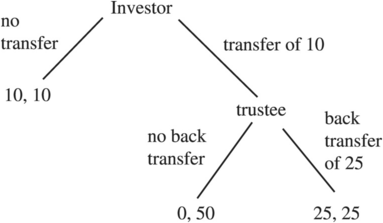 Figure 20.1
In addition, after the trustee made his decision both players received an additional endowment of 20 MU. The investor could use his endowment to punish the trustee, in either of two conditions.7 In a “costly” condition, the investor could attach up to 20 “punishment points” to the trustee; each point caused the investor to lose 1 MU and the trustee to lose 2 MU. Thus by punishing maximally, the investor could ensure that the pay-off of the trustee was reduced from 70 (50 + 20) to 30, while his own was reduced from 20 to 0. In a “costless” condition, only the trustee was affected by the punishment.
All of fifteen investors but one consistently chose to make transfers. The experiment was manipulated so that each investor played against seven trustees, of whom three made the back transfer while four kept all for themselves. These selfish trustees were the focus of the experiment. After a trustee had announced his decision to keep all for himself, the investor had one minute to deliberate and decide whether he wanted to punish the trustee and how severely. During this period his brain was scanned to detect activities in the various regions that might be relevant. One region, the caudate nucleus, is closely linked to the processing of rewards. Another, the prefrontal and orbitofrontal cortex, is linked to the integration of separate cognitive processes, for example, to trade-offs between costs and benefits. In each of these regions the pattern of activities confirmed the hypothesis about the motivation for punishment that I shall now go on to state.
In both the costly and the costless conditions there was a correlation between activation of reward-related circuits and the actual monetary punishment that was imposed. This correlation could mean either that the decision to punish induces satisfaction or that the expected satisfaction from punishment induces the decision to punish. To distinguish between the two hypotheses the experimenters considered eleven subjects who imposed the maximal feasible punishment in the “costless” condition. Among these subjects, those whose reward circuits were more highly activated also imposed more severe punishments in the “costly” condition. As they got more of a kick from punishing, they were willing to spend more on it, thus supporting the second hypothesis. This interpretation is also confirmed by the fact that the cortex was more highly activated in the costly condition, when subjects had to trade off the material costs and psychic benefits of punishment against each other, than in the costless condition. This finding seems to confirm the “warm glow” theory of this particular form of altruistic behavior (Chapter 5).
I am agnostic about the robustness of the finding. Neuroeconomics still has a long way to go. In its current state, it may be a form of premature reductionism. To be sure, we can say without looking that the brain must be involved, but the exact form of the involvement may elude us. We can compare the case with Descartes's mechanistic physiology, on which Pascal commented in the following terms: “Descartes. We must say summarily: ‘This is made by figure and motion,’ for it is true. But to say what these are, and to compose the machine, is ridiculous. For it is useless, uncertain, and painful.”8 Also, in real-life situations we tend to avoid rather than punish those who betray our trust (see also Chapter 23).
Trust and institutions
Citizens and institutions may entertain mutual relations of trust and distrust. In many countries, surveys indicate the level of trust citizens have in various institutions. A representative sample is shown in Table 20.1.
Table 20.1The Harris Poll. February 16–21, 2010. N = 1,010 adults nationwide. Margin of error ± 3.
“As far as people in charge of running [see below] are concerned, would you say you have a great deal of confidence at all in them?”
|
Percentage |
|
|
The military |
59 |
|
Small business |
50 |
|
Major educational institutions, such as colleges and universities |
35 |
|
Medicine |
34 |
|
The US Supreme Court |
31 |
|
The White House |
27 |
|
Organized religion |
26 |
|
The courts and the justice system |
24 |
|
Public schools |
22 |
|
Television news |
17 |
|
Major companies |
15 |
|
Organized labor |
14 |
|
The press |
13 |
|
Law firms |
13 |
|
Congress |
8 |
|
Wall Street |
8 |
This survey, like the others I have seen, does not distinguish between trust or confidence in the competence of these institutions and confidence in their honesty (see the discussion of virtue and ability in Chapter 5). Because this distinction is fundamental, it is hard to know how to interpret the answers to the survey questions. One might have trust in the competence of the army, but be afraid that it might stage a coup; in fact, the trust in its competence might fuel the fear. Also, survey answers are intrinsically less reliable than behavioral evidence. Individuals show their distrust of banks when they keep their savings at home in the form of cash. Women show their distrust of the police or of the justice system when they fail to report being raped. Some workers refuse to join unions, and some citizens do not watch TV or read newspapers because they distrust either the competence or the honesty of these institutions. People can show their distrust of the political system by not voting, and their distrust of lawyers by trying to reach private settlements. It is harder, however, for individuals to show their distrust of institutions by monitoring them, as distinct from not engaging with them. A fortiori, it is difficult to trust institutions by abstaining from monitoring them.
Relations of trust and distrust between citizens and institutions work in both directions. Public agencies may trust citizens by abstaining from monitoring their claims to welfare services, or distrust them by carrying out invasive home checks. The number of people employed by the Internal Revenue Service as a percentage of taxpayers may perhaps serve as an indicator of the trust of the government in the honesty of the citizens. The Norwegian practice, established in 2001, of making the income and tax payments of all citizens accessible on the internet seems to reflect a distrust of taxpayers’ honesty. The system generated additional tax payments of approximately $100 million (in a country of five million inhabitants), perhaps because citizens fear that neighbors who can observe a discrepancy between reported income and lifestyle will report them to the tax authorities. Hence the distrust may well have been justified. After the system was revised in 2014 so that taxpayers will be automatically informed of the identity of those who have accessed their tax information, some of these additional payments may be lost.
An important open question is whether increased government trust in citizens will lead to increased citizens’ trust in the government. If the police, for instance, behave in ways that makes them appear less of an enemy to citizens, will the latter be more willing to volunteer information? If the claims of women to have been raped are treated with less skepticism, will more claims be made?
Bibliographical note
Evidence that the trustworthy are those who trust others is offered in D. Glaeser et al., “Measuring trust,” Quarterly Journal of Economics 115 (2000), 811–46. The diamond merchant community in New York is analyzed by B. Richman, “How community institutions create economic advantage: Jewish diamond merchants in New York,” Law and Social Inquiry 31 (2006), 382–420. The use of signs and signals by taxi drivers to determine the trustworthiness of their passengers is the topic of D. Gambetta and H. Hamill, Streetwise (New York: Russell Sage, 2005). The ways to make a scam appear credible are analyzed in a neglected book by N. Leff, Swindling and Selling (New York: Free Press, 1976). On trust games in general, see C. Camerer, Behavioral Game Theory (New York: Russell Sage, 2004), Chapter 2.7. The trust game with optional punishment is reported in E. Fehr and B. Rockenbach, “Detrimental effects of sanctions on human altruism,” Nature 422 (2003), 137–40. The social-norm explanation of why investors make a transfer even when they have no reason to expect a back transfer is proposed in D. Dunning et al., “Trust at zero acquaintance,” Journal of Personality and Social Psychology, 107 (2014), 122–41. The impact of oxytocin on trust is shown in M. Kosfeld et al., “Oxytocin increases trust in humans,” Nature 435 (2005), 673–6. The idea of betrayal-aversion is confirmed by I. Bohnet and R. Zeckhauser, “Trust, risk and betrayal,” Journal of Economic Behavior and Organization 55 (2004), 467–84. The study of trust and revenge is by J. F. de Quervain et al. (2004), “The neural basis of altruistic punishment,” Science 305 (2004), 1254–8.
1 In an older literature on economic development, corruption was sometimes assigned the role of lubricant.
2 Trust thus understood involves a double abstention, one party's refraining from precautions in the hope that the other will refrain from opportunistic behavior.
3 I use “refrain” to indicate a deliberate abstention. In some of the cases I discuss, the idea of taking precautions, for example, by reading the diary of a spouse, may never have crossed the person's mind. Yet this is not “blind trust” as I shall define it later, if the agent had the opportunity of taking precautions. For the other person in the relationship, the fact that the agent had the opportunity but did not use it is a telling sign, whether or not the abstention is perceived as deliberate.
4 La Rochefoucauld thought differently: “People are never deceived so easily as when they are out to deceive others.”
5 This is not the simple tit-for-tat mechanism, in which a player who defects in one round and is punished in the next round may be forgiven if he resumes his cooperative behavior. Rather, it is a “grim trigger” mechanism by which a single defection precludes redemption by good behavior later on.
6 Referring to the servant who had charge of his purse, Montaigne wrote that “He could cheat me just as well if I kept accounts, and, unless he is a devil, by such reckless trust I oblige him to be honest.” Since he asserts that any precautions he could have taken would have been useless, Montaigne did not show trust in the sense I have defined it here, but “blind trust.” I suspect, though, that he could have prevented his servant from cheating him by taking very strict precautions.
7 The trustees were unaware of the punishment option.
8 This criticism was one of the passages Valéry had in mind when he claimed that Pascal was envious of Descartes (see Chapter 16). Yet since the criticism was obviously right, there is no need to invoke envy!