
19
Intentions and consequences
The conceptual structure of game theory is illuminating. Does it also help us explain behavior? Consider the game-theoretic rationale for burning one's bridges or one's ships. This behavior could be undertaken for the strategic reasons set out in the last chapter, but also for others. In the most famous example, Hernán Cortés destroyed all his ships after arriving on the coast of Mexico in 1519, partly to prevent a conspiracy among some of his men to seize a ship and escape to Cuba, partly to add sailors to his infantry. He later wrote that by this act he gave the men the “certainty that they must either win the land or die in the attempt.” To my knowledge, there is no evidence that he also intended to signal this fact to Montezuma, as the game-theoretic rationale would require.
In fact, there is no documented instance (once again, to my knowledge) of such reasoning.1 The claim that William the Conqueror burned his ships upon arriving in England in 1066 seems to be a myth. Hume cites James Lancaster's attack in 1594 on Pernambuco in Brazil: “As he approached the shore, he saw it lined with great numbers of the enemy; but no-wise daunted at this appearance, he placed the stoutest of his men in boats, and ordered them to row with such violence, on the landing place, as to split them in pieces. By this bold action, he both deprived his men of all resource but in victory, and terrified the enemy, who fled after a short resistance.” The reference to the terror-struck enemy is missing in other accounts, but even if accurate would not support, in fact would contradict, the idea that the enemy fled as a rational response to a rational action. (It is also possible that Lancaster had a prudential fear that the men might retreat out of visceral fear if they were left the opportunity to do so.) Nor do other famous ship-burning episodes fit the game-theoretic pattern. When Agathocles, a tyrant of Sicily in the third century BC, burned his ships, it was because he did not want them to fall into the hands of the enemy, and because he could not spare the men to guard them. According to Gibbon, Emperor Julian destroyed the bridges behind him “to convince the troops that they must place their hopes of safety in the success of their arms” and, on another occasion, burned his fleet because it was “the only measure which could save that valuable prize from the hands” of the enemy. Gibbon also cites the example of the Norman adventurer Robert Guiscard, who urged his followers to burn their boats “to deprive cowardice of the means of escape.”2
I cannot vouch for the accuracy of any of these accounts, which I cite only for methodological purposes. Even though the game-theoretical reasoning might explain the seemingly paradoxical behavior of an agent throwing away some of his assets, evidence about intentions is needed to make it more than a just-so story. Game theorists routinely refer to William the Conqueror and to Cortés to illustrate the claim that the enemy might rationally refrain from attacking a general who has made himself unable to retreat, but they never (to my knowledge) try to show that anyone ever did use that strategy. I return to this general point in the Conclusion.
In some cases, to be sure, there is evidence that the actors intended to bring about the consequences predicted by the model. In Chapter 24 I give examples from the theory of bargaining (a branch of game theory), such as firms that build up a large inventory to make it more costly for workers to strike. Proven cases of this kind are, however, surprisingly rare. As I noted in Chapter 3, uncovering the intentions and beliefs of social agents can be difficult, but it is not impossible. If scholars shy away from the difficulty, their work will suffer.
Game theory can also address situations in which some of the actors do not care about the consequences. Consider, for instance, the interaction between the European Union and the new entrants from Eastern Europe. The old member states might be tempted to impose conditions for entry that would entail permanently lower agricultural subsidies for the new states, compared to those of same-size old states. In material terms, the new states would benefit so much from entry that they would be better off as second-rank members than as non-members, although less well off than they would be as full members. In psychological terms, the insult of being treated as inferior might cause them to reject such conditions.3 Anticipating this reaction, the old states might be induced to offer entry on terms of full equality. The belief that material terms were not all the new states cared about might get them better material terms.
Since I was not privy to the entry negotiations, these remarks are conjectural. We know, however, that arguments of this kind were made at the Federal Convention in Philadelphia in 1787 in the debate over the terms of accession of future western states. Gouverneur Morris and others proposed that these should be admitted as second-rate states, so that they would never be able to outvote the original thirteen states. Against this view, George Mason argued strongly for admission with the same rights as the original states. First, he argued from principle: by admitting the western states on equal terms, the framers would do “what we know to be right in itself.” To those who might not accept that argument, he added that the new states would in any case be unlikely to accept a degrading proposal.
If the Western States are to be admitted into the Union, as they arise, they must be treated as equals, and subjected to no degrading discriminations. They will have the same pride & other passions which we have, and will either not unite with or will speedily revolt from the Union, if they are not in all respects placed on an equal footing with their brethren.
Mason refers to the “pride and passions” of the new states, not to their self-interest. Even if it would in fact be in their interest to accede to the union on unequal terms rather than remain outside, they might still, out of resentment, prefer to stay outside. At the same time, he appeals to the self-interest of the old states, not to their sense of justice. In the terminology of Chapter 4, he is telling them that because the new states might be motivated by passion rather than by interest, it would be in the interest of the old states to act as if they were motivated by reason rather than by interest.
This situation has been studied experimentally by means of the Ultimatum Game and Dictator Game (Figure 19.1). In the Ultimatum Game, one person (the Proposer) can propose a distribution (x, 10–x) of $10 between him and another person (the Responder). Offers can be made only in whole dollars. If the Responder accepts, that distribution is implemented. If the Responder rejects the proposal, neither gets anything. Although the game has been studied in many variants, I focus on one-shot interactions under conditions of anonymity. Because subjects interact through computer terminals they do not know the identity of their partner. Often it is also made clear to them that the experimenter will be unable to determine who made which choices, thus eliminating the possibility that their decisions might be influenced by the desire to please her. When subjects play the game many times, they never meet the same partner, thus allowing for learning but not for reputation building. Under these conditions, there is maximal scope for the decisions to reflect unfettered self-interest.
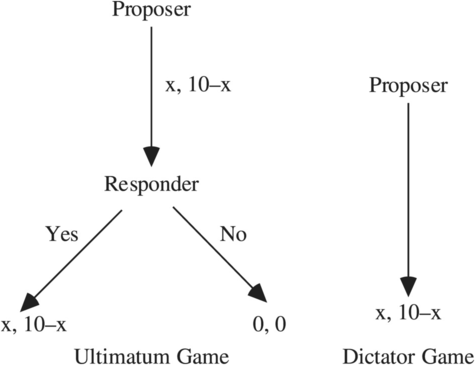 Figure 19.1
Assuming that both agents are rational, are self-interested, and have full information about the pay-off structure and that these facts are common knowledge, the Proposer will offer (9, 1), which the Responder will accept. If offers could be made in cents, the Proposer would offer (9.99, 0.01), which would still be accepted, since something is better than nothing. In experiments, proposals are typically around (6, 4). Responders usually reject proposals offering them 2 or less.4 They are willing to cut off their nose to spite their face. Clearly, one of the assumptions is violated. By virtue of the way the experiment is set up, we can exclude lack of information and lack of common knowledge about information. We cannot exclude, however, failure of rationality or non-self-interested motivations.
The Proposer might be an altruist, who prefers a somewhat equal allocation to one in which he gets everything. Although altruism toward perfect strangers who are not in any obvious need is a somewhat strange idea, it is at least consistent with rationality. We can reject this hypothesis, however, by comparing behavior in the Ultimatum Game to behavior in the Dictator Game. In the latter, which is not really a “game” at all, the Proposer unilaterally allocates the money between him and the Responder, leaving the latter no opportunity to respond. If proposals in the Ultimatum Game were dictated only by altruism, allocations in the Dictator Game should be no different. In experiments, though, Proposer behavior is much less generous in the Dictator Game. Clearly, the behavior of the Proposer in the Ultimatum Game is driven, at least in part, by the expectation of rejection of ungenerous offers.
To explain this rejection, we might assume that Responders will be motivated by envy to reject low offers, and that self-interested Proposers, anticipating this effect, will make offers that are just generous enough to be accepted. If this explanation were correct, we should expect that the frequency of rejection of (8, 2) should be the same when the Proposer is free to propose any allocation and when he is constrained – and known to be constrained – to choose between (8, 2) and (2, 8). In experiments, the rejection rate is lower in the latter case. This result suggests that Responder behavior is determined by considerations of fairness. For the Proposer to offer (8, 2) when he could have offered (5, 5) is seen as more unfair than when his only alternative was one that was equally disadvantageous to him. What matter are intentions, not outcomes.
This interpretation is supported by the importance of strong reciprocity in other games such as the Trust Game (Chapter 20). People are sometimes willing to punish others, at some cost and no benefit to themselves, for behaving unfairly. This practice seems to violate one of the canons of rationality enumerated in Chapter 14: in a choice between acting and doing nothing, a rational agent will not act if the expected costs exceed the expected benefits. Explanations in terms of altruism or envy would not violate this principle. For an altruist, the outcome can be better when he benefits another at some cost to himself, and for the envious person when he harms another at some cost to himself. Such behavior violates the assumption of self-interest, but not the rationality assumption. By contrast, the fairness explanation seems to violate the latter. Strong reciprocity induces behavior similar to what we do when we stumble over a stone and kick it in retaliation: it does not help and just aggravates the pain.
Backward induction
In the Ultimatum Game, the game shown in Figure 18.5 and other sequential games, the equilibrium is found by backward induction. In the Ultimatum Game, the Proposer anticipates how the Responder might react to a given proposal and then adjusts his behavior accordingly. In these examples, the calculations involved are very simple. In other experiments, subjects might have to carry out longer chains of reasoning. Two subjects may be told, for instance, to go through three rounds of offers and counteroffers to divide a sum of money, which shrinks 50 percent for each round of offers.5 At each point, an agent can either accept the proposal and go “right” or make a counterproposal and go “down.” Rationality, self-interest, and common knowledge then induce the following reasoning.
The person making the first proposal (Player I) will have to take into account whether Player II will prefer the proposed division to one in which he would get a larger share of a smaller pie. At the same time, Player I knows that Player II will not make a proposal that would make I worse off by accepting it than he would be by going to the last round. In Figure 19.2, Player I can get at least 1.25 by taking all that is left in the third round. Player II cannot, therefore, offer him less than 1.25 in the second round, leaving 1.25 as the maximum for himself. Knowing this, Player I will offer (3.75, 1.25) and II will accept.
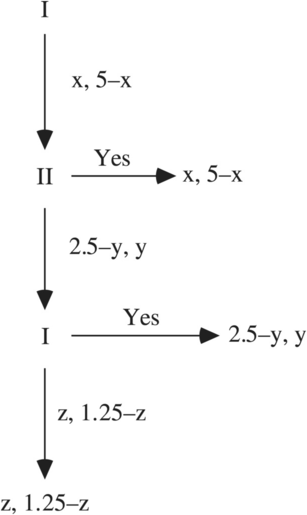 Figure 19.2
In experiments, the mean offer made by I is (2.89, 2.11), substantially more generous than the equilibrium offer. Clearly, one or more of the assumptions is violated. (1) The first player might be altruistic. (2) He might fear that the other player would reject the equilibrium offer because he is incapable of following the logic of backward induction. (3) He might himself be unable to follow that logic. (4) He might fear that the second player would reject the equilibrium offer out of resentment. The first, second, and fourth hypotheses can be eliminated by observing the responses when subjects in the role of the first player are told that they are playing against a computer that is programmed to respond optimally. In that case the average first offer is (3.16, 1.84), which remains substantially more generous than the equilibrium. Since the subjects making the high offers could hardly have altruistic feelings toward a computer or believe it to be incompetent or resentful, they must be incompetent themselves.
It is not that the task is difficult. Once subjects have the logic of backward induction explained to them, they perform impeccably in further games. Rather, the experiment shows that this kind of reasoning does not come naturally to human beings. Even simple forward-looking reasoning may not occur spontaneously, as shown by the Winner's Curse (Chapter 13). The “younger sibling” syndrome (Chapter 17) has some of the same flavor. It is not that people cannot understand, on reflection, that others are as rational and capable of deliberation as they are themselves, only that their spontaneous tendency is to think about others as set in their habits rather than as adjusting to their environments.
Some failures of rational-choice game theory
Among many other findings that reveal the predictive failures of game theory, I shall discuss the “finitely repeated Prisoner's Dilemma,” the “Chain Store Paradox,” the “Centipede Game,” the “Traveler's Dilemma,” and the “Beauty Contest.”
When subjects play many successive PDs against one another and know which round will be the last, we observe a substantial proportion of C choices, often exceeding 30 percent. An intuitive explanation is that a player may choose C in one round in the hope that the other will reciprocate (“tit-for-tat”). Yet if the players adopt backward induction, they will understand that in the final game both will choose D since there will not be an opportunity to influence behavior in a later game. In the penultimate game, too, the players will choose D since the behavior in the final game is driven by the previous argument. This argument “zips back” all the way to the first round, thus inducing defection in all games.
A chain store has branches in twenty cities, and in each city it faces a potential challenger. The challenger has to decide whether to set up a store to share the market with the chain store or stay out of the city. The chain store has the option of responding aggressively by predatory underpricing, thus bankrupting the rival but also imposing a loss on itself, or agreeing on market sharing. The pay-offs are as in Figure 19.3; the first number in each pair is the pay-off to the potential entrant.
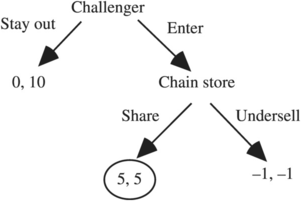 Figure 19.3
Backward induction in a single game yields (5, 5) as the equilibrium outcome: the rival enters and the chain store accepts sharing the market. Yet, thinking ahead to later challenges, the chain store might decide to behave more aggressively and ruin the entrant, at some cost to itself, to deter potential entrants in other cities. But if we apply backward-induction reasoning to the sequence of twenty games, this strategy is not viable. In the twentieth game, there are no further benefits to be had from behaving aggressively, so the firm might as well share the market with the entrant. But that implies that there are no benefits to be gained from predatory pricing in the nineteenth game either, and so on, back to the first game. Although the extent of predatory pricing in actual markets is controversial, it does show up in experimental markets.
The Centipede Game6 is shown in Figure 19.4 (pay-offs in dollars). Backward induction tells Player I to choose Stop at the beginning, leaving each of the two with one-sixteenth of the pay-offs they could have obtained by continuing all the way to the end. In one typical experiment, 22 percent chose Stop at the first choice “node,” 41 percent of those who remained chose Stop at the second node, 74 percent of those still remaining then chose Stop at the third node, and of the remaining, half chose Stop at the fourth node and half chose Go. The deviation from the (circled) equilibrium predicted by backward induction is large, as is the average increase in gains for the players.
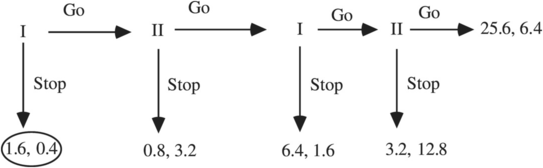 Figure 19.4
To explain these instances of apparently irrational cooperation and predation, one might stipulate the existence of uncertainty about some aspect of the games. Real-life players are rarely faced with a finite and known number of rounds. Often, they might believe that the interaction will continue for an indefinite time, so that there is no final round from which backward induction could begin. In such cases, mutual adoption of tit-for-tat may be an equilibrium in the iterated PD. (It is not unique, since “Always defect, always defect” is also an equilibrium. Structurally, this is a bit like the Assurance Game, with one good equilibrium and one bad.) If real life induces tit-for-tat behavior, agents may apply it to laboratory situations in which it is not optimal.
Alternatively, an agent might be uncertain about the type of player she is facing. Suppose there is common knowledge that there are some irrational individuals in the population. It is known that some agents will always cooperate, that others use tit-for-tat in finitely iterated PDs, that still others will use predatory pricing to deter entrants even in the twentieth city, and so on. It is not known, however, exactly who these individuals are. Any agent might, with some positive probability, be irrational. In the Chain Store Paradox, a potential entrant will be deterred if the probability she assigns to the chain store manager's being irrational is sufficiently large. The manager, knowing this, has an incentive to engage in predatory pricing toward the first entrant to make others believe he is irrational. When potential entrants in other cities observe this behavior, they use Bayesian reasoning (Chapter 13) to assign a higher probability to his being irrational. It may not be high enough to deter them, but if he does it again and again, it may eventually reach a level at which it is more rational for them to stay out. A similar argument might explain cooperation in the finitely iterated PD and the Centipede Game.
Yet another possibility is that in the iterated Prisoner's Dilemma and the Centipede Game cooperation has something of a focal-point quality. Although rational individuals would defect on the first occasion, reasonable persons would not. Although this suggestion (about which more later) is pretty vague, it rings truer, to me at least, than the arguments based on uncertainty about the other person's type. For one thing, these arguments require players to carry out enormously complicated calculations, which take up many pages in textbooks. For another, introspection and casual observation suggest that we do not, when making decisions in everyday life, think about others in this way. When I trust somebody with a small amount of money, but not with a large one, it is not because I assign a small probability to his being unconditionally trustworthy, but because I judge that he can be trusted only when the stakes are not very high.
In the Traveler's Dilemma, two players simultaneously state claims, between $80 and $200, for lost luggage. To discourage excessive claims, the airline pays each traveler the minimum of the two claims, adds a sum R to the person who made the lower claim, and deducts the same amount from the person who made the higher claim. Consider a pair of claims such as (100, 150), yielding pay-offs of (100 + R, 100 – R). This pair cannot be an equilibrium, since the first player would have an incentive to claim 149, yielding a pay-off of 149 + R, to which the second player would respond by claiming 148, and so on. As this example suggests, the unique equilibrium occurs when both claim 80. In experiments, this outcome is in fact observed when R is large. When R is small, however, subjects make claims closer to the upper limit of 200. Again, my intuition is that something like focal-point reasoning is operating. Each traveler knows that given the gains from coordinating on a high claim it would be silly to adopt the equilibrium strategy, and she expects the other to know it too.
John Maynard Keynes compared the stock market to a Beauty Contest. He had in mind contests that were popular in England at the time, in which a newspaper would print 100 photographs, and people would write in to say which six faces they liked most. Everyone who picked the most popular face was automatically entered in a raffle, in which they could win a prize. Keynes wrote, “It is not a case of choosing those [faces] which, to the best of one's judgment, are really the prettiest, nor even those which average opinion genuinely thinks the prettiest. We have reached the third degree where we devote our intelligences to anticipating what average opinion expects the average opinion to be. And there are some, I believe, who practise the fourth, fifth and higher degrees.”
In a game inspired by Keynes's remarks, subjects are asked to pick a number between 0 and 100. The player whose number is closest to two-thirds of the average of all the numbers chosen wins a fixed prize. The average is constrained to be 100 or less, implying that two-thirds of the average is constrained to be 67 or less. Hence for any average resulting from the choices of the other players, 67 will be closer to two-thirds of that average than will any number larger than 67. But when numbers are constrained to be 67 or less, two-thirds of the average is constrained to be 44 or less, and so on, until one reaches the unique equilibrium of 0. In experiments, very few subjects choose 0; the average number is around 35. For someone to choose this number, he must believe that most others choose larger numbers – the younger sibling syndrome. The fact that this number is about two-thirds of the average of the whole range, 50, suggests that the typical subject might believe that others pick a number at random while he is free to optimize. Alternatively, the typical subject might believe that others go through two rounds of elimination, leaving him free to optimize by adding a third round.
I have been suggesting that when people fail to conform to the predictions of game theory, it may be because they are less than rational or more than rational. The younger sibling syndrome is certainly a failure of rationality, as is the inability to carry out simple backward induction. To be reasonable is to transcend the traps of rationality – to concentrate on the fact that both players can gain while ignoring the best-response logic. As I have said, the latter idea is somewhat akin to the focal-point notion, but only somewhat. Focal points are equilibria, whereas cooperation in the finitely repeated Prisoner's Dilemma, a high claim in the Traveler's Dilemma, or the choice of Go in the Centipede Game are not. What these choices have in common with focal-point choices is a hard-to-define and highly context-dependent property of obviousness and reasonableness.
This argument might seem more similar to magical thinking (Chapter 7) than to focal-point reasoning. To ignore the Sirens of rationality is to follow John Donne's injunction in “The Anniversary”:
Who is so safe as we? where none can do
Treason to us, except one of us two.
True and false fears let us refrain.
To ignore true fears seems irrational, or magical. (The same holds for ignoring true prospects of gain.) Alternatively, and this is how I prefer to view it, such behavior reflects a higher standard than mere rationality. These are difficult issues, and readers are invited to make up their own minds. Some of the questions are pursued in the next chapter.
Bibliographical note
C. Camerer, Behavioral Game Theory (New York: Russell Sage, 2004), is the source for most of the examples in this chapter. A useful analysis of the conditions under which the predictions of standard game theory break down is J. K. Goeree and C. A. Holt, “Ten little treasures of game theory and ten intuitive contradictions,” American Economic Review 91 (2001), 1402–22. The apparently simple idea of backward induction turns out to harbor deep paradoxes, some of which are set out in the Introduction to my The Cement of Society (Cambridge University Press, 1989). The game illustrated in Figure 19.2 is taken from E. Johnson et al., “Detecting failures of backward induction,” Journal of Economic Theory 104 (2002), 16–47. The Traveler's Dilemma is taken from K. Basu, “The traveler's dilemma: paradoxes of rationality in game theory,” American Economic Review: Papers and Proceedings 84 (1994), 391–5. For the distinction between the reasonable and the rational, see R. D. Luce and H. Raiffa, Games and Decisions (New York: Wiley, 1957), p. 101.
1 Nor does there seem to be any instance of an admiral or general burning his ships or bridges as a precommitment measure to prevent himself (rather than his soldiers) from succumbing to fear.
2 In addition to burning ships or bridges, Montaigne offers this example: “There are several examples in Roman history of captains … who would order their horsemen to dismount to remove from the soldiers any hope of flight.”
3 In 2003 President Chirac offered an example of this attitude when he responded to expressions of support for US policy in Iraq by East European politicians by saying that they had missed a great opportunity to keep silent, adding that they had obviously not been very well brought up.
4 I say “typically” and “usually” because of the considerable variation in the findings. Some of the variation is gender-based, some culture-based. Because most experiments use students as subjects, nobody to my knowledge has looked at age differences.
5 The shrinking may be seen as an effect of time discounting (Chapter 6).
6 The name refers to a version of the game with 100 nodes.