
23
Collective action can be defined as decentralized action by the members of a group to eliminate public bads that affect all of them or to create public goods that benefit all of them. Although such actions benefit everybody (they are Pareto-superior to the status quo), it may not be in the self-interest of any individual to participate or contribute. To show the pervasive character of this dilemma between the individual and the collective good, I begin the chapter by offering a large number of examples, before discussing their fine grain.
In some cases, successful collective action arises out of horizontal interaction among group members. In other cases, a government or an institution may promote Pareto-improving actions by vertical measures (rewards or punishments) that affect the choice set, and therefore the choices, of the members. Not all vertical measures generate Pareto improvements, however; some create winners and losers. In the latter case, the obstacle to their implementation is group interest, not individual self-interest. In the next two chapters I consider several cases of that kind.
Some collective action problems
A collective action problem is a many-person Prisoner's Dilemma (Chapter 18), at least as far as material incentives are concerned. To illustrate the variety and ubiquity of collective action, I shall present a number of examples, several of them mentioned in earlier chapters or discussed later. In enumerating the cases, I identify them by the cooperative strategy.1
Voting in elections.
Elected members of parliament being present for votes and debates.
Committee members or market traders taking the time to inform themselves rather than counting on someone else to gather information (“informational free riding”).
Joining an insurrectional movement.
Joining a trade union.
In revolutionary America, joining a non-importation movement or a non-consumption movement.
Industry unions making moderate demands for wage increases. (An encompassing trade union, organizing workers in all industries, will pull its punches out of self-interest, since all members will feel the full impact of the price increase triggered by high wages. Workers in one industry, however, usually do not consume so much (if anything) of its output that the price increase offsets their wage increase.)
Respecting an agreed-upon cartel prize or volume of production.
Abstaining from littering, polluting, overgrazing, overfishing.
Refusing government subsidies. “Democratic centuries are times of trial, innovation, and adventure. There are always a host of men engaged in difficult or novel enterprises which they pursue independently, unencumbered by their fellow men. These people accept the general principle that the public authorities should not intervene in public affairs, but each of them seeks, as an exception to this rule, help in the affair that is of special concern to him and tries to interest the government in acting in that area while continuing to ask that its action in other areas be restricted. Because so many men take this particular view of so many different objectives at the same time, the sphere of the central power imperceptibly expands in every direction, even though each of them wishes to restrict it” (Tocqueville). Marx made a similar claim: “The attitude of the bourgeois to the institutions of his regime is like that of the Jew to the law; he evades them whenever it is possible to do so in each individual case, but he wants everybody else to observe them.”
Doing military service. Free-riding tactics for avoiding military service include cutting off a finger, paying a substitute, taking a debilitating drug prior to the medical examination, obtaining a needless orthodontic treatment, getting married, going to college, going into hiding, or leaving the country.
Reporting one's income correctly and paying one's taxes on time.
In federal systems, each state contributing its fair share of taxes and soldiers. This problem also arose in France under the ancien régime, when the country was divided into three estates (clergy, nobility, commoners), which constantly fought to achieve tax exemptions.
In military systems, each branch (air force, navy, army) providing accurate rather than self-serving estimates of the best way to conduct or prepare for war.
Shipowners contributing to build a lighthouse.
Car drivers abstaining from using a new road connecting two cities. Braess's paradox shows that the result of making a new road available can be to increase the average time of driving, for a given number of cars.2 In Stuttgart, after investments in the road network in 1969, the traffic situation did not improve until a section of newly built road was closed for traffic. In 1990 the closing of 42nd Street in New York City reduced the amount of congestion in the area (Wikipedia).
In classical Athens, rich citizens voluntarily providing public goods for the city (evergetism). In the words of its foremost historian, “It was … in the interest of each notable not to sacrifice himself to the ideal, and to let others shine in his stead.” If they nonetheless stood fast, it was because of “the precise fear of vague sanctions and vague fear of precise sanctions.”
Feudal lords staying at court rather than at their estates. In England, in one view, “the barons regarded this attendance as their principal privilege; in another, as a grievous burden. That no momentous affairs could be transacted without their consent and advice, was in general esteemed the great security of their possessions and dignities: but as they reaped no immediate profit from their attendance at court, and were exposed to great inconvenience and charge by an absence from their own estates, every one was glad to exempt himself from each particular exertion of this power; and was pleased both that the call for that duty should seldom return upon him, and that others should undergo the burden in his stead” (Hume). In his book on the ancien régime, Tocqueville made the opposite argument with regard to France: the nobility as a class would have benefited if the nobles had stayed on their estates, but the individual noble preferred the lures of the court. “The limbs gained at the expense of the body.”
Popes showing intertemporal solidarity with other popes and monarchs international solidarity with other monarchs. Concerning popes, Hume writes that “The industry and perseverance are surprising, with which the popes had been treasuring up powers and pretensions during so many ages of ignorance; while each pontiff employed every fraud for advancing purposes of imaginary piety, and cherished all claims which might turn to the advantage of his successors, though he himself could not expect ever to reap any benefit from them.” Concerning monarchs, Queen Elizabeth I refused to support the Dutch revolt against her enemy Philip II of Spain because, as a reigning monarch she “view[ed] with suspicion those whose claims arguably constituted an encroachment on the rights of sovereigns.”
Families limiting their number of children.
Participating in community work.
Soldiers using latrines when available. A description of what happens when soldiers instead defecate at their convenience can be taken from a book about the Italian army in World War I: “Incredibly, the men could not see how needlessly unpleasant they made life for everybody – themselves included – by not using the latrines. This chronic inability to grasp the wider effect of their actions was a trait that [an observer] dubbed ‘the cretinous egotism of the Italian.’”
Letting one's children be vaccinated. This constitutes a collective action problem when two conditions are satisfied: (i) vaccination has a small risk of serious side effects; (ii) if nearly everyone is vaccinated, they provide protection for the non-vaccinated.
Doctors abstaining from treating ordinary infections with antibiotics, whether they are viral or bacterial. This is not the only mechanism by which overuse of antibiotics generates a collective action problem. Other mechanisms include excessive prophylactic use of antibiotics by doctors, the use of wide-spectrum drugs when a narrow-spectrum drug would suffice, and the use of antibiotics to enhance growth in livestock.
Nations or (in federal systems) states resisting the temptation to offer low corporate taxes, to prevent a “race to the bottom.”
Ignoring social norms of wasteful conspicuous consumption, such as SUVs.
Making charitable donations (see Chapter 5).
Reducing water consumption in times of shortage (see Chapter 5).
The technology of collective action
In the following I shall assume that no actor is “big enough” to have a selfish reason for cooperating even when no one else does so. By making this assumption, I exclude two interesting cases. First, when there is one big actor and many small ones, for instance one large shipowner and many small ones, the latter may abstain from making a financial contribution to the building of a lighthouse if they expect that the former will do so out of his self-interest. If one trade union organizes a majority of the workers, while the rest are organized in many small unions, the former may make moderate wage demands out of self-interest, while none of the latter has any incentive to restrain itself. This phenomenon has been called “the exploitation of the large by the small.” Second, if there are two big actors, their relation may be that of a Game of Chicken (Chapter 18): each shipowner will build the lighthouse on his own if and only if he is certain that the other will not. The union case is different: each of two large trade unions might have an interest in making moderate demands, regardless of what the other does, if its members as consumers would be sufficiently hurt by the inflation caused by high demands.
In a group of n + 1 individuals, Figure 23.1 indicates how the pay-off to a given individual varies as a function of his own behavior and of that of the others.3 The behavior of others is indicated along the horizontal axis, which measures the number of cooperators (among these others). If the individual is also a cooperator, his utility, measured along the vertical axis, is indicated along the R line AB in the diagrams. If he is a non-cooperator, his utility is measured along the L line OC. The L and R lines intersect the vertical axes in the order that defines the ordinary (two-person) PD: the most preferred outcome is unilateral non-cooperation (free riding), the next best is universal cooperation, the third best universal non-cooperation, and the worst outcome unilateral cooperation (being exploited). As in the two-person case, non-cooperation is a dominant strategy, since the L line is everywhere above the R line. In contrast to the two-person case, however, we can define a number of cooperators M that can make themselves better off by cooperating, even in the presence of free riders whom they make even better off. The line OB shows the average benefit to everybody, cooperators and non-cooperators, as a function of the number of cooperators. As the number of agents is constant, OB will also reflect the total benefit produced by cooperation.
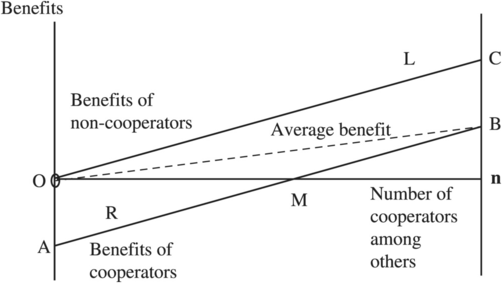
Figure 23.1
Redrawn from T. Schelling, Micromotives and Macrobehavior
(New York: Norton, 1978)
The situation in Figure 23.1 reflects a special case. It assumes that the cost of cooperation, measured by the distance between the L and R curves, is constant. In other cases, the cost of cooperation increases as more people cooperate. As people join call-in campaigns for public radio, the lines become congested and it takes more time to get through. It may then happen that the last to join4 actually reduce the average benefit, because the cost to them of participating exceeds the sum of the benefits they generate for everybody else (and for themselves). The cost may also be high initially and then decrease. As more people join up in a demonstration, policy and security forces have to spread themselves more thinly, unless new troops can be called in.
Figure 23.1 also assumes that the benefits of cooperation, given by the L line, are a linear function of the number of cooperators. Each new cooperator adds the same amount to everybody's welfare. Increasing marginal benefits can be illustrated by cleaning a beach of litter: the last bottle that is removed makes more of an aesthetic difference than the penultimate one. Decreasing marginal benefits are also frequent. A simple example is calling city hall about a pothole in a middle-class urban area: the first person who takes the time to call could make the probability 0.4 that the hole will be fixed, the second raise it to 0.7, the third to 0.8, the fourth to 0.85, the fifth to 0.88, and so on. Sometimes, both the first and last contributors add little, whereas those in the middle are more efficacious. A few revolutionaries or strikers do not make much of a difference, and when almost everyone has joined it matters little whether the few uncommitted do so too. In social movements, this pattern is probably typical.
The marginal benefits of cooperation may even be negative over some range of cooperators. Unilateral disarmament can make all nations worse off if it creates a power vacuum to be invaded, thus unleashing a general war. Isolated acts of rebellion may give the authorities a pretext for cracking down on potential rebels as well as on the actual ones. Conversely, there may be too many cooperators. Suppose that in wartime everybody insists on joining the army, so that industries vital to the war effort are understaffed and the war is lost. If everyone insists on helping out with the dinner at the outing, the many cooks may spoil the broth.
As these remarks show, the technology of collective action differs from case to case. In the following, I focus on the case shown in Figure 23.2, which I believe to be fairly typical of social movements trying to bring about a change of policy. The first contributors incur high costs or risks and produce few benefits for others. They may, in fact, harm others rather than benefit them. Their net contribution is negative. The last contributors also produce few benefits. In some cases, their cost may be decreasing, as I suggested. In other cases, all who fight for a cause may incur considerable costs or risks until the adversary capitulates. Those who joined the French resistance in 1944 often did little damage to the Germans, but all ran a considerable risk to their lives.
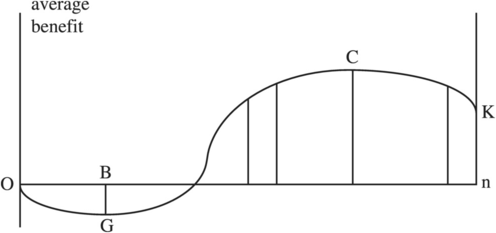 Figure 23.2
Unraveling
Cooperation can unravel in a variety of ways. As an illustration, I offer the following fable in which members of university departments or workers’ collectives may recognize themselves. Initially, the group handles its common affairs informally, on the basis of trust and cooperation. At some point, a black sheep makes his or her entrance, and the group is transformed. The motives of appointed or elected leaders are questioned. Procedure takes precedence over substance. Many low-level decisions are appealed to higher authorities. The decisions and internal workings of the organization are denounced in the social media. When allocating benefits such as travel allowances among members of the group, the norm is “Nobody shall have what not everyone can have.” Trust is replaced by suspicion, and cooperation by opportunism or worse. Everything takes twice as long, and results are worse. While not reflecting a universal tendency, the fable is more than anecdotal.
The following public good experiment (a stylized version of many actual experiments) offers a formal demonstration of unraveling. Each experiment has several rounds, in each of which the participants receive 10 monetary units (MU), which can be converted into cash at the end of the session. They can either keep the tokens to themselves or donate them to a common pool. If they donate, the donations are multiplied, but not enough to make it selfishly rational to donate. If all donate, however, all gain. The structure, in other words, is that of a many-person Prisoner's Dilemma. After each round, the participants are told how many donated and how much, before deciding whether and how much to donate in the following round. In other words, they make their decisions on the basis of their knowledge about outcomes, not actions. They are not told who donated and who did not, nor, if they had been told, would they have any way of taking account of this information by punishing specific individuals.
Suppose there are four participants and that the game has ten rounds. Three participants are perfect conditional cooperators, in the sense that they initially donate all their MU and, in later rounds, donate the average of the donations in the previous round. The fourth is a perfect egoist, who prefers to free ride and never donates anything. In one sequence, the game could go as shown in Table 23.1.
Table 23.1
|
Subjects |
||||||
|
1 |
2 |
3 |
4 |
Mean |
||
|
1 |
10 |
10 |
10 |
0 |
7.5 |
|
|
2 |
7.5 |
7.5 |
7.5 |
0 |
5.6 |
|
|
Periods |
3 |
5.6 |
5.6 |
5.6 |
0 |
4.2 |
|
4 |
4.2 |
4.2 |
4.2 |
0 |
3.1 |
|
|
5 |
3.1 |
3.1 |
3.1 |
0 |
2.4 |
|
|
. |
||||||
|
. |
||||||
|
10 |
0.4 |
0.4 |
0.4 |
0 |
0.3 |
|
After ten rounds, the initially high contributions have fallen almost to zero. If the fourth agent had also been a perfect conditional cooperator, no unraveling would have occurred. It is the one black sheep that spoils the flock. If the proverb is right and every flock has a black sheep, the prospects for sustained cooperation are poor.
Prospects may be improved, however, if the group contains an unconditional cooperator. In the hypothetical experiment shown in Table 23.2, the third subject always donates 10 MU, regardless of what others do. With this single “white sheep,” the amount donated by each conditional cooperator (“grey sheep”) converges to 5 MU per round. Overall, the donations amount to 20 MU per round, half of what would have been achieved with four perfect cooperators, but much more than the outcome of the game in Table 23.1. To a considerable extent, the white sheep neutralizes the black sheep.
Table 23.2
|
Subjects |
||||||
|
1 |
2 |
3 |
4 |
Mean |
||
|
1 |
10 |
10 |
10 |
0 |
7.5 |
|
|
2 |
7.5 |
7.5 |
10 |
0 |
6.2 |
|
|
Periods |
3 |
6.2 |
6.2 |
10 |
0 |
5.6 |
|
4 |
5.6 |
5.6 |
10 |
0 |
5.3 |
|
|
5 |
5.3 |
5.3 |
10 |
0 |
5.1 |
|
|
. |
||||||
|
. |
||||||
|
10 |
5 |
5 |
10 |
0 |
5 |
|
Outside the laboratory, the decline in trade union membership in some countries may be due to an unraveling mechanism. In many American states, “right-to-work” legislation prevents unions from requiring non-unionized workers to join the union (“closed shop”) or, if they do not join, to pay a negotiating fee to the union. Without a “fair-share” provision of this kind, workers may prefer to be free riders on the union effort to negotiate wage increases. Although the importance of this effect is debated, common sense and much scholarship suggests that it is non-negligible.
Maintaining cooperation
Given the ubiquitous free-rider temptation, how do we explain the substantial amounts of cooperation that we observe? In addition to the presence of unconditional cooperators, cooperation by selfish individuals may be sustained by selective rewards and selective punishments (see Chapter 18 and Chapter 25). Here, rewards and punishments are taken in a wide sense, which includes any deliberate action to lower the costs of cooperation and increase the costs of non-cooperation by any means, for instance by acting on prices. Rewards as well as punishments can be provided either vertically, by the state or an organization, or horizontally, by other members of the group that faces a collective action problem. As horizontally provided rewards seem marginal, I shall ignore them. I am not denying, of course, that people can be motivated by the desire to be praised by their peers, only that this desire is an important factor in overcoming the free-rider problem. Although some laboratory experiments find this effect, I doubt they matter “in the wild.” We do not praise people for voting, putting the ice cream wrapper in a garbage can, or vaccinating their children.
Rewards can be important in sustaining unions, since members can get access to the union's summer camp, cheaper insurance than individuals could negotiate on their own, and other goods. The collective action problem in voting can be alleviated by paying voters for showing up, as was done in classical Athens.5 In November 2006, a ballot initiative in Arizona to award $1 million to a randomly selected voter, for the purpose of increasing turnout, was rejected by roughly one million votes against and half a million in favor. The Norwegian municipality Evenes successfully adopted a similar policy in 1995, when turnout went up from 63 percent to 71 percent after it set up an election lottery with a trip to southern Europe as a prize. In 2009, the Norwegian municipality of Høyland offered a prize of 100,000 Norwegian crowns, about $20,000, to the electoral district with the highest turnout.6 The winner, Utsira municipality, with a total population of 216, achieved a turnout of 92.5 percent. As the mayor observed, the distance to the polling station was short; as he did not say, the ease of detecting and ostracizing non-voters probably also contributed to the high turnout. This kind of collective reward system is similar to the use of team bonuses, which are also more likely to make people cooperate if the group is small enough that members can monitor each other.7
Punishment is widely used to deter non-cooperative behavior. Vertical punishment is based on the law or on the by-laws of organizations, which can fine or exclude their members. Parliament could, but rarely does, fine members if they are absent without a good reason. When people pay their taxes, and pay them on time, it is at least in part because of the fines and jail sentences that can be imposed on tax evaders or procrastinators. In some countries, voting is mandatory. Vaccination, too, is often a duty rather than a right. China's one-child policy was imposed to block the incentive of families to have many children who will take care of them when they grow old. The use of polluting products can be limited by taxing them. Since readers can easily multiply examples, I turn to the more complex case of horizontal punishment.
Many experiments have found that the punishment of non-cooperators by co-subjects is effective in preventing the unraveling of cooperation. In addition to (i) keeping his endowment or (ii) donating some of it to the common pool, a subject may (iii) use part of it to punish another subject, usually for being non-cooperative.8 The punishment takes the form of reducing the endowment of the target person, usually by less than what it costs to punish him. In the representative public goods game showed in Figure 23.3, subjects interacted with an anonymous partner from a previous round, with randomly assigned individuals (strangers), or with randomly assigned individuals with whom they would never interact more than once (perfect strangers). Allowing for the punishment of non-cooperators had a strong effect on the level of cooperation – strongest, perhaps surprisingly, on the partners. Earlier (Chapter 21) I suggested that the target of punishment may be more affected by how much it costs the punisher than by what it costs him.9 To my knowledge, no experiment has been run that would allow us to distinguish the effects of these two variables.10
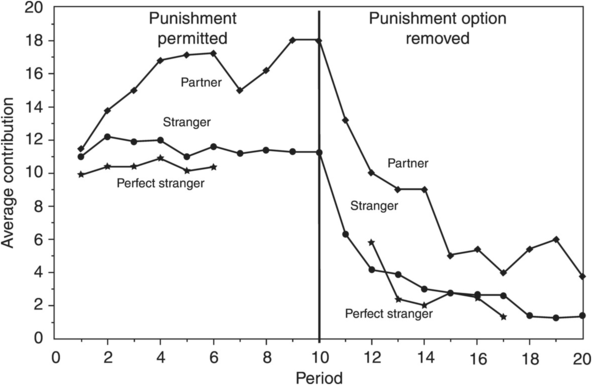 Figure 23.3
What is the relevance of these findings “in the wild,” outside the laboratory? In everyday life, we do not go around punishing people who misbehave merely by lack of cooperativeness.11 Instead we express disapproval, avoid them if we can, and keep our distance if we cannot.12 In the laboratory, how strongly I punish misbehavior depends on three factors: how badly I think the other person behaved, the cost to me of punishing him, and the cost to him of being punished. In ordinary interactions, how strongly I express disapproval depends mainly on the first factor, although instrumental considerations can also matter. Moreover, what makes disapproval for the target so painful is the face-to-face character of the interaction, in contrast to the artificially anonymous conditions in the laboratory. There is no doubt that anticipation of face-to-face disapproval of free riding can prevent cooperation from unraveling, as I suggested in the comments on collective reward systems and team bonuses. The question, to which I have no answer, is whether the experiments demonstrate a punishing propensity that is reinforced by personal interactions or whether interactions preempt the triggering of that propensity.
An important collective action problem in modern societies is that of tax payment and tax collection. How can citizens be made to declare their income honestly and pay their taxes on time? Although facts are hard to come by, it is estimated that in the United States 18–19 percent of reportable income is not reported to the Internal Revenue Service, causing an annual revenue loss of $450–500 billion, about four times as much the federal budget for education. In addition to the obvious coercive tools at the disposal of the government, could horizontal mechanisms, such as social norms and quasi-moral norms (Chapter 5) also induce compliance?
Considering first quasi-moral norms, it is often argued that people are more willing to report their taxes correctly if – but only if – they believe that most others are doing so. They are conditional cooperators, wanting to do their “fair share,” but not willing to be taken advantage of. This may well be true, but where do these beliefs come from and how accurate are they? We may compare tax compliance with the effort to reduce water consumption in Bogotá that I mentioned in Chapter 5. In that case, the citizens had access in real time to data about the aggregate consumption. In the American Revolution, “newspapers made it possible for Americans to imagine that virtual strangers were actively supporting each other” in the non-importation campaign. With regard to underreported income, there are no comparable data. It is highly unlikely that citizens read technical econometric studies of the incidence of tax evasion before deciding whether it is low enough to keep them honest. In Norway, as I mentioned in Chapter 21, citizens can access the internet to peek at the income and tax data of their friends or neighbors, and compare them with their observed lifestyle. Also, multimillionaires who pay little or no income tax are regularly denounced in the newspapers. Such information does not, however, provide the basis for a rational belief about the average level of compliance. Nor could any untrained person – and probably no trained person either – draw inferences about tax compliance from data about the provision of the public goods that are funded by taxes.
Social norms may be more effective in sustaining voting as well as honest reporting of income. In Argentina, people who might be tempted to stay home on election day could be deterred by the fear that neighbors and friends could ask them, “So, I noticed that you didn't vote – how come?” In Norway, people who might be tempted to cheat on their taxes could be deterred by the fear of intrusive questioning – “How could you afford that expensive car, after buying that new cottage last year?” In addition, they might fear being denounced to the tax authorities. If the internet access scheme was set up to instill this fear, it seems to have been successful.
Snowballing
In previous sections I have discussed the unraveling of collective action, and some mechanisms that can prevent unraveling. Here I discuss the process of snowballing from non-cooperation to cooperation, using as an example the non-violent revolutionary collective action that took place throughout Eastern Europe in the summer and fall of 1989. I shall consider both within-country and between-country snowballing. Although the latter was not itself a form of collective action, it may have been a facilitator of the within-country processes.
I take it for granted that the situation in the Communist bloc before 1989 was suboptimal for everybody except a small elite, and that collective action was needed to reach a better equilibrium. Unlike countries occupied by Nazi Germany, the satellite Communist countries never saw any assassinations of domestic or foreign oppressors, perhaps because there were no parallels to the organized resistance organizations in Western Europe during World War II or perhaps because potential assassins thought the population would blame them rather than the regime for the inevitable reprisals. Opposition to the regimes mainly took the form of public demonstrations. My focus here is on the snowballing of these demonstrations. The most striking examples were the demonstrations in Leipzig on successive Mondays in the fall of 1989, with numbers increasing from 8,000 (the largest since the insurrection in 1953) on September 25, through 20,000 on October 2, to 70,000 on October 9. Even though the regime was widely detested or hated, that fact by itself was not what brought people out onto the streets. A similar scenario had been enacted earlier in Budapest, and would be enacted later in Prague.
As I noted earlier, Poland in early 1989 was characterized by a state of pluralistic ignorance. Foreign observers, members of the government and of the Solidarity movement, and presumably the population at large, believed that enough people would vote for the Communists in the first semi-free elections to ensure a Communist majority in parliament (Radio Free Europe Research, April 7, 1989). They were proven wrong: Solidarity swept the free part of the June elections. The reason why the Solidarity negotiators in the Round Table Talks only made (what they wrongly believed to be) relatively modest demands was the fear that a radical regime change might trigger Soviet intervention. When the demands did lead to a radical change (because of the pluralistic ignorance) and the Soviets did not intervene, other countries, notably Hungary, could use rough Bayesian updating (Chapter 13) to revise their beliefs about this risk.
It may be useful to distinguish between political contagion and political snowballing across countries. A classical case of revolutionary contagion occurred in 1848, when the February revolution in France triggered similar regime changes in many other European countries. More recently, the Arab Spring provides an example. The psychological mechanism of contagion remains opaque. It is not clear why information about a revolution in one country should make people take to the streets in another country with different economic, social, and political conditions.13 After all, no material or cognitive obstacles prevented the Egyptians from doing before the revolution in Tunis what they did after it erupted. If events in Tunisia shaped events in Egypt, it was not by virtue of providing new information or by exporting money, arms, leaders, or fighters. The commonly used phrase of “providing inspiration” is vacuous; yet some causal mechanism must have been at work.
Political snowballing occurs when events in one country provide information that was previously not available to citizens in another. In stylized form, it involves three countries: A, B, and their common hegemon C. The citizens of A and B may be reluctant to rise up against C, fearing a violent oppression. If, nevertheless, there is an uprising in A and C does not react, the citizens of B may use Bayesian updating for a downward revision of the probability of C intervening in the case of an uprising in country B. During the Cold War, the “domino theory” stated that if C was America and A and B were two countries within the American sphere of influence, a failure of America to stop a Communist takeover in A would serve as a green light for insurrection in B. The theory served as the justification for the American war in Vietnam. Although the phrase “domino theory” was to my knowledge not used about the Communist world, the Soviet leadership probably thought in similar terms when they crushed uprisings in Berlin, Budapest, and Prague. In 1989, with Poland and Hungary in the role of A and B and the Soviet Union in the role of C, the non-intervention in Poland probably did serve as a green light for the Hungarian transition, by reducing the expected costs of participation in collective action. Moreover, by some further steps of Bayesian updating, Soviet passivity in Hungary probably reduced the expected costs of participation in East Germany and Czechoslovakia.
While private costs and risks of participation do enter into the decisions of individuals to take to the streets, other motivations matter as well. In classifying them, I shall cite their double heterogeneity, qualitative as well as quantitative. Different agents may have qualitatively different motivations. These include the personal costs and risks of participation, consequentialist and non-consequentialist moral norms, social norms, and quasi-moral norms.14 The triggering of norms may also, as noted earlier, be sensitive to quantitative thresholds. Consequentialist moral norms range from utilitarianism to various degrees of altruism. The more people care about the welfare of others, the more willing they are to suffer risks, and the earlier they will join the demonstrations at a stage when there is less “safety in numbers.” With regard to social norms, one person may join a movement if a single friend or neighbor expresses disapproval of his passivity, whereas another may require the sustained pressure of many. With regard to quasi-moral norms, one person may join a march once he observes that a hundred others have done so, whereas another waits until the crowd has grown to a thousand. The triggering of non-consequentialist moral norms is of course threshold-independent. At the other extreme, those who care only about their personal costs and risks will never participate in collective action.
On this background, let me sketch a generic scenario for snowballing:
1.Everyday Kantians, saints, heroes, and the slightly mad initiate collective action without regard to consequences.
2.If and when the first group is large enough for individual participation to produce a positive expected benefit, net of costs and risks to the agent, people motivated by consequentialist norms come on board.
3.Some people motivated by quasi-moral norms will join when the observable subset of (1) + (2) exceeds a certain numerical threshold p.
4.Some people motivated by social norms will join when the subset of (1) + (2) who observe them exceeds a certain threshold q.
5.Other people motivated by quasi-moral norms will join when the subset they observe of (1) + (2) + (3) + (4) exceeds a threshold p* > p.
6.Other people motivated by social norms will join when the subset of (1) + (2) + (3) + (4) who observe them exceeds a threshold q* > q.
7.And so on.
Depending on the distribution of motivations and of thresholds in the population, the process may not get beyond (1) and run out of steam quickly, or end up reaching everybody.
Historians or other scholars will probably never be able to reconstitute a full process of this kind. The micro-mechanisms can be documented, but their relative importance and the way in which one creates the conditions for the triggering of another cannot be established without evidence they are unlikely to possess.
Bibliographical note
A classical study of collective action, emphasizing cooperation induced by selective rewards, is M. Olson, The Logic of Collective Action (Cambridge MA: Harvard University Press, 1965). The example of evergetism is taken from P. Veyne, Le pain et le cirque (Paris: Seuil, 1976), and the observation on the solidarity of Elizabeth I with Philip II from A. Somerset, Elizabeth I (New York: Anchor Books, 1991), p. 289. The example of Italian latrines is taken from M. Thompson, The White War (New York: Basic Books, 2010), p. 151; and that of vaccination from P. Fine and J. Clarkson, “Individual versus public priorities in the determination of optimal vaccination policies,” American Journal of Epidemiology 124 (1986), 1012–20. Data on the overuse of antibiotics are found in E. Kades, “Preserving a precious resource: rationalizing the use of antibiotics,” Northwestern University Law Review 99 (2005), 611–75. Some of the many experiments by E. Fehr and his collaborators on the maintenance or unraveling of cooperation are discussed in E. Fehr and S. Gächter, “Cooperation and punishment in public goods experiments,” American Economic Review 90 (2000), 980–94 and, by the same authors, “Altruistic punishment in humans,” Nature 415 (2002), 137–40. Figure 23.3 is reproduced with permission from H. Gintis et al., “Moral sentiments and material interests: origins, evidence, and consequences,” in H. Gintis et al. (eds.), Moral Sentiments and Material Interests (Cambridge MA: MIT Press, 2006). Evidence on the effects of closed shops on trade unions is in D. Ellwood and G. Fine, “The impact of right-to-work laws on union bargaining,” Journal of Political Economy 95 (1987), 250–73. The punishment of do-gooders is documented in B. Herrmann, C. Thöni, and S. Gächter, “Anti-social punishment across societies,” Science 319 (2008), 1362–7. The difference between disapproval and punishment is the topic of A. Leibbrand and R. López-Pérez, “Different carrots and different sticks: do we reward and punish differently than we approve and disapprove?” Theory and Decision 76 (2014), 95–118. Non-importation and non-consumption movements in America are studied in T. Green, The Market Place of Revolution (Oxford University Press, 2004). The open internet access to income and tax data in Norway and its consequences are discussed in J. Slemrod, T. Thoresen, and E. Bø, “Taxes on the internet: deterrence effects of public disclosure” (2013), available at: www.cesifo-group.de/ifoHome/publications/working papers/CESifoWP/CESifoWPdetails?wp_id=19075157. The snowballing effects in Eastern Europe are studied in more detail by R. Petersen in Chapter 8 of Resistance and Rebellion (Cambridge University Press, 2001). The quantitative threshold model on which I draw here is due to M. Granovetter, “Threshold models of collective behavior,” American Journal of Sociology 83 (1978), 1420–43, further explored by T. Kuran, Private Truths, Public Lies (Cambridge MA: Harvard University Press, 1995).
1 In spite of the intuitive positive connotations of the word, “cooperation” is used here as a technical term, with no implication for the desirability or social utility of the action. Cartels are almost universally, and trade unions occasionally, viewed as acting contrary to the general interest. Criminal gangs have collective action problems arising from snitching.
2 A better-known problem (discussed in Chapter 17) is that the new road may encourage more drivers to use their cars.
3 I shall write as if individual choices are binary (individuals either cooperate or they do not) and as if outcomes are continuously variable (a public good, such as clean air, may be provided to a smaller or larger extent). In reality, individuals may differ in how much they contribute, not merely in whether they do. I shall not take this complication into account. Also, some public goods are “lumpy” or discrete. If individuals are in a community lobby to keep the local school open, it will either close or remain open. This complication can be finessed by interpreting the outcome as the continuously variable probability of the public good's being provided.
4 Here and elsewhere, words such as “first,” “middle,” and “last” can refer to the times at which successive cooperators join, as in building a revolutionary movement. But they can also refer to simultaneous acts of cooperation, as in voting. To say that the last voters add little is to say that the benefit created in a situation in which everyone votes is nearly the same as the benefit created when almost everyone votes.
5 To encourage the voting of those who have some, although not a very strong, sense of civic duty, the state can lower the cost of voting by making registration easier and providing many polling stations.
6 To increase its own chances of winning, it offered a free pizza to all voters, in an amusing contrast to earlier centuries when a candidate would ply voters with food and drink to make them vote for him.
7 Jejune economists and political scientists have tried to find other private benefits for participants in collective action. Thus voting has been explained by its psychic benefits, or the warm glow from doing one's duty. As Kant noted, this hypothesis can never be definitely excluded, but that fact is hardly a reason for adopting it. As I discussed in Chapter 5, the warm-glow theory has also been invoked to explain charitable donations; as I argued there, the merits of the explanation are doubtful. Finally, some scholars have asserted that people join revolutionary movements because they are motivated by the private reward of becoming leaders in the post-revolutionary order, rather than by the collective good of a better society. In the Conclusion, I argue that this claim is unproven and implausible.
8 Some intriguing experiments show, however, that subjects sometimes punish cooperators, perhaps for being “do-gooders” who make others feel ashamed.
9 Experiments show that unraveling may also be prevented if members of the group can award “disapproval points” to non-cooperators. Although the effect is less than when they can award monetary “punishment points,” the difference may be due to the fact that awarding disapproval points is costless.
10 To do so, one would have to compare the effect of one set of vectors (p, q) of costs to the punisher and costs to the target person with the effect of another set (p + ∂, q), ∂ > 0. Because a punisher will usually punish less if it costs him more, one would have to tell him that the cost was p while telling the target person, falsely, that they were p + ∂. Experimenters are reluctant, however, to lie to their subjects about the pay-off conditions, since if the practice became known the credibility of the instructions in later experiments would be undermined.
11 Adam Smith insisted on this point: “Though Nature … exhorts mankind to acts of beneficence, by the pleasing consciousness of deserved reward, she has not thought it necessary to guard and enforce the practice of it by the terrors of merited punishment in case it should be neglected.” He also asserted that lack of gratitude cannot be punished. Seneca claimed, however, that the Macedonians had laws against ingratitude, a claim that has also been made about ancient Persia.
12 If those who misbehave are powerful, we might, Seneca suggests, avoid showing that we avoid them. Gibbon observed that it was dangerous to trust the Emperor Augustus, and even more dangerous to show one's distrust.
13 Nor is it clear why the Arab Spring scared the Chinese authorities so much that they banned news about it.
14 As noted earlier it is unlikely that participants in movements for regime change were motivated by the expected material benefits that will accrue to them as leaders of the new regime. Also, some scholars have suggested other motivating factors, such as “process benefits” or “agency benefits,” that is the pleasure of participating in a collective movement or of experiencing an enhanced sense of being in control over one's own fate. Whatever the importance of these benefits once a movement is underway, it seems implausible that the expectation of receiving them could motivate agents to join.