
24
Often, members of a group – from the family to society as a whole – need to regulate matters of common concern by making decisions that are binding on them all. Consider again the question of regulating water consumption during periods of scarcity (Chapter 5). Sometimes, this collective action problem may be resolved by decentralized decisions, through a combination of moral, quasi-moral, and social norms.1 Often, however, the city council has to limit the water supply or reduce consumption by banning certain uses, such as watering the lawn or filling up swimming pools. When collective action fails, collective decision making may be required.
For another example, take the practice of voting in national elections. As explained in the previous chapter, the choice whether to vote or stay home is a classic collective action problem. Knowing that his or her voice makes virtually no difference to the outcome, each citizen has a personal interest that dictates abstention. Yet if everybody abstained, or if voting dropped to very low levels, democracy itself might be in danger of being replaced by a dictatorship or an oligarchy, against (almost) everybody's interest. In many democracies voting does in fact reach respectable levels, from 50 percent to 80 percent, as a result of decentralized decisions by the citizens. Some may ask themselves, “But what if everybody abstained?” Others may say to themselves, “Since most others bother to vote, it is only fair that I should do so too.” Still others may calculate that “although the impact of my vote on the viability of democracy is tiny, it is important if multiplied by the large number of other citizens it affects.” In a small village, some may fear that “if I stay home, my neighbors will notice and express their disapproval.”
If these motivations, singly and combined, prove too weak, voting may fall to disastrously low levels, in a process that is in part self-reinforcing (“Since few others bother to vote, why should I?”). To reverse this process, parliament may legislate to make voting obligatory and to impose a fine on non-voters, and submit the law to the approval of the voters in a referendum. When voting on whether voting ought to be made obligatory, the citizens face a choice that is very different from the one they confront when contemplating whether to vote in ordinary elections with non-mandatory voting. The options are not “I vote” versus “I stay home” but “Everybody votes” versus “Everybody is free to stay home.”2 If many of those who prefer the second option in the first choice prefer the first option in the second choice, they will decide collectively to make voting obligatory, in a form of collective self-paternalism. Experiments suggest that people are even willing to make personal sacrifices for the sake of future generations, as long as free-rider behavior is excluded by majority voting.
Collective decision making is about making a policy choice. Before entering into the process of collective decision making, each member has certain policy preferences, which derive from his or her fundamental preferences together with factual beliefs and causal beliefs about ends-means relations. The basic goal of collective decision making is to aggregate individual policy preferences by one of three mechanisms to be discussed shortly.3 The aggregation may also induce a transformation of individual policy preferences as the result of discussion, and it may create an incentive for individuals to misrepresent their policy preferences. The interaction among aggregation, transformation, and misrepresentation of preferences can make for considerable complexity.
In many of the cases I shall discuss, a smaller group of individuals make decisions that are binding on a larger group. Sometimes, they are delegated to do so, as representatives of or negotiators for the larger body. In that case, they may be constrained by the knowledge that their decisions will have to be ratified by their constituency, or that they will not be reelected if they fail to achieve satisfactory results. In other cases, the larger society has no power, short of a revolution, to influence those who make the decisions that shape their lives. Yet even here we may talk of collective decision making within the elite. After the fall of Stalin, there followed collective leadership by the Politburo. The Chilean junta that exercised power from 1973 to 1980 had a highly structured internal mode of collective decision making.
The three aggregation mechanisms I shall consider are arguing, bargaining, and voting. I believe that this is an exhaustive list, although in some cases the distinction may be blurred. Toward the end of the chapter I note some cases in which the distinction between arguing and bargaining breaks down.
Each method can be used in collective decision making involving any number of agents. In discussing bargaining, though, I shall limit myself to two-person cases. Although multiperson bargaining certainly occurs, as in the formation of a coalition government or the allocation of emission quotas to nations, the processes are not well understood. In some three-person bargaining games, essentially any strategy combination is a game-theoretic equilibrium. In some two-person cases, only bargaining is effective. If two agents cannot reach agreement by arguing, voting will obviously not solve the problem, so only the bargaining procedure remains.
Let me first give some examples of the three procedures. Pure argument is observed (or at least is supposed to be the rule) in juries for which unanimity is required. Even here, some jurors may resort to tacit bargaining by virtue of their greater ability to hold out, that is, their lesser impatience to get out of jury work and back to their ordinary life.4 Because time always matters when a decision has to be made, and because the participants in the process often discount the future at different rates, this case may in fact be typical.
Pure bargaining is illustrated by sequential “divide-a-dollar” games in which the parties make successive offers and counteroffers. The outcome is determined by the bargaining mechanism and the bargaining power of the parties, that is, the resources that enable them to make credible threats and promises. The process is illustrated in Figure 19.2.
Pure voting was Rousseau's conception of collective decision making. The citizens were to form their preferences in isolation from one another so as not to be contaminated by eloquence and demagogy. Because they would also cast their votes in isolation from one another, vote trading would be excluded. In actual political systems this ideal is never realized. It may be illustrated, perhaps, by certain low-stake decisions such as the election of members to a scientific academy whose main function is to elect new members.
The decisions to which these methods are applied vary widely. Below I give examples ranging from two parents bargaining over child custody to voting over the location of an airport. Most surprisingly, perhaps, all three procedures have been used to settle, or attempt to settle, conflicts over religious dogma. The Christian definition of the Supreme Being was reached by majority voting among the bishops assembled at Nicaea in AD 325. In 1561, Queen Regent Catherine of France called a colloquium at Poissy, in which leading Protestants and Catholics argued over the dogma of transubstantiation. At one point they seemed close to reach an agreement, but in the end they failed. The wars of religion that were then unleashed were resolved by bargaining between Henri de Navarre (the later Henri IV) and four bishops in 1593. While accepting many Catholic tenets, Henri refused to accept the doctrine of purgatory and expressed reservations about the permanent “real presence” of Christ in the sacramental bread outside the hours of church services. At the Canterbury convocation of bishops in 1532 that preceded Henry VIII's break with Catholicism, reformers and traditionalists used the common bargaining technique of splitting the difference. According to Hume, “the two sects seem to have made a fair partition, by alternately sharing the several clauses.”
In addition to cases involving only one of the three methods, there are many mixed cases.
Mixed arguing and voting, without bargaining, may be illustrated by hiring and tenure decisions in a university department. These are supposed to be governed only by deliberation about the merits of the candidate followed by a vote. Although this ideal does not always correspond to the reality, it sometimes does. In good departments there is a norm against logrolling, reinforced by a norm against voting without explaining one's vote.
Mixed arguing and bargaining, without voting, is illustrated by collective wage bargaining. When a union and management are deciding how to divide the income of the firm, it might appear as if only bargaining is taking place. On closer inspection, however, there is always a substantial amount of arguing about factual matters, such as the financial well-being of the firm and the productivity of the labor force.
Mixed bargaining and voting was institutionalized in the British Wages Councils and Boards in the 1950s. The possibility of a vote shaped wage bargaining even though in most cases no vote took place. The crucial factor was the presence at the bargaining table of an uneven number of independent members, along with equal numbers of members representing employers and workers. The first group served both as a mediator between the two others in the course of the bargaining process and, by virtue of their uneven number, as a guarantee that the wage would be settled by a decisive vote if no negotiated agreement was reached.
Political decision making, whether by a committee, an assembly, or the population at large, often involves all three procedures.5 Again, this fact follows from the need to reach a decision sooner rather than later. Voting tends to arise when an issue has to be decided urgently, so that the participants do not have the time to deliberate until they reach unanimity. More prosaically, they may not be motivated to search for unanimity. If the decision is more urgent for some participants than for others, the possibility of bargaining also arises, since those who can better afford to wait may demand concessions in exchange for an early decision. In standing committees and assemblies, bargaining also arises through logrolling, which is due to unequal intensity of preferences over the issues to be traded off against each other. Other bargaining mechanisms in legislatures include filibustering, endless amendments, and “the politics of the empty chair” by which a group may exploit the rules of quorum to obtain what they could not achieve by other means.
In such cases, the sources of bargaining power are created within the assembly itself. In other cases, the decision makers can draw on resources that exist independently of the assembly – money and manpower. In 1789, the debates in the French constituent assembly were suspended between the king's troops and the crowds in Paris. In 1989, the quasi-constitutional or preconstitutional Round Table Talks in Poland were suspended between the threat of Soviet intervention and the prospect of a general strike and economic paralysis. If a vote cannot be bought with the promise of another vote, as in logrolling, it can be bought with money, for instance, with the allocation of party funds for purposes of reelection campaigning.
As will be clear from this discussion, the three modes of collective decision making may be seen as three steps in an idealized sequence, in the sense that each of them arises naturally from the preceding one. Although arguing intrinsically aims at unanimity, in the sense that it is based on reasons that are supposed to be valid for all, this end is rarely achieved. To settle the issue, voting is needed. Because voting often takes place among individuals who have many issues to decide on, it naturally gives rise to bargaining in the form of logrolling.
Arguing
Arguing is the effort to persuade by reason giving. Ever since Pericles’ eulogy of Athens, this mode of decision making has been closely linked to democratic politics:
Our public men have, besides politics, their private affairs to attend to, and our ordinary citizens, though occupied with the pursuits of industry, are still fair judges of public matters; for, unlike any other nation, we regard the citizen who takes no part in these duties not as unambitious but as useless, and we are able to judge proposals even if we cannot originate them; instead of looking on discussion as a stumbling-block in the way of action, we think it an indispensable preliminary to any wise action at all.
The link between the institution of public debate and “wise action” can be somewhat indirect. Often, the main effect of the public setting is to exclude overt appeals to interest. In a public debate, a speaker who said, “We should do this because it is good for me” would not persuade anyone, and would, moreover, be subject to informal sanctions and ostracism that would make her less effective in the future. Even those who are motivated solely by interest are constrained by the public setting to present their policy proposals as motivated by more impartial values. This process of misrepresentation of preferences differs from that of transmutation (Chapter 9) in the same way as deception differs from self-deception. It is the interest of the speaker, not her need for self-esteem, that causes her to misrepresent her interest as reason. Her interest may also cause her to make the misrepresentation hard to perceive, by arguing in impartial terms for a policy that deviates somewhat (but not too much) from the one that would coincide perfectly with her interest. The misrepresentation might, in fact, backfire if it were too obvious. In addition to this “imperfection constraint,” speakers are subject to a “consistency constraint.” Once a speaker has adopted an impartial argument on opportunistic grounds she cannot easily abandon it if, on another occasion, it no longer matches her interest. Hence the need to disguise one's fundamental preference may induce a shift in one's policy preference, by what we may think of as “the civilizing force of hypocrisy.”6 The seventeenth-century American minister Roger Williams put it starkly, when he wrote that Pharisees make good citizens.
To illustrate the imperfection constraint, we may first note that in many societies, property has been used as a criterion for suffrage. One may, to be sure, offer impartial arguments for this principle. At the Federal Convention, Madison argued that stringent property qualifications for the Senate, rather than protecting the privileged against the people, were a device for protecting the people against itself. But as noted, there is something inherently suspicious about such arguments, which coincide too well with the self-interest of the rich. It may then be useful to turn to literacy, as an impartial criterion that is highly but imperfectly correlated with property. At various stages in American history literacy has also served as a legitimizing proxy for other unavowable goals, such as the desire to keep blacks or Catholics out of politics. American immigration policy has also used literacy as a proxy for criteria that could not be stated publicly. Proposals to screen immigrants by testing them for literacy in their native language were usually justified as a way of selecting on the basis of individual merit, a widely accepted impartial procedure. The real motivation of the advocates of literacy was, however, prejudice or group interest. Patrician nativists wanted to exclude the usually illiterate immigrants from central and southeastern Europe. Labor feared that an influx of unskilled workers might drive wages down.
To illustrate the consistency constraint, I shall cite some arguments used in wage bargaining. As I note later in the chapter, the outcome of wage bargaining is often shaped by the raw material bargaining power of the parties. It can also, however, be affected by norms of fairness. If one party adopts a norm on opportunistic grounds, it may, however, be stuck with it. Thus if a union successfully argues for a wage rise by citing a norm that windfall gains for the firm should be shared with the workers, it may find it difficult to resist the argument that windfall losses should also be shared. Conversely, once the Great Depression ended, many firms regretted the ability-to-pay argument they had used to keep wages down. When, in the 1930s, the wages of Swedish metal workers lagged behind those in the construction industry, they appealed successfully to a solidaristic wage policy to reduce the differential. Later, when the metal workers became the high-wage outliers, they were bound by their past appeals to solidarity.
It would obviously be wrong to think that arguing can always be reduced to more or less subtle ways of promoting one's interest. If that were the case, there would be no point in misrepresentation since nobody would ever be taken in. If speakers are motivated by a sincere desire to promote the public good, argument and debate may change their beliefs in ways that induce a change in policy preferences. This is especially likely to occur if the various members of a group have access to different information, so that they can improve the quality of their decisions by pooling their knowledge.7 If the body is a representative one, it is then important to select delegates with widely different backgrounds. In electing representatives to a national assembly, for instance, this consideration speaks in favor of proportional voting with a low threshold or no threshold at all.8 One might also require representatives from an electoral district to be residents of that community.
People also, although perhaps more rarely, argue about fundamental preferences and change them as a result of debate. Often, change occurs through the discovery of hidden similarities between cases or the exposure of superficial similarities. Many people are opposed, for instance, to the mandatory use of “cadaver organs” for transplantation purposes. They believe that if the family has religious objections to this procedure, their feelings ought to be respected. Against this view one might point to the mandatory use of autopsies in the case of suspicious deaths, even when the procedure is contrary to the religious beliefs of the family. If invasive measures are in order to determine the cause of death, one might argue that they should also be acceptable for the purpose of saving lives. Change can also occur when a general principle is seen to contradict intuitions about particular cases. A person might accept the mandatory use of cadaver organs on utilitarian grounds but balk at the implication that one would be justified in killing a randomly chosen person and using their heart, kidneys, lungs, and liver to save the lives of five others.9 As a result, an initial unqualified utilitarianism might be revised to take account of non-consequentialist values (Chapter 4).
The benefits of arguing may be undermined, however, by the effects of speaking before an audience. Public-minded individuals may, no less than others, be subject to amour-propre that makes them reluctant to admit in public that they have changed their mind. In Chapter 3 I noted that this was the main reason Madison gave, long afterward, why the Federal Convention was held behind closed doors with silence imposed on the delegates. His argument might, however, seem to conflict with a traditional argument for opening assembly debates to the public. Many legislative decisions have a strong short-term impact on legislator interests. If the decision-making process is shielded from the public eye, arguing about the common interest will easily degenerate into naked interest bargaining. Allowing the public to follow the proceedings and observe the votes tends to limit such self-serving scheming and, as a by-product, promote the public good. As Bentham wrote, “The greater the number of temptations to which the exercise of political power is exposed, the more necessary is it to give to those who possess it, the most powerful reasons to resist it. But there is no reason more constant and more universal than the superintendence of the public.” Or as the American judge Louis Brandeis said, “Sunlight is the best disinfectant.”
These remarks point to a tension in the process of arguing. If debates are held in public, the quality of argument will suffer. If they take place behind closed doors, arguing may degenerate into bargaining. The tension may be attenuated, however, if the matters to be decided leave little room for the play of private interest. Constituent assemblies may be less prone to self-serving decisions than ordinary legislatures, not because the delegates are more impartially motivated but because (or to the extent that) their interests have less purchase on the issues at hand.
Voting
Voting may be needed when arguing fails to generate a consensus on policy. Voting systems vary greatly. In popular voting, dimensions of variation include suffrage, eligibility, the mode of voting (secret versus open), the majority needed for a decision, and, in most referendum systems, the quorum. In assembly votes, the main dimensions are the quorum, the size of the majority, and the choice between roll-call voting and a show of hands (and similar procedures, such as “shouting” or “sitting and standing”). Secret voting in assemblies is rare, but not unheard of. It occurred in the French parliament between 1798 and 1843, and in Italy between 1948 and 1988. Most assemblies choose their presidents by secret ballot. Note that secret voting is to be distinguished from closed proceedings in which no visitors are allowed. The latter may be combined with public voting that enables the assembly members to make credible promises of logrolling, which would be impossible with secret voting. By contrast, if the proceedings are open to the public some auditors may have a negative reaction if they see their representatives voting against their preference on one issue, since they cannot observe the gains thus made possible on another.
In the following I restrict myself to majority voting. Even though this is not a universal practice, the decision to adopt proposals by a larger majority such as three-fifths or two-thirds would itself, it seems, have to be made by simple majority. Constituent assemblies, which often impose qualified majorities for future constitutional amendments, almost invariably use simple majority voting in their own proceedings.10 The idealized model in which constituent assemblies behind the veil of ignorance decide by unanimity that they will decide by majority voting once the veil is lifted has little relevance for actual constitution making. I shall ignore the issue of quorum, except to note that abstention or the “politics of the empty chair” can be used by a minority to block a decision that would have passed had it shown up and voted against it.
Voters may differ in their beliefs as well as in their ultimate goals (see the example of the French debate on bicameralism in 1789 that I discuss later). In other cases, they may be similar in one of these two respects and differ in the other. Since what is actually observed and aggregated are policy preferences, it may be hard to disentangle the two factors that go into their making. In the abstract, we may nevertheless try to determine the effects of majority voting on the aggregation of beliefs (assuming identical goals) and on the aggregation of fundamental preferences (assuming identical beliefs). According to Tocqueville, democracy (i.e. majority voting with a large franchise) was the best system for determining the ends of public policy, but a poor system for determining the means to those ends. Democratic officials may “commit grave errors” but “will never systematically adopt a line hostile to the majority.”11 Earlier, James Harrington had observed that the people would not “cast themselves into the sea” as a mad prince might do.
Consider first aggregation of beliefs. There is a long-standing debate whether an extended or a narrow franchise is the better procedure for arriving at correct beliefs – whether the many are wiser than the few. According to Aristotle, this was a matter of weighing quantity (the number of participants in the political process) against quality (the competence of the participants):
Quality may exist in one of the classes which make up the state and quantity in the other. For example the low-born may be more numerous than the noble or the poor more than the rich, yet the more numerous class may not exceed in quantity as much as they fall behind in quality. Hence these two factors have to be judged in comparison with one another. Where therefore the multitude of the poor exceeds in the proportion stated [so as to offset their inferior quality], it is natural for there to be a democracy.
In modern language, the issue can be stated in terms of Condorcet's “jury theorem.” Suppose that members of a jury state their beliefs about whether the accused has in fact done what the prosecutor claims he did, and that each of them has a greater than 50 percent chance of being right. Condorcet showed that if the jury decides by majority voting and the members form their opinions independently of each other, its chance of getting it right increases with the size of the jury,12 and converges to certainty when the jury becomes indefinitely large. Also, for a given size of the jury, the chance of the majority's getting it right increases when the chance of each jury member's getting it right goes up.13 Hence, as Aristotle suggested, one may improve the outcome either by increasing the number of jurors or by increasing their qualifications.14
Going beyond Aristotle, we can observe that qualifications may be a direct function of number rather than of socioeconomic position. In social-science language, the competence of voters may be “endogenous” to the system rather than given “exogenously.” Suppose one has to choose between two political systems, oligarchy and democracy, both deciding by majority vote but with different size of the franchise. In a democracy voters will rationally decide to remain ignorant, since the impact of each on the outcome is very small.15 In an oligarchy, voters will invest more in gathering information since each of them has a larger impact.
Bentham noted that this argument also applies to voting in an assembly: “The greater the number of voters the less the weight and the value of each vote, the less its price in the eyes of the voter, and the less of an incentive he has in assuring that it conforms to the true end and even in casting it at all.” In responding to the argument that an assembly (he had in mind the French Assemblée Constituante of 1789) ought to be numerous, since “the probability of wisdom increases with the number of members,” he wrote that “the reduction that this same cause brings in the strength of the motivation to exercise one's enlightenment offsets this advantage.” In this quality–quantity trade-off there will be an optimal size of the electorate or the assembly that maximizes the probability that majority voting will yield the correct belief.16 Whether that optimum can be effectively determined, is another matter.
Consider next aggregation of preferences by voting. People may have an incentive to vote for other proposals or candidates than those they would most prefer to see adopted or elected. The choice of the open rather than the secret ballot can induce this phenomenon. In classical Athens, most decisions by the assembly were by a show of hands, with the result that some citizens may have been afraid to vote their minds. Thus Thucydides states that “with the enthusiasm of the majority [for the Sicilian expedition], the few that liked it not, feared to appear unpatriotic by holding up their hands against it.” The choice of roll-call vote rather than other methods, such as “standing versus sitting,” can also intimidate voters. In the constituent assemblies in Paris (1789–91) and in Frankfurt (1848), radicals routinely demanded roll-call votes in important matters, with the implicit and sometimes explicit threat that they would expose those who voted against radical proposals to popular violence by circulating lists of their names. Even if there was a clear majority under the “standing versus sitting” system, which made it difficult to identify how individuals cast their vote, the outcome might be reversed upon roll-call vote.
Misrepresentation can also arise with the secret ballot. In essentially all voting systems situations can arise in which a voter, by voting for an alternative other than her first-ranked one, can bring about an outcome that she prefers to the one that would have occurred had she voted sincerely. (An exception could arise if candidates or proposals were chosen by a randomizing device, with the probability of an alternative's being chosen equal to the proportion of voters favoring it. In this case, the problem of the “wasted vote” would not arise. The disadvantages of the system are obvious and explain why it has never been chosen.) The desire to see one's first-ranked option win by a margin that is not too wide may induce one to vote against it. In Chapter 17 I mentioned, for instance, how Socialists might vote for Communists in order to move the platform of their party to the left. If it is certain that one's first-ranked option will not be chosen, one may vote for the best alternative of those that have some chance of winning. Some voting systems also create an incentive to rank a candidate or proposal preferred by other voters less favorably than one's real preferences would dictate (see the example later), or to introduce new alternatives for the sole purpose of making the choice of one's preferred alternative more likely.
How voting differs from individual decisions
An individual decision is based on the desires and beliefs of the agent. I have assumed that she knows what she wants and what she believes, in other words that the premises for her decision are determinate. The decision itself may of course be indeterminate, not in the sense that she does not make any, but in the sense that it is not determined uniquely by the premises. In the presence of uncertainty, for instance, the agent may not know what to do and decides by flipping a coin. Collective decisions based on majority voting can be indeterminate in the more fundamental sense that, metaphorically speaking, the group does not know what it wants or does not know what it believes. These expressions are metaphors, since only individuals can have wants and beliefs. Yet it might seem natural and harmless to impute wants and beliefs to a group by determining the majority preference and the majority belief. It has been known since 1785 and 1837, however, that the notions of a majority preference and of a majority belief can be indeterminate. I shall name these situations, after their discoverers, the Condorcet paradox and the Poisson paradox.17
The Condorcet paradox arises when the outcome of majority voting is indeterminate. Suppose there are three blocs of roughly equal size in a municipal assembly, representing, respectively, the business community, industrial workers, and social service professionals. The assembly is to choose among building an indoor swimming pool, subsidizing the local symphony orchestra, or building a golf course. Conforming to the stereotype of these groups, suppose that (after long debates) they rank the options as shown in Table 24.1.
Table 24.1
|
Businesspeople |
Workers |
Professionals |
|
|
Golf course |
1 |
2 |
3 |
|
Orchestra |
2 |
3 |
1 |
|
Pool |
3 |
1 |
2 |
If the alternatives are held up against each other in pairwise votes, there is a majority of businesspeople and workers who prefer the golf course to the orchestra, a majority of businesspeople and professionals who prefer the orchestra to the pool, and a majority of professionals and workers who prefer the pool to the golf course. Hence the “social preferences” are intransitive or cycling. In the case of individual choice, transitivity was a requirement of rationality (Chapter 13). In the present context, the question is not so much one of rationality as of determinacy. If all the municipal council has to go by is the rankings in Table 24.1, it is hard to see how they could make any decision at all. Since the vote was taken because the council was unable to reach consensus, more debate is unlikely to help. If one could measure the intensity with which the various groups prefer one of the options to another, or the extent to which the options satisfy objective needs, one might be able to say that one option was unambiguously superior to the others. There is no general procedure, however, that allows us to compare degrees of preference intensity or of need satisfaction across individuals. Asking them how much they value the options, for instance, by making them rank them on a scale from 0 to 10, is pointless. We cannot know whether a given score (e.g. 7) means the same thing for members of the three groups. Also, asking them to rank the options would give them an incentive to misrepresent the intensity of their preferences, for example by assigning 10 to their top-ranked option and 0 to the main rival even if it is in fact their second choice.
It is not clear how important this problem of “cycling social preferences” is in practice. It cannot arise if individual preferences are “single peaked,” meaning that the options can be ranked from “highest” to “lowest” in such a way that the preferences of each individual are steadily increasing toward his or her most preferred policy and steadily decreasing as one moves away from it. In many cases, this is a reasonable property of preferences. If an individual's preferred tax schedule is 20 percent, he or she will prefer 19 percent to 18 percent and 21 percent to 22 percent. Moreover, there are no instances of an assembly's simply throwing up its hands and declaring that because there is no “popular will” no decision will be made. In fact, if the status quo is one of the options, this idea is incoherent. Some decision is always made, whether by default (retaining the status quo), by adoption of a traditional voting procedure, or by manipulation of the agenda.
Yet the fact that a decision is reached does not imply that it embodies the popular or “general” will in some non-arbitrary sense. For a constellation of (sincere) preferences such as the one given in Table 24.1, the very idea of a general will is meaningless. How often do such constellations occur? Political scientists have offered a number of examples. Others have argued that the alleged examples have been misdescribed, and that a closer examination refutes these specific claims about cycling majorities. I shall describe two cases that appear to be genuine instances of cycling preferences.
On October 8, 1992, the Norwegian parliament decided that the future airport for the Oslo area should be located at Gardermoen (I shall refer to this option as alternative G). Other options were Hobøl (alternative H) and a solution that involved a combination of Gardermoen and the existing Fornebu airport (alternative D). The options were not to be held up against each other but considered successively against the status quo. Once an option received a majority of the votes, it was adopted. Although this serial voting was the traditional voting system in the parliament, other systems are possible, for example, holding the options up against each other in pairwise votes until one winner remains. With successive voting, the order in which the options are voted on can be decisive, as we shall see shortly.
The expressed party preferences, which with unimportant exceptions coincided with the votes of the deputies, were as follows:
The Labor Party (63 deputies): G > D > H
A coalition of the Socialist Left Party, the Christian Democrats, and the Agrarian Party (42 deputies): D > H > G
The Conservative Party (37 deputies): H > G > D
The Progress Party (22 deputies): H > D > G
One independent deputy: G > H > D
Assuming these to be the sincere preferences, social preferences were cycling: D beats H 105 to 60, H beats G 101 to 64, and G beats D 101 to 64. Before voting, parliament voted on the order in which the alternatives should be considered. Labor proposed G-D-H, whereas the president of the parliament proposed D–H–G. When the proposals were held up against each other, Labor's won. If the president's proposal had won, Labor would probably had voted for D, since otherwise its failure to garner a majority for D would have led to the adoption of its bottom-ranked proposal, H. Under the order that was adopted, the Conservative Party was in a similar predicament. In the end, the Conservatives voted for G, since if they had voted against it, their bottom-ranked proposal, D, would have won. Although it is abstractly possible that Labor was insincere in stating D as its second-ranked option, and that it did so only to make the Conservative Party believe that voting against G would lead to the adoption of D, there is no evidence to that effect. If this was in fact the case, social preferences would not be cycling, since H would beat both D and G.
In the second example it is pretty much excluded that the cycling preferences could be a mere artifact of misrepresentation. It arose in the context of deciding the order of demobilization from the American army after World War II. Getting out early was a scarce good, which had to be allocated fairly. To determine the criteria, the army conducted large-scale surveys among the enlisted men. In a survey in which the criteria were held up against each other in pairwise comparisons, the rankings showed some collective inconsistency. Thus 55 percent thought that a married man with two children who had not seen combat should be released before a single man with two campaigns of combat; 52 percent rated eighteen months overseas as more important than two children; and 60 percent rated two campaigns as worth more than eighteen months overseas. It is most unlikely that the respondents were misrepresenting their preferences.18
The Poisson paradox. In a book on the statistical analysis of legal decisions, the French mathematician Poisson inserted, perhaps as a curiosum, this footnote:
Two individuals, whom I shall call Pierre and Paul, are accused of theft; to the question whether Pierre is guilty, four jurors say yes, three others yes, and the five remaining no: the defendant is declared guilty by a majority of seven votes to five; to the question whether Paul is guilty, the first four jurors say yes, the three others who had said yes against Pierre say no against Paul, and the five remaining say yes: Pierre is therefore declared guilty by a majority of nine votes to three. Next one asks whether the theft has been committed by several individuals, which in case of an affirmative answer entails a more serious punishment. Following their previous votes, the first four jurors say yes and the remaining eight who had declared either Paul or Pierre to be innocent, say no. Hence even though there is no contradiction in the votes of the jurors, the decision of the jury is that both are guilty of theft and that the theft has not been committed by several individuals.
The jurors could reach their decision on the issue of joint guilt by two procedures. If they voted directly on this issue, a majority would find Not Guilty. If they voted on the question of the guilt of each individual and then drew the logical conclusion from these two votes, a majority would find Guilty. These are usually referred to as the “conclusion-based” and the “premise-based” procedures. Since both seem equally plausible, we might say that the jury does not know what it believes. Although Poisson may have believed the paradox to be a mere curiosum, it has been shown to occur quite frequently, notably in the deliberations of multi-judge courts.
A similar paradox can arise when a group has to aggregate both beliefs and preferences. As an example, consider the debates over unicameralism versus bicameralism in the French Assemblée Constituante of 1789. Very broadly speaking, the assembly contained three roughly equal-sized groups. The reactionary right wanted to set the clock back to absolute monarchy, the moderate center wanted a constitutional monarchy with strong checks on parliament, and the left wanted a constitutional monarchy with weak checks on parliament. On the issue of bicameralism, the constellations were, highly simplified, as shown in Table 24.2.
Table 24.2
|
Fundamental Preferences |
Beliefs |
Policy preferences |
|
|
Reactionaries |
Destabilize the regime |
Bicameralism will stabilize the regime |
Unicameralism |
|
Moderates |
Stabilize the regime |
Bicameralism will stabilize the regime |
Bicameralism |
|
Radicals |
Stabilize the regime |
Bicameralism will destabilize the regime |
Unicameralism |
In the end, bicameralism was defeated by the alliance of reactionaries and radicals. This general phenomenon – policy agreement based on preference differences and belief differences that cancel each other – is quite common. One might even achieve unanimity on that basis,19 although obviously of a different kind from the one that might emerge in the “ideal speech situation” in which speakers are motivated only by the common good and are willing to listen to argument.
In my stylized rendering of the debate, a majority believed that bicameralism would stabilize the regime and a (different) majority wanted to stabilize the regime (see Table 24.1). If collective decisions had been made by first aggregating beliefs by (sincere) majority voting, next aggregating fundamental preferences by (sincere) majority voting, and finally taking the action that according to the aggregate belief would best realize the aggregate preference, bicameralism would have been the choice.20 The actual decision was taken by voting directly on the conclusion, and unicameralism was adopted.
To my knowledge, assemblies always vote directly on proposals, never on premises or “reasons” for the proposals.21 As I mentioned, smaller groups can use either procedure. For a realistic instance in which the Poisson paradox might arise in a mixed belief–preference aggregation, consider a Central Bank Committee that is to decide on changes (or no change) in the key interest rate. Each member has factual beliefs about the state of the economy and normative views about the trade-off between inflation and unemployment. The final decision might depend on whether the committee uses the conclusion-based or the premise-based procedure.
Bargaining
Bargaining occurs in a situation of mixed cooperation and conflict. Two parties are in a situation where they can make each other better off by cooperating. There are, however, many such mutually improving arrangements, with unequal benefits to the two parties. Each party will therefore try to obtain a cooperative arrangement that is favorable to himself. The basic dilemma of bargaining is that many tactics and strategies that bargainers use to obtain an agreement that are favorable to themselves tend to delay the agreement and to impose other costs of bargaining that reduce the size of the pie that is to be divided. In the words of one scholar, “Bargaining has an inherent tendency to eliminate the potential gain which is the object of the bargaining.” An important example is the tendency of some firms to build up large inventories for the sole purpose of being able to weather a strike.
Threats and promises are the main tools of bargaining. A spouse may threaten to litigate for sole custody of a child unless the other spouse agrees to joint custody. In wage bargaining, workers can threaten to strike, to work to rule, or to refuse overtime work, while employers can threaten with lockouts or plant closures. The management of a firm may threaten to fire an employee unless he works harder at his job. One country may threaten to invade another unless it makes territorial concessions. In a constituent assembly, a delegate from one territorial unit may threaten to walk out unless the assembly adopts a mode of representation that is to the advantage of that unit. American senators may threaten with filibustering to make the president withdraw a nomination. Congress may threaten to refuse to vote the budget if the president uses a veto to override legislation.
Turning to promises, a member of a group that decides by voting may promise to vote for a proposal that is important for one of her colleagues, on the condition that the latter votes for one that matters to her (logrolling). The seller of a house may promise not to begin renegotiating if a buyer meets his asking price. Similarly, a kidnapper may promise to release the victim once the ransom has been paid, rather than retaining the victim and making a new demand. Conversely, a government may promise to let a terrorist out of jail once his co-terrorists have released the victim they have kidnapped. A victim of kidnapping may promise not to describe the appearance of the kidnappers to the police if they release him. A person in a Prisoner's Dilemma situation may promise to cooperate if the other does so as well.
To be effective, that is, to change behavior, threats and promises have to be credible. The person who is the target of a threat or a promise has to believe that the threat will be carried out if he does not comply or that the promise will be kept if he does. In the simplest case, this belief is based on the fact that it will be in the interest of the person making the threat to carry it out or in the interest of the person making the promise to keep it. If I surprise an unarmed burglar in my house and threaten to call the police unless he leaves, he will comply because he knows it will be in my interest to do so if he does not. (If he is armed, the threat may not be credible.) In a classical example proposed by Thomas Schelling, a promise to my kidnapper not to reveal his identity if he releases me is credible if I provide him with damaging and verifiable information about myself that he would have an incentive to divulge if arrested.
A person can also make it a rule always to keep a promise or carry out a threat, even when on a given occasion it is not in her interest to do so. By this means she can build a reputation that will be useful over the long run. Irrationality can also be a boon in bargaining (but only if perceived by others). In a given situation, the threat to walk away from the bargaining table might be credible if made in anger, but not otherwise. Incompetence, too, can be helpful, if a bargainer is (perceived to be) unable to see where her interest lies. Agents may also invest in credibility, as when President Kennedy asserted, after the fiasco of the Bay of Pigs, that “We have a problem in trying to make our power look credible, and Vietnam looks like the place.” Most explanations of the Vietnam War refer to the belief by successive American administrations in the domino theory – the threat of the United States to intervene against Communist forces in Laos and other countries would not be credible if it abandoned South Vietnam. Kennedy's remark adds a twist to this explanation, by suggesting that the Vietnam War was initiated to create credibility and not only pursued to maintain it.
Let me give some examples of non-credible promises and threats. Beginning with promises, consider a failed attempt at logrolling in the French constituent assembly in the fall of 1789. In three meetings between the leader of the moderates, Mounier, and the radicals Barnave, Duport, and Alexandre Lameth, the latter three made the following proposal. They would offer Mounier both an absolute veto for the king and bicameralism, if he in return would accept that the king gave up his right to dissolve the assembly, that the upper chamber would have a suspensive veto only, and that there would be periodic conventions for the revision of the constitution. Mounier refused outright, arguably because he did not believe in the ability of the three to deliver on their promise, since the assembly did not have parties in the modern sense of disciplined groupings that can be made to vote as a single bloc.
For another instance, consider promises of immunity to prosecution for outgoing leaders in transitions to democracy. Promises to this effect were made, accepted, and broken in Argentina in 1983, in Uruguay in 1984, and in Poland and Hungary in 1989. (In the Latin American countries, threats of a military coup then forced compliance.) In retrospect, the generals and party leaders should have understood that these promises were not credible, since the negotiating incoming leaders could not guarantee that courts and legislatures would respect them. In Poland, the negotiators for the opposition in the Round Table Talks, who belonged to the left wing of Solidarity, argued that pacta sunt servanda – promises are to be kept. When the right wing of the movement gained power, they ignored the pledge. In the demobilization of the Colombia paramilitaries that began in 2003, the government's negotiators made several promises that were subsequently struck down by the courts.
In Chapter 25, I discuss why the lack of a hard-to-amend written constitution made it impossible for the British parliament in the eighteenth century to make credible promises to the American colonies. It has also been argued that, prior to the Glorious Revolution of 1688, English monarchs were hampered by their inability to make credible promises to honor their commitments to creditors. As a result, they had to pay higher interest on their loans to compensate for the risk of default. When Robert Walpole established the Sinking Fund in 1717, “he announced that the appropriation of duties to the Fund would constitute a kind of ‘fundamental law’, to be considered unbreakable by future Chancellors of the Exchequer.” Since no government can bind a future government, his commitment was empty. Walpole himself was the first Chancellor to violate this contract, when he transferred surpluses on the Fund to his budgetary account in 1733. French kings, too, were “impotent because omnipotent.” Machault, the ablest minister of Louis XV, tried to establish a sinking fund to be used only for the payment of debts, but since he was unable to prevent the fund from being raided in times of urgency, creditors were not impressed.
In everyday life, instances of non-credible threats are commonplace. As any parent knows, children often call the bluff of angry parents when they announce drastic punishments for the performance or non-performance of some action. More generally, if threats are made in the heat of passion and the target knows that passions tend to decay quickly, he may dismiss them. Until the resignation of Spiro Agnew, the threat to impeach Richard Nixon was not credible, because the consequences would be unacceptably bad. In 1986, Ronald Reagan's threat to create a missile-defense system was intrinsically non-credible, except to his interlocutor in Reykjavik, Mikhail Gorbachev. The historian of their encounter, who was present at the talks, writes that “Reagan wanted so badly to build it and Gorbachev wanted so badly to stop it, that it assumed for them, and practically only for them, a reality it actually lacked.” Their situation was a perfect illustration of a phrase I have quoted repeatedly, that one easily believes what one fears and what one hopes. The question whether the threats of the United States and the Soviet Union to use nuclear weapons against an attack were credible poses intriguing philosophical issues, but does not lend itself to empirical resolution. President Clinton and President Obama called the bluff of the leaders of the Republican Party when they threatened to shut down government unless certain demands were met. The North Korean threats against the universe at large would be non-credible were it not so clear they are made for internal consumption only.
I now consider two examples in more detail: wage bargaining between a firm and a trade union22 and bargaining between two parents over child custody.
Important determinants of a negotiated wage agreement are the outside and inside options of the parties. In wage bargaining, a worker will not accept an offer for a lower wage than he can get at the firm across the street. This is the worker's outside option. The wage he can get by moving to another province does not provide a lower bound on the employer's offer, since the move is costly. The wage paid to workers in another industry does not constitute a lower bound either, if the worker would be unqualified for a job in that industry. It may nevertheless influence the bargaining outcome through social norms. The firm, too, has outside options, such as closing down its operations and selling the plant at scrap value.23 These outside options represent the value of the alternatives open to the parties after a definitive break-up of the relationship.
The firm and the worker also have inside options. These are the resources that enable the parties to hold out during a temporary break-up of the relationship, caused by a strike or a lock-out. Tocqueville noted that in France around 1830, “nearly all workers have some secure resources [a plot of land] that allow them to withhold their services when others are unwilling to grant them what they consider a just reward for their labor.” In contemporary societies, the most important inside option for the workers is the strike fund. For the employers, it is the size of the inventory. To break the British coal-mining unions, Margaret Thatcher encouraged the coal-mining employers to build up a year's worth of coal inventories. The inside options of the workers improve if most of them are young men or women without families or do not have heavy mortgages on their homes. The inside option of the firm is improved if it employs labor-intensive rather than capital-intensive technology, since the latter usually requires higher interest payments on loans.24
Bargaining outcomes are also affected by the “formal preferences” (Chapter 5) of the agents – time discounting and risk attitudes. Generally speaking, impatient and risk-averse agents are at disadvantage. In this case, impatience is not due to pure time discounting, but to scarcity (see Chapter 6), such as lacking a small plot or a strike fund to support the workers during a strike. Since an impatient agent is willing to give up a share of the pie in order to get it earlier, she gets a smaller share than a more patient agent. Risk aversion makes workers less willing to substitute higher wages for a greater unemployment risk. The outcomes can also be affected by social or moral norms. A firm that increases its profits but does not offer a wage increase may be seen as acting unfairly, generating strong emotions of anger. Under the influence of this emotion, the workers may carry out a strike threat even though their inside options, by assumption, have not improved. Comparisons with wages in other firms are also important in shaping perceptions of fairness, even when a job in these firms does not constitute an outside option. If a firm pays its workers a wage of C, an increase in the legal minimal wage from A to B can induce an increase in the wage from C to D even when C > B.
When couples with a child or several children split up, they may not be able to agree on child custody. Before going to the courts, they may engage in private bargaining. I shall assume that there are two children, a boy and a girl, and that the parents rank the custody allocations as follows:
FATHER:Custody of both children preferred to custody of boy only preferred to custody of girl only preferred to custody of neither. We indicate the cardinal utilities of these options as u1, u2, u3 and u4.
MOTHER:Custody of both children preferred to custody of girl only preferred to custody of boy only preferred to custody of neither. We indicate the cardinal utilities of these options as v1, v2, v3 and v4.
If the parents cannot reach a negotiated agreement, they go to court. The expected outcome of the legal decision represents their outside option, or, as it is also called, the threat point. Their private bargaining takes place “in the shadow of the law,” in the sense that neither parent will accept a custody arrangement whose utility for him or her is less than the expected utility of the court-imposed solution. Suppose for specificity that they believe it is equally likely that the court will award full custody of both children either to the one or to the other.25 The expected utility of this solution (u1 + u4)/2 for the father and (v1 + v4)/2 for the mother. (Recall from Chapter 12 that cardinal utilities are linear in probability.) Suppose, moreover, that utilities for the possible arrangements are as shown in Figure 24.1.
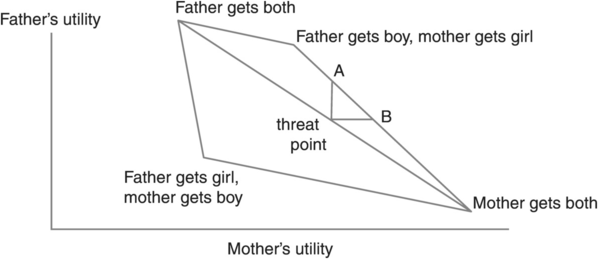 Figure 24.1
In theories of bargaining, the lines connecting the four vertices represent the utilities to the parents of various custody probabilities. For instance, the midpoint on the line between “father gets both” and “father gets boy, mother gets girl” indicates the expected utility to the parents if they flipped a coin between these two options. Needless to say, this will never happen in actual bargaining between the parents; it is merely a device for making the situation mathematically tractable. In a more realistic interpretation, we can assume that the parents are bargaining simultaneously over child custody and the division of their financial assets. The midpoint on the line could then indicate a situation in which the mother made a financial side payment to the father to get custody of her daughter. None of the “pure” solutions represented by the vertices will be acceptable to both parents, since one of them will always prefer going to court. The only mutually acceptable outcomes are “mixed solutions” on the line AB, since all combinations of custody and financial settlements on this line have higher utility for both parents than the expected utility of going to court.26
Although this analysis gives a rough intuitive understanding of some of the issues involved, it does not capture all of them. In particular, it has no room for inside options, that is, for what happens during bargaining and litigation. If one parent has larger financial resources, he (more rarely she) can use them to hire expensive lawyers and expert witnesses. Moreover, if parent A cares more about the harm done to the children by the often painful and protracted custody litigation than does parent B, parent A may be willing to give up custody. Although Solomon would then have accorded custody to parent A, courts cannot take this factor into account.27
As the subjective mental states such as impatience and risk aversion that shape the outcome of bargaining cannot be directly observed, bargainers have an interest in misrepresenting them, by verbal or non-verbal behavior. In logrolling, each side will exaggerate the importance of what she is being asked to give up in order to force a large concession by the other. When workers claim to attach great importance to costly safety measures at the workplace, it may be a stratagem to justify a big wage increase as the price of forgoing them. In many cases, attempts to deceive may be too transparent to work. If a divorcing parent claims great concern for getting custody of the children to get a favorable financial settlement, the other parent may be able to document a consistent lack of interest in the children before the marriage began to break down or the recent acceptance of a job that involves a great deal of traveling. A farsighted parent might, however, anticipate this problem and lay the groundwork for a claim to care about the children before the other parent understands that the marriage is breaking down.
Like parties engaged in arguing, bargainers can have an incentive to misrepresent their interest as based on principle. The reasoning behind the misrepresentation is different, though. In arguing, the parties want to prevent the opprobrium of basing their proposals on naked interest. In bargaining, no opprobrium attaches to expression of interest. Firms and workers are supposed to be concerned with profits and wages, not with the common good. Bargainers may nevertheless gain a strategic advantage from framing their demands in terms of principle. They may claim that in backing down from a principle-based claim they are making a greater concession, and hence expect greater concessions from the other side, than if mere interest is at stake. If each side employs this tactic, however, the bargaining may break down.
Negotiations over the allocation of emission rights are vulnerable to this problem, as nations may be attracted to the principles that fit their material interests. One study focuses on four principles:
The egalitarian rule incorporates the principle of equal per capita emissions. It implies that a country whose population amounts to x percent of the global population should receive x percent of global entitlements for greenhouse gas emissions.
The sovereignty rule incorporates the principle of equal percentage reduction of current emissions. It implies that a country whose greenhouse gas emissions amount to x percent of global emissions should receive x percent of global emissions entitlements.
The polluter-pays rule incorporates the principle of equal ratio between abatement costs and emissions. It implies that a country whose greenhouse gas emissions amount to x percent of global emissions should bear x percent of global abatement costs.
The ability-to-pay rule incorporates the principle of equal ratio between abatement costs and GDP. It implies that a country whose GDP amounts to x percent of gross world product should bear x percent of global abatement costs.
The authors of the study first assessed the costs of each of these principles for Russia, the European Union, China, and the United States. They then reported the results of a survey carried out among agents involved in climate policy, asking them to assess, for each of the equity rules, how much these countries or groups of countries could be expected to support it. There was a clear perception that the EU, the US, and Russia supported the equity principles that would impose the least costs on them. For China, the results were ambiguous. Such strategic use of principles blurs the distinction between arguing and bargaining.
The distinction is also blurred when it is unclear whether a statement shall be understood as a threat or a warning. I understand a threat as a statement by A that A will harm B if B does not do X, and a warning as a statement by A that if B does X something bad will happen to B, but not as a result of an action by A.28 I understand a promise as a statement by A that A will help B if B does X and an assurance as a statement by A that if B does X something good will happen to B, but not as a result of an action by A.
The wage bargaining system that is emerging in China, notably in Guangzhou, illustrates the blurring between threats and warnings. According to Chinese labor law, individual Chinese workers are allowed to strike. At least in theory, they are paid while striking and are not penalized by dismissal for striking. Worker collectives are allowed to form trade unions and elect a leader. However, unlike Western trade unions, their Chinese counterparts are not allowed to threaten to strike.29 Union leaders get around this obstacle by warning the management that workers are so discontented with their wages or working conditions that they will strike unless their demands are met. They can also refer to highly publicized incidents at other factories, such as Foxconn in Zhenzhen where fourteen workers killed themselves in 2010 in despair over their working conditions, and suggest that similar events might happen at the local plant. These are simple factual statements, to be assessed for their truth or falsity, whereas a threat is assessed by its credibility or lack of it.30 In reality, of course, what the workers do is to some extent under the control of the union leader, since he is in a position to influence their state of mind.
Another instance of a threat disguised as warning occurred in the Constituent Assembly at Versailles on July 9, 1789, when the Comte de Mirabeau addressed Louis XVI directly after troops were concentrated around the assembly. He first stated that the “French soldiers, close to the center of discussions and sharing the passions as well as the interests of the people, may forget that a commitment made them soldiers, and remember that nature made them men.” Technically, the statement was a warning, not a threat. It would have been a threat had he made the assertion – which would have made him liable to a charge of treason – that he would remind the soldiers that nature had made them men. Since the speech would be instantly diffused throughout the army, it was a self-fulfilling warning – not a threat, but close enough. Next, he warned the king that the deputies might lose control of themselves. “We are only men: our distrust of ourselves, the fear of appearing weak, might lead us beyond what we want.” Technically, this was a warning too, since he was asserting that the future actions of the deputies would not be under their own control. The effect was the same as that of a threat.31
A further example can be taken from the debates of the Federal Convention over the representation of the states in the Senate. The bone of contention was whether all states would have equal representation, as the small states demanded, or whether representation would be proportional to population, as the large states demanded. On June 30, 1787, the delegate Bedford from Delaware, a state that had asserted the equal representation aggressively, claimed that “The Large States dare not dissolve the confederation. If they do the small ones will find some foreign ally of more honor and good faith, who will take them by the hand and do them justice. He did not mean by this to intimidate or alarm. It was a natural consequence; which ought to be avoided by enlarging the federal powers not annihilating the federal system.”
This was incendiary language, with the reference to “natural consequence” underlying the credibility of the threat. On July 5, Gouverneur Morris from Pennsylvania counterattacked:
Let us suppose that the larger States shall agree; and the smaller refuse: and let us trace the consequences. The opponents of the system in the smaller States will no doubt make a party and noise for some time, but the ties of interest, of kindred & common habits which connect them with the other States will be too strong to be easily broken. In N. Jersey particularly he was sure a great many would follow the sentiments of Pena. & N. York. This Country must be united. If persuasion does not unite it, the sword will. He begged that this consideration might have its due weight. The scenes of horror attending civil commotion can not be described, and the conclusion of them will be worse than the term of their continuance. The stronger party will then make traytors of the weaker; and the Gallows and Halter will finish the work of the sword. How far foreign powers would be ready to take part in the confusion he would not say. Threats that they will be invited have it seems been thrown out.
The statement can be read as both a warning and a threat. Some delegates certainly took it as a threat, as indicated by the following retreat on behalf of Morris by Williamson from North Carolina: he “did not conceive that Mr. Govr. Morris meant that the sword ought to be drawn agst. the smaller states. He only pointed out the probable consequences of anarchy in the US.” In other words, Morris had not made a threat, only pointed out the consequences that could be predicted. On the same day, July 5, Bedford also retreated, by making it clear that:
he did not mean that the small States would court the aid & interposition of foreign powers. He meant that they would not consider the federal compact as dissolved until it should be so by the acts of the large States. In this case the consequence of the breach of faith on their part, and the readiness of the small States to fulfil their engagements, would be that foreign nations having demands on this Country would find it in their interest to take the small States by the hand, in order to do themselves justice.32
In Chinese wage bargaining and in Mirabeau's address to the king, the resort to the language of warnings was probably due to the fact that threats would have been illegal and even treasonable. In Philadelphia, the cause may have been the social opprobrium attached to the overt use of threats. Even in this small assembly debating behind closed doors, in which many delegates based their claims on naked interest, threats were beyond the pale.
In bargaining situations, each side may consist of several groups with different aims. Thus in negotiated transitions from authoritarian to democratic political systems, the government as well as the opposition may be divided into hardliners and softliners, the former being more unwilling to compromise. Thus in negotiations between the softliners on the two sides, each may refer to the hardliners in their own camp to argue that there are limits to how much they can concede. They do not, that is, threaten to carry out any particular actions, only warn about what their hardline allies might do. The same principle can apply in international relations. In his memoirs, Richard Nixon wrote that his frustration with Syngman Rhee's tendency to act independently of the United States was assuaged when Rhee told him that “any statements I have made about Korea acting independently were made to help America … The moment the Communists are certain that the United States controls Rhee, you will have lost one of your most effective bargaining points … The Communists think that America wants peace so badly that you will do anything to get it … But they do not think that this is true as far as I am concerned, and I believe you would be wrong to dispel their doubts in that respect” (my italics).
Summary
Pulling together the various strands of this chapter, the process of collective decision making can be represented as shown in Figure 24.2. The central point is perhaps that each of the mechanisms of collective decision making – arguing, voting, and bargaining – creates an incentive to misrepresent some aspect of one's preferences. In other words, an aggregation mechanism contributes to shaping the inputs to the mechanism itself. The expressed policy preferences are a function both of the real policy preferences and of the mechanism that aggregates expressed policy preferences. The welfare impact of misrepresentation is ambiguous. By virtue of the civilizing force of hypocrisy, the effects may be socially beneficial. In other cases, generalized use of this tactic may create a Prisoner's Dilemma type of situation, in which everybody loses.
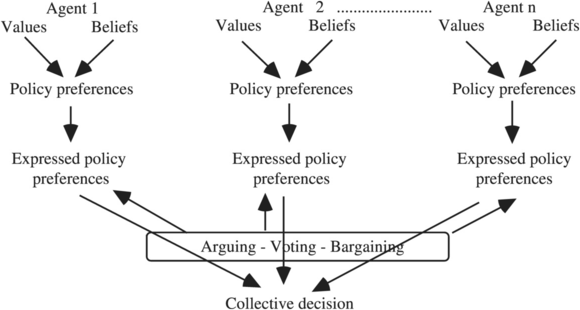 Figure 24.2
Bibliographical note
The experiments showing willingness to sacrifice personal gains for the sake of future generations is described in L. Putterman et al., “Cooperating with the future,” Nature 511 (2014), 220–3. I discuss arguing and voting at greater length in Chapter 2 of Securities Against Misrule (Cambridge University Press, 2013), and bargaining in The Cement of Society (Cambridge University Press, 1989). For mechanisms that are in some respects intermediate between collective action and collective decision making, see E. Ostrom, Governing the Commons: The Evolution of Institutions for Collective Action (Cambridge University Press, 1990). A luminous if occasionally eccentric discussion of arguing and voting is J. Bentham, Political Tactics (Oxford University Press, 1999). The passages quoted from Bentham (translated from French) are in the equally interesting Rights, Representation, and Reform (Oxford University Press, 2002), pp. 35 and 122. For the practices of the British Wages Council, see F. Bayliss, “The independent members of the British Wages Councils and Boards,” British Journal of Sociology 8 (1957) 1–25. The best descriptive studies of arguing (as distinct from normative analyses) are Aristotle's Rhetoric and C. Perelman and L. Olbrechts-Tyteca, The New Rhetoric (Notre Dame, IN: University of Notre Dame Press, 1969). The Italian practice of secret voting in parliament is explained in D. Giannetti, “Secret voting in the Italian Parliament,” J. Elster (ed.), Publicity and Secrecy in Votes and Debates (Cambridge University Press, 2015). For misrepresentation induced by deliberation, see Chapter 5 of my Alchemies of the Mind (Cambridge University Press, 1999). The paradox named after the Marquis de Condorcet was first stated in his 1785 Essai sur l'application de l’analyse à la probabilité des décisions rendues à la pluralité des voix. G. Mackie, Democracy Defended (Cambridge University Press, 2003), contains extensive analyses of cycling social preferences, and a claim that almost all alleged examples of cycling in legislatures are based on flawed readings of the evidence. The example of Oslo airport is taken from A. Hylland, “The Condorcet paradox in theory and practice,” in J. Elster et al. (eds.), Understanding Choice, Explaining Behavior: Essays in Honour of Ole-Jørgen Skog (Oslo Academic Press, 2006). The example of the demobilization of American soldiers is taken from S. Stouffer (ed.), The American Soldier, vol. II (Princeton University Press, 1949), Chapter 11. The paradox named after the mathematician Poisson was first stated in his 1837 Recherches sur la probabilité des jugements en matières criminelles et matière civile. For misrepresentation induced by voting, see M. Balinski and I. Laraki, Majority Judgment (Cambridge, MA: MIT Press, 2010). This work also offers an important challenge to the main paradigm of voting theory. For the vote on bicameralism in 1789, see J. Egret, La révolution des notables (Paris: Armand Colin, 1950). The discussion of Condorcet's jury theorem draws on D. Karotkin and J. Paroush, “Optimum committee size: quality-versus-quantity dilemma,” Social Choice and Welfare 20 (2003), 429–41. A full treatment of the history of the secret ballot is H. Buchstein, Öffentliche und geheime Stimmangabe (Baden-Baden: Nomos, 2000). The note on the Civil Rights Act of 1964 is taken more or less verbatim from H. Brady and J. Ferejohn, “Congress and civil rights policy: an examination of endogenous preferences,” in I. Katznelson and B. Weingast (eds.), Preferences and Situations (New York: Russell Sage, 2005). The seminal work on bargaining is T. Schelling, The Strategy of Conflict (Cambridge, MA: Harvard University Press, 1960). The argument that bargaining tends to eliminate the gains that are the object of bargaining is in L. Johansen, “The bargaining society and the inefficiency of bargaining,” Kyklos 32 (1979), 497–522. A classic work on bargaining in practice is H. Raiffa, The Art and Science of Negotiation (Cambridge, MA: Harvard University Press, 1982). The claim that the Glorious Revolution enabled English monarchs to make credible promises is made in D. North and B. Weingast, “Constitutions and commitment,” Journal of Economic History 43 (1989), 803–32, and critically examined in several chapters in D. Coffman, A. Leonard, and L. Neal, Questioning Credible Commitment (Cambridge University Press, 2013). The reference to Louis XV's minister Machault is from M. Marion, Machault d'Arnouville (Paris: Hachette, 1891), p. 365. An informal exposition of bargaining theory is A. Muthoo, “A non-technical introduction to bargaining theory,” World Economics 1 (2000), 145–66. I discuss wage bargaining in Chapter 2 of The Cement of Society, and child custody issues in Chapter 3 of Solomonic Judgments (Cambridge University Press, 1989). On Robert Walpole and the Sinking Fund, see P. Langford, Public Life and the Propertied Englishman (Oxford University Press, 1991), p. 155. On Reagan and Gorbachev in Reykjavik, see K. Adelman, Reagan at Reykvavik: 48 Hours that Ended the Cold War (New York: Broadside Books, 2014). For misrepresentation induced by bargaining, see J. Sobel, “Distortion of utilities and the bargaining problem,” Econometrica 49 (1981), 597–617. For the misrepresentation of interests as principles in climate change negotiations, see A. Lange et al., “On the self-interested use of equity in international climate negotiations,” European Economic Review 54 (2010), 359–75. For some skeptical and commonsensical comments on the importance of the issue of misrepresentation in voting and bargaining, see L. Johansen, “The theory of public goods: misplaced emphasis?” Journal of Public Economics 7 (1977), 147–52.
1 In Bogotá, though, the city government had an active role in providing the information needed to trigger the quasi-moral norms (Chapter 5).
2 To put it differently, “I stay home but everybody else has to vote” will not be among the options in the referendum.
3 Although the phrase “aggregation mechanism” is usually reserved for voting procedures, I use it here to denote any process in which actors who may have initially different preferences interact to bring about a decision that all of them accept as binding.
4 In early English jury trials the practice of starving the jurors (or having them pay for their own food) until they reached a unanimous decision may also have conferred greater bargaining power on some than on others.
5 Even general elections may offer scope for bargaining. If voting is public, voters and candidate may haggle over the price of votes.
6 Might the outward expression of a hypocritical belief also induce inward endorsement? Commenting on the persecution of heretics under Henry VIII, Hume wrote that the practice “may, indeed, seem better calculated to make hypocrites than converts; but experience teaches us, that the habits of hypocrisy often turn into reality; and the children at least, ignorant of the dissimulation of their parents, may happily be educated in more orthodox tenets.” I am more persuaded by the latter part of the argument than by the former, since persecution offers the victim a reason to dissimulate (Chapter 9).
7 Recall, however, that this improvement is more likely if they pool their raw data than if they simply pool the conclusions reached on the basis of raw data (Chapter 22).
8 Other considerations, notably the need for effective governance, may speak in favor of majority voting or proportional voting with a high threshold. In elections to constituent assemblies, in which governance is a secondary consideration, there is a tendency to choose delegates by proportional voting.
9 Utilitarians tend to deny that this implication follows. They argue, typically, that the negative effects of the fear and uncertainty that would be generated by the knowledge that one might be chosen as a “random donor” would more than offset the benefits of the practice. But how do they know this? I suspect that they reason backward, from the obvious unacceptability of the practice to the existence of costs that would exclude it on utilitarian grounds, rather than forward, from the demonstration of costs to the rejection of the procedure.
10 The making of the South African constitution of 1996 is a partial exception. The requirement that it be adopted by a qualified majority was laid down in the interim constitution of 1993, which was itself adopted by bargaining rather than voting. Another exception is the making of the Norwegian constitution of 1814, when the assembly decided that any proposal that garnered more than two-thirds of the votes would be definitely adopted, that is, not be subject to revisions in later sessions. Thus the framers deviated from a principle that is normally followed in constituent assemblies: since the effect of a given clause in the constitution often depends on the other clauses, nothing is settled until everything is settled.
11 He does not ask, though, whether the occasional liability to grave mistakes might not be more serious than the systematic bias of a non-democratic regime. Although Tocqueville claimed that because of its favorable geographical situation the United States could afford to make mistakes, that might not be true of other countries.
12 Assuming, contrary to what is argued in the next paragraph, that the likelihood of each voter's being right is unaffected by an increase in the number of voters.
13 The chance of the majority's getting it right also increases if one requires a qualified majority, such as 60 percent. In that case, however, one might get a “hung jury” in which neither the guilt nor the innocence of the accused gathers the required majority.
14 One might also try to ensure that the conditions of Condorcet's theorem obtain by making it more likely that the beliefs of the voters are in fact independent of each other. In this perspective, Rousseau's proposal to ban discussion prior to deliberation might make sense. At the same time, if deliberation improves the quality of beliefs, it cannot be an objection that it also makes them less independent of each other. The conditions of the theorem are sufficient for majority voting to produce a good outcome, but not necessary.
15 Since the decision to vote may itself be irrational (Chapter 14), one might ask whether citizens might not also irrationally invest in information about the issues at stake. In the present context, however, the relevant issue is whether citizens invest more when the franchise is narrow than when it is wide, just as more voters may turn out when the election is seen as close.
16 In the abstract the optimum could be at one of the extreme ends – either a single individual or all adult persons. Under reasonable assumptions, there is more likely to be an “interior maximum.” If the optimal size is small, one might choose the voters at random among the citizens at large to ensure that they do not represent sectarian interests. In this perspective, voting would be a function rather than a right.
17 What I call the Poisson paradox is more usually named the “doctrinal paradox” or the “discursive dilemma,” terms coined by legal scholars and philosophers who rediscovered it in the 1980s and 1990s. Earlier, it was rediscovered in 1921 by the Italian legal scholar Vacca.
18 The authors of the study from which I take these findings wrote that “a high degree of internal consistency on such intricate hypothetical choices was hardly to be expected,” suggesting that the problem was one of individually inconsistent rankings. If the majorities had added up to more than 200 percent, this suggestion would have been justified. As they add up only to 167 percent, it is quite possible that the rankings were individually consistent and yet gave rise to a collective intransitivity. The study was published in 1949, two years before Kenneth Arrow's pathbreaking work on preference aggregation and the inconsistencies to which it is vulnerable.
19 In the French assembly, this outcome occurred in May 1791 when radicals, moderates, and reactionaries joined forces in voting for a law that made the members of the constituent assembly ineligible for the first ordinary legislature. The aim of the radicals was to weaken the legislature in favor of the club of the Jacobins; that of the reactionaries to weaken it in favor of the king. The vote was unanimous, since the moderate center, “drunk with disinterestedness” (Chapter 5), enthusiastically voted to deny themselves a role in the future legislature.
20 To prevent this outcome, the reactionaries could have falsely stated a belief that bicameralism would destabilize the regime, thus creating a majority for that belief and hence a majority for the choice of unicameralism.
21 On December 2, 1882, the House of Commons adopted a resolution requiring that any vote on the reasons for a piece of legislation be taken after the vote on the law itself. According to Robert's Rules of Order, “It is usually inadvisable to include reasons for a motion's adoption within the motion itself.”
22 Here I first consider Western-style wage bargaining. Toward the end of the chapter, I discuss the emerging wage bargaining system in China.
23 The threat of shutting down a plant permanently might seem non-credible, Yet that is what Roger Milliken did in 1956, when workers at his Darlington factory organized to form a union. I do not know whether he had threatened to do so.
24 It is not true, therefore, as Marx said, that machinery “is the most powerful weapon for suppressing strikes.” The decline in the US steel industry has been explained by the fear of investing in “hostage capital.”
25 This might come about, for instance, in the unlikely event that the law says that the court should flip a coin between these two solutions, or if both parents believe that both are equally fit for custody. In many actual cases, the sum of the probability the father assigns to getting full custody and the probability the mother assigns to getting full custody probably exceeds 100 percent.
26 Various, largely irrelevant mathematical theories yield different predictions as to which of these combinations will be chosen.
27 If it did, and were known to do so, parent B might also be tempted to give up custody.
28 Some writers use the warning–threat opposition for the distinction between what in my usage are credible and non-credible threats.
29 In Western countries, too, it is sometimes illegal to threaten (or promise) to do what it is legal to do. The law does not prevent a woman from telling her lover's wife that they have had an affair, but if she threatens to do so unless he pays her off, it is blackmail and illegal. Voters are free to cast their vote for any of the candidates in the running, but are not allowed to promise to vote for one of them in exchange for money.
30 Western trade union leaders may also disguise their threats as warnings, but for strategic rather than for legal reasons.
31 Similarly, Gibbon asserts that a statement by Bishop Ambrosius to the ministers of the Emperor Valentian that “he had not contributed to excite, but it was in the power of God alone to appease, the rage of the people; he deprecated the scenes of blood and confusion, which were likely to ensue” could be “interpreted as a serious declaration of civil war.” Gibbon also refers to a similarly ambiguous statement (perhaps inspired by Ambrosius) by Cardinal de Retz to Anne of Austria.
32 Note that in the first statement by Bedford that I have italicized, the initiative of an alliance with foreign allies is imputed to the States, while in the second it is imputed to the foreign nations.