
As kids, one of us and his buddies set out to create secret “gang” code words so that we could visually—and quietly—communicate from a distance. There were signals for “attack,” “hide,” “back to base,” that kind of thing, although most of the details have long been forgotten. But somewhere on that list of a few dozen codes were two of the most important signals of all: “Yes” and “No.” Or, in much more sophisticated parlance, “affirmative” and “negative.”
Where are the yes and no among all those emotional expressions in Figures 29 and 30 back in chapter five? You can peruse those diagrams all day long, but you won’t find them in there. How can this signaling system serve as a “first language” if social animals can’t say the two most important things that need to be in any signaling system? How did we end up with a slew of eighty-one qualitatively different expressions, and yet no way to say yes or no?
Despite yes and no not being explicitly labeled among the repertoire of emotional expressions, they’re actually accounted for.
Yes is easy. To say yes, one merely says nothing. Or, at least, doesn’t counter-respond with anything else. And doesn’t start a fight about it either. Recall that response emotional expressions signal my correction to what you said. The less I disagree, the lower the amplitude of my emotional expression. So, if I don’t disagree—ahem, if I agree, and am thereby saying yes—then my response emotional expression’s amplitude can be zero . . . which is just an overly clever way of saying that I don’t need to express a response at all. My neutral face response expresses yes. Of course, if I am saying yes, I’m saying it in reply to an offer you just made. So, to let you know I got that message, I will express my acknowledgment to that. My acknowledgment expression of happy—without any response expression along with it—says: “You offered me a better deal. And, yes, I’ll take it.”
We suspect there will usually be some simple further signal signifying that “this emotional expression is the totality of what I’m signaling,” so that you’re not left wondering whether, despite my expressing happy and currently not expressing a response, I might at any future moment express a response. For English speakers these days, a slight nod of the head often suffices to let the other party know “that’s that.”
How, then, does one say no?
While the eight pure acknowledgment expressions (at the center of each leaf bunch) are the various ways to say yes, everything else is no. If I counter-respond at all, then it means I disagree. That’s what responses are. Any response signal could always have no appended to the front of the statement without any change in meaning. Aggression may mean, “I should get more,” but we could easily rephrase it as, “No, I should get more.” And so, if there are eight yes expressions and one neutral, then the remaining expressions among the eighty-one total are no. That’s seventy-two ways to say no, which sounds like a great title to a self-empowerment book.
That said, not all seventy-two versions are the same. Among responses, there are very no-like nos, and there are actually some yes-like nos.
To help us get a better grasp of these varieties of nos, we’ll show you a new diagram. Remember when we first presented the acknowledgment emotional expressions in Figure 22 at the start of chapter five? In that diagram Tim’s response emotional expressions were within the central square and flipped horizontally to jive with the fact that Tim’s favored direction is rightward whereas Mark’s is leftward. Mark’s acknowledgment expressions were shown along the perimeter. That was helpful in seeing how Mark’s (acknowledgment) expressions connect to Tim’s (response) expressions.
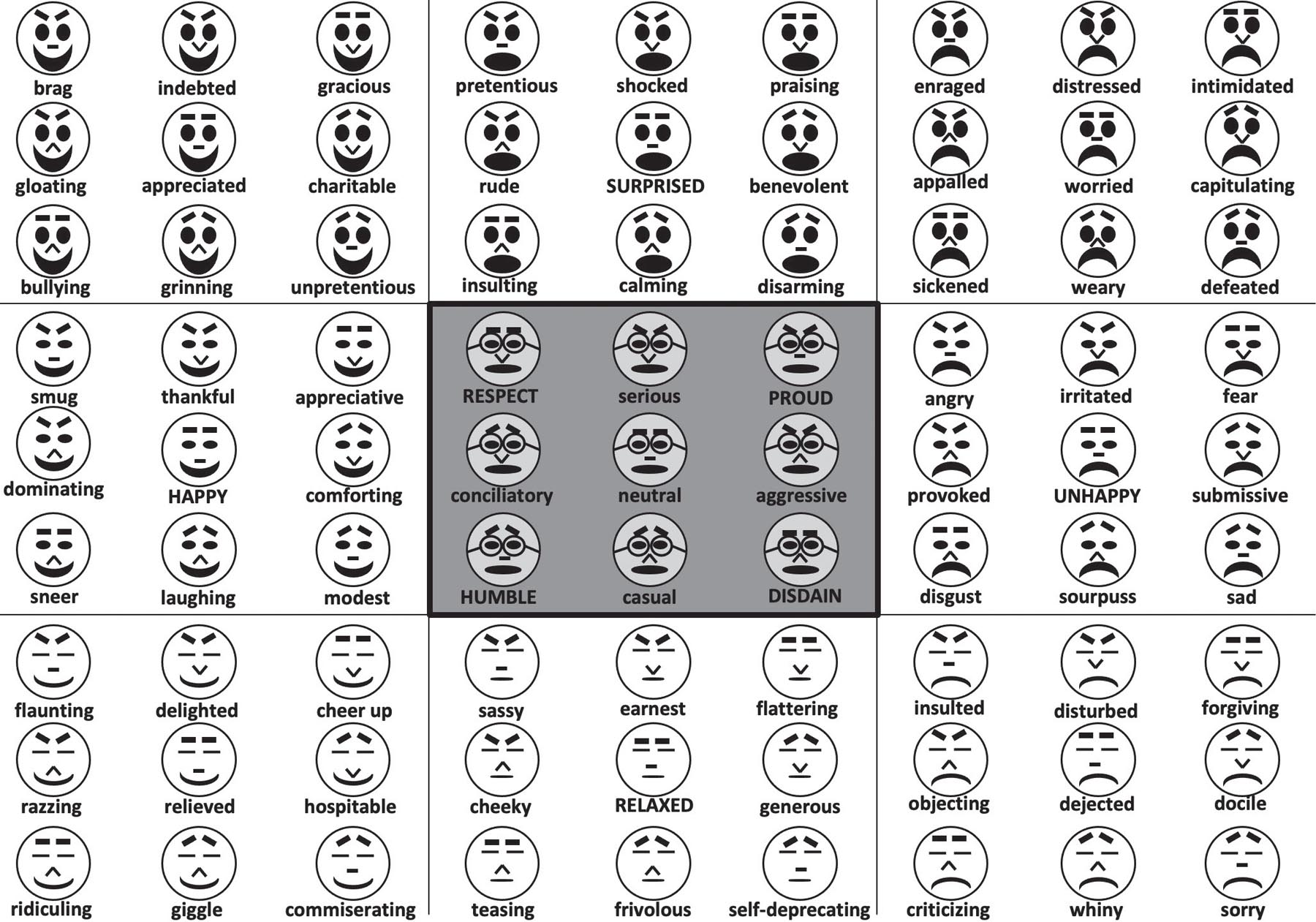
Figure 45. The central square, which usually has my (leftward-favoring) response emotional expressions, has been replaced with the previous response emotional expression by you (and you’re now sporting glasses), and this entire central cluster is now the horizontal mirror reflection of mine from the earlier Figure 29. By putting your response emotional expressions within the inner square, we can more easily see my range of possible emotional expressions in reaction to your most recent response. For example, if you were just aggressive (which means you could have signaled any emotion having an aggressive component, e.g., dominating or appalled or gloating, etc.), then we can look within the center square and see that aggressive is on the right side (for you). That means we look to the square adjacent to it (in this case on the right), which is the unhappy square, and my subsequent emotional expression will be chosen within this cluster.
All the diagrams since that one, however, don’t have this nice mix of both parties’ emotional expressions. In Figure 45, we’ve provided a variant of Figure 29, but now we’ve crammed you inside. In the earlier Figure 29, the central cluster showed my raw response emotional expressions (i.e., uncolored by an acknowledgment). In Figure 45, however, the central cluster shows your raw response emotional expressions. Remember that, because you’re pushing rightward (for a greater fraction of the loaf, as if you’re Tim), your responses are the horizontal mirror-reflected version of mine (pretending now to be Mark), which is why your aggressive is on the right, whereas mine is on the left.
Figure 45 is no longer good for displaying the entire four-dimensional space of my emotional expressions (unless one remembers the inner cluster needs to be horizontally flipped, and that I don’t wear glasses), but it is helpful in thinking through the sorts of responses I might make depending on what you just signaled.
For example, if you were just now conciliatory, then the sorts of emotionally expressive reactions I might have are no longer spread over the entire four-dimensional space. Instead, my emotional expression will be somewhere within the left-side happy cluster, adjacent to your conciliatory signal. For example, maybe I express thankful; if so, that means my response was serious, and so we can use the same diagram to look at your range of possible expressions as a response. We just have to look at the mirror version of the entire diagram.
Figure 46 shows the example negotiation between Tim and Mark from Figure 19, but it’s now using our previous Figure 45 to help us see the total emotional expression for each party at each of the three “moves.”
Cramming you inside the diagram is not only helpful in thinking through the turn taking, but also in understanding yes and no. Recall from earlier in this section that the lone acknowledgments are, in essence, the yes expressions. In Figure 45 they’re at the center of each of the leaf bunches.
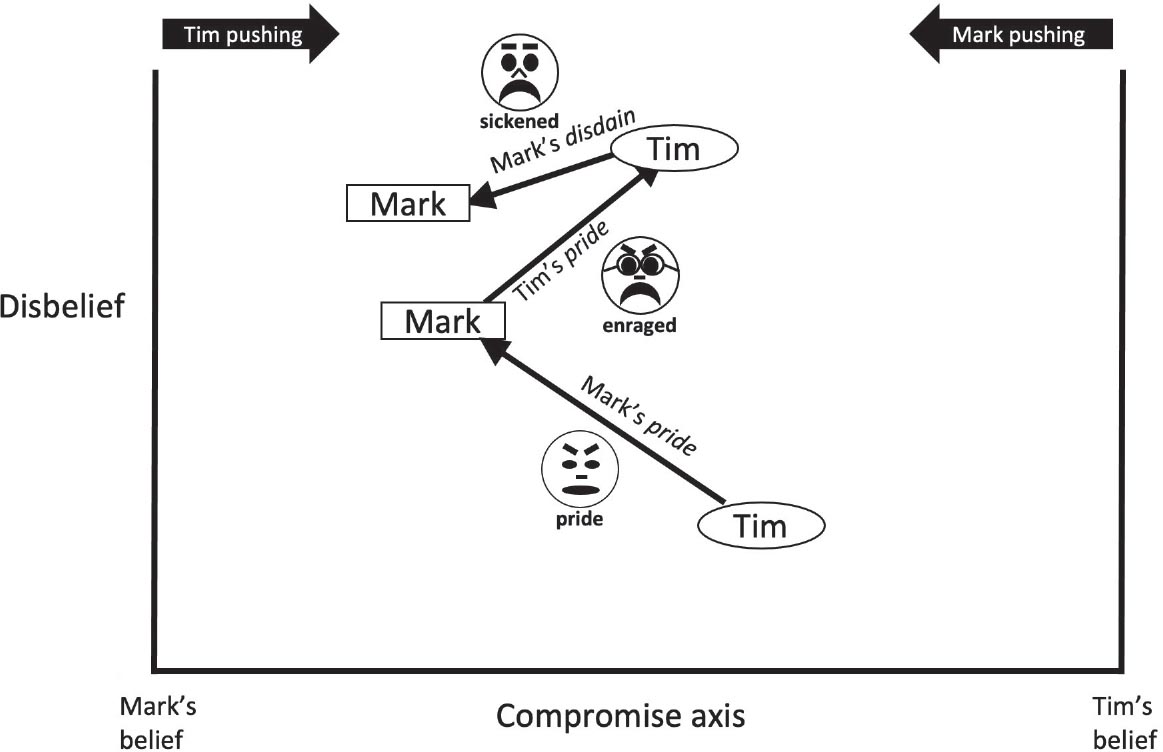
Figure 46. This depicts the same example negotiation between Tim and Mark from the earlier Figure 19, but now adjacent to each response arrow is the entire expression due to the party’s acknowledgment and response.
Let’s look first at one of the varieties of no, the direct contradictions, as shown in Figure 47, a variant of Figure 45, but focusing a bit toward the central cluster. These emotional expressions around the outside of Figure 47 are where my response component is the opposite of your last response, “opposite” in the sense of (partially or more than fully) undoing whatever shift you just made in the discussion space.
For example, if I show an emotion of provoked, I am undoing your aggressive claim, saying, “No, you should not get any of that extra amount of loaf you just asked for.” In this case, I’m responding to your aggression with my own aggression, but when combined with unhappy (which acknowledges your aggression), it becomes a strong kind of no, saying by itself that it is contradicting exactly what you claimed.
As another example, consider earnest, which says about your signal of casual, “No, I am not going to treat this issue lightly.” Direct contradictions sound inherently unfriendly, but they’re actually not. If in reaction to your expression of humility I signal cheer up—a case of relief and respect—then not only am I expressing happy (which is part of relief), but I’m offering you a better deal. “Nah, you certainly should get more than that.”
Figure 47 catalogs the eight direct contradiction nos. Although there are a wide variety of meanings among the eight, they’re each a simple and straightforward “no to what you just said.”
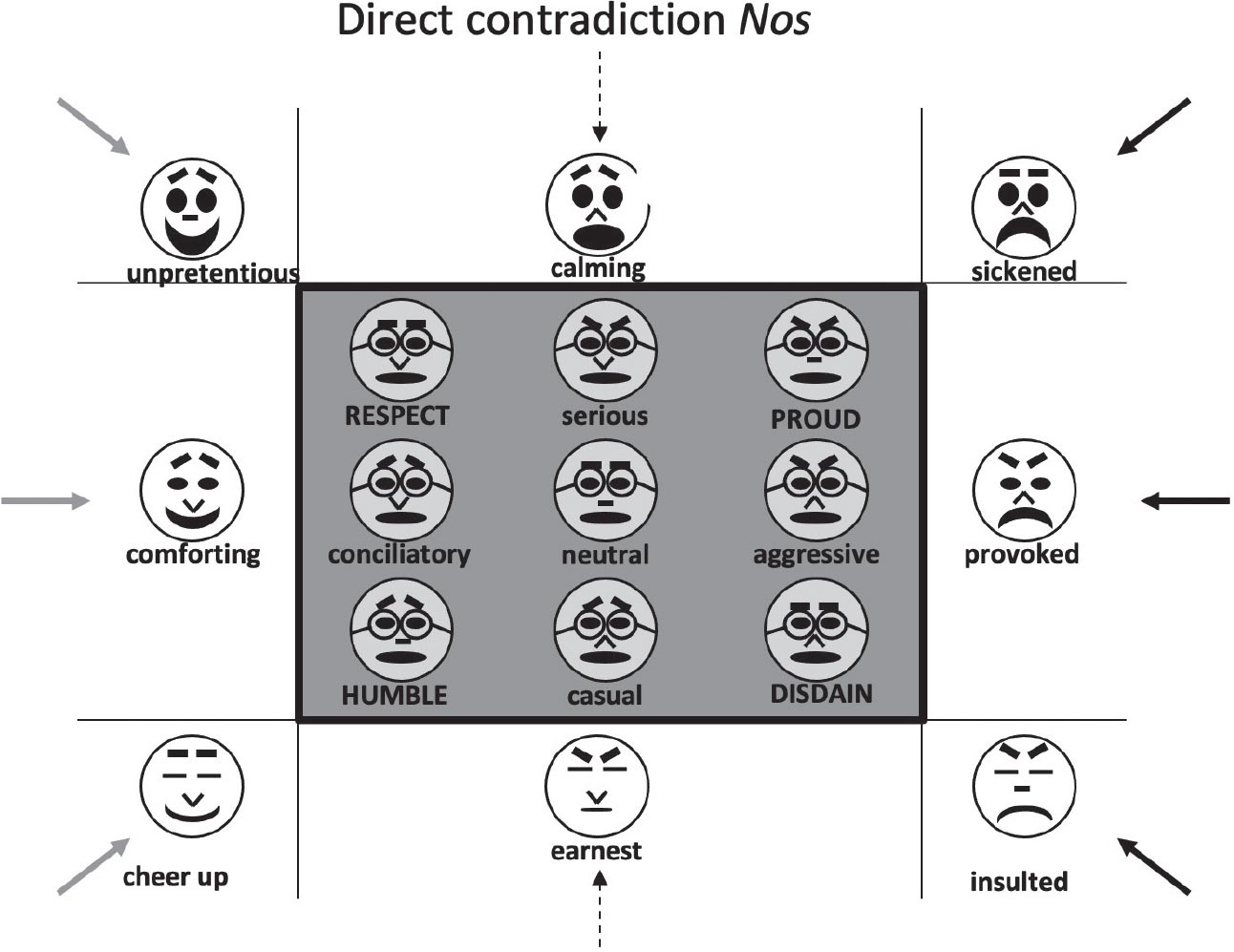
Figure 47. There are eight kinds of direct contradiction nos, one within each of the clusters on the outside by me, one for each of your responses in the center square. They’re “direct” contradictions in that I am saying the opposite of your last response. For example, if you show pride, which pushes the compromise in your favor and raises the tension, to undo that I show disdain. But combined with my worried acknowledging your pride, it becomes sickened. Said differently, my full expression is one of direct contradiction, where my response is proposing the opposite of what I am acknowledging you proposed. Sickened says, “You think you’re certain! No way. You’re not.” But note that being directly contradictory isn’t always so harsh sounding. If I signal comforting, then I’m saying, “Nah, I don’t deserve that much extra loaf.” It may be a direct contradiction no, but it’s warm and friendly. And, for example, calming has no horizontal component and so is only a contradiction concerning the tension, saying, “No, there’s no reason for things to get tense. Let’s settle down now.” Note these are all the emotional expressions in the outer squares with response arrows pointed directly inward.
While those expressions are direct contradictions, they’re not necessarily the most dramatic sorts of nos. So, for example, provoked might be a direct contradiction to your signal of aggressive, but angry is more dramatic, raising the prospects of a fight. And comforting might be a direct contradiction to your conciliatory signal, but if I am appreciative, I not only politely push back on your nice offer but raise the level of formality.
Whereas we’ve pointed out direct contradictions and some of the even more dramatic sorts of nos, there are some yes-like responses as well. They’re still ultimately nos because all responses are nos.
But there are some emotions I might express that say, “Yes, but more.” The no is hiding in my “but.”
For example, my signal of dominating means not only that I accept your conciliatory offer of more zucchini bread for me, but I demand even more than you’ve offered. And my intimidated means not only that I agree with you that you’re more confident, but that I claim you’re even more confident than that.
They’re therefore a bit like yes, even though they’re, strictly speaking, still nos. And note that not every yes is nice. If I signal dominating, I’m saying, “Yes, but I’d like even more than that.” That’s not too friendly.
And if I signal intimidated, then I’m saying, “Yes, and I think you’re even more confident than you say.” That is somewhat nice (it’s always nice to give to others), albeit I’m not happy about it.
Figure 48 summarizes these eight qualitatively distinct kinds of yes.
As you might have noticed by looking at Figures 47 and 48, whereas the direct contradiction cases within each square are the expressions with response arrows pointing inward toward the center, opposite to your previous response direction, the yes-like cases within each square are the expressions with response arrows pointing outward, away from the center, and in the same direction your response was pushing. In this valence/arousal space, the contradictory nos are centripetal (inward pointing), and the yeses are centrifugal (outward-pointing).
Social animals do indeed need to be able to say yes and no. But they’re not playing twenty questions, where pure responses of yes and no suffice. The range of emotional expressions has the needed richness not only to say yes and no, but to say it in the ways needed for a compromise-finding discussion.
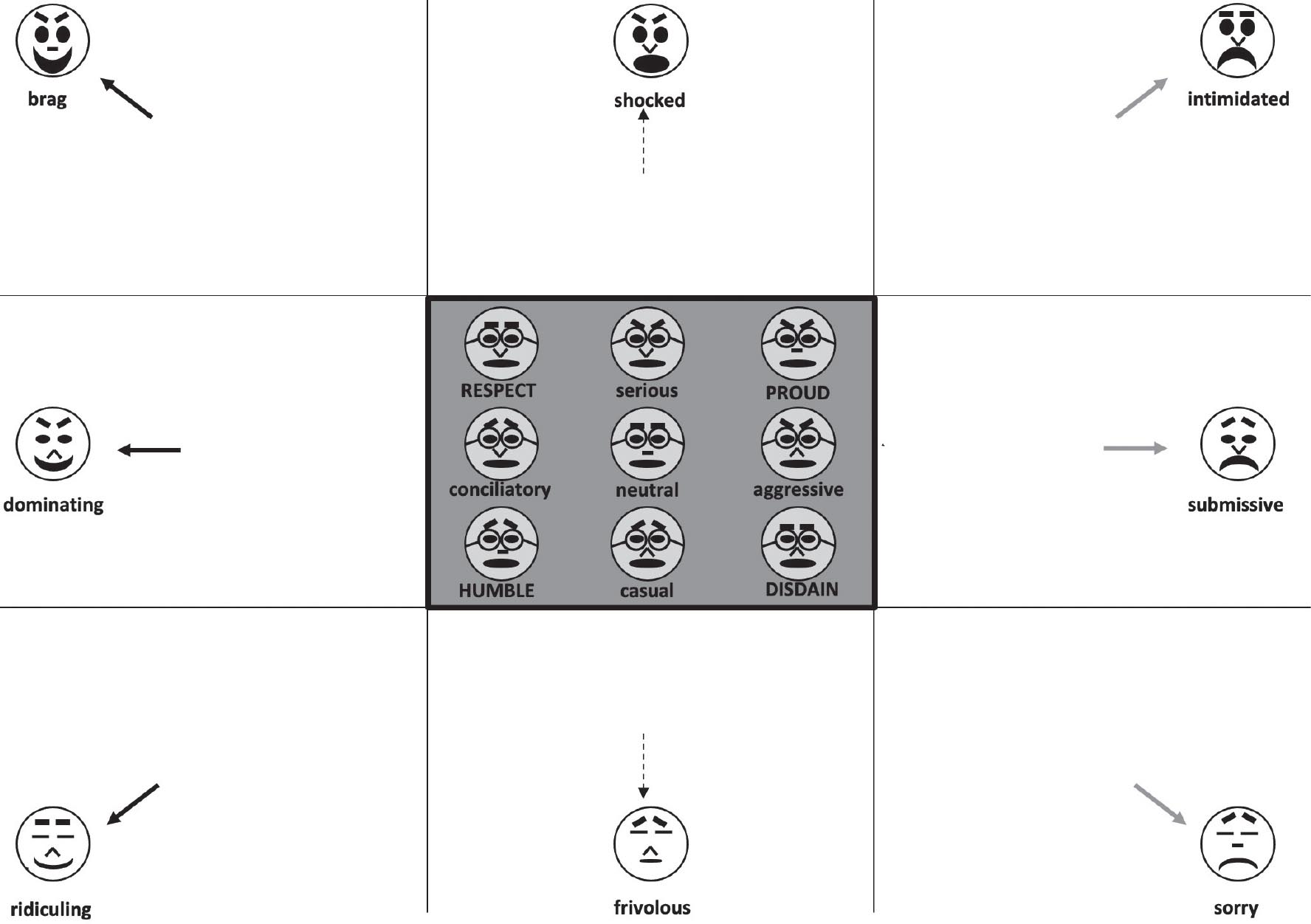
Figure 48. My yes-like responses are shown. They are yes-like in the sense that they agree with your response, but I’m asking for even more in the same direction. So, for example, submissive means that not only am I assenting to your aggressive demand of more zucchini bread for yourself, but I’m offering you even more than that. And shocked means that not only am I agreeing with you that a fight is more likely, but I think its possibility is higher still. Note these are all the emotions in the outer squares with response arrows pointed directly outward.