
CHAPTER 10
[T]he plains were covered with buffalo in every direction.—Henry and Thompson 1799
The country is devoid of game.—Nicollet 1838
Buffalo herds in the East were never huge, never teeming, never rivaling the truly vast herds that thundered across the Plains.—Belue 1996
The question of whether bison and cattle are analogous herbivores may be of less importance than asking how Great Plains plants and animals communities are influenced by . . . management activities.—Hartnett et al. 1997
We recommend that the focus of mixed prairie conservation be on developing ecologically sound goals and practices for grazing management, rather than on whether bison or cattle are the more appropriate grazers.—Steuter and Hidinger 1999
Where boundaries of warring tribes met, buffer zones of various tribes met, buffer zones of various sizes that neither side occupied became established where some hunting was allowed but was usually light. . . . The importance of these buffer zones is that they left game within them relatively undisturbed and allowed the buildup of herds.—Flores 2001
IF THE PUP AND I have a choice between walking a thoughtfully grazed prairie or an ungrazed prairie, it’s really not a choice. We’ll take the grazed prairie every time. There’s more to see, more patterns on the landscape, more plants to identify, and often more birds, butterflies, and bees to see. Identifying plants in full bloom is easy. Identifying grazed grasses provides an enjoyable botanical challenge.
Well-grazed prairies open up so many new questions as we walk and observe. Why did the animals graze here instead of there? Why did they graze at different intensities in different areas? How does the wildlife respond to the grazing patterns?
In reading early descriptions of the North American continent, it’s easy to believe that wildlife was lined up shoulder to shoulder from sea to shining sea, and the sun was daily eclipsed by the vast clouds of waterfowl, passenger pigeon, shorebirds, and songbirds. While that was the case sometimes, it wasn’t always like that everywhere.
Animals were so scarce that we suffered much from hunger. (Henry and Thompson 1799)
On the route from Chicago to Fort Crawford we saw but one deer . . . upon upwards of two hundred miles of prairie land. (Keating 1823)
We’ve seen how people had a strong influence on the prairie landscape and vegetation. They also influenced the distribution of wildlife at regional scales. Native American groups informally created wide buffers between tribal areas (Hickerson 1965). It was safe for them to travel in their area, but they would minimize travel in these buffer areas to avoid conflict with neighboring groups. Wildlife would concentrate in these areas where they received the least hunting pressure.
On the banks of this river [Sheyenne River] I am informed they [black bears] are also very numerous, and seldom molested by the hunters, it being the frontier of the Sioux, where none can hunt in safety; so there they breed and multiply in security. (Henry and Thompson 1799)
Toward 6:00 we pass near a pond where the buffalo come frequently to refresh themselves with its salt water; it is a good area for hunting, but the Sioux seldom come here for fear of meeting their enemies. (Nicollet 1838)
Mammalian diversity on the prairie lags behind other groups of animals, such as birds and invertebrates. A review of the Konza Prairie mammal list includes American badger, two shrews, one mole, one ground squirrel, one gopher, six species of mice, two voles, one lemming, and two rats, among other species. In other parts of the prairie we can add Franklin’s and Richardson’s ground squirrels and a few other rodent species. Unfortunately, most of these species are hidden in the grass, out of sight and out of mind to most people. And let’s face it, mice are never going to be as charismatic and generate the conservation interest and concern that warblers will.
Other species such as red fox, striped skunk, raccoon, several weasels, and white-tailed deer are more forest or forest-edge species. The coyote is probably a true grassland species, although they do well in almost any habitat.
We often think of elk as a forested species that lives in the mountains. That’s because it is the only habitat we have allowed them to persist in. Reading early accounts of the prairie demonstrate that the elk is very much a grassland or grassland-forest edge species.
That said, this chapter will focus on THE prairie animal, the bison. Going back in time, bison evolved in Europe and came to North America over the Bering Land Bridge during a past glacial period 200,000 to 800,000 years ago (Dary 1974). Just like so many iconic prairie plants, the iconic prairie animal isn’t originally from the prairies. They aren’t even from North America. The modern bison was at least the fourth, and probably smallest bison in North America. The three extinct species include the long-horned bison, the giant bison, and Bison antiquus (Geist 1996).
There’s one question that almost always comes up before any other. How many bison were there? Many early descriptions left people with images of solid masses of bison.
You may see them for whole days on each side of you as far as your sight will extend, apparently so thick, that one might easily walk for miles upon their backs. (Pike 1832)
This plain was literally covered with buffaloes as far as we could see. (Bradbury 1810)
Reports from the 1870s state that the size of herds, or bands or family groups, rarely exceeded sixty, were never greater than two hundred, and that bands of fifteen were the most common (Haines 1970). These small herds were scattered over wide areas with hundreds of yards between bands. There may have been fifteen to twenty bison per acre to twenty-six bison per square mile (Shaw 1995). At a larger scale, the Lewis and Clark Expedition saw bison only on 15 percent of the days they were in the grasslands (Botkin 1995). That’s hardly bison standing shoulder to shoulder across the plains and prairies.
Sixty million bison is a commonly cited number and probably dates to Seton (1929). These estimates “contain serious shortcomings” (Shaw 1995), but this number is “as close to religious dogma as a secular society’s belief can be” (Lott 2002). Thirty million bison may be a more realistic estimate (McHugh 1972; Flores 1991).
Coming up with any number, no matter how carefully it’s done, almost implies there is some right or correct number of bison, or any wildlife, that was supposed to be on the prairie.
The grass on one hand and the wolves on the other gave the wandering herds of herbivores a social organization and put a premium on proper numbers. (Milne and Milne 1960)
The term “proper numbers” gets back to the balance of nature concept and people wanting the natural world to be predictable and at equilibrium. There’s a question that may be more interesting than how many there were. How much did populations fluctuate? To build on that idea, we need to understand what factors, singly or working together, caused the population to fluctuate.
Both Charles Elton, who is sometimes referred to as the father of modern animal ecology, and Aldo Leopold try to dispel the notion of the “balance of nature” (their quotes) as it applies to animal populations. Elton (1930) wrote, “The number of wild animals are constantly varying to a greater or less extent, and the variations are usually irregular in period and always irregular in amplitude. Each variation in the numbers of one species causes direct and indirect repercussions on the numbers of the others, and since many of the latter are themselves independently varying in numbers, the resultant confusion is remarkable.” Three years later, Leopold (1933) wrote, “Fluctuation in numbers is nearly universal.” These statements provide further evidence that there is no balance in the natural world. Elton also describes how changes in one population can affect many other populations, often in unpredictable ways. His phrase that the “confusion is remarkable” summarizes the prairie pretty well.
Several factors could control the bison population size, or the size of any animal population. We can imagine a period of relatively wet summers and mild winters when the population may have increased significantly. We can also imagine extended droughts or a series of very severe winters that would have reduced the population. Imagine a late winter storm when a herd is probably stressed and fat reserves in their bodies are getting low. First, there is a heavy snowstorm. That is followed by freezing rain, locking everything under a layer of ice. Now, already weakened bison have to plow through deep drifts and break through the ice layer. These winter storms could be a “major check” on bison numbers (Madson 1979). These storms weren’t rare. Catastrophic losses of bison to winter weather were “were almost regular events in historic times” (McHugh 1972). Summer droughts would be equally deadly. There are many accounts of early explorers finding areas covered with bison skeletons. It’s hard to imagine what, besides the weather, could kill this many animals.
White buffalo skulls and bones glisten everywhere. (Maximilian of Wied 1832)
Here we found the prairie completely black, having been thoroughly burnt over; and soon we came to where the ground was strewed with countless bleached skeletons of buffaloes. (Featherstonhaugh 1847)
Another common observation of early European explorers is bison killed trying to cross rivers, especially in the spring as the ice was starting to break up (Catlin 1844).
(April 1) It is really astonishing what vast numbers have perished, they formed one continuous line in the current for two days and nights.
(April 18) Rain, downed buffalo still drifting down the river, but not in such vast numbers as before, many having lodged on the banks and along the beach.
(April 30) Drowned buffalo drift as usual.
(May 1) The stench from the vast numbers of drowned buffalo along the river was intolerable. . . . They tell me the number of buffalo lying along the beach and on the banks above passes all imagination; they form one continuous line, and emit a horrid stench.
(Henry and Thompson 1799)
During the remainder of that day we paddled onward, and passed many of their carcasses floating in the current, or lodged on the heads of islands and sandbars. (Catlin 1844)
If the “horrid stench” was “intolerable,” we can only imagine the quality of drinking water along those rivers. If it wasn’t ice, fire may have caught and injured entire herds at once.
Plains burned in every direction and blind buffalo seen every moment wandering about. The poor beasts have all the hair singed off; even the skin in many places is shriveled up and terribly burned, and their eyes are swollen and closed fast. . . . In one spot we found an entire herd lying dead. (Henry and Thompson 1799)
However, not all fires were this intense.
[T]he fire slowly creeps with a feeble flame, which one can easily step over, where wild animals often rest in their lairs until the flames almost burn their noses, when they will reluctantly rise, and leap over it, and trot off among the cinders. (Catlin 1844)
These, and similar factors, then have to be weighed against the impact of predation by grizzly bears, wolves, mountain lions, as well as the impact of human hunting on the bison population. Then add disease and parasites.
Next, we can add a spatial component. We can imagine a period of mild climates in the southern prairies and plains when herd size increases. At the same time, a series of severe winters in the north could seriously reduce those herds. Or there could be a mild period in the north while the south suffers a severe drought. Within any region, and between regions, herds were constantly on the move.
Scientists are pretty sure that the vast herds of bison described of the western Plains were not characteristic of the eastern prairies. Given how lush and productive eastern grasslands were compared to the drier and less productive western grasslands, it seems like there was a lot more forage and therefore should have been more foragers: bison, elk, and other grazers. The differences in the amount of grass and the densities of bison “seems an enigma.” One possible explanation is that western grasses have higher protein levels than eastern grasses. It was the distribution of protein in the grasses, not the amount of grass, which affected bison distribution (C. W. Johnson 1951).
One major question, both historically and perhaps relevant to modern management, is the prevalence of bison in the tallgrass region, especially the eastern tallgrass region. We know that bison were seen as far east as Maryland in 1612 (Dary 1974). And we know that there were relatively large herds in the southeastern pineries (Belue 1996). How long had they been there, in ecological and evolutionary time? The answer is probably not very long.
Some argue that it probably wasn’t until after European diseases started to decimate Native American tribes, and reduce their hunting pressure, that bison moved into the eastern extent of the tallgrass region and beyond (Geist 1996; Flores 2001).
This relates back to the influence of Native Americans on both the land itself as well as wildlife populations. Were there enough people and were they efficient enough hunters to hold wildlife populations at low numbers before European diseases came to North America? Were they efficient enough to exclude an animal like bison from half a continent? What role did human predation play on wildlife numbers relative to predation from four-legged predators, thawing rivers, blizzards, and droughts?
Looked at another way, were Native Americans so effective at habitat manipulation, fire, that they created more grassland habitat in the east, and therefore wildlife, than there would have been without people or with fewer people? Diseases ravaging Native American populations could have had two contrasting effects. The reduced hunting pressure allowed bison to expand eastward. Alternatively, fewer people presumably reduced the amount of fire that could have led to rapid forest expansion and less grassland available to the bison.
Was the wealth of wildlife reported by early European explorers a result of an inherently productive continent? Was it the result of habitat manipulation on a broad scale by Native Americans to favor wildlife? Did introduced diseases create a scenario where “game overran the land” and “the massive, thundering herds were pathological, something that the land had not seen before and was unlikely to see again” (Mann 2005)?
Regardless of the reasons, it appears that bison in the eastern extent of the tallgrass prairie were a relatively recent phenomenon of the last few centuries. This brings up the question of management in the modern day. Was the Mississippi River a barrier to movement (Geist 1996)? If so, is grazing more natural in eastern Iowa, but less natural in western Illinois? Should management of prairies on either side of the river be different because of this?
Had bison been in the eastern tallgrass prairie region for an extended period of time, ecologically speaking? No. Are the plants in this region the same plants in the western tallgrass prairie that are evolutionarily adapted to periodic grazing? Yes. Therefore we might conclude that grazing can be an effective management tool in eastern grasslands, even with a short grazing history, because those prairies are composed of species evolutionarily adapted to grazing.
This doesn’t take into account the modern size of the prairies in Wisconsin, Michigan, Illinois, and Indiana. Moving eastward, prairies tend to be smaller and more fragmented. These small fragmented remnants, often dotted with tombstones, are clearly not suited to any type of grazing, no matter how well managed.
For decades, wilderness advocates and conservationists told each other and the general public that livestock are bad. Two of the strongest voices were John Muir in the alpine meadows of California’s Sierra Mountains and Edward Abbey in the desert Southwest. Livestock were “hoofed locusts” (Muir 1911) or “a pest and a plague” Abbey (1977). These words are obviously both powerful and inflammatory.
Today, many prairie managers are trying to promote grazing as a management tool. This is leading to some confusion and angst among conservationists. Alpine tundra has a very short growing season and thin soils, while deserts have little rainfall and generally nutrient-poor soils. Neither of these ecosystems has an ecological history of grazing and the plants are not evolutionarily adapted to large animal grazing. As such, it may take years or decades for these ecosystems to recover from even a single grazing event. In this context, Muir and Abbey’s comments may be partially or fully justified, even if intended to be provocative.
However, tallgrass prairie isn’t tundra or desert. Tallgrass prairie has deep, rich, fertile soils, sufficient rain most years, a long growing season, and is a very productive plant community dominated by species adapted to grazing.
That’s not to say that all prairie grazing is good or beneficial to grasslands (Figure 7). It’s very easy to graze prairies too much, too often, and for too long and impact their diversity and long-term productivity. Done carefully and thoughtfully, grazing can be beneficial to prairie plants, wildlife, and livestock. Perhaps more than any other management practice, grazing requires close monitoring. Note the contrast in Figures 7a and 7b. One general rule of thumb is that if you can see hooves, especially for too long or too many years in a row, the grass is too short. In the second photo, the bellies of the cattle aren’t even visible.
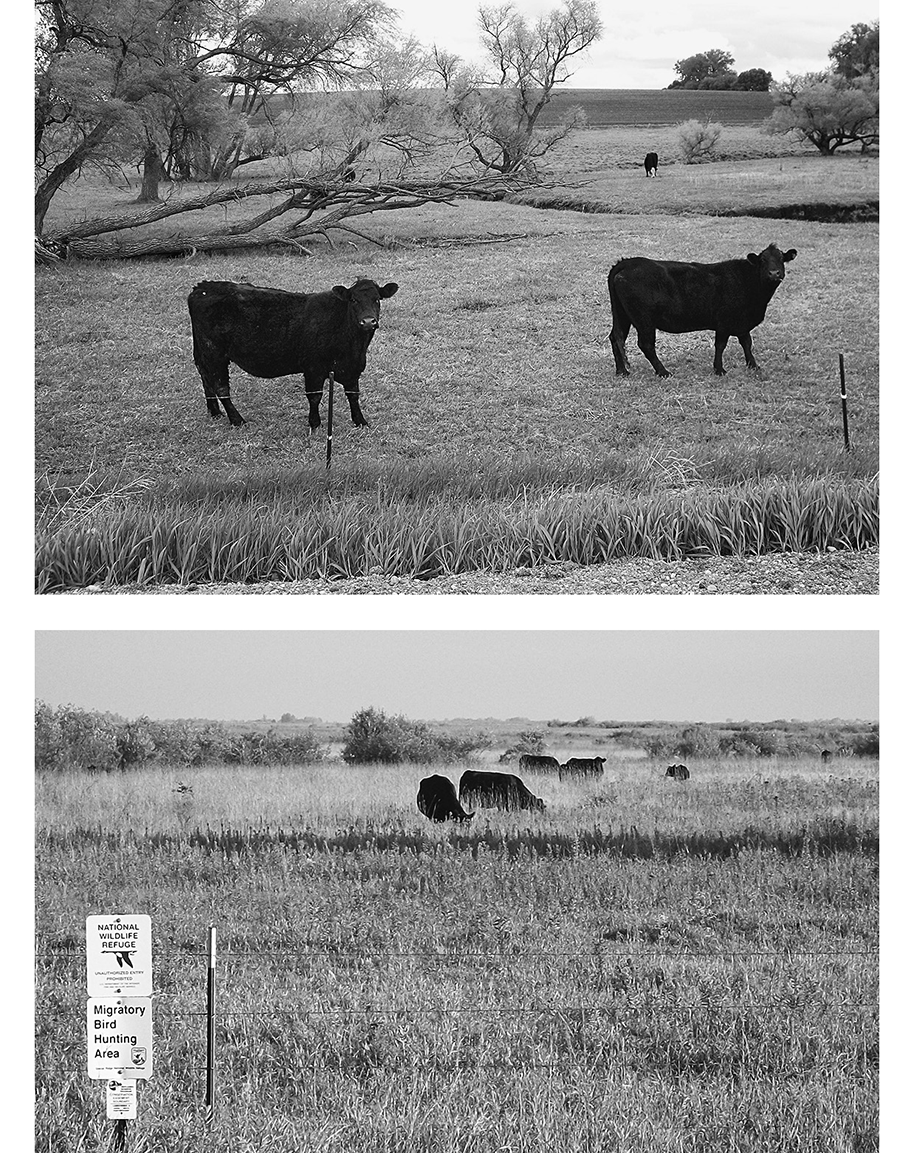
FIGURE 7. Overgrazed pasture (top photo) and grazing intended to benefit wildlife habitat at Glacial Ridge National Wildlife Refuge (bottom photo). Photos courtesy of the author.
One way to think about sustainable grazing is the old range management adage of “take half, leave half.” Take half for this year’s grazing, leave half to improve the forage quality for next year. Or put into a conservation perspective, take half for the livestock, leave half for the wildlife.
Taking half can be done in several ways. The grass could be lightly grazed each year, removing about half of the vegetation. An area could be grazed intensively for the first half the summer and completely rested for the second half of the summer. (This does cause some heartburn, especially among ornithologists, since the most intensive grazing is during the nesting season.) An area could be heavily grazed for an entire summer, but then completely rested for a year or more. Each scenario depends on the management objective for the livestock, the vegetation, and the wildlife at a specific location.
Grazers such as bison and domestic cattle prefer to graze on grasses (Plumb and Dodd 1993; Coppedge et al. 1998). When a disturbance decreases one group of dominant plants (grasses) disproportionately, other plants (forbs) increase. Bison select areas with higher densities of big bluestem and lower densities of forbs (Vinton et al. 1993). Reducing the grass in these areas benefits forbs and increases plant species richness (Collins et al. 1998; Towne et al. 2005). Likewise, forb biomass increases with grazing (Vermeire et al. 2004; Elson and Hartnett 2017).
Some have tried to categorize plants as grazing increasers and grazing decreasers (Weaver 1968). Others take this a step further to imply that grazing increasers are weedier species and grazing decreasers are more valuable or higher quality species. This is where cattle and conservation have collided in the past. Supposedly, cattle degrade prairies by eating the “good” plants and leaving the “bad” plants, or the weeds.
That’s where management comes in. What is the grazing intensity and stocking rate? How often is the area grazed? How frequent and how long are the rest periods? Are the pastures grazed all season long every year or is there a short pulse of intense grazing? If there’s a drought are the cattle pulled off the pasture? A lot of those increaser and decreaser labels were created from pastures that are grazed season-long year after year regardless of the weather.
This gets us back to the Intermediate Disturbance Hypothesis. Too much grazing can be detrimental, but too little grazing could also impact the prairie. The trick for any landowner or manager is to figure out that happy medium between the two that meets the management objective for the site.
Although overgrazing can severely damage a prairie over time, so can grazing deprivation. . . . The challenge is to determine a pattern and intensity of grazing that reduces dominance by a few species without eliminating the more conservative species. (Davison and Kindscher 1999)
When done carefully, grazing can increase populations of even the most desirable and conservative species. Weaver (1968) listed a number of grazing decreaser species. All the species on his list were legumes. I looked at the average number of plots from 2009–18 in two ungrazed (4A and 4B) and two grazed (N4A and N4D) watersheds on Konza Prairie where each of the species Weaver listed occur. All four watersheds had a four-year burn interval. I didn’t do the statistics, but leadplant, ground plum, white prairie clover, purple prairie clover, round-headed bush clover, silver-leafed scurfpea, prairie turnip, and scurfpea were all more common in grazed areas. It’s hard to argue that leadplant, prairie turnip, and ground plum are undesirable prairie plants.
There are a few ways in which grazing and fire have similar effects, such as removing the plant canopy. In this way, grazing can be beneficial to some species that emerge early in the spring and don’t do well with spring fires. Species such as pasqueflower and prairie smoke emerge early and are low growing. Although they both grow primarily on hilltop or thin-soiled prairies, they can have trouble emerging though even the thin thatch layer of these prairies and grazing may be especially beneficial for these species. In my own adventures, I can find a few prairie smoke scattered around ungrazed sites, but grazed sites often have dense blankets of prairie smoke that sometimes cover several acres.
It’s difficult to talk about fire effects, because there can be so many different effects depending on the timing of the fire. The same applies to grazing and grazing effects, as well as the interactions between grazing and fire. One study concluded that relying solely on fire as the “only restoration tool was not effective at achieving a species-diverse prairie community” (Heslinga and Grese 2010). Similarly, a study comparing grazing and fire separately and when used in combination concluded that “to maintain maximum diversity across the landscape, however, both approaches are necessary” (D. L. Larson et al. 2020). Managers can’t simply say that burning has this effect and grazing has that effect. It depends on how each tool is used and how many tools the manager is using.
An issue that grazing cannot address is replacing fire. Too often managers use phrases such as “I can’t burn it, so I’ll graze it instead.” Grazing is an ecological disturbance. Fire is an ecological disturbance. They are not synonymous, nor are they interchangeable. Probably the easiest example of this is with red cedar invasion into grasslands. Fire kills cedars. Grazing will cause cedars to invade even faster.
One question people have when it comes to management is whether bison are better than cattle (Noss 1994; Kohl et al. 2013). First, for those who do want to graze their natural area, park, or wildlife area, there is obviously a strong visual and psychological appeal to using bison. Bison may just feel or seem better because they look more natural than a herd of Angus or Hereford cattle.
There are some anecdotal and observational differences to these two species. Bison move around more than cattle and will not concentrate around water as much as cattle. On hot days, bison often head to the hilltops to catch a breeze, while cattle often crowd into the shade along streams where they can do some damage. The grazing preferences of the two vary a little when it comes to favorite plants to graze and they may graze in different patterns. However, it’s the management of the beast, not the beast itself, which matters the most (Plumb and Dodd 1994; Hartnett et al. 1997; Towne et al. 2005).
Grazing can give managers flexibility in wildlife habitat management. It’s an oversimplification, but with prescribed fire we can have burned or unburned prairie. In some cases, we can burn only parts of larger tracts of prairie. Managers can burn in early spring, late spring, late summer, or fall. But that’s still not a lot of variability.
With grazing, there is far more flexibility. Managers can adjust exactly where to graze by using temporary fencing. They can control the stocking rate, timing, and duration to meet very specific management objectives. They can graze season-long or they could flash-graze an area for a few days. They can also remove the livestock early if something isn’t going right or the objective was met ahead of schedule. With a fire, once the head fire is lit, it’s difficult to bring things to a halt.
Haying is another alternative to grazing. Haying removes nutrients from the area while grazing recycles them back into the soil. Haying is also more homogeneous than grazing. However, haying doesn’t require writing a complex grazing plan, installing fencing, or providing water. Managers can work with local cooperators to be very specific about where and when to cut the hay to meet a specific management objective.
Perhaps most importantly, livestock and grazing can be a new, or newer, model for grassland conservation. Done properly, properly sometimes being hard to define, grazing can increase the diversity and productivity of prairies as well as manage and manipulate habitat for a range of wildlife species. As importantly, grazing integrates conservation lands into local agricultural economies, benefitting both wildlife and the ranching community.
An Acceptable Substitute
A FEW WEEKS AGO, dawn echoed with the booming of prairie-chickens. Today we watch marbled godwits circle overhead while upland sandpipers and western meadowlarks serenade us from the tops of fenceposts. I think of Aldo Leopold. “Whoever invented the word ‘grace’ must have seen the wing-folding of the plover.” We see more meadowlarks here than anywhere else.
After a couple of hours surveying plants, my four-legged field assistant and I sit on the tail gate; he snoozes in the mid-morning sun while I snack on an apple. We think about the steak thawing on the kitchen counter, dinner for me and the last couple bites are treats for him.
This is one of my favorite prairies. There are a couple of birds and plants we find only on this prairie. Other plants that are rare or scattered at other sites are abundant here.
As the morning warms, we continue our surveys, my partner close at heel due to the nesting season. There’s a new sound now. Under the birdsong, beneath the ever-present prairie wind, there is a buzzing and droning of hundreds of bees. Once I’m aware of it, the hum becomes louder and louder. Looking down, there seems to be a bee on every other flower. If my entomologist friends were here, they might identify as many as a score of different native bee species and who knows how many butterflies.
To our south there are stacks of commercial beehives literally humming with activity. To our northeast a herd of cattle stand knee deep in lush grass and a kaleidoscope of wildflowers. As conservationists, our first instincts are often to think about the birds. Where will the prairie-chickens boom on their spring leks? Where will the sharp-tails raise their broods each summer? That’s too narrow of a focus.
Grazing is a working lands approach to habitat conservation. Ruffed grouse and woodcock hunters in the east know the value of careful timber harvests for those birds and their habitat. The same basic principle applies for grassland birds and well-managed grazing.
Beekeepers are another group that work the land. Many honeybees start the year in California’s almond groves. From there they may go to the Pacific Northwest to pollinate apple orchards, to New England’s cranberry bogs, to the mid-Atlantic states for melons, or Florida for citrus groves.
After the crops are pollinated, many beekeepers return their bees to the plains and prairies for the summer and fall. Prairie wildflowers provide an abundance and diversity of pollen and nectar for the bees. A diverse diet is just as important for bees as a well-balanced diet is for us.
Scientists and writers are always looking for connections, interactions, relationships of one species to another. This morning’s apple, tonight’s steak, prairie-chicken, godwit, sandpiper, meadowlark, cattle, monarch, honeybee, and thousands of insect species all have one connection: prairie.
Prairie conservationists have natural partners in ranchers and beekeepers. Together, we can be a stronger voice for grassland conservation. Just as importantly, the conservation community can and should listen to them. While most conservationists visit prairies only on the weekend or a few times a year, these people are out every day in all weathers. They know a lot and conservationists have a lot to learn from them.
And it’s a two-way street. I was talking to a rancher several years ago who rotated his cattle onto public land for the summer. He saw such a good response in both his pasture and his cattle that he decided to shift the way he manages his own pastures quite dramatically. He learned a lot about his herd when he worked with conservationists to enhance bird habitat.
Aldo Leopold stated that the upland plover, now sandpiper, find cattle an “acceptable substitute” for the bison.
The prairie-chickens, meadowlarks, pollinators, and diversity of plants demonstrate that livestock can benefit the habitat and the wildlife. I would like to think that this diversity and productivity are because of, not in spite of, the cattle and the thoughtful rancher who cares for cattle, land, and wildlife.