
 Backcountry Rank Ways: A System of Stratification Without Orders
As these patterns of wealth and inheritance suggest, social stratification in the backcountry was a system of high complexity. Extreme inequalities of material condition were joined to an intense concern for equality of esteem.
Visitors of exalted rank complained that they were not treated with the same respect as in other parts of British America. The Anglican missionary Charles Woodmason filled his journal with angry accounts of “ill treatment” by “insolent” and “impudent” settlers who stubbornly refused to display the deference which he thought his due. He complained that these people were “the most audacious of any set of mortals I ever met with.”1 William Byrd, on his various backcountry rambles, also complained of undue “familiarity,” and a lack of deference to age, wealth, birth and breeding. Militiamen in the backcountry commonly refused to obey orders from their officers, unless persuaded to do so. Colonel David Stokes of backcountry Lunenburg, Virginia, characterized the militia of his county as marked by “unruly licentiousness.”2
These complaints rose from fundamental differences in social manners and expectations. In the backcountry, rich and poor men dealt with one another more or less as social equals. They wore similar clothing, and addressed each other by first names. They worked, ate, laughed, played, and fought together on a footing of equality. Many backcountry proverbs captured the equality of manners that coexisted with inequalities of material condition in this culture:
The rain don’t know broadcloth from jeans.
No man can help his birth.
Poor folks have poor ways, and rich folk damned mean ones.
Any fool can make money.
Don’t care keeps a big house.
As Black as the Earl of Hell.
A falling master makes a standing man.
He who is at the bottom can fall no lower.
All Stuarts are not kinsmen of the king.3
These attitudes were not invented on the frontier. They had long been characteristic of the borderers. Travelers in this region frequently described the manners of the natives in terms such as “insolence,” “impudence,” “forwardness,” “familiarity,” “unruliness,” “licentiousness” and “pride.” The authorities complained for example that the famous border reiver Sandie Scott was worse than a thief—he was a “proud thief who not only stole from his superiors, but believed himself to be their equal. Here was another border pattern that came to the American backcountry.4
Despite this equality of manners, a clear-cut system of social status existed in both the borderlands and the backcountry, which differed from ranking customs in other parts of British America. At the top of this system was the “ascendancy” whom we have already noticed. These families cherished the memory of immigrant-ancestors who had been highly placed in North British society—not at the very top, but high enough to have a coat-of-arms on the silverware, or to send a younger son to the university, or to marry a daughter to a good family, or at least to dress and act like a gentleman. In the American backcountry this elite rapidly acquired a firm hold on wealth and power throughout the region. They owned a large part of the best lands and held most of the top military and political offices. Their manners tended to be very rough, and were not much refined by their new environment. But they knew who they were, and instantly recognized one another, and cemented their status by ties of marriage and friendship. Andrew Jackson’s violent courtship of Rachel Donelson, for example, was not a spontaneous event, but a calculated act of high consequence. Jackson thought of himself as a gentleman, and took a wife who was appropriate to his rank. She was described as “the daughter of a man of considerable prestige, one of the richest and most distinguished of the western Virginians, but she went into the forest when a young girl, and the result was that she was barely literate, and she smoked a pipe on occasion.”5
This backcountry elite was not distinguished by learning, breeding, intellect or refinement. In consequence, its eminence was always directly contingent upon its wealth and power. In the southern highlands (and indeed on the southern rim to this day) one rarely finds the tattered respectability of old families in Massachusetts, or the threadbare gentility of tidewater Virginia. A backcountry family that lost its property fell instantly to a lower level of society, and disappeared from the ascendancy without a trace. The result was a highly materialistic system of social rank. Wealth alone became more important as a determinant of status than in New England, Pennsylvania or Virginia.
Below the ascendancy was a middle class which has sometimes been called the “yeomanry” of the southern highlands. Most were small farmers who owned their own land. A native of the region writes:
Differences in the status of families at either end of the group are striking, but often such disparity as exists is not noticeable save in the size of the houses and the land holdings. One may remark a less bountiful table. … He may note, too, if he is observing, less stock and scantier farm equipment; but the life of this class is homogeneous, and the absence of some things noted in the homes of the more well-to-do is not of necessity an indication of greater poverty. It may be merely a sign of greater simplicity in the taste of a family.6
Below this comparatively small backcountry middle class was a large rural proletariat, who owned no land and few personal possessions. Most were either tenants or squatters. Their property ran on four legs—consisting mostly of cattle and swine which they raised in the woods. Their pride was heavily invested in these animals. The Hatfield-McCoy feud, in which more than twenty people were killed, started as an argument over two hogs.
In the eighteenth century, this backcountry underclass was called by many names which have become a permanent part of the American language. By and large these words connoted a stubborn combination of poverty and pride which had existed on the borders of north Britain. The words themselves, though now thought of as Americanisms, were also carried from the borderlands. One such term was hoosier. Everitt Dick writes that
before it was used to designate the citizens of Indiana, the term “Hoosier” was used in the South to describe a rough or uncouth
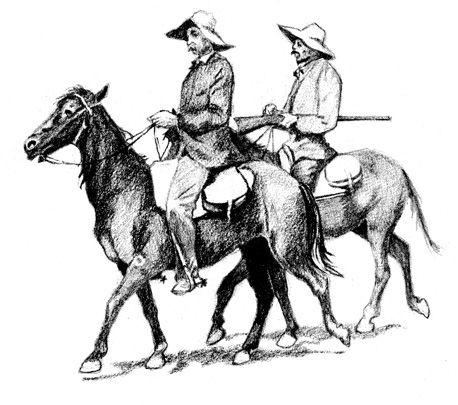
Crackers, Rednecks, Hoosiers—words that described the largest social class in the American backcountry—were not coined in the New World. They were carried out of North Britain. For three centuries these terms were variously used as praise words and pejoratives, according to context and occasion. But always they described the same paradox of poverty and pride. Something of that spirit was captured by the American painter Frederic Remington in a sketch from which this drawing is taken.
person. … the name “hoosier” was often applied to these backwoodsmen even as far south as northern Louisiana and southern Arkansas. Everywhere the general characteristics of this tribe were the same, east to Georgia and from Mississippi and Alabama north to Illinois and Indiana.7
The word hoosier comes from hoozer or hoozier in the old Cumberland dialect, which meant something or someone who was unusually large and rough—in W. J. Cash’s phrase, “a hell of a fellow.” After coming to America in the eighteenth century, the noun migrated north to Indiana with so much of backcountry culture, and was attached to the citizens of that state to distinguish them from their Yankee neighbors.8
Another term for this rural proletariat was redneck, which was originally applied to the backsettlers because of their religion. The earliest American example known to this historian was recorded in North Carolina by Anne Royall in 1830, who noted that “red-neck” was “a name bestowed upon the Presbyterians.” It had long been a slang word for religious dissenters in the north of England.9
A third word for this rural proletariat which also came from Britain was cracker, which derived from an English pejorative for a low and vulgar braggart. In 1766, an informant wrote the Earl of Dartmouth about the American backcountry,
I should explain to your Lordship what is meant by Crackers; a name they have got from being great boasters; they are a lawless set of rascals on the frontiers of Virginia, Maryland, the Carolinas and Georgia, who often change their abode.10
This distinctive backcountry underclass was in being by the mid-eighteenth century. Its call names had originated in North Britain. So also had its character and culture, which still survive today.