
 The Backcountry Comity: Patterns of Migration, Settlement, and Association
The borderers were a restless people who carried their migratory ways from Britain to America. There had been many folk movements in their history before the Atlantic crossing, and many more were yet to come. The history of these people was a long series of removals—from England to Scotland, from Scotland to Ireland, from Ireland to Pennsylvania, from Pennsylvania to Carolina, from Carolina to the Mississippi Valley, from the Mississippi to Texas, from Texas to California, and from California to the rainbow’s end.
Rates of geographic migration were very high in this culture. In Britain, some of the highest rates of rural migration were to be found on the northern borders. The Scottish village of Fintray, for example, had a turnover of 75 percent in five years (1696-1701)—a rate much above the parishes of southern England.1 Similar patterns also appeared in the American backcountry, where rates of internal migration were also higher than in the rural communities of New England, the Delaware and tidewater Virginia. In backcountry Lunenburg County, Virginia, for example, one historian found what he called “phenomenal movement” of the population. From 1750 to 1769, 80 percent of the population disappeared from the county; 40 percent did so in five years from 1764 to 1769. These rates of movement were exceptional by eighteenth-century standards.2
The backsettlers thought about moving in a way that was different from more sedentary people. There was a folk-saying in the southern highlands: “When I get ready to move, I just shut the door, call the dogs and start.” This was the footloose way in which Andrew Jackson was said to have come into the backcountry, with nothing but two riding horses, a gun at his side, and a pack of hunting dogs at his heel.3
Most geographic migration in both the British borderlands and the American backcountry consisted of short-distance movements that covered only a few miles, as families searched for slightly better living conditions. Frequent removals were encouraged by low levels of property-owning and by characteristic attitudes toward wealth and land and work in this culture.
During the first few years of settlement, backcountry folk settled close to one another for mutual protection. The result was the planting of “stations” in Tennessee, and “forts” in Kentucky. But as the backcountry gradually became more secure, another pattern appeared—one that was very different from the comities of Massachusetts, Virginia and Pennsylvania.
The backcountry ideal was a scattered settlement pattern in isolated farmsteads, loosely grouped in sprawling “neighborhoods” that covered many miles. The German traveler Schoepf in 1784 observed that in North Carolina the farms were “scattered about in these woods at various distances, three to six miles, and often as much as ten or fifteen or twenty miles apart.”4 North Carolina Congressman Nathaniel Macon startled his Yankee colleagues by arguing that “no man ought to live so near another as to hear his neighbor’s dog bark.”5 That attitude was widely shared in the backcountry. In this culture, a house became a hermitage, beyond sight and sound of every human habitation. Once again, Andrew Jackson personified his culture. Jackson’s home in Tennessee was actually called the Hermitage. When he was away from it he wrote home to his wife expressing his longing for “sweet retirement,” apart from other people.6
There were, of course, physical limits to the realization of this idea. But the idea itself became an important reality in the culture of the backcountry. It persisted for many generations in the isolated homes that were built in the hollows of the Appalachians, the canebreaks of Kentucky, the flatlands of Texas and the ravines of southern California.
Samual Kercheval described the common settlement pattern. “The greater number of farms in the western parts of Pennsylvania and Virginia,” he wrote, “bear a striking resemblence to an amphitheater. The buildings occupy a low situation, and the tops of the surrounding hills are the boundaries of the tract to which the family mansion belongs. Our forefathers were fond of farms of this description, because, as they said, they are attended with this convenience, “that everything comes to the house down hill.”7
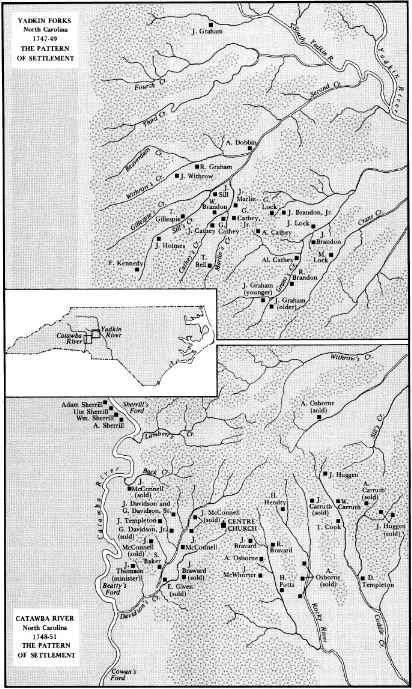
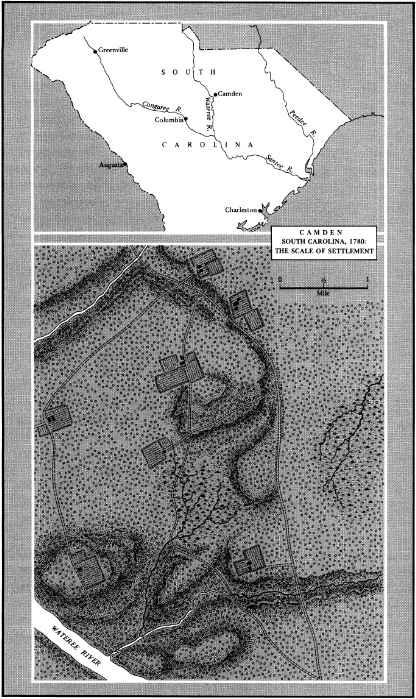
This pattern of settlement had often occurred on the borders of North Britain, where even today one finds isolated farmsteads nestled in valleys, with barren hillsides rising high above them on every side. One geographer observes that “The Scotch-Irish brought the Celtic dispersed farm with cattle-grazing and kitchen garden common in Ireland and Scotland. Members of each group moved in single family units onto the uplands. The Scotch-Irish often squatted on land in forested coves and mountainsides.”8
Unlike the road-bound settlements of New England or the fluvial patterns of Virginia, the backsettlers built their houses near creeks or springs. Emma Miles wrote:
The site of a cabin is usually chosen as near as possible to a fine spring. No other advantages will ever make up for the lack of good water. There is a strong prejudice against pumps … cisterns are considered “dead water,” hardly fit to wash one’s face in. The mountaineer takes the same pride in his water supply as the rich man in his wine cellar, and is in this respect a connoisseur. None but the purest and coldest of freestone will satisfy him.9
This also had been a border habit, where a safe supply of water could be a matter of life or death.
This pattern of settlement engendered a distinctive style of association. Family, friends and neighbors visited one another over long distances, staying in each other’s houses, sleeping in the same beds, eating from the same dish. Few homes were so humble as not to have some accommodation for visitors, even if only a mattress, a stool and a spoon.
There was always a welcome for kin and friends, but an intense suspicion of strangers. This cultural attitude had deep roots in the borderlands of North Britain; one Cumbrian observed that anyone from a neighboring district was looked upon as a “‘foreigner.’”10Precisely the same outlook long existed in the back-country, where there were many bizarre proverbs on the subject:
Put the stranger near the danger.
Let the blame of every ill be on the stranger.
The bad and no good on the back of a stranger.
The stranger is for the wolf.11
The backsettlers had little tolerance for those who broke their own rules. They dealt harshly with social deviance by a ritual which they called “hating out.” Kercheval explained “the punishment for idleness, lying, dishonesty and ill-fame generally was that of ‘hating the offender out,’ as they expressed it … a general sentiment of indignation against such as transgressed the moral maxims of the community.” Hating out could take many forms. Sometimes it was the “silent treatment,” or a form of ritual abuse called “tongue-lashing,” or petty harassment, or whipping, or banishment outright.12
These punishments derived their force from the importance of reputation in this culture. The backsettlers were as sensitive to questions of honor as the gentlemen of Virginia—but not in precisely the same way. In the backcountry, honor had very little to do with gentility. An Alabama planter summarized the prevailing attitude in a simple verse:
Honor and shame from all conditions rise;
Act well your part and their [sic] the honor lies13
Backcountry ideas of honor were understood more in terms of valor and virility. To behave dishonorably was to commit an “unmanly act.” Folk punishments in the backcountry were designed to inflict humiliation by depriving an offender of his manhood—sometimes in a direct and literal sense. One common penalty was called “riding the stang.” James Parton explained:
A kind of punishment was formerly inflicted occasionally, called Riding the Stang, meaning riding upon a sting, that is, receiving chastisement for some offense of which the common law did not take any cognizance. On these occasions, some low fellow, who represented the delinquent, was mounted on a long pole carried on men’s shoulders, and in this way he was taken about the streets, the bearers occasionally halting, and making loud proclamation of the person’s real or alleged offense, the crowd huzzaing. They afterwards repaired to the residence of the offender, where a grand proclamation was made of his crime, or misdemeanor; after which the common dispersed, giving three hearty cheers.14
Altogether, reputation in the back settlements was very much a matter of what historian Bertram Wyatt-Brown calls “primal honor.”15
In all of its many aspects, this backcountry comity has sometimes been interpreted by historians as a product of “the frontier.” But it did not develop on other frontiers, and was remarkably similar to patterns of settlement, migration, association, and belonging on the borderlands of north Britain. Here again, the pattern of cultural persistence was very strong.