
 Exodus: The Four Great Migrations, 1629-1750
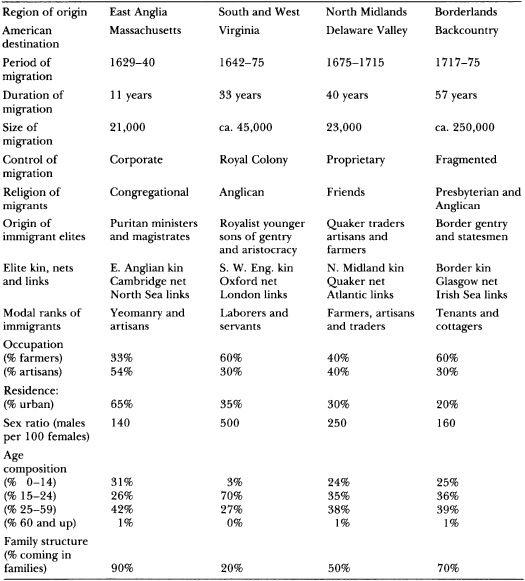
After 1629 the major folk movements began to occur, in the series of waves that are the subject of this book. As we have seen, the first wave (1629-40) was an exodus of English Puritans who came mainly from the eastern counties and planted in Massachusetts a very special culture with unique patterns of speech and architecture, distinctive ideas about marriage and the family, nucleated settlements, congregational churches, town meetings, and a tradition of ordered liberty.
The second wave brought to Virginia a different set of English folkways, mainly from a broad belt of territory that extended from Kent and Devon north to Northamptonshire and Warwickshire. This culture was characterized by scattered settlements, extreme hierarchies of rank, strong oligarchies, Anglican churches, a highly developed sense of honor and an idea of hegemonic liberty.
The third wave (ca. 1675-1715) was the Friends’ migration, which carried yet another culture from the England’s North Midlands to the Delaware Valley. It was founded on a Christian idea of spiritual equality, a work ethic of unusual intensity, a suspicion of social hierarchy, and an austerity which Max Weber called “worldly asceticism.” It also preserved many elements of North Midland speech, architecture, dress and food ways. Most important, it deliberately created a pluralistic system of reciprocal liberty in the Delaware Valley.
The fourth great migration (1717-75) came to the backcountry from the borderlands of North Britain—an area which included the Scottish lowlands, the north of Ireland and England’s six northern counties. These emigrants were of different ethnic stocks, but shared a common border culture which was unique in its speech, architecture, family ways and child-rearing customs. Its material culture was marked by extreme inequalities of condition, and its public life was dominated by a distinctive ideal of natural liberty.
Each of these four folk cultures in early America had a distinctive character which was closer to its popular reputation than to many academic “reinterpretations” in the twentieth century. The people in Puritan Massachusetts were in fact highly puritanical. They were not traditional peasants, modern capitalists, village communists, modern individualists, Renaissance humanists, Victorian moralists, neo-Freudian narcissists or prototypical professors of English literature. They were a people of their time and place who had an exceptionally strong sense of themselves, and a soaring spiritual purpose which has been lost beneath many layers of revisionist scholarship.
The first gentlemen of Virginia were truly cavaliers. They were not the pasteboard protagonists of Victorian fiction, or the celluloid heroes of Gone with the Wind. But neither were they self-made bourgeois capitalists, modern agro-businessmen, upwardly mobile yeomen or “plain folk.” Most were younger sons of proud armigerous families with strong Royalist politics, a devout Anglican faith, decided rural prejudices, entrenched manorial ideals, exalted notions of their own honor and at least the rudiments of an Aristotelian education. The majority of Virginia’s white population were indentured servants, landless tenants and poor whites—a degraded rural proletariat who had no hope of rising to the top of their society. Not a single ex-servant or son of a servant became a member of Virginia’s House of Burgesses during the late seventeenth century. The mythical, figures of Virginia cavaliers and poor whites were solidly founded in historical fact.
The culture of the Delaware Valley was dominated by British Quakers and German Pietists whose Christian beliefs had a special moral character. Here again, their culture has been distorted
Four English Folk Migrations: Modal Characteristics
by historical revisionists who have variously “reinterpreted” them as utopian cranks, manipulative materialists, secular pluralists and the “first modern Americans.” The modernity of the Delaware Valley has been much exaggerated, and the primitive Christian roots of William Penn’s “holy experiment” have too often been forgotten.
The backsettlers also possessed a strong and vibrant culture which also has been much misunderstood. They were not ancient Celts, or wild Scotch-Irish savages, or innocent children of nature. Neither were they rootless pluralists, incipient entrepreneurs, agents of the Edinburgh enlightenment or heralds of the New South. The majority, no matter whether northern Irish, lowland Scots or North Country English, shared a culture of high integrity which had been tempered in fire of the British borderlands. The more we learn by empirical research about these four cultures of British America, the more distinctive they appear from one another, and the closer to historical “myths” which they inspired.