
 British Origins: The Regional Factor
The origins of these cultures were highly complex, involving differences of British region, religion, rank, and generation, as well as of the American environment, and the process of migration. Let us briefly examine each of these determinants, beginning with British regions—not because this factor was more important than any other, but because it has been less clearly understood.
The idea of a region creates few practical problems for American historians, who tend normally to think in regional terms without reflecting very much about them. In English historiography, however, region remains an alien concept. The history of England is highly developed on national and local levels, but a third level is missing in between. So little has been written about the history of English regions that in a formal sense there is no regional historiography at all—that is, no established set of regionalproblematiques.5
Regional history has long flourished in France, Germany, Italy, Spain and even in smaller countries such as Belgium, Switzerland, Sweden and the Netherlands. England is unique in the exceptional riches of its national and local historiography and the poverty of its regional research.6
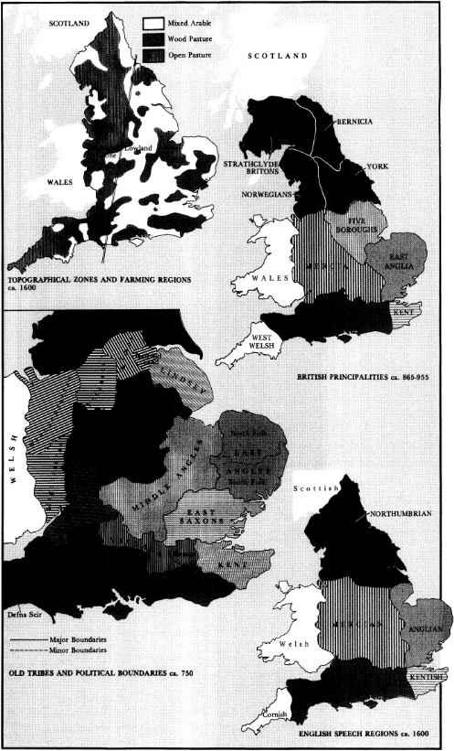
This has been so not because England is more uniform than other nations, but because its internal differences are more complex. To travel across the English countryside is to be continuously surprised by the complexity of its cultural terrain. One meets many different ideas of spatial discrimination which have the collective effect of blurring regional perceptions. The leading regional ideas might be summarized in a few sentences:
Zones are topographical units popularized by Cyril Fox, who divided England into a “highland zone” (the north and west) and a “lowland zone” (the south and east), each supporting different cultures.7
Pays in English usage are soil regions and agricultural regimes. Leading examples are David Underdown’s elegant essay on “the chalk and the cheese,” and Joan Thirsk’s meticulous studies of wood pasture and open pasture, “fielden, forest, fell and fen.”8
Principates refer to ancient sovereignties, which tend to be strong sources of regional identity throughout Europe. They are weaker in England where national unity came early, but the ancient kingdoms of East Anglia, Wessex, Mercia and Northumbria still survive as regional conceptions.
Counties are more than administrative units; many of England’s collective memories are organized by counties. Its archives are lodged in county offices, its military traditions are kept by county regiments, its gentry were defined by county visitations, and its scholarship is written in county histories. County consciousness was even stronger in the past; one historian asserts that “when an Englishman of the early seventeenth century said, ‘my country’ he meant ‘my county.’”9 Most regional taxonomies in English scholarship today are county-clusters.10
Provinces refer collectively to all of England except London, in a great disjunction between the metropolis and the rest of the nation. This idea is very strong in English scholarship today, but it is not very old—perhaps not older than the eighteenth century.11Nevertheless, many historians apply it to earlier periods.12
Hinterlands include both individual towns and the areas around them. This spatial unit is especially popular among English geographers, and has been highly developed in general studies of migration and trade.13
Other quasi-regional ideas include river systems which are ecological units of increasing conceptual prominence in England today; one thinks of the Thames Valley, the Severn Valley, Merseyside, Humberside and Tyneside. Also much in use is the idea of ecological districts, defined by their terrain, climate, flora and fauna—such as the Lake District, the Peak District, the Cotswolds, the Chilterns, the Yorkshire Dales, the Norfolk Broads, the Weald of Kent and Sussex, and various Moorlands and Downlands.
What, after all, is a region? For many scholars it is a physical entity formed by terrain, soil, climate, resources and systems of production. But these material models of English regions do not fit the facts of this inquiry. They do not coincide with patterns of emigration. Another approach to the problem works better. A region may also be thought of as a cultural phenomenon, created by a common customs and experiences. It might be defined primarily in historical terms, as a place in time whose people share a common heritage that sets them apart from others of their nation. A major conclusion of this work is that regions, so understood, have been more important in the history of Britain than they are in its historiography. But they have not always been the same regions, nor have they always been important in the same way. Regional boundaries have changed with historical conditions.14
This inquiry was not about English regions in general, but historical regions that existed at a particular point in time, during the seventeenth and the early eighteenth century. They appear most clearly not in evidence collected after the industrial revolution, but in maps of cultural processes and political events through the preceding seven hundred years—in the jurisdiction of the Dane Law and the ancient boundaries of British kingdoms before King Edred; in the English earldoms of 1066 and the areas of support and opposition to King John in 1215; in the Peasants’ Rebellion of 1381 and Jack Cade’s Revolt in 1450; in the distribution of Marian martyrs in the sixteenth century and the incidence of Elizabethean Puritanism; in the areas that rallied to Parliament and to the Crown in the seventeenth century; and not least in patterns of emigration to the American colonies.
All of this evidence shows strong and consistent regional patterns that do not conform to the boundaries of topographical zones, soil types, field systems, farming regimes, hinterlands, river systems or ecological districts. The regions of seventeenth-century England were defined primarily by broad ethnic, cultural and historical processes.15
Four historical regions in seventeenth-century Britain were specially important to this inquiry. The first of them lay in the east of England, and included the three peninsulae of East Anglia itself, eastern Lincolnshire and the northeastern fringe of Kent. The boundary of this territory ran through the old counties of Rutland, Huntingdon and Hertford. In the seventeenth century, this area was commonly called the “East” or “eastern England.” With the addition of Kent it corresponded roughly to the area of the “Eastern Association” which supported Parliament in the
English Civil War. This region produced approximately 60 percent of emigrants to Massachusetts.16
A second historical region, which sent many sons to Virginia, was a broad belt of territory through the south of England, extending from Kent to Devon, and north as far as Warwick. It encompassed the ancient kingdom of Wessex and its Mercian protectorates—the realm of Alfred and Aethelred. This area had the least articulated sense of regional identity because it believed itself to be the heartland of the country—in Henry James’s phrase, “midmost England, unmitigated England.” Nevertheless, it had a cultural existence which was defined by its history, in ways that made it distinct from East Anglia, the North Country and the Celtic cultures of Wales and Cornwall to the west. Roughly 60 percent of Virginia gentlemen and servants came from this region.17
A third historical region lay in the North Midlands of England. It included a broad belt of territory from Cheshire and Derbyshire north through Lancashire and the West Riding of Yorkshire to southern Cumbria. This area was called “the North Country” in the seventeenth century. Thus a Quaker named John Crock wrote, “I was born in the North Country.” Another wrote that “he heard of a people in the North of England, who preferred the light. …” And a third described Quakerism as “glad tidings brought out of the north.” This area was the source of approximately 60 percent of the Quaker population which settled in the Delaware Valley.18
The fourth historical region was an area which included the English counties of Westmorland, Cumberland, Northumberland, Durham, and the North Riding of Yorkshire, together with the southern counties of Scotland. As early as the fifteenth century this region was called the “border,” or “borders,” and its inhabitants called themselves “borderers.”19 These people of Scotland and northern England, together with their transplanted cousins in Ulster, were very mixed in their ethnicity, but they shared a common culture which was shaped by the history of their region. More than 60 percent of settlers in the American backcountry were immigrants or the children of immigrants from northern Ireland, the lowlands of Scotland, and the six northern counties of England.
The origin of regional differences between East Anglia, southwestern England, the North Country and the borderlands is a problem that carries far beyond the subject of this book. A search for their beginning leads back a thousand years before American history to ethnic movements as early as the seventh century—and even that date is not early enough to mark the beginning of differences between these cultural regions in the east and south and north of England, which had important consequences for American history.