
 British Origins: The Factor of Social Rank
Another determinant of cultural differences in British America was the social rank of the colonists. This factor worked in two ways. First, the founders of America’s various regional cultures came from different strata of British society. Second, major changes occurred in England’s ranking system during the era of colonization. Emigrants in the early seventeenth century had one way of thinking about social status; those who arrived in the mid-eighteenth century had another. This process of change added another dimension to regional differences in America.
To understand this problem we must study the ranking systems of earlier periods in their own terms. Between 1577 and 1600, this subject was discussed by three English writers: Thomas Smith (1583), William Harrison (1587), and Thomas Wilson (1600).20None of these authors thought in terms of modern social classes, or even used the word “class.” Sir Thomas Wilson wrote of “estates”; Harrison, of “conditions” and “degrees”; Smith, of “orders.” These categories were defined not by material possessions or by the means of production, but by access to power. In Smith’s phrase they were “orders of authority … annexed to the blood and progeny.”21
The three authors agreed in their description of the upper orders. At the top of every list came the King himself, who was quaintly called the “first gentleman” or “chief gentleman” of England. Then came the princes and the “nobilitas major,” an order so small in England that Harrison could list every member on a single page: he counted one marquis, twenty earls, two viscounts and forty-one barons, plus twenty-four bishops who were the “lords spiritual” of England. Smith’s list in 1600 was even smaller—sixty-one noblemen altogether. This was England’s high aristocracy; it contributed much to the capitalization of British America but little to its population.22
Next came the nobilitas minor, who were identified as knights, esquires, and gentlemen. Wilson reckoned that there were about 500 knights and 16,000 esquires whom he defined as “gentlemen whose ancestors are or were knights, or else they are the heirs and eldest of their houses and of some competent quantity of revenue.” This order or estate also included a residue of undifferentiated gentlemen who were defined in different ways. Smith identified them as “those whom their blood and race doth make noble and known,” or “whose ancestor hath been notable in riches or for his virtues, or (in fewer words) old riches.”23 Wilson, on the other hand, defined them in an interesting way as “younger brothers,” and added:
their state is of all stations for gentlemen the most miserable, for … my elder brother forsooth must be my master. … This I must confess doth us good someways, for it makes us industrious to apply ourselves to letters or to arms, whereby many times we become my master elder-brothers’ masters, at least their betters in honour and reputation, while he lives at home like a mome [a fool].24
This group, particularly the younger sons, played an important role in the creation of a Virginia elite.
Beneath the rank of gentlemen were clergy, lawyers and learned professions. There was general agreement that professional men were “made good cheape in England,” and had become too numerous for the good of the realm. Below the professions, all writers recognized an estate of “citizens” who had been admitted to the liberties of England’s towns and boroughs—“a commonwealth among themselves,” Wilson wrote.25
Next came the yeomanry. Wilson divided this rank into “great yeomanry” (10,000 strong), whom he thought much “decayed,” but often with estates larger than “some covetous mongrel gentleman.” Below them came “yeomen of meaner ability which are called freeholders,” whom he reckoned to have been 80,000 strong, after having studied the sheriff’s’ books in which they were listed.26 Smith noted that the rank of yeoman, though mainly defined by possession of a freehold, also implied a certain age. “Commonly, he wrote, “we do not call any a yeoman till he be married, and have children, and as it were have some authority among his neighbours …”27 Harrison wrote that “this sort of people have a certain pre-eminence … live wealthily, keep good houses and travail [work] to get riches.” This rank, with lawyers, clergy and citizens, was important in the formation of New England’s elite.28
Below the rank of yeoman, all of these lists became very thin as they reached the “lower orders” who included the great majority of England’s population. Wilson’s taxonomy ended in a single broad category which embraced “copyholders who hold some land and tenements of some other lord,” and “cottagers,” who “live chiefly upon country labour, working by the day for meat and drink and some small wages.” He noted that “the number of this latter sort is uncertain because there is no books or records kept of them.” Smith also had a catch-all category at the bottom for “day laborers, poor husbandmen, merchants or retailers which have no free land, copyholders, all artificers.” To a modern mind this lower order seems a very mixed group, but all shared a quality in common. Smith called them “men which do not rule.” Harrison explained, “These have no voice or authority in our common wealth, and no account is made of them but only to be ruled.”29
This was England’s system of social rank at the beginning of the seventeenth century—a complex set of orders, degrees, estates or conditions which were more rigid than modern classes. It was a way of thinking that persisted through the period of the English Civil War. The poll tax of 1660, for example, recognized the same taxonomy.
By the late seventeenth century, however, new ideas of social rank were stirring in England. A case in point was a famous analysis of English society by Gregory King. At first sight, his list of “ranks, degrees, orders and qualifications” seemed similar to those of Harrison, Smith and Wilson nearly 100 years earlier. But on closer examination, important differences appeared. King’s social orders were less distinct than those a century earlier. Between the nobilitas major and nobilitas minor, the rank of baronet had been introduced as a fund-raising device by cash-poor Stuart kings. The professions had grown more numerous and
Three Taxonomies of Social Rank in England, 1577-1600
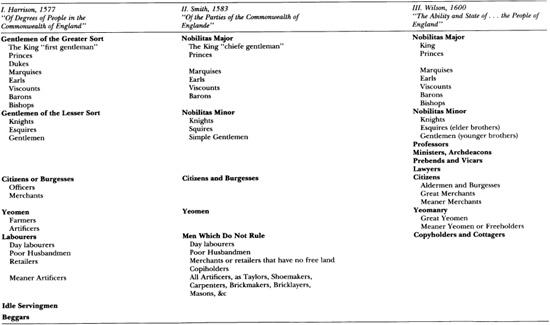
more complex, and two new ranks were added for “persons in office.” Merchants had advanced from the bottom to near the top—above even the clergy. The lower ranks had become elaborately subdivided by occupation.30
In the early eighteenth century, this new way of thinking about stratification began to develop rapidly. Rank was defined increasingly not by origins, but by possessions. One finds this new ranking system in the writings of Daniel Defoe, who used the word “class” in its modern sense as early as the year 1705.31 In 1709, Defoe described English society as follows:
1. The great, who live profusely.
2. The rich, who live very plentifully.
3. The middle sort, who live well.
4. The working trades, who labour hard, but feel no want.
5. The country people, farmers, &c, who fare indifferently.
6. The poor, that fare hard.
7. The miserable, that really pinch and suffer want.32
Here was a modern class model in which people were assigned a place according to their material possessions. Thereafter, this idea developed steadily through the eighteenth century. Raymond Williams writes that the “development of class in its modern social sense, with relatively fixed names for particular classes (lower class, middle class, upper class, working class) belongs essentially to the period between 1770 and 1840.”33
This transformation had important consequences for American history. The four waves of British emigrants came not only from different ranks, but also from different periods in the history of ranking systems. The older system of orders came to Massachusetts where it survived in a truncated form, and also to Virginia where it was extended by the development of servitude and slavery. But the founders of the Quaker colonies and especially the back settlements came from a later era in which orders and estates were yielding to social classes. This fact made a difference in the development of regional cultures throughout British America.