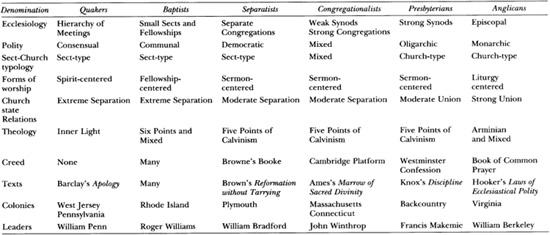
British Origins: The Religious Factor
Of all the determinants which shaped the cultural character of British America, the most powerful was religion. During the seventeenth century, the English-speaking people were deeply divided by the great questions of the Protestant Reformation. These divisions in turn created a broad spectrum of English denominations in the New World.
The “right wing” of the British Reformation was the party of Anglican Episcopacy which favored an inclusive national church, a hierarchy of priests, compulsory church taxes and a union of church and crown. Its worship centered on liturgy and ritual, its theology became increasingly Arminian in the seventeenth century, and its creed was defined by the Book of Common Prayer. This denomination was specially strong in the south and west of England. It was destined to dominate Virginia for more than a century.
Next to the Episcopalians on Britain’s spectrum of religious belief were Presbyterians. They also favored a broad national church, but one which was ruled by strong synods of ministers and elders rather than by bishops and priests. The theology of Presbyterianism was Calvinist; its worship centered on preaching and conversion. The Presbyterians were numerous in North Britain, where they made much use of evangelical field meetings and prayer meetings. They became very strong in the American backcountry.
Near the center were Congregationalists, who defined their position as the “middle way.” Their church government was a mixed confederacy of independent congregations and weak synods. Their theology took a middle ground between Arminianism (which tended toward rationalism and free will) and Antinomianism (the dominion of the spirit). Their formal beliefs were defined by the Synod of Dort (1618-19) in the five points of Calvinism (total depravity, limited atonement, unconditional election, irresistible grace and the final perseverance of the saints)—a Christian creed of extreme austerity. This group was strong in the eastern counties of England. It founded the colonies of Massachusetts and Connecticut.
To the left of the Congregationalists were the Separatists, who believed in the autonomy of each congregation, and wished to separate themselves from the corruption of an unreformed national church. Their theology was broadly Calvinist, and their classical text was Robert Browne’s Reformation without Tarrying for Any (1583). This denomination included the Mayflower Pilgrims who founded Plymouth Colony.
Farther left were various sects of Anabaptists, many of whom subscribed to the five points of Calvinism, but added a “sixth principle” that baptism should be restricted to regenerate Christians. Their theology stressed the working of the Holy Spirit more than the teaching of divine law. Their church was a fellowship in which worship was a sharing of the spirit of Grace. Most Baptists also believed in the separation of church and state, primarily to preserve the church from spiritual pollution. They founded the colony of Rhode Island.
Beyond the Baptists were the Quakers, who believed that Jesus died not merely for a chosen few but for everyone, and that a Holy Spirit called the Inner Light dwelled within all people. Their beliefs rose from the teachings of George Fox and received their classic statement in Robert Barclay’s Apology for the True Christian Religion. Quakers rejected the legitimacy of established churches, ordained clergy and formal liturgy. Their meetings for worship centered upon the movement of the spirit. This denomination first appeared in the North Midlands of England. It founded the colonies of West Jersey, Pennsylvania and Delaware.
Because religion touched so many parts of life in the era of the reformation, these denominational divisions created deep cultural differences which have survived in American regions long after their original purposes have been lost.
British Protestantism in the Seventeenth Century: The Spectrum of Practice and Belief